SCRUM ALLIANCE | SPRINT PLANNING FRAMEWORK
Sprint Planning • Scrum Team • Product Goal • Sprint Goal • Increment
Page 1
SCRUM ALLIANCE
Sprint Planning Framework Action Plan
Sprint-based planning • Product value • Team collaboration • Inspection • Adaptation
Strategic Foundation
Purpose and direction.
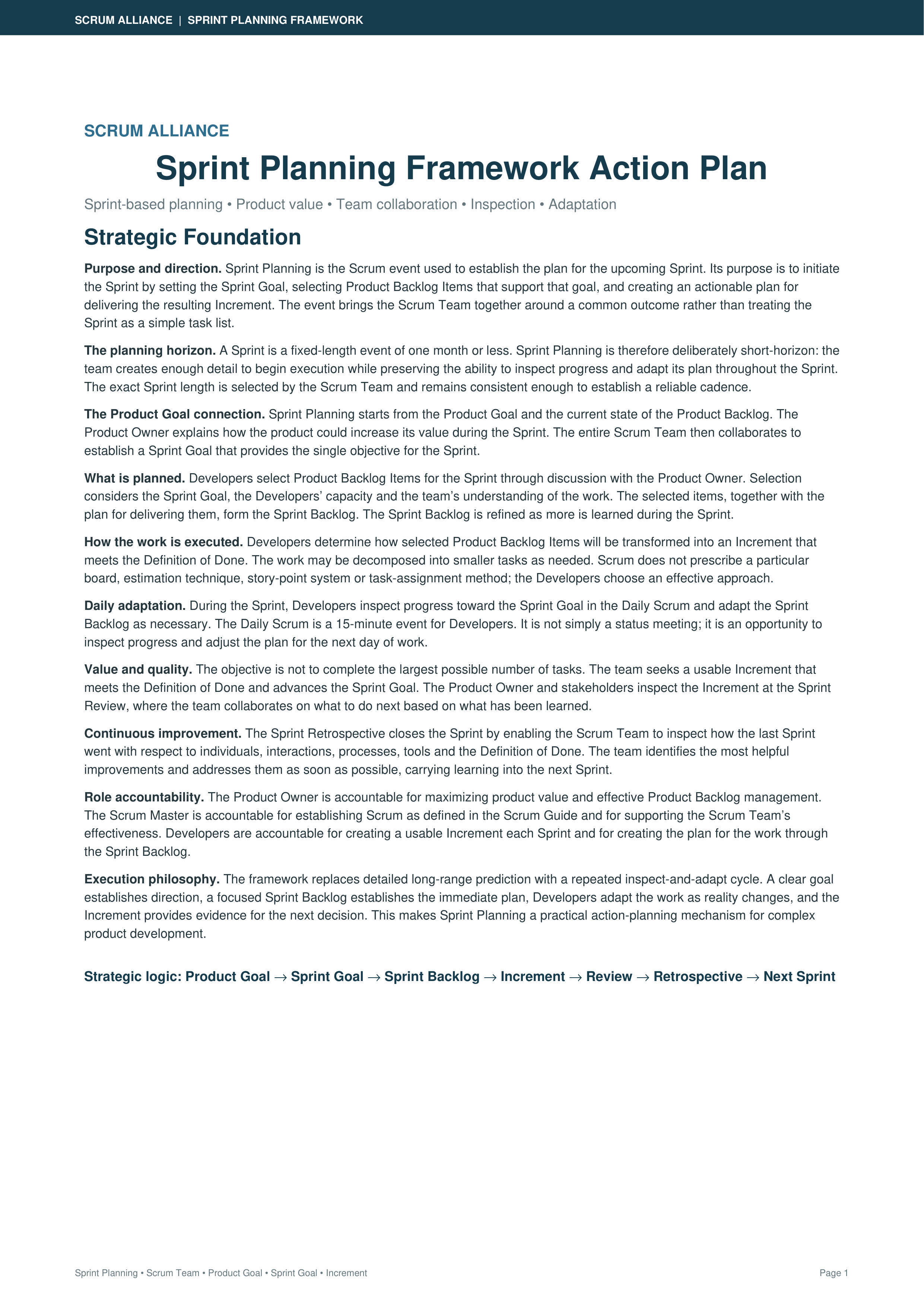
Sprint Planning is the Scrum event used to establish the plan for the upcoming Sprint. Its purpose is to initiate
the Sprint by setting the Sprint Goal, selecting Product Backlog Items that support that goal, and creating an actionable plan for
delivering the resulting Increment. The event brings the Scrum Team together around a common outcome rather than treating the
Sprint as a simple task list.
The planning horizon.
A Sprint is a fixed-length event of one month or less. Sprint Planning is therefore deliberately short-horizon: the
team creates enough detail to begin execution while preserving the ability to inspect progress and adapt its plan throughout the Sprint.
The exact Sprint length is selected by the Scrum Team and remains consistent enough to establish a reliable cadence.
The Product Goal connection.
Sprint Planning starts from the Product Goal and the current state of the Product Backlog. The
Product Owner explains how the product could increase its value during the Sprint. The entire Scrum Team then collaborates to
establish a Sprint Goal that provides the single objective for the Sprint.
What is planned.
Developers select Product Backlog Items for the Sprint through discussion with the Product Owner. Selection
considers the Sprint Goal, the Developers’ capacity and the team’s understanding of the work. The selected items, together with the
plan for delivering them, form the Sprint Backlog. The Sprint Backlog is refined as more is learned during the Sprint.
How the work is executed.
Developers determine how selected Product Backlog Items will be transformed into an Increment that
meets the Definition of Done. The work may be decomposed into smaller tasks as needed. Scrum does not prescribe a particular
board, estimation technique, story-point system or task-assignment method; the Developers choose an effective approach.
Daily adaptation.
During the Sprint, Developers inspect progress toward the Sprint Goal in the Daily Scrum and adapt the Sprint
Backlog as necessary. The Daily Scrum is a 15-minute event for Developers. It is not simply a status meeting; it is an opportunity to
inspect progress and adjust the plan for the next day of work.
Value and quality.
The objective is not to complete the largest possible number of tasks. The team seeks a usable Increment that
meets the Definition of Done and advances the Sprint Goal. The Product Owner and stakeholders inspect the Increment at the Sprint
Review, where the team collaborates on what to do next based on what has been learned.
Continuous improvement.
The Sprint Retrospective closes the Sprint by enabling the Scrum Team to inspect how the last Sprint
went with respect to individuals, interactions, processes, tools and the Definition of Done. The team identifies the most helpful
improvements and addresses them as soon as possible, carrying learning into the next Sprint.
Role accountability.
The Product Owner is accountable for maximizing product value and effective Product Backlog management.
The Scrum Master is accountable for establishing Scrum as defined in the Scrum Guide and for supporting the Scrum Team’s
effectiveness. Developers are accountable for creating a usable Increment each Sprint and for creating the plan for the work through
the Sprint Backlog.
Execution philosophy.
The framework replaces detailed long-range prediction with a repeated inspect-and-adapt cycle. A clear goal
establishes direction, a focused Sprint Backlog establishes the immediate plan, Developers adapt the work as reality changes, and the
Increment provides evidence for the next decision. This makes Sprint Planning a practical action-planning mechanism for complex
product development.
Strategic logic: Product Goal
→
Sprint Goal
→
Sprint Backlog
→
Increment
→
Review
→
Retrospective
→
Next Sprint
SCRUM ALLIANCE | SPRINT PLANNING FRAMEWORK
Sprint Planning • Scrum Team • Product Goal • Sprint Goal • Increment
Page 2
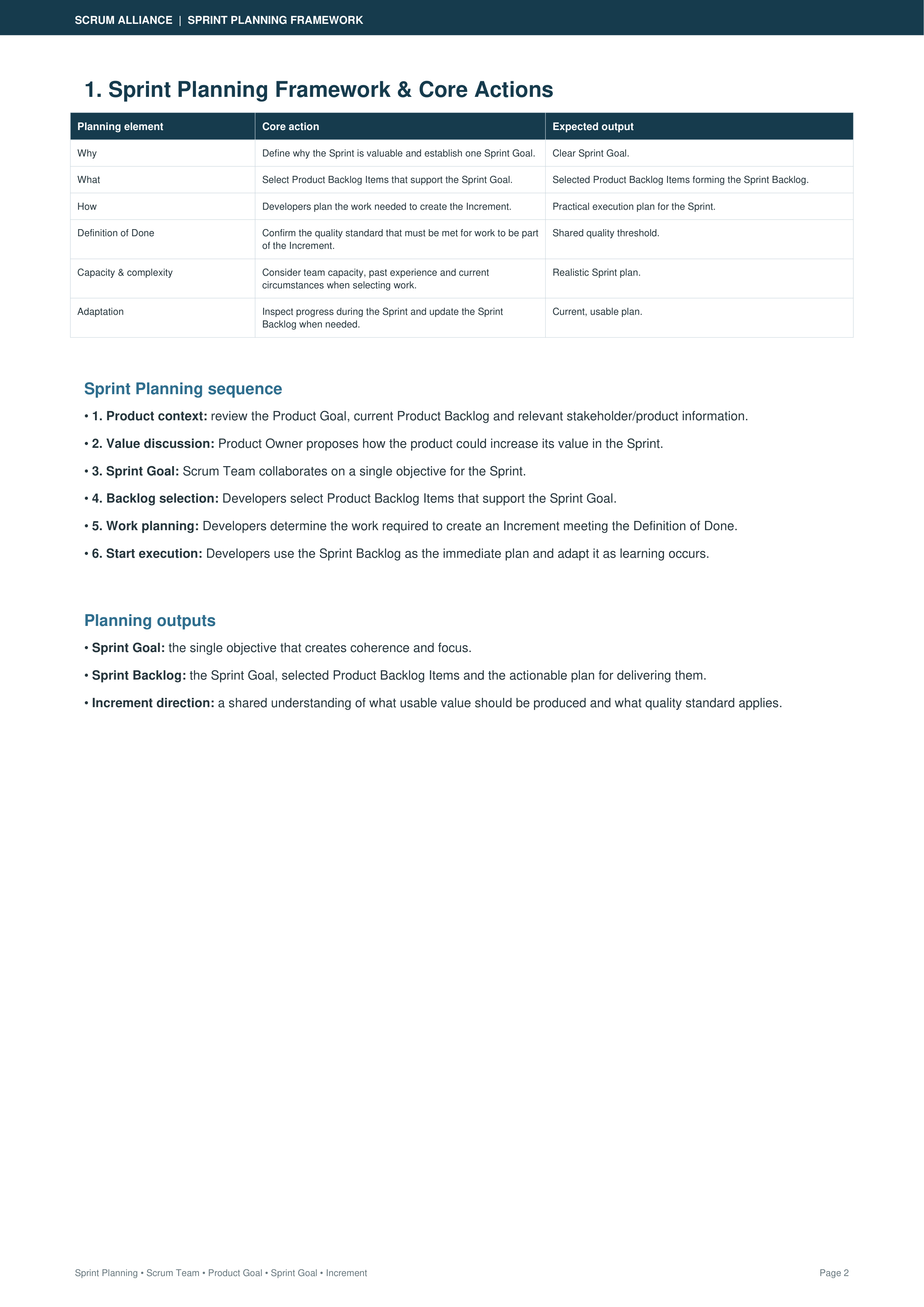
1. Sprint Planning Framework & Core Actions
Planning element
Core action
Expected output
Why
Define why the Sprint is valuable and establish one Sprint Goal.
Clear Sprint Goal.
What
Select Product Backlog Items that support the Sprint Goal.
Selected Product Backlog Items forming the Sprint Backlog.
How
Developers plan the work needed to create the Increment.
Practical execution plan for the Sprint.
Definition of Done
Confirm the quality standard that must be met for work to be part
of the Increment.
Shared quality threshold.
Capacity & complexity
Consider team capacity, past experience and current
circumstances when selecting work.
Realistic Sprint plan.
Adaptation
Inspect progress during the Sprint and update the Sprint
Backlog when needed.
Current, usable plan.
Sprint Planning sequence
•
1. Product context:
review the Product Goal, current Product Backlog and relevant stakeholder/product information.
•
2. Value discussion:
Product Owner proposes how the product could increase its value in the Sprint.
•
3. Sprint Goal:
Scrum Team collaborates on a single objective for the Sprint.
•
4. Backlog selection:
Developers select Product Backlog Items that support the Sprint Goal.
•
5. Work planning:
Developers determine the work required to create an Increment meeting the Definition of Done.
•
6. Start execution:
Developers use the Sprint Backlog as the immediate plan and adapt it as learning occurs.
Planning outputs
•
Sprint Goal:
the single objective that creates coherence and focus.
•
Sprint Backlog:
the Sprint Goal, selected Product Backlog Items and the actionable plan for delivering them.
•
Increment direction:
a shared understanding of what usable value should be produced and what quality standard applies.
SCRUM ALLIANCE | SPRINT PLANNING FRAMEWORK
Sprint Planning • Scrum Team • Product Goal • Sprint Goal • Increment
Page 3
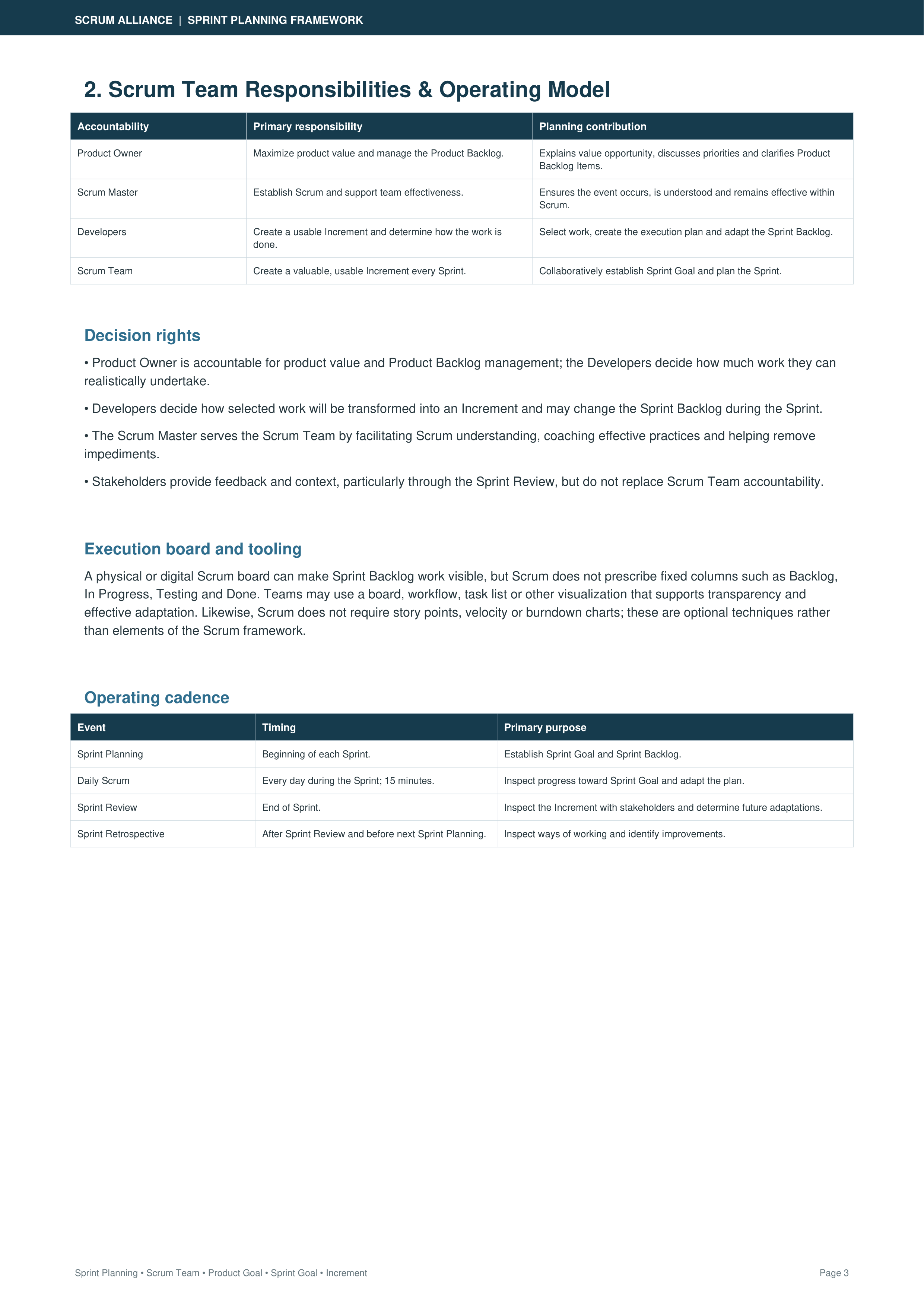
2. Scrum Team Responsibilities & Operating Model
Accountability
Primary responsibility
Planning contribution
Product Owner
Maximize product value and manage the Product Backlog.
Explains value opportunity, discusses priorities and clarifies Product
Backlog Items.
Scrum Master
Establish Scrum and support team effectiveness.
Ensures the event occurs, is understood and remains effective within
Scrum.
Developers
Create a usable Increment and determine how the work is
done.
Select work, create the execution plan and adapt the Sprint Backlog.
Scrum Team
Create a valuable, usable Increment every Sprint.
Collaboratively establish Sprint Goal and plan the Sprint.
Decision rights
• Product Owner is accountable for product value and Product Backlog management; the Developers decide how much work they can
realistically undertake.
• Developers decide how selected work will be transformed into an Increment and may change the Sprint Backlog during the Sprint.
• The Scrum Master serves the Scrum Team by facilitating Scrum understanding, coaching effective practices and helping remove
impediments.
• Stakeholders provide feedback and context, particularly through the Sprint Review, but do not replace Scrum Team accountability.
Execution board and tooling
A physical or digital Scrum board can make Sprint Backlog work visible, but Scrum does not prescribe fixed columns such as Backlog,
In Progress, Testing and Done. Teams may use a board, workflow, task list or other visualization that supports transparency and
effective adaptation. Likewise, Scrum does not require story points, velocity or burndown charts; these are optional techniques rather
than elements of the Scrum framework.
Operating cadence
Event
Timing
Primary purpose
Sprint Planning
Beginning of each Sprint.
Establish Sprint Goal and Sprint Backlog.
Daily Scrum
Every day during the Sprint; 15 minutes.
Inspect progress toward Sprint Goal and adapt the plan.
Sprint Review
End of Sprint.
Inspect the Increment with stakeholders and determine future adaptations.
Sprint Retrospective
After Sprint Review and before next Sprint Planning.
Inspect ways of working and identify improvements.
SCRUM ALLIANCE | SPRINT PLANNING FRAMEWORK
Sprint Planning • Scrum Team • Product Goal • Sprint Goal • Increment
Page 4
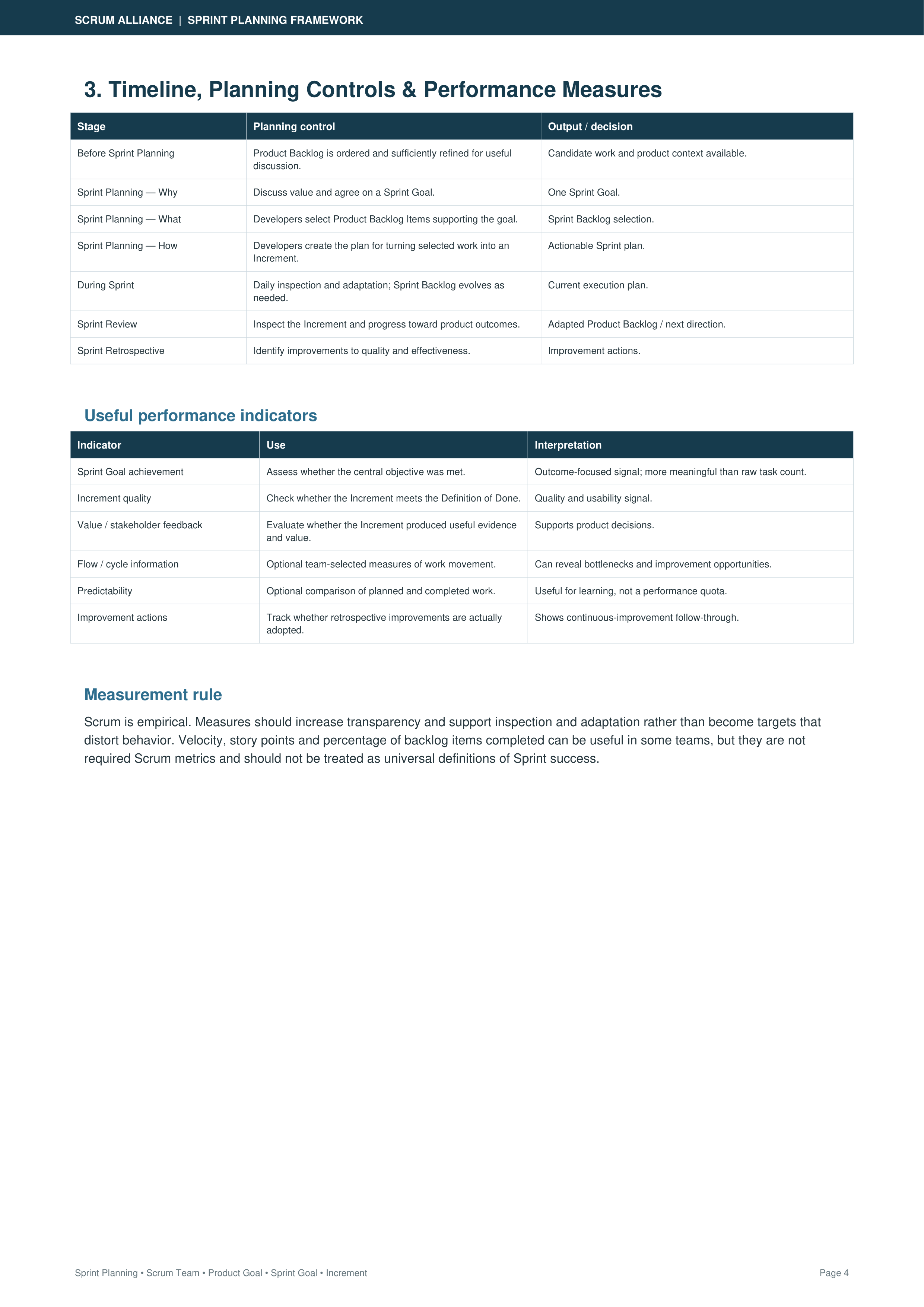
3. Timeline, Planning Controls & Performance Measures
Stage
Planning control
Output / decision
Before Sprint Planning
Product Backlog is ordered and sufficiently refined for useful
discussion.
Candidate work and product context available.
Sprint Planning — Why
Discuss value and agree on a Sprint Goal.
One Sprint Goal.
Sprint Planning — What
Developers select Product Backlog Items supporting the goal.
Sprint Backlog selection.
Sprint Planning — How
Developers create the plan for turning selected work into an
Increment.
Actionable Sprint plan.
During Sprint
Daily inspection and adaptation; Sprint Backlog evolves as
needed.
Current execution plan.
Sprint Review
Inspect the Increment and progress toward product outcomes.
Adapted Product Backlog / next direction.
Sprint Retrospective
Identify improvements to quality and effectiveness.
Improvement actions.
Useful performance indicators
Indicator
Use
Interpretation
Sprint Goal achievement
Assess whether the central objective was met.
Outcome-focused signal; more meaningful than raw task count.
Increment quality
Check whether the Increment meets the Definition of Done.
Quality and usability signal.
Value / stakeholder feedback
Evaluate whether the Increment produced useful evidence
and value.
Supports product decisions.
Flow / cycle information
Optional team-selected measures of work movement.
Can reveal bottlenecks and improvement opportunities.
Predictability
Optional comparison of planned and completed work.
Useful for learning, not a performance quota.
Improvement actions
Track whether retrospective improvements are actually
adopted.
Shows continuous-improvement follow-through.
Measurement rule
Scrum is empirical. Measures should increase transparency and support inspection and adaptation rather than become targets that
distort behavior. Velocity, story points and percentage of backlog items completed can be useful in some teams, but they are not
required Scrum metrics and should not be treated as universal definitions of Sprint success.
SCRUM ALLIANCE | SPRINT PLANNING FRAMEWORK
Sprint Planning • Scrum Team • Product Goal • Sprint Goal • Increment
Page 5
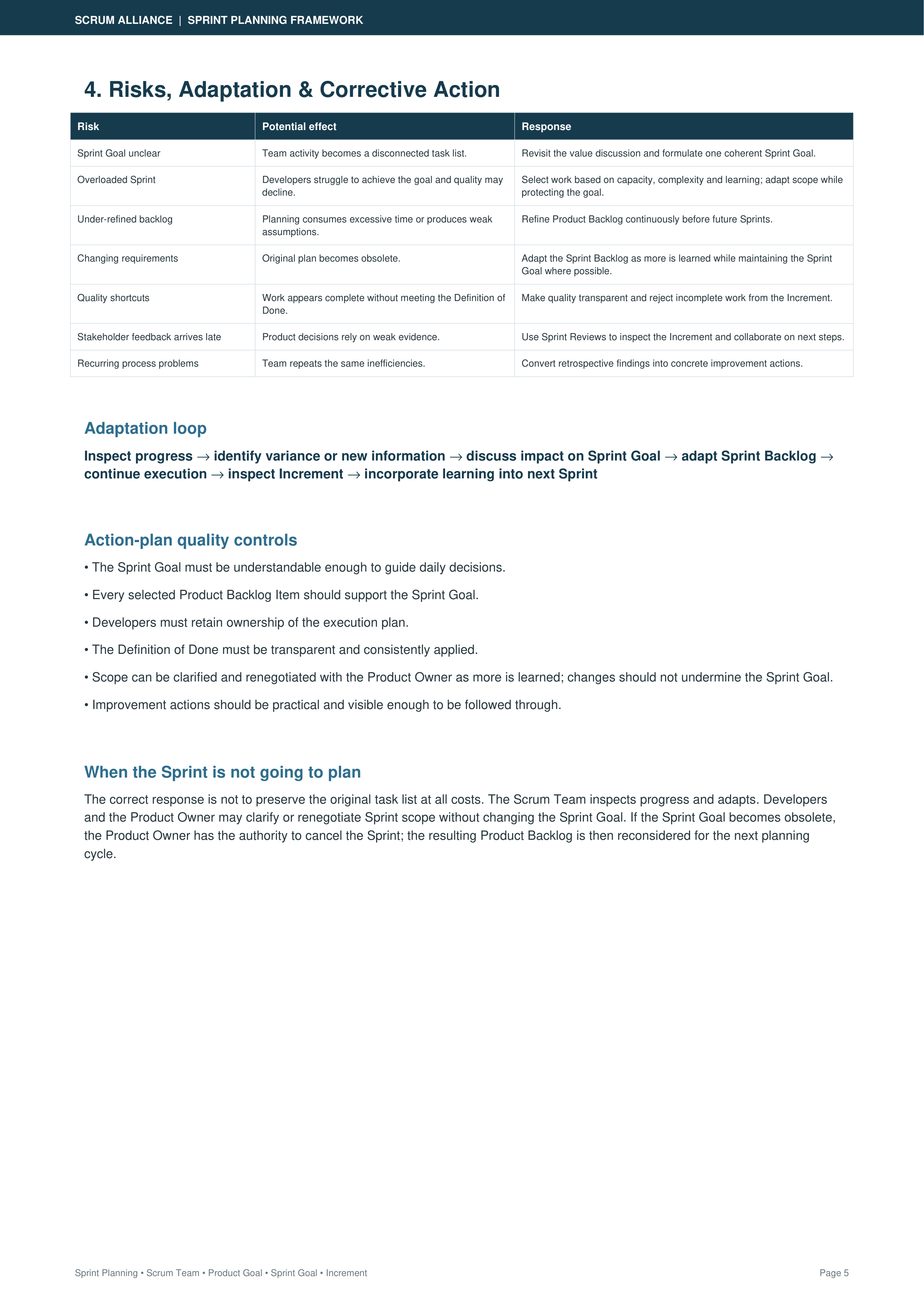
4. Risks, Adaptation & Corrective Action
Risk
Potential effect
Response
Sprint Goal unclear
Team activity becomes a disconnected task list.
Revisit the value discussion and formulate one coherent Sprint Goal.
Overloaded Sprint
Developers struggle to achieve the goal and quality may
decline.
Select work based on capacity, complexity and learning; adapt scope while
protecting the goal.
Under-refined backlog
Planning consumes excessive time or produces weak
assumptions.
Refine Product Backlog continuously before future Sprints.
Changing requirements
Original plan becomes obsolete.
Adapt the Sprint Backlog as more is learned while maintaining the Sprint
Goal where possible.
Quality shortcuts
Work appears complete without meeting the Definition of
Done.
Make quality transparent and reject incomplete work from the Increment.
Stakeholder feedback arrives late
Product decisions rely on weak evidence.
Use Sprint Reviews to inspect the Increment and collaborate on next steps.
Recurring process problems
Team repeats the same inefficiencies.
Convert retrospective findings into concrete improvement actions.
Adaptation loop
Inspect progress
→
identify variance or new information
→
discuss impact on Sprint Goal
→
adapt Sprint Backlog
→
continue execution
→
inspect Increment
→
incorporate learning into next Sprint
Action-plan quality controls
• The Sprint Goal must be understandable enough to guide daily decisions.
• Every selected Product Backlog Item should support the Sprint Goal.
• Developers must retain ownership of the execution plan.
• The Definition of Done must be transparent and consistently applied.
• Scope can be clarified and renegotiated with the Product Owner as more is learned; changes should not undermine the Sprint Goal.
• Improvement actions should be practical and visible enough to be followed through.
When the Sprint is not going to plan
The correct response is not to preserve the original task list at all costs. The Scrum Team inspects progress and adapts. Developers
and the Product Owner may clarify or renegotiate Sprint scope without changing the Sprint Goal. If the Sprint Goal becomes obsolete,
the Product Owner has the authority to cancel the Sprint; the resulting Product Backlog is then reconsidered for the next planning
cycle.
SCRUM ALLIANCE | SPRINT PLANNING FRAMEWORK
Sprint Planning • Scrum Team • Product Goal • Sprint Goal • Increment
Page 6
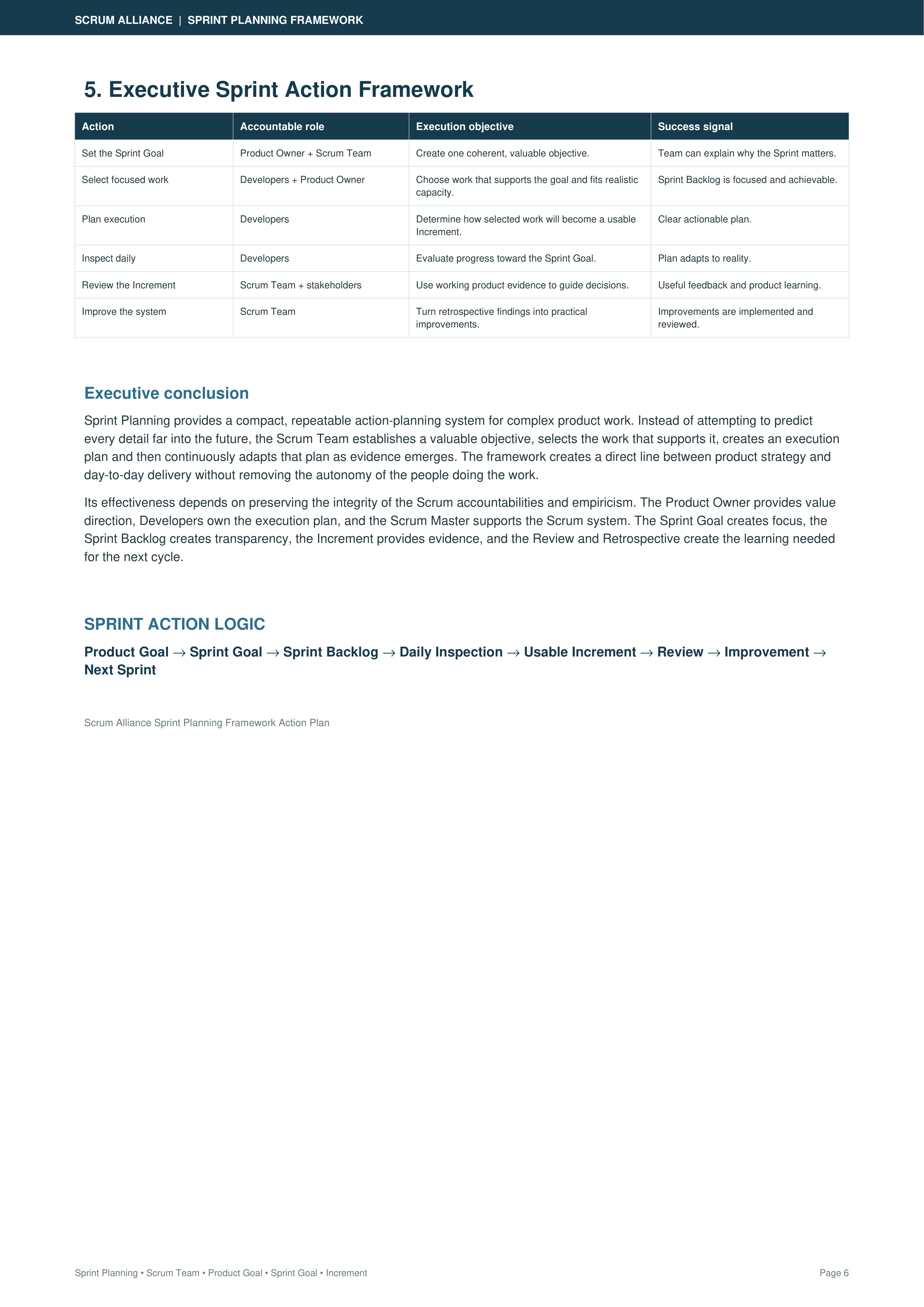
5. Executive Sprint Action Framework
Action
Accountable role
Execution objective
Success signal
Set the Sprint Goal
Product Owner + Scrum Team
Create one coherent, valuable objective.
Team can explain why the Sprint matters.
Select focused work
Developers + Product Owner
Choose work that supports the goal and fits realistic
capacity.
Sprint Backlog is focused and achievable.
Plan execution
Developers
Determine how selected work will become a usable
Increment.
Clear actionable plan.
Inspect daily
Developers
Evaluate progress toward the Sprint Goal.
Plan adapts to reality.
Review the Increment
Scrum Team + stakeholders
Use working product evidence to guide decisions.
Useful feedback and product learning.
Improve the system
Scrum Team
Turn retrospective findings into practical
improvements.
Improvements are implemented and
reviewed.
Executive conclusion
Sprint Planning provides a compact, repeatable action-planning system for complex product work. Instead of attempting to predict
every detail far into the future, the Scrum Team establishes a valuable objective, selects the work that supports it, creates an execution
plan and then continuously adapts that plan as evidence emerges. The framework creates a direct line between product strategy and
day-to-day delivery without removing the autonomy of the people doing the work.
Its effectiveness depends on preserving the integrity of the Scrum accountabilities and empiricism. The Product Owner provides value
direction, Developers own the execution plan, and the Scrum Master supports the Scrum system. The Sprint Goal creates focus, the
Sprint Backlog creates transparency, the Increment provides evidence, and the Review and Retrospective create the learning needed
for the next cycle.
SPRINT ACTION LOGIC
Product Goal
→
Sprint Goal
→
Sprint Backlog
→
Daily Inspection
→
Usable Increment
→
Review
→
Improvement
→
Next Sprint
Scrum Alliance Sprint Planning Framework Action Plan