Roland Berger AI-First Automotive Process Redesign Action Plan
Page 6
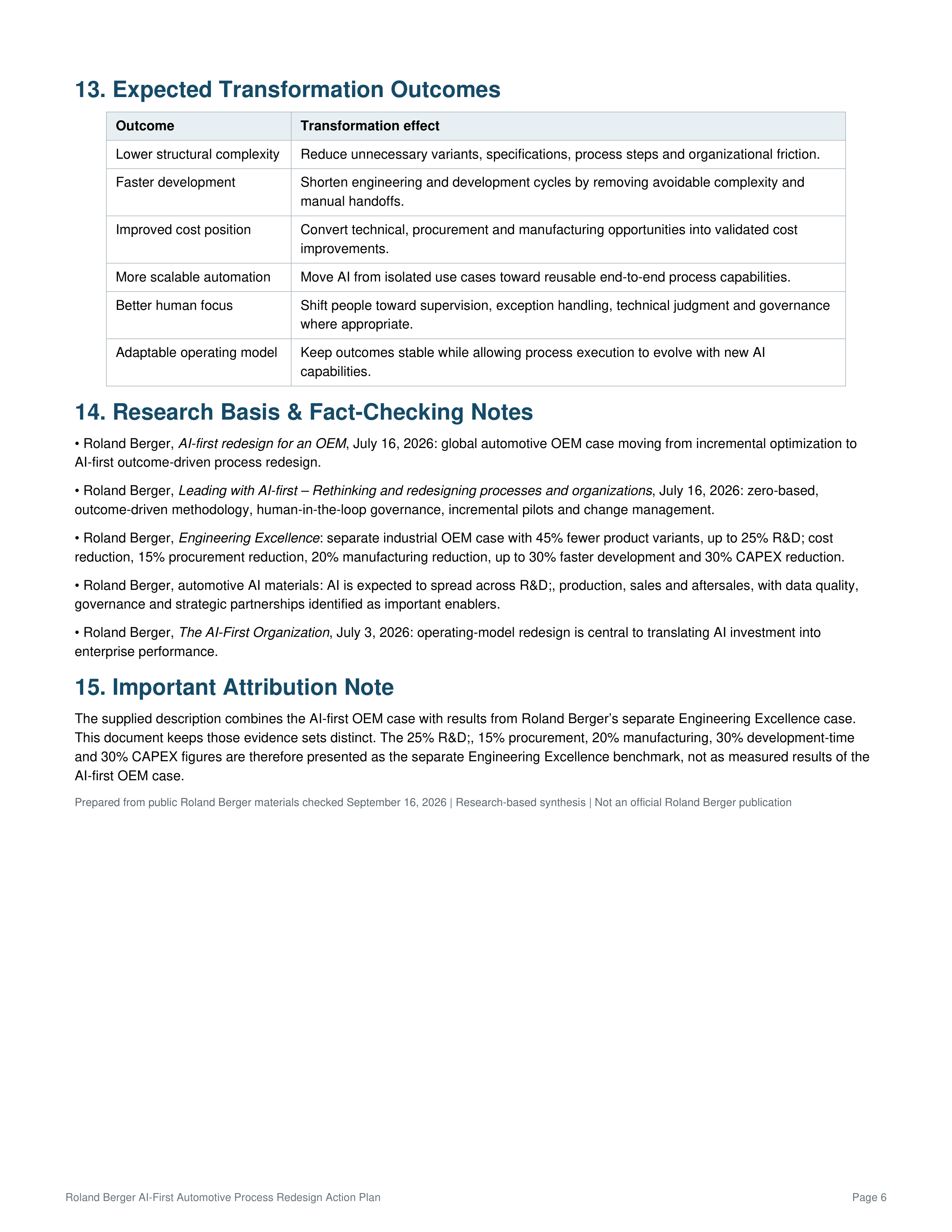
13. Expected Transformation Outcomes
Outcome
Transformation effect
Lower structural complexity
Reduce unnecessary variants, specifications, process steps and organizational friction.
Faster development
Shorten engineering and development cycles by removing avoidable complexity and
manual handoffs.
Improved cost position
Convert technical, procurement and manufacturing opportunities into validated cost
improvements.
More scalable automation
Move AI from isolated use cases toward reusable end-to-end process capabilities.
Better human focus
Shift people toward supervision, exception handling, technical judgment and governance
where appropriate.
Adaptable operating model
Keep outcomes stable while allowing process execution to evolve with new AI
capabilities.
14. Research Basis & Fact-Checking Notes
• Roland Berger,
AI-first redesign for an OEM
, July 16, 2026: global automotive OEM case moving from incremental optimization to
AI-first outcome-driven process redesign.
• Roland Berger,
Leading with AI-first – Rethinking and redesigning processes and organizations
, July 16, 2026: zero-based,
outcome-driven methodology, human-in-the-loop governance, incremental pilots and change management.
• Roland Berger,
Engineering Excellence
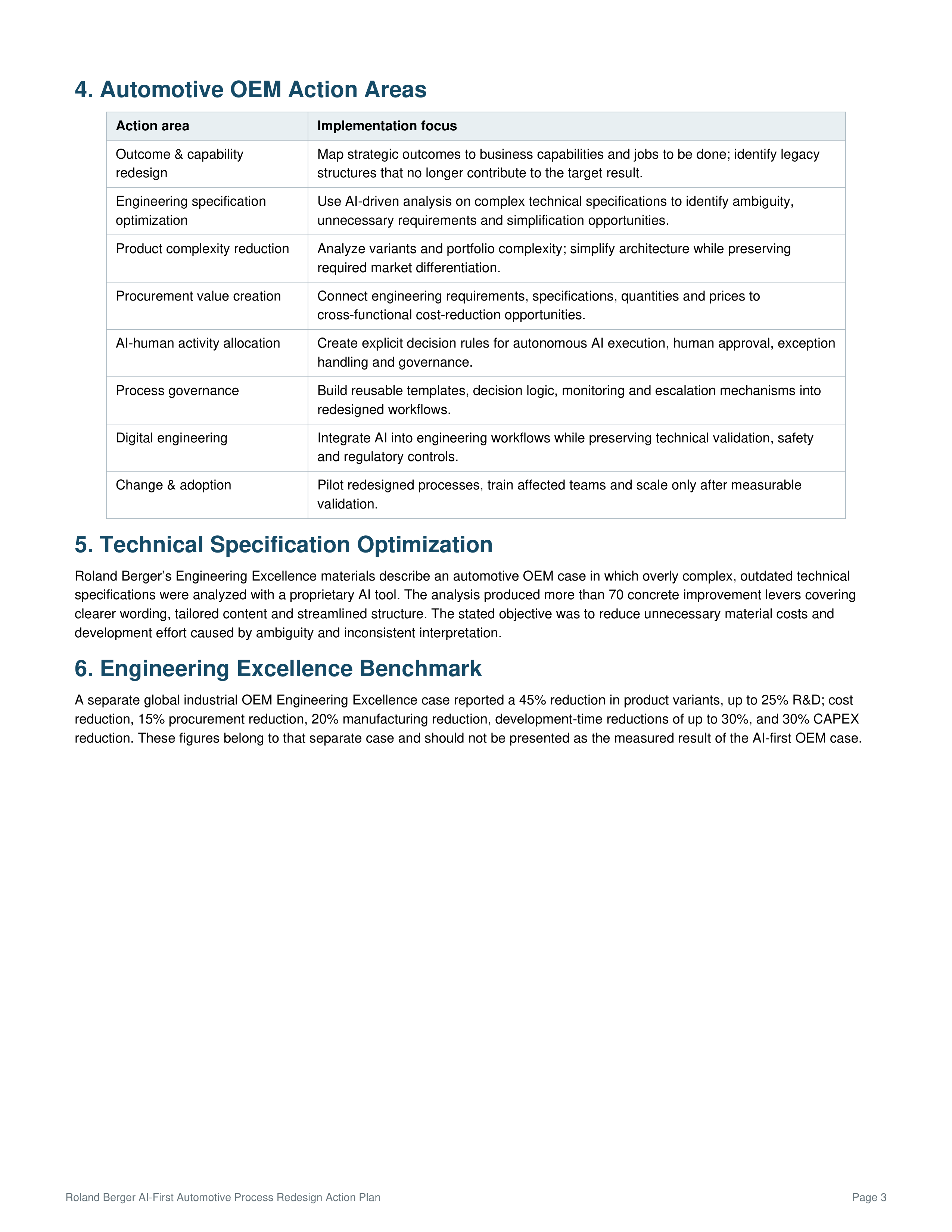
: separate industrial OEM case with 45% fewer product variants, up to 25% R&D; cost
reduction, 15% procurement reduction, 20% manufacturing reduction, up to 30% faster development and 30% CAPEX reduction.
• Roland Berger, automotive AI materials: AI is expected to spread across R&D;, production, sales and aftersales, with data quality,
governance and strategic partnerships identified as important enablers.
• Roland Berger,
The AI-First Organization
, July 3, 2026: operating-model redesign is central to translating AI investment into
enterprise performance.
15. Important Attribution Note
The supplied description combines the AI-first OEM case with results from Roland Berger’s separate Engineering Excellence case.
This document keeps those evidence sets distinct. The 25% R&D;, 15% procurement, 20% manufacturing, 30% development-time
and 30% CAPEX figures are therefore presented as the separate Engineering Excellence benchmark, not as measured results of the
AI-first OEM case.
Prepared from public Roland Berger materials checked September 16, 2026 | Research-based synthesis | Not an official Roland Berger publication