
AI market trend analysis tools use artificial intelligence to identify emerging consumer behavior, competitive shifts, demand patterns, and industry opportunities from large-scale datasets. Businesses use AI market trend analysis platforms to monitor search activity, social conversations, website traffic, customer sentiment, and market movements faster than traditional research methods. In 2026, these tools have become essential for marketers, analysts, startups, ecommerce brands, and enterprise teams that need real-time insights, predictive forecasting, and data-driven decision-making across rapidly changing markets.
Best AI Market Trend Analysis Tools
These AI market trend analysis tools help businesses identify emerging trends, monitor competitors, forecast market demand, and analyze consumer behavior using real-time data and predictive analytics.
- Exploding Topics AI
- Crayon AI
- AlphaSense AI
- Similarweb AI
- Glimpse AI
- Brandwatch AI
- SparkToro AI
- Quantilope AI
- Pecan AI
- Remesh AI
AI Market Trend Analysis Tools Comparison Table
Different AI market trend analysis tools focus on different types of intelligence. Some platforms specialize in search trend forecasting and predictive analytics, while others focus on competitor monitoring, audience research, consumer sentiment analysis, or enterprise market intelligence. The comparison table below helps identify which platform fits specific business and research needs in 2026.
| Tool | Best For | Key Features | Pricing | Category |
|---|---|---|---|---|
| Exploding Topics AI | Early trend discovery | Trend forecasting, startup tracking, demand analysis, trend database | Free plan + paid plans from approximately $99/month | Trend Discovery |
| Crayon AI | Competitive intelligence | Competitor monitoring, pricing alerts, battlecards, market tracking | Custom enterprise pricing | Competitive Intelligence |
| AlphaSense AI | Enterprise market intelligence | AI search engine, financial research, earnings transcripts, market analysis | Custom enterprise pricing | Enterprise Intelligence |
| Similarweb AI | Digital market analysis | Website traffic analytics, audience insights, benchmarking, channel intelligence | Free plan + paid enterprise plans | Digital Intelligence |
| Glimpse AI | Search trend forecasting | Predictive search trends, keyword forecasting, demand prediction | Free plan + paid plans from approximately $49/month | Trend Forecasting |
| Brandwatch AI | Consumer intelligence | Social listening, sentiment analysis, brand monitoring, trend tracking | Custom enterprise pricing | Social Intelligence |
| SparkToro AI | Audience research | Audience behavior analysis, influencer discovery, media consumption insights | Free plan + paid plans from approximately $50/month | Audience Intelligence |
| Quantilope AI | Automated market research | AI-powered surveys, consumer panels, advanced analytics, segmentation | Custom pricing | Research Automation |
| Pecan AI | Predictive analytics | Predictive modeling, forecasting automation, business intelligence analytics | Custom pricing | Predictive Analytics |
| Remesh AI | Qualitative market research | AI-moderated live research, audience conversations, instant insights | Custom enterprise pricing | Consumer Research |
Each platform approaches AI market trend analysis differently. Some tools are designed for enterprise research and forecasting, while others focus on identifying emerging consumer interests, monitoring competitors, or analyzing digital behavior.
The next section breaks down how each tool works, its strongest use cases, pricing structure, and which businesses benefit most from using it.
1. Exploding Topics AI
What is Exploding Topics
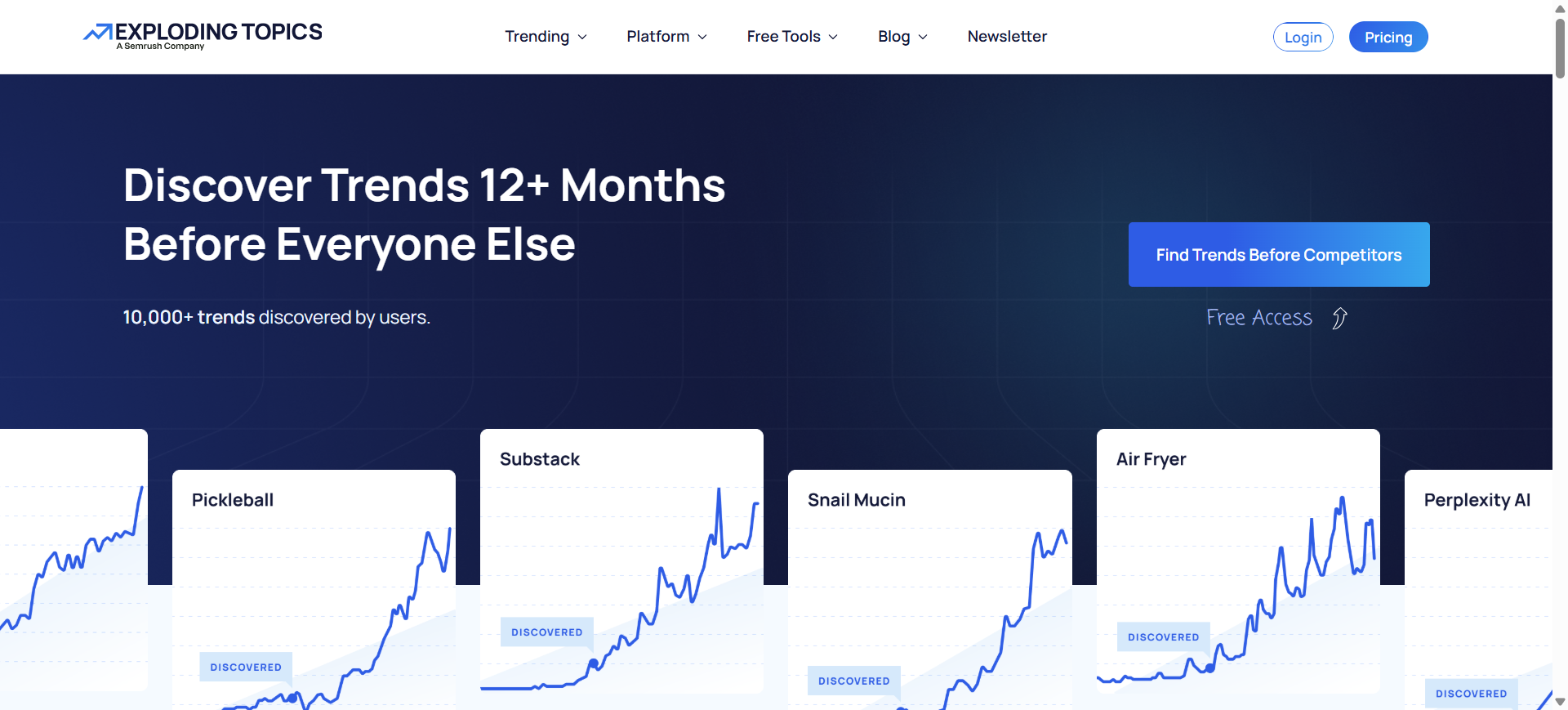
Exploding Topics is an AI-powered trend discovery platform designed to identify emerging market trends before they become mainstream. The platform analyzes search behavior, online discussions, startup activity, and digital growth signals to detect rising topics across industries. It is widely used for market research, product discovery, content planning, ecommerce analysis, and investment research. Unlike traditional analytics tools that focus on current demand, Exploding Topics focuses on early-stage trend detection and future market opportunities.
Who Should Use Exploding Topics
- Ecommerce brands researching product demand
- Content marketing teams tracking emerging topics
- Startup founders validating new business ideas
- Investors monitoring fast-growing industries
- SEO and market research professionals
How to use Exploding Topics for Market Trend Analysis
- Search for a keyword, niche, or industry inside the platform dashboard.
- Analyze growth patterns, search trends, and related emerging topics.
- Track selected trends using alerts and saved dashboards.
- Use forecasting insights to evaluate demand before market saturation.
Benefits of Using Exploding Topics
- Reduces manual trend research time
- Helps identify opportunities before competitors
- Improves product and content planning decisions
- Supports faster market validation workflows
- Simplifies long-term demand forecasting
Real World Example
A DTC skincare company used Exploding Topics to identify rising interest in PDRN toner and barrier repair products before they became highly competitive. The marketing team adjusted product inventory, launched educational content early, and secured influencer partnerships ahead of larger competitors entering the category.
Pricing
Exploding Topics offers a free plan with limited trend access and basic research features. Paid plans start at approximately $39 per month, with higher-tier plans providing expanded forecasting, trend tracking, startup analysis, and advanced reports.
Pros
- Strong early trend detection capabilities
- Easy-to-use dashboard and reports
- Useful for multiple industries and niches
Cons
- Advanced features require paid plans
- Limited competitor intelligence functionality
2. Crayon AI
What is Crayon
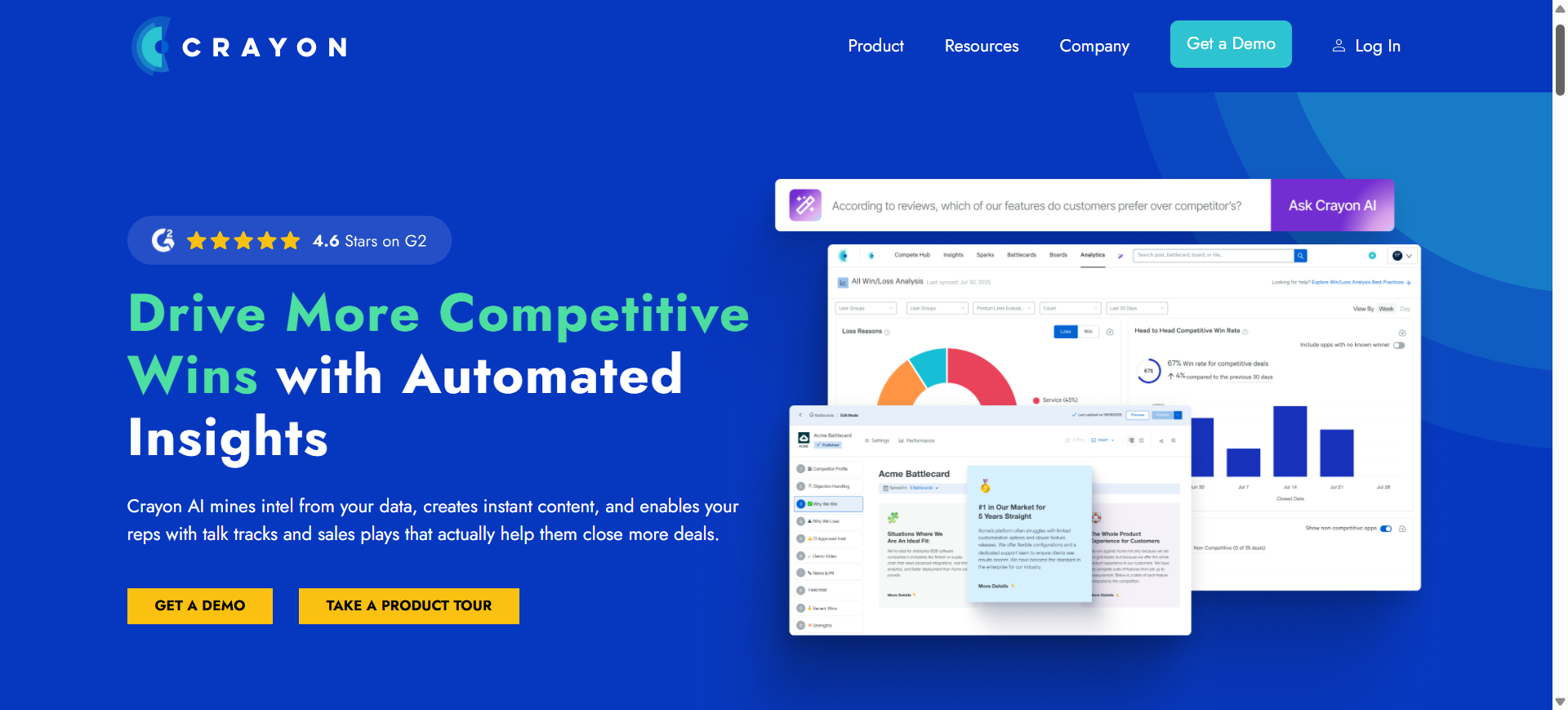
Crayon is an AI-powered competitive intelligence platform designed to help businesses monitor competitor activity in real time. The platform tracks changes across competitor websites, pricing pages, product updates, marketing campaigns, reviews, and sales messaging. It uses artificial intelligence to organize large volumes of competitive data into actionable insights for sales, marketing, product, and strategy teams. Crayon is commonly used by B2B companies that need continuous visibility into fast-changing market conditions and competitor positioning.
Who Should Use Crayon
- B2B SaaS companies tracking competitors
- Sales enablement teams building battlecards
- Product marketing managers monitoring positioning
- Competitive intelligence analysts
- Enterprise strategy and research teams
How to use Crayon for Market Trend Analysis
- Add competitors, industry players, and target markets to the monitoring dashboard.
- Configure tracking for pricing changes, messaging updates, campaigns, and product launches.
- Review AI-generated alerts and competitive summaries inside the platform.
- Use trend insights to adjust positioning, product strategy, or sales messaging.
Benefits of Using Crayon
- Automates competitor monitoring workflows
- Reduces manual research and tracking effort
- Helps teams react faster to market shifts
- Improves sales and positioning alignment
- Centralizes competitive intelligence in one platform
Real World Example
A cybersecurity software company used Crayon to monitor pricing and feature updates from competing vendors during enterprise procurement cycles. The sales team used automated battlecards generated from competitor changes to improve win rates during high-value contract negotiations.
Pricing
Crayon does not publicly list standard pricing plans on its official website. Businesses typically receive custom enterprise pricing based on monitoring scale, number of competitors, integrations, and team size.
Pros
- Strong real-time competitor tracking
- Useful sales enablement workflows
- Comprehensive monitoring across channels
Cons
- Primarily focused on enterprise use cases
- Pricing may be expensive for small teams
3. AlphaSense AI
What is AlphaSense
AlphaSense is an AI-powered market intelligence and financial research platform built for enterprise decision-making. The platform combines company filings, earnings transcripts, broker research, news, expert interviews, and market reports into a searchable intelligence system. Its AI search and natural language processing capabilities help businesses identify market trends, competitive risks, investment signals, and industry developments faster than manual research methods. AlphaSense is widely used in finance, consulting, healthcare, technology, and corporate strategy environments.
Who Should Use AlphaSense
- Investment and equity research teams
- Corporate strategy departments
- Consulting and advisory firms
- Enterprise market intelligence analysts
- Financial and risk management professionals
How to use AlphaSense for Market Trend Analysis
- Search industries, companies, or market topics using natural language queries.
- Analyze earnings calls, filings, expert transcripts, and research reports.
- Set alerts for competitor updates, industry changes, or financial signals.
- Use AI-generated summaries and trend insights to support strategic decisions.
Benefits of Using AlphaSense
- Speeds up large-scale market research workflows
- Reduces time spent reviewing financial documents
- Improves visibility into industry and competitor movements
- Centralizes multiple research sources in one platform
- Supports faster executive decision-making
Real World Example
A global pharmaceutical company used AlphaSense to monitor biotech acquisitions, regulatory approvals, and competitor pipeline developments across multiple regions. The strategy team used AI-powered transcript analysis to identify emerging therapeutic categories before allocating research investment budgets.
Pricing
AlphaSense does not publicly display fixed pricing plans on its official website. Pricing is typically customized based on research access, user seats, enterprise integrations, and data requirements, with demo access available for businesses evaluating the platform.
Pros
- Extensive financial and enterprise research database
- Powerful AI-powered document search
- Strong real-time market intelligence capabilities
Cons
- Primarily designed for enterprise users
- Higher pricing compared to standard research tools
4. Similarweb AI
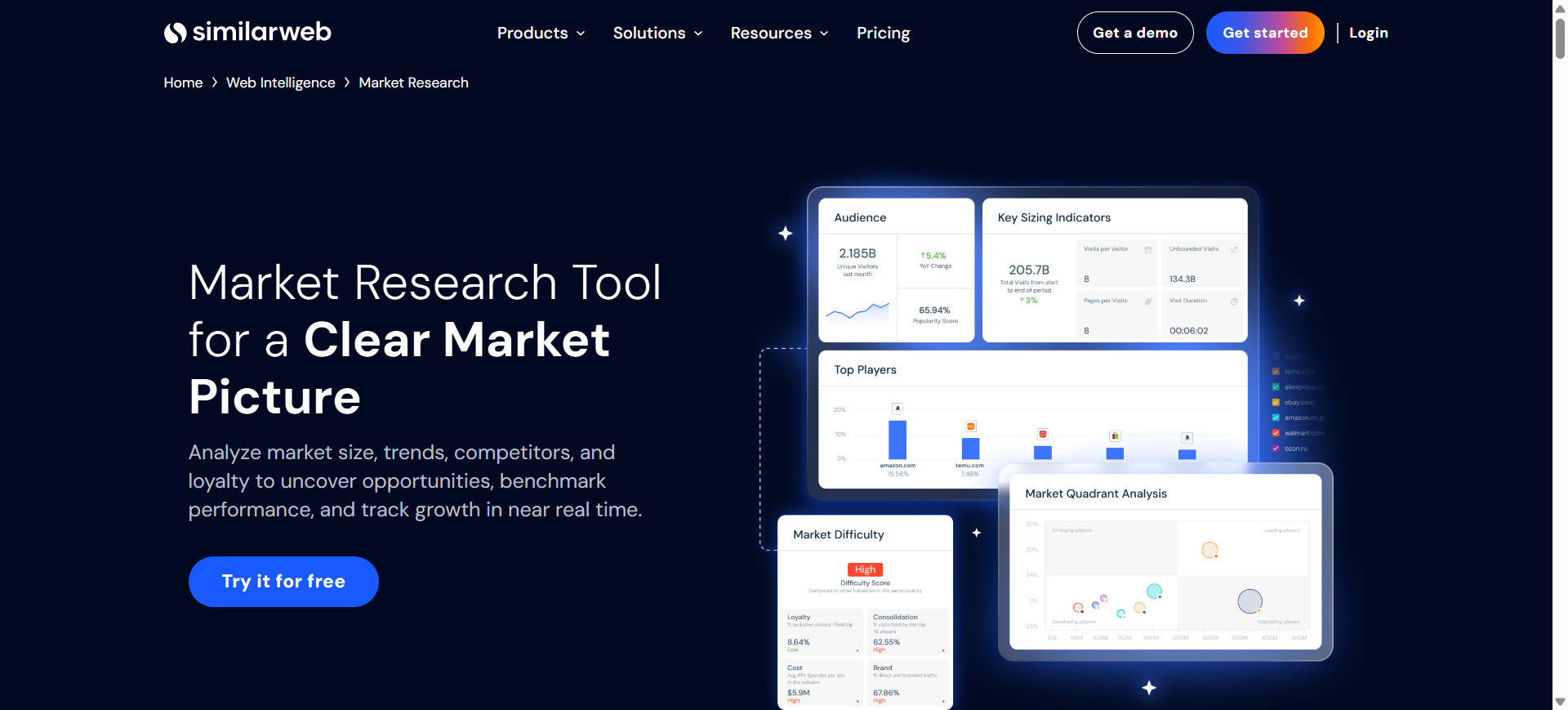
What is Similarweb
Similarweb is an AI-powered digital intelligence platform that helps businesses analyze website traffic, audience behavior, market demand, and competitor performance across industries. The platform combines web analytics, search intelligence, app data, ecommerce insights, and AI-driven market analysis into a single research system. Businesses use Similarweb to understand market trends, benchmark competitors, identify customer acquisition opportunities, and monitor changing digital behavior across regions and channels. It is widely used in marketing, ecommerce, consulting, finance, and enterprise research environments.
Who Should Use Similarweb
- Ecommerce and digital marketing teams
- Competitive intelligence analysts
- SEO and growth marketing professionals
- Market research and consulting firms
- Enterprise business strategy teams
How to use Similarweb for Market Trend Analysis
- Enter competitor websites, industries, or market segments into the dashboard.
- Analyze traffic sources, audience behavior, and engagement trends.
- Compare market share and channel performance across competitors.
- Use AI-powered reports and forecasting insights to identify growth opportunities.
Benefits of Using Similarweb
- Simplifies large-scale competitor research
- Helps identify emerging digital market trends
- Improves strategic marketing decisions
- Reduces manual traffic analysis work
- Supports data-driven market expansion planning
Real World Example
A global fashion retailer used Similarweb to analyze rising traffic patterns across fast-growing online apparel brands in Southeast Asia. The company identified increasing mobile shopping demand in specific markets and adjusted its regional advertising strategy before expanding local ecommerce operations.
Pricing
Similarweb offers limited free access and trial options for basic website analytics. Paid plans typically start around $125 to $199 per month for individual users, while enterprise plans include advanced AI intelligence, API access, and deeper market research capabilities.
Pros
- Comprehensive digital market intelligence data
- Strong competitor benchmarking capabilities
- Useful for SEO and traffic analysis
Cons
- Advanced plans can become expensive
- Some smaller websites have limited data accuracy
5. Glimpse AI
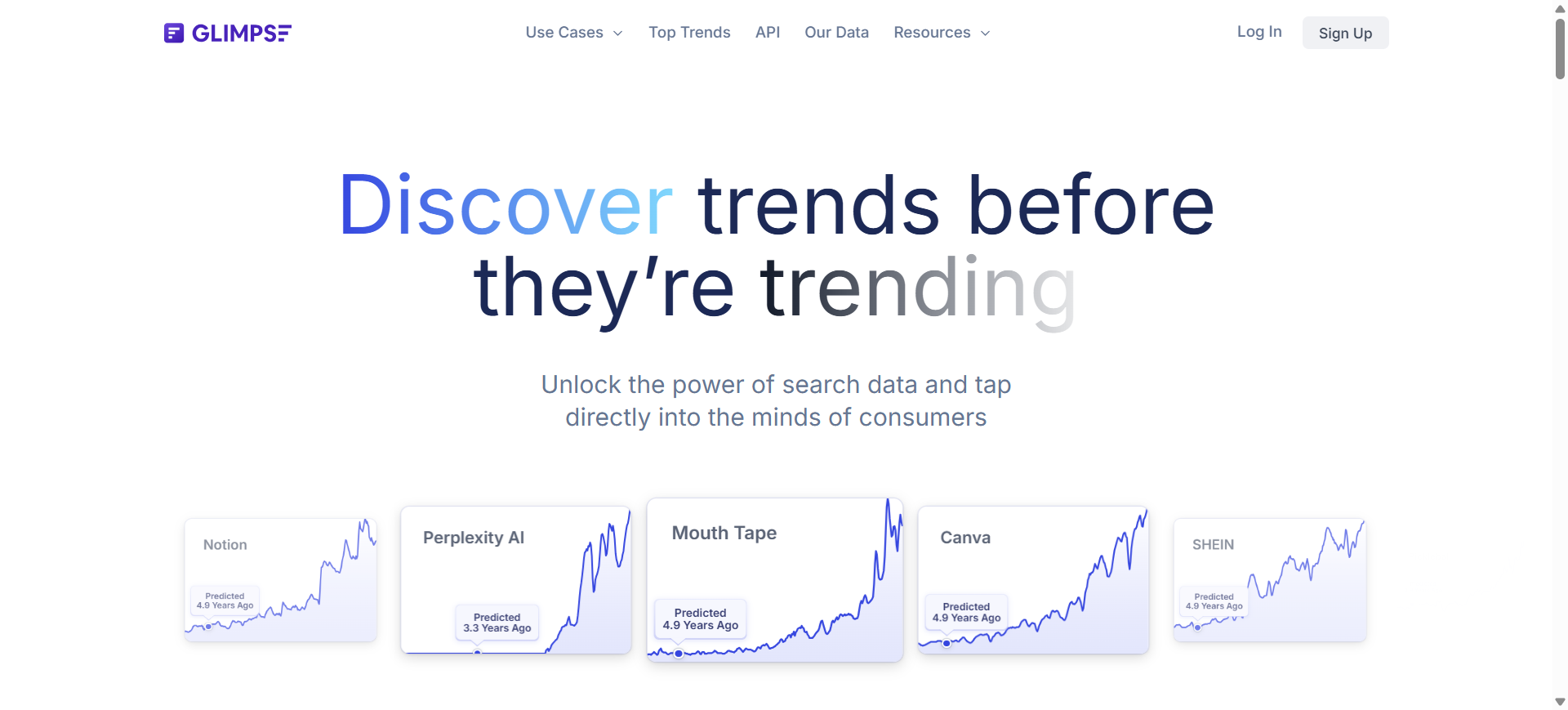
What is Glimpse
Glimpse is an AI-powered trend forecasting platform that helps businesses identify emerging consumer interests through search behavior and online demand signals. The platform analyzes billions of search queries, web activity patterns, and digital conversations to detect fast-growing trends before they become highly competitive. Glimpse is commonly used for product research, ecommerce planning, content strategy, and startup idea validation. Its predictive analytics capabilities make it useful for businesses that need early visibility into changing market demand.
Who Should Use Glimpse
- Ecommerce brands researching product demand
- Startup founders validating niche markets
- SEO and content strategy teams
- Consumer trend research analysts
- Product and innovation managers
How to use Glimpse for Market Trend Analysis
- Search for industries, products, or consumer topics inside the dashboard.
- Review growth curves, search volume patterns, and forecasted demand data.
- Track related rising trends and keyword clusters across categories.
- Use alerts and forecasting insights to guide marketing or product decisions.
Benefits of Using Glimpse
- Helps identify trends before market saturation
- Speeds up product and niche validation
- Reduces guesswork in demand forecasting
- Supports faster content planning workflows
- Improves strategic decision-making using search data
Real World Example
A fitness equipment startup used Glimpse to detect rising interest in smart recovery tools and portable cold therapy devices. The company adjusted its product roadmap and launched targeted advertising campaigns before larger competitors increased investment in the category.
Pricing
Glimpse offers a free plan with limited searches and basic trend insights. Paid plans typically start around $49 per month, with advanced forecasting, trend tracking, and expanded market intelligence features available in higher-tier subscriptions.
Pros
- Strong predictive trend forecasting
- Simple and beginner-friendly interface
- Useful for ecommerce and content research
Cons
- Limited enterprise intelligence features
- Forecast accuracy may vary by niche
6. Brandwatch AI
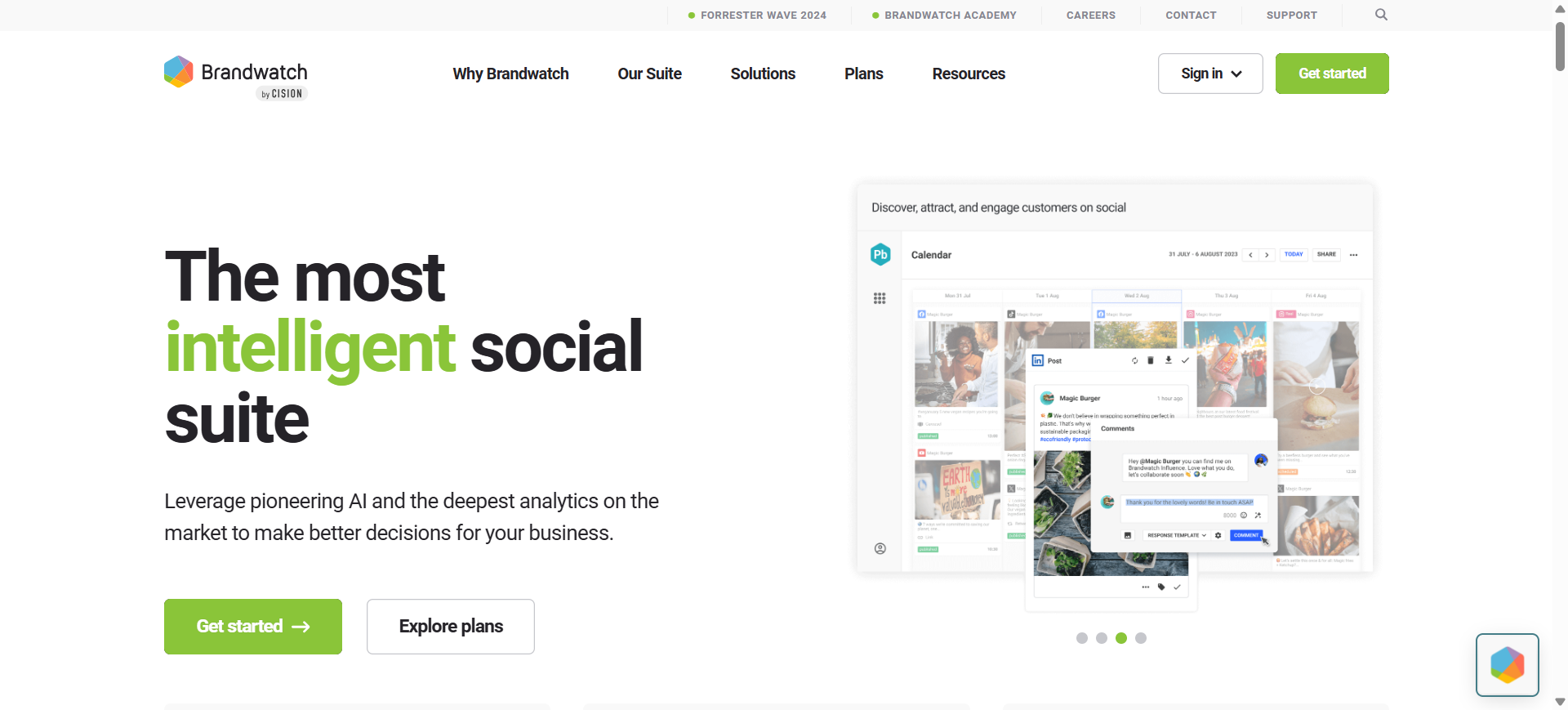
What is Brandwatch
Brandwatch is an AI-powered consumer intelligence and social listening platform that helps businesses analyze online conversations, audience sentiment, and emerging market trends. The platform collects data from social media platforms, forums, news sites, reviews, and digital communities to identify how consumers discuss brands, industries, and products. Brandwatch is widely used for brand monitoring, reputation management, customer research, and trend analysis. Its AI-driven analytics help businesses understand public perception and changing consumer behavior in real time.
Who Should Use Brandwatch
- Enterprise marketing and brand teams
- Social media and community managers
- Consumer insights researchers
- PR and reputation management teams
- Agencies handling brand monitoring
How to use Brandwatch for Market Trend Analysis
- Set up dashboards to track brands, industries, competitors, or keywords.
- Monitor social conversations, hashtags, mentions, and sentiment patterns.
- Analyze trending discussions and audience behavior across channels.
- Use AI-generated insights to guide campaigns, positioning, or product strategy.
Benefits of Using Brandwatch
- Simplifies large-scale social listening workflows
- Improves visibility into consumer sentiment
- Helps brands react faster to market conversations
- Reduces manual monitoring across platforms
- Supports stronger customer and audience understanding
Real World Example
A global beverage company used Brandwatch to monitor consumer reactions to sugar-free drink launches across different regions. The marketing team identified increasing demand for natural ingredient discussions and adjusted campaign messaging based on real-time audience sentiment data.
Pricing
Brandwatch primarily offers custom enterprise pricing based on business requirements, data access, and team size. The platform also provides demos and tailored onboarding for organizations evaluating social intelligence solutions.
Pros
- Strong social listening and sentiment analysis
- Supports multiple digital data sources
- Useful for enterprise brand monitoring
Cons
- Custom pricing limits transparency
- Advanced setup may require training
7. SparkToro AI
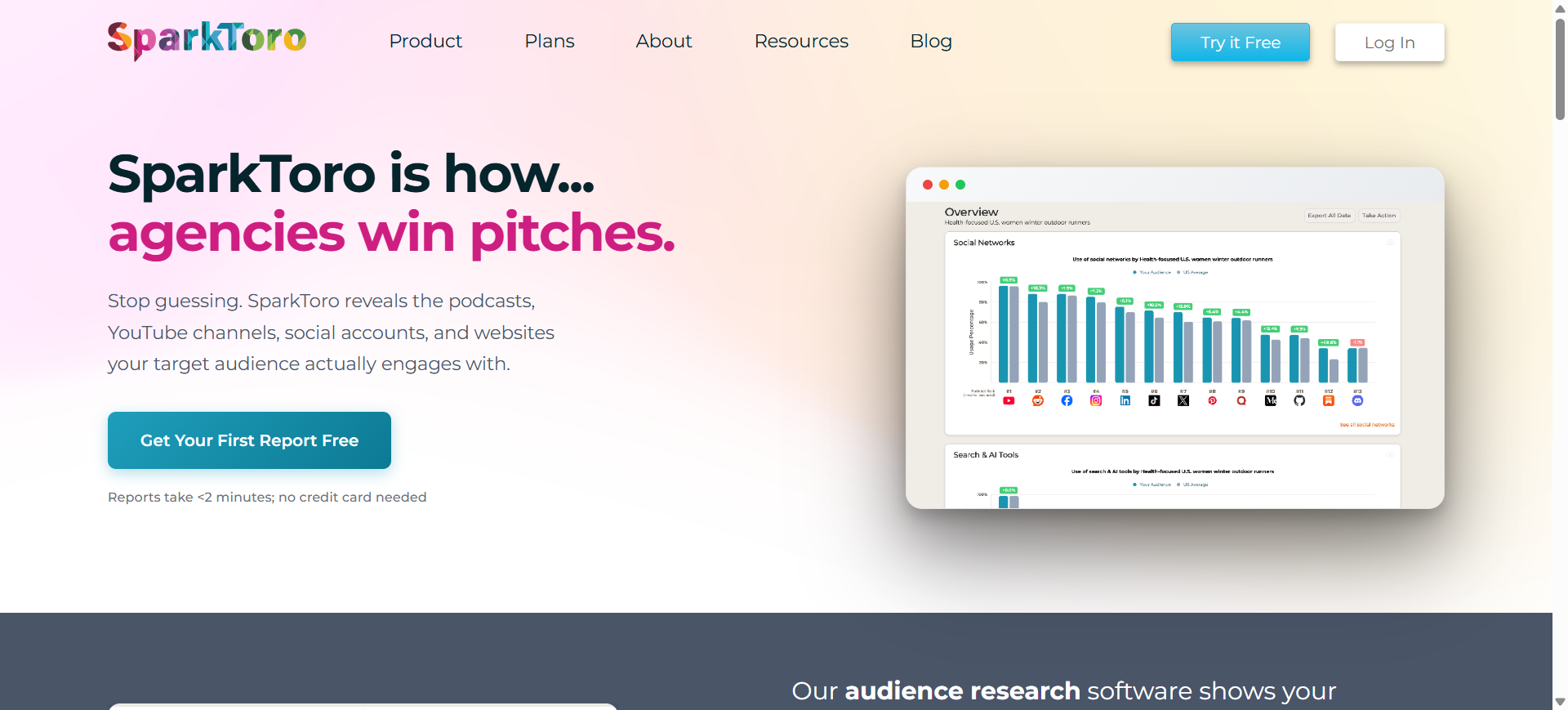
What is SparkToro
SparkToro is an audience intelligence platform that helps businesses understand where their target audience spends time online, what content they consume, and which creators or websites influence their decisions. Instead of focusing only on search or social metrics, SparkToro analyzes audience behavior across podcasts, YouTube channels, websites, social accounts, and online communities. The platform is commonly used for market research, audience analysis, influencer discovery, and content strategy planning.
Who Should Use SparkToro
- Content marketing and SEO teams
- B2B and SaaS marketing companies
- Podcast and creator marketing teams
- Audience research professionals
- Agencies managing digital campaigns
How to use SparkToro for Market Trend Analysis
- Search for an audience segment, keyword, hashtag, or job title inside the platform.
- Analyze the websites, podcasts, creators, and social accounts the audience follows.
- Identify trending interests, content sources, and influential communities.
- Use audience behavior insights to guide campaigns, partnerships, or content strategies.
Benefits of Using SparkToro
- Simplifies audience research workflows
- Helps identify niche communities faster
- Improves content targeting and distribution
- Reduces time spent on manual influencer research
- Supports more accurate customer understanding
Real World Example
A B2B cybersecurity startup used SparkToro to identify which podcasts, newsletters, and LinkedIn creators were most followed by IT decision-makers. The company shifted its advertising budget toward niche security communities and increased webinar registrations from qualified enterprise leads.
Pricing
SparkToro offers a free plan with limited searches and audience data access. Paid plans typically start around $50 per month, with higher-tier subscriptions offering expanded searches, exports, audience tracking, and team collaboration features.
Pros
- Strong audience behavior insights
- Easy-to-understand reporting interface
- Useful for influencer and content research
Cons
- Limited predictive forecasting capabilities
- Smaller datasets compared to enterprise platforms
8. Quantilope AI
What is Quantilope
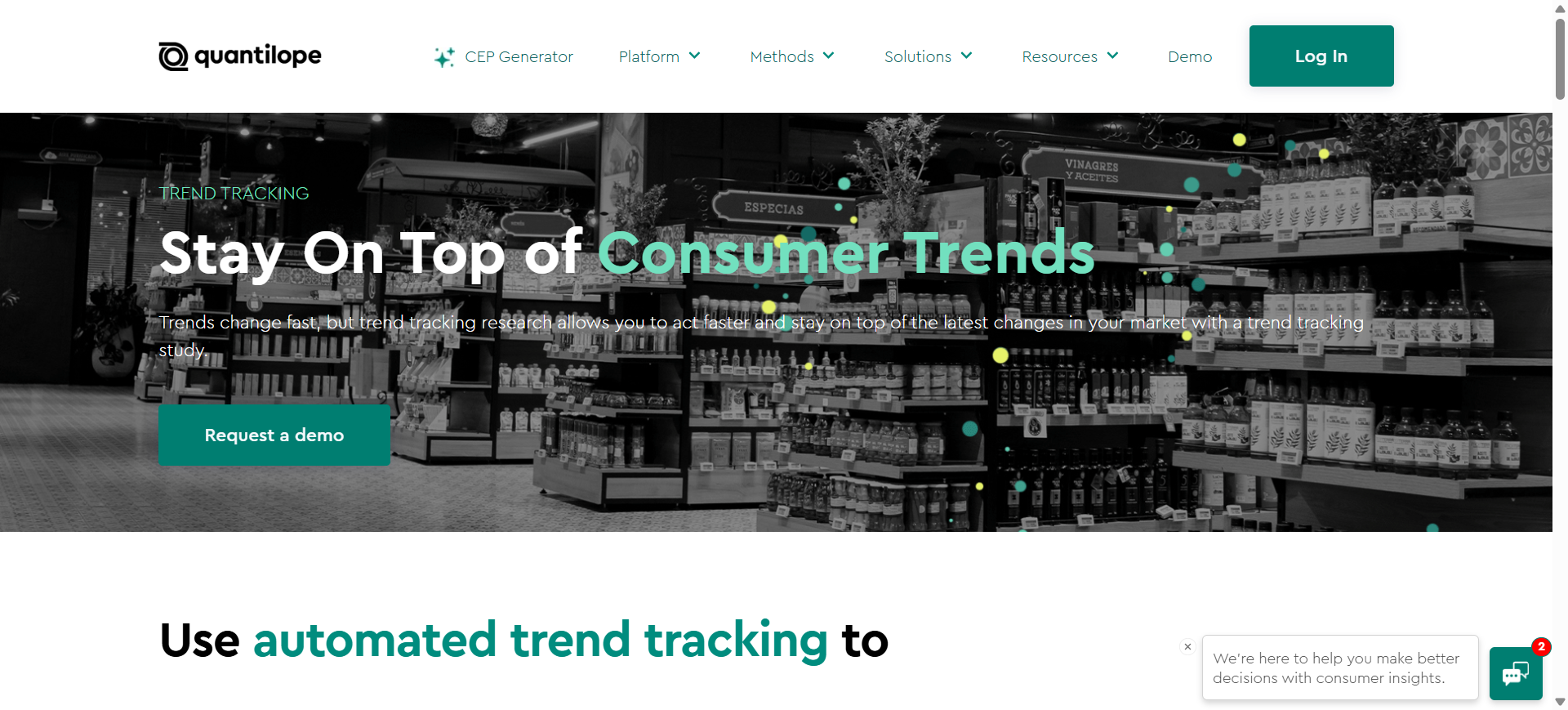
Quantilope is an AI-powered consumer research and market insights platform built to automate advanced quantitative research workflows. The platform combines survey automation, audience segmentation, pricing analysis, and behavioral research into a single system designed for enterprise research teams. Quantilope is commonly used by brands, research agencies, and product teams that need faster consumer insights without relying heavily on manual analysis. Its AI-driven automation helps businesses conduct large-scale market research more efficiently across global markets.
Who Should Use Quantilope
- Enterprise consumer research teams
- FMCG and retail brands
- Product innovation managers
- Market research agencies
- Customer insights professionals
How to use Quantilope for Market Trend Analysis
- Create research studies using the platform’s automated survey and analytics tools.
- Select target audience segments and configure research methodologies.
- Collect and analyze consumer responses through AI-powered dashboards.
- Use insights to evaluate demand patterns, pricing strategies, and customer preferences.
Benefits of Using Quantilope
- Speeds up market research project execution
- Reduces manual survey analysis effort
- Improves consistency across research workflows
- Helps teams gather consumer insights faster
- Supports scalable multi-market research operations
Real World Example
A global snack food company used Quantilope to test consumer reactions to new flavor concepts across multiple countries. The insights team identified regional taste preferences and optimized product packaging before launching the products into retail distribution channels.
Pricing
Quantilope primarily offers custom enterprise pricing based on research scale, audience access, and platform usage requirements. Businesses can request demos and tailored plans depending on survey volume, analytics needs, and team size.
Pros
- Strong automation for quantitative research
- Useful advanced analytics capabilities
- Supports global consumer studies
Cons
- Better suited for enterprise teams
- Limited transparency around pricing
9. Pecan AI
What is Pecan
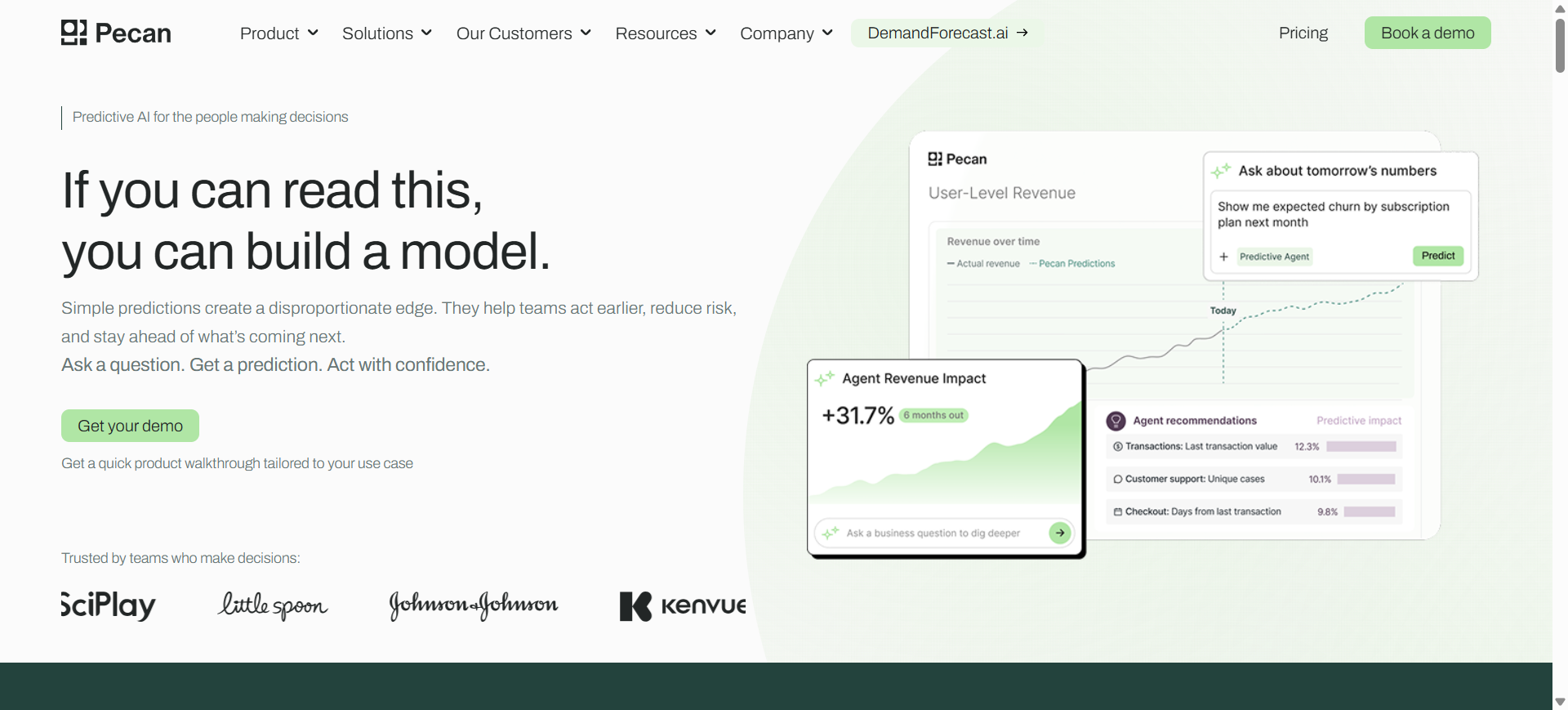
Pecan is an AI-powered predictive analytics platform designed to help business teams forecast future outcomes using machine learning and automation. The platform enables analysts, marketers, and operations teams to build predictive models without requiring advanced data science expertise. Pecan focuses on forecasting customer behavior, churn risk, sales performance, demand trends, and marketing outcomes using historical business data. Its low-code environment and AI-assisted workflows make predictive analytics more accessible for growing businesses and enterprise teams.
Who Should Use Pecan
- Marketing analytics teams
- Ecommerce and retail businesses
- SaaS companies tracking churn risk
- Business intelligence and data analysts
- Operations and forecasting teams
How to use Pecan for Market Trend Analysis
- Connect business data sources such as CRM systems, sales platforms, or marketing databases.
- Select a predictive use case like demand forecasting, churn prediction, or customer lifetime value analysis.
- Allow the platform to automatically build and train predictive models using AI.
- Review forecasts, trend insights, and recommendations inside the analytics dashboard.
Benefits of Using Pecan
- Reduces reliance on manual predictive modeling
- Speeds up forecasting and analytics workflows
- Helps businesses make proactive decisions
- Improves visibility into future customer behavior
- Simplifies machine learning implementation for non-technical teams
Real World Example
An online subscription meal delivery company used Pecan to predict which customers were likely to cancel recurring plans after price increases. The retention team launched personalized discount campaigns for high-risk users and reduced churn during a competitive market period.
Pricing
Pecan offers custom enterprise pricing along with structured plans for growing teams. Pricing reportedly starts around $760 per month for starter plans, while larger business and enterprise plans scale based on model usage, storage, and prediction volume.
Pros
- Strong predictive analytics automation
- Low-code interface for business teams
- Useful forecasting and churn prediction tools
Cons
- Better suited for data-driven organizations
- Advanced usage may require technical onboarding
10. Remesh AI
What is Remesh
Remesh is an AI-powered qualitative research platform that helps businesses gather large-scale consumer insights through live conversations and interactive research sessions. The platform combines AI moderation, natural language processing, and audience analytics to analyze open-ended responses in real time. Remesh is widely used for customer feedback analysis, product testing, brand perception research, and market validation. Unlike traditional surveys that rely heavily on static responses, Remesh focuses on conversational research and live audience engagement.
Who Should Use Remesh
- Consumer insights and research teams
- Product development departments
- Marketing and brand strategy teams
- Research agencies and consultants
- Enterprise customer experience teams
How to use Remesh for Market Trend Analysis
- Create a live research session with target audience participants.
- Ask open-ended questions related to products, trends, or customer behavior.
- Allow the AI system to analyze responses and identify common themes instantly.
- Use real-time insights to guide product strategy, messaging, or market decisions.
Benefits of Using Remesh
- Speeds up qualitative research analysis
- Reduces manual interpretation of responses
- Helps businesses capture real-time consumer feedback
- Improves collaboration between research and marketing teams
- Supports faster product and campaign decision-making
Real World Example
A national grocery retailer used Remesh to test customer reactions to AI-powered self-checkout systems before expanding store deployments. The company identified major customer concerns around transaction speed and payment flexibility, allowing operations teams to adjust rollout plans before launch.
Pricing
Remesh primarily offers custom enterprise pricing based on participant volume, research usage, and platform access requirements. Businesses can request demos and tailored plans depending on project scale and research needs.
Pros
- Strong real-time qualitative research capabilities
- Useful AI-powered response analysis
- Supports large-scale audience conversations
Cons
- Primarily focused on enterprise research workflows
- Limited pricing transparency
Where AI is Used in Market Trend Analysis
AI is widely used in retail, ecommerce, and consumer goods industries to identify changing buying behavior, seasonal demand patterns, and emerging product categories. Businesses analyze search trends, purchase activity, reviews, and social discussions to understand what customers are likely to buy next.
In digital marketing and competitive intelligence, AI helps companies monitor competitor campaigns, pricing updates, audience engagement, and online visibility across multiple channels. These insights allow brands to react faster to market changes and improve strategic decision-making using real-time data.
Financial firms, startups, and enterprise research teams also use AI market trend analysis for forecasting, investment research, risk assessment, and business expansion planning. AI systems process large volumes of market data to detect patterns, predict opportunities, and support long-term growth strategies.
Benefits of AI Market Trend Analysis Tools
AI market trend analysis tools help businesses process large amounts of market data faster and more accurately than traditional research methods. They improve visibility into customer behavior, competitor activity, and emerging industry trends while reducing manual analysis work.
Main Benefits
- Detects emerging trends earlier than manual research
- Reduces time spent on data collection and analysis
- Improves forecasting and strategic planning accuracy
- Helps businesses respond faster to market changes
- Supports data-driven product, marketing, and investment decisions
How AI Market Trend Analysis Works
AI market trend analysis tools collect data from multiple digital sources such as search engines, social media platforms, ecommerce websites, competitor pages, customer reviews, forums, news publications, and business databases. Instead of relying on small datasets or manual surveys, AI systems continuously process millions of data points in real time.
After collecting data, artificial intelligence uses technologies like natural language processing, machine learning, and predictive analytics to identify patterns, consumer sentiment, rising topics, and behavioral changes. These systems can detect unusual spikes in demand, track competitor movements, and identify early signals of market shifts before they become mainstream.
Many AI tools also organize information into dashboards, alerts, forecasts, and visual reports that help businesses understand trends more clearly. Companies use these insights to improve product planning, marketing strategies, audience targeting, inventory management, competitive positioning, and investment decisions.
Modern AI market trend analysis platforms are designed to reduce manual research effort while improving speed and decision-making accuracy. Instead of spending weeks analyzing spreadsheets and reports, teams can quickly access real-time intelligence and make faster strategic decisions based on continuously updated market data.
How to Choose the Right AI Market Trend Analysis Tool
Choosing the right AI market trend analysis tool depends on your business goals, research needs, data requirements, and workflow complexity. Some platforms focus on predictive forecasting and search trends, while others specialize in competitor monitoring, audience intelligence, consumer sentiment, or enterprise research. Evaluating the right factors helps businesses select a platform that aligns with their market analysis strategy.
Choose Based on Data Sources
Different AI tools collect information from different sources such as search engines, social media, ecommerce platforms, customer reviews, financial reports, or competitor websites. Businesses should choose tools that provide access to the specific data sources most relevant to their industry and research goals.
Consider Forecasting Capabilities
Some platforms focus mainly on historical analytics, while others provide predictive forecasting and trend prediction features. Businesses looking for early market opportunities should prioritize tools that can identify rising demand patterns and future consumer behavior before trends become highly competitive.
Evaluate Competitive Intelligence Features
Competitive intelligence capabilities are important for businesses that need visibility into competitor pricing, campaigns, product launches, and market positioning. Tools with real-time competitor monitoring help teams react faster to industry changes and improve strategic planning.
Analyze Reporting and Visualization Tools
Clear dashboards, reports, alerts, and data visualizations make trend analysis easier for teams and decision-makers. Businesses should look for platforms that simplify complex market data into understandable insights that support faster decision-making and collaboration.
Check Integration and Workflow Compatibility
AI market trend analysis tools should integrate smoothly with existing business systems such as CRM platforms, analytics tools, marketing software, or business intelligence dashboards. Strong integrations reduce manual work and improve operational efficiency across teams.
Compare Pricing and Scalability
Pricing structures vary significantly between platforms, especially between startup-focused tools and enterprise intelligence solutions. Businesses should evaluate whether a platform can scale with future growth while remaining cost-effective for their current research and operational needs.
Who Should Use AI Market Trend Analysis Tools
AI market trend analysis tools are useful for businesses and professionals that need faster access to market insights, consumer behavior data, competitive intelligence, and predictive forecasting. These platforms support both small teams and large enterprises by improving research efficiency and helping organizations make more informed strategic decisions.
Marketing Teams
Marketing teams use AI trend analysis tools to monitor audience interests, identify emerging content opportunities, analyze campaign performance, and track changing consumer behavior across digital channels.
Business Analysts
Business analysts rely on AI platforms to process large datasets, identify market patterns, evaluate industry movements, and generate data-driven insights for operational and strategic planning.
Ecommerce Brands
Ecommerce businesses use AI trend analysis to forecast product demand, identify fast-growing categories, monitor shopping behavior, and optimize inventory and advertising strategies.
Product Managers
Product managers use AI-driven market intelligence to understand customer needs, evaluate competitor products, identify feature demand, and guide product development decisions.
Startup Founders
Startup founders use trend analysis tools to validate business ideas, identify underserved markets, research customer demand, and reduce uncertainty before launching products or services.
Enterprise Research Teams
Enterprise research departments use AI systems for large-scale market monitoring, consumer intelligence, forecasting, and strategic planning across multiple markets and industries.
Investors and Consultants
Investors and consultants use AI trend analysis to evaluate industry growth, monitor market shifts, identify emerging sectors, and support investment or advisory decisions.
Competitive Intelligence Teams
Competitive intelligence professionals use AI platforms to track competitor activity, pricing changes, product launches, and positioning strategies in real time.
Common Challenges in AI Market Trend Analysis
AI market trend analysis tools provide valuable insights, but businesses can still face operational, technical, and strategic challenges while using them. Understanding these limitations helps teams apply AI-generated insights more effectively and avoid poor decision-making based on incomplete or misleading data.
| Challenge | Explanation |
|---|---|
| Data Accuracy Limitations | AI tools depend on the quality of the data they collect. Inaccurate, outdated, or incomplete data can reduce forecasting reliability and affect decision-making accuracy. |
| Signal Noise from Social Platforms | Viral content, spam, and short-term online discussions can create misleading trend signals that do not reflect long-term market demand. |
| Regional Bias in Trend Detection | Some platforms have stronger data coverage in specific countries or languages, which may affect the accuracy of global trend analysis. |
| Overreliance on Automation | AI-generated insights still require human validation. Automated systems may miss industry context, business priorities, or sudden market disruptions. |
| Integration Complexity | Enterprise platforms often require integration with analytics tools, CRMs, and business intelligence systems, which can increase setup time and technical effort. |
| Pricing Barriers for Enterprise Platforms | Advanced AI market intelligence tools can be expensive for startups or small businesses due to enterprise-level pricing models and custom plans. |
| Limited Industry-Specific Context | Some AI systems provide generalized insights that may not fully reflect niche industries, specialized markets, or unique customer behavior patterns. |
| Rapidly Changing Market Conditions | AI models may struggle during sudden economic shifts, policy changes, or unexpected market disruptions where historical data becomes less reliable. |
Future of AI Market Trend Analysis in 2026 and Beyond
AI market trend analysis is becoming faster, smarter, and more automated. Modern AI tools can now track consumer behavior, competitor activity, search trends, and market demand in real time, helping businesses make quicker and more informed decisions.
Predictive analytics is also improving, allowing companies to forecast future trends and customer behavior more accurately. In the future, AI platforms are expected to combine data from text, video, social media, and ecommerce platforms to provide deeper and more complete market insights.
As AI-driven market intelligence becomes more advanced, businesses are increasingly using predictive insights to improve decision-making and reduce market uncertainty.
Conclusion
AI market trend analysis tools have become essential for businesses that need faster insights, better forecasting, and stronger visibility into changing consumer behavior and market conditions. From competitive intelligence and audience research to predictive analytics and trend forecasting, these platforms help organizations make more informed strategic decisions using real-time data.
The right tool depends on specific business goals, available data sources, workflow complexity, and market research needs. As AI technology continues to evolve, businesses that combine automated intelligence with human decision-making will be better positioned to identify opportunities, reduce risk, and adapt to rapidly changing markets.
FAQs
What is the best AI tool for market trend analysis in 2026?
The best AI market trend analysis tool depends on business goals and research needs. Platforms like Exploding Topics AI and Glimpse AI are useful for identifying emerging trends, while Crayon AI focuses on competitor intelligence. Enterprise businesses often use AlphaSense AI or Similarweb AI for deeper market and industry analysis.
How do AI market trend analysis tools collect data?
AI market trend analysis tools collect data from search engines, social media platforms, websites, ecommerce stores, customer reviews, news sources, forums, and competitor platforms. These systems process large datasets using machine learning and natural language processing to identify trends, sentiment, and behavioral patterns.
Can AI predict future market trends accurately?
AI can improve market forecasting accuracy by analyzing historical data, consumer behavior, and real-time market activity. While AI tools can identify patterns and predict possible trends, forecasts are not always guaranteed because market conditions, economic changes, and consumer behavior can shift unexpectedly.
Which AI tool is best for competitor trend analysis?
Crayon AI is one of the strongest tools for competitor trend analysis because it monitors pricing changes, product launches, campaigns, and competitor messaging in real time. Similarweb AI and Brandwatch AI are also widely used for competitor intelligence and digital market monitoring.
Are free AI market trend analysis tools reliable?
Free AI market trend analysis tools can provide useful insights for startups, small businesses, and early-stage research. However, free plans often include limited data access, fewer forecasting features, and restricted analytics compared to paid enterprise platforms with larger datasets and advanced intelligence capabilities.
What industries use AI market trend analysis tools the most?
Industries that heavily use AI market trend analysis tools include ecommerce, retail, finance, technology, healthcare, consumer goods, digital marketing, and consulting. These industries rely on AI insights to monitor demand, track competitors, forecast trends, and improve strategic planning.
How do businesses use AI for consumer trend forecasting?
Businesses use AI to analyze customer behavior, search activity, social discussions, purchase patterns, and market signals. AI systems identify rising interests and behavioral changes, helping companies forecast future demand, optimize marketing campaigns, improve product planning, and respond faster to market shifts.
What is the difference between market research tools and trend analysis tools?
Market research tools mainly focus on collecting customer feedback, surveys, and audience insights. Trend analysis tools focus more on identifying emerging market movements, forecasting future demand, tracking competitor activity, and monitoring changes in consumer behavior using real-time data and predictive analytics.