
Career
Opportunity
&
Professional
Goals
1 / 9
1.
Core
Skills
Inventory
The
following
skills
form
the
foundation
for
the
career
opportunities
targeted
in
this
plan
.
Each
is
rated
by
current
proficiency
so
that
development
effort
can
be
directed
at
the
gaps
that
matter
most
for
advancement
.
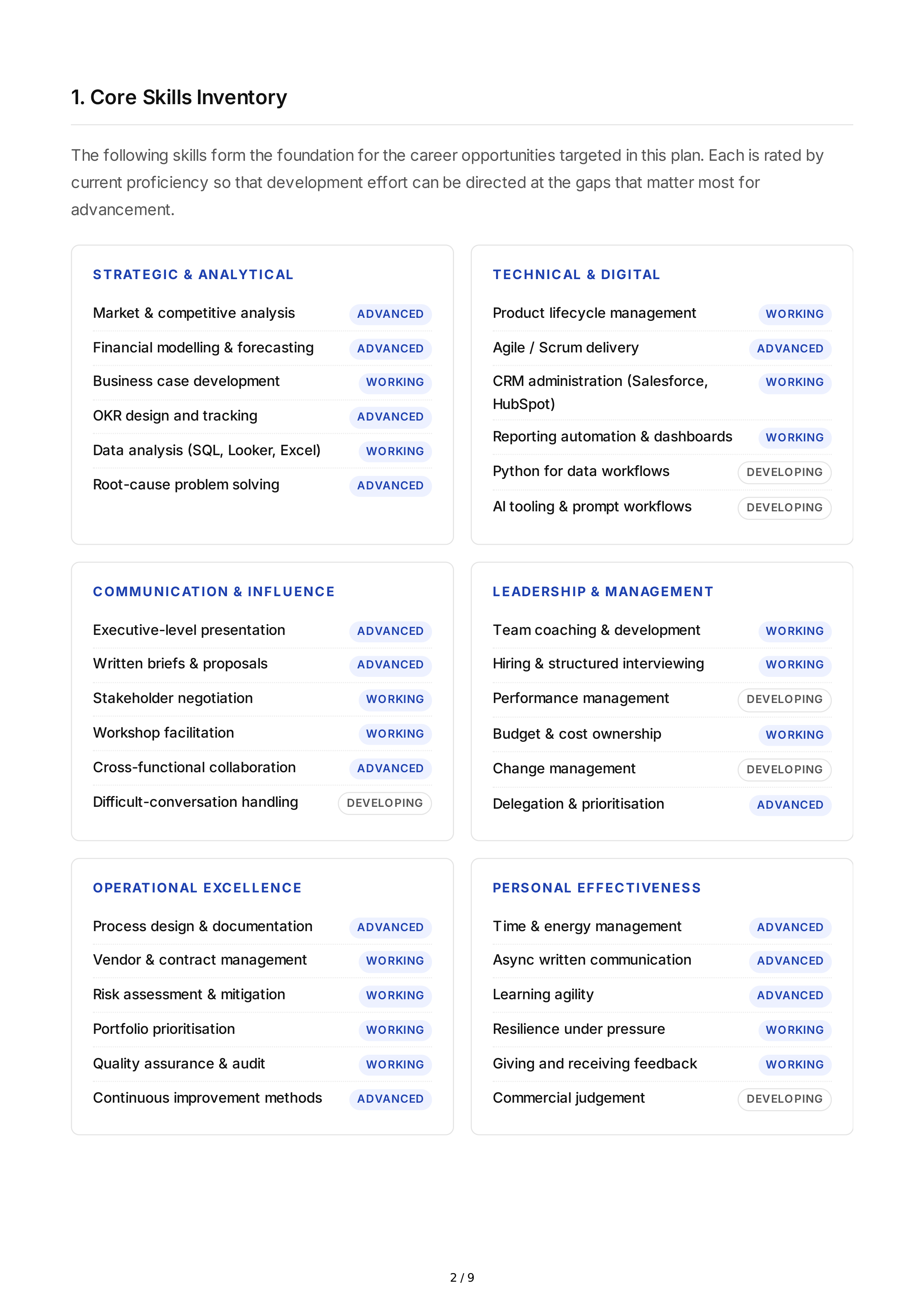
STRATEGIC
&
ANALYTICAL
Market
&
competitive
analysis
ADVANCED
Financial
modelling
&
forecasting
ADVANCED
Business
case
development
WORKING
OKR
design
and
tracking
ADVANCED
Data
analysis
(
SQL
,
Looker
,
Excel
)
WORKING
Root
-
cause
problem
solving
ADVANCED
TECHNICAL
&
DIGITAL
Product
lifecycle
management
WORKING
Agile
/
Scrum
delivery
ADVANCED
CRM
administration
(
Salesforce
,
HubSpot
)
WORKING
Reporting
automation
&
dashboards
WORKING
Python
for
data
workflows
DEVELOPING
AI
tooling
&
prompt
workflows
DEVELOPING
COMMUNICATION
&
INFLUENCE
Executive
-
level
presentation
ADVANCED
Written
briefs
&
proposals
ADVANCED
Stakeholder
negotiation
WORKING
Workshop
facilitation
WORKING
Cross
-
functional
collaboration
ADVANCED
Difficult
-
conversation
handling
DEVELOPING
LEADERSHIP
&
MANAGEMENT
Team
coaching
&
development
WORKING
Hiring
&
structured
interviewing
WORKING
Performance
management
DEVELOPING
Budget
&
cost
ownership
WORKING
Change
management
DEVELOPING
Delegation
&
prioritisation
ADVANCED
OPERATIONAL
EXCELLENCE
Process
design
&
documentation
ADVANCED
Vendor
&
contract
management
WORKING
Risk
assessment
&
mitigation
WORKING
Portfolio
prioritisation
WORKING
Quality
assurance
&
audit
WORKING
Continuous
improvement
methods
ADVANCED
PERSONAL
EFFECTIVENESS
Time
&
energy
management
ADVANCED
Async
written
communication
ADVANCED
Learning
agility
ADVANCED
Resilience
under
pressure
WORKING
Giving
and
receiving
feedback
WORKING
Commercial
judgement
DEVELOPING
2 / 9

How
to
read
the
ratings
.
Advanced
means
the
skill
can
be
demonstrated
to
an
external
interviewer
with
concrete
evidence
.
Working
means
it
is
used
regularly
but
not
yet
at
a
level
that
would
differentiate
a
candidacy
.
Developing
means
it
is
a
stated
gap
and
a
priority
for
the
next
twelve
months
.
3 / 9
2.
Professional
Goals
by
Horizon
Goals
are
grouped
by
the
time
horizon
over
which
they
are
realistically
achievable
.
Every
goal
is
written
so
that
it
can
be
evidenced
—
either
by
an
artefact
,
a
metric
,
or
a
documented
role
change
.
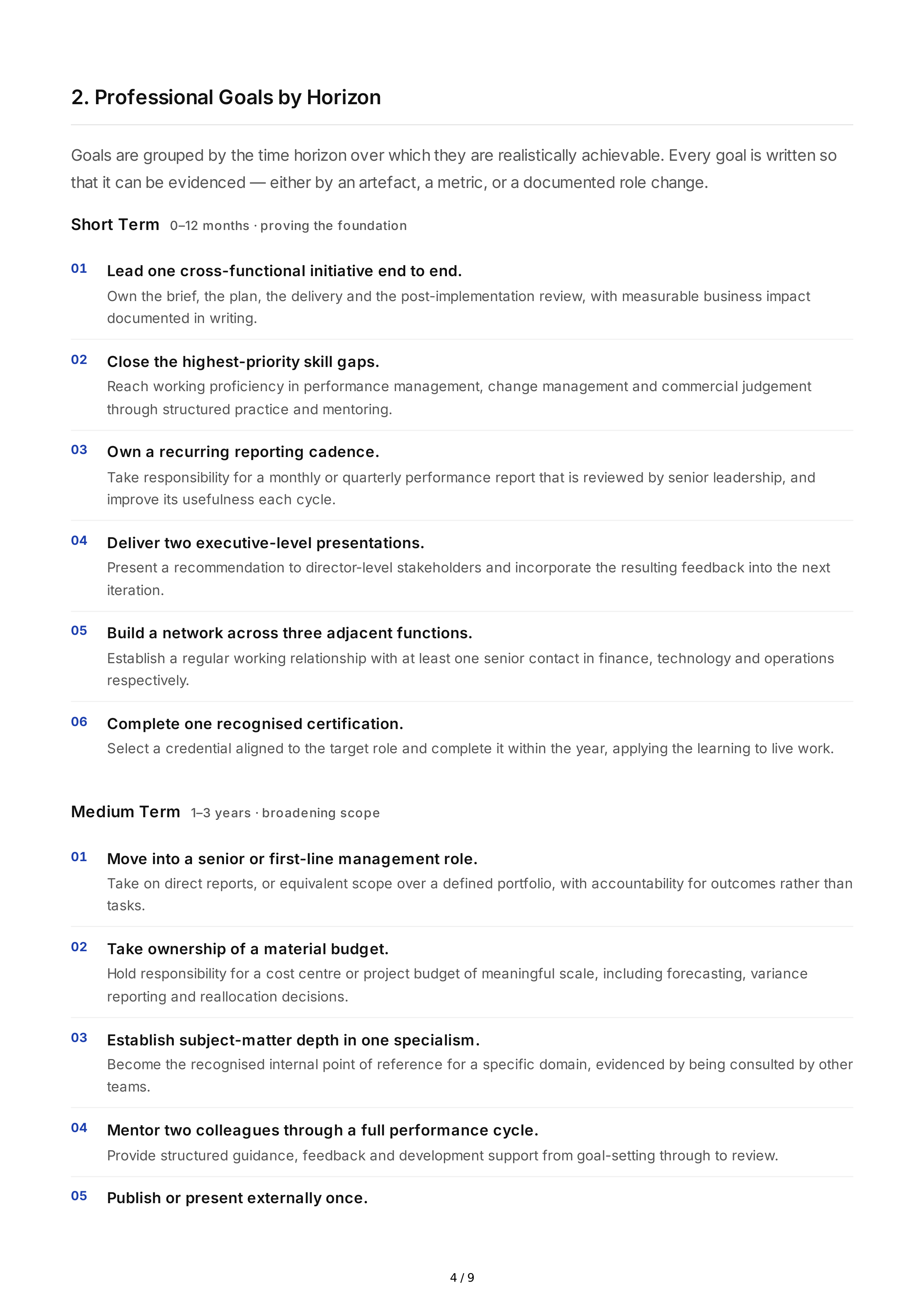
Short
Term
0–12
months
·
proving
the
foundation
Medium
Term
1–3
years
·
broadening
scope
Lead
one
cross
-
functional
initiative
end
to
end
.
Own
the
brief
,
the
plan
,
the
delivery
and
the
post
-
implementation
review
,
with
measurable
business
impact
documented
in
writing
.
01
Close
the
highest
-
priority
skill
gaps
.
Reach
working
proficiency
in
performance
management
,
change
management
and
commercial
judgement
through
structured
practice
and
mentoring
.
02
Own
a
recurring
reporting
cadence
.
Take
responsibility
for
a
monthly
or
quarterly
performance
report
that
is
reviewed
by
senior
leadership
,
and
improve
its
usefulness
each
cycle
.
03
Deliver
two
executive
-
level
presentations
.
Present
a
recommendation
to
director
-
level
stakeholders
and
incorporate
the
resulting
feedback
into
the
next
iteration
.
04
Build
a
network
across
three
adjacent
functions
.
Establish
a
regular
working
relationship
with
at
least
one
senior
contact
in
finance
,
technology
and
operations
respectively
.
05
Complete
one
recognised
certification
.
Select
a
credential
aligned
to
the
target
role
and
complete
it
within
the
year
,
applying
the
learning
to
live
work
.
06
Move
into
a
senior
or
first
-
line
management
role
.
Take
on
direct
reports
,
or
equivalent
scope
over
a
defined
portfolio
,
with
accountability
for
outcomes
rather
than
tasks
.
01
Take
ownership
of
a
material
budget
.
Hold
responsibility
for
a
cost
centre
or
project
budget
of
meaningful
scale
,
including
forecasting
,
variance
reporting
and
reallocation
decisions
.
02
Establish
subject
-
matter
depth
in
one
specialism
.
Become
the
recognised
internal
point
of
reference
for
a
specific
domain
,
evidenced
by
being
consulted
by
other
teams
.
03
Mentor
two
colleagues
through
a
full
performance
cycle
.
Provide
structured
guidance
,
feedback
and
development
support
from
goal
-
setting
through
to
review
.
04
Publish
or
present
externally
once
.
05
4 / 9
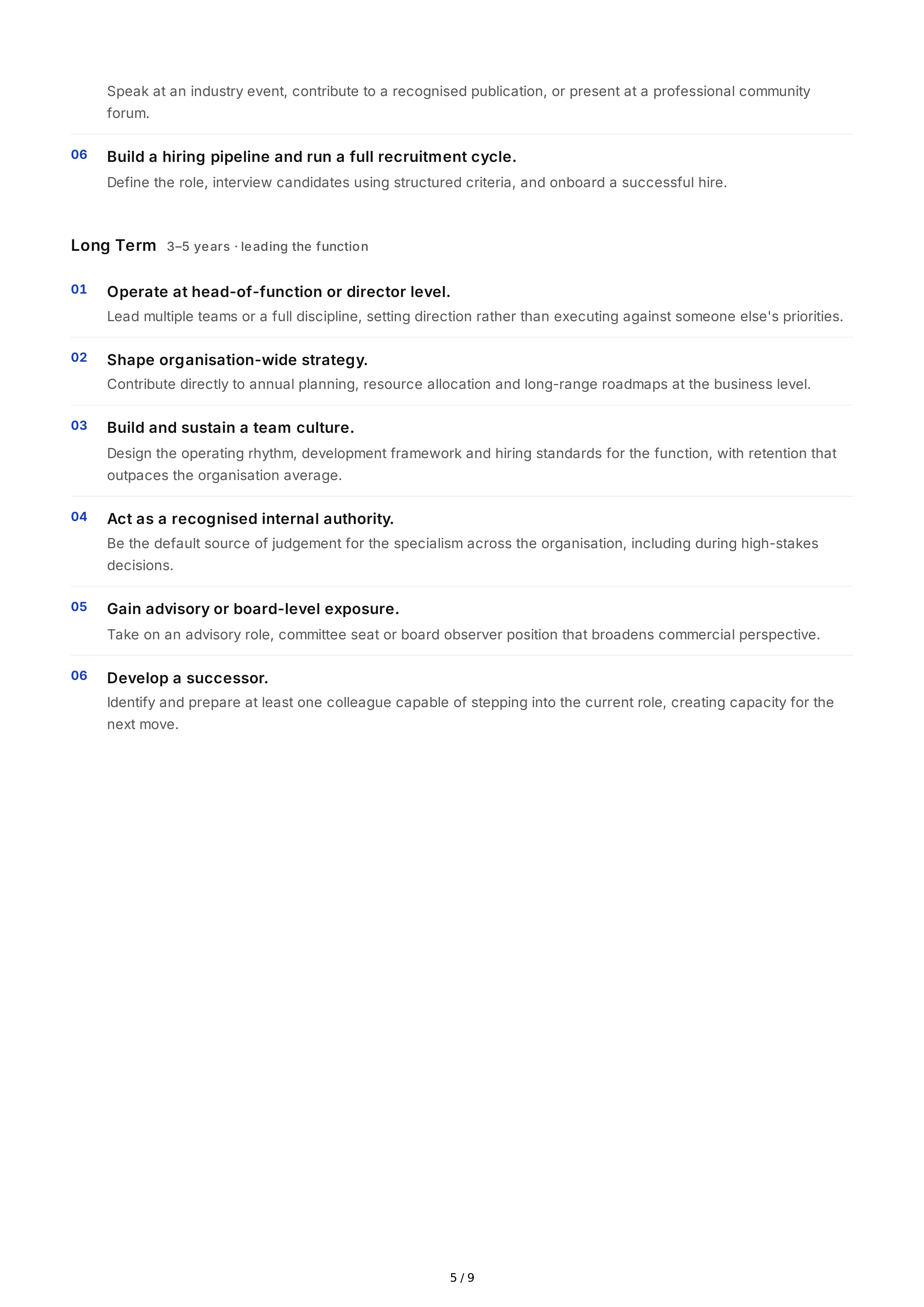
Long
Term
3–5
years
·
leading
the
function
Speak
at
an
industry
event
,
contribute
to
a
recognised
publication
,
or
present
at
a
professional
community
forum
.
Build
a
hiring
pipeline
and
run
a
full
recruitment
cycle
.
Define
the
role
,
interview
candidates
using
structured
criteria
,
and
onboard
a
successful
hire
.
06
Operate
at
head
-
of
-
function
or
director
level
.
Lead
multiple
teams
or
a
full
discipline
,
setting
direction
rather
than
executing
against
someone
else
'
s
priorities
.
01
Shape
organisation
-
wide
strategy
.
Contribute
directly
to
annual
planning
,
resource
allocation
and
long
-
range
roadmaps
at
the
business
level
.
02
Build
and
sustain
a
team
culture
.
Design
the
operating
rhythm
,
development
framework
and
hiring
standards
for
the
function
,
with
retention
that
outpaces
the
organisation
average
.
03
Act
as
a
recognised
internal
authority
.
Be
the
default
source
of
judgement
for
the
specialism
across
the
organisation
,
including
during
high
-
stakes
decisions
.
04
Gain
advisory
or
board
-
level
exposure
.
Take
on
an
advisory
role
,
committee
seat
or
board
observer
position
that
broadens
commercial
perspective
.
05
Develop
a
successor
.
Identify
and
prepare
at
least
one
colleague
capable
of
stepping
into
the
current
role
,
creating
capacity
for
the
next
move
.
06
5 / 9
3.
Priority
Goals
in
Detail
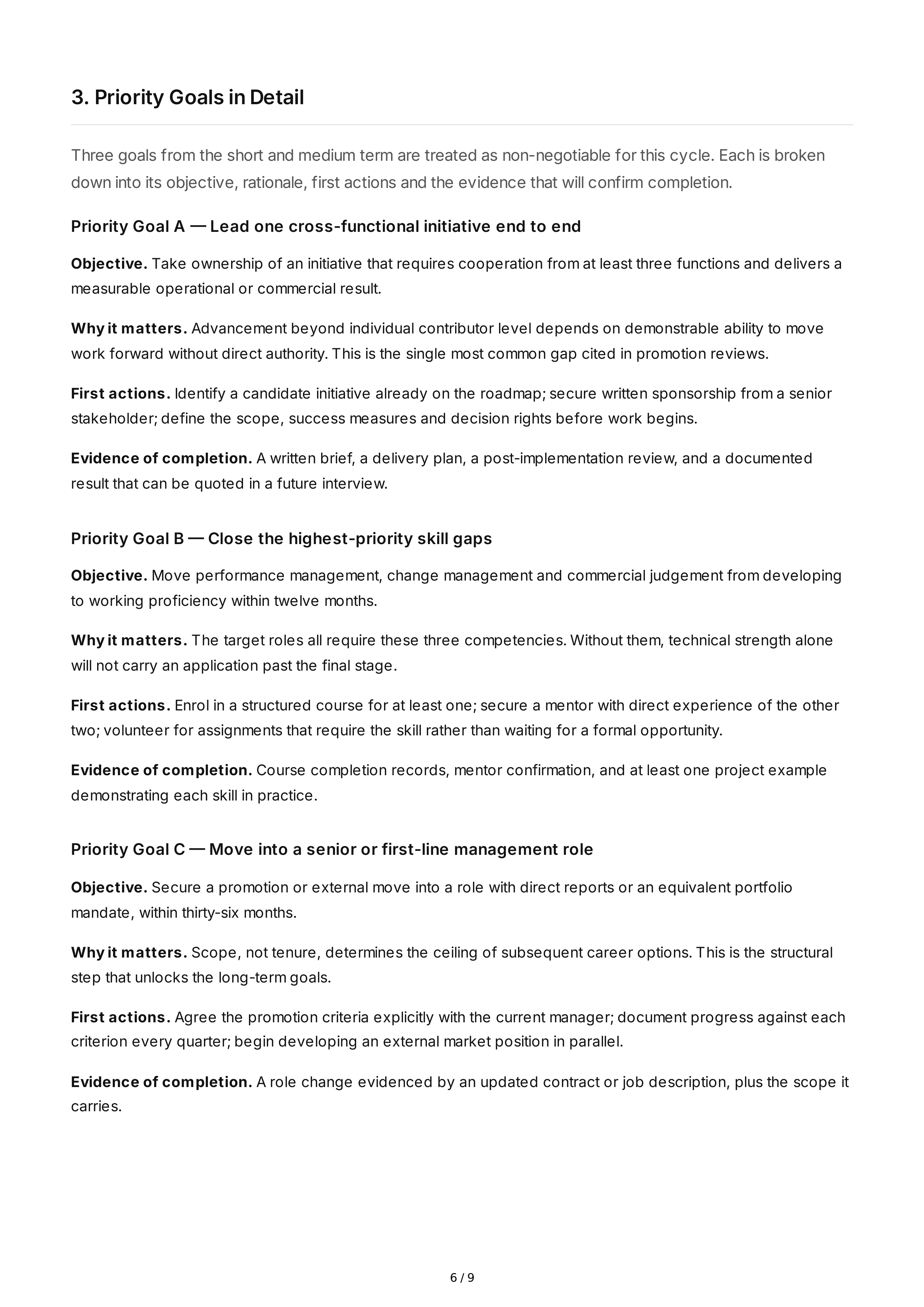
Three
goals
from
the
short
and
medium
term
are
treated
as
non
-
negotiable
for
this
cycle
.
Each
is
broken
down
into
its
objective
,
rationale
,
first
actions
and
the
evidence
that
will
confirm
completion
.
Priority
Goal
A
—
Lead
one
cross
-
functional
initiative
end
to
end
Objective
.
Take
ownership
of
an
initiative
that
requires
cooperation
from
at
least
three
functions
and
delivers
a
measurable
operational
or
commercial
result
.
Why
it
matters
.
Advancement
beyond
individual
contributor
level
depends
on
demonstrable
ability
to
move
work
forward
without
direct
authority
.
This
is
the
single
most
common
gap
cited
in
promotion
reviews
.
First
actions
.
Identify
a
candidate
initiative
already
on
the
roadmap
;
secure
written
sponsorship
from
a
senior
stakeholder
;
define
the
scope
,
success
measures
and
decision
rights
before
work
begins
.
Evidence
of
completion
.
A
written
brief
,
a
delivery
plan
,
a
post
-
implementation
review
,
and
a
documented
result
that
can
be
quoted
in
a
future
interview
.
Priority
Goal
B
—
Close
the
highest
-
priority
skill
gaps
Objective
.
Move
performance
management
,
change
management
and
commercial
judgement
from
developing
to
working
proficiency
within
twelve
months
.
Why
it
matters
.
The
target
roles
all
require
these
three
competencies
.
Without
them
,
technical
strength
alone
will
not
carry
an
application
past
the
final
stage
.
First
actions
.
Enrol
in
a
structured
course
for
at
least
one
;
secure
a
mentor
with
direct
experience
of
the
other
two
;
volunteer
for
assignments
that
require
the
skill
rather
than
waiting
for
a
formal
opportunity
.
Evidence
of
completion
.
Course
completion
records
,
mentor
confirmation
,
and
at
least
one
project
example
demonstrating
each
skill
in
practice
.
Priority
Goal
C
—
Move
into
a
senior
or
first
-
line
management
role
Objective
.
Secure
a
promotion
or
external
move
into
a
role
with
direct
reports
or
an
equivalent
portfolio
mandate
,
within
thirty
-
six
months
.
Why
it
matters
.
Scope
,
not
tenure
,
determines
the
ceiling
of
subsequent
career
options
.
This
is
the
structural
step
that
unlocks
the
long
-
term
goals
.
First
actions
.
Agree
the
promotion
criteria
explicitly
with
the
current
manager
;
document
progress
against
each
criterion
every
quarter
;
begin
developing
an
external
market
position
in
parallel
.
Evidence
of
completion
.
A
role
change
evidenced
by
an
updated
contract
or
job
description
,
plus
the
scope
it
carries
.
6 / 9
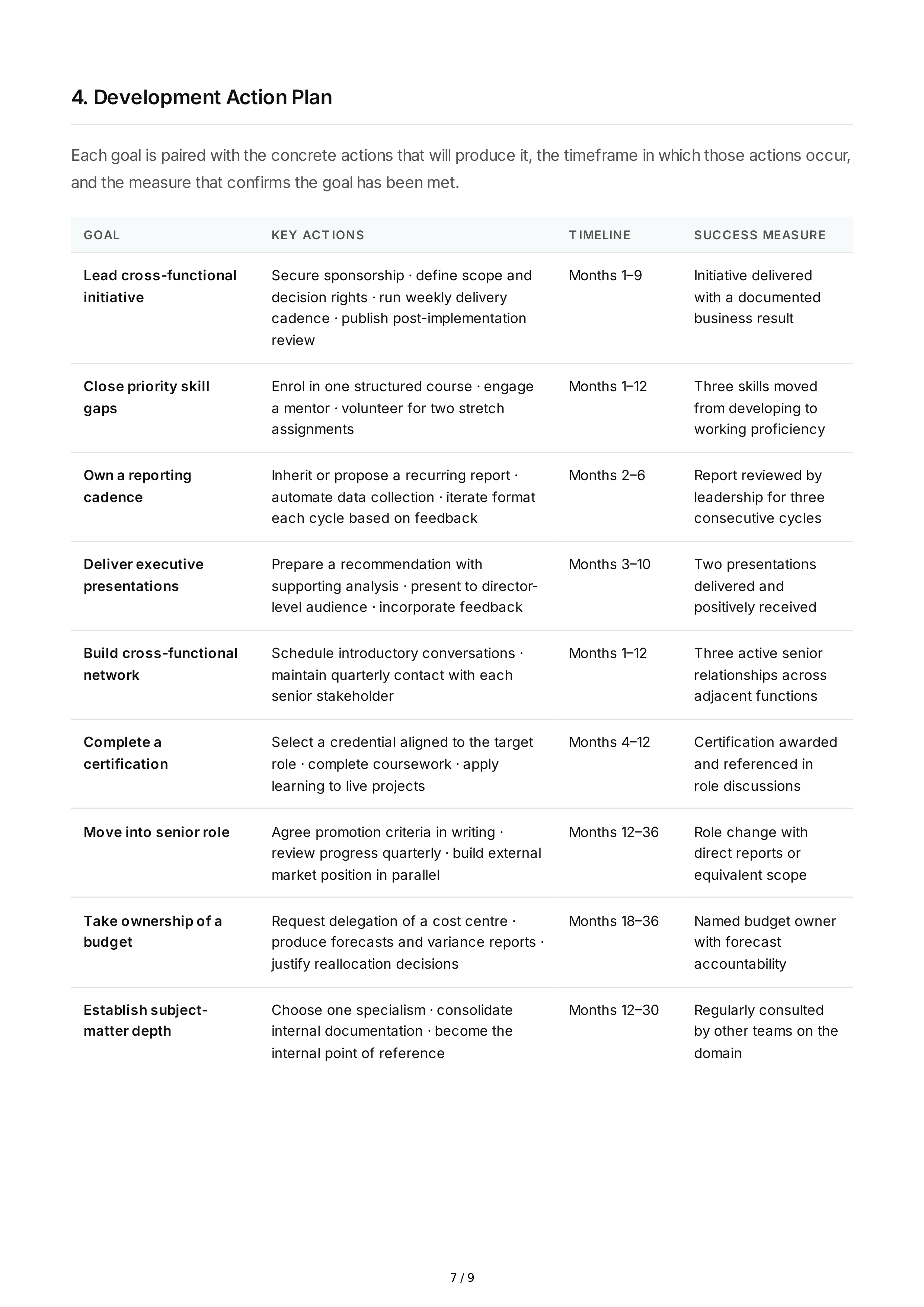
4.
Development
Action
Plan
Each
goal
is
paired
with
the
concrete
actions
that
will
produce
it
,
the
timeframe
in
which
those
actions
occur
,
and
the
measure
that
confirms
the
goal
has
been
met
.
GOAL
KEY
ACT IONS
T IMELINE
SUCCESS
MEASURE
Lead
cross
-
functional
initiative
Secure
sponsorship
·
define
scope
and
decision
rights
·
run
weekly
delivery
cadence
·
publish
post
-
implementation
review
Months
1–9
Initiative
delivered
with
a
documented
business
result
Close
priority
skill
gaps
Enrol
in
one
structured
course
·
engage
a
mentor
·
volunteer
for
two
stretch
assignments
Months
1–12
Three
skills
moved
from
developing
to
working
proficiency
Own
a
reporting
cadence
Inherit
or
propose
a
recurring
report
·
automate
data
collection
·
iterate
format
each
cycle
based
on
feedback
Months
2–6
Report
reviewed
by
leadership
for
three
consecutive
cycles
Deliver
executive
presentations
Prepare
a
recommendation
with
supporting
analysis
·
present
to
director
-
level
audience
·
incorporate
feedback
Months
3–10
Two
presentations
delivered
and
positively
received
Build
cross
-
functional
network
Schedule
introductory
conversations
·
maintain
quarterly
contact
with
each
senior
stakeholder
Months
1–12
Three
active
senior
relationships
across
adjacent
functions
Complete
a
certification
Select
a
credential
aligned
to
the
target
role
·
complete
coursework
·
apply
learning
to
live
projects
Months
4–12
Certification
awarded
and
referenced
in
role
discussions
Move
into
senior
role
Agree
promotion
criteria
in
writing
·
review
progress
quarterly
·
build
external
market
position
in
parallel
Months
12–36
Role
change
with
direct
reports
or
equivalent
scope
Take
ownership
of
a
budget
Request
delegation
of
a
cost
centre
·
produce
forecasts
and
variance
reports
·
justify
reallocation
decisions
Months
18–36
Named
budget
owner
with
forecast
accountability
Establish
subject
-
matter
depth
Choose
one
specialism
·
consolidate
internal
documentation
·
become
the
internal
point
of
reference
Months
12–30
Regularly
consulted
by
other
teams
on
the
domain
7 / 9
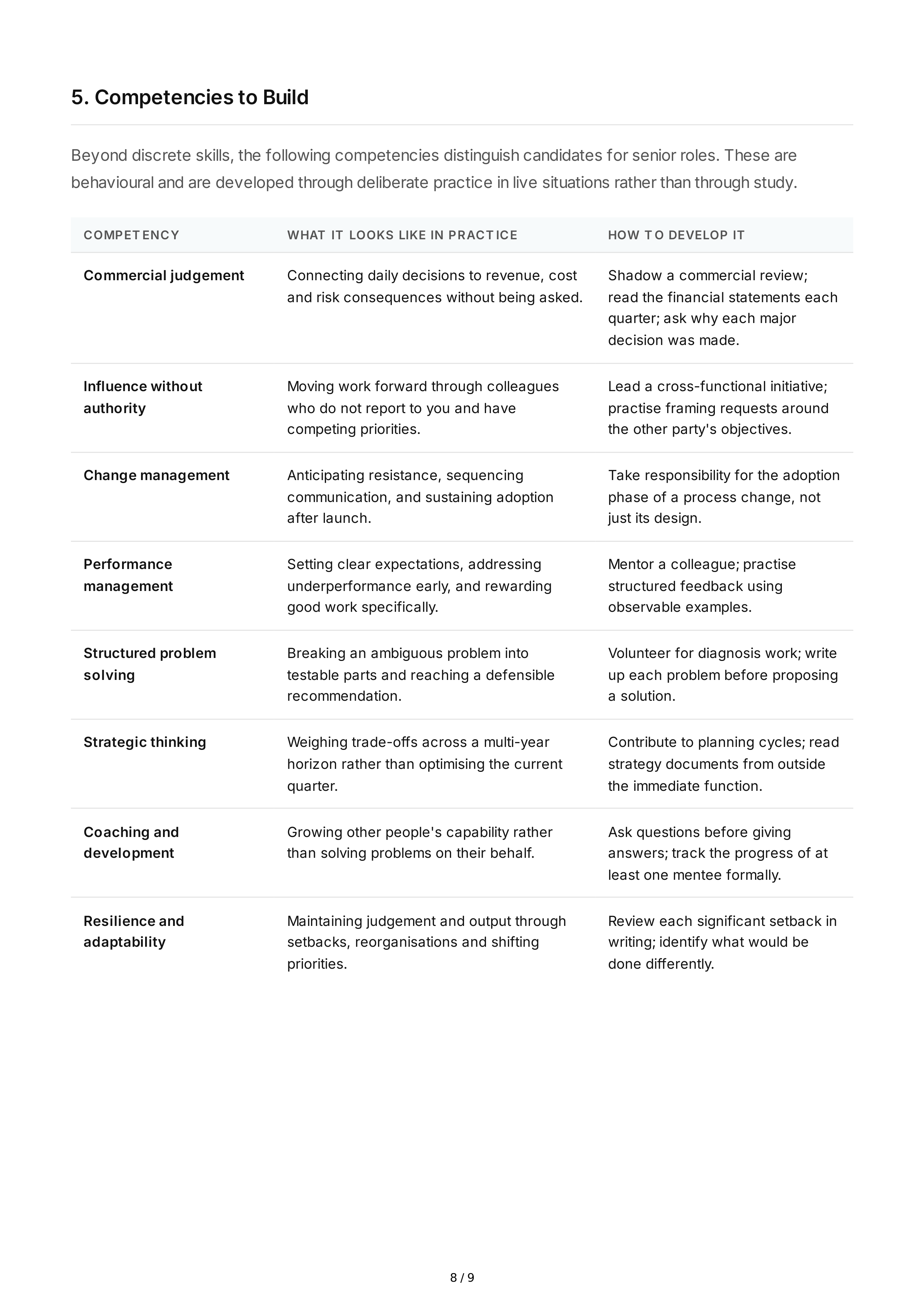
5.
Competencies
to
Build
Beyond
discrete
skills
,
the
following
competencies
distinguish
candidates
for
senior
roles
.
These
are
behavioural
and
are
developed
through
deliberate
practice
in
live
situations
rather
than
through
study
.
COMPET ENCY
WHAT
IT
LOOKS
LIKE
IN
PRACT ICE
HOW
T O
DEVELOP
IT
Commercial
judgement
Connecting
daily
decisions
to
revenue
,
cost
and
risk
consequences
without
being
asked
.
Shadow
a
commercial
review
;
read
the
financial
statements
each
quarter
;
ask
why
each
major
decision
was
made
.
Influence
without
authority
Moving
work
forward
through
colleagues
who
do
not
report
to
you
and
have
competing
priorities
.
Lead
a
cross
-
functional
initiative
;
practise
framing
requests
around
the
other
party
'
s
objectives
.
Change
management
Anticipating
resistance
,
sequencing
communication
,
and
sustaining
adoption
after
launch
.
Take
responsibility
for
the
adoption
phase
of
a
process
change
,
not
just
its
design
.
Performance
management
Setting
clear
expectations
,
addressing
underperformance
early
,
and
rewarding
good
work
specifically
.
Mentor
a
colleague
;
practise
structured
feedback
using
observable
examples
.
Structured
problem
solving
Breaking
an
ambiguous
problem
into
testable
parts
and
reaching
a
defensible
recommendation
.
Volunteer
for
diagnosis
work
;
write
up
each
problem
before
proposing
a
solution
.
Strategic
thinking
Weighing
trade
-
offs
across
a
multi
-
year
horizon
rather
than
optimising
the
current
quarter
.
Contribute
to
planning
cycles
;
read
strategy
documents
from
outside
the
immediate
function
.
Coaching
and
development
Growing
other
people
'
s
capability
rather
than
solving
problems
on
their
behalf
.
Ask
questions
before
giving
answers
;
track
the
progress
of
at
least
one
mentee
formally
.
Resilience
and
adaptability
Maintaining
judgement
and
output
through
setbacks
,
reorganisations
and
shifting
priorities
.
Review
each
significant
setback
in
writing
;
identify
what
would
be
done
differently
.
8 / 9
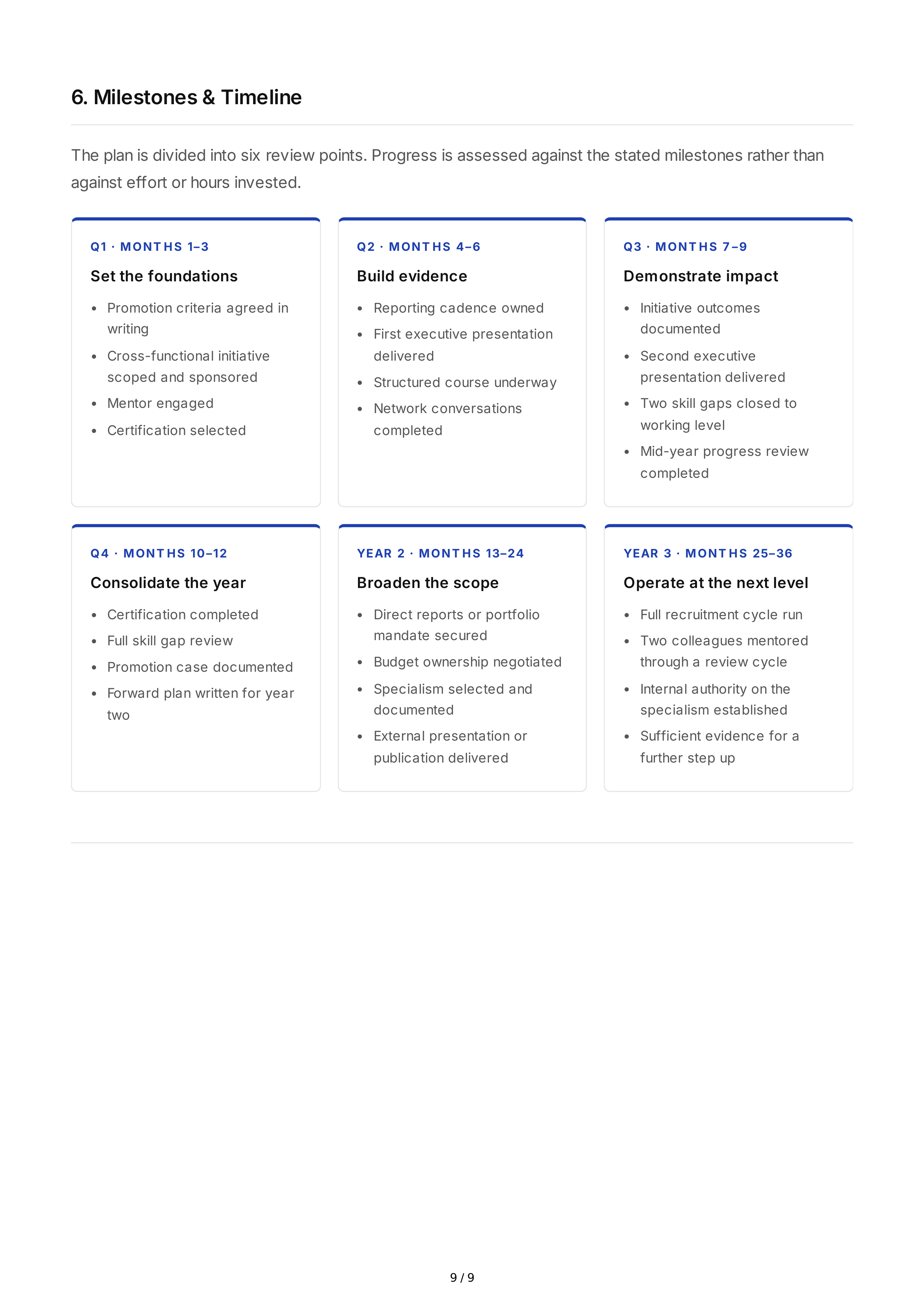
6.
Milestones
&
Timeline
The
plan
is
divided
into
six
review
points
.
Progress
is
assessed
against
the
stated
milestones
rather
than
against
effort
or
hours
invested
.
Q
1 ·
MONT HS
1–3
Set
the
foundations
Promotion
criteria
agreed
in
writing
Cross
-
functional
initiative
scoped
and
sponsored
Mentor
engaged
Certification
selected
Q
2 ·
MONT HS
4–6
Build
evidence
Reporting
cadence
owned
First
executive
presentation
delivered
Structured
course
underway
Network
conversations
completed
Q
3 ·
MONT HS
7 –9
Demonstrate
impact
Initiative
outcomes
documented
Second
executive
presentation
delivered
Two
skill
gaps
closed
to
working
level
Mid
-
year
progress
review
completed
Q
4 ·
MONT HS
10–12
Consolidate
the
year
Certification
completed
Full
skill
gap
review
Promotion
case
documented
Forward
plan
written
for
year
two
YEAR
2 ·
MONT HS
13–24
Broaden
the
scope
Direct
reports
or
portfolio
mandate
secured
Budget
ownership
negotiated
Specialism
selected
and
documented
External
presentation
or
publication
delivered
YEAR
3 ·
MONT HS
25–36
Operate
at
the
next
level
Full
recruitment
cycle
run
Two
colleagues
mentored
through
a
review
cycle
Internal
authority
on
the
specialism
established
Sufficient
evidence
for
a
further
step
up
9 / 9
