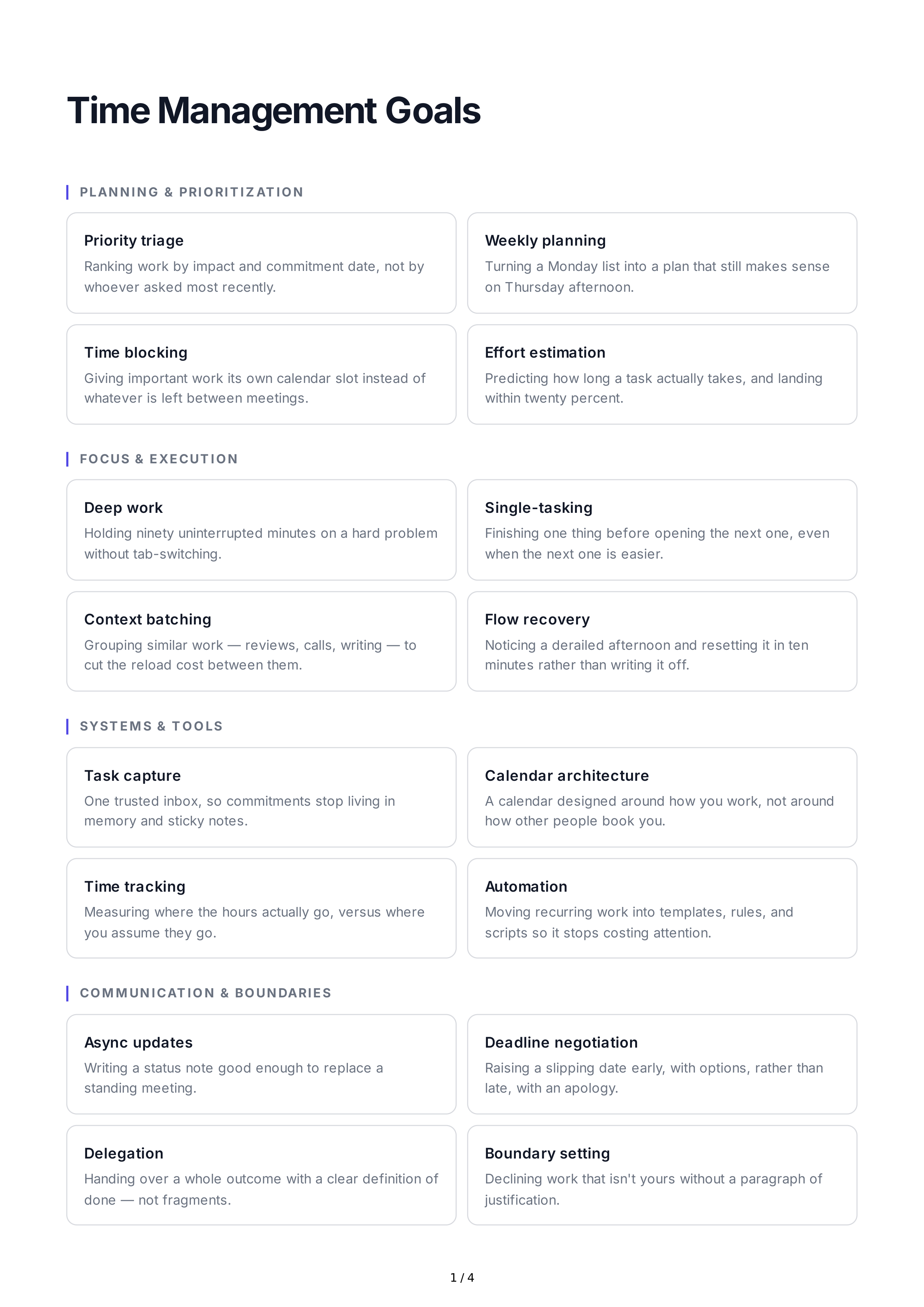
Time
Management
Goals
PLAN N IN G
&
PRIO RIT IZ AT IO N
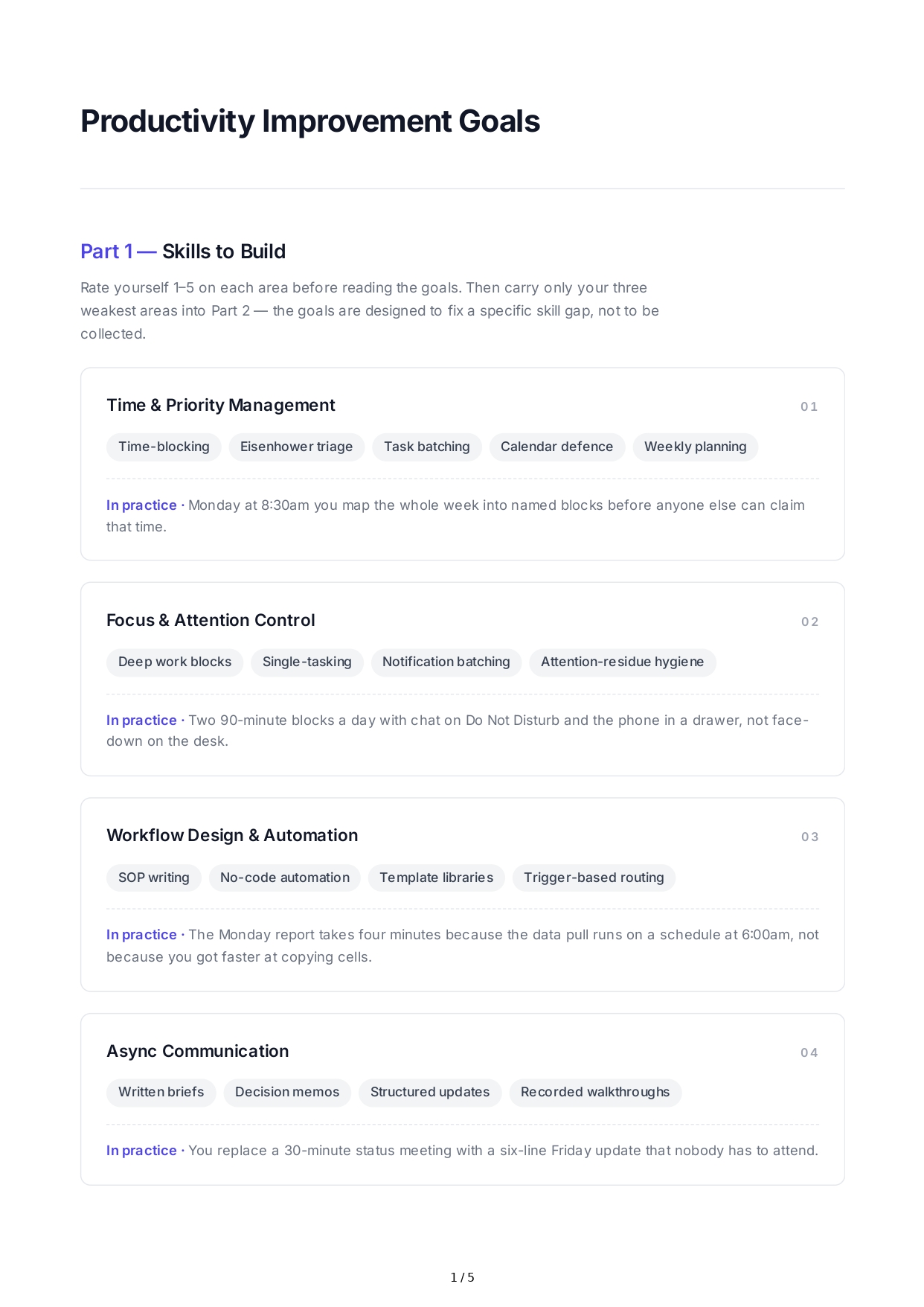
Priority
triage
Ranking
work
by
impact
and
commitment
date
,
not
by
whoever
asked
most
recently
.
Weekly
planning
Turning
a
Monday
list
into
a
plan
that
still
makes
sense
on
Thursday
afternoon
.
Time
blocking
Giving
important
work
its
own
calendar
slot
instead
of
whatever
is
left
between
meetings
.
Effort
estimation
Predicting
how
long
a
task
actually
takes
,
and
landing
within
twenty
percent
.
FO CUS
&
EXECUT IO N
Deep
work
Holding
ninety
uninterrupted
minutes
on
a
hard
problem
without
tab
-
switching
.
Single
-
tasking
Finishing
one
thing
before
opening
the
next
one
,
even
when
the
next
one
is
easier
.
Context
batching
Grouping
similar
work
—
reviews
,
calls
,
writing
—
to
cut
the
reload
cost
between
them
.
Flow
recovery
Noticing
a
derailed
afternoon
and
resetting
it
in
ten
minutes
rather
than
writing
it
off
.
SYST EM S
&
T O O LS
Task
capture
One
trusted
inbox
,
so
commitments
stop
living
in
memory
and
sticky
notes
.
Calendar
architecture
A
calendar
designed
around
how
you
work
,
not
around
how
other
people
book
you
.
Time
tracking
Measuring
where
the
hours
actually
go
,
versus
where
you
assume
they
go
.
Automation
Moving
recurring
work
into
templates
,
rules
,
and
scripts
so
it
stops
costing
attention
.
CO M M UN ICAT IO N
&
BO UN DARIES
Async
updates
Writing
a
status
note
good
enough
to
replace
a
standing
meeting
.
Deadline
negotiation
Raising
a
slipping
date
early
,
with
options
,
rather
than
late
,
with
an
apology
.
Delegation
Handing
over
a
whole
outcome
with
a
clear
definition
of
done
—
not
fragments
.
Boundary
setting
Declining
work
that
isn
'
t
yours
without
a
paragraph
of
justification
.
1 / 4
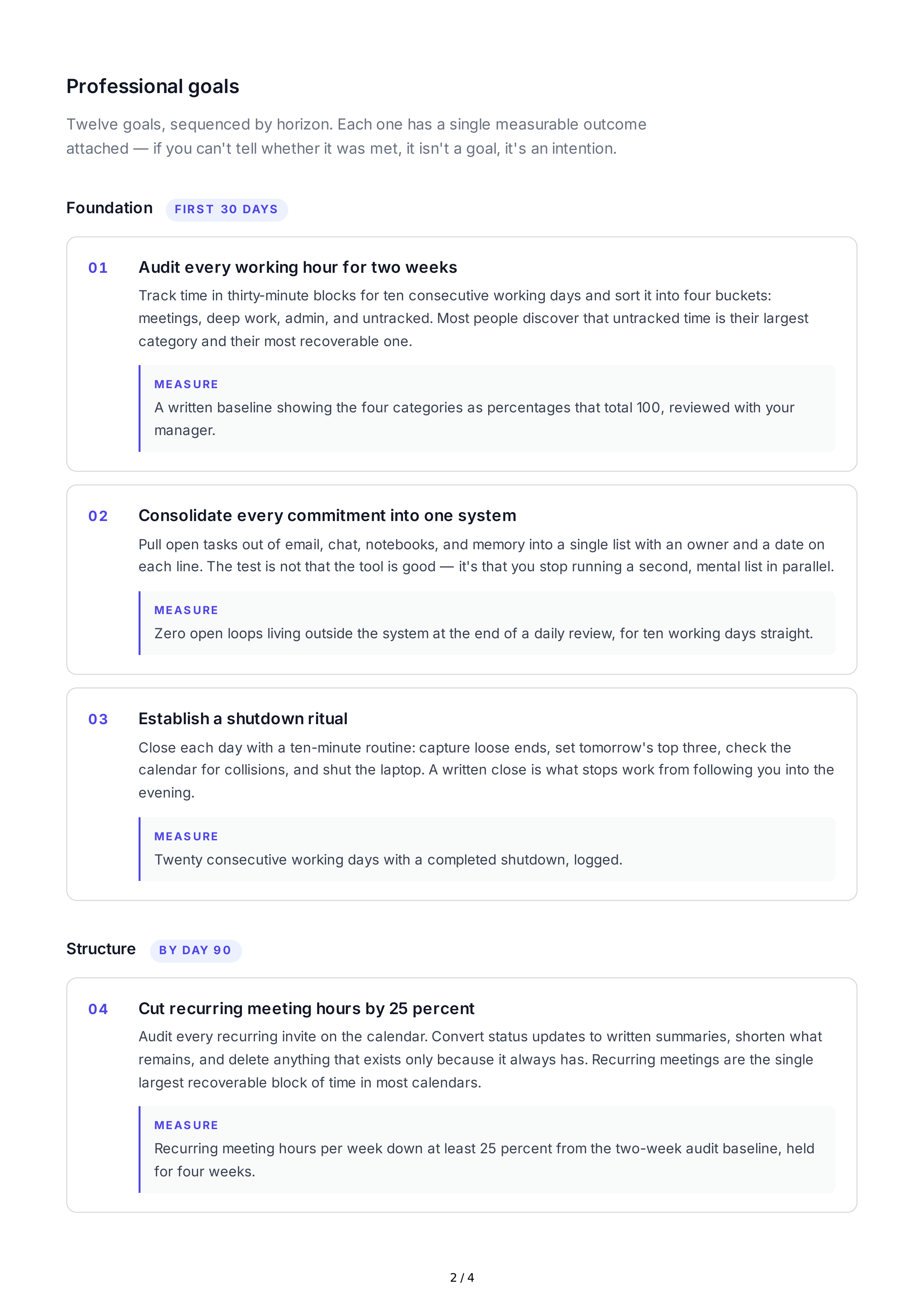
Professional
goals
Twelve
goals
,
sequenced
by
horizon
.
Each
one
has
a
single
measurable
outcome
attached
—
if
you
can
'
t
tell
whether
it
was
met
,
it
isn
'
t
a
goal
,
it
'
s
an
intention
.
Foundation
FIR S T
30
DAYS
01
Audit
every
working
hour
for
two
weeks
Track
time
in
thirty
-
minute
blocks
for
ten
consecutive
working
days
and
sort
it
into
four
buckets
:
meetings
,
deep
work
,
admin
,
and
untracked
.
Most
people
discover
that
untracked
time
is
their
largest
category
and
their
most
recoverable
one
.
ME AS URE
A
written
baseline
showing
the
four
categories
as
percentages
that
total
100,
reviewed
with
your
manager
.
02
Consolidate
every
commitment
into
one
system
Pull
open
tasks
out
of
email
,
chat
,
notebooks
,
and
memory
into
a
single
list
with
an
owner
and
a
date
on
each
line
.
The
test
is
not
that
the
tool
is
good
—
it
'
s
that
you
stop
running
a
second
,
mental
list
in
parallel
.
ME AS URE
Zero
open
loops
living
outside
the
system
at
the
end
of
a
daily
review
,
for
ten
working
days
straight
.
03
Establish
a
shutdown
ritual
Close
each
day
with
a
ten
-
minute
routine
:
capture
loose
ends
,
set
tomorrow
'
s
top
three
,
check
the
calendar
for
collisions
,
and
shut
the
laptop
.
A
written
close
is
what
stops
work
from
following
you
into
the
evening
.
ME AS URE
Twenty
consecutive
working
days
with
a
completed
shutdown
,
logged
.
Structure
B Y
DAY
9 0
04
Cut
recurring
meeting
hours
by
25
percent
Audit
every
recurring
invite
on
the
calendar
.
Convert
status
updates
to
written
summaries
,
shorten
what
remains
,
and
delete
anything
that
exists
only
because
it
always
has
.
Recurring
meetings
are
the
single
largest
recoverable
block
of
time
in
most
calendars
.
ME AS URE
Recurring
meeting
hours
per
week
down
at
least
25
percent
from
the
two
-
week
audit
baseline
,
held
for
four
weeks
.
2 / 4
05
Protect
two
deep
-
work
blocks
every
week
Calendar
-
block
two
ninety
-
minute
sessions
with
notifications
off
and
a
stated
topic
.
Treat
them
as
unmovable
:
they
can
be
moved
,
but
only
by
an
equal
swap
,
never
simply
deleted
.
ME AS URE
Eight
blocks
completed
per
month
,
tracked
by
topic
—
not
eight
blocks
scheduled
.
06
Hit
80
percent
of
weekly
top
-
three
commitments
Set
three
meaningful
objectives
each
Monday
—
the
work
that
would
make
the
week
count
—
and
close
at
least
80
percent
by
Friday
.
Not
every
task
,
just
the
three
that
mattered
most
.
ME AS URE
Rolling
four
-
week
completion
rate
at
or
above
80
percent
.
Performance
B Y
S IX
M ONT HS
07
Bring
estimation
error
within
20
percent
Record
an
estimate
and
an
actual
for
every
task
over
two
hours
.
Compare
them
weekly
and
adjust
.
Accurate
estimation
is
a
learned
skill
,
and
it
only
improves
if
the
data
gets
written
down
.
ME AS URE
Median
variance
between
estimate
and
actual
within
plus
or
minus
20
percent
across
a
rolling
month
.
08
Reduce
project
lead
time
by
30
percent
Map
where
work
actually
waits
—
review
queues
,
approval
chains
,
handoffs
—
and
remove
one
source
of
delay
each
month
.
Lead
time
is
usually
lost
in
waiting
,
not
in
working
.
ME AS URE
Median
lead
time
from
start
to
shipped
,
down
30
percent
from
the
two
-
week
audit
baseline
.
09
Make
every
handoff
self
-
contained
Every
delegation
includes
the
outcome
,
the
deadline
,
the
constraints
,
and
a
definition
of
done
.
A
handoff
that
generates
three
clarifying
messages
cost
more
time
than
doing
the
work
would
have
.
ME AS URE
Fewer
than
one
clarification
round
-
trip
per
handoff
,
measured
over
a
quarter
.
3 / 4
Leadership
B Y
T WELVE
M ONT HS
10
Publish
a
team
working
agreement
Write
down
when
the
team
is
deep
-
working
,
when
it
is
reachable
,
how
urgent
requests
escalate
,
and
what
response
times
are
realistic
.
Ambiguity
about
availability
is
what
creates
constant
interruption
.
ME AS URE
Written
,
shared
,
adopted
by
the
team
,
and
reviewed
once
per
quarter
.
11
Reclaim
five
hours
a
week
for
strategic
work
Hold
a
standing
half
-
day
for
planning
,
hiring
,
and
roadmap
work
—
the
jobs
that
only
get
done
when
they
are
defended
in
the
calendar
.
Reclaimed
time
gets
reabsorbed
by
meetings
unless
it
is
protected
explicitly
.
ME AS URE
Sustained
for
twelve
consecutive
weeks
with
no
cancellations
.
12
Mentor
two
colleagues
on
these
systems
Run
a
monthly
working
session
using
the
skills
and
workflows
built
above
.
Teaching
a
system
is
the
fastest
way
to
find
the
parts
of
it
that
don
'
t
actually
work
.
ME AS URE
Two
mentees
report
a
measurable
improvement
in
their
own
delivery
at
the
six
-
month
mark
.
4 / 4