Professional
Competency
Goals
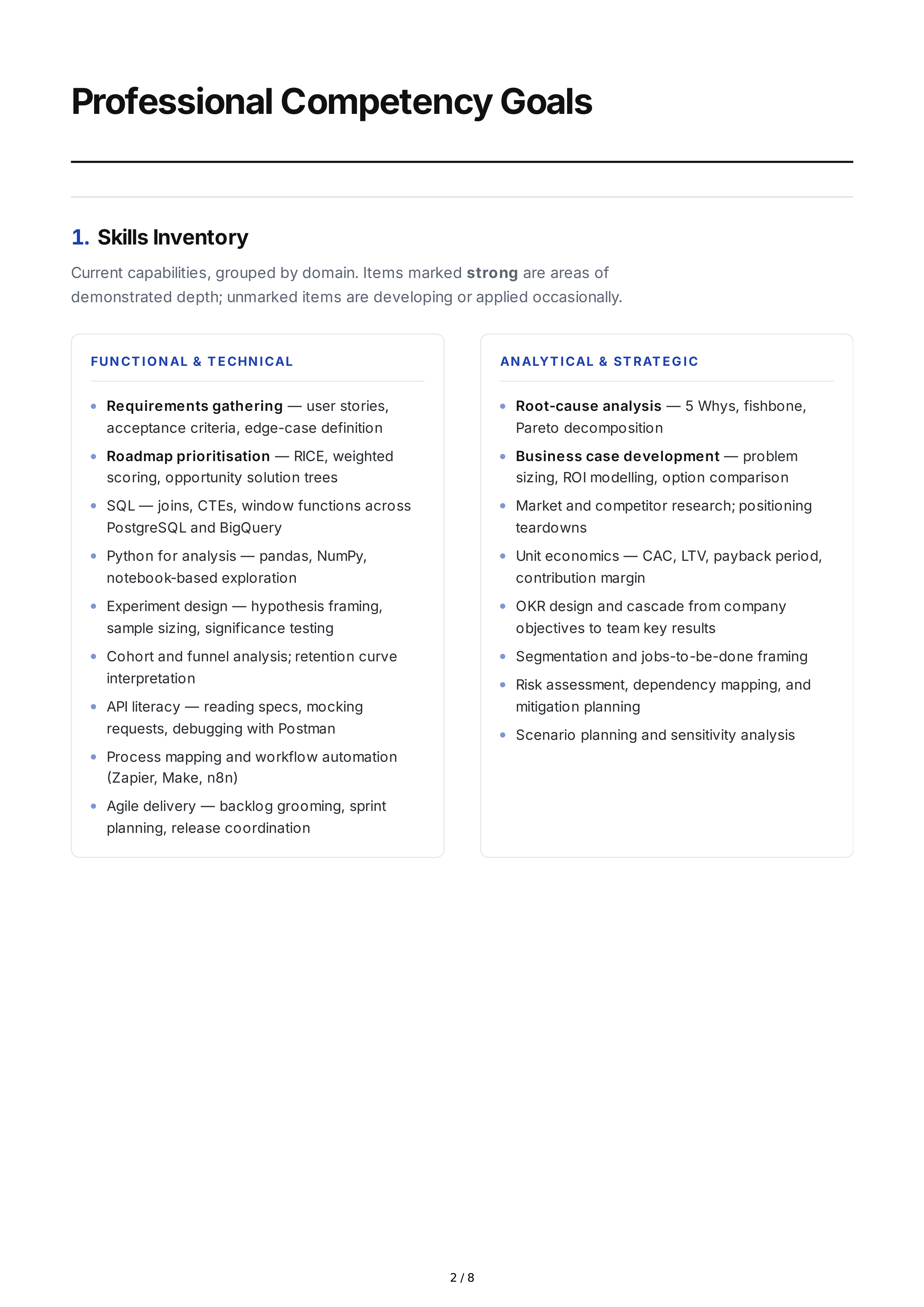
1.
Skills
Inventory
Current
capabilities
,
grouped
by
domain
.
Items
marked
strong
are
areas
of
demonstrated
depth
;
unmarked
items
are
developing
or
applied
occasionally
.
FUN CT ION AL
&
T ECHN ICAL
AN ALYT ICAL
&
ST RAT EG IC
Requirements
gathering
—
user
stories
,
acceptance
criteria
,
edge
-
case
definition
Roadmap
prioritisation
—
RICE
,
weighted
scoring
,
opportunity
solution
trees
SQL
—
joins
,
CTEs
,
window
functions
across
PostgreSQL
and
BigQuery
Python
for
analysis
—
pandas
,
NumPy
,
notebook
-
based
exploration
Experiment
design
—
hypothesis
framing
,
sample
sizing
,
significance
testing
Cohort
and
funnel
analysis
;
retention
curve
interpretation
API
literacy
—
reading
specs
,
mocking
requests
,
debugging
with
Postman
Process
mapping
and
workflow
automation
(
Zapier
,
Make
,
n
8
n
)
Agile
delivery
—
backlog
grooming
,
sprint
planning
,
release
coordination
Root
-
cause
analysis
— 5
Whys
,
fishbone
,
Pareto
decomposition
Business
case
development
—
problem
sizing
,
ROI
modelling
,
option
comparison
Market
and
competitor
research
;
positioning
teardowns
Unit
economics
—
CAC
,
LTV
,
payback
period
,
contribution
margin
OKR
design
and
cascade
from
company
objectives
to
team
key
results
Segmentation
and
jobs
-
to
-
be
-
done
framing
Risk
assessment
,
dependency
mapping
,
and
mitigation
planning
Scenario
planning
and
sensitivity
analysis
2 / 8
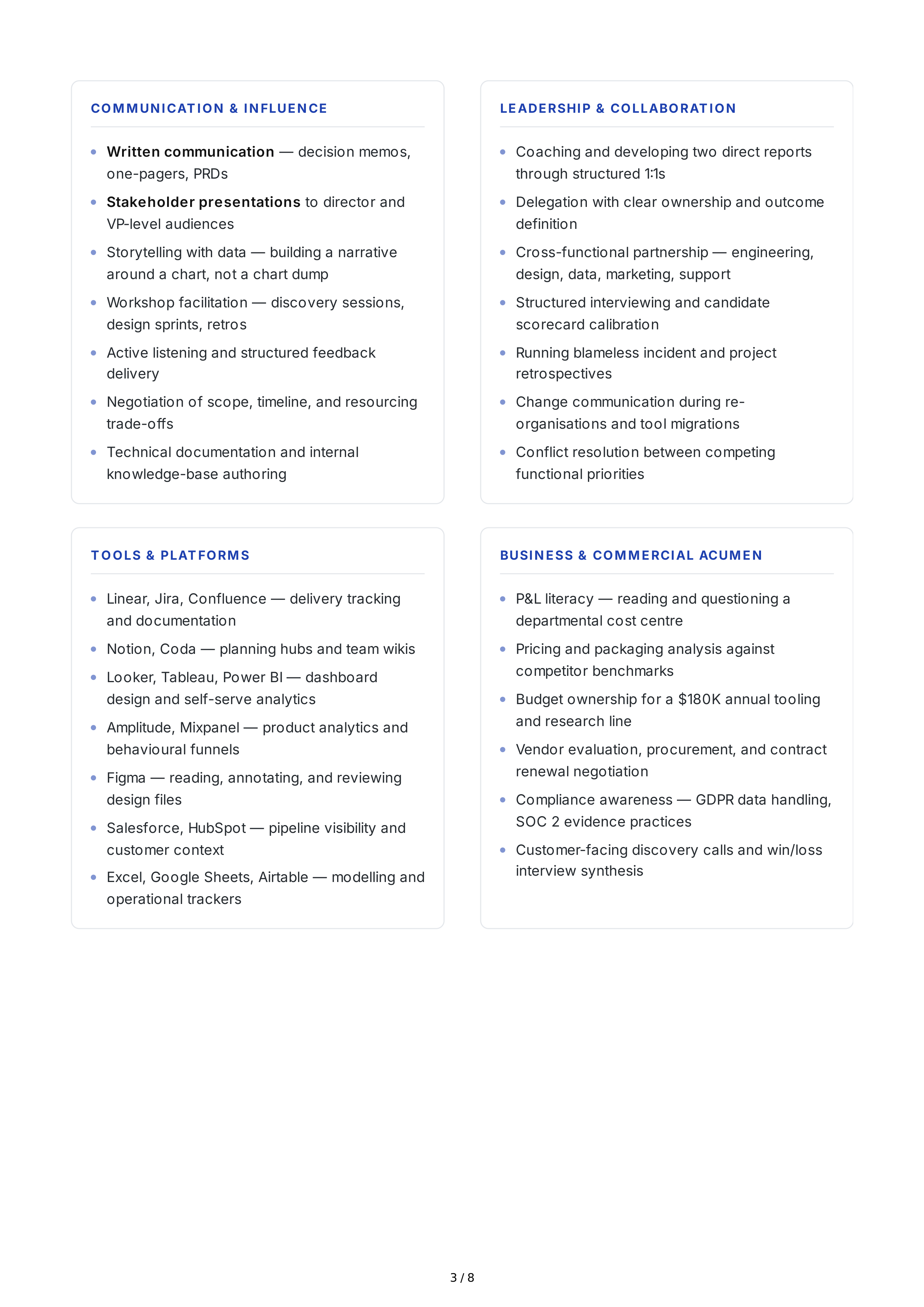
COMMUN ICAT ION
&
IN FLUEN CE
LEADERSHIP
&
COLLABORAT ION
T OOLS
&
PLAT FORMS
BUSIN ESS
&
COMMERCIAL
ACUMEN
Written
communication
—
decision
memos
,
one
-
pagers
,
PRDs
Stakeholder
presentations
to
director
and
VP
-
level
audiences
Storytelling
with
data
—
building
a
narrative
around
a
chart
,
not
a
chart
dump
Workshop
facilitation
—
discovery
sessions
,
design
sprints
,
retros
Active
listening
and
structured
feedback
delivery
Negotiation
of
scope
,
timeline
,
and
resourcing
trade
-
offs
Technical
documentation
and
internal
knowledge
-
base
authoring
Coaching
and
developing
two
direct
reports
through
structured
1:1
s
Delegation
with
clear
ownership
and
outcome
definition
Cross
-
functional
partnership
—
engineering
,
design
,
data
,
marketing
,
support
Structured
interviewing
and
candidate
scorecard
calibration
Running
blameless
incident
and
project
retrospectives
Change
communication
during
re
-
organisations
and
tool
migrations
Conflict
resolution
between
competing
functional
priorities
Linear
,
Jira
,
Confluence
—
delivery
tracking
and
documentation
Notion
,
Coda
—
planning
hubs
and
team
wikis
Looker
,
Tableau
,
Power
BI
—
dashboard
design
and
self
-
serve
analytics
Amplitude
,
Mixpanel
—
product
analytics
and
behavioural
funnels
Figma
—
reading
,
annotating
,
and
reviewing
design
files
Salesforce
,
HubSpot
—
pipeline
visibility
and
customer
context
Excel
,
Google
Sheets
,
Airtable
—
modelling
and
operational
trackers
P
&
L
literacy
—
reading
and
questioning
a
departmental
cost
centre
Pricing
and
packaging
analysis
against
competitor
benchmarks
Budget
ownership
for
a
$
180
K
annual
tooling
and
research
line
Vendor
evaluation
,
procurement
,
and
contract
renewal
negotiation
Compliance
awareness
—
GDPR
data
handling
,
SOC
2
evidence
practices
Customer
-
facing
discovery
calls
and
win
/
loss
interview
synthesis
3 / 8
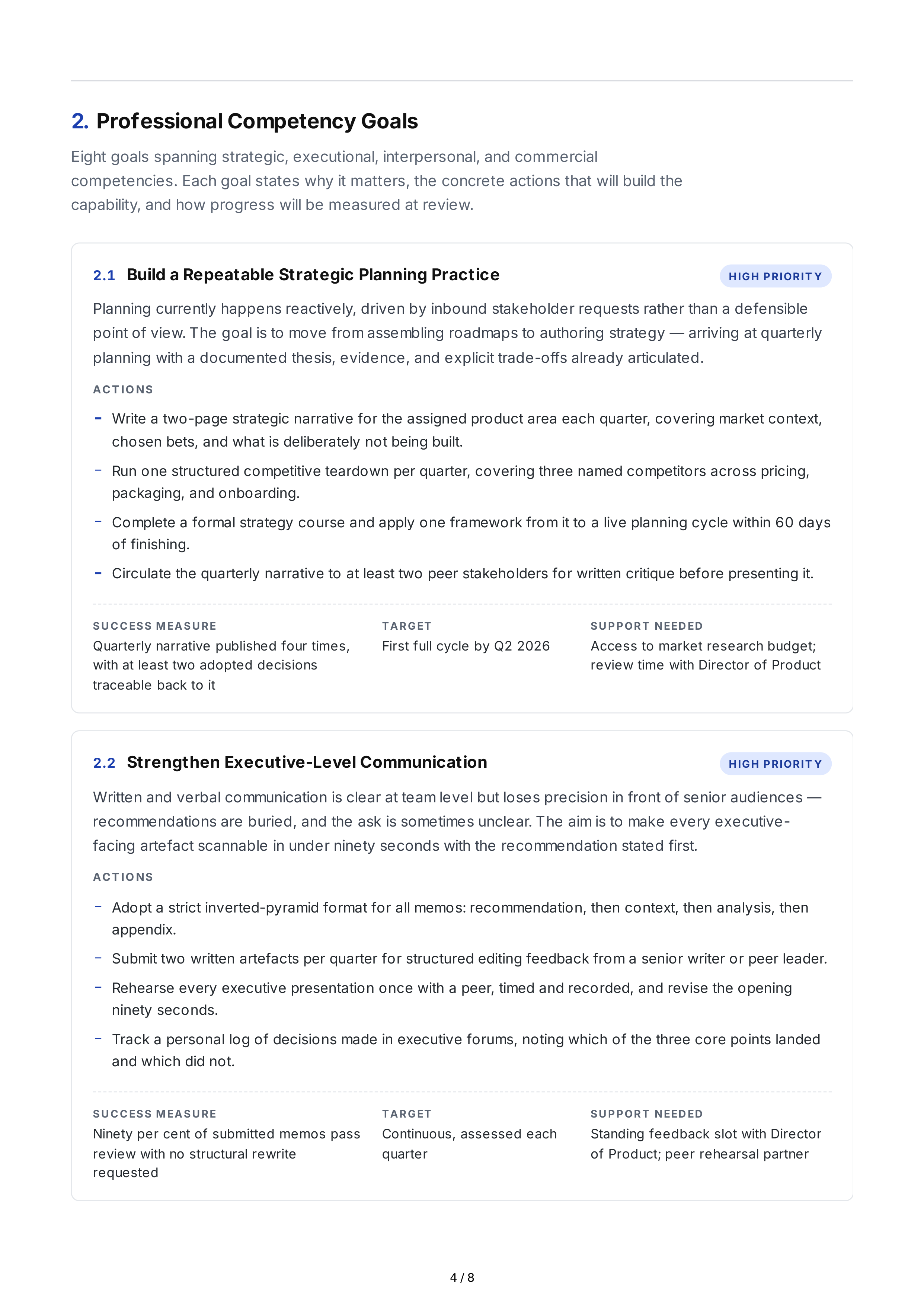
2.
Professional
Competency
Goals
Eight
goals
spanning
strategic
,
executional
,
interpersonal
,
and
commercial
competencies
.
Each
goal
states
why
it
matters
,
the
concrete
actions
that
will
build
the
capability
,
and
how
progress
will
be
measured
at
review
.
2.1
Build
a
Repeatable
Strategic
Planning
Practice
HIGH
PRIORIT Y
Planning
currently
happens
reactively
,
driven
by
inbound
stakeholder
requests
rather
than
a
defensible
point
of
view
.
The
goal
is
to
move
from
assembling
roadmaps
to
authoring
strategy
—
arriving
at
quarterly
planning
with
a
documented
thesis
,
evidence
,
and
explicit
trade
-
offs
already
articulated
.
ACT IO NS
SU C C ESS
M EASU RE
Quarterly
narrative
published
four
times
,
with
at
least
two
adopted
decisions
traceable
back
to
it
TARGET
First
full
cycle
by
Q
2 2026
SU PPORT
NEED ED
Access
to
market
research
budget
;
review
time
with
Director
of
Product
2.2
Strengthen
Executive
-
Level
Communication
HIGH
PRIORIT Y
Written
and
verbal
communication
is
clear
at
team
level
but
loses
precision
in
front
of
senior
audiences
—
recommendations
are
buried
,
and
the
ask
is
sometimes
unclear
.
The
aim
is
to
make
every
executive
-
facing
artefact
scannable
in
under
ninety
seconds
with
the
recommendation
stated
first
.
ACT IO NS
SU C C ESS
M EASU RE
Ninety
per
cent
of
submitted
memos
pass
review
with
no
structural
rewrite
requested
TARGET
Continuous
,
assessed
each
quarter
SU PPORT
NEED ED
Standing
feedback
slot
with
Director
of
Product
;
peer
rehearsal
partner
Write
a
two
-
page
strategic
narrative
for
the
assigned
product
area
each
quarter
,
covering
market
context
,
chosen
bets
,
and
what
is
deliberately
not
being
built
.
Run
one
structured
competitive
teardown
per
quarter
,
covering
three
named
competitors
across
pricing
,
packaging
,
and
onboarding
.
Complete
a
formal
strategy
course
and
apply
one
framework
from
it
to
a
live
planning
cycle
within
60
days
of
finishing
.
Circulate
the
quarterly
narrative
to
at
least
two
peer
stakeholders
for
written
critique
before
presenting
it
.
Adopt
a
strict
inverted
-
pyramid
format
for
all
memos
:
recommendation
,
then
context
,
then
analysis
,
then
appendix
.
Submit
two
written
artefacts
per
quarter
for
structured
editing
feedback
from
a
senior
writer
or
peer
leader
.
Rehearse
every
executive
presentation
once
with
a
peer
,
timed
and
recorded
,
and
revise
the
opening
ninety
seconds
.
Track
a
personal
log
of
decisions
made
in
executive
forums
,
noting
which
of
the
three
core
points
landed
and
which
did
not
.
4 / 8
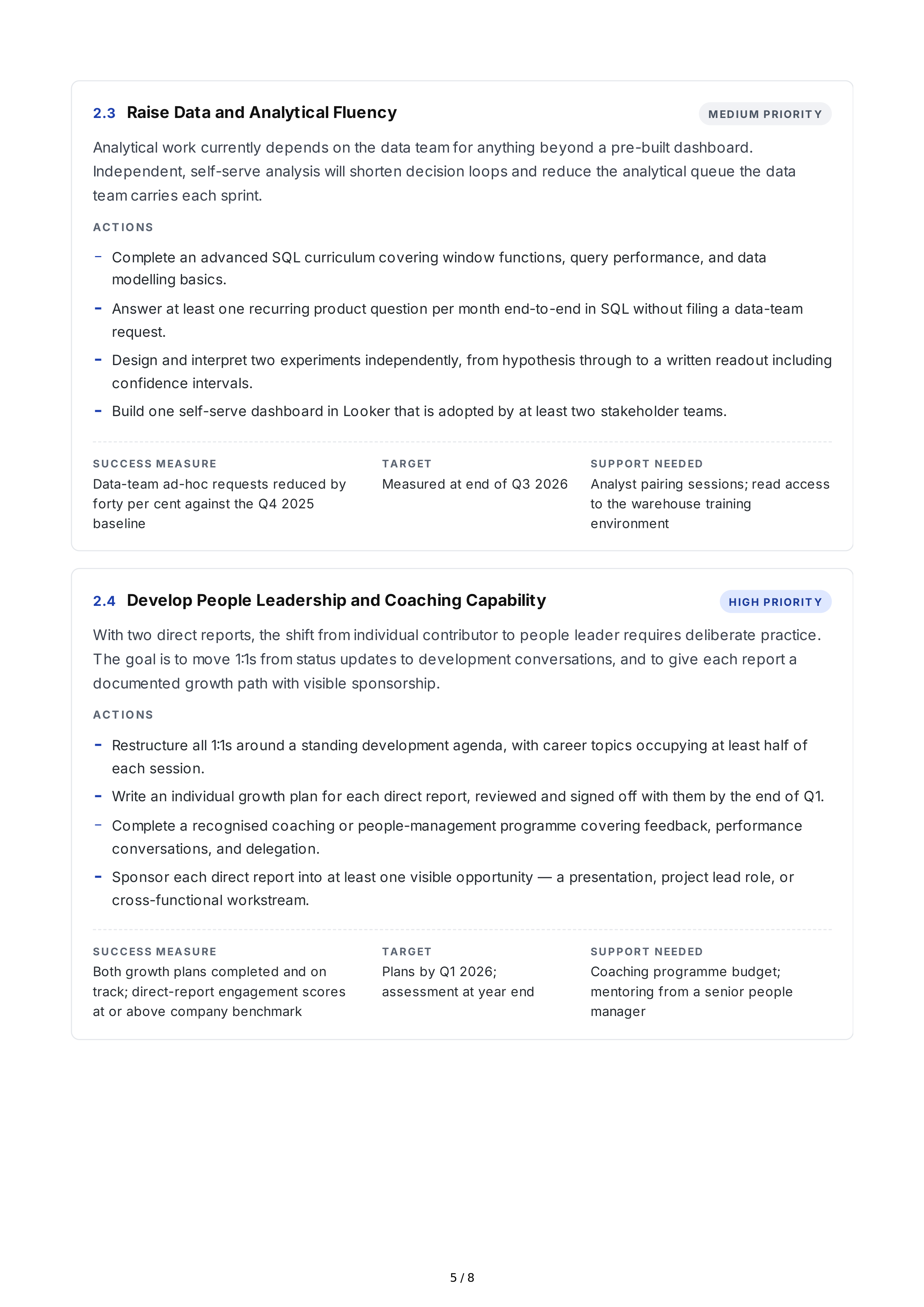
2.3
Raise
Data
and
Analytical
Fluency
MED IUM
PRIORIT Y
Analytical
work
currently
depends
on
the
data
team
for
anything
beyond
a
pre
-
built
dashboard
.
Independent
,
self
-
serve
analysis
will
shorten
decision
loops
and
reduce
the
analytical
queue
the
data
team
carries
each
sprint
.
ACT IO NS
SU C C ESS
M EASU RE
Data
-
team
ad
-
hoc
requests
reduced
by
forty
per
cent
against
the
Q
4 2025
baseline
TARGET
Measured
at
end
of
Q
3 2026
SU PPORT
NEED ED
Analyst
pairing
sessions
;
read
access
to
the
warehouse
training
environment
2.4
Develop
People
Leadership
and
Coaching
Capability
HIGH
PRIORIT Y
With
two
direct
reports
,
the
shift
from
individual
contributor
to
people
leader
requires
deliberate
practice
.
The
goal
is
to
move
1:1
s
from
status
updates
to
development
conversations
,
and
to
give
each
report
a
documented
growth
path
with
visible
sponsorship
.
ACT IO NS
SU C C ESS
M EASU RE
Both
growth
plans
completed
and
on
track
;
direct
-
report
engagement
scores
at
or
above
company
benchmark
TARGET
Plans
by
Q
1 2026;
assessment
at
year
end
SU PPORT
NEED ED
Coaching
programme
budget
;
mentoring
from
a
senior
people
manager
Complete
an
advanced
SQL
curriculum
covering
window
functions
,
query
performance
,
and
data
modelling
basics
.
Answer
at
least
one
recurring
product
question
per
month
end
-
to
-
end
in
SQL
without
filing
a
data
-
team
request
.
Design
and
interpret
two
experiments
independently
,
from
hypothesis
through
to
a
written
readout
including
confidence
intervals
.
Build
one
self
-
serve
dashboard
in
Looker
that
is
adopted
by
at
least
two
stakeholder
teams
.
Restructure
all
1:1
s
around
a
standing
development
agenda
,
with
career
topics
occupying
at
least
half
of
each
session
.
Write
an
individual
growth
plan
for
each
direct
report
,
reviewed
and
signed
off
with
them
by
the
end
of
Q
1.
Complete
a
recognised
coaching
or
people
-
management
programme
covering
feedback
,
performance
conversations
,
and
delegation
.
Sponsor
each
direct
report
into
at
least
one
visible
opportunity
—
a
presentation
,
project
lead
role
,
or
cross
-
functional
workstream
.
5 / 8
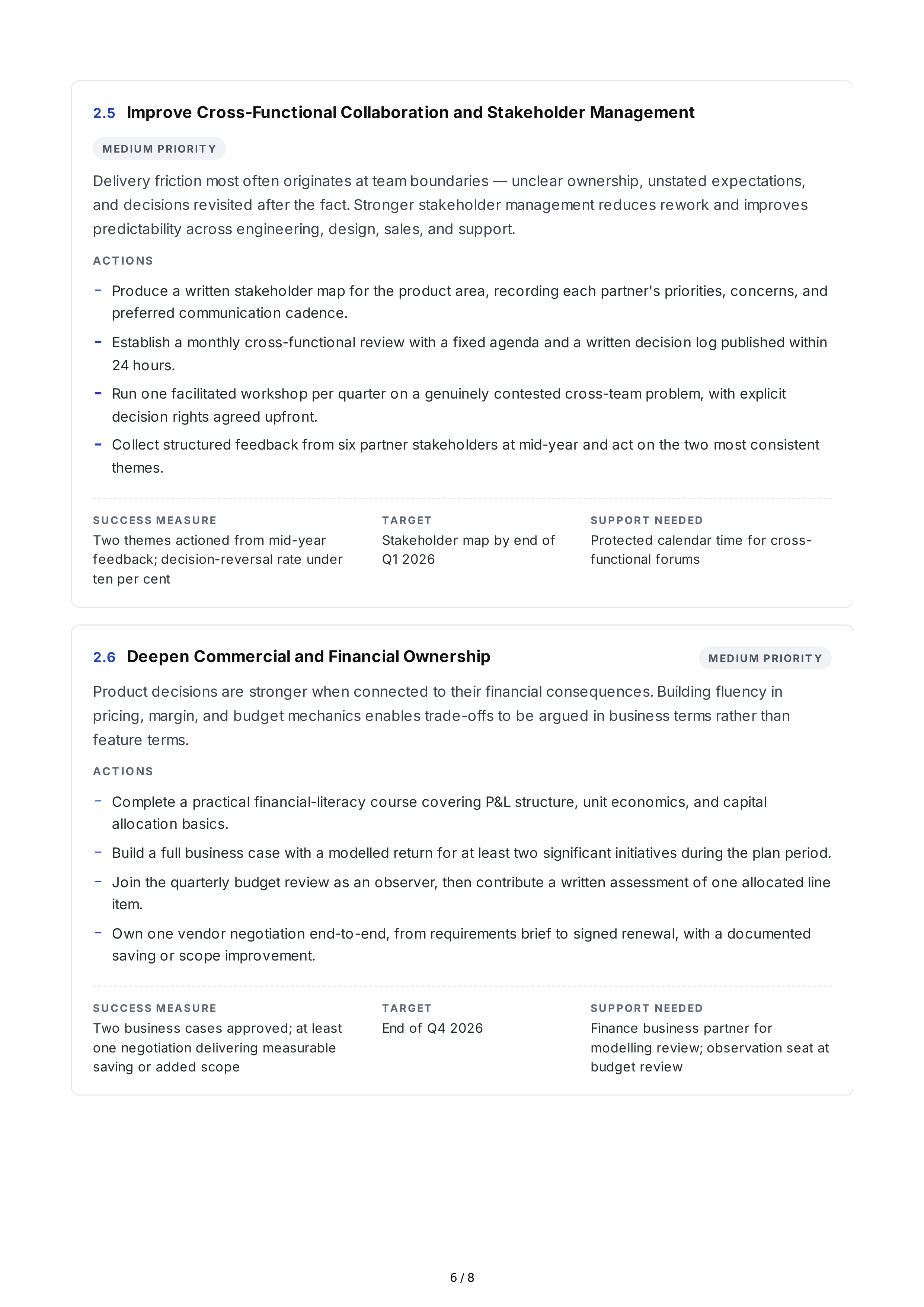
2.5
Improve
Cross
-
Functional
Collaboration
and
Stakeholder
Management
MED IUM
PRIORIT Y
Delivery
friction
most
often
originates
at
team
boundaries
—
unclear
ownership
,
unstated
expectations
,
and
decisions
revisited
after
the
fact
.
Stronger
stakeholder
management
reduces
rework
and
improves
predictability
across
engineering
,
design
,
sales
,
and
support
.
ACT IO NS
SU C C ESS
M EASU RE
Two
themes
actioned
from
mid
-
year
feedback
;
decision
-
reversal
rate
under
ten
per
cent
TARGET
Stakeholder
map
by
end
of
Q
1 2026
SU PPORT
NEED ED
Protected
calendar
time
for
cross
-
functional
forums
2.6
Deepen
Commercial
and
Financial
Ownership
MED IUM
PRIORIT Y
Product
decisions
are
stronger
when
connected
to
their
financial
consequences
.
Building
fluency
in
pricing
,
margin
,
and
budget
mechanics
enables
trade
-
offs
to
be
argued
in
business
terms
rather
than
feature
terms
.
ACT IO NS
SU C C ESS
M EASU RE
Two
business
cases
approved
;
at
least
one
negotiation
delivering
measurable
saving
or
added
scope
TARGET
End
of
Q
4 2026
SU PPORT
NEED ED
Finance
business
partner
for
modelling
review
;
observation
seat
at
budget
review
Produce
a
written
stakeholder
map
for
the
product
area
,
recording
each
partner
'
s
priorities
,
concerns
,
and
preferred
communication
cadence
.
Establish
a
monthly
cross
-
functional
review
with
a
fixed
agenda
and
a
written
decision
log
published
within
24
hours
.
Run
one
facilitated
workshop
per
quarter
on
a
genuinely
contested
cross
-
team
problem
,
with
explicit
decision
rights
agreed
upfront
.
Collect
structured
feedback
from
six
partner
stakeholders
at
mid
-
year
and
act
on
the
two
most
consistent
themes
.
Complete
a
practical
financial
-
literacy
course
covering
P
&
L
structure
,
unit
economics
,
and
capital
allocation
basics
.
Build
a
full
business
case
with
a
modelled
return
for
at
least
two
significant
initiatives
during
the
plan
period
.
Join
the
quarterly
budget
review
as
an
observer
,
then
contribute
a
written
assessment
of
one
allocated
line
item
.
Own
one
vendor
negotiation
end
-
to
-
end
,
from
requirements
brief
to
signed
renewal
,
with
a
documented
saving
or
scope
improvement
.
6 / 8
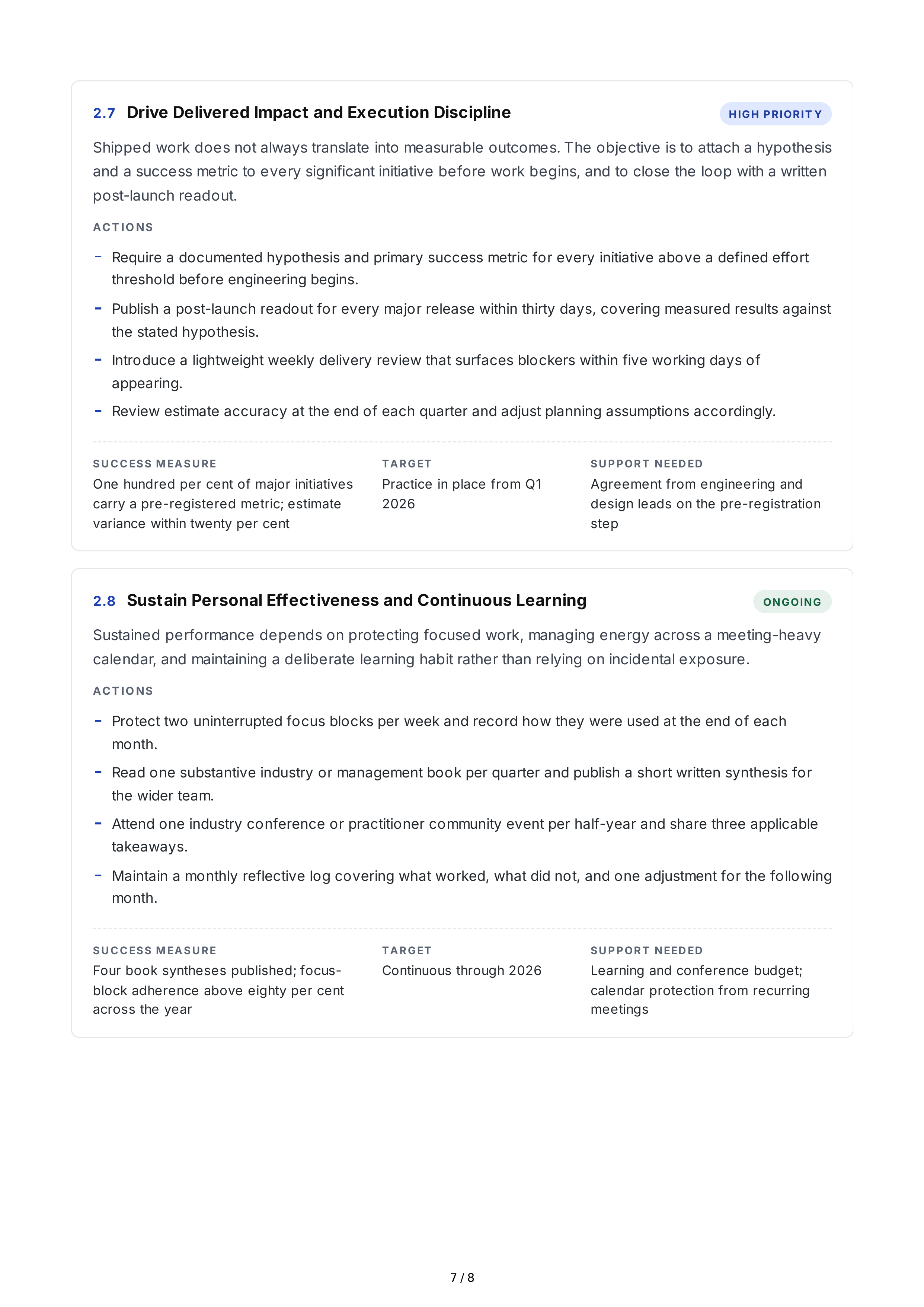
2.7
Drive
Delivered
Impact
and
Execution
Discipline
HIGH
PRIORIT Y
Shipped
work
does
not
always
translate
into
measurable
outcomes
.
The
objective
is
to
attach
a
hypothesis
and
a
success
metric
to
every
significant
initiative
before
work
begins
,
and
to
close
the
loop
with
a
written
post
-
launch
readout
.
ACT IO NS
SU C C ESS
M EASU RE
One
hundred
per
cent
of
major
initiatives
carry
a
pre
-
registered
metric
;
estimate
variance
within
twenty
per
cent
TARGET
Practice
in
place
from
Q
1
2026
SU PPORT
NEED ED
Agreement
from
engineering
and
design
leads
on
the
pre
-
registration
step
2.8
Sustain
Personal
Effectiveness
and
Continuous
Learning
ONGOING
Sustained
performance
depends
on
protecting
focused
work
,
managing
energy
across
a
meeting
-
heavy
calendar
,
and
maintaining
a
deliberate
learning
habit
rather
than
relying
on
incidental
exposure
.
ACT IO NS
SU C C ESS
M EASU RE
Four
book
syntheses
published
;
focus
-
block
adherence
above
eighty
per
cent
across
the
year
TARGET
Continuous
through
2026
SU PPORT
NEED ED
Learning
and
conference
budget
;
calendar
protection
from
recurring
meetings
Require
a
documented
hypothesis
and
primary
success
metric
for
every
initiative
above
a
defined
effort
threshold
before
engineering
begins
.
Publish
a
post
-
launch
readout
for
every
major
release
within
thirty
days
,
covering
measured
results
against
the
stated
hypothesis
.
Introduce
a
lightweight
weekly
delivery
review
that
surfaces
blockers
within
five
working
days
of
appearing
.
Review
estimate
accuracy
at
the
end
of
each
quarter
and
adjust
planning
assumptions
accordingly
.
Protect
two
uninterrupted
focus
blocks
per
week
and
record
how
they
were
used
at
the
end
of
each
month
.
Read
one
substantive
industry
or
management
book
per
quarter
and
publish
a
short
written
synthesis
for
the
wider
team
.
Attend
one
industry
conference
or
practitioner
community
event
per
half
-
year
and
share
three
applicable
takeaways
.
Maintain
a
monthly
reflective
log
covering
what
worked
,
what
did
not
,
and
one
adjustment
for
the
following
month
.
7 / 8
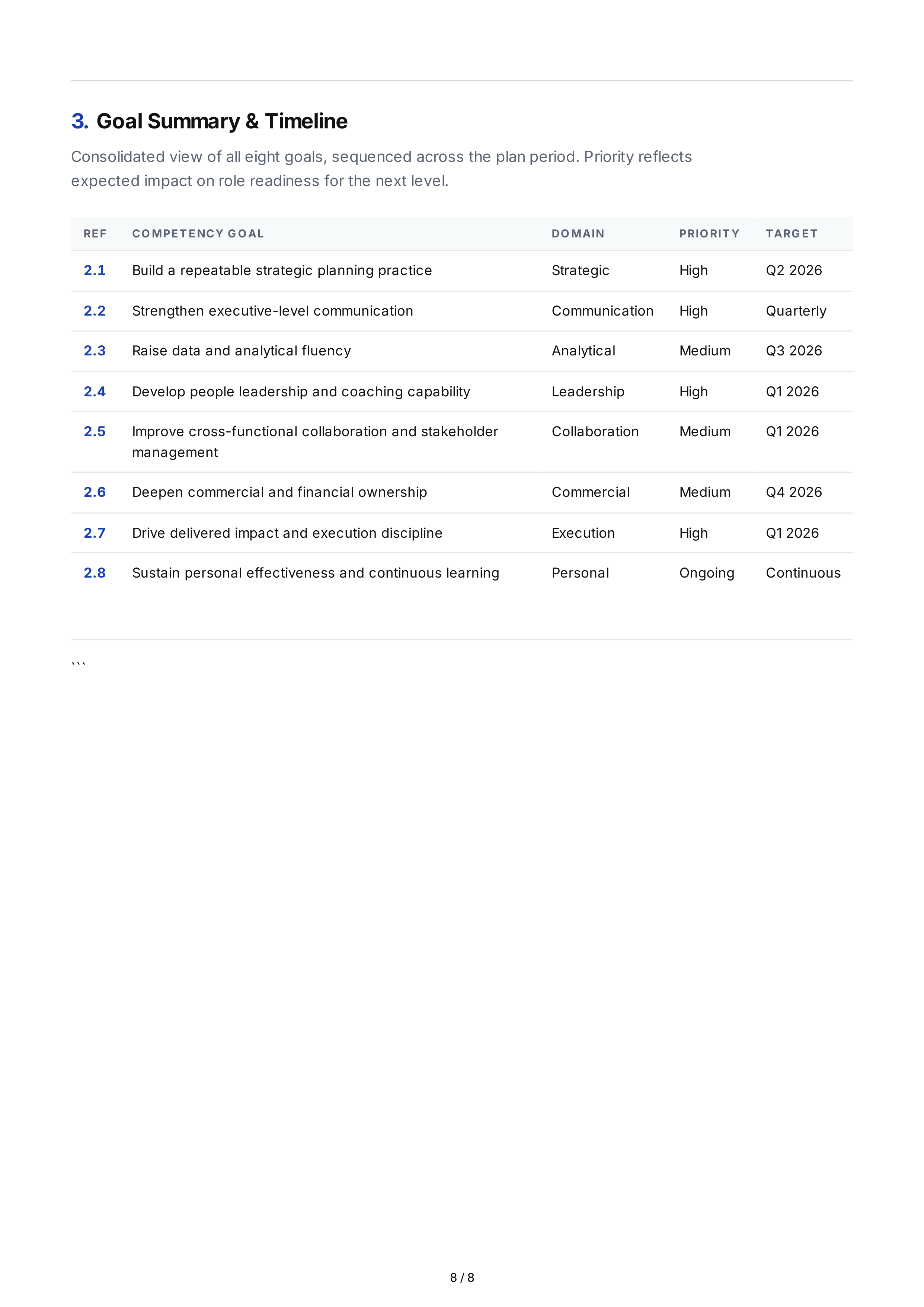
3.
Goal
Summary
&
Timeline
Consolidated
view
of
all
eight
goals
,
sequenced
across
the
plan
period
.
Priority
reflects
expected
impact
on
role
readiness
for
the
next
level
.
REF
CO MPET ENCY
G O AL
DO MAIN
PRIO RIT Y
TARG ET
2.1
Build
a
repeatable
strategic
planning
practice
Strategic
High
Q
2 2026
2.2
Strengthen
executive
-
level
communication
Communication
High
Quarterly
2.3
Raise
data
and
analytical
fluency
Analytical
Medium
Q
3 2026
2.4
Develop
people
leadership
and
coaching
capability
Leadership
High
Q
1 2026
2.5
Improve
cross
-
functional
collaboration
and
stakeholder
management
Collaboration
Medium
Q
1 2026
2.6
Deepen
commercial
and
financial
ownership
Commercial
Medium
Q
4 2026
2.7
Drive
delivered
impact
and
execution
discipline
Execution
High
Q
1 2026
2.8
Sustain
personal
effectiveness
and
continuous
learning
Personal
Ongoing
Continuous
```
8 / 8