Delegation
Professional
Goals
1 / 7
01
Skills
for
Effective
Delegation
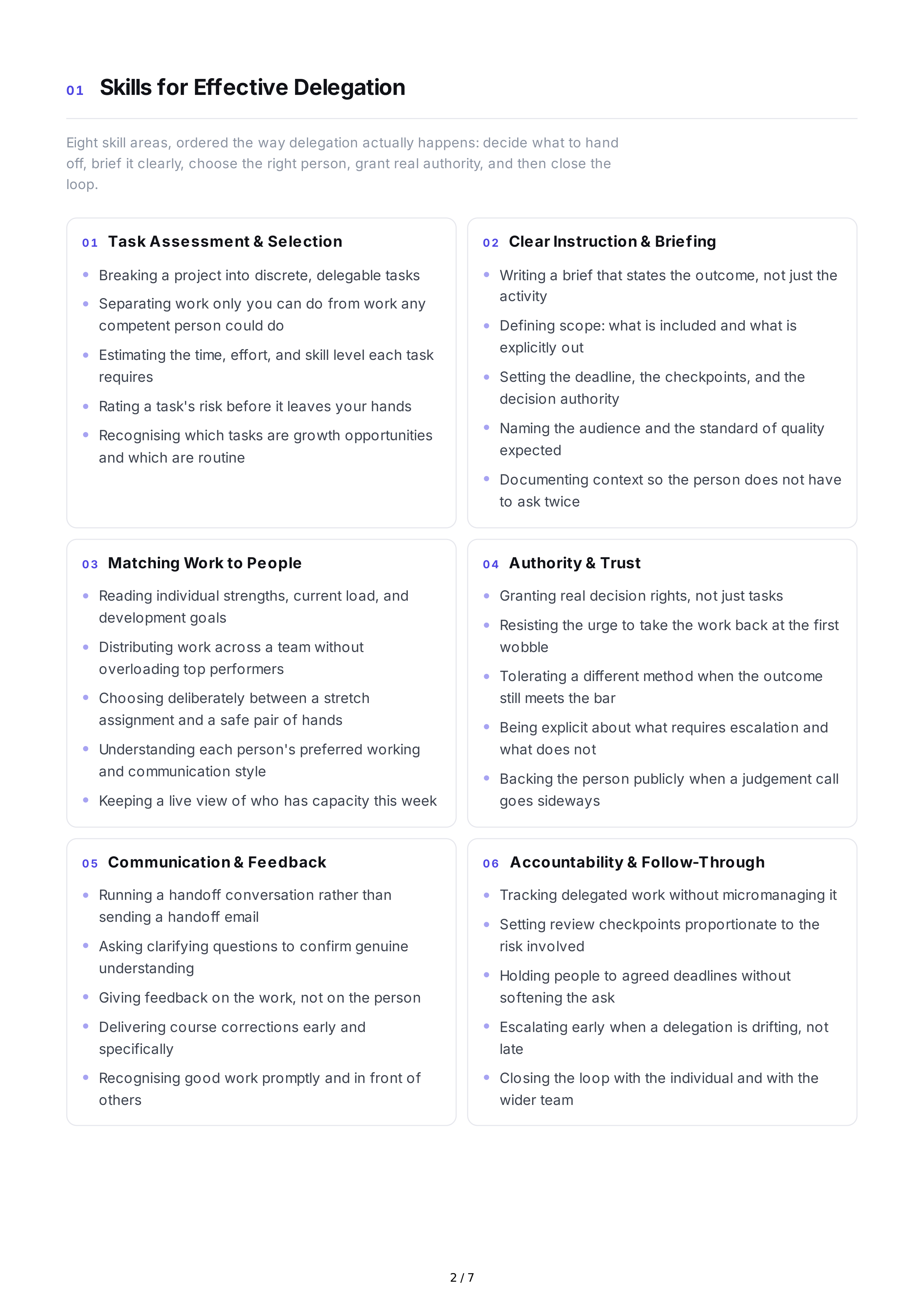
Eight
skill
areas
,
ordered
the
way
delegation
actually
happens
:
decide
what
to
hand
off
,
brief
it
clearly
,
choose
the
right
person
,
grant
real
authority
,
and
then
close
the
loop
.
0 1
Task
Assessment
&
Selection
0 2
Clear
Instruction
&
Briefing
0 3
Matching
Work
to
People
0 4
Authority
&
Trust
0 5
Communication
&
Feedback
0 6
Accountability
&
Follow
-
Through
Breaking
a
project
into
discrete
,
delegable
tasks
Separating
work
only
you
can
do
from
work
any
competent
person
could
do
Estimating
the
time
,
effort
,
and
skill
level
each
task
requires
Rating
a
task
'
s
risk
before
it
leaves
your
hands
Recognising
which
tasks
are
growth
opportunities
and
which
are
routine
Writing
a
brief
that
states
the
outcome
,
not
just
the
activity
Defining
scope
:
what
is
included
and
what
is
explicitly
out
Setting
the
deadline
,
the
checkpoints
,
and
the
decision
authority
Naming
the
audience
and
the
standard
of
quality
expected
Documenting
context
so
the
person
does
not
have
to
ask
twice
Reading
individual
strengths
,
current
load
,
and
development
goals
Distributing
work
across
a
team
without
overloading
top
performers
Choosing
deliberately
between
a
stretch
assignment
and
a
safe
pair
of
hands
Understanding
each
person
'
s
preferred
working
and
communication
style
Keeping
a
live
view
of
who
has
capacity
this
week
Granting
real
decision
rights
,
not
just
tasks
Resisting
the
urge
to
take
the
work
back
at
the
first
wobble
Tolerating
a
different
method
when
the
outcome
still
meets
the
bar
Being
explicit
about
what
requires
escalation
and
what
does
not
Backing
the
person
publicly
when
a
judgement
call
goes
sideways
Running
a
handoff
conversation
rather
than
sending
a
handoff
email
Asking
clarifying
questions
to
confirm
genuine
understanding
Giving
feedback
on
the
work
,
not
on
the
person
Delivering
course
corrections
early
and
specifically
Recognising
good
work
promptly
and
in
front
of
others
Tracking
delegated
work
without
micromanaging
it
Setting
review
checkpoints
proportionate
to
the
risk
involved
Holding
people
to
agreed
deadlines
without
softening
the
ask
Escalating
early
when
a
delegation
is
drifting
,
not
late
Closing
the
loop
with
the
individual
and
with
the
wider
team
2 / 7
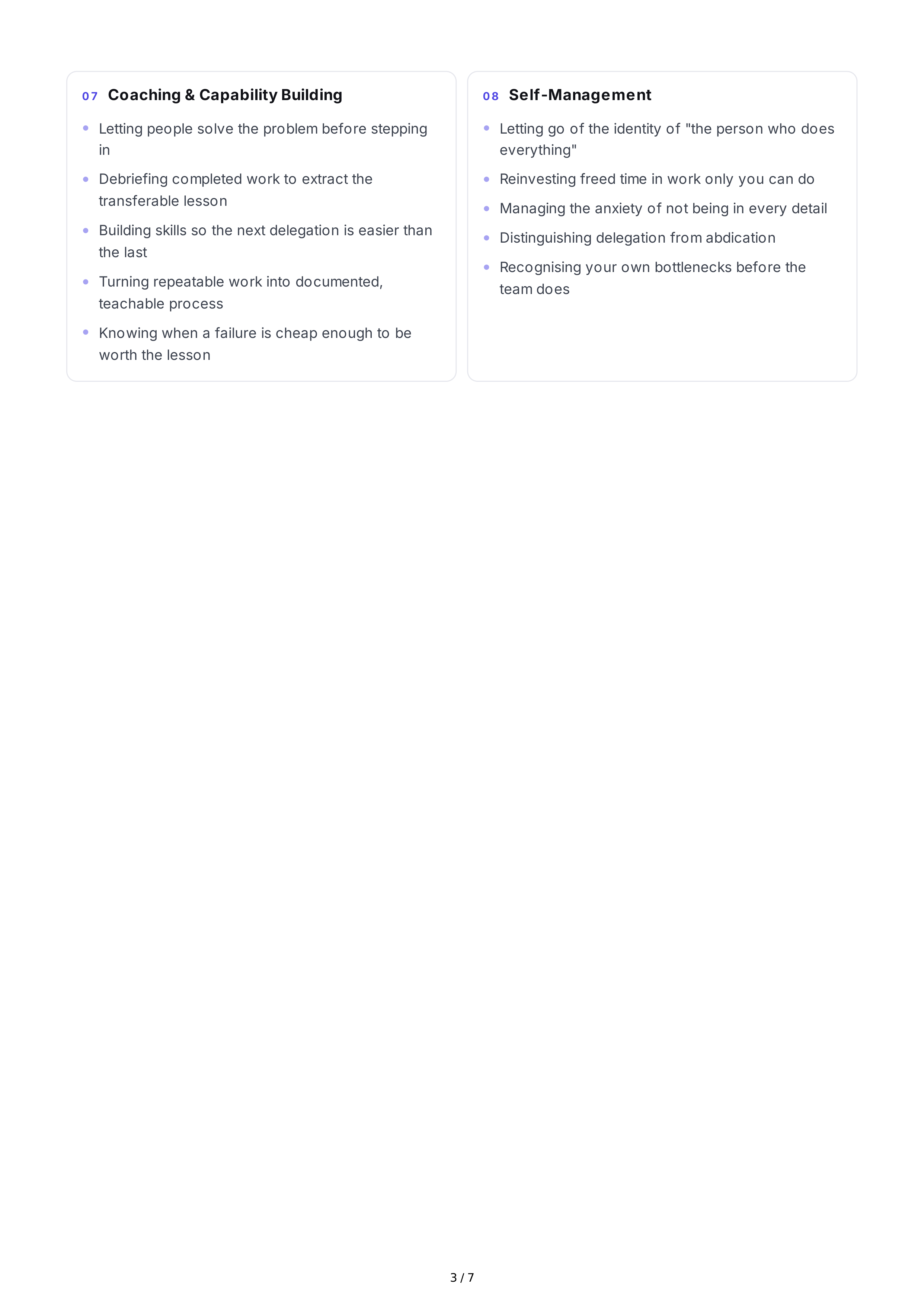
0 7
Coaching
&
Capability
Building
0 8
Self
-
Management
Letting
people
solve
the
problem
before
stepping
in
Debriefing
completed
work
to
extract
the
transferable
lesson
Building
skills
so
the
next
delegation
is
easier
than
the
last
Turning
repeatable
work
into
documented
,
teachable
process
Knowing
when
a
failure
is
cheap
enough
to
be
worth
the
lesson
Letting
go
of
the
identity
of
"
the
person
who
does
everything
"
Reinvesting
freed
time
in
work
only
you
can
do
Managing
the
anxiety
of
not
being
in
every
detail
Distinguishing
delegation
from
abdication
Recognising
your
own
bottlenecks
before
the
team
does
3 / 7
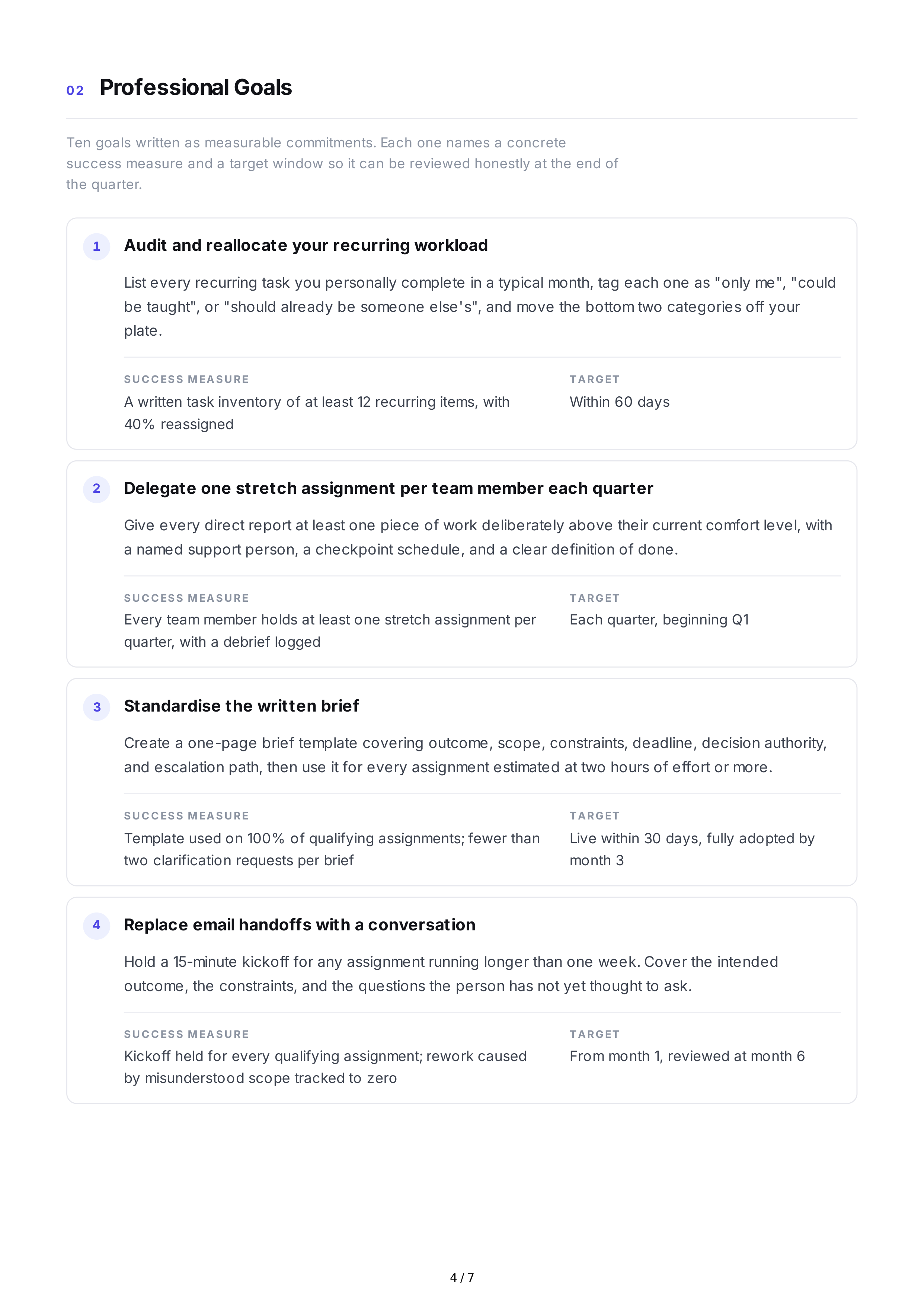
02
Professional
Goals
Ten
goals
written
as
measurable
commitments
.
Each
one
names
a
concrete
success
measure
and
a
target
window
so
it
can
be
reviewed
honestly
at
the
end
of
the
quarter
.
1
Audit
and
reallocate
your
recurring
workload
List
every
recurring
task
you
personally
complete
in
a
typical
month
,
tag
each
one
as
"
only
me
", "
could
be
taught
",
or
"
should
already
be
someone
else
'
s
",
and
move
the
bottom
two
categories
off
your
plate
.
SU C C ESS
M EA SU RE
A
written
task
inventory
of
at
least
12
recurring
items
,
with
40%
reassigned
TA RG ET
Within
60
days
2
Delegate
one
stretch
assignment
per
team
member
each
quarter
Give
every
direct
report
at
least
one
piece
of
work
deliberately
above
their
current
comfort
level
,
with
a
named
support
person
,
a
checkpoint
schedule
,
and
a
clear
definition
of
done
.
SU C C ESS
M EA SU RE
Every
team
member
holds
at
least
one
stretch
assignment
per
quarter
,
with
a
debrief
logged
TA RG ET
Each
quarter
,
beginning
Q
1
3
Standardise
the
written
brief
Create
a
one
-
page
brief
template
covering
outcome
,
scope
,
constraints
,
deadline
,
decision
authority
,
and
escalation
path
,
then
use
it
for
every
assignment
estimated
at
two
hours
of
effort
or
more
.
SU C C ESS
M EA SU RE
Template
used
on
100%
of
qualifying
assignments
;
fewer
than
two
clarification
requests
per
brief
TA RG ET
Live
within
30
days
,
fully
adopted
by
month
3
4
Replace
email
handoffs
with
a
conversation
Hold
a
15-
minute
kickoff
for
any
assignment
running
longer
than
one
week
.
Cover
the
intended
outcome
,
the
constraints
,
and
the
questions
the
person
has
not
yet
thought
to
ask
.
SU C C ESS
M EA SU RE
Kickoff
held
for
every
qualifying
assignment
;
rework
caused
by
misunderstood
scope
tracked
to
zero
TA RG ET
From
month
1,
reviewed
at
month
6
4 / 7
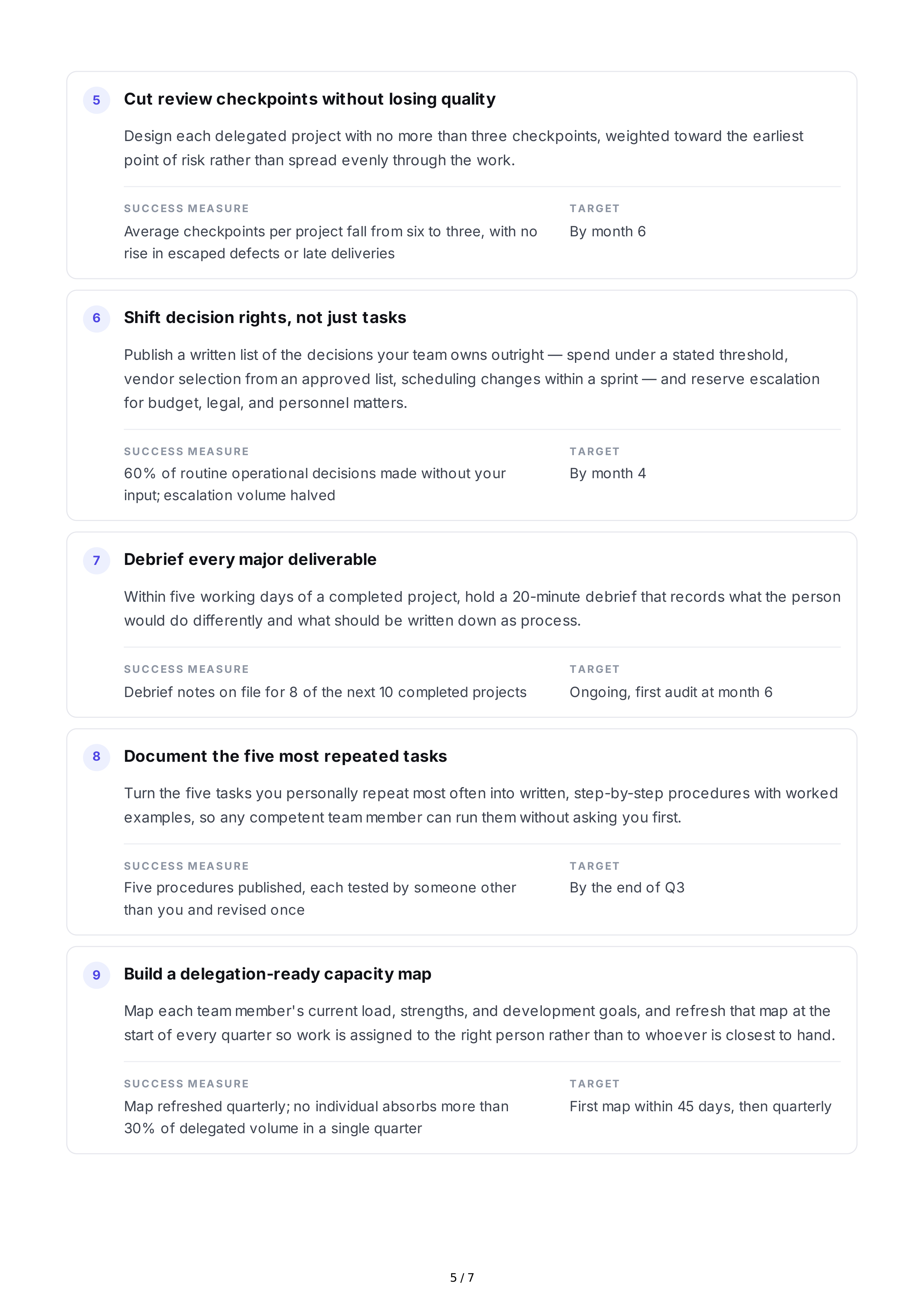
5
Cut
review
checkpoints
without
losing
quality
Design
each
delegated
project
with
no
more
than
three
checkpoints
,
weighted
toward
the
earliest
point
of
risk
rather
than
spread
evenly
through
the
work
.
SU C C ESS
M EA SU RE
Average
checkpoints
per
project
fall
from
six
to
three
,
with
no
rise
in
escaped
defects
or
late
deliveries
TA RG ET
By
month
6
6
Shift
decision
rights
,
not
just
tasks
Publish
a
written
list
of
the
decisions
your
team
owns
outright
—
spend
under
a
stated
threshold
,
vendor
selection
from
an
approved
list
,
scheduling
changes
within
a
sprint
—
and
reserve
escalation
for
budget
,
legal
,
and
personnel
matters
.
SU C C ESS
M EA SU RE
60%
of
routine
operational
decisions
made
without
your
input
;
escalation
volume
halved
TA RG ET
By
month
4
7
Debrief
every
major
deliverable
Within
five
working
days
of
a
completed
project
,
hold
a
20-
minute
debrief
that
records
what
the
person
would
do
differently
and
what
should
be
written
down
as
process
.
SU C C ESS
M EA SU RE
Debrief
notes
on
file
for
8
of
the
next
10
completed
projects
TA RG ET
Ongoing
,
first
audit
at
month
6
8
Document
the
five
most
repeated
tasks
Turn
the
five
tasks
you
personally
repeat
most
often
into
written
,
step
-
by
-
step
procedures
with
worked
examples
,
so
any
competent
team
member
can
run
them
without
asking
you
first
.
SU C C ESS
M EA SU RE
Five
procedures
published
,
each
tested
by
someone
other
than
you
and
revised
once
TA RG ET
By
the
end
of
Q
3
9
Build
a
delegation
-
ready
capacity
map
Map
each
team
member
'
s
current
load
,
strengths
,
and
development
goals
,
and
refresh
that
map
at
the
start
of
every
quarter
so
work
is
assigned
to
the
right
person
rather
than
to
whoever
is
closest
to
hand
.
SU C C ESS
M EA SU RE
Map
refreshed
quarterly
;
no
individual
absorbs
more
than
30%
of
delegated
volume
in
a
single
quarter
TA RG ET
First
map
within
45
days
,
then
quarterly
5 / 7
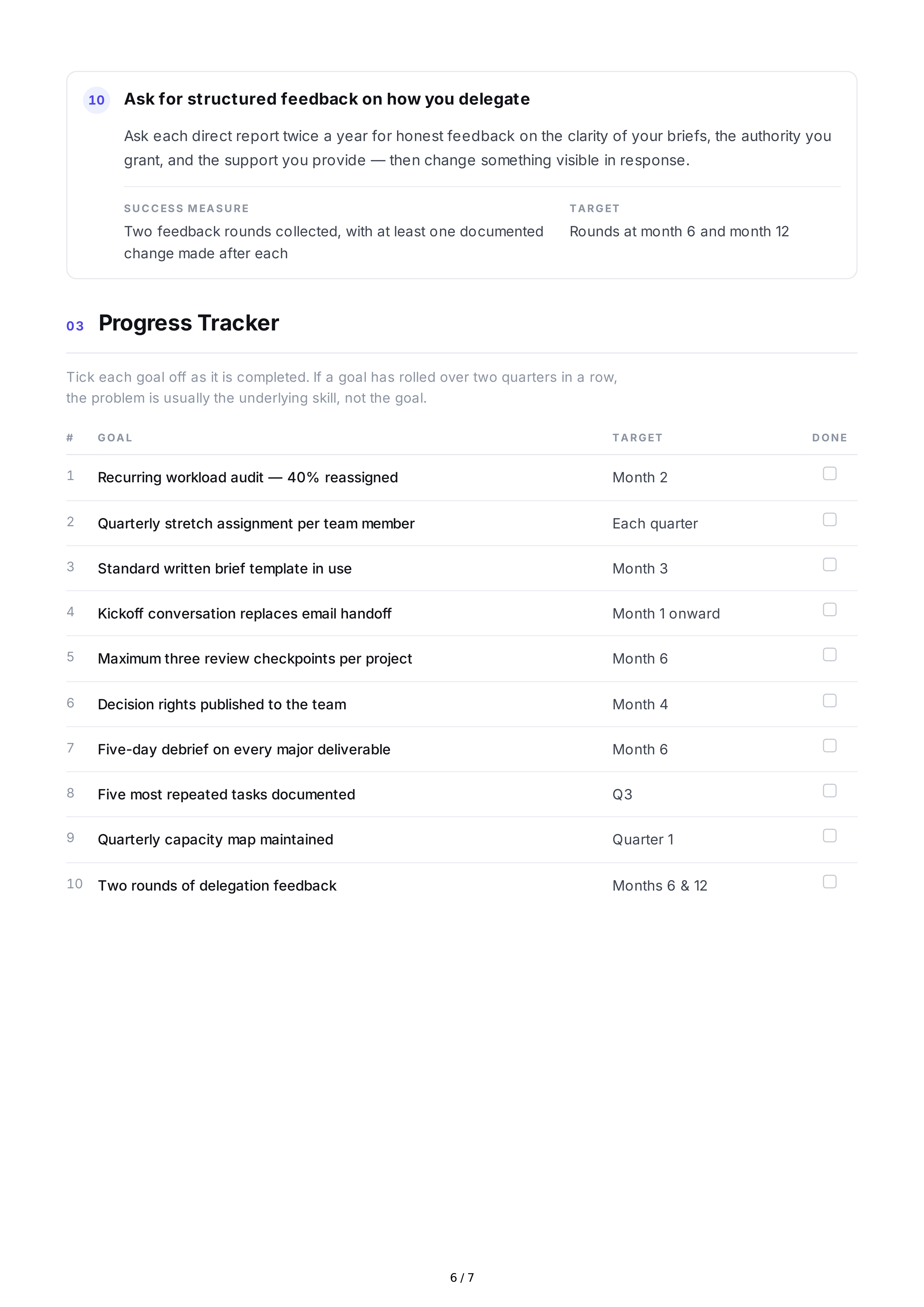
10
Ask
for
structured
feedback
on
how
you
delegate
Ask
each
direct
report
twice
a
year
for
honest
feedback
on
the
clarity
of
your
briefs
,
the
authority
you
grant
,
and
the
support
you
provide
—
then
change
something
visible
in
response
.
SU C C ESS
M EA SU RE
Two
feedback
rounds
collected
,
with
at
least
one
documented
change
made
after
each
TA RG ET
Rounds
at
month
6
and
month
12
03
Progress
Tracker
Tick
each
goal
off
as
it
is
completed
.
If
a
goal
has
rolled
over
two
quarters
in
a
row
,
the
problem
is
usually
the
underlying
skill
,
not
the
goal
.
#
GOA L
TA RG ET
D ONE
1
Recurring
workload
audit
— 40%
reassigned
Month
2
2
Quarterly
stretch
assignment
per
team
member
Each
quarter
3
Standard
written
brief
template
in
use
Month
3
4
Kickoff
conversation
replaces
email
handoff
Month
1
onward
5
Maximum
three
review
checkpoints
per
project
Month
6
6
Decision
rights
published
to
the
team
Month
4
7
Five
-
day
debrief
on
every
major
deliverable
Month
6
8
Five
most
repeated
tasks
documented
Q
3
9
Quarterly
capacity
map
maintained
Quarter
1
10
Two
rounds
of
delegation
feedback
Months
6 & 12
6 / 7
04
Review
Cadence
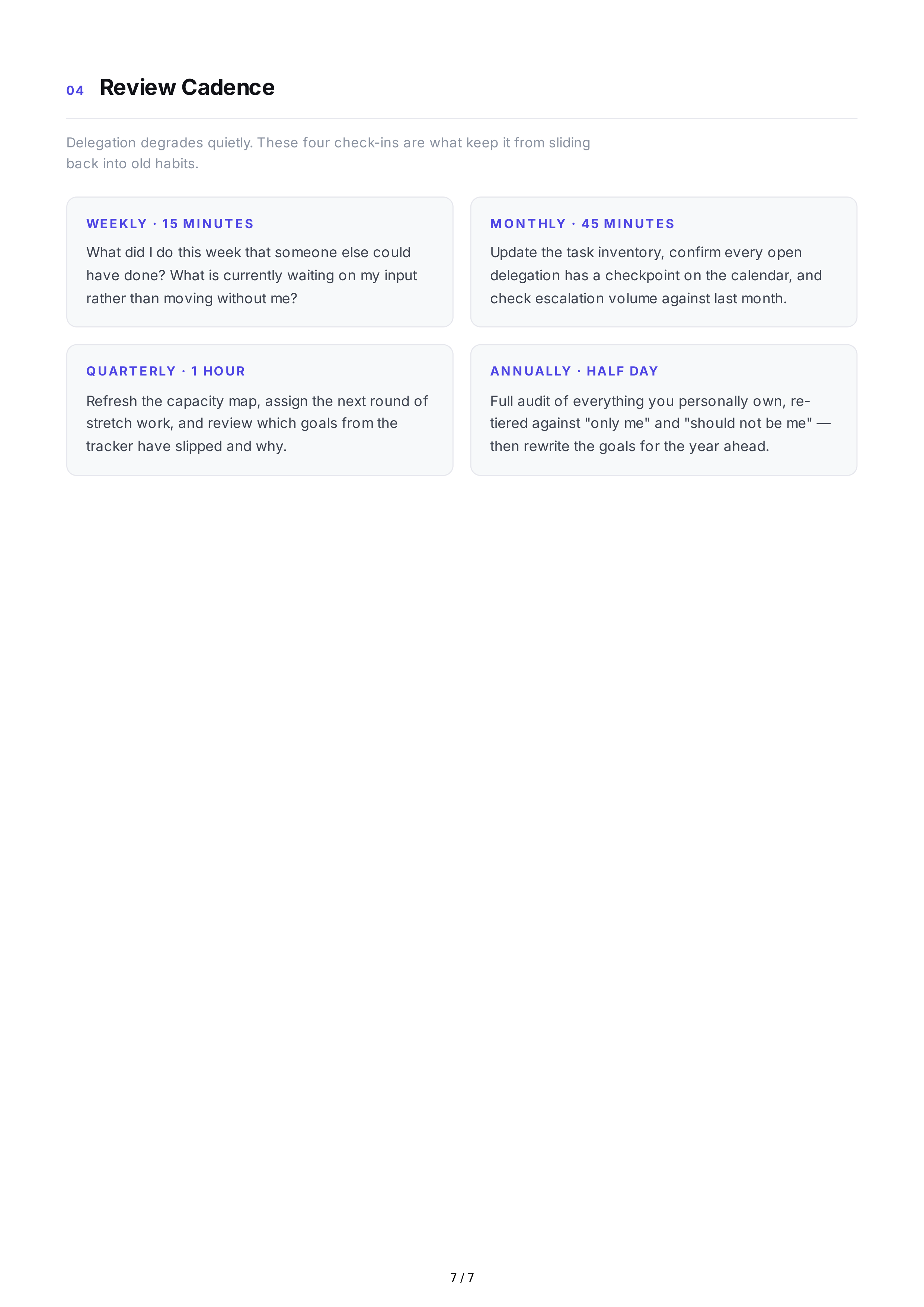
Delegation
degrades
quietly
.
These
four
check
-
ins
are
what
keep
it
from
sliding
back
into
old
habits
.
WE E KLY
· 1 5
M I N UT E S
What
did
I
do
this
week
that
someone
else
could
have
done
?
What
is
currently
waiting
on
my
input
rather
than
moving
without
me
?
M O N T HLY
· 45
M I N UT E S
Update
the
task
inventory
,
confirm
every
open
delegation
has
a
checkpoint
on
the
calendar
,
and
check
escalation
volume
against
last
month
.
Q UART E RLY
· 1
HO UR
Refresh
the
capacity
map
,
assign
the
next
round
of
stretch
work
,
and
review
which
goals
from
the
tracker
have
slipped
and
why
.
AN N UALLY
·
HALF
DAY
Full
audit
of
everything
you
personally
own
,
re
-
tiered
against
"
only
me
"
and
"
should
not
be
me
" —
then
rewrite
the
goals
for
the
year
ahead
.
7 / 7