Public
Speaking
—
Skills
&
Professional
Goals
1 / 6
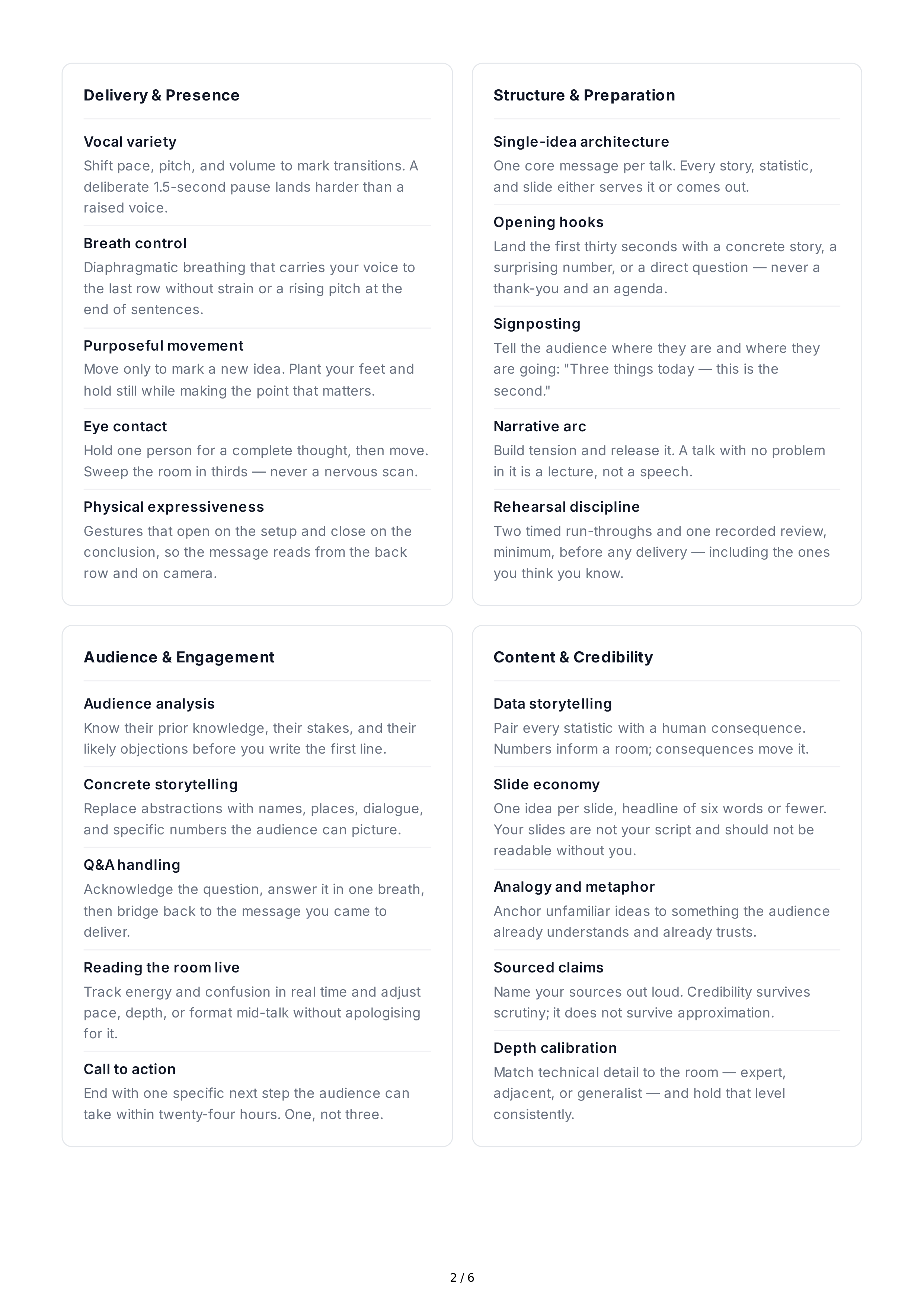
Delivery
&
Presence
Vocal
variety
Shift
pace
,
pitch
,
and
volume
to
mark
transitions
.
A
deliberate
1.5-
second
pause
lands
harder
than
a
raised
voice
.
Breath
control
Diaphragmatic
breathing
that
carries
your
voice
to
the
last
row
without
strain
or
a
rising
pitch
at
the
end
of
sentences
.
Purposeful
movement
Move
only
to
mark
a
new
idea
.
Plant
your
feet
and
hold
still
while
making
the
point
that
matters
.
Eye
contact
Hold
one
person
for
a
complete
thought
,
then
move
.
Sweep
the
room
in
thirds
—
never
a
nervous
scan
.
Physical
expressiveness
Gestures
that
open
on
the
setup
and
close
on
the
conclusion
,
so
the
message
reads
from
the
back
row
and
on
camera
.
Structure
&
Preparation
Single
-
idea
architecture
One
core
message
per
talk
.
Every
story
,
statistic
,
and
slide
either
serves
it
or
comes
out
.
Opening
hooks
Land
the
first
thirty
seconds
with
a
concrete
story
,
a
surprising
number
,
or
a
direct
question
—
never
a
thank
-
you
and
an
agenda
.
Signposting
Tell
the
audience
where
they
are
and
where
they
are
going
: "
Three
things
today
—
this
is
the
second
."
Narrative
arc
Build
tension
and
release
it
.
A
talk
with
no
problem
in
it
is
a
lecture
,
not
a
speech
.
Rehearsal
discipline
Two
timed
run
-
throughs
and
one
recorded
review
,
minimum
,
before
any
delivery
—
including
the
ones
you
think
you
know
.
Audience
&
Engagement
Audience
analysis
Know
their
prior
knowledge
,
their
stakes
,
and
their
likely
objections
before
you
write
the
first
line
.
Concrete
storytelling
Replace
abstractions
with
names
,
places
,
dialogue
,
and
specific
numbers
the
audience
can
picture
.
Q
&
A
handling
Acknowledge
the
question
,
answer
it
in
one
breath
,
then
bridge
back
to
the
message
you
came
to
deliver
.
Reading
the
room
live
Track
energy
and
confusion
in
real
time
and
adjust
pace
,
depth
,
or
format
mid
-
talk
without
apologising
for
it
.
Call
to
action
End
with
one
specific
next
step
the
audience
can
take
within
twenty
-
four
hours
.
One
,
not
three
.
Content
&
Credibility
Data
storytelling
Pair
every
statistic
with
a
human
consequence
.
Numbers
inform
a
room
;
consequences
move
it
.
Slide
economy
One
idea
per
slide
,
headline
of
six
words
or
fewer
.
Your
slides
are
not
your
script
and
should
not
be
readable
without
you
.
Analogy
and
metaphor
Anchor
unfamiliar
ideas
to
something
the
audience
already
understands
and
already
trusts
.
Sourced
claims
Name
your
sources
out
loud
.
Credibility
survives
scrutiny
;
it
does
not
survive
approximation
.
Depth
calibration
Match
technical
detail
to
the
room
—
expert
,
adjacent
,
or
generalist
—
and
hold
that
level
consistently
.
2 / 6
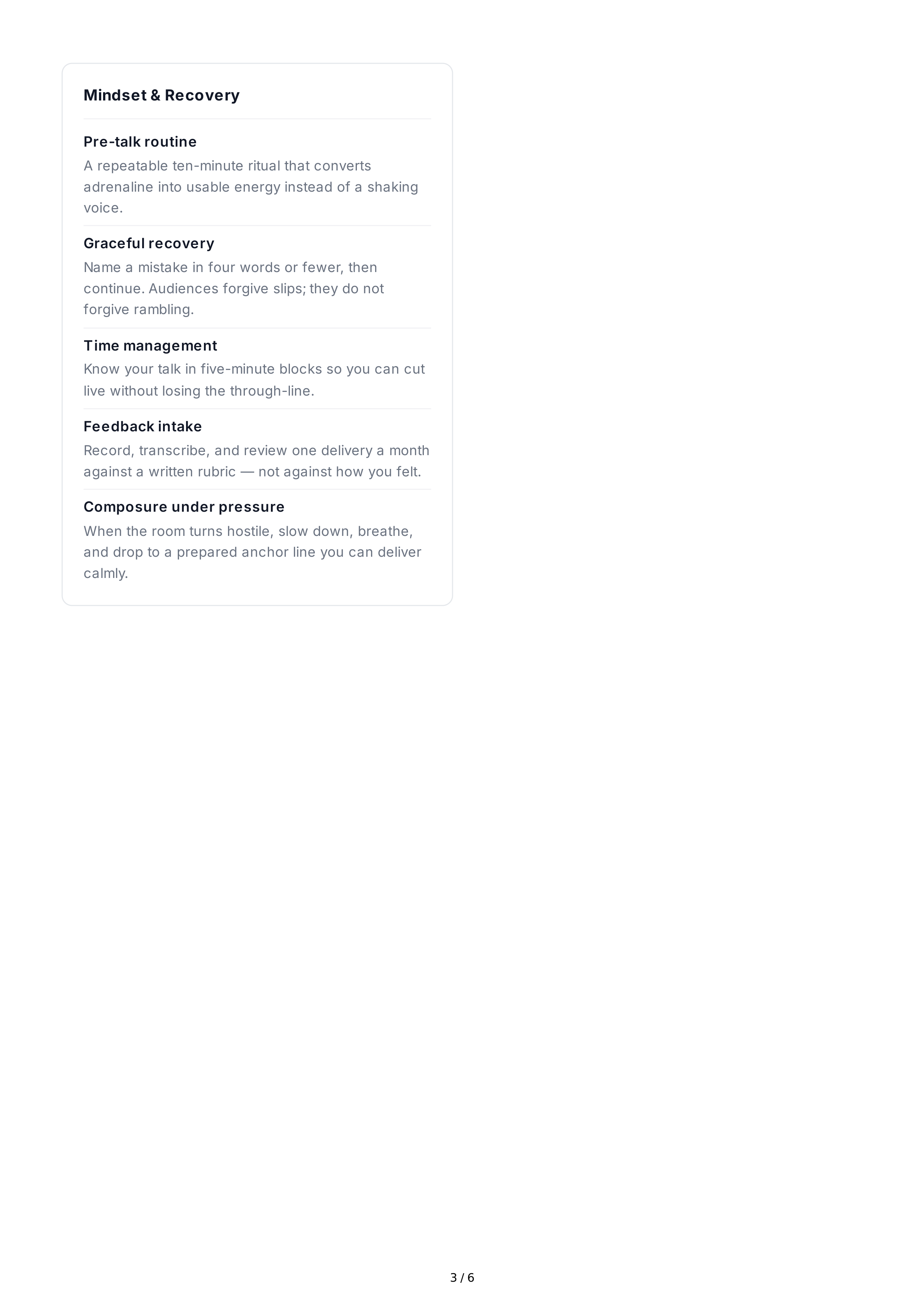
Mindset
&
Recovery
Pre
-
talk
routine
A
repeatable
ten
-
minute
ritual
that
converts
adrenaline
into
usable
energy
instead
of
a
shaking
voice
.
Graceful
recovery
Name
a
mistake
in
four
words
or
fewer
,
then
continue
.
Audiences
forgive
slips
;
they
do
not
forgive
rambling
.
Time
management
Know
your
talk
in
five
-
minute
blocks
so
you
can
cut
live
without
losing
the
through
-
line
.
Feedback
intake
Record
,
transcribe
,
and
review
one
delivery
a
month
against
a
written
rubric
—
not
against
how
you
felt
.
Composure
under
pressure
When
the
room
turns
hostile
,
slow
down
,
breathe
,
and
drop
to
a
prepared
anchor
line
you
can
deliver
calmly
.
3 / 6
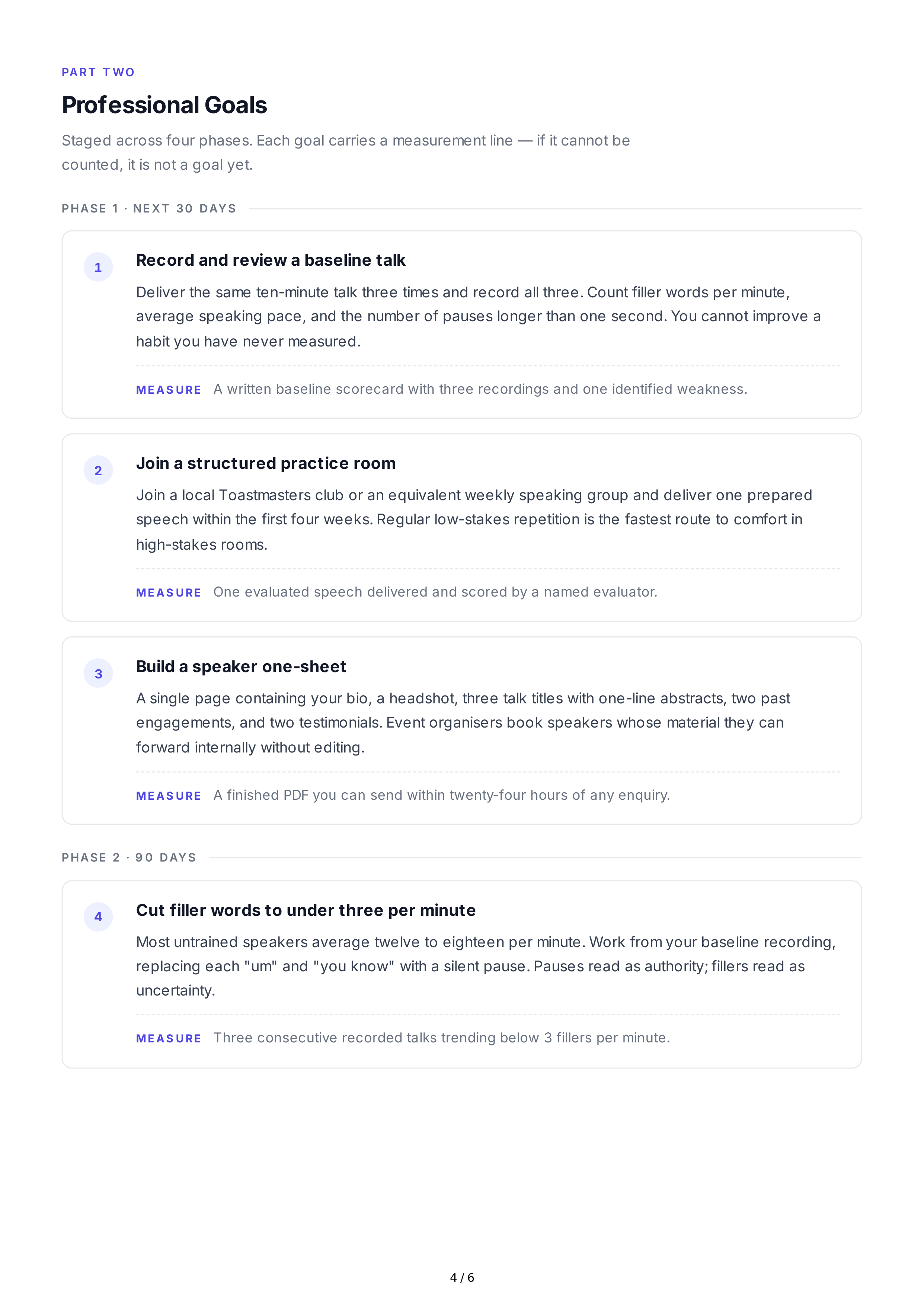
PART
T WO
Professional
Goals
Staged
across
four
phases
.
Each
goal
carries
a
measurement
line
—
if
it
cannot
be
counted
,
it
is
not
a
goal
yet
.
PHASE
1 ·
NE XT
30
DAYS
1
Record
and
review
a
baseline
talk
Deliver
the
same
ten
-
minute
talk
three
times
and
record
all
three
.
Count
filler
words
per
minute
,
average
speaking
pace
,
and
the
number
of
pauses
longer
than
one
second
.
You
cannot
improve
a
habit
you
have
never
measured
.
ME AS U RE
A
written
baseline
scorecard
with
three
recordings
and
one
identified
weakness
.
2
Join
a
structured
practice
room
Join
a
local
Toastmasters
club
or
an
equivalent
weekly
speaking
group
and
deliver
one
prepared
speech
within
the
first
four
weeks
.
Regular
low
-
stakes
repetition
is
the
fastest
route
to
comfort
in
high
-
stakes
rooms
.
ME AS U RE
One
evaluated
speech
delivered
and
scored
by
a
named
evaluator
.
3
Build
a
speaker
one
-
sheet
A
single
page
containing
your
bio
,
a
headshot
,
three
talk
titles
with
one
-
line
abstracts
,
two
past
engagements
,
and
two
testimonials
.
Event
organisers
book
speakers
whose
material
they
can
forward
internally
without
editing
.
ME AS U RE
A
finished
PDF
you
can
send
within
twenty
-
four
hours
of
any
enquiry
.
PHASE
2 · 9 0
DAYS
4
Cut
filler
words
to
under
three
per
minute
Most
untrained
speakers
average
twelve
to
eighteen
per
minute
.
Work
from
your
baseline
recording
,
replacing
each
"
um
"
and
"
you
know
"
with
a
silent
pause
.
Pauses
read
as
authority
;
fillers
read
as
uncertainty
.
ME AS U RE
Three
consecutive
recorded
talks
trending
below
3
fillers
per
minute
.
4 / 6
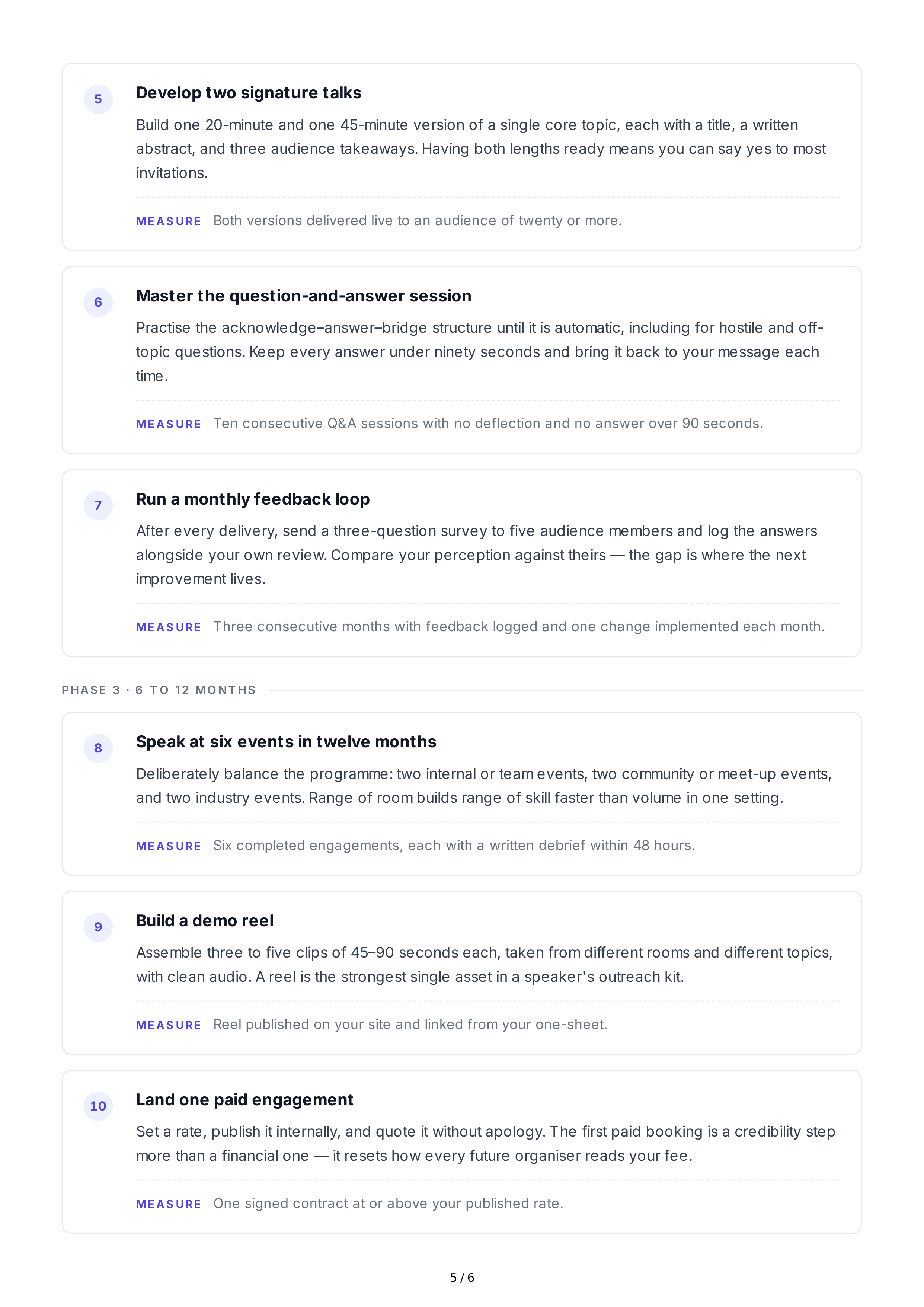
5
Develop
two
signature
talks
Build
one
20-
minute
and
one
45-
minute
version
of
a
single
core
topic
,
each
with
a
title
,
a
written
abstract
,
and
three
audience
takeaways
.
Having
both
lengths
ready
means
you
can
say
yes
to
most
invitations
.
ME AS U RE
Both
versions
delivered
live
to
an
audience
of
twenty
or
more
.
6
Master
the
question
-
and
-
answer
session
Practise
the
acknowledge
–
answer
–
bridge
structure
until
it
is
automatic
,
including
for
hostile
and
off
-
topic
questions
.
Keep
every
answer
under
ninety
seconds
and
bring
it
back
to
your
message
each
time
.
ME AS U RE
Ten
consecutive
Q
&
A
sessions
with
no
deflection
and
no
answer
over
90
seconds
.
7
Run
a
monthly
feedback
loop
After
every
delivery
,
send
a
three
-
question
survey
to
five
audience
members
and
log
the
answers
alongside
your
own
review
.
Compare
your
perception
against
theirs
—
the
gap
is
where
the
next
improvement
lives
.
ME AS U RE
Three
consecutive
months
with
feedback
logged
and
one
change
implemented
each
month
.
PHASE
3 · 6
T O
1 2
MO NT HS
8
Speak
at
six
events
in
twelve
months
Deliberately
balance
the
programme
:
two
internal
or
team
events
,
two
community
or
meet
-
up
events
,
and
two
industry
events
.
Range
of
room
builds
range
of
skill
faster
than
volume
in
one
setting
.
ME AS U RE
Six
completed
engagements
,
each
with
a
written
debrief
within
48
hours
.
9
Build
a
demo
reel
Assemble
three
to
five
clips
of
45–90
seconds
each
,
taken
from
different
rooms
and
different
topics
,
with
clean
audio
.
A
reel
is
the
strongest
single
asset
in
a
speaker
'
s
outreach
kit
.
ME AS U RE
Reel
published
on
your
site
and
linked
from
your
one
-
sheet
.
10
Land
one
paid
engagement
Set
a
rate
,
publish
it
internally
,
and
quote
it
without
apology
.
The
first
paid
booking
is
a
credibility
step
more
than
a
financial
one
—
it
resets
how
every
future
organiser
reads
your
fee
.
ME AS U RE
One
signed
contract
at
or
above
your
published
rate
.
5 / 6
11
Pitch
twenty
-
four
conferences
Submit
two
proposals
every
month
for
a
year
to
events
that
genuinely
match
your
topic
.
Track
every
submission
,
response
,
and
outcome
in
one
sheet
so
you
can
see
which
pitch
language
converts
.
ME AS U RE
24
submissions
sent
, 6
shortlisted
, 2
accepted
.
PHASE
4 · 2
T O
3
YE ARS
12
Deliver
a
keynote
at
a
national
conference
Move
from
breakout
rooms
and
panels
to
a
main
-
stage
keynote
slot
.
This
usually
comes
from
a
track
record
of
strong
breakout
talks
and
at
least
one
widely
shared
recording
of
the
same
material
.
ME AS U RE
One
main
-
stage
keynote
of
30
minutes
or
longer
on
a
published
programme
.
13
Publish
one
signature
talk
that
travels
Give
your
best
talk
a
title
,
a
defined
thesis
,
and
a
recording
worth
sharing
.
A
talk
that
circulates
without
you
in
the
room
keeps
working
while
you
sleep
.
ME AS U RE
One
published
recording
reaching
100,000
views
across
all
platforms
.
14
Coach
five
speakers
to
their
first
stage
Teach
the
craft
you
have
practised
.
Coaching
forces
you
to
articulate
principles
precisely
,
which
sharpens
your
own
delivery
and
establishes
a
second
reputation
alongside
speaking
itself
.
ME AS U RE
Five
people
who
deliver
their
first
public
talk
after
working
with
you
.
6 / 6