Professional
Collaboration
Goals
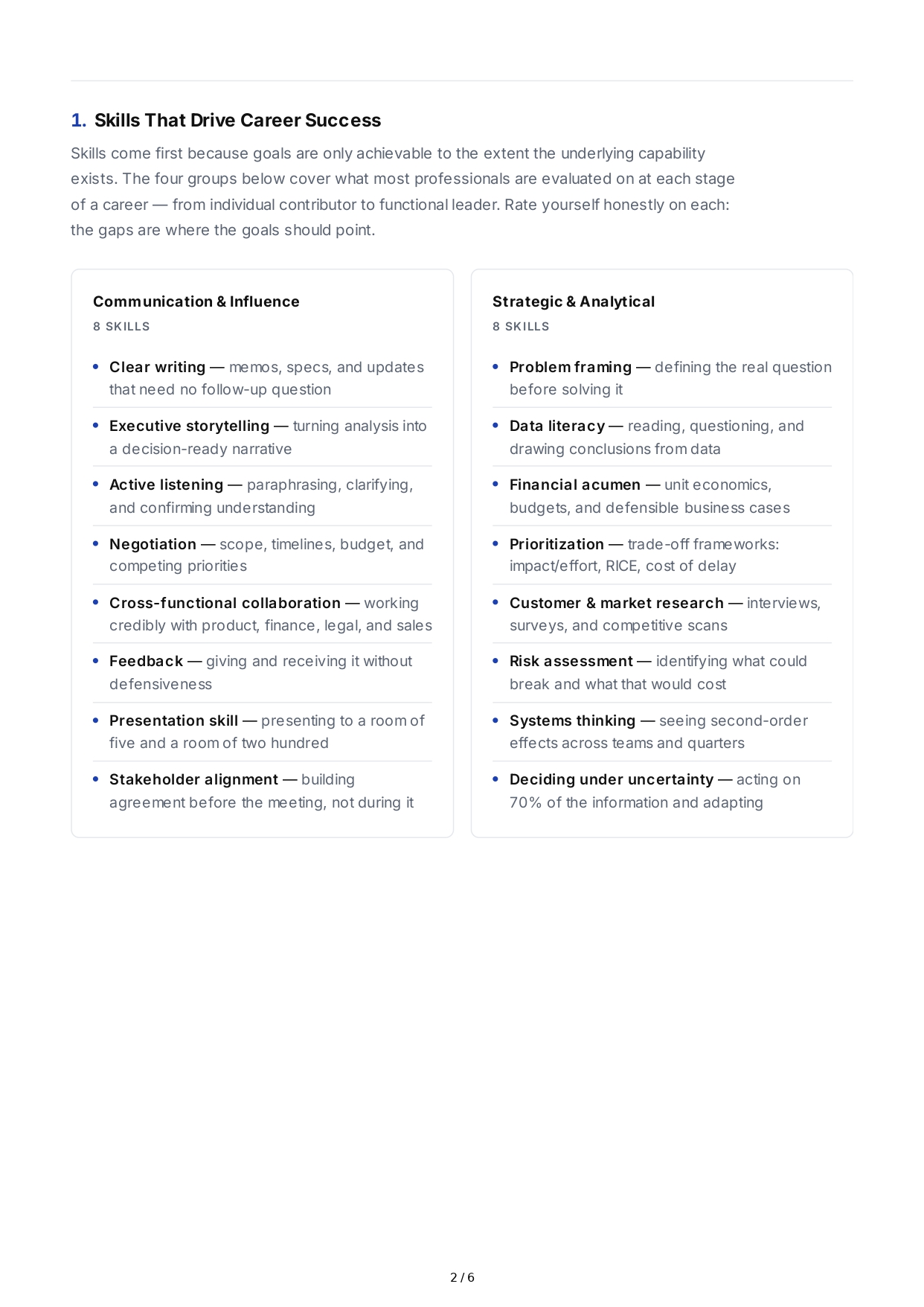
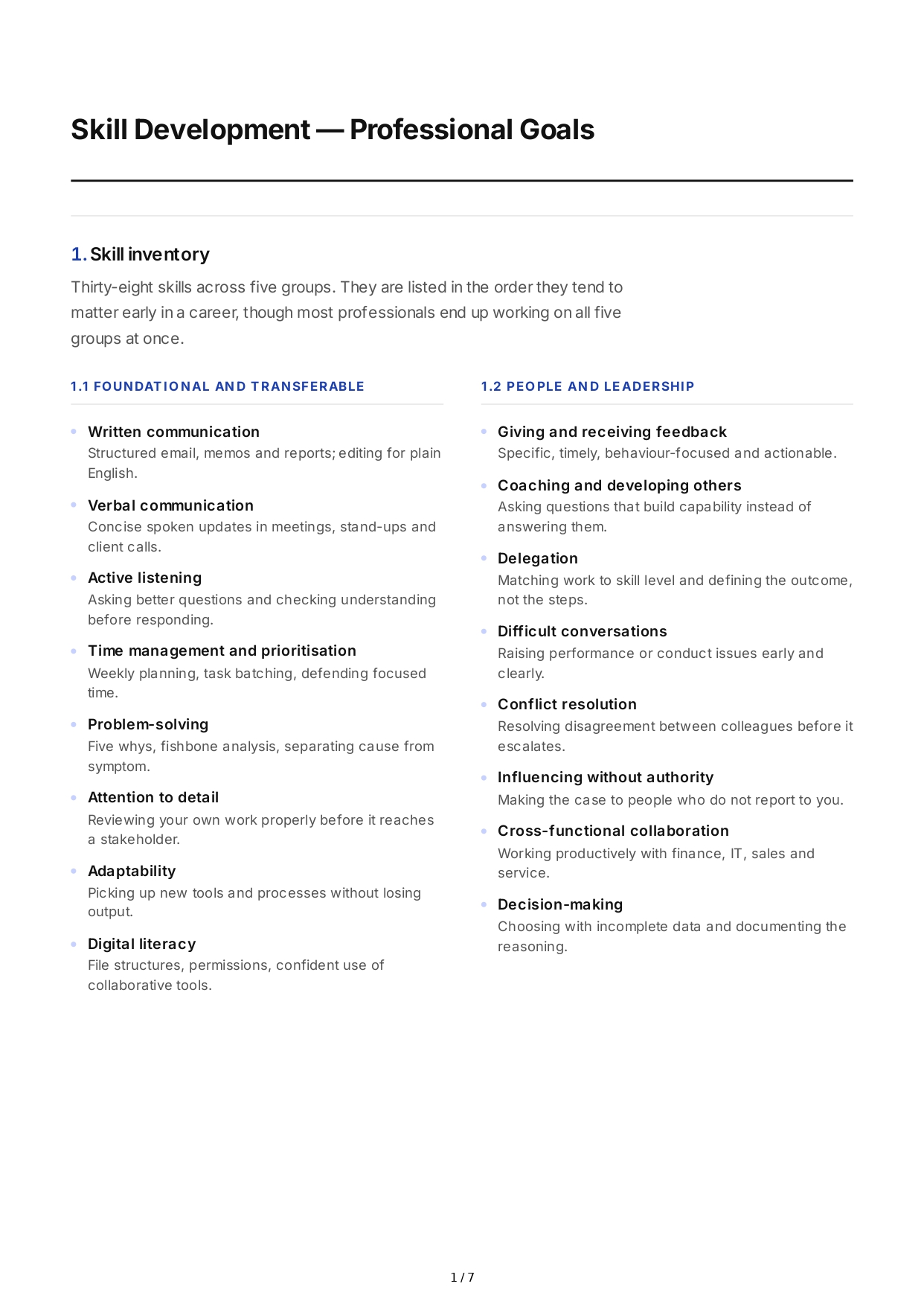
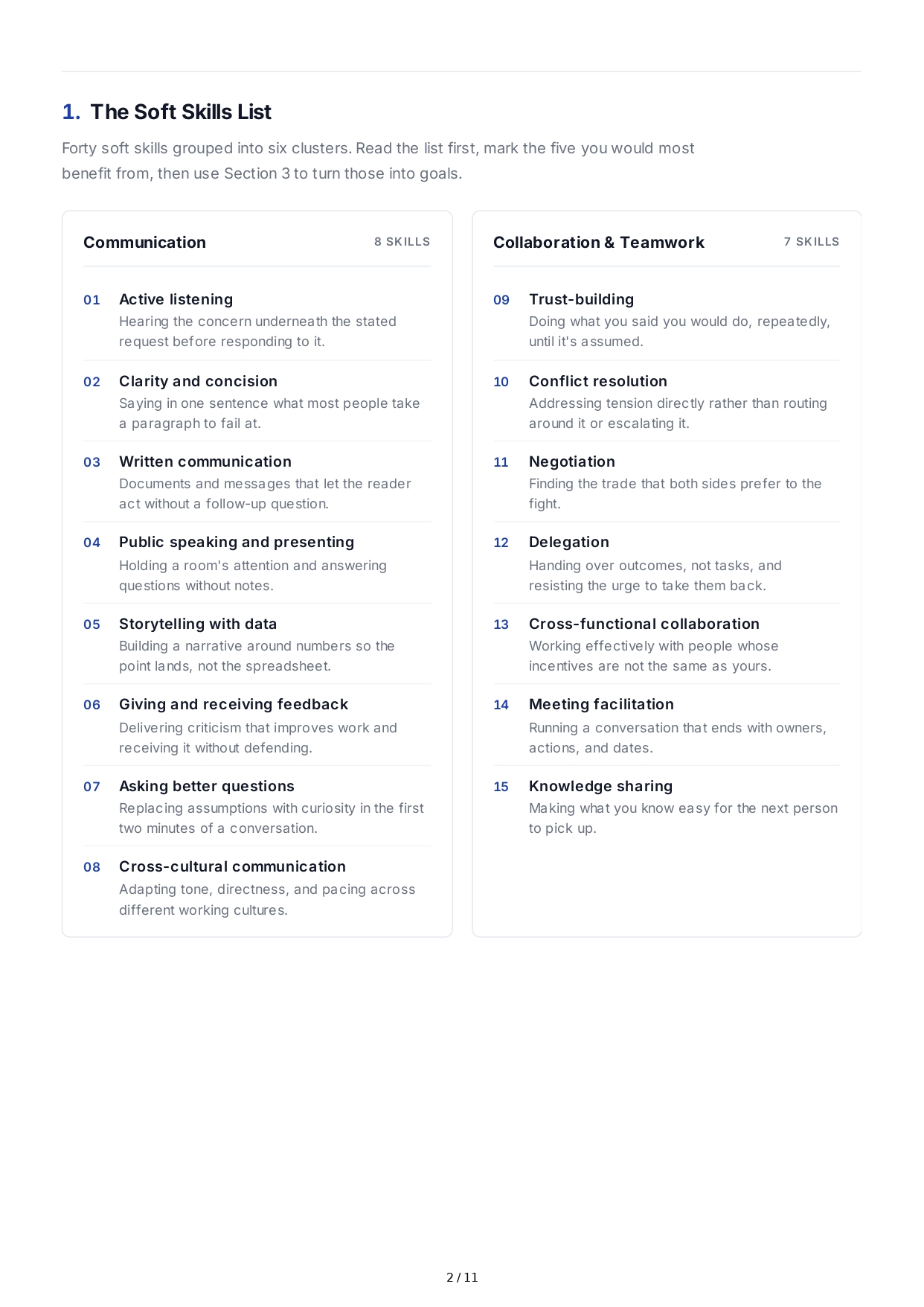
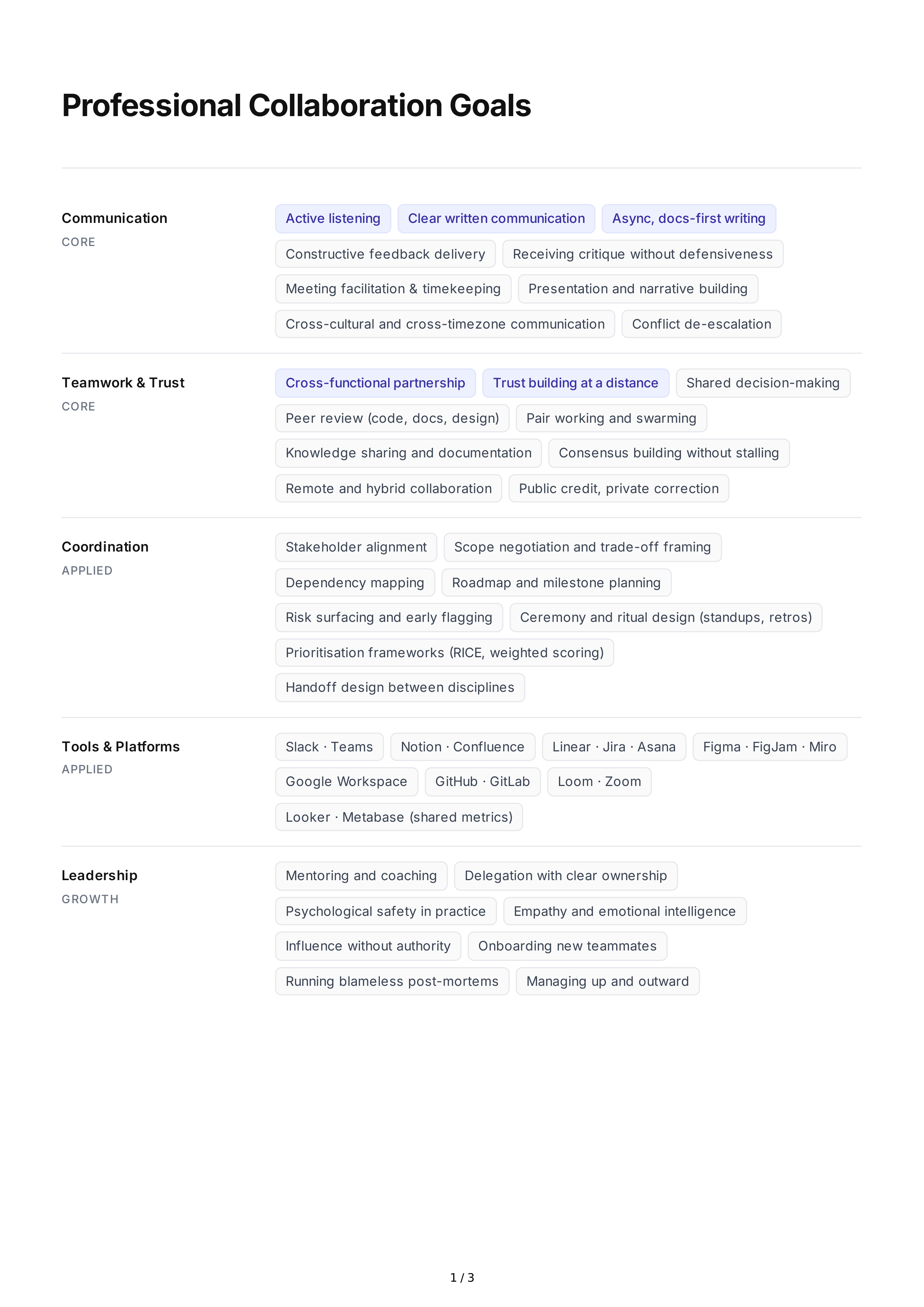
Communication
CORE
Active
listening
Clear
written
communication
Async
,
docs
-
first
writing
Constructive
feedback
delivery
Receiving
critique
without
defensiveness
Meeting
facilitation
&
timekeeping
Presentation
and
narrative
building
Cross
-
cultural
and
cross
-
timezone
communication
Conflict
de
-
escalation
Teamwork
&
Trust
CORE
Cross
-
functional
partnership
Trust
building
at
a
distance
Shared
decision
-
making
Peer
review
(
code
,
docs
,
design
)
Pair
working
and
swarming
Knowledge
sharing
and
documentation
Consensus
building
without
stalling
Remote
and
hybrid
collaboration
Public
credit
,
private
correction
Coordination
APPLIED
Stakeholder
alignment
Scope
negotiation
and
trade
-
off
framing
Dependency
mapping
Roadmap
and
milestone
planning
Risk
surfacing
and
early
flagging
Ceremony
and
ritual
design
(
standups
,
retros
)
Prioritisation
frameworks
(
RICE
,
weighted
scoring
)
Handoff
design
between
disciplines
Tools
&
Platforms
APPLIED
Slack
·
Teams
Notion
·
Confluence
Linear
·
Jira
·
Asana
Figma
·
FigJam
·
Miro
Google
Workspace
GitHub
·
GitLab
Loom
·
Zoom
Looker
·
Metabase
(
shared
metrics
)
Leadership
GROWTH
Mentoring
and
coaching
Delegation
with
clear
ownership
Psychological
safety
in
practice
Empathy
and
emotional
intelligence
Influence
without
authority
Onboarding
new
teammates
Running
blameless
post
-
mortems
Managing
up
and
outward
1 / 3
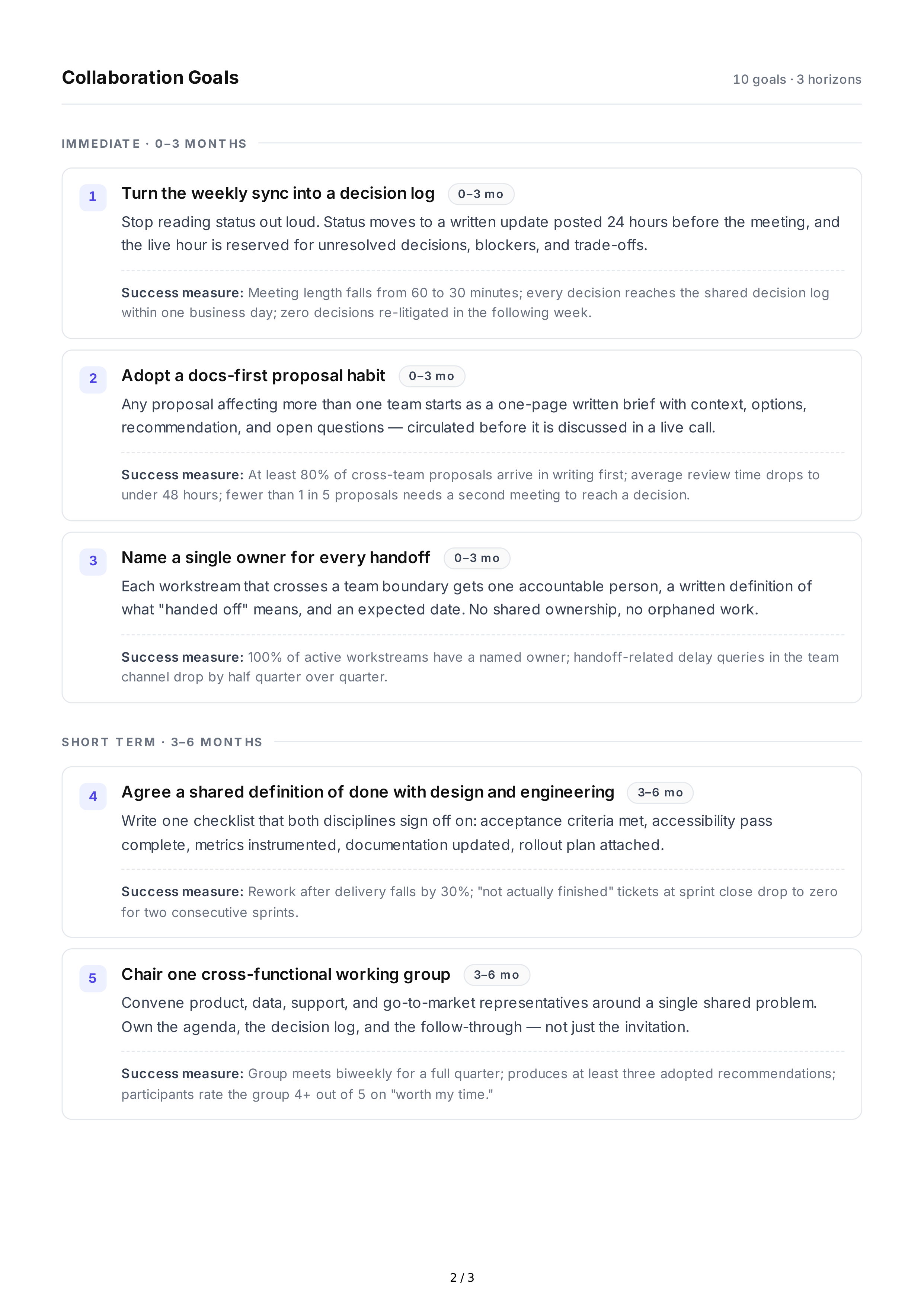
Collaboration
Goals
10
goals
· 3
horizons
IM M EDIAT E
· 0 –3
M ON T HS
1
Turn
the
weekly
sync
into
a
decision
log
0–3
mo
Stop
reading
status
out
loud
.
Status
moves
to
a
written
update
posted
24
hours
before
the
meeting
,
and
the
live
hour
is
reserved
for
unresolved
decisions
,
blockers
,
and
trade
-
offs
.
Success
measure
:
Meeting
length
falls
from
60
to
30
minutes
;
every
decision
reaches
the
shared
decision
log
within
one
business
day
;
zero
decisions
re
-
litigated
in
the
following
week
.
2
Adopt
a
docs
-
first
proposal
habit
0–3
mo
Any
proposal
affecting
more
than
one
team
starts
as
a
one
-
page
written
brief
with
context
,
options
,
recommendation
,
and
open
questions
—
circulated
before
it
is
discussed
in
a
live
call
.
Success
measure
:
At
least
80%
of
cross
-
team
proposals
arrive
in
writing
first
;
average
review
time
drops
to
under
48
hours
;
fewer
than
1
in
5
proposals
needs
a
second
meeting
to
reach
a
decision
.
3
Name
a
single
owner
for
every
handoff
0–3
mo
Each
workstream
that
crosses
a
team
boundary
gets
one
accountable
person
,
a
written
definition
of
what
"
handed
off
"
means
,
and
an
expected
date
.
No
shared
ownership
,
no
orphaned
work
.
Success
measure
:
100%
of
active
workstreams
have
a
named
owner
;
handoff
-
related
delay
queries
in
the
team
channel
drop
by
half
quarter
over
quarter
.
S HOR T
T ER M
· 3–6
M ON T HS
4
Agree
a
shared
definition
of
done
with
design
and
engineering
3–6
mo
Write
one
checklist
that
both
disciplines
sign
off
on
:
acceptance
criteria
met
,
accessibility
pass
complete
,
metrics
instrumented
,
documentation
updated
,
rollout
plan
attached
.
Success
measure
:
Rework
after
delivery
falls
by
30%; "
not
actually
finished
"
tickets
at
sprint
close
drop
to
zero
for
two
consecutive
sprints
.
5
Chair
one
cross
-
functional
working
group
3–6
mo
Convene
product
,
data
,
support
,
and
go
-
to
-
market
representatives
around
a
single
shared
problem
.
Own
the
agenda
,
the
decision
log
,
and
the
follow
-
through
—
not
just
the
invitation
.
Success
measure
:
Group
meets
biweekly
for
a
full
quarter
;
produces
at
least
three
adopted
recommendations
;
participants
rate
the
group
4+
out
of
5
on
"
worth
my
time
."
2 / 3
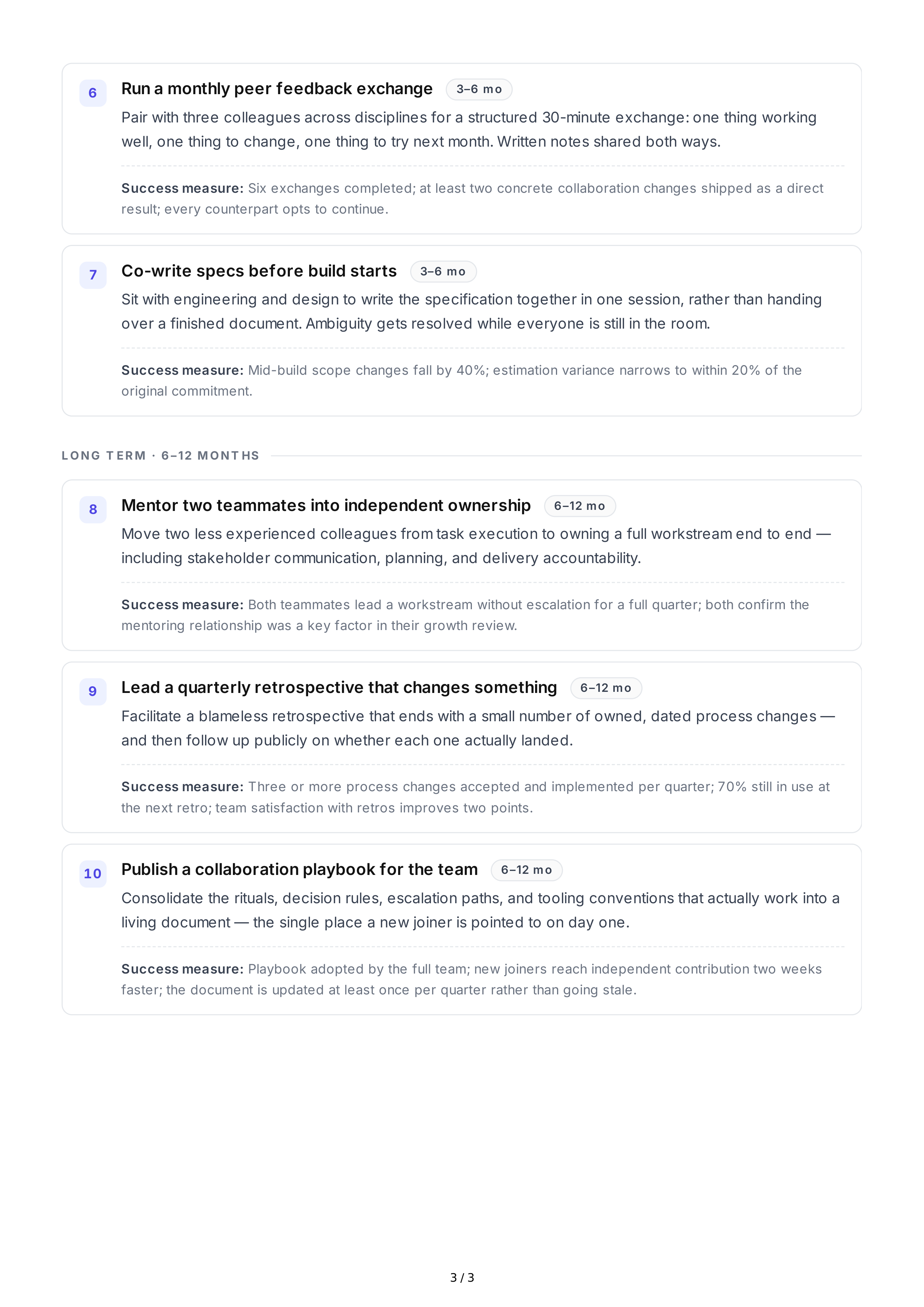
6
Run
a
monthly
peer
feedback
exchange
3–6
mo
Pair
with
three
colleagues
across
disciplines
for
a
structured
30-
minute
exchange
:
one
thing
working
well
,
one
thing
to
change
,
one
thing
to
try
next
month
.
Written
notes
shared
both
ways
.
Success
measure
:
Six
exchanges
completed
;
at
least
two
concrete
collaboration
changes
shipped
as
a
direct
result
;
every
counterpart
opts
to
continue
.
7
Co
-
write
specs
before
build
starts
3–6
mo
Sit
with
engineering
and
design
to
write
the
specification
together
in
one
session
,
rather
than
handing
over
a
finished
document
.
Ambiguity
gets
resolved
while
everyone
is
still
in
the
room
.
Success
measure
:
Mid
-
build
scope
changes
fall
by
40%;
estimation
variance
narrows
to
within
20%
of
the
original
commitment
.
L ON G
T ER M
· 6 –12
M ON T HS
8
Mentor
two
teammates
into
independent
ownership
6–12
mo
Move
two
less
experienced
colleagues
from
task
execution
to
owning
a
full
workstream
end
to
end
—
including
stakeholder
communication
,
planning
,
and
delivery
accountability
.
Success
measure
:
Both
teammates
lead
a
workstream
without
escalation
for
a
full
quarter
;
both
confirm
the
mentoring
relationship
was
a
key
factor
in
their
growth
review
.
9
Lead
a
quarterly
retrospective
that
changes
something
6–12
mo
Facilitate
a
blameless
retrospective
that
ends
with
a
small
number
of
owned
,
dated
process
changes
—
and
then
follow
up
publicly
on
whether
each
one
actually
landed
.
Success
measure
:
Three
or
more
process
changes
accepted
and
implemented
per
quarter
; 70%
still
in
use
at
the
next
retro
;
team
satisfaction
with
retros
improves
two
points
.
10
Publish
a
collaboration
playbook
for
the
team
6–12
mo
Consolidate
the
rituals
,
decision
rules
,
escalation
paths
,
and
tooling
conventions
that
actually
work
into
a
living
document
—
the
single
place
a
new
joiner
is
pointed
to
on
day
one
.
Success
measure
:
Playbook
adopted
by
the
full
team
;
new
joiners
reach
independent
contribution
two
weeks
faster
;
the
document
is
updated
at
least
once
per
quarter
rather
than
going
stale
.
3 / 3