Team
Building
Professional
Goals
1 / 8
PAR T
O N E
Skill
Inventory
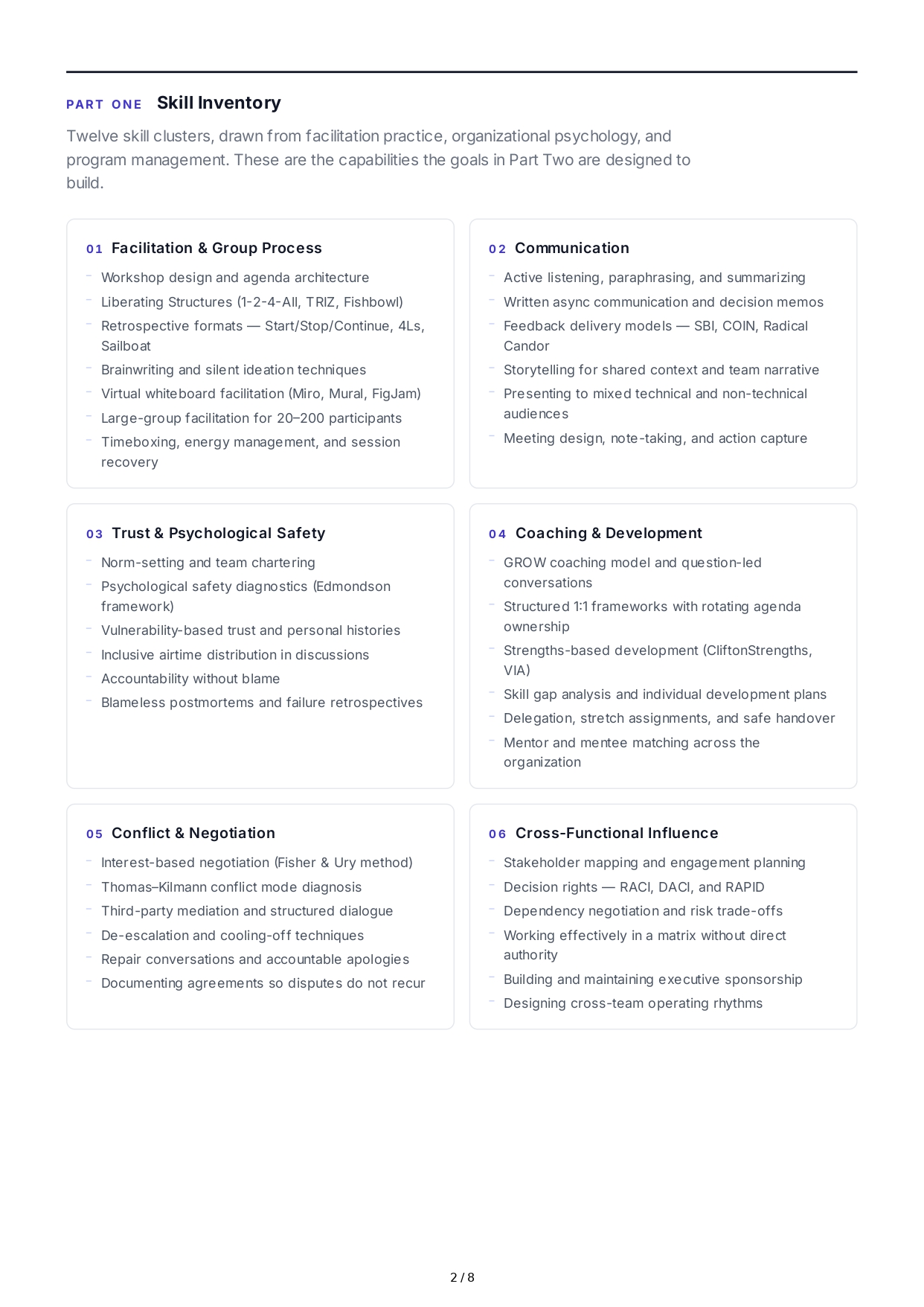
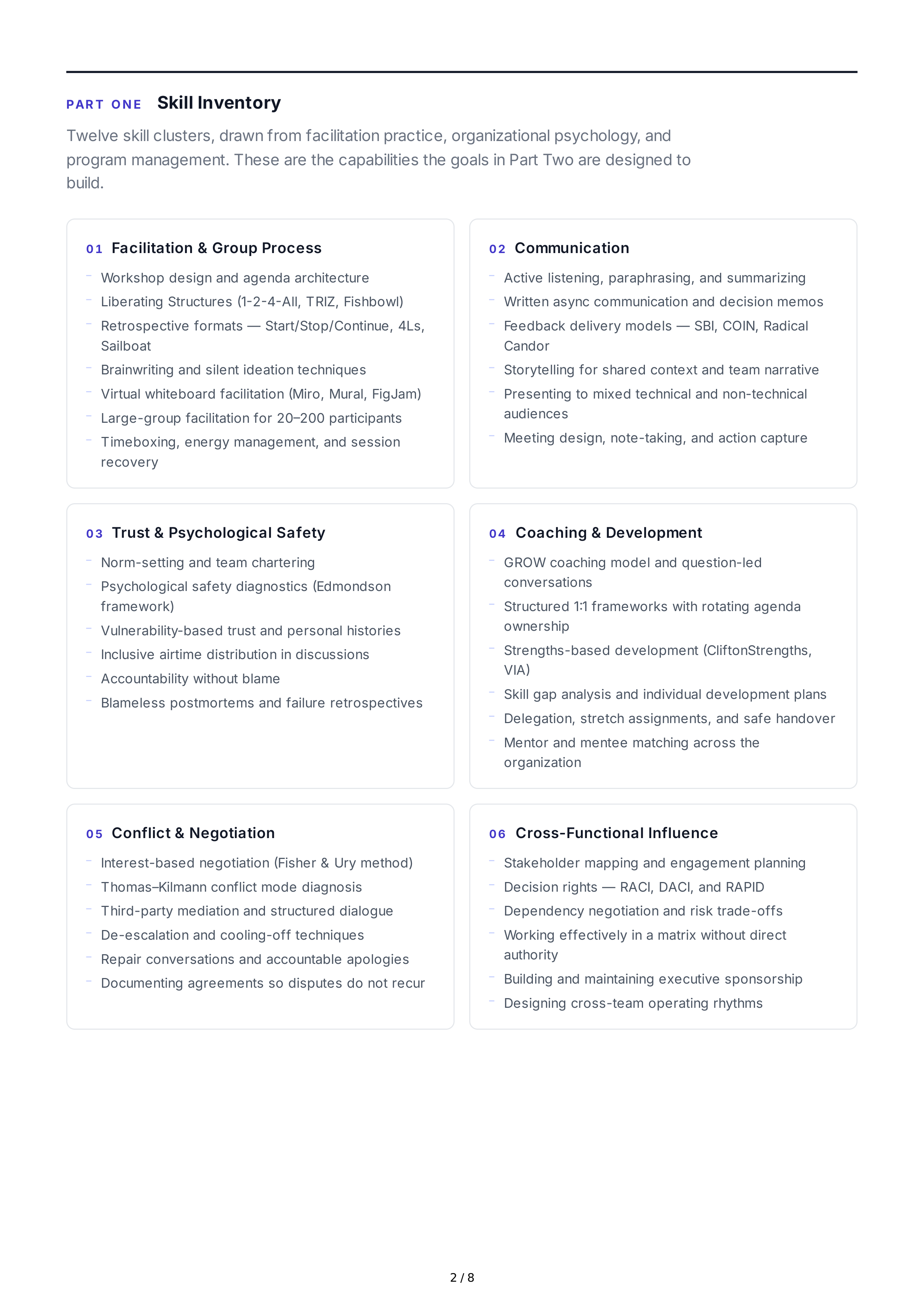
Twelve
skill
clusters
,
drawn
from
facilitation
practice
,
organizational
psychology
,
and
program
management
.
These
are
the
capabilities
the
goals
in
Part
Two
are
designed
to
build
.
01
Facilitation
&
Group
Process
02
Communication
03
Trust
&
Psychological
Safety
04
Coaching
&
Development
05
Conflict
&
Negotiation
06
Cross
-
Functional
Influence
Workshop
design
and
agenda
architecture
Liberating
Structures
(1-2-4-
All
,
TRIZ
,
Fishbowl
)
Retrospective
formats
—
Start
/
Stop
/
Continue
, 4
Ls
,
Sailboat
Brainwriting
and
silent
ideation
techniques
Virtual
whiteboard
facilitation
(
Miro
,
Mural
,
FigJam
)
Large
-
group
facilitation
for
20–200
participants
Timeboxing
,
energy
management
,
and
session
recovery
Active
listening
,
paraphrasing
,
and
summarizing
Written
async
communication
and
decision
memos
Feedback
delivery
models
—
SBI
,
COIN
,
Radical
Candor
Storytelling
for
shared
context
and
team
narrative
Presenting
to
mixed
technical
and
non
-
technical
audiences
Meeting
design
,
note
-
taking
,
and
action
capture
Norm
-
setting
and
team
chartering
Psychological
safety
diagnostics
(
Edmondson
framework
)
Vulnerability
-
based
trust
and
personal
histories
Inclusive
airtime
distribution
in
discussions
Accountability
without
blame
Blameless
postmortems
and
failure
retrospectives
GROW
coaching
model
and
question
-
led
conversations
Structured
1:1
frameworks
with
rotating
agenda
ownership
Strengths
-
based
development
(
CliftonStrengths
,
VIA
)
Skill
gap
analysis
and
individual
development
plans
Delegation
,
stretch
assignments
,
and
safe
handover
Mentor
and
mentee
matching
across
the
organization
Interest
-
based
negotiation
(
Fisher
&
Ury
method
)
Thomas
–
Kilmann
conflict
mode
diagnosis
Third
-
party
mediation
and
structured
dialogue
De
-
escalation
and
cooling
-
off
techniques
Repair
conversations
and
accountable
apologies
Documenting
agreements
so
disputes
do
not
recur
Stakeholder
mapping
and
engagement
planning
Decision
rights
—
RACI
,
DACI
,
and
RAPID
Dependency
negotiation
and
risk
trade
-
offs
Working
effectively
in
a
matrix
without
direct
authority
Building
and
maintaining
executive
sponsorship
Designing
cross
-
team
operating
rhythms
2 / 8
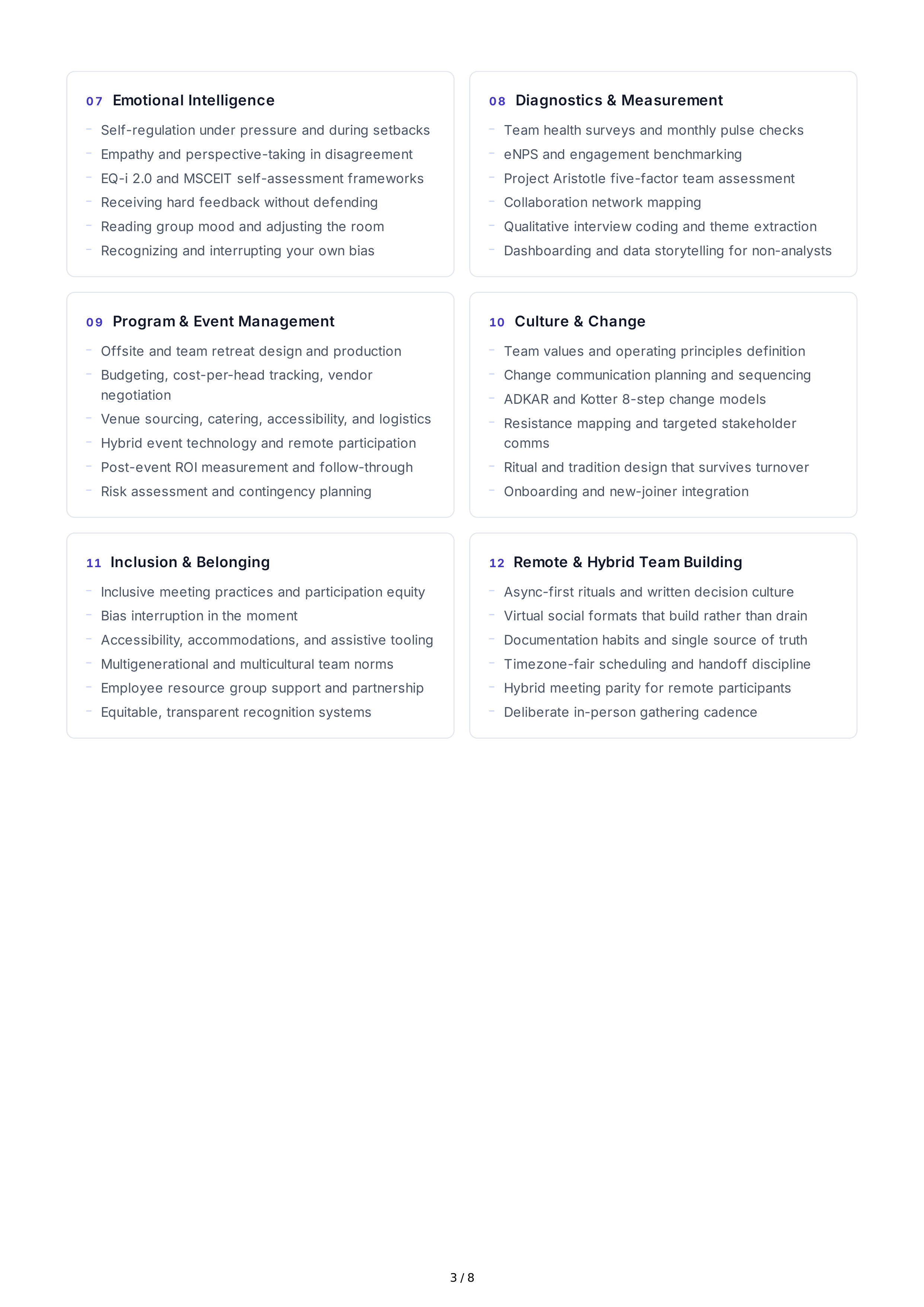
07
Emotional
Intelligence
08
Diagnostics
&
Measurement
09
Program
&
Event
Management
10
Culture
&
Change
11
Inclusion
&
Belonging
12
Remote
&
Hybrid
Team
Building
Self
-
regulation
under
pressure
and
during
setbacks
Empathy
and
perspective
-
taking
in
disagreement
EQ
-
i
2.0
and
MSCEIT
self
-
assessment
frameworks
Receiving
hard
feedback
without
defending
Reading
group
mood
and
adjusting
the
room
Recognizing
and
interrupting
your
own
bias
Team
health
surveys
and
monthly
pulse
checks
eNPS
and
engagement
benchmarking
Project
Aristotle
five
-
factor
team
assessment
Collaboration
network
mapping
Qualitative
interview
coding
and
theme
extraction
Dashboarding
and
data
storytelling
for
non
-
analysts
Offsite
and
team
retreat
design
and
production
Budgeting
,
cost
-
per
-
head
tracking
,
vendor
negotiation
Venue
sourcing
,
catering
,
accessibility
,
and
logistics
Hybrid
event
technology
and
remote
participation
Post
-
event
ROI
measurement
and
follow
-
through
Risk
assessment
and
contingency
planning
Team
values
and
operating
principles
definition
Change
communication
planning
and
sequencing
ADKAR
and
Kotter
8-
step
change
models
Resistance
mapping
and
targeted
stakeholder
comms
Ritual
and
tradition
design
that
survives
turnover
Onboarding
and
new
-
joiner
integration
Inclusive
meeting
practices
and
participation
equity
Bias
interruption
in
the
moment
Accessibility
,
accommodations
,
and
assistive
tooling
Multigenerational
and
multicultural
team
norms
Employee
resource
group
support
and
partnership
Equitable
,
transparent
recognition
systems
Async
-
first
rituals
and
written
decision
culture
Virtual
social
formats
that
build
rather
than
drain
Documentation
habits
and
single
source
of
truth
Timezone
-
fair
scheduling
and
handoff
discipline
Hybrid
meeting
parity
for
remote
participants
Deliberate
in
-
person
gathering
cadence
3 / 8
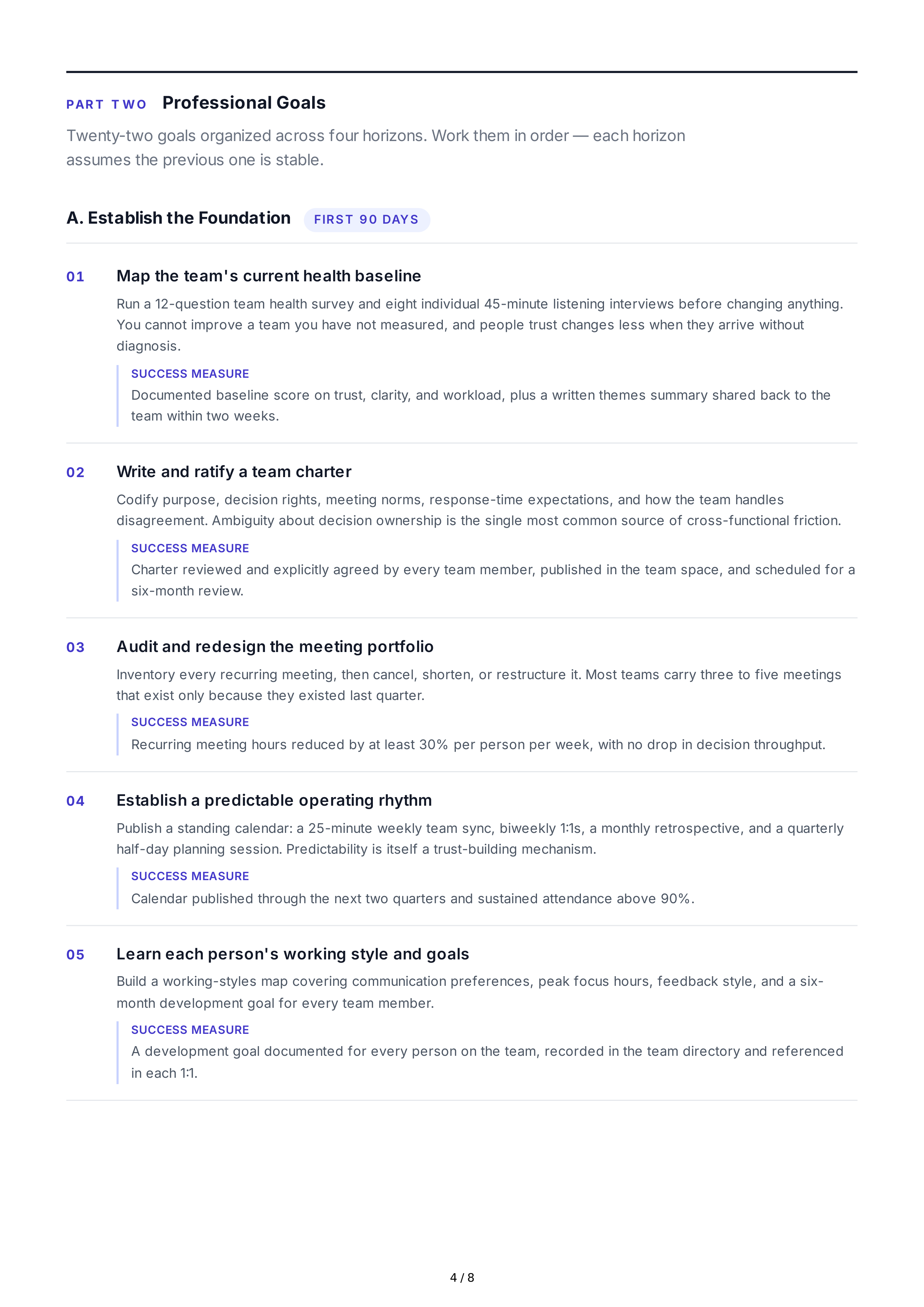
PAR T
T WO
Professional
Goals
Twenty
-
two
goals
organized
across
four
horizons
.
Work
them
in
order
—
each
horizon
assumes
the
previous
one
is
stable
.
A
.
Establish
the
Foundation
FIRST
90
DAYS
01
Map
the
team
'
s
current
health
baseline
Run
a
12-
question
team
health
survey
and
eight
individual
45-
minute
listening
interviews
before
changing
anything
.
You
cannot
improve
a
team
you
have
not
measured
,
and
people
trust
changes
less
when
they
arrive
without
diagnosis
.
SUCCESS
MEASURE
Documented
baseline
score
on
trust
,
clarity
,
and
workload
,
plus
a
written
themes
summary
shared
back
to
the
team
within
two
weeks
.
02
Write
and
ratify
a
team
charter
Codify
purpose
,
decision
rights
,
meeting
norms
,
response
-
time
expectations
,
and
how
the
team
handles
disagreement
.
Ambiguity
about
decision
ownership
is
the
single
most
common
source
of
cross
-
functional
friction
.
SUCCESS
MEASURE
Charter
reviewed
and
explicitly
agreed
by
every
team
member
,
published
in
the
team
space
,
and
scheduled
for
a
six
-
month
review
.
03
Audit
and
redesign
the
meeting
portfolio
Inventory
every
recurring
meeting
,
then
cancel
,
shorten
,
or
restructure
it
.
Most
teams
carry
three
to
five
meetings
that
exist
only
because
they
existed
last
quarter
.
SUCCESS
MEASURE
Recurring
meeting
hours
reduced
by
at
least
30%
per
person
per
week
,
with
no
drop
in
decision
throughput
.
04
Establish
a
predictable
operating
rhythm
Publish
a
standing
calendar
:
a
25-
minute
weekly
team
sync
,
biweekly
1:1
s
,
a
monthly
retrospective
,
and
a
quarterly
half
-
day
planning
session
.
Predictability
is
itself
a
trust
-
building
mechanism
.
SUCCESS
MEASURE
Calendar
published
through
the
next
two
quarters
and
sustained
attendance
above
90%.
05
Learn
each
person
'
s
working
style
and
goals
Build
a
working
-
styles
map
covering
communication
preferences
,
peak
focus
hours
,
feedback
style
,
and
a
six
-
month
development
goal
for
every
team
member
.
SUCCESS
MEASURE
A
development
goal
documented
for
every
person
on
the
team
,
recorded
in
the
team
directory
and
referenced
in
each
1:1.
4 / 8
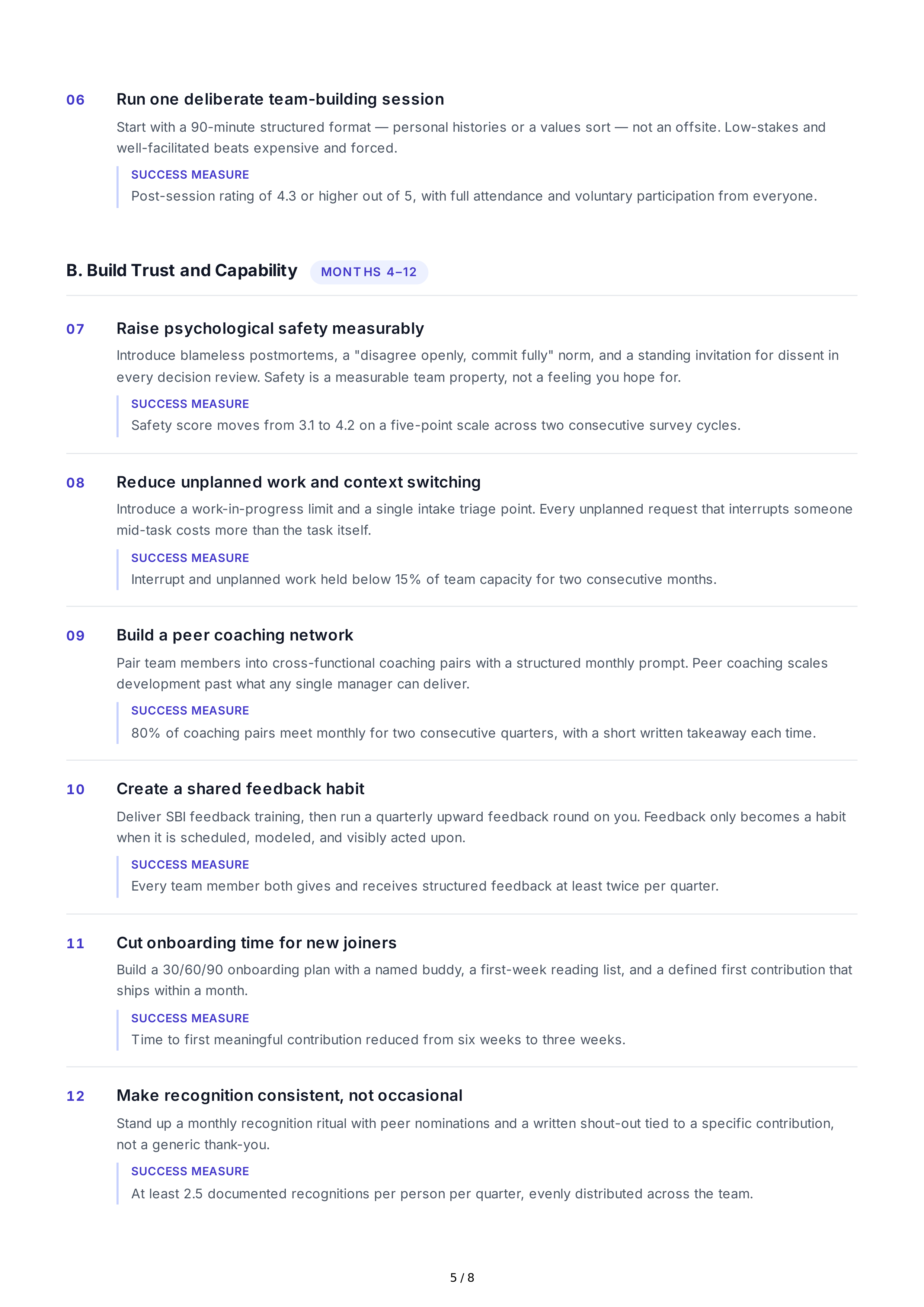
06
Run
one
deliberate
team
-
building
session
Start
with
a
90-
minute
structured
format
—
personal
histories
or
a
values
sort
—
not
an
offsite
.
Low
-
stakes
and
well
-
facilitated
beats
expensive
and
forced
.
SUCCESS
MEASURE
Post
-
session
rating
of
4.3
or
higher
out
of
5,
with
full
attendance
and
voluntary
participation
from
everyone
.
B
.
Build
Trust
and
Capability
MONT HS
4–12
07
Raise
psychological
safety
measurably
Introduce
blameless
postmortems
,
a
"
disagree
openly
,
commit
fully
"
norm
,
and
a
standing
invitation
for
dissent
in
every
decision
review
.
Safety
is
a
measurable
team
property
,
not
a
feeling
you
hope
for
.
SUCCESS
MEASURE
Safety
score
moves
from
3.1
to
4.2
on
a
five
-
point
scale
across
two
consecutive
survey
cycles
.
08
Reduce
unplanned
work
and
context
switching
Introduce
a
work
-
in
-
progress
limit
and
a
single
intake
triage
point
.
Every
unplanned
request
that
interrupts
someone
mid
-
task
costs
more
than
the
task
itself
.
SUCCESS
MEASURE
Interrupt
and
unplanned
work
held
below
15%
of
team
capacity
for
two
consecutive
months
.
09
Build
a
peer
coaching
network
Pair
team
members
into
cross
-
functional
coaching
pairs
with
a
structured
monthly
prompt
.
Peer
coaching
scales
development
past
what
any
single
manager
can
deliver
.
SUCCESS
MEASURE
80%
of
coaching
pairs
meet
monthly
for
two
consecutive
quarters
,
with
a
short
written
takeaway
each
time
.
10
Create
a
shared
feedback
habit
Deliver
SBI
feedback
training
,
then
run
a
quarterly
upward
feedback
round
on
you
.
Feedback
only
becomes
a
habit
when
it
is
scheduled
,
modeled
,
and
visibly
acted
upon
.
SUCCESS
MEASURE
Every
team
member
both
gives
and
receives
structured
feedback
at
least
twice
per
quarter
.
11
Cut
onboarding
time
for
new
joiners
Build
a
30/60/90
onboarding
plan
with
a
named
buddy
,
a
first
-
week
reading
list
,
and
a
defined
first
contribution
that
ships
within
a
month
.
SUCCESS
MEASURE
Time
to
first
meaningful
contribution
reduced
from
six
weeks
to
three
weeks
.
12
Make
recognition
consistent
,
not
occasional
Stand
up
a
monthly
recognition
ritual
with
peer
nominations
and
a
written
shout
-
out
tied
to
a
specific
contribution
,
not
a
generic
thank
-
you
.
SUCCESS
MEASURE
At
least
2.5
documented
recognitions
per
person
per
quarter
,
evenly
distributed
across
the
team
.
5 / 8
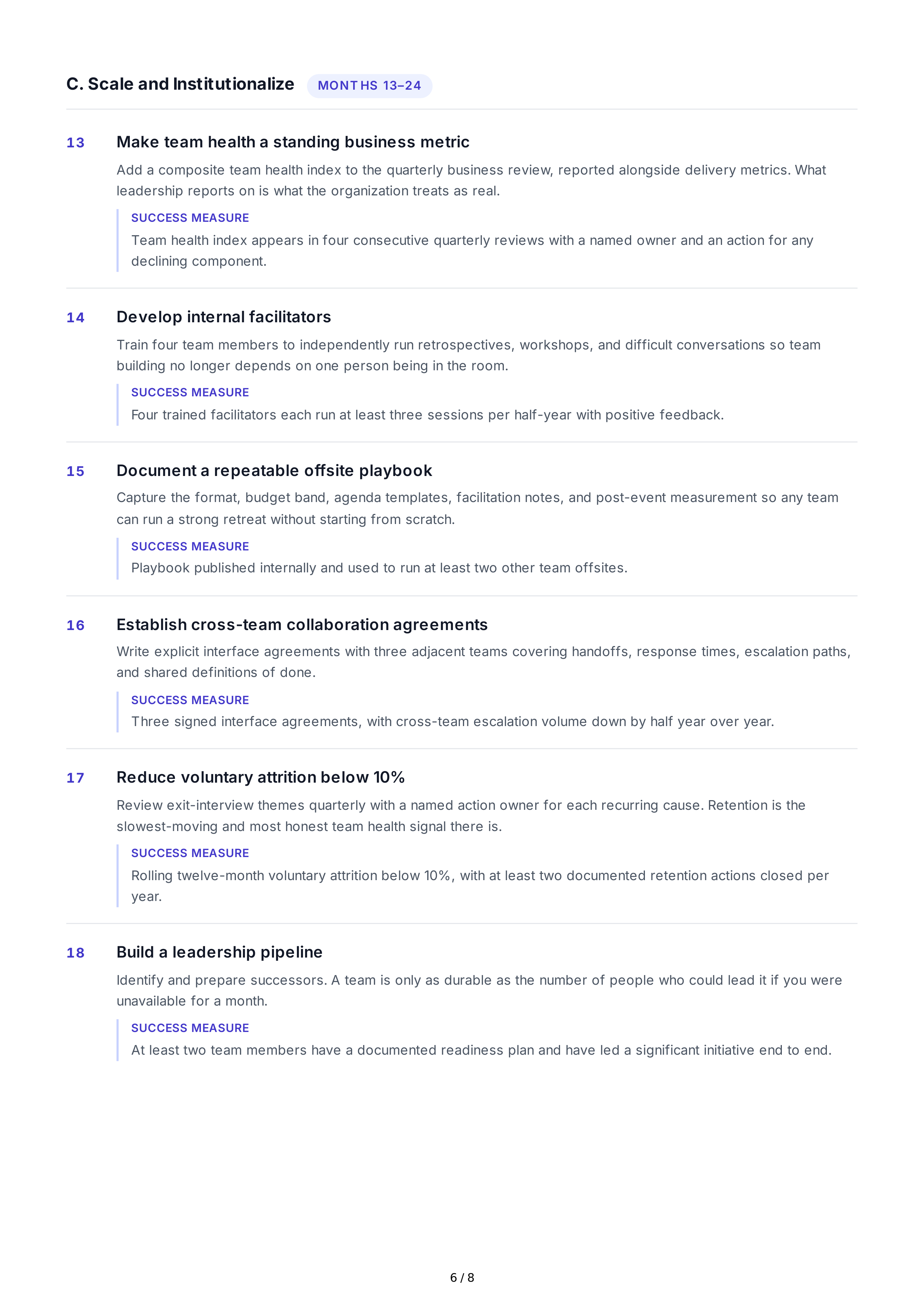
C
.
Scale
and
Institutionalize
MONT HS
13–24
13
Make
team
health
a
standing
business
metric
Add
a
composite
team
health
index
to
the
quarterly
business
review
,
reported
alongside
delivery
metrics
.
What
leadership
reports
on
is
what
the
organization
treats
as
real
.
SUCCESS
MEASURE
Team
health
index
appears
in
four
consecutive
quarterly
reviews
with
a
named
owner
and
an
action
for
any
declining
component
.
14
Develop
internal
facilitators
Train
four
team
members
to
independently
run
retrospectives
,
workshops
,
and
difficult
conversations
so
team
building
no
longer
depends
on
one
person
being
in
the
room
.
SUCCESS
MEASURE
Four
trained
facilitators
each
run
at
least
three
sessions
per
half
-
year
with
positive
feedback
.
15
Document
a
repeatable
offsite
playbook
Capture
the
format
,
budget
band
,
agenda
templates
,
facilitation
notes
,
and
post
-
event
measurement
so
any
team
can
run
a
strong
retreat
without
starting
from
scratch
.
SUCCESS
MEASURE
Playbook
published
internally
and
used
to
run
at
least
two
other
team
offsites
.
16
Establish
cross
-
team
collaboration
agreements
Write
explicit
interface
agreements
with
three
adjacent
teams
covering
handoffs
,
response
times
,
escalation
paths
,
and
shared
definitions
of
done
.
SUCCESS
MEASURE
Three
signed
interface
agreements
,
with
cross
-
team
escalation
volume
down
by
half
year
over
year
.
17
Reduce
voluntary
attrition
below
10%
Review
exit
-
interview
themes
quarterly
with
a
named
action
owner
for
each
recurring
cause
.
Retention
is
the
slowest
-
moving
and
most
honest
team
health
signal
there
is
.
SUCCESS
MEASURE
Rolling
twelve
-
month
voluntary
attrition
below
10%,
with
at
least
two
documented
retention
actions
closed
per
year
.
18
Build
a
leadership
pipeline
Identify
and
prepare
successors
.
A
team
is
only
as
durable
as
the
number
of
people
who
could
lead
it
if
you
were
unavailable
for
a
month
.
SUCCESS
MEASURE
At
least
two
team
members
have
a
documented
readiness
plan
and
have
led
a
significant
initiative
end
to
end
.
6 / 8
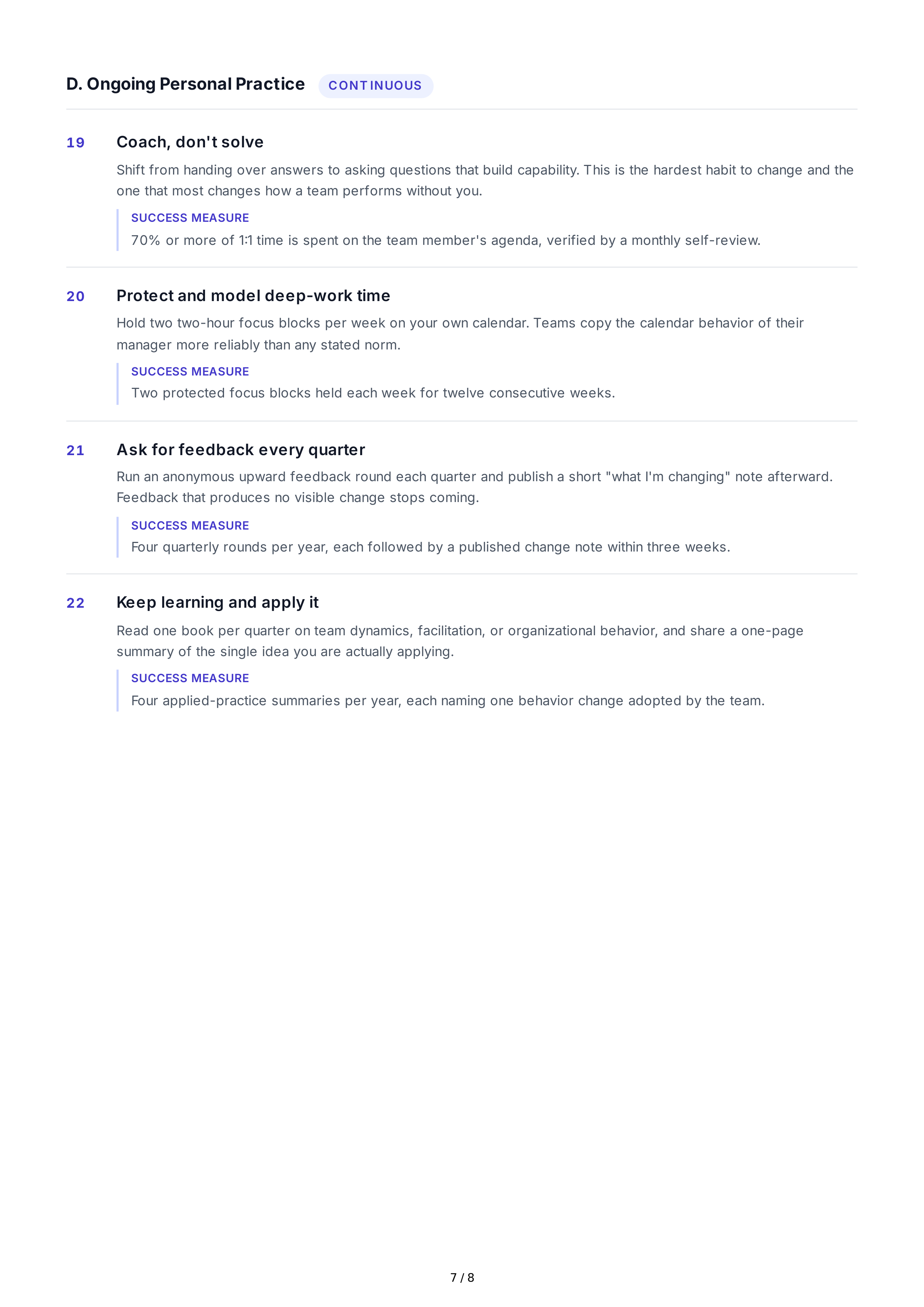
D
.
Ongoing
Personal
Practice
CONT INUOUS
19
Coach
,
don
'
t
solve
Shift
from
handing
over
answers
to
asking
questions
that
build
capability
.
This
is
the
hardest
habit
to
change
and
the
one
that
most
changes
how
a
team
performs
without
you
.
SUCCESS
MEASURE
70%
or
more
of
1:1
time
is
spent
on
the
team
member
'
s
agenda
,
verified
by
a
monthly
self
-
review
.
20
Protect
and
model
deep
-
work
time
Hold
two
two
-
hour
focus
blocks
per
week
on
your
own
calendar
.
Teams
copy
the
calendar
behavior
of
their
manager
more
reliably
than
any
stated
norm
.
SUCCESS
MEASURE
Two
protected
focus
blocks
held
each
week
for
twelve
consecutive
weeks
.
21
Ask
for
feedback
every
quarter
Run
an
anonymous
upward
feedback
round
each
quarter
and
publish
a
short
"
what
I
'
m
changing
"
note
afterward
.
Feedback
that
produces
no
visible
change
stops
coming
.
SUCCESS
MEASURE
Four
quarterly
rounds
per
year
,
each
followed
by
a
published
change
note
within
three
weeks
.
22
Keep
learning
and
apply
it
Read
one
book
per
quarter
on
team
dynamics
,
facilitation
,
or
organizational
behavior
,
and
share
a
one
-
page
summary
of
the
single
idea
you
are
actually
applying
.
SUCCESS
MEASURE
Four
applied
-
practice
summaries
per
year
,
each
naming
one
behavior
change
adopted
by
the
team
.
7 / 8
PAR T
T H R EE
Measurement
Framework
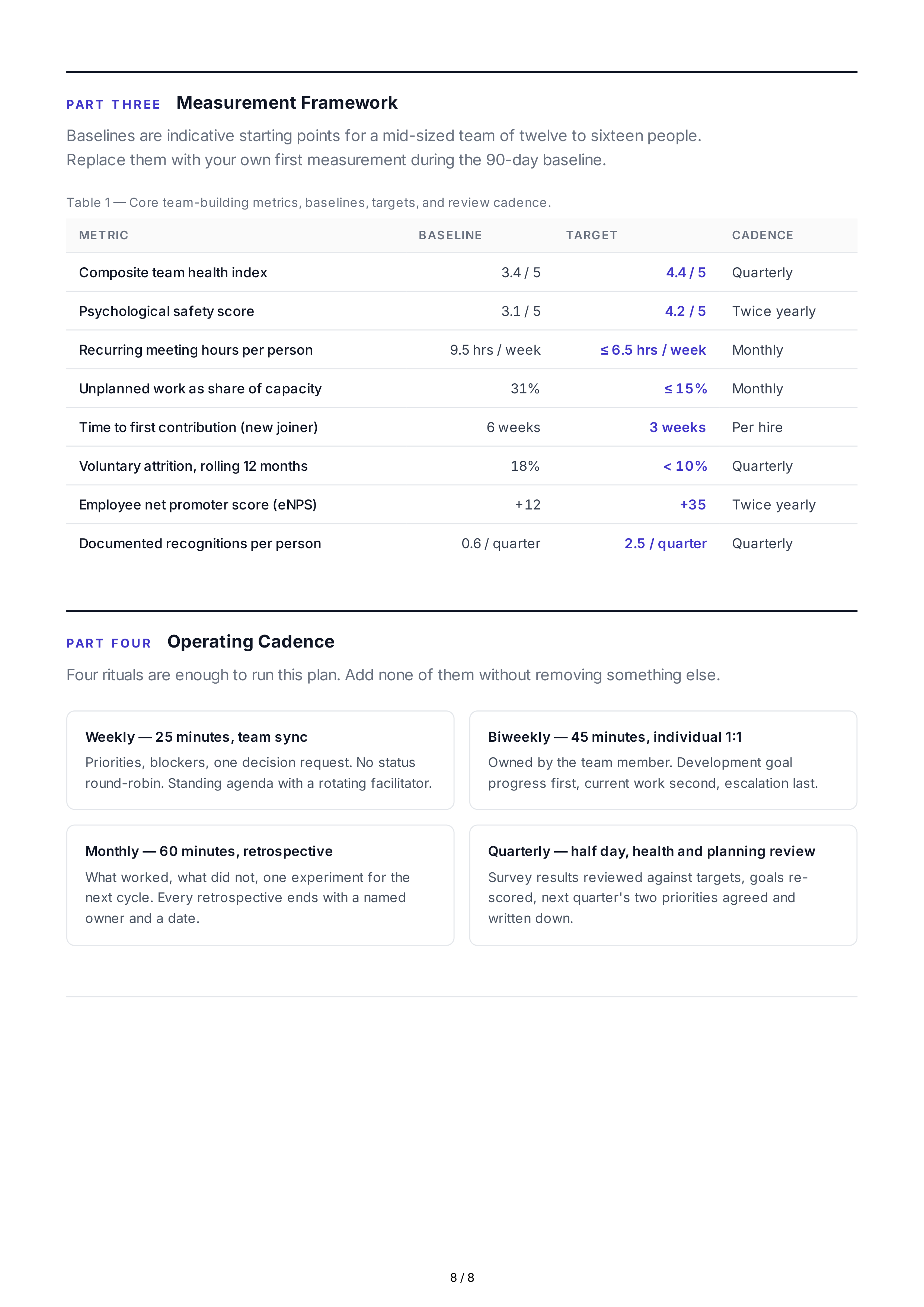
Baselines
are
indicative
starting
points
for
a
mid
-
sized
team
of
twelve
to
sixteen
people
.
Replace
them
with
your
own
first
measurement
during
the
90-
day
baseline
.
Table
1 —
Core
team
-
building
metrics
,
baselines
,
targets
,
and
review
cadence
.
METRIC
BASELINE
TARGET
CADENCE
Composite
team
health
index
3.4 / 5
4.4 / 5
Quarterly
Psychological
safety
score
3.1 / 5
4.2 / 5
Twice
yearly
Recurring
meeting
hours
per
person
9.5
hrs
/
week
≤
6.5
hrs
/
week
Monthly
Unplanned
work
as
share
of
capacity
31%
≤
15%
Monthly
Time
to
first
contribution
(
new
joiner
)
6
weeks
3
weeks
Per
hire
Voluntary
attrition
,
rolling
12
months
18%
< 10%
Quarterly
Employee
net
promoter
score
(
eNPS
)
+12
+35
Twice
yearly
Documented
recognitions
per
person
0.6 /
quarter
2.5 /
quarter
Quarterly
PAR T
F O U R
Operating
Cadence
Four
rituals
are
enough
to
run
this
plan
.
Add
none
of
them
without
removing
something
else
.
Weekly
— 25
minutes
,
team
sync
Priorities
,
blockers
,
one
decision
request
.
No
status
round
-
robin
.
Standing
agenda
with
a
rotating
facilitator
.
Biweekly
— 45
minutes
,
individual
1:1
Owned
by
the
team
member
.
Development
goal
progress
first
,
current
work
second
,
escalation
last
.
Monthly
— 60
minutes
,
retrospective
What
worked
,
what
did
not
,
one
experiment
for
the
next
cycle
.
Every
retrospective
ends
with
a
named
owner
and
a
date
.
Quarterly
—
half
day
,
health
and
planning
review
Survey
results
reviewed
against
targets
,
goals
re
-
scored
,
next
quarter
'
s
two
priorities
agreed
and
written
down
.
8 / 8