
Soft
Skill
Development
—
Professional
Goals
1 / 11
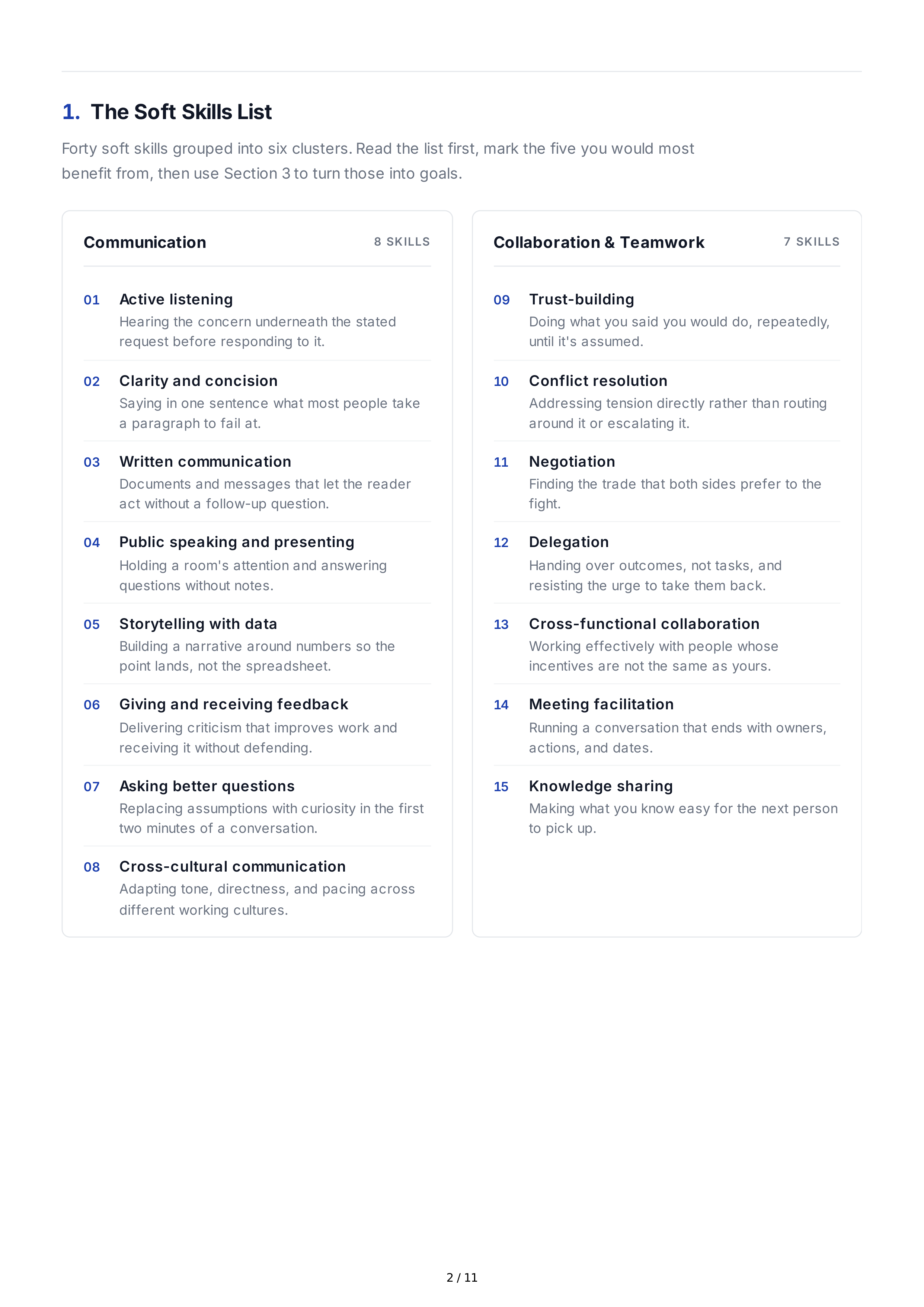
1.
The
Soft
Skills
List
Forty
soft
skills
grouped
into
six
clusters
.
Read
the
list
first
,
mark
the
five
you
would
most
benefit
from
,
then
use
Section
3
to
turn
those
into
goals
.
8
SKILLS
Communication
01
Active
listening
Hearing
the
concern
underneath
the
stated
request
before
responding
to
it
.
02
Clarity
and
concision
Saying
in
one
sentence
what
most
people
take
a
paragraph
to
fail
at
.
03
Written
communication
Documents
and
messages
that
let
the
reader
act
without
a
follow
-
up
question
.
04
Public
speaking
and
presenting
Holding
a
room
'
s
attention
and
answering
questions
without
notes
.
05
Storytelling
with
data
Building
a
narrative
around
numbers
so
the
point
lands
,
not
the
spreadsheet
.
06
Giving
and
receiving
feedback
Delivering
criticism
that
improves
work
and
receiving
it
without
defending
.
07
Asking
better
questions
Replacing
assumptions
with
curiosity
in
the
first
two
minutes
of
a
conversation
.
08
Cross
-
cultural
communication
Adapting
tone
,
directness
,
and
pacing
across
different
working
cultures
.
7
SKILLS
Collaboration
&
Teamwork
09
Trust
-
building
Doing
what
you
said
you
would
do
,
repeatedly
,
until
it
'
s
assumed
.
10
Conflict
resolution
Addressing
tension
directly
rather
than
routing
around
it
or
escalating
it
.
11
Negotiation
Finding
the
trade
that
both
sides
prefer
to
the
fight
.
12
Delegation
Handing
over
outcomes
,
not
tasks
,
and
resisting
the
urge
to
take
them
back
.
13
Cross
-
functional
collaboration
Working
effectively
with
people
whose
incentives
are
not
the
same
as
yours
.
14
Meeting
facilitation
Running
a
conversation
that
ends
with
owners
,
actions
,
and
dates
.
15
Knowledge
sharing
Making
what
you
know
easy
for
the
next
person
to
pick
up
.
2 / 11
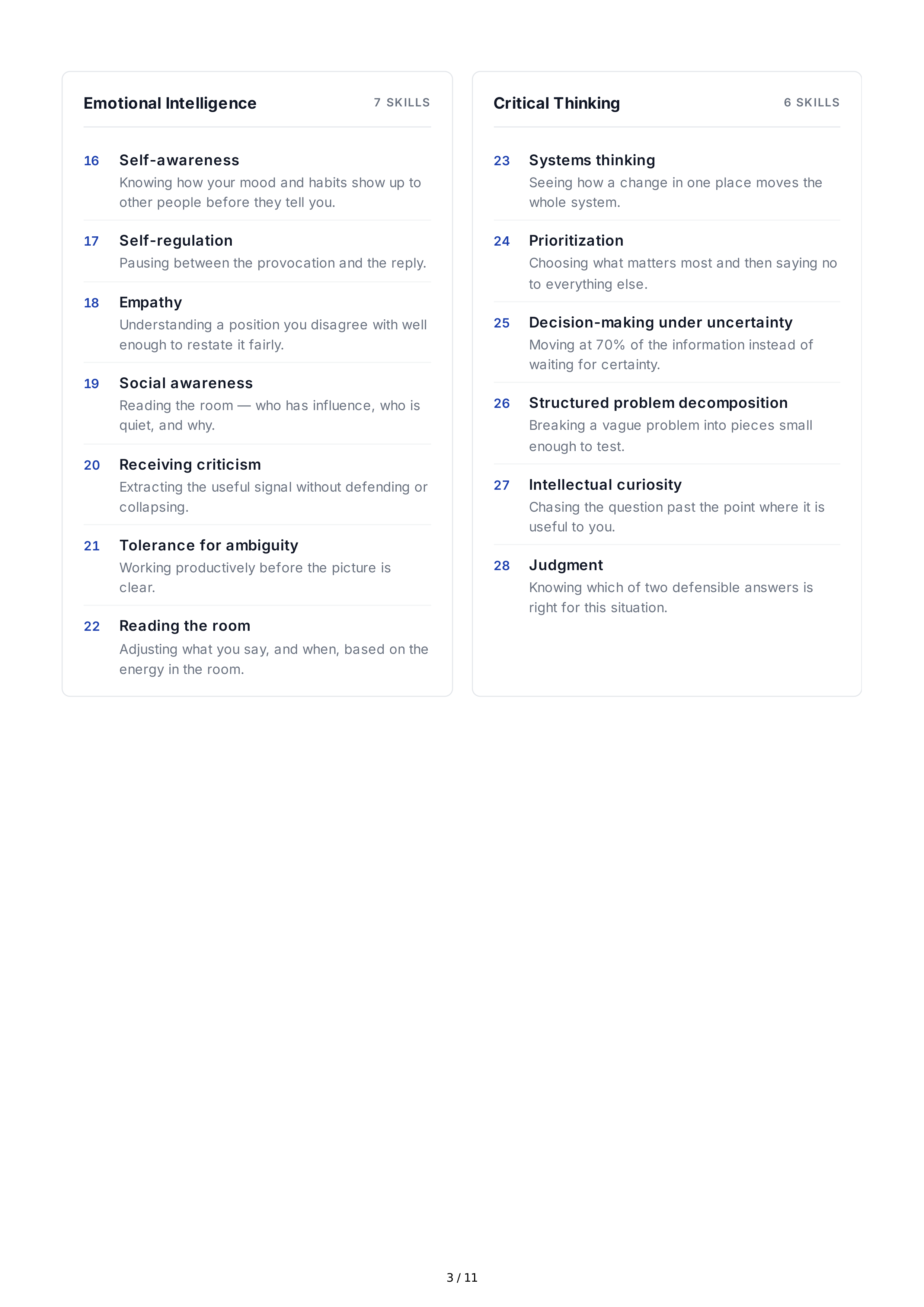
7
SKILLS
Emotional
Intelligence
16
Self
-
awareness
Knowing
how
your
mood
and
habits
show
up
to
other
people
before
they
tell
you
.
17
Self
-
regulation
Pausing
between
the
provocation
and
the
reply
.
18
Empathy
Understanding
a
position
you
disagree
with
well
enough
to
restate
it
fairly
.
19
Social
awareness
Reading
the
room
—
who
has
influence
,
who
is
quiet
,
and
why
.
20
Receiving
criticism
Extracting
the
useful
signal
without
defending
or
collapsing
.
21
Tolerance
for
ambiguity
Working
productively
before
the
picture
is
clear
.
22
Reading
the
room
Adjusting
what
you
say
,
and
when
,
based
on
the
energy
in
the
room
.
6
SKILLS
Critical
Thinking
23
Systems
thinking
Seeing
how
a
change
in
one
place
moves
the
whole
system
.
24
Prioritization
Choosing
what
matters
most
and
then
saying
no
to
everything
else
.
25
Decision
-
making
under
uncertainty
Moving
at
70%
of
the
information
instead
of
waiting
for
certainty
.
26
Structured
problem
decomposition
Breaking
a
vague
problem
into
pieces
small
enough
to
test
.
27
Intellectual
curiosity
Chasing
the
question
past
the
point
where
it
is
useful
to
you
.
28
Judgment
Knowing
which
of
two
defensible
answers
is
right
for
this
situation
.
3 / 11
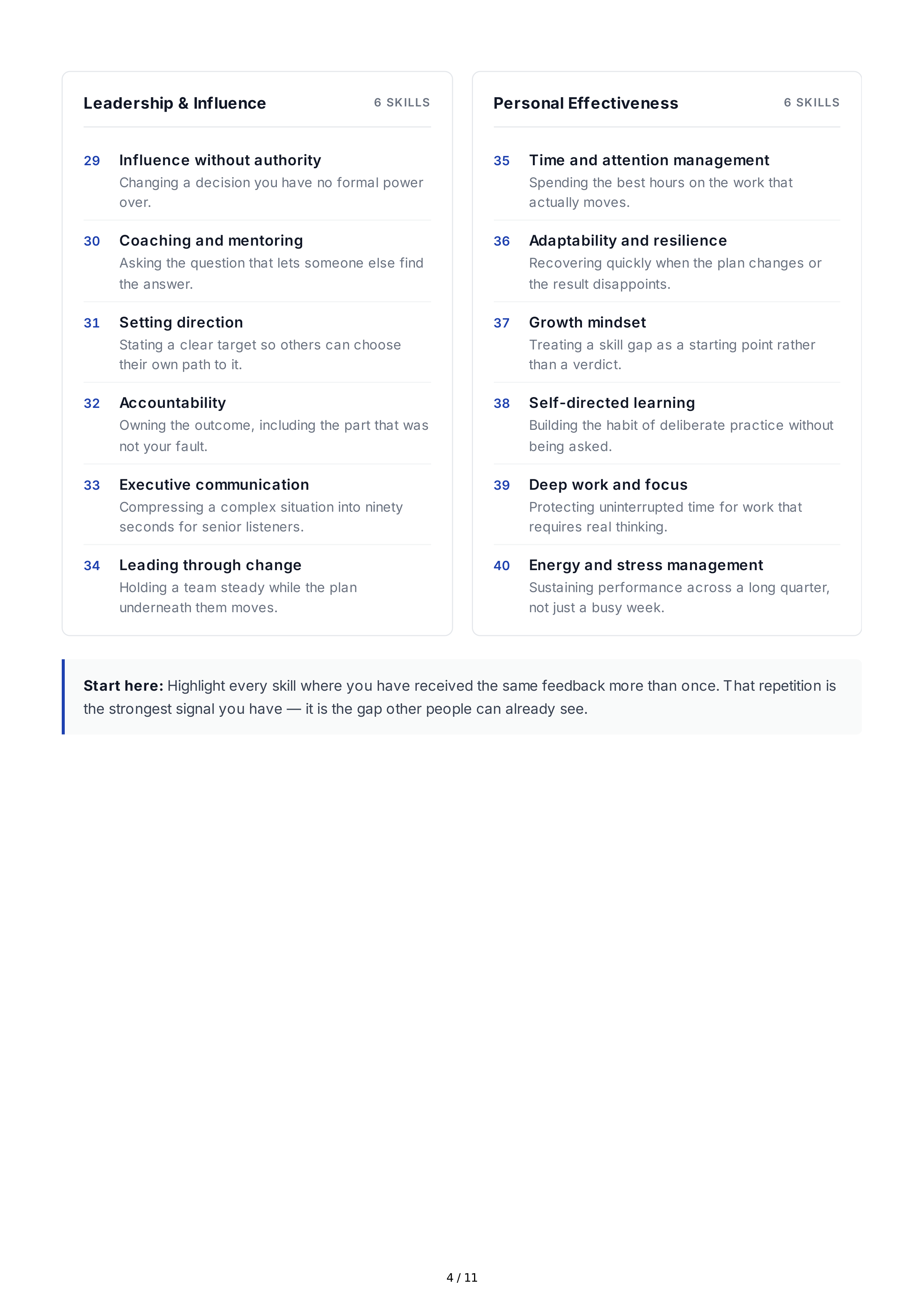
6
SKILLS
Leadership
&
Influence
29
Influence
without
authority
Changing
a
decision
you
have
no
formal
power
over
.
30
Coaching
and
mentoring
Asking
the
question
that
lets
someone
else
find
the
answer
.
31
Setting
direction
Stating
a
clear
target
so
others
can
choose
their
own
path
to
it
.
32
Accountability
Owning
the
outcome
,
including
the
part
that
was
not
your
fault
.
33
Executive
communication
Compressing
a
complex
situation
into
ninety
seconds
for
senior
listeners
.
34
Leading
through
change
Holding
a
team
steady
while
the
plan
underneath
them
moves
.
6
SKILLS
Personal
Effectiveness
35
Time
and
attention
management
Spending
the
best
hours
on
the
work
that
actually
moves
.
36
Adaptability
and
resilience
Recovering
quickly
when
the
plan
changes
or
the
result
disappoints
.
37
Growth
mindset
Treating
a
skill
gap
as
a
starting
point
rather
than
a
verdict
.
38
Self
-
directed
learning
Building
the
habit
of
deliberate
practice
without
being
asked
.
39
Deep
work
and
focus
Protecting
uninterrupted
time
for
work
that
requires
real
thinking
.
40
Energy
and
stress
management
Sustaining
performance
across
a
long
quarter
,
not
just
a
busy
week
.
Start
here
:
Highlight
every
skill
where
you
have
received
the
same
feedback
more
than
once
.
That
repetition
is
the
strongest
signal
you
have
—
it
is
the
gap
other
people
can
already
see
.
4 / 11
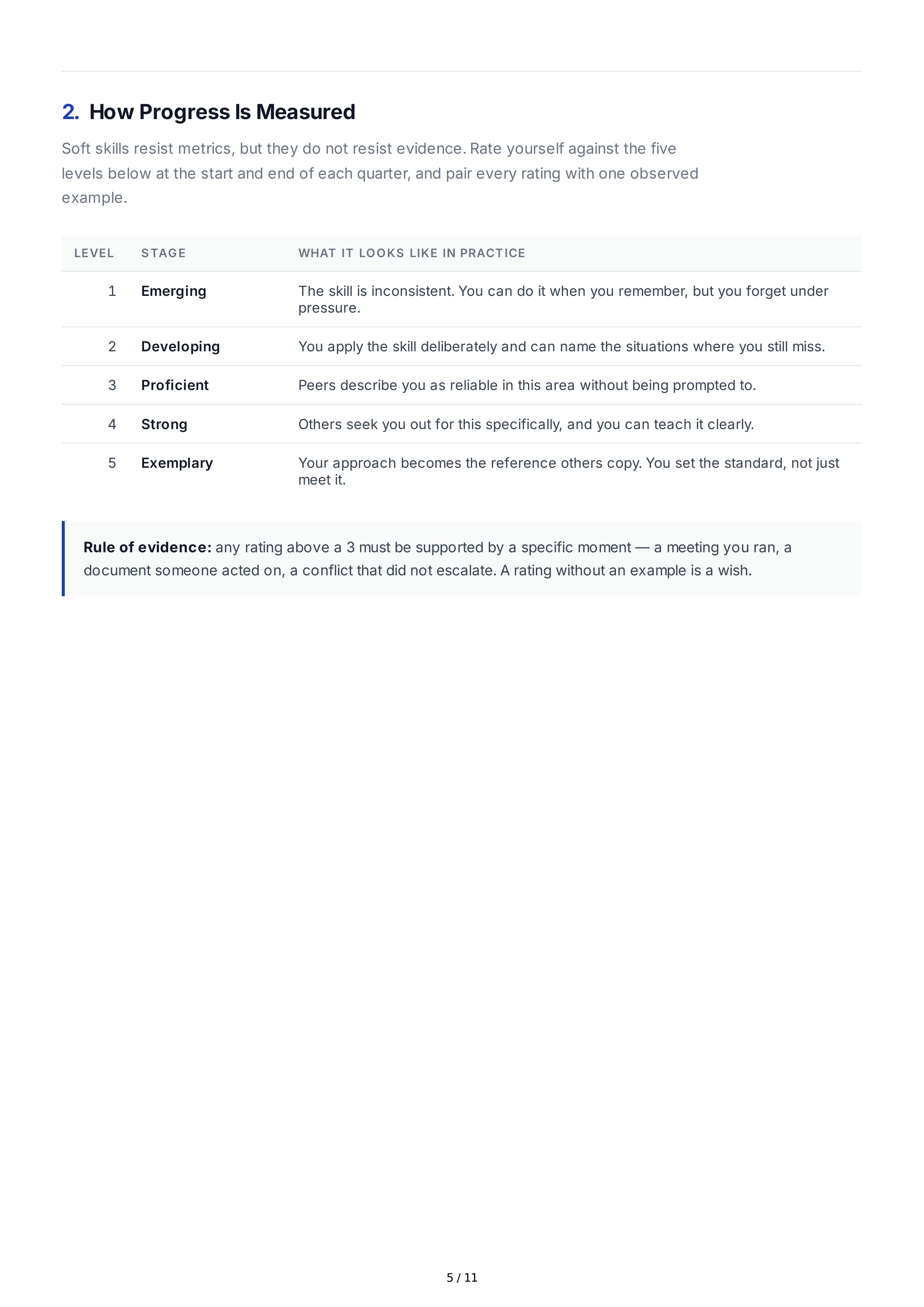
2.
How
Progress
Is
Measured
Soft
skills
resist
metrics
,
but
they
do
not
resist
evidence
.
Rate
yourself
against
the
five
levels
below
at
the
start
and
end
of
each
quarter
,
and
pair
every
rating
with
one
observed
example
.
LEVEL
STAGE
WHAT
IT
LOOKS
LIKE
IN
PRACTICE
1
Emerging
The
skill
is
inconsistent
.
You
can
do
it
when
you
remember
,
but
you
forget
under
pressure
.
2
Developing
You
apply
the
skill
deliberately
and
can
name
the
situations
where
you
still
miss
.
3
Proficient
Peers
describe
you
as
reliable
in
this
area
without
being
prompted
to
.
4
Strong
Others
seek
you
out
for
this
specifically
,
and
you
can
teach
it
clearly
.
5
Exemplary
Your
approach
becomes
the
reference
others
copy
.
You
set
the
standard
,
not
just
meet
it
.
Rule
of
evidence
:
any
rating
above
a
3
must
be
supported
by
a
specific
moment
—
a
meeting
you
ran
,
a
document
someone
acted
on
,
a
conflict
that
did
not
escalate
.
A
rating
without
an
example
is
a
wish
.
5 / 11
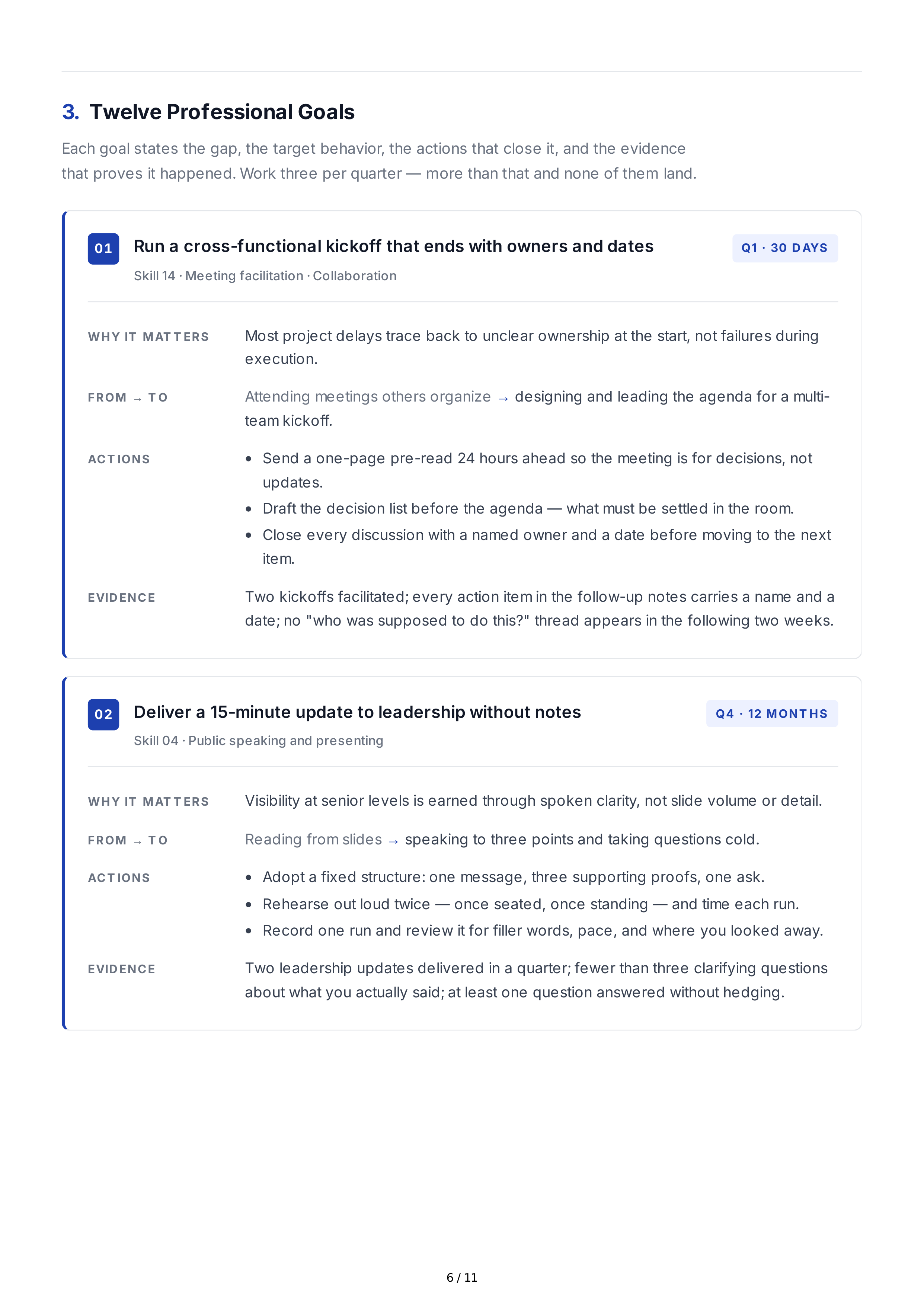
3.
Twelve
Professional
Goals
Each
goal
states
the
gap
,
the
target
behavior
,
the
actions
that
close
it
,
and
the
evidence
that
proves
it
happened
.
Work
three
per
quarter
—
more
than
that
and
none
of
them
land
.
01
Run
a
cross
-
functional
kickoff
that
ends
with
owners
and
dates
Skill
14 ·
Meeting
facilitation
·
Collaboration
Q
1 · 30
D AYS
WHY
IT
MAT T ERS
Most
project
delays
trace
back
to
unclear
ownership
at
the
start
,
not
failures
during
execution
.
FROM
→
T O
Attending
meetings
others
organize
→
designing
and
leading
the
agenda
for
a
multi
-
team
kickoff
.
ACT IONS
Send
a
one
-
page
pre
-
read
24
hours
ahead
so
the
meeting
is
for
decisions
,
not
updates
.
Draft
the
decision
list
before
the
agenda
—
what
must
be
settled
in
the
room
.
Close
every
discussion
with
a
named
owner
and
a
date
before
moving
to
the
next
item
.
EVID ENCE
Two
kickoffs
facilitated
;
every
action
item
in
the
follow
-
up
notes
carries
a
name
and
a
date
;
no
"
who
was
supposed
to
do
this
?"
thread
appears
in
the
following
two
weeks
.
02
Deliver
a
15-
minute
update
to
leadership
without
notes
Skill
04 ·
Public
speaking
and
presenting
Q
4 · 12
MONT HS
WHY
IT
MAT T ERS
Visibility
at
senior
levels
is
earned
through
spoken
clarity
,
not
slide
volume
or
detail
.
FROM
→
T O
Reading
from
slides
→
speaking
to
three
points
and
taking
questions
cold
.
ACT IONS
Adopt
a
fixed
structure
:
one
message
,
three
supporting
proofs
,
one
ask
.
Rehearse
out
loud
twice
—
once
seated
,
once
standing
—
and
time
each
run
.
Record
one
run
and
review
it
for
filler
words
,
pace
,
and
where
you
looked
away
.
EVID ENCE
Two
leadership
updates
delivered
in
a
quarter
;
fewer
than
three
clarifying
questions
about
what
you
actually
said
;
at
least
one
question
answered
without
hedging
.
6 / 11
03
Build
a
feedback
loop
that
actually
changes
behavior
Skill
06 ·
Giving
and
receiving
feedback
Q
3 · 6–9
MONT HS
WHY
IT
MAT T ERS
Feedback
that
is
not
acted
on
within
a
week
is
forgotten
.
Feedback
that
is
acted
on
compounds
.
FROM
→
T O
Hears
feedback
and
nods
→
documents
it
,
picks
one
change
,
and
reports
back
on
the
result
.
ACT IONS
After
every
review
,
write
the
feedback
down
verbatim
before
the
wording
softens
in
memory
.
Choose
one
behavior
to
change
and
consciously
ignore
the
rest
for
30
days
.
Tell
the
reviewer
what
you
changed
and
ask
them
to
re
-
check
it
two
weeks
later
.
EVID ENCE
A
running
feedback
log
with
at
least
four
entries
per
quarter
,
each
with
a
dated
follow
-
up
conversation
attached
.
04
Handle
one
conflict
directly
instead
of
routing
around
it
Skill
10 ·
Conflict
resolution
Q
4 · 12
MONT HS
WHY
IT
MAT T ERS
Unaddressed
tension
between
two
people
quietly
becomes
a
tax
on
the
whole
team
.
FROM
→
T O
Avoiding
the
conversation
or
working
around
the
person
→
initiating
a
private
,
specific
,
blame
-
free
conversation
within
48
hours
.
ACT IONS
Separate
the
issue
from
the
person
in
your
own
framing
before
you
walk
in
.
Open
with
curiosity
about
their
constraint
rather
than
your
grievance
.
Agree
on
one
behavior
change
from
each
side
and
write
it
down
.
EVID ENCE
One
conflict
resolved
with
a
written
recap
both
parties
agree
to
;
no
escalation
to
a
manager
was
needed
.
7 / 11
05
Coach
a
junior
colleague
through
a
full
project
cycle
Skill
30 ·
Coaching
and
mentoring
Q
3 · 6–9
MONT HS
WHY
IT
MAT T ERS
Teaching
is
the
fastest
way
to
convert
your
own
experience
into
judgment
you
can
reuse
.
FROM
→
T O
Answering
questions
→
asking
the
question
that
lets
them
answer
it
themselves
.
ACT IONS
Hold
a
30-
minute
weekly
session
with
an
agenda
they
set
,
not
you
.
Ask
"
what
have
you
tried
?"
before
offering
any
solution
.
Let
them
present
their
own
work
to
stakeholders
,
even
if
you
would
present
it
better
.
EVID ENCE
The
colleague
ships
a
project
end
-
to
-
end
;
they
report
needing
fewer
rescues
over
the
quarter
than
the
one
before
.
06
Write
so
the
reader
acts
on
the
first
read
Skill
03 ·
Written
communication
Q
1 · 30
D AYS
WHY
IT
MAT T ERS
Written
clarity
is
the
highest
-
leverage
skill
in
distributed
and
asynchronous
work
.
FROM
→
T O
Context
first
,
ask
buried
at
the
end
→
recommendation
first
,
evidence
second
.
ACT IONS
Open
every
document
with
the
ask
in
a
single
sentence
.
Cut
the
draft
by
30%
before
sending
—
then
check
the
ask
still
survives
the
cut
.
Put
the
decision
needed
and
the
deadline
in
the
subject
line
.
EVID ENCE
A
measurable
drop
in
"
can
you
clarify
?"
replies
on
written
proposals
;
at
least
two
decisions
made
from
written
documents
alone
,
with
no
meeting
required
.
8 / 11
07
Influence
a
decision
you
do
not
own
Skill
29 ·
Influence
without
authority
Q
2 · 3–6
MONT HS
WHY
IT
MAT T ERS
After
your
first
few
years
,
most
of
your
impact
comes
from
persuading
people
outside
your
reporting
line
.
FROM
→
T O
Waiting
for
the
authority
to
decide
→
mapping
the
stakeholders
before
the
proposal
is
written
.
ACT IONS
Identify
the
four
people
who
can
block
or
accelerate
the
decision
.
Speak
to
each
one
individually
before
the
group
meeting
,
so
the
room
is
never
the
first
conversation
.
Frame
the
proposal
in
terms
of
their
goals
,
not
yours
.
EVID ENCE
One
decision
changed
or
accelerated
through
pre
-
work
;
a
stakeholder
can
state
your
rationale
back
to
you
in
their
own
words
.
08
Decide
faster
with
70%
of
the
information
Skill
25 ·
Decision
-
making
under
uncertainty
Q
2 · 3–6
MONT HS
WHY
IT
MAT T ERS
Slow
decisions
cost
more
than
occasional
wrong
ones
,
as
long
as
the
wrong
ones
are
reversible
.
FROM
→
T O
Gathering
one
more
data
point
→
classifying
each
decision
as
reversible
or
irreversible
and
moving
accordingly
.
ACT IONS
Ask
"
is
this
reversible
?"
before
every
delay
you
are
about
to
justify
.
Set
the
decision
deadline
when
the
topic
opens
,
not
when
the
thread
has
run
for
a
week
.
Write
a
one
-
line
rationale
for
each
call
so
the
thinking
stays
auditable
.
EVID ENCE
Average
turnaround
on
reversible
decisions
drops
noticeably
;
a
decision
log
with
ten
or
more
entries
and
their
rationales
.
9 / 11
09
Make
every
meeting
you
run
produce
owners
and
dates
Skill
14 ·
Meeting
facilitation
·
Skill
32
Accountability
Q
1 · 30
D AYS
WHY
IT
MAT T ERS
Meetings
are
where
momentum
goes
to
die
when
nobody
leaves
with
a
job
to
do
.
FROM
→
T O
"
Good
discussion
"
→
five
lines
of
commitments
in
the
follow
-
up
note
.
ACT IONS
Send
an
agenda
with
a
stated
purpose
and
a
timebox
for
each
item
.
End
five
minutes
early
to
assign
actions
while
everyone
is
still
present
.
Circulate
notes
within
two
hours
,
formatted
as
owner
,
action
,
date
.
EVID ENCE
Follow
-
up
notes
sent
within
two
hours
for
every
meeting
you
own
;
fewer
than
10%
of
action
items
carried
over
twice
.
10
Stay
effective
when
priorities
shift
mid
-
quarter
Skill
36 ·
Adaptability
and
resilience
Q
4 · 12
MONT HS
WHY
IT
MAT T ERS
Composure
under
change
is
what
separates
people
who
are
trusted
with
larger
scopes
.
FROM
→
T O
Frustrated
by
re
-
planning
→
re
-
plans
within
a
day
and
states
plainly
what
is
now
being
dropped
.
ACT IONS
Keep
a
visible
priority
list
in
three
tiers
so
re
-
ranking
is
a
decision
,
not
a
scramble
.
When
a
new
priority
lands
,
name
explicitly
what
you
will
stop
doing
to
make
room
.
Reframe
the
change
for
your
team
in
one
sentence
within
24
hours
.
EVID ENCE
Two
mid
-
quarter
replans
handled
within
a
day
,
with
no
commitments
missed
;
a
manager
or
peer
comments
on
the
steadiness
.
10 / 11
11
Protect
two
hours
of
deep
work
,
four
days
a
week
Skill
39 ·
Deep
work
and
focus
Q
3 · 6–9
MONT HS
WHY
IT
MAT T ERS
Attention
is
the
raw
material
of
every
other
soft
skill
.
Fragmented
attention
makes
all
of
them
harder
.
FROM
→
T O
A
calendar
that
fills
itself
→
a
calendar
with
defended
blocks
that
other
people
respect
.
ACT IONS
Block
the
first
two
hours
of
the
day
before
anyone
else
can
claim
them
.
Set
a
focus
status
and
turn
off
notifications
for
the
duration
of
the
block
.
Batch
messages
into
two
windows
a
day
instead
of
answering
them
as
they
arrive
.
EVID ENCE
A
four
-
week
streak
of
at
least
eight
protected
blocks
per
week
,
reviewed
every
Friday
and
recorded
.
12
Tell
the
story
of
your
work
with
numbers
Skill
05 ·
Storytelling
with
data
·
Skill
33
Executive
communication
Q
2 · 3–6
MONT HS
WHY
IT
MAT T ERS
Good
work
that
is
not
quantified
gets
discounted
at
review
time
,
regardless
of
the
effort
behind
it
.
FROM
→
T O
Describing
activity
→
describing
outcome
—
cost
avoided
,
time
saved
,
failures
prevented
.
ACT IONS
Pick
one
metric
per
project
on
day
one
and
track
it
through
to
the
end
.
Rewrite
your
last
status
update
as
a
single
before
-
and
-
after
sentence
.
Build
one
chart
that
shows
the
change
in
the
outcome
,
not
the
shape
of
the
process
.
EVID ENCE
Every
monthly
update
leads
with
a
number
;
a
manager
repeats
your
framing
in
a
leadership
meeting
.
11 / 11
