Relationship
Building
—
Professional
Goals
1 / 8
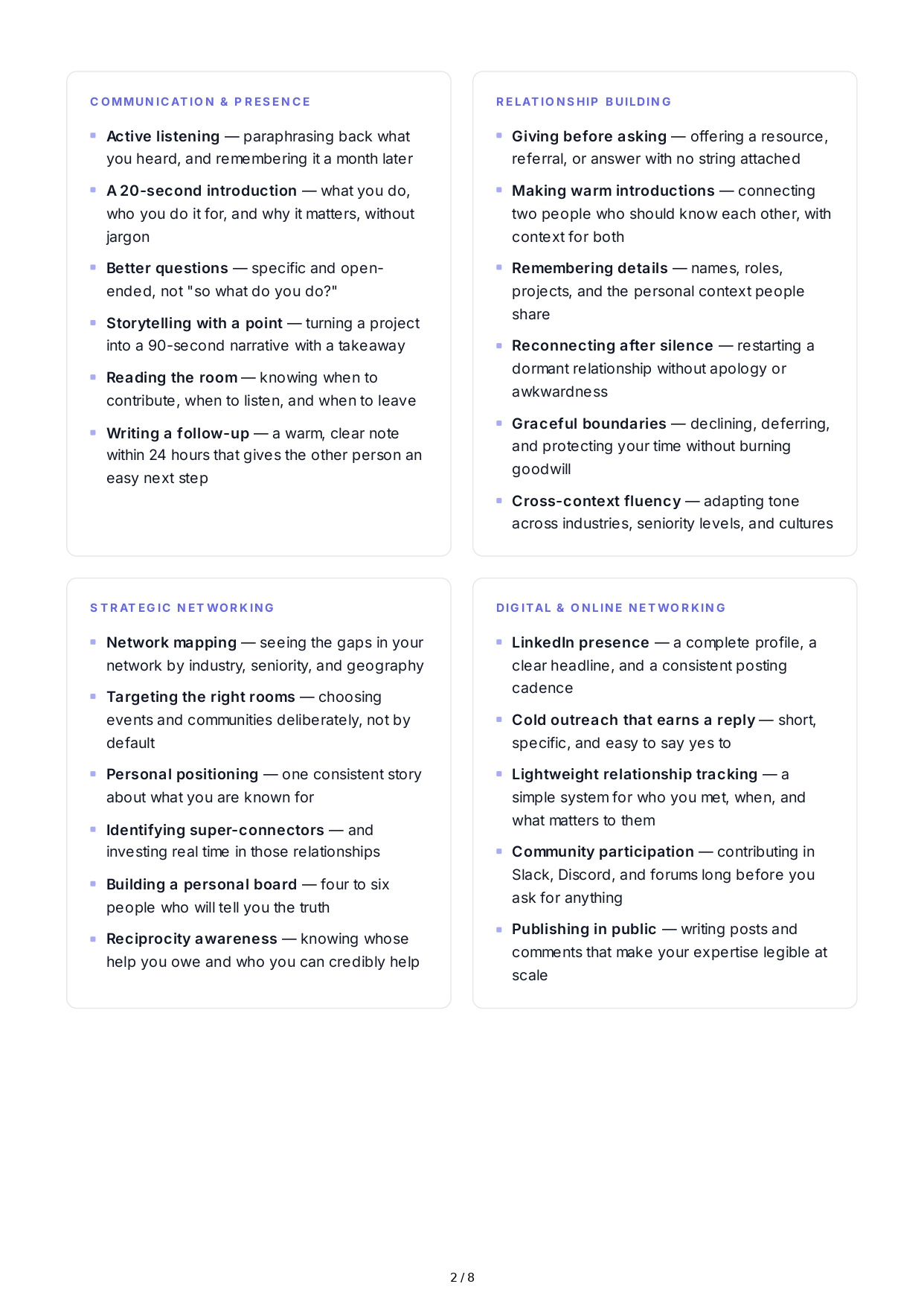
COMMUN ICAT ION
FUN DAMEN TALS
T RUST
AN D
RELIABILIT Y
EMOT ION AL
IN T ELLIG EN CE
N ET WORKIN G
AN D
OUT REACH
IN FLUEN CE
AN D
COLLABORAT ION
CON FLICT
AN D
DIFFICULT
CON VERSAT ION S
RELAT ION SHIP
MAIN T EN AN CE
REMOT E
AN D
DIG ITAL
PRESEN CE
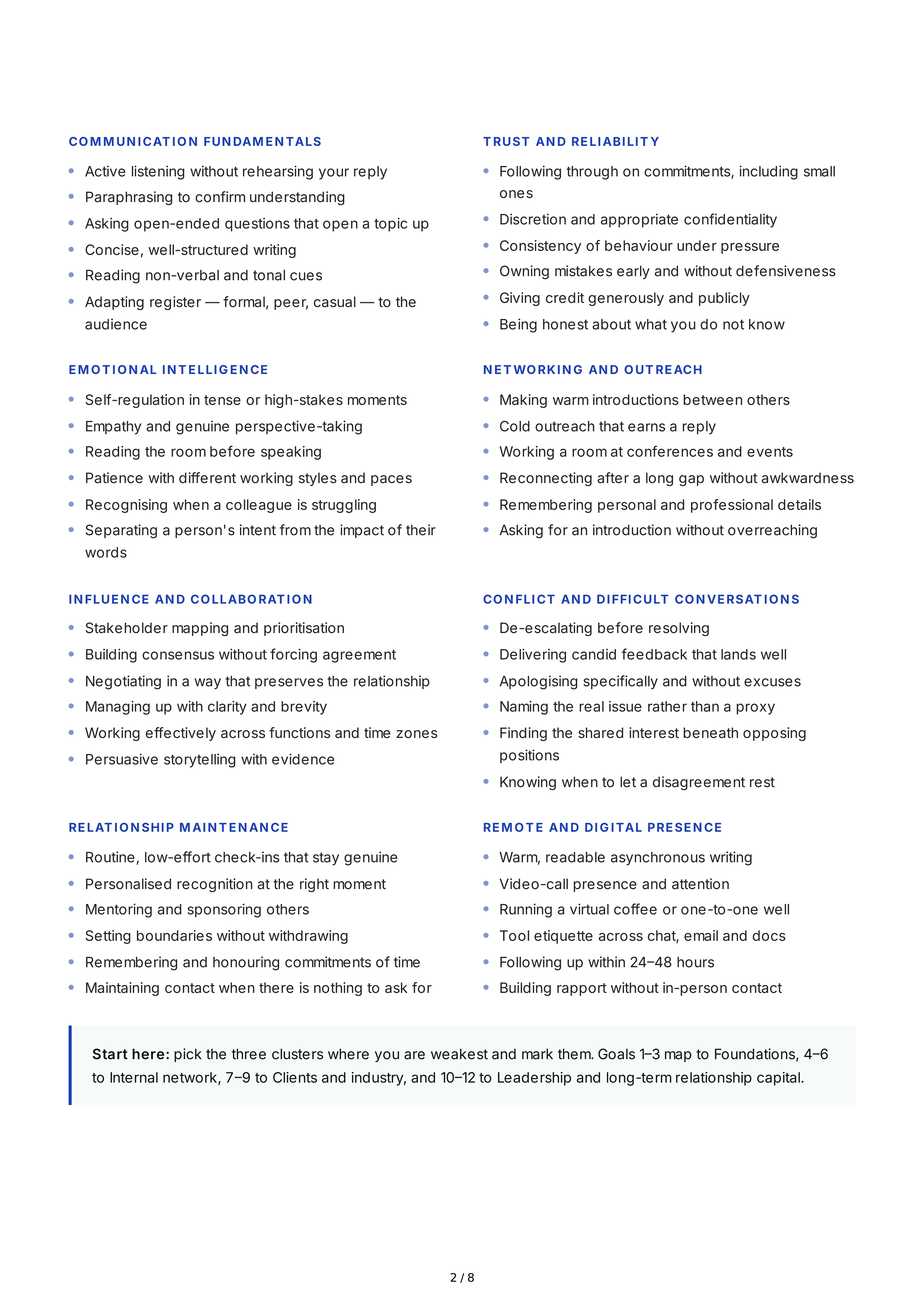
Start
here
:
pick
the
three
clusters
where
you
are
weakest
and
mark
them
.
Goals
1–3
map
to
Foundations
, 4–6
to
Internal
network
, 7–9
to
Clients
and
industry
,
and
10–12
to
Leadership
and
long
-
term
relationship
capital
.
Active
listening
without
rehearsing
your
reply
Paraphrasing
to
confirm
understanding
Asking
open
-
ended
questions
that
open
a
topic
up
Concise
,
well
-
structured
writing
Reading
non
-
verbal
and
tonal
cues
Adapting
register
—
formal
,
peer
,
casual
—
to
the
audience
Following
through
on
commitments
,
including
small
ones
Discretion
and
appropriate
confidentiality
Consistency
of
behaviour
under
pressure
Owning
mistakes
early
and
without
defensiveness
Giving
credit
generously
and
publicly
Being
honest
about
what
you
do
not
know
Self
-
regulation
in
tense
or
high
-
stakes
moments
Empathy
and
genuine
perspective
-
taking
Reading
the
room
before
speaking
Patience
with
different
working
styles
and
paces
Recognising
when
a
colleague
is
struggling
Separating
a
person
'
s
intent
from
the
impact
of
their
words
Making
warm
introductions
between
others
Cold
outreach
that
earns
a
reply
Working
a
room
at
conferences
and
events
Reconnecting
after
a
long
gap
without
awkwardness
Remembering
personal
and
professional
details
Asking
for
an
introduction
without
overreaching
Stakeholder
mapping
and
prioritisation
Building
consensus
without
forcing
agreement
Negotiating
in
a
way
that
preserves
the
relationship
Managing
up
with
clarity
and
brevity
Working
effectively
across
functions
and
time
zones
Persuasive
storytelling
with
evidence
De
-
escalating
before
resolving
Delivering
candid
feedback
that
lands
well
Apologising
specifically
and
without
excuses
Naming
the
real
issue
rather
than
a
proxy
Finding
the
shared
interest
beneath
opposing
positions
Knowing
when
to
let
a
disagreement
rest
Routine
,
low
-
effort
check
-
ins
that
stay
genuine
Personalised
recognition
at
the
right
moment
Mentoring
and
sponsoring
others
Setting
boundaries
without
withdrawing
Remembering
and
honouring
commitments
of
time
Maintaining
contact
when
there
is
nothing
to
ask
for
Warm
,
readable
asynchronous
writing
Video
-
call
presence
and
attention
Running
a
virtual
coffee
or
one
-
to
-
one
well
Tool
etiquette
across
chat
,
email
and
docs
Following
up
within
24–48
hours
Building
rapport
without
in
-
person
contact
2 / 8
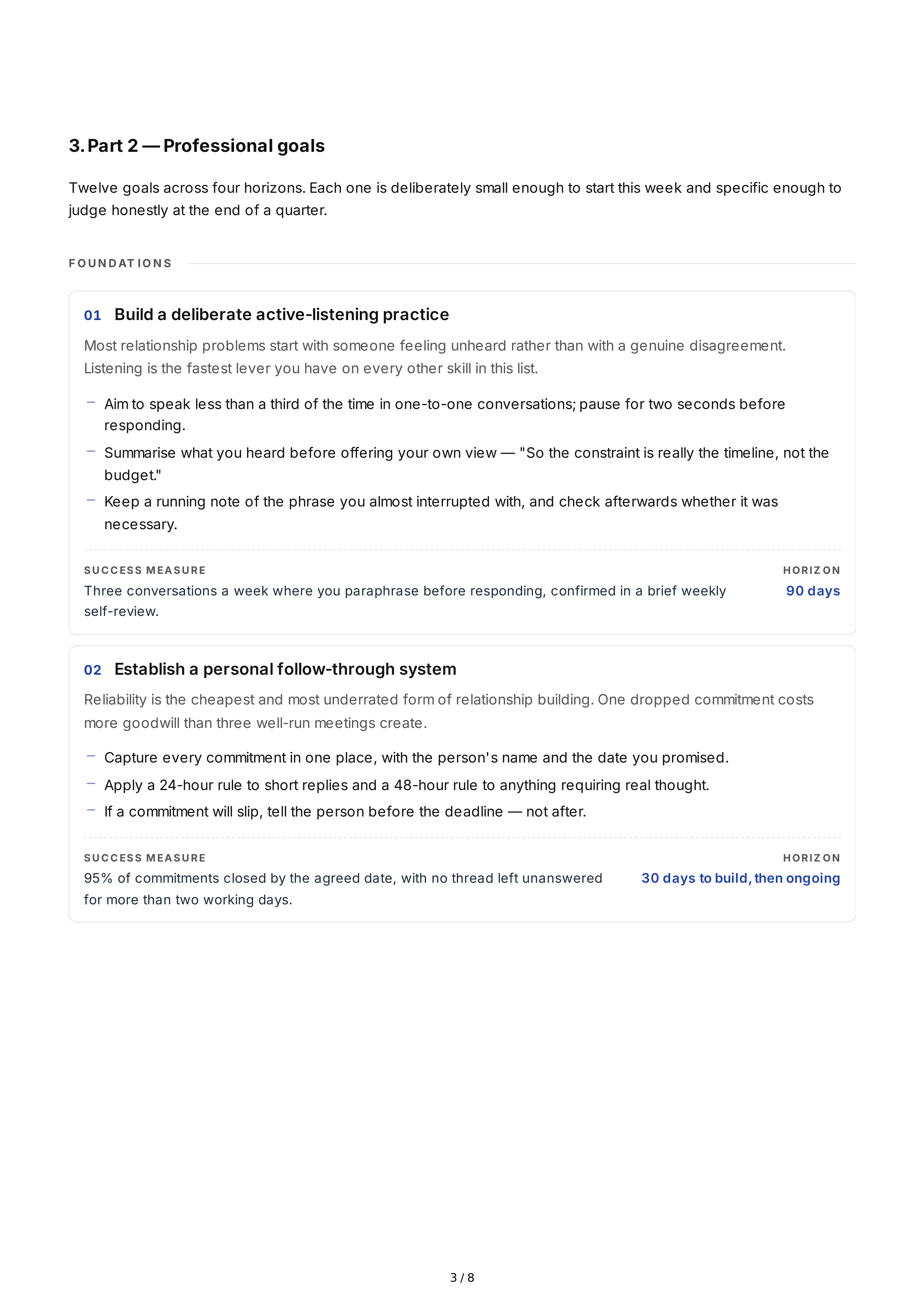
3.
Part
2 —
Professional
goals
Twelve
goals
across
four
horizons
.
Each
one
is
deliberately
small
enough
to
start
this
week
and
specific
enough
to
judge
honestly
at
the
end
of
a
quarter
.
F O UN DAT IO N S
01
Build
a
deliberate
active
-
listening
practice
Most
relationship
problems
start
with
someone
feeling
unheard
rather
than
with
a
genuine
disagreement
.
Listening
is
the
fastest
lever
you
have
on
every
other
skill
in
this
list
.
SU C C ESS
M EA SU RE
Three
conversations
a
week
where
you
paraphrase
before
responding
,
confirmed
in
a
brief
weekly
self
-
review
.
H ORIZ ON
90
days
02
Establish
a
personal
follow
-
through
system
Reliability
is
the
cheapest
and
most
underrated
form
of
relationship
building
.
One
dropped
commitment
costs
more
goodwill
than
three
well
-
run
meetings
create
.
SU C C ESS
M EA SU RE
95%
of
commitments
closed
by
the
agreed
date
,
with
no
thread
left
unanswered
for
more
than
two
working
days
.
H ORIZ ON
30
days
to
build
,
then
ongoing
Aim
to
speak
less
than
a
third
of
the
time
in
one
-
to
-
one
conversations
;
pause
for
two
seconds
before
responding
.
Summarise
what
you
heard
before
offering
your
own
view
— "
So
the
constraint
is
really
the
timeline
,
not
the
budget
."
Keep
a
running
note
of
the
phrase
you
almost
interrupted
with
,
and
check
afterwards
whether
it
was
necessary
.
Capture
every
commitment
in
one
place
,
with
the
person
'
s
name
and
the
date
you
promised
.
Apply
a
24-
hour
rule
to
short
replies
and
a
48-
hour
rule
to
anything
requiring
real
thought
.
If
a
commitment
will
slip
,
tell
the
person
before
the
deadline
—
not
after
.
3 / 8
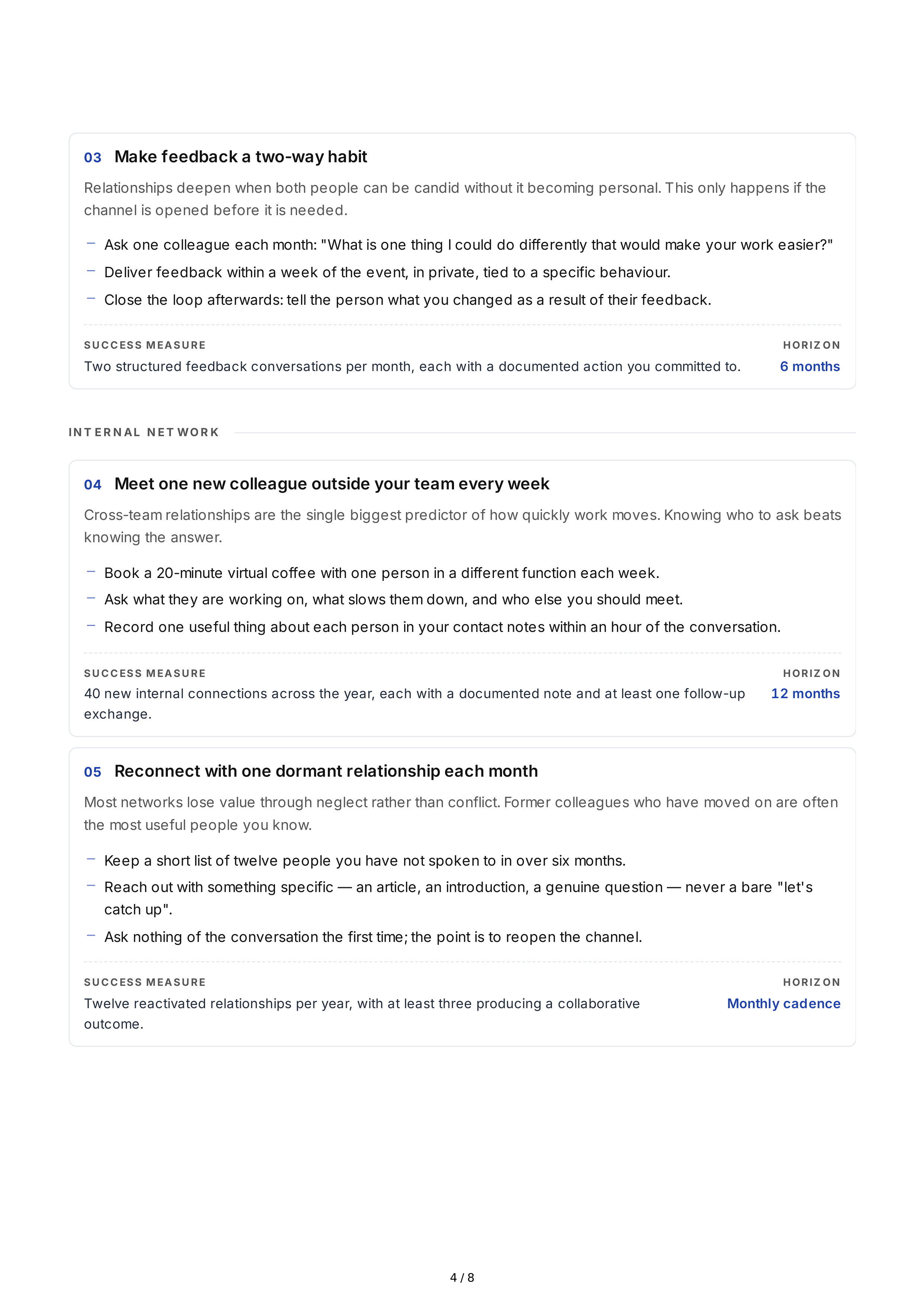
03
Make
feedback
a
two
-
way
habit
Relationships
deepen
when
both
people
can
be
candid
without
it
becoming
personal
.
This
only
happens
if
the
channel
is
opened
before
it
is
needed
.
SU C C ESS
M EA SU RE
Two
structured
feedback
conversations
per
month
,
each
with
a
documented
action
you
committed
to
.
H ORIZ ON
6
months
IN T E R N AL
N E T WO R K
04
Meet
one
new
colleague
outside
your
team
every
week
Cross
-
team
relationships
are
the
single
biggest
predictor
of
how
quickly
work
moves
.
Knowing
who
to
ask
beats
knowing
the
answer
.
SU C C ESS
M EA SU RE
40
new
internal
connections
across
the
year
,
each
with
a
documented
note
and
at
least
one
follow
-
up
exchange
.
H ORIZ ON
12
months
05
Reconnect
with
one
dormant
relationship
each
month
Most
networks
lose
value
through
neglect
rather
than
conflict
.
Former
colleagues
who
have
moved
on
are
often
the
most
useful
people
you
know
.
SU C C ESS
M EA SU RE
Twelve
reactivated
relationships
per
year
,
with
at
least
three
producing
a
collaborative
outcome
.
H ORIZ ON
Monthly
cadence
Ask
one
colleague
each
month
: "
What
is
one
thing
I
could
do
differently
that
would
make
your
work
easier
?"
Deliver
feedback
within
a
week
of
the
event
,
in
private
,
tied
to
a
specific
behaviour
.
Close
the
loop
afterwards
:
tell
the
person
what
you
changed
as
a
result
of
their
feedback
.
Book
a
20-
minute
virtual
coffee
with
one
person
in
a
different
function
each
week
.
Ask
what
they
are
working
on
,
what
slows
them
down
,
and
who
else
you
should
meet
.
Record
one
useful
thing
about
each
person
in
your
contact
notes
within
an
hour
of
the
conversation
.
Keep
a
short
list
of
twelve
people
you
have
not
spoken
to
in
over
six
months
.
Reach
out
with
something
specific
—
an
article
,
an
introduction
,
a
genuine
question
—
never
a
bare
"
let
'
s
catch
up
".
Ask
nothing
of
the
conversation
the
first
time
;
the
point
is
to
reopen
the
channel
.
4 / 8
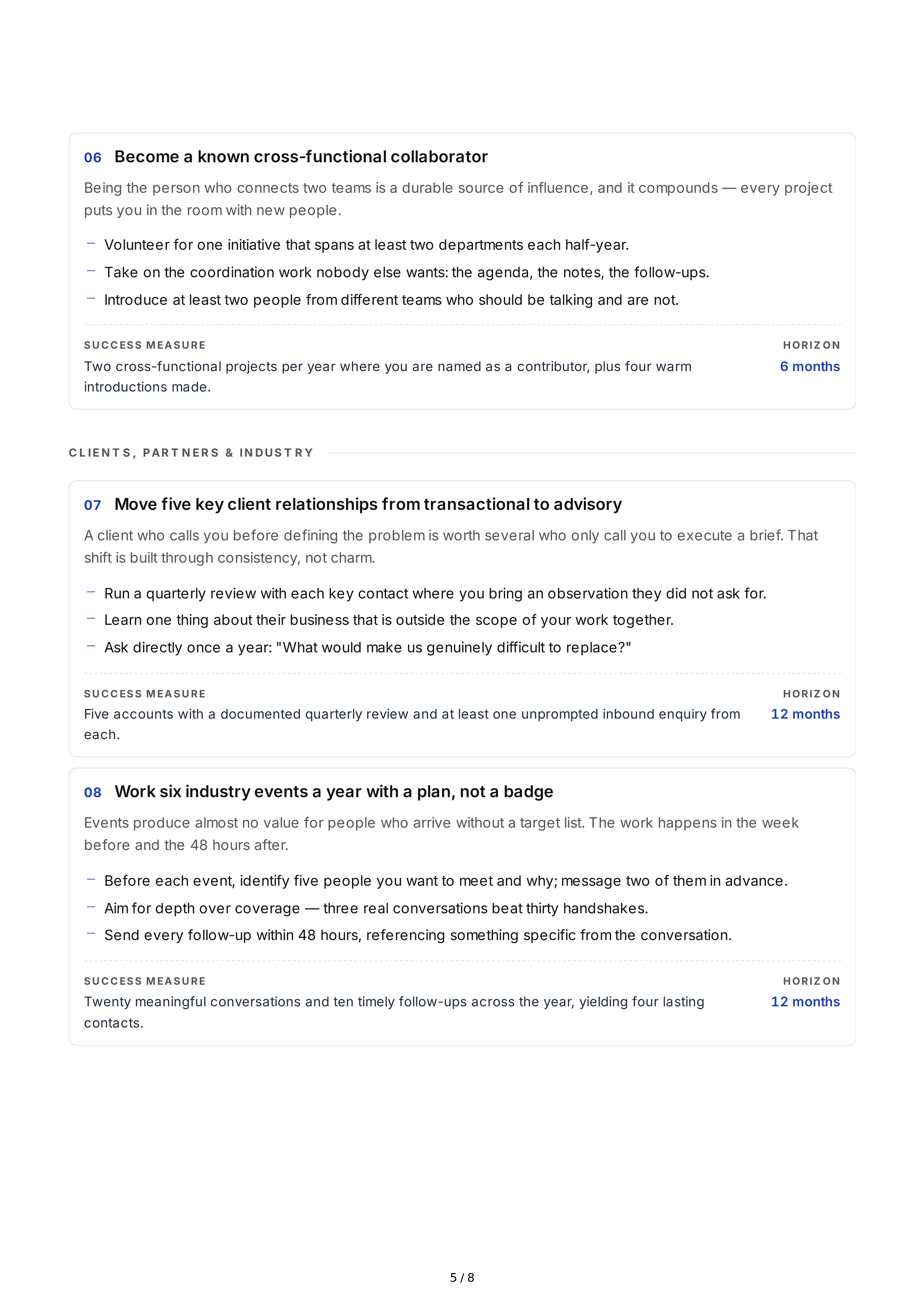
06
Become
a
known
cross
-
functional
collaborator
Being
the
person
who
connects
two
teams
is
a
durable
source
of
influence
,
and
it
compounds
—
every
project
puts
you
in
the
room
with
new
people
.
SU C C ESS
M EA SU RE
Two
cross
-
functional
projects
per
year
where
you
are
named
as
a
contributor
,
plus
four
warm
introductions
made
.
H ORIZ ON
6
months
C L IE N T S
,
PAR T N E R S
&
IN DUS T R Y
07
Move
five
key
client
relationships
from
transactional
to
advisory
A
client
who
calls
you
before
defining
the
problem
is
worth
several
who
only
call
you
to
execute
a
brief
.
That
shift
is
built
through
consistency
,
not
charm
.
SU C C ESS
M EA SU RE
Five
accounts
with
a
documented
quarterly
review
and
at
least
one
unprompted
inbound
enquiry
from
each
.
H ORIZ ON
12
months
08
Work
six
industry
events
a
year
with
a
plan
,
not
a
badge
Events
produce
almost
no
value
for
people
who
arrive
without
a
target
list
.
The
work
happens
in
the
week
before
and
the
48
hours
after
.
SU C C ESS
M EA SU RE
Twenty
meaningful
conversations
and
ten
timely
follow
-
ups
across
the
year
,
yielding
four
lasting
contacts
.
H ORIZ ON
12
months
Volunteer
for
one
initiative
that
spans
at
least
two
departments
each
half
-
year
.
Take
on
the
coordination
work
nobody
else
wants
:
the
agenda
,
the
notes
,
the
follow
-
ups
.
Introduce
at
least
two
people
from
different
teams
who
should
be
talking
and
are
not
.
Run
a
quarterly
review
with
each
key
contact
where
you
bring
an
observation
they
did
not
ask
for
.
Learn
one
thing
about
their
business
that
is
outside
the
scope
of
your
work
together
.
Ask
directly
once
a
year
: "
What
would
make
us
genuinely
difficult
to
replace
?"
Before
each
event
,
identify
five
people
you
want
to
meet
and
why
;
message
two
of
them
in
advance
.
Aim
for
depth
over
coverage
—
three
real
conversations
beat
thirty
handshakes
.
Send
every
follow
-
up
within
48
hours
,
referencing
something
specific
from
the
conversation
.
5 / 8
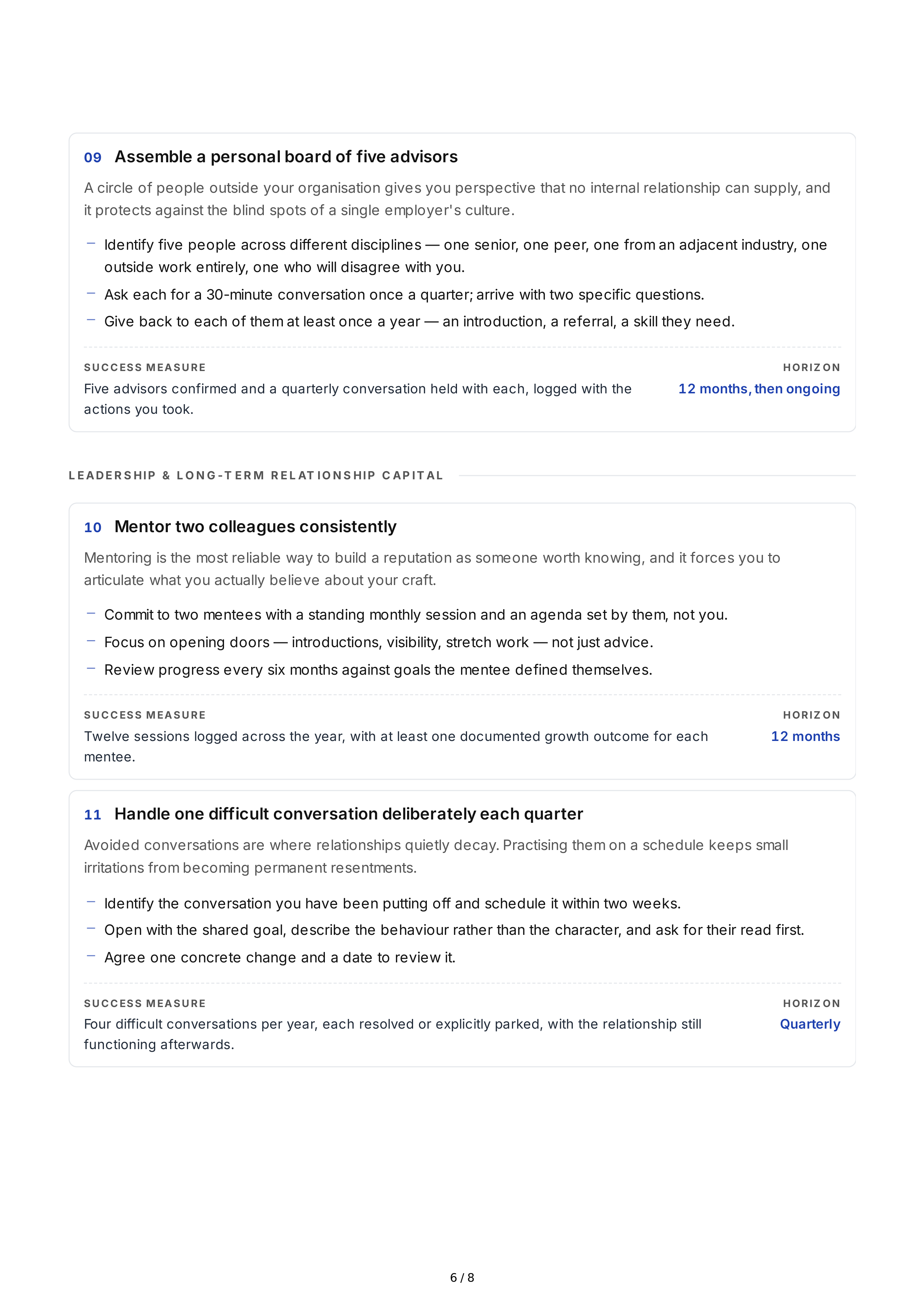
09
Assemble
a
personal
board
of
five
advisors
A
circle
of
people
outside
your
organisation
gives
you
perspective
that
no
internal
relationship
can
supply
,
and
it
protects
against
the
blind
spots
of
a
single
employer
'
s
culture
.
SU C C ESS
M EA SU RE
Five
advisors
confirmed
and
a
quarterly
conversation
held
with
each
,
logged
with
the
actions
you
took
.
H ORIZ ON
12
months
,
then
ongoing
L E ADE R S HIP
&
L O N G
-
T E R M
R E L AT IO N S HIP
C AP IT AL
10
Mentor
two
colleagues
consistently
Mentoring
is
the
most
reliable
way
to
build
a
reputation
as
someone
worth
knowing
,
and
it
forces
you
to
articulate
what
you
actually
believe
about
your
craft
.
SU C C ESS
M EA SU RE
Twelve
sessions
logged
across
the
year
,
with
at
least
one
documented
growth
outcome
for
each
mentee
.
H ORIZ ON
12
months
11
Handle
one
difficult
conversation
deliberately
each
quarter
Avoided
conversations
are
where
relationships
quietly
decay
.
Practising
them
on
a
schedule
keeps
small
irritations
from
becoming
permanent
resentments
.
SU C C ESS
M EA SU RE
Four
difficult
conversations
per
year
,
each
resolved
or
explicitly
parked
,
with
the
relationship
still
functioning
afterwards
.
H ORIZ ON
Quarterly
Identify
five
people
across
different
disciplines
—
one
senior
,
one
peer
,
one
from
an
adjacent
industry
,
one
outside
work
entirely
,
one
who
will
disagree
with
you
.
Ask
each
for
a
30-
minute
conversation
once
a
quarter
;
arrive
with
two
specific
questions
.
Give
back
to
each
of
them
at
least
once
a
year
—
an
introduction
,
a
referral
,
a
skill
they
need
.
Commit
to
two
mentees
with
a
standing
monthly
session
and
an
agenda
set
by
them
,
not
you
.
Focus
on
opening
doors
—
introductions
,
visibility
,
stretch
work
—
not
just
advice
.
Review
progress
every
six
months
against
goals
the
mentee
defined
themselves
.
Identify
the
conversation
you
have
been
putting
off
and
schedule
it
within
two
weeks
.
Open
with
the
shared
goal
,
describe
the
behaviour
rather
than
the
character
,
and
ask
for
their
read
first
.
Agree
one
concrete
change
and
a
date
to
review
it
.
6 / 8
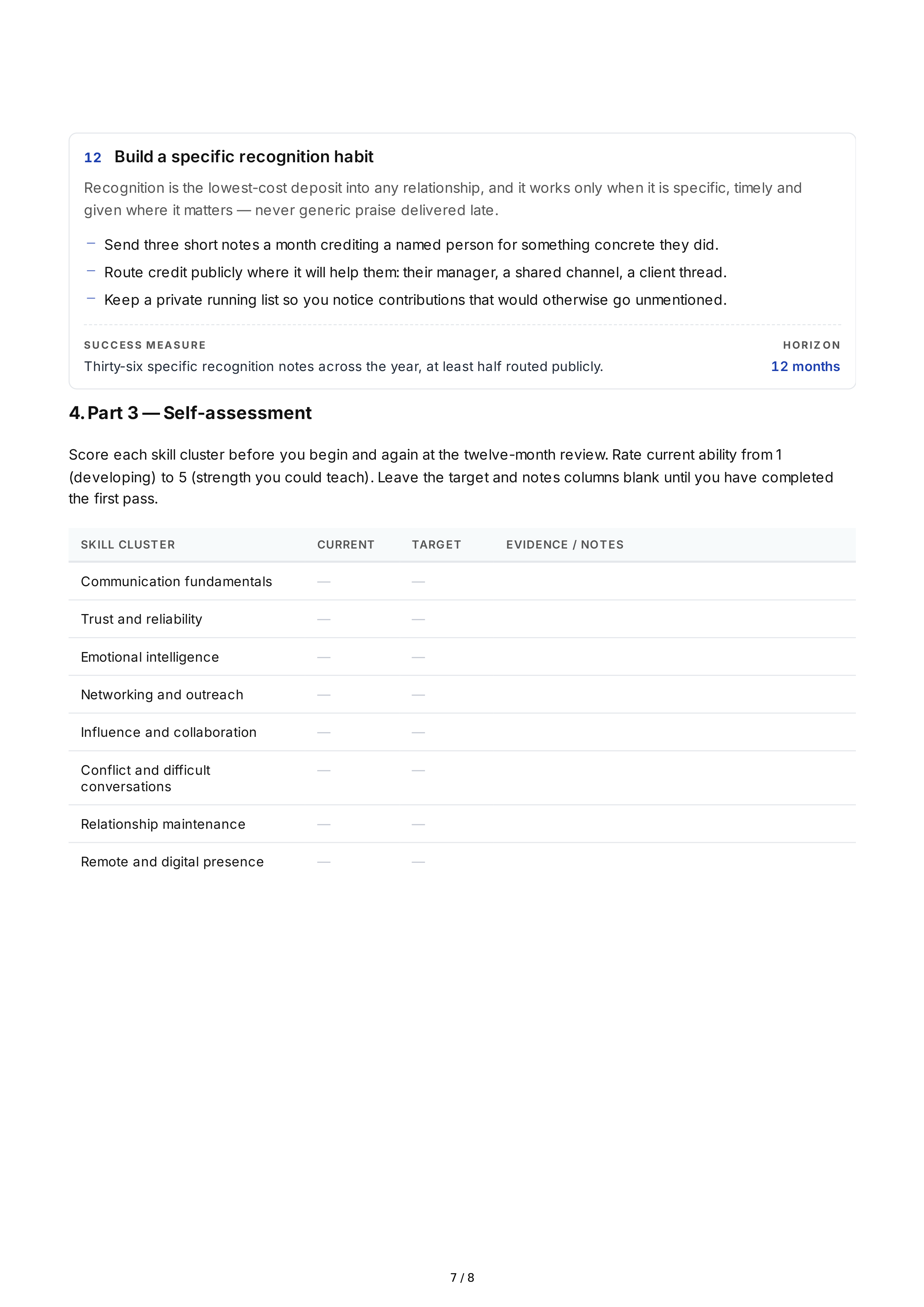
12
Build
a
specific
recognition
habit
Recognition
is
the
lowest
-
cost
deposit
into
any
relationship
,
and
it
works
only
when
it
is
specific
,
timely
and
given
where
it
matters
—
never
generic
praise
delivered
late
.
SU C C ESS
M EA SU RE
Thirty
-
six
specific
recognition
notes
across
the
year
,
at
least
half
routed
publicly
.
H ORIZ ON
12
months
4.
Part
3 —
Self
-
assessment
Score
each
skill
cluster
before
you
begin
and
again
at
the
twelve
-
month
review
.
Rate
current
ability
from
1
(
developing
)
to
5 (
strength
you
could
teach
).
Leave
the
target
and
notes
columns
blank
until
you
have
completed
the
first
pass
.
SKILL
CLUSTER
CURRENT
TARGET
EVIDENCE
/
NOTES
Communication
fundamentals
—
—
Trust
and
reliability
—
—
Emotional
intelligence
—
—
Networking
and
outreach
—
—
Influence
and
collaboration
—
—
Conflict
and
difficult
conversations
—
—
Relationship
maintenance
—
—
Remote
and
digital
presence
—
—
Send
three
short
notes
a
month
crediting
a
named
person
for
something
concrete
they
did
.
Route
credit
publicly
where
it
will
help
them
:
their
manager
,
a
shared
channel
,
a
client
thread
.
Keep
a
private
running
list
so
you
notice
contributions
that
would
otherwise
go
unmentioned
.
7 / 8
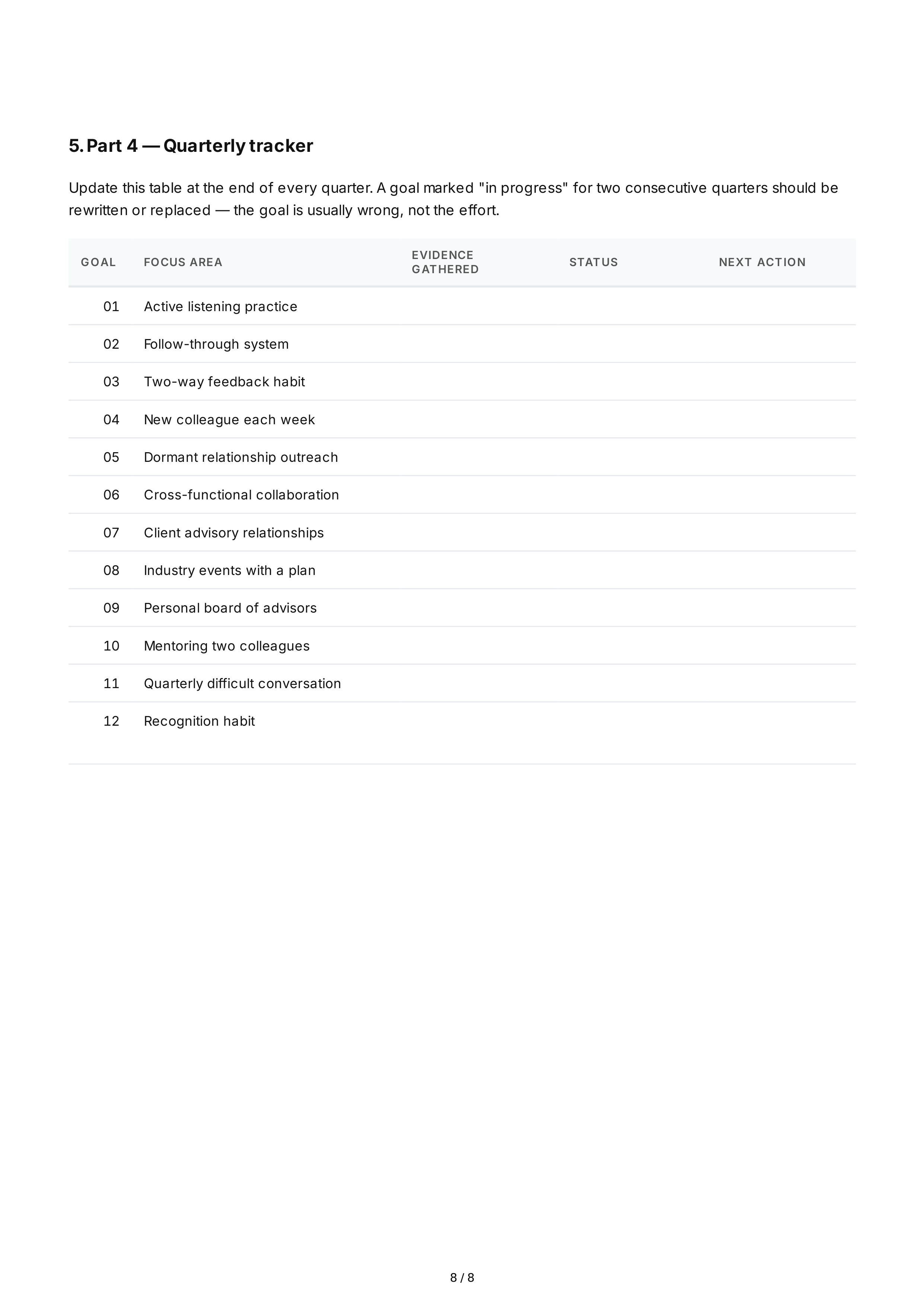
5.
Part
4 —
Quarterly
tracker
Update
this
table
at
the
end
of
every
quarter
.
A
goal
marked
"
in
progress
"
for
two
consecutive
quarters
should
be
rewritten
or
replaced
—
the
goal
is
usually
wrong
,
not
the
effort
.
GOAL
FOCUS
AREA
EVIDENCE
GATHERED
STATUS
NEXT
ACTION
01
Active
listening
practice
02
Follow
-
through
system
03
Two
-
way
feedback
habit
04
New
colleague
each
week
05
Dormant
relationship
outreach
06
Cross
-
functional
collaboration
07
Client
advisory
relationships
08
Industry
events
with
a
plan
09
Personal
board
of
advisors
10
Mentoring
two
colleagues
11
Quarterly
difficult
conversation
12
Recognition
habit
8 / 8