Creative
Skill
Development
—
Professional
Goals
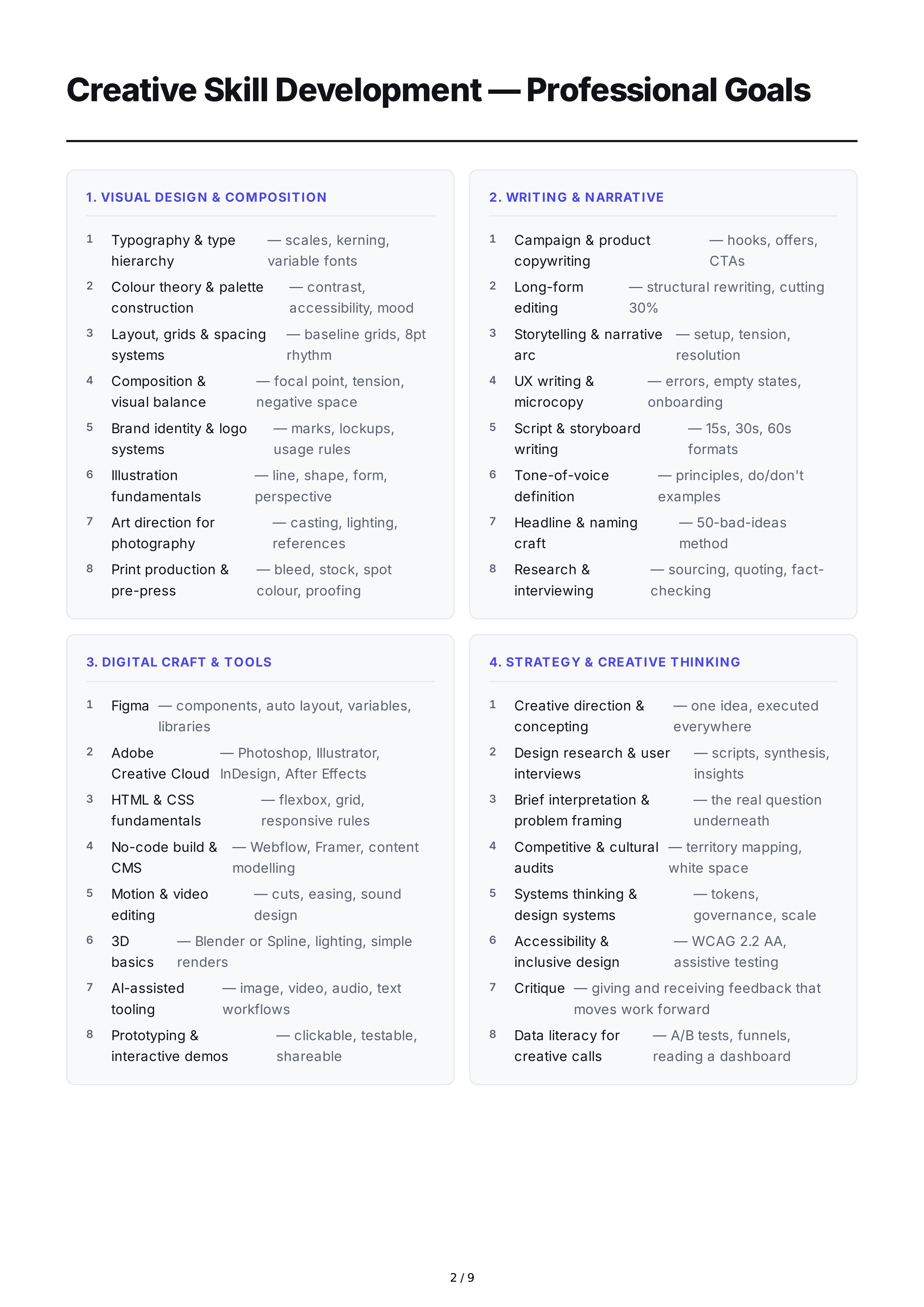
1.
VISUAL
DESIGN
&
COMPOSITION
1
Typography
&
type
hierarchy
—
scales
,
kerning
,
variable
fonts
2
Colour
theory
&
palette
construction
—
contrast
,
accessibility
,
mood
3
Layout
,
grids
&
spacing
systems
—
baseline
grids
, 8
pt
rhythm
4
Composition
&
visual
balance
—
focal
point
,
tension
,
negative
space
5
Brand
identity
&
logo
systems
—
marks
,
lockups
,
usage
rules
6
Illustration
fundamentals
—
line
,
shape
,
form
,
perspective
7
Art
direction
for
photography
—
casting
,
lighting
,
references
8
Print
production
&
pre
-
press
—
bleed
,
stock
,
spot
colour
,
proofing
2.
WRITING
&
NARRATIVE
1
Campaign
&
product
copywriting
—
hooks
,
offers
,
CTAs
2
Long
-
form
editing
—
structural
rewriting
,
cutting
30%
3
Storytelling
&
narrative
arc
—
setup
,
tension
,
resolution
4
UX
writing
&
microcopy
—
errors
,
empty
states
,
onboarding
5
Script
&
storyboard
writing
— 15
s
, 30
s
, 60
s
formats
6
Tone
-
of
-
voice
definition
—
principles
,
do
/
don
'
t
examples
7
Headline
&
naming
craft
— 50-
bad
-
ideas
method
8
Research
&
interviewing
—
sourcing
,
quoting
,
fact
-
checking
3.
DIGITAL
CRAFT
&
TOOLS
1
Figma
—
components
,
auto
layout
,
variables
,
libraries
2
Adobe
Creative
Cloud
—
Photoshop
,
Illustrator
,
InDesign
,
After
Effects
3
HTML
&
CSS
fundamentals
—
flexbox
,
grid
,
responsive
rules
4
No
-
code
build
&
CMS
—
Webflow
,
Framer
,
content
modelling
5
Motion
&
video
editing
—
cuts
,
easing
,
sound
design
6
3
D
basics
—
Blender
or
Spline
,
lighting
,
simple
renders
7
AI
-
assisted
tooling
—
image
,
video
,
audio
,
text
workflows
8
Prototyping
&
interactive
demos
—
clickable
,
testable
,
shareable
4.
STRATEGY
&
CREATIVE
THINKING
1
Creative
direction
&
concepting
—
one
idea
,
executed
everywhere
2
Design
research
&
user
interviews
—
scripts
,
synthesis
,
insights
3
Brief
interpretation
&
problem
framing
—
the
real
question
underneath
4
Competitive
&
cultural
audits
—
territory
mapping
,
white
space
5
Systems
thinking
&
design
systems
—
tokens
,
governance
,
scale
6
Accessibility
&
inclusive
design
—
WCAG
2.2
AA
,
assistive
testing
7
Critique
—
giving
and
receiving
feedback
that
moves
work
forward
8
Data
literacy
for
creative
calls
—
A
/
B
tests
,
funnels
,
reading
a
dashboard
2 / 9
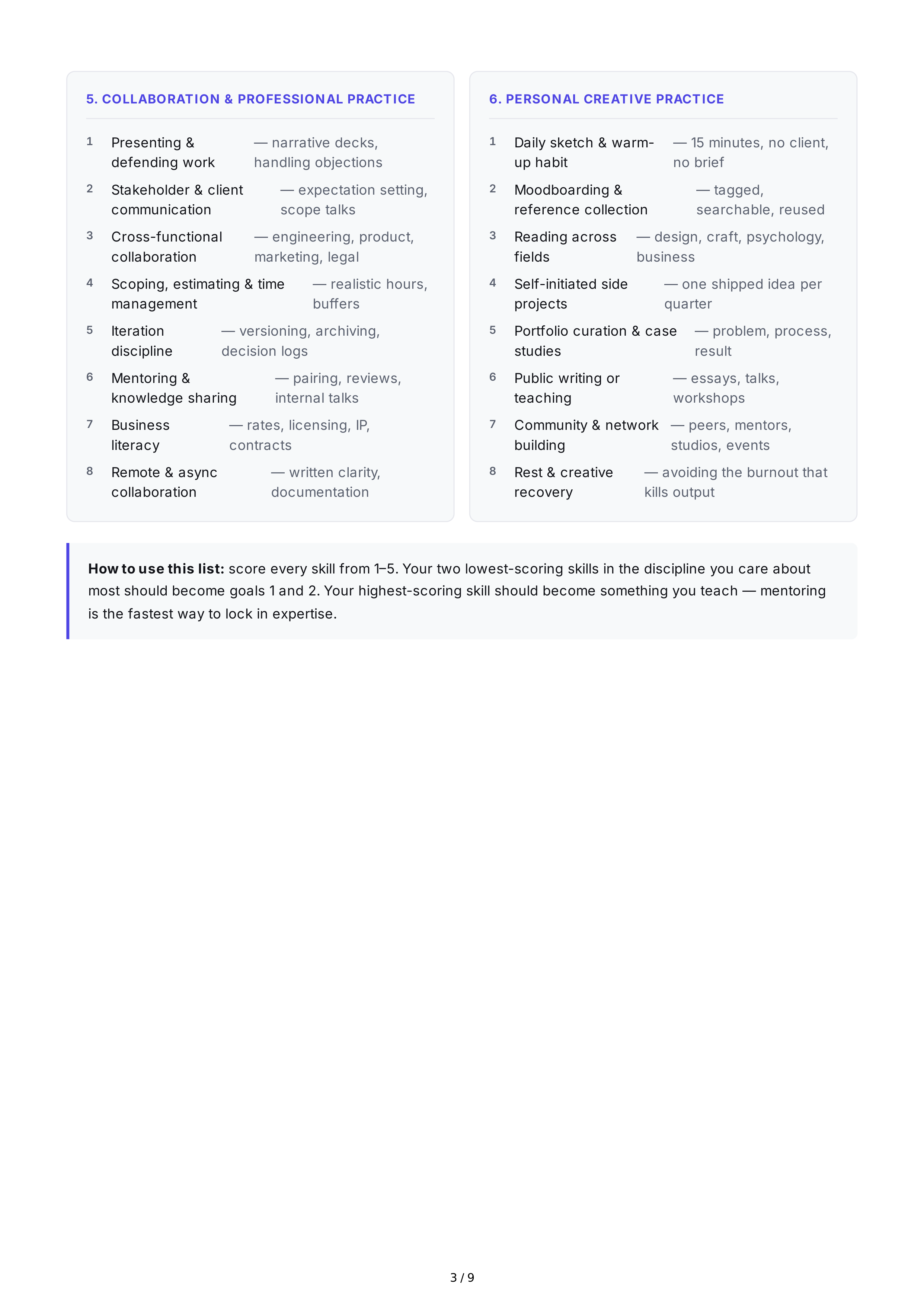
5.
COLLABORATION
&
PROFESSIONAL
PRACTICE
1
Presenting
&
defending
work
—
narrative
decks
,
handling
objections
2
Stakeholder
&
client
communication
—
expectation
setting
,
scope
talks
3
Cross
-
functional
collaboration
—
engineering
,
product
,
marketing
,
legal
4
Scoping
,
estimating
&
time
management
—
realistic
hours
,
buffers
5
Iteration
discipline
—
versioning
,
archiving
,
decision
logs
6
Mentoring
&
knowledge
sharing
—
pairing
,
reviews
,
internal
talks
7
Business
literacy
—
rates
,
licensing
,
IP
,
contracts
8
Remote
&
async
collaboration
—
written
clarity
,
documentation
6.
PERSONAL
CREATIVE
PRACTICE
1
Daily
sketch
&
warm
-
up
habit
— 15
minutes
,
no
client
,
no
brief
2
Moodboarding
&
reference
collection
—
tagged
,
searchable
,
reused
3
Reading
across
fields
—
design
,
craft
,
psychology
,
business
4
Self
-
initiated
side
projects
—
one
shipped
idea
per
quarter
5
Portfolio
curation
&
case
studies
—
problem
,
process
,
result
6
Public
writing
or
teaching
—
essays
,
talks
,
workshops
7
Community
&
network
building
—
peers
,
mentors
,
studios
,
events
8
Rest
&
creative
recovery
—
avoiding
the
burnout
that
kills
output
How
to
use
this
list
:
score
every
skill
from
1–5.
Your
two
lowest
-
scoring
skills
in
the
discipline
you
care
about
most
should
become
goals
1
and
2.
Your
highest
-
scoring
skill
should
become
something
you
teach
—
mentoring
is
the
fastest
way
to
lock
in
expertise
.
3 / 9
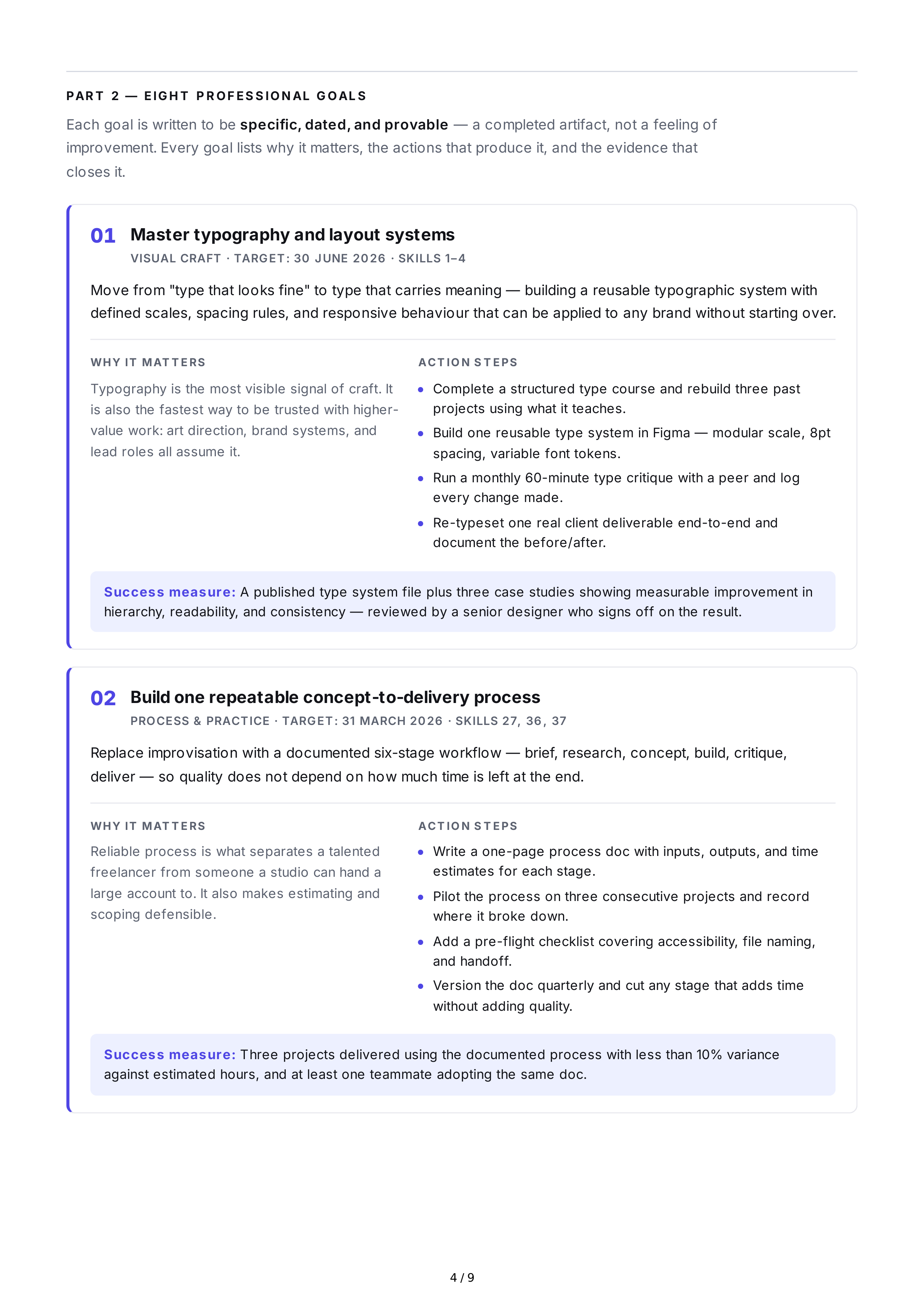
PAR T
2 —
EIG H T
P R O F ES S IO N AL
G O AL S
Each
goal
is
written
to
be
specific
,
dated
,
and
provable
—
a
completed
artifact
,
not
a
feeling
of
improvement
.
Every
goal
lists
why
it
matters
,
the
actions
that
produce
it
,
and
the
evidence
that
closes
it
.
01
Master
typography
and
layout
systems
VISUAL
CRAFT
·
TARGET
: 30
JUNE
2026 ·
SKILLS
1–4
Move
from
"
type
that
looks
fine
"
to
type
that
carries
meaning
—
building
a
reusable
typographic
system
with
defined
scales
,
spacing
rules
,
and
responsive
behaviour
that
can
be
applied
to
any
brand
without
starting
over
.
WHY
IT
MAT T E RS
Typography
is
the
most
visible
signal
of
craft
.
It
is
also
the
fastest
way
to
be
trusted
with
higher
-
value
work
:
art
direction
,
brand
systems
,
and
lead
roles
all
assume
it
.
ACT IO N
S T E PS
Success
measure
:
A
published
type
system
file
plus
three
case
studies
showing
measurable
improvement
in
hierarchy
,
readability
,
and
consistency
—
reviewed
by
a
senior
designer
who
signs
off
on
the
result
.
02
Build
one
repeatable
concept
-
to
-
delivery
process
PROCESS
&
PRACTICE
·
TARGET
: 31
MARCH
2026 ·
SKILLS
27, 36, 37
Replace
improvisation
with
a
documented
six
-
stage
workflow
—
brief
,
research
,
concept
,
build
,
critique
,
deliver
—
so
quality
does
not
depend
on
how
much
time
is
left
at
the
end
.
WHY
IT
MAT T E RS
Reliable
process
is
what
separates
a
talented
freelancer
from
someone
a
studio
can
hand
a
large
account
to
.
It
also
makes
estimating
and
scoping
defensible
.
ACT IO N
S T E PS
Success
measure
:
Three
projects
delivered
using
the
documented
process
with
less
than
10%
variance
against
estimated
hours
,
and
at
least
one
teammate
adopting
the
same
doc
.
Complete
a
structured
type
course
and
rebuild
three
past
projects
using
what
it
teaches
.
Build
one
reusable
type
system
in
Figma
—
modular
scale
, 8
pt
spacing
,
variable
font
tokens
.
Run
a
monthly
60-
minute
type
critique
with
a
peer
and
log
every
change
made
.
Re
-
typeset
one
real
client
deliverable
end
-
to
-
end
and
document
the
before
/
after
.
Write
a
one
-
page
process
doc
with
inputs
,
outputs
,
and
time
estimates
for
each
stage
.
Pilot
the
process
on
three
consecutive
projects
and
record
where
it
broke
down
.
Add
a
pre
-
flight
checklist
covering
accessibility
,
file
naming
,
and
handoff
.
Version
the
doc
quarterly
and
cut
any
stage
that
adds
time
without
adding
quality
.
4 / 9
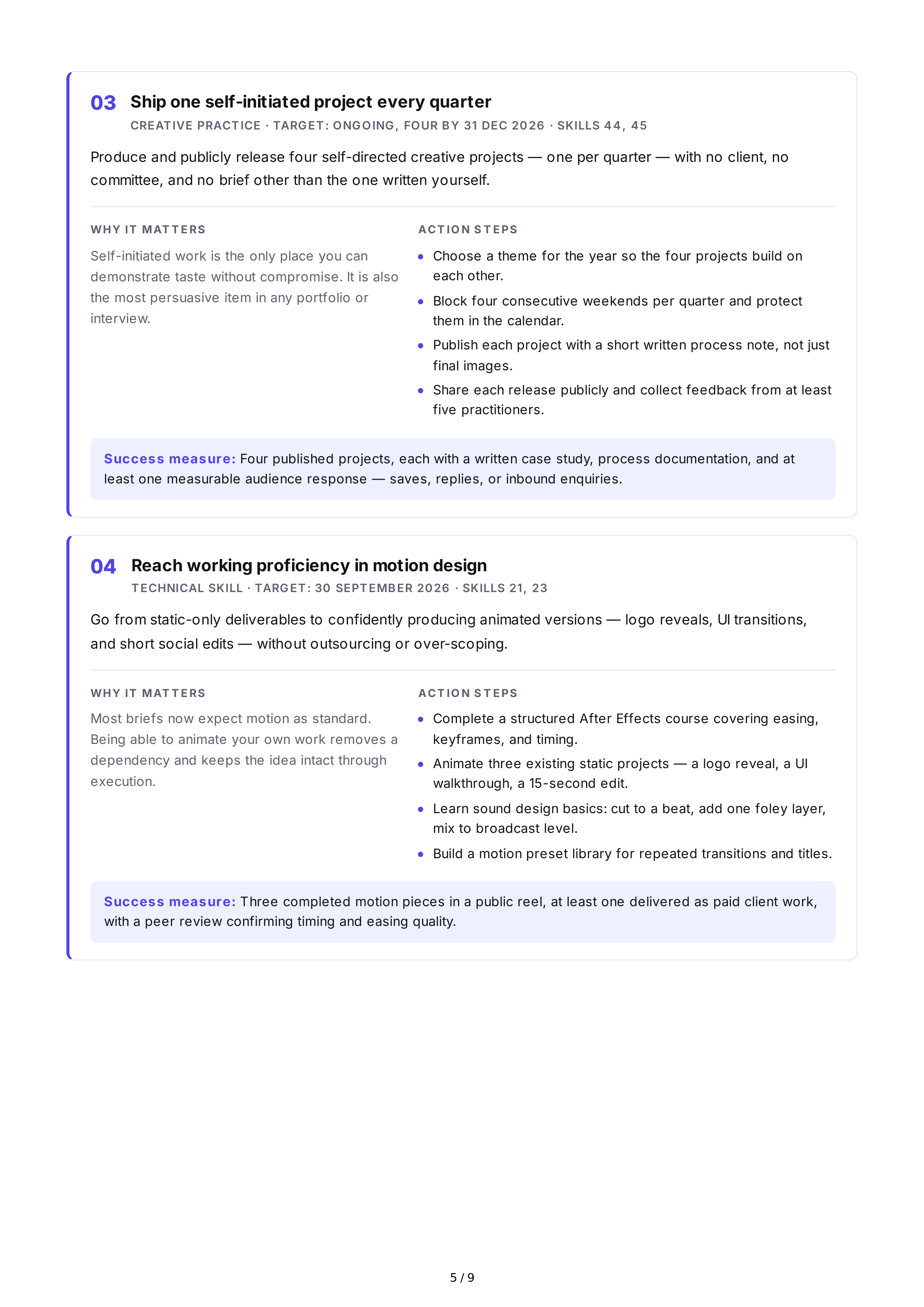
03
Ship
one
self
-
initiated
project
every
quarter
CREATIVE
PRACTICE
·
TARGET
:
ONGOING
,
FOUR
BY
31
DEC
2026 ·
SKILLS
44, 45
Produce
and
publicly
release
four
self
-
directed
creative
projects
—
one
per
quarter
—
with
no
client
,
no
committee
,
and
no
brief
other
than
the
one
written
yourself
.
WHY
IT
MAT T E RS
Self
-
initiated
work
is
the
only
place
you
can
demonstrate
taste
without
compromise
.
It
is
also
the
most
persuasive
item
in
any
portfolio
or
interview
.
ACT IO N
S T E PS
Success
measure
:
Four
published
projects
,
each
with
a
written
case
study
,
process
documentation
,
and
at
least
one
measurable
audience
response
—
saves
,
replies
,
or
inbound
enquiries
.
04
Reach
working
proficiency
in
motion
design
TECHNICAL
SKILL
·
TARGET
: 30
SEPTEMBER
2026 ·
SKILLS
21, 23
Go
from
static
-
only
deliverables
to
confidently
producing
animated
versions
—
logo
reveals
,
UI
transitions
,
and
short
social
edits
—
without
outsourcing
or
over
-
scoping
.
WHY
IT
MAT T E RS
Most
briefs
now
expect
motion
as
standard
.
Being
able
to
animate
your
own
work
removes
a
dependency
and
keeps
the
idea
intact
through
execution
.
ACT IO N
S T E PS
Success
measure
:
Three
completed
motion
pieces
in
a
public
reel
,
at
least
one
delivered
as
paid
client
work
,
with
a
peer
review
confirming
timing
and
easing
quality
.
Choose
a
theme
for
the
year
so
the
four
projects
build
on
each
other
.
Block
four
consecutive
weekends
per
quarter
and
protect
them
in
the
calendar
.
Publish
each
project
with
a
short
written
process
note
,
not
just
final
images
.
Share
each
release
publicly
and
collect
feedback
from
at
least
five
practitioners
.
Complete
a
structured
After
Effects
course
covering
easing
,
keyframes
,
and
timing
.
Animate
three
existing
static
projects
—
a
logo
reveal
,
a
UI
walkthrough
,
a
15-
second
edit
.
Learn
sound
design
basics
:
cut
to
a
beat
,
add
one
foley
layer
,
mix
to
broadcast
level
.
Build
a
motion
preset
library
for
repeated
transitions
and
titles
.
5 / 9
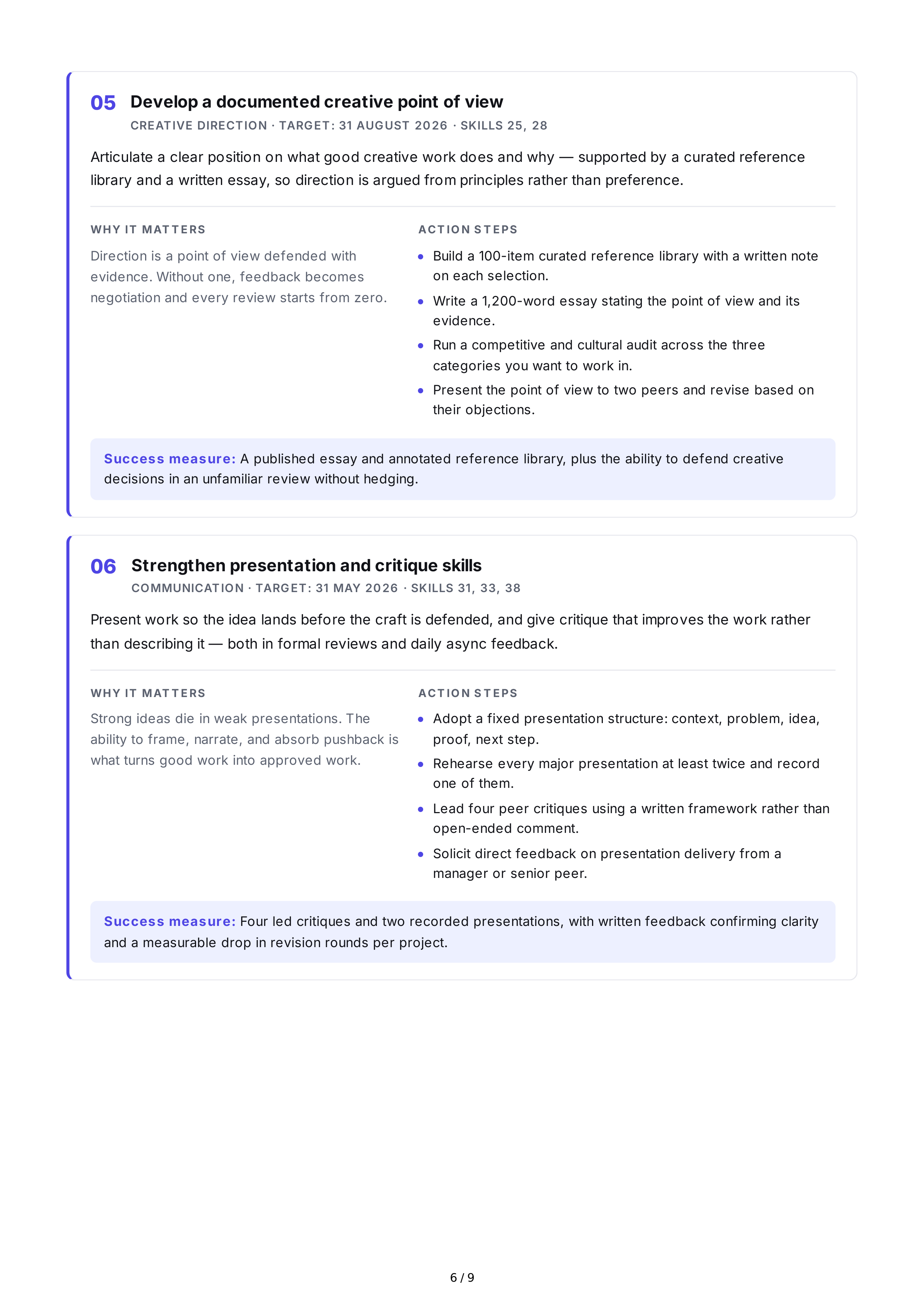
05
Develop
a
documented
creative
point
of
view
CREATIVE
DIRECTION
·
TARGET
: 31
AUGUST
2026 ·
SKILLS
25, 28
Articulate
a
clear
position
on
what
good
creative
work
does
and
why
—
supported
by
a
curated
reference
library
and
a
written
essay
,
so
direction
is
argued
from
principles
rather
than
preference
.
WHY
IT
MAT T E RS
Direction
is
a
point
of
view
defended
with
evidence
.
Without
one
,
feedback
becomes
negotiation
and
every
review
starts
from
zero
.
ACT IO N
S T E PS
Success
measure
:
A
published
essay
and
annotated
reference
library
,
plus
the
ability
to
defend
creative
decisions
in
an
unfamiliar
review
without
hedging
.
06
Strengthen
presentation
and
critique
skills
COMMUNICATION
·
TARGET
: 31
MAY
2026 ·
SKILLS
31, 33, 38
Present
work
so
the
idea
lands
before
the
craft
is
defended
,
and
give
critique
that
improves
the
work
rather
than
describing
it
—
both
in
formal
reviews
and
daily
async
feedback
.
WHY
IT
MAT T E RS
Strong
ideas
die
in
weak
presentations
.
The
ability
to
frame
,
narrate
,
and
absorb
pushback
is
what
turns
good
work
into
approved
work
.
ACT IO N
S T E PS
Success
measure
:
Four
led
critiques
and
two
recorded
presentations
,
with
written
feedback
confirming
clarity
and
a
measurable
drop
in
revision
rounds
per
project
.
Build
a
100-
item
curated
reference
library
with
a
written
note
on
each
selection
.
Write
a
1,200-
word
essay
stating
the
point
of
view
and
its
evidence
.
Run
a
competitive
and
cultural
audit
across
the
three
categories
you
want
to
work
in
.
Present
the
point
of
view
to
two
peers
and
revise
based
on
their
objections
.
Adopt
a
fixed
presentation
structure
:
context
,
problem
,
idea
,
proof
,
next
step
.
Rehearse
every
major
presentation
at
least
twice
and
record
one
of
them
.
Lead
four
peer
critiques
using
a
written
framework
rather
than
open
-
ended
comment
.
Solicit
direct
feedback
on
presentation
delivery
from
a
manager
or
senior
peer
.
6 / 9
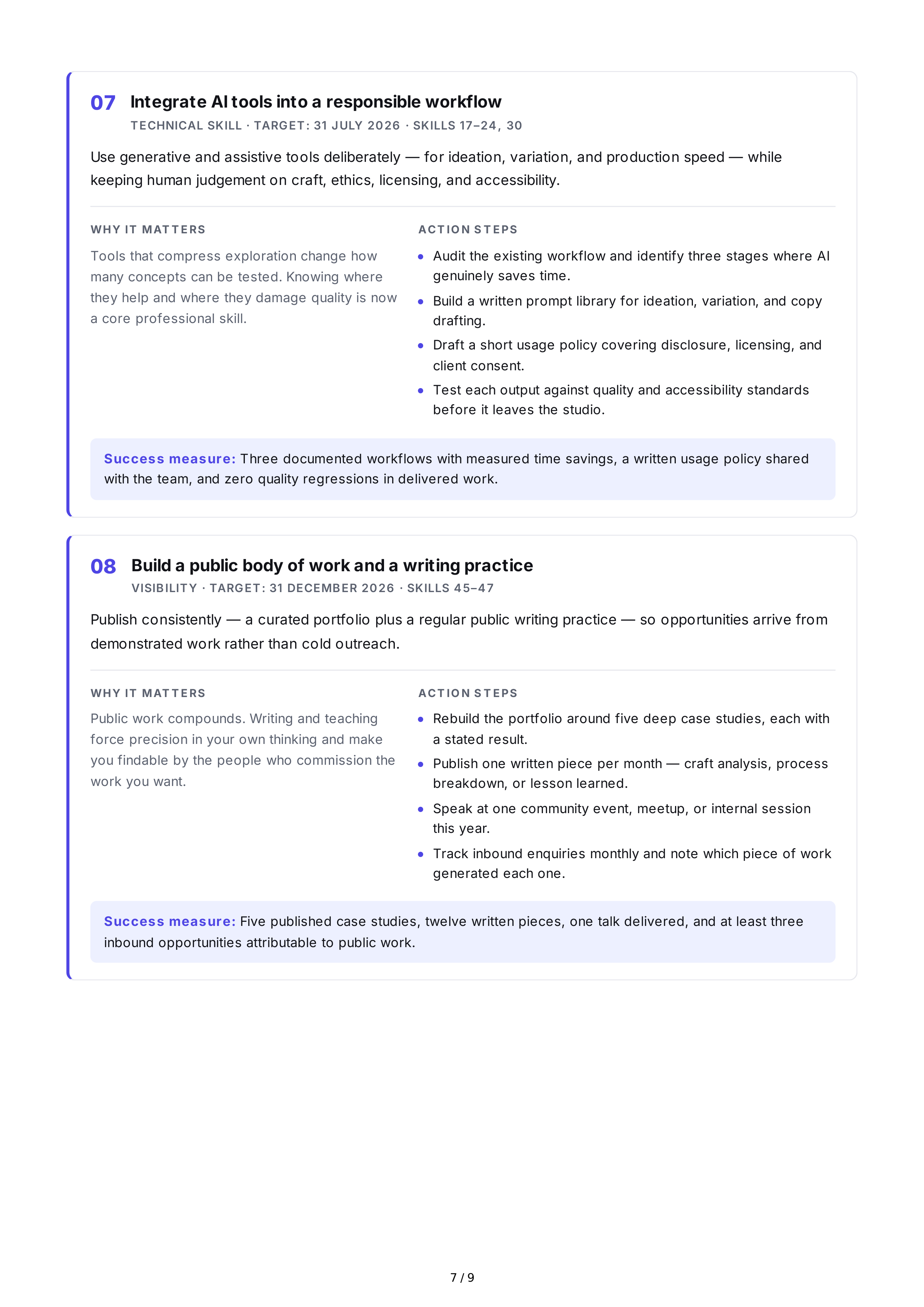
07
Integrate
AI
tools
into
a
responsible
workflow
TECHNICAL
SKILL
·
TARGET
: 31
JULY
2026 ·
SKILLS
17–24, 30
Use
generative
and
assistive
tools
deliberately
—
for
ideation
,
variation
,
and
production
speed
—
while
keeping
human
judgement
on
craft
,
ethics
,
licensing
,
and
accessibility
.
WHY
IT
MAT T E RS
Tools
that
compress
exploration
change
how
many
concepts
can
be
tested
.
Knowing
where
they
help
and
where
they
damage
quality
is
now
a
core
professional
skill
.
ACT IO N
S T E PS
Success
measure
:
Three
documented
workflows
with
measured
time
savings
,
a
written
usage
policy
shared
with
the
team
,
and
zero
quality
regressions
in
delivered
work
.
08
Build
a
public
body
of
work
and
a
writing
practice
VISIBILITY
·
TARGET
: 31
DECEMBER
2026 ·
SKILLS
45–47
Publish
consistently
—
a
curated
portfolio
plus
a
regular
public
writing
practice
—
so
opportunities
arrive
from
demonstrated
work
rather
than
cold
outreach
.
WHY
IT
MAT T E RS
Public
work
compounds
.
Writing
and
teaching
force
precision
in
your
own
thinking
and
make
you
findable
by
the
people
who
commission
the
work
you
want
.
ACT IO N
S T E PS
Success
measure
:
Five
published
case
studies
,
twelve
written
pieces
,
one
talk
delivered
,
and
at
least
three
inbound
opportunities
attributable
to
public
work
.
Audit
the
existing
workflow
and
identify
three
stages
where
AI
genuinely
saves
time
.
Build
a
written
prompt
library
for
ideation
,
variation
,
and
copy
drafting
.
Draft
a
short
usage
policy
covering
disclosure
,
licensing
,
and
client
consent
.
Test
each
output
against
quality
and
accessibility
standards
before
it
leaves
the
studio
.
Rebuild
the
portfolio
around
five
deep
case
studies
,
each
with
a
stated
result
.
Publish
one
written
piece
per
month
—
craft
analysis
,
process
breakdown
,
or
lesson
learned
.
Speak
at
one
community
event
,
meetup
,
or
internal
session
this
year
.
Track
inbound
enquiries
monthly
and
note
which
piece
of
work
generated
each
one
.
7 / 9
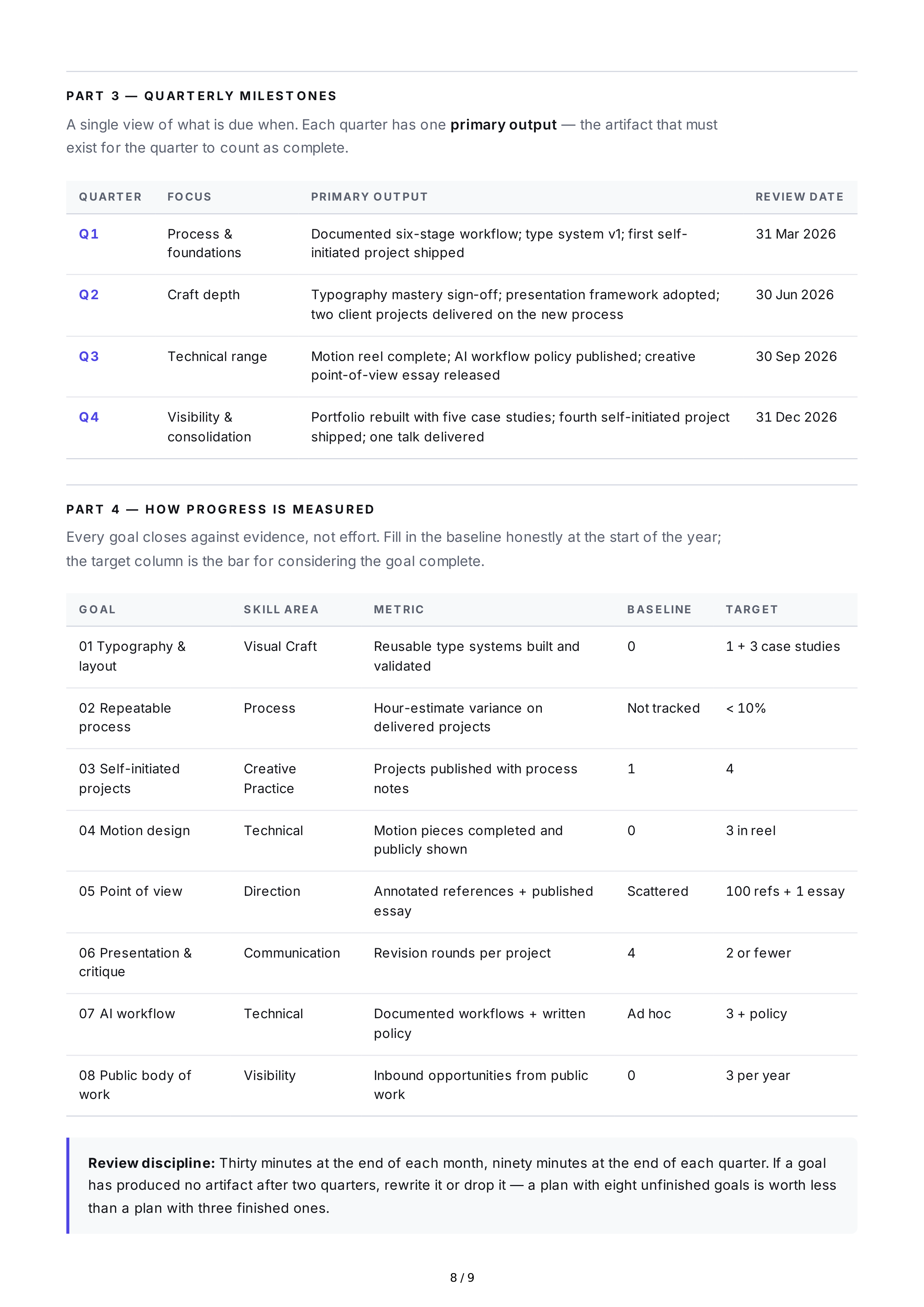
PAR T
3 —
QU AR T ER LY
M IL ES T O N ES
A
single
view
of
what
is
due
when
.
Each
quarter
has
one
primary
output
—
the
artifact
that
must
exist
for
the
quarter
to
count
as
complete
.
Q UART ER
FO CUS
PRIMARY
O UT PUT
REVIEW
DAT E
Q
1
Process
&
foundations
Documented
six
-
stage
workflow
;
type
system
v
1;
first
self
-
initiated
project
shipped
31
Mar
2026
Q
2
Craft
depth
Typography
mastery
sign
-
off
;
presentation
framework
adopted
;
two
client
projects
delivered
on
the
new
process
30
Jun
2026
Q
3
Technical
range
Motion
reel
complete
;
AI
workflow
policy
published
;
creative
point
-
of
-
view
essay
released
30
Sep
2026
Q
4
Visibility
&
consolidation
Portfolio
rebuilt
with
five
case
studies
;
fourth
self
-
initiated
project
shipped
;
one
talk
delivered
31
Dec
2026
PAR T
4 —
H O W
P R O G R ES S
IS
M EAS U R ED
Every
goal
closes
against
evidence
,
not
effort
.
Fill
in
the
baseline
honestly
at
the
start
of
the
year
;
the
target
column
is
the
bar
for
considering
the
goal
complete
.
G O AL
S KILL
AREA
MET RIC
B AS ELINE
TARG ET
01
Typography
&
layout
Visual
Craft
Reusable
type
systems
built
and
validated
0
1 + 3
case
studies
02
Repeatable
process
Process
Hour
-
estimate
variance
on
delivered
projects
Not
tracked
< 10%
03
Self
-
initiated
projects
Creative
Practice
Projects
published
with
process
notes
1
4
04
Motion
design
Technical
Motion
pieces
completed
and
publicly
shown
0
3
in
reel
05
Point
of
view
Direction
Annotated
references
+
published
essay
Scattered
100
refs
+ 1
essay
06
Presentation
&
critique
Communication
Revision
rounds
per
project
4
2
or
fewer
07
AI
workflow
Technical
Documented
workflows
+
written
policy
Ad
hoc
3 +
policy
08
Public
body
of
work
Visibility
Inbound
opportunities
from
public
work
0
3
per
year
Review
discipline
:
Thirty
minutes
at
the
end
of
each
month
,
ninety
minutes
at
the
end
of
each
quarter
.
If
a
goal
has
produced
no
artifact
after
two
quarters
,
rewrite
it
or
drop
it
—
a
plan
with
eight
unfinished
goals
is
worth
less
than
a
plan
with
three
finished
ones
.
8 / 9

CREATIVE
SKILL
DEVELOPMENT
—
PROFESSIONAL
G OALS
REVIEW
CYCLE
2026 ·
QUARTERLY
PAG E
1
OF
1
9 / 9