
Executive
Career
Professional
Goals
1 / 6
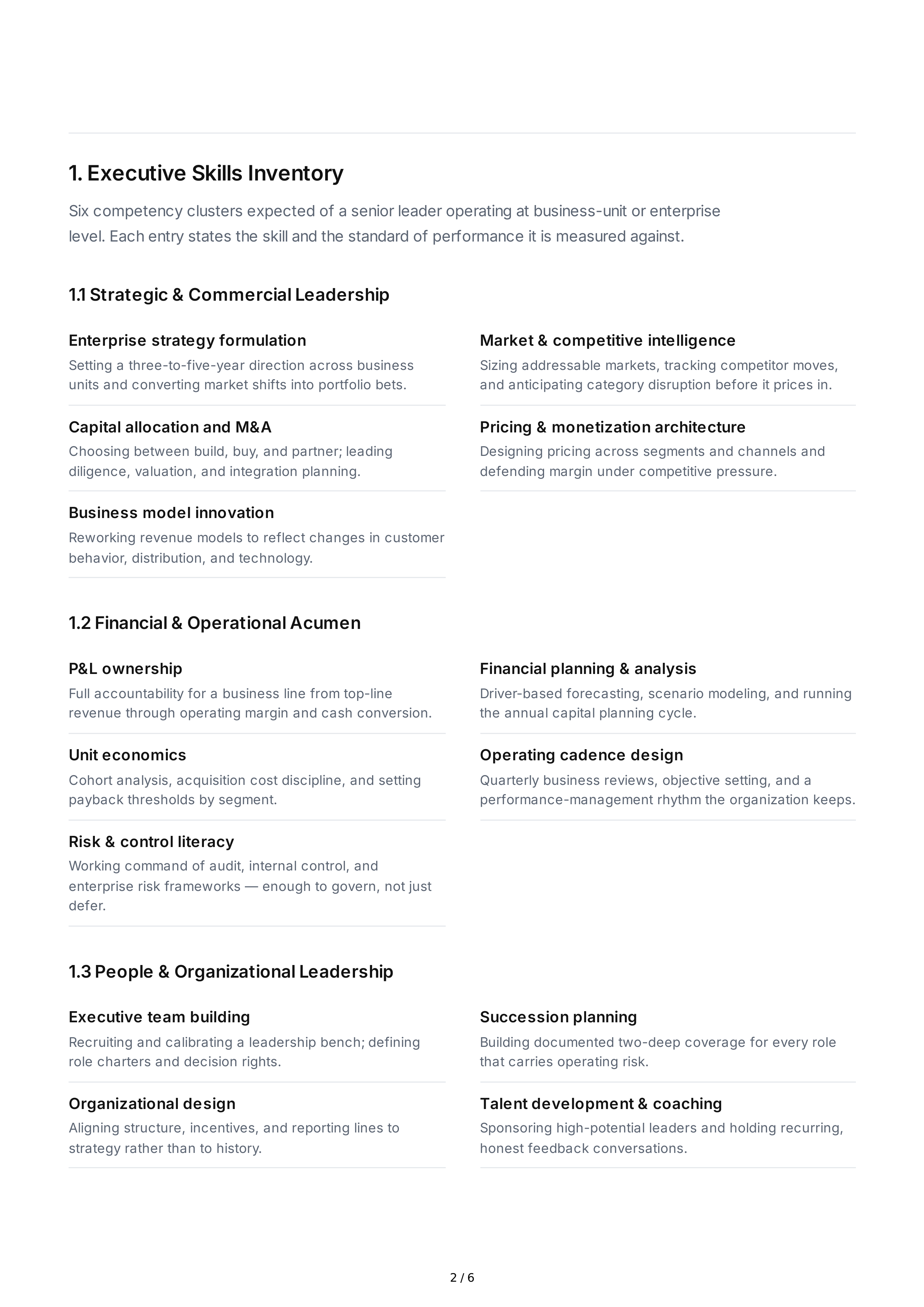
1.
Executive
Skills
Inventory
Six
competency
clusters
expected
of
a
senior
leader
operating
at
business
-
unit
or
enterprise
level
.
Each
entry
states
the
skill
and
the
standard
of
performance
it
is
measured
against
.
1.1
Strategic
&
Commercial
Leadership
Enterprise
strategy
formulation
Setting
a
three
-
to
-
five
-
year
direction
across
business
units
and
converting
market
shifts
into
portfolio
bets
.
Market
&
competitive
intelligence
Sizing
addressable
markets
,
tracking
competitor
moves
,
and
anticipating
category
disruption
before
it
prices
in
.
Capital
allocation
and
M
&
A
Choosing
between
build
,
buy
,
and
partner
;
leading
diligence
,
valuation
,
and
integration
planning
.
Pricing
&
monetization
architecture
Designing
pricing
across
segments
and
channels
and
defending
margin
under
competitive
pressure
.
Business
model
innovation
Reworking
revenue
models
to
reflect
changes
in
customer
behavior
,
distribution
,
and
technology
.
1.2
Financial
&
Operational
Acumen
P
&
L
ownership
Full
accountability
for
a
business
line
from
top
-
line
revenue
through
operating
margin
and
cash
conversion
.
Financial
planning
&
analysis
Driver
-
based
forecasting
,
scenario
modeling
,
and
running
the
annual
capital
planning
cycle
.
Unit
economics
Cohort
analysis
,
acquisition
cost
discipline
,
and
setting
payback
thresholds
by
segment
.
Operating
cadence
design
Quarterly
business
reviews
,
objective
setting
,
and
a
performance
-
management
rhythm
the
organization
keeps
.
Risk
&
control
literacy
Working
command
of
audit
,
internal
control
,
and
enterprise
risk
frameworks
—
enough
to
govern
,
not
just
defer
.
1.3
People
&
Organizational
Leadership
Executive
team
building
Recruiting
and
calibrating
a
leadership
bench
;
defining
role
charters
and
decision
rights
.
Succession
planning
Building
documented
two
-
deep
coverage
for
every
role
that
carries
operating
risk
.
Organizational
design
Aligning
structure
,
incentives
,
and
reporting
lines
to
strategy
rather
than
to
history
.
Talent
development
&
coaching
Sponsoring
high
-
potential
leaders
and
holding
recurring
,
honest
feedback
conversations
.
2 / 6
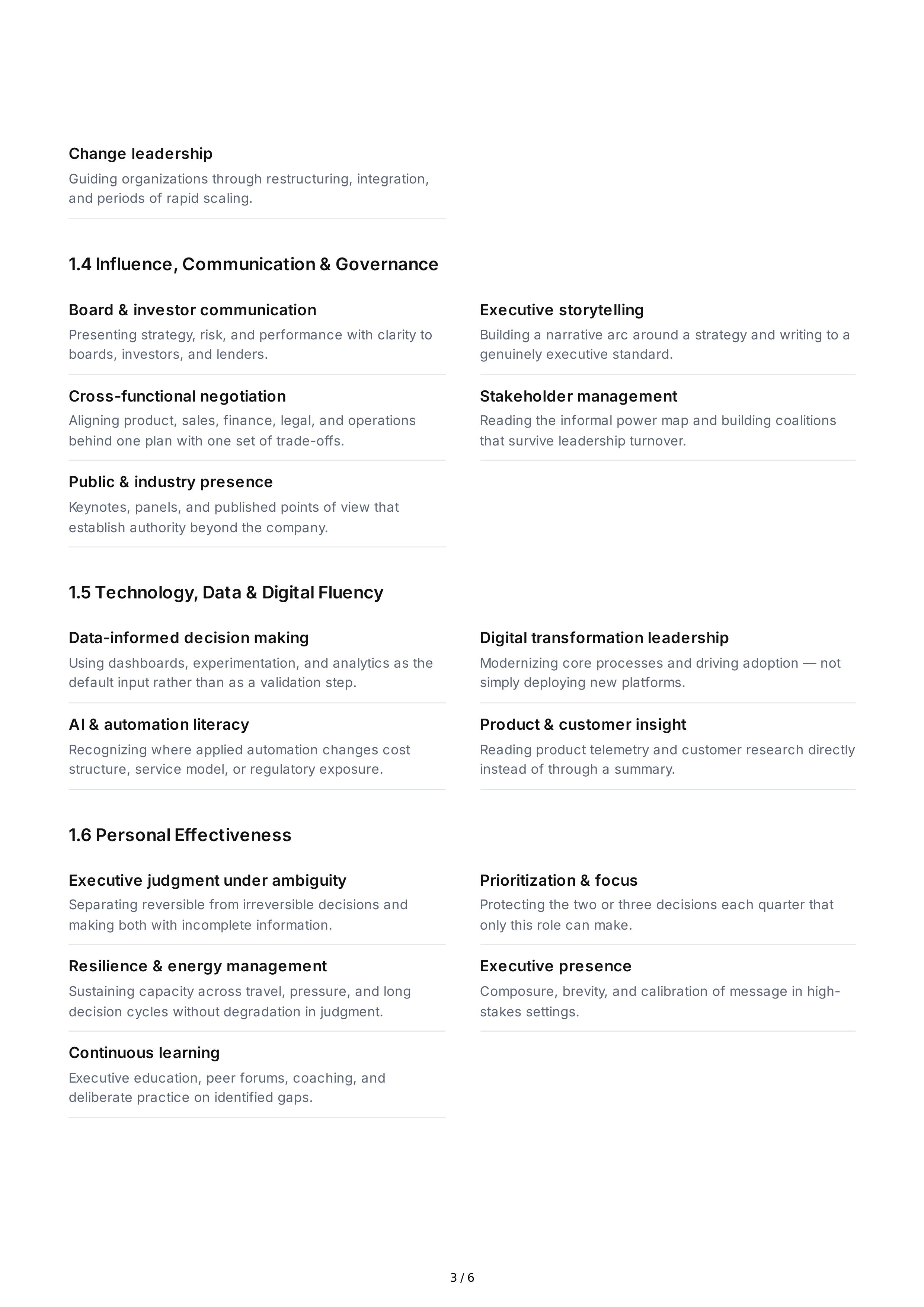
Change
leadership
Guiding
organizations
through
restructuring
,
integration
,
and
periods
of
rapid
scaling
.
1.4
Influence
,
Communication
&
Governance
Board
&
investor
communication
Presenting
strategy
,
risk
,
and
performance
with
clarity
to
boards
,
investors
,
and
lenders
.
Executive
storytelling
Building
a
narrative
arc
around
a
strategy
and
writing
to
a
genuinely
executive
standard
.
Cross
-
functional
negotiation
Aligning
product
,
sales
,
finance
,
legal
,
and
operations
behind
one
plan
with
one
set
of
trade
-
offs
.
Stakeholder
management
Reading
the
informal
power
map
and
building
coalitions
that
survive
leadership
turnover
.
Public
&
industry
presence
Keynotes
,
panels
,
and
published
points
of
view
that
establish
authority
beyond
the
company
.
1.5
Technology
,
Data
&
Digital
Fluency
Data
-
informed
decision
making
Using
dashboards
,
experimentation
,
and
analytics
as
the
default
input
rather
than
as
a
validation
step
.
Digital
transformation
leadership
Modernizing
core
processes
and
driving
adoption
—
not
simply
deploying
new
platforms
.
AI
&
automation
literacy
Recognizing
where
applied
automation
changes
cost
structure
,
service
model
,
or
regulatory
exposure
.
Product
&
customer
insight
Reading
product
telemetry
and
customer
research
directly
instead
of
through
a
summary
.
1.6
Personal
Effectiveness
Executive
judgment
under
ambiguity
Separating
reversible
from
irreversible
decisions
and
making
both
with
incomplete
information
.
Prioritization
&
focus
Protecting
the
two
or
three
decisions
each
quarter
that
only
this
role
can
make
.
Resilience
&
energy
management
Sustaining
capacity
across
travel
,
pressure
,
and
long
decision
cycles
without
degradation
in
judgment
.
Executive
presence
Composure
,
brevity
,
and
calibration
of
message
in
high
-
stakes
settings
.
Continuous
learning
Executive
education
,
peer
forums
,
coaching
,
and
deliberate
practice
on
identified
gaps
.
3 / 6
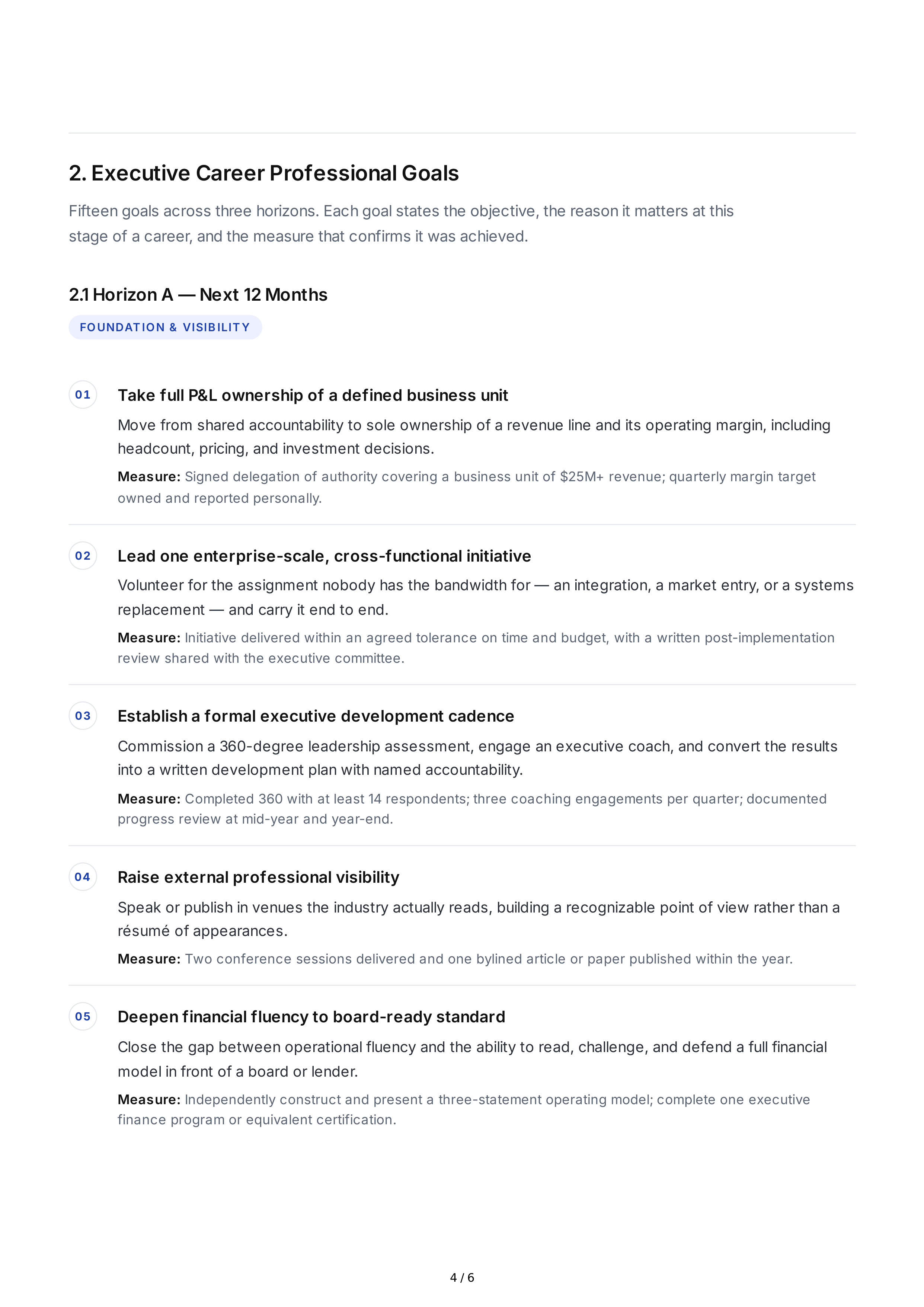
2.
Executive
Career
Professional
Goals
Fifteen
goals
across
three
horizons
.
Each
goal
states
the
objective
,
the
reason
it
matters
at
this
stage
of
a
career
,
and
the
measure
that
confirms
it
was
achieved
.
2.1
Horizon
A
—
Next
12
Months
FOUNDAT ION
&
VISIB ILIT Y
01
Take
full
P
&
L
ownership
of
a
defined
business
unit
Move
from
shared
accountability
to
sole
ownership
of
a
revenue
line
and
its
operating
margin
,
including
headcount
,
pricing
,
and
investment
decisions
.
Measure
:
Signed
delegation
of
authority
covering
a
business
unit
of
$
25
M
+
revenue
;
quarterly
margin
target
owned
and
reported
personally
.
02
Lead
one
enterprise
-
scale
,
cross
-
functional
initiative
Volunteer
for
the
assignment
nobody
has
the
bandwidth
for
—
an
integration
,
a
market
entry
,
or
a
systems
replacement
—
and
carry
it
end
to
end
.
Measure
:
Initiative
delivered
within
an
agreed
tolerance
on
time
and
budget
,
with
a
written
post
-
implementation
review
shared
with
the
executive
committee
.
03
Establish
a
formal
executive
development
cadence
Commission
a
360-
degree
leadership
assessment
,
engage
an
executive
coach
,
and
convert
the
results
into
a
written
development
plan
with
named
accountability
.
Measure
:
Completed
360
with
at
least
14
respondents
;
three
coaching
engagements
per
quarter
;
documented
progress
review
at
mid
-
year
and
year
-
end
.
04
Raise
external
professional
visibility
Speak
or
publish
in
venues
the
industry
actually
reads
,
building
a
recognizable
point
of
view
rather
than
a
résumé
of
appearances
.
Measure
:
Two
conference
sessions
delivered
and
one
bylined
article
or
paper
published
within
the
year
.
05
Deepen
financial
fluency
to
board
-
ready
standard
Close
the
gap
between
operational
fluency
and
the
ability
to
read
,
challenge
,
and
defend
a
full
financial
model
in
front
of
a
board
or
lender
.
Measure
:
Independently
construct
and
present
a
three
-
statement
operating
model
;
complete
one
executive
finance
program
or
equivalent
certification
.
4 / 6
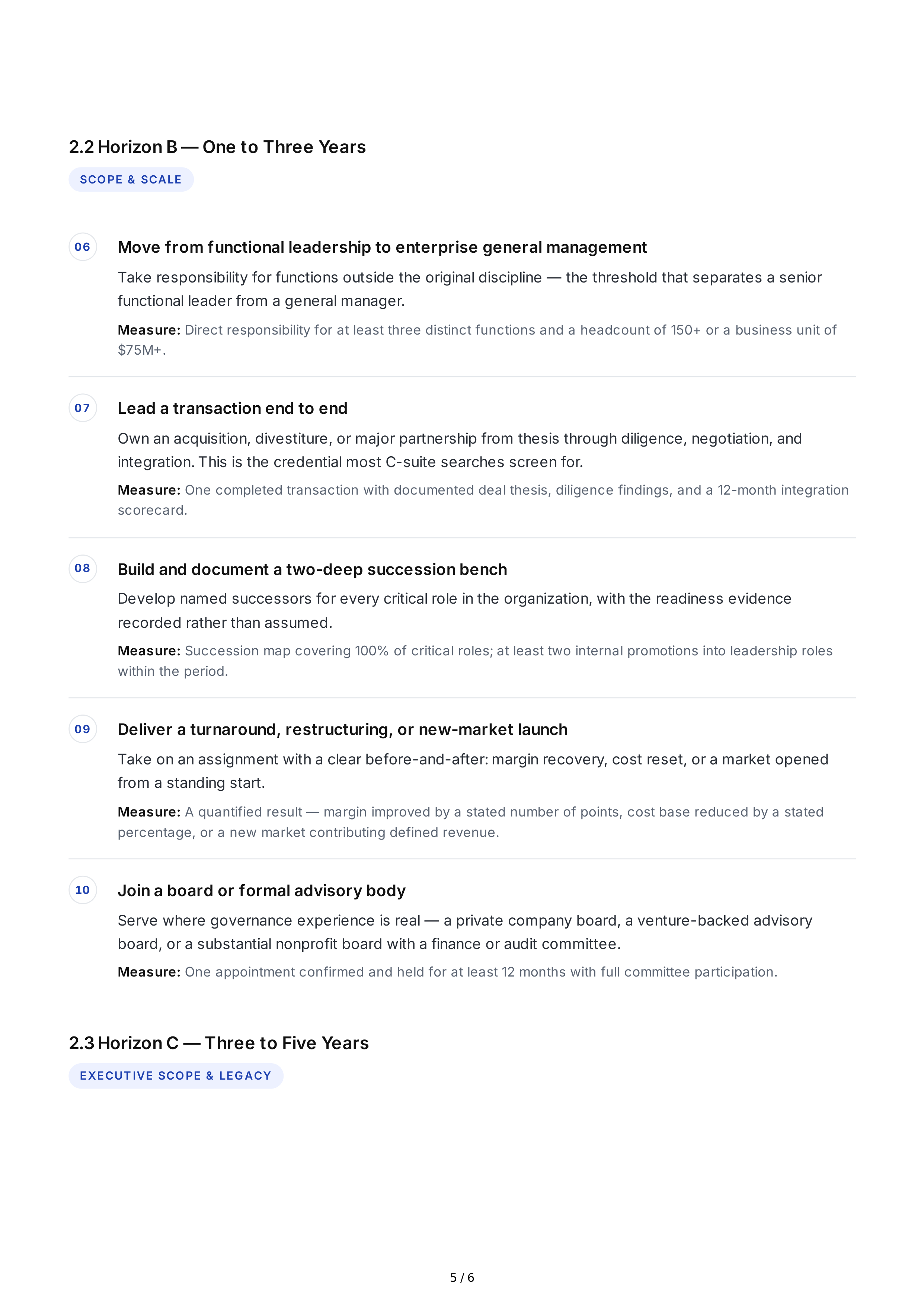
2.2
Horizon
B
—
One
to
Three
Years
SCOPE
&
SCALE
06
Move
from
functional
leadership
to
enterprise
general
management
Take
responsibility
for
functions
outside
the
original
discipline
—
the
threshold
that
separates
a
senior
functional
leader
from
a
general
manager
.
Measure
:
Direct
responsibility
for
at
least
three
distinct
functions
and
a
headcount
of
150+
or
a
business
unit
of
$
75
M
+.
07
Lead
a
transaction
end
to
end
Own
an
acquisition
,
divestiture
,
or
major
partnership
from
thesis
through
diligence
,
negotiation
,
and
integration
.
This
is
the
credential
most
C
-
suite
searches
screen
for
.
Measure
:
One
completed
transaction
with
documented
deal
thesis
,
diligence
findings
,
and
a
12-
month
integration
scorecard
.
08
Build
and
document
a
two
-
deep
succession
bench
Develop
named
successors
for
every
critical
role
in
the
organization
,
with
the
readiness
evidence
recorded
rather
than
assumed
.
Measure
:
Succession
map
covering
100%
of
critical
roles
;
at
least
two
internal
promotions
into
leadership
roles
within
the
period
.
09
Deliver
a
turnaround
,
restructuring
,
or
new
-
market
launch
Take
on
an
assignment
with
a
clear
before
-
and
-
after
:
margin
recovery
,
cost
reset
,
or
a
market
opened
from
a
standing
start
.
Measure
:
A
quantified
result
—
margin
improved
by
a
stated
number
of
points
,
cost
base
reduced
by
a
stated
percentage
,
or
a
new
market
contributing
defined
revenue
.
10
Join
a
board
or
formal
advisory
body
Serve
where
governance
experience
is
real
—
a
private
company
board
,
a
venture
-
backed
advisory
board
,
or
a
substantial
nonprofit
board
with
a
finance
or
audit
committee
.
Measure
:
One
appointment
confirmed
and
held
for
at
least
12
months
with
full
committee
participation
.
2.3
Horizon
C
—
Three
to
Five
Years
EXECUT IVE
SCOPE
&
LEG ACY
5 / 6
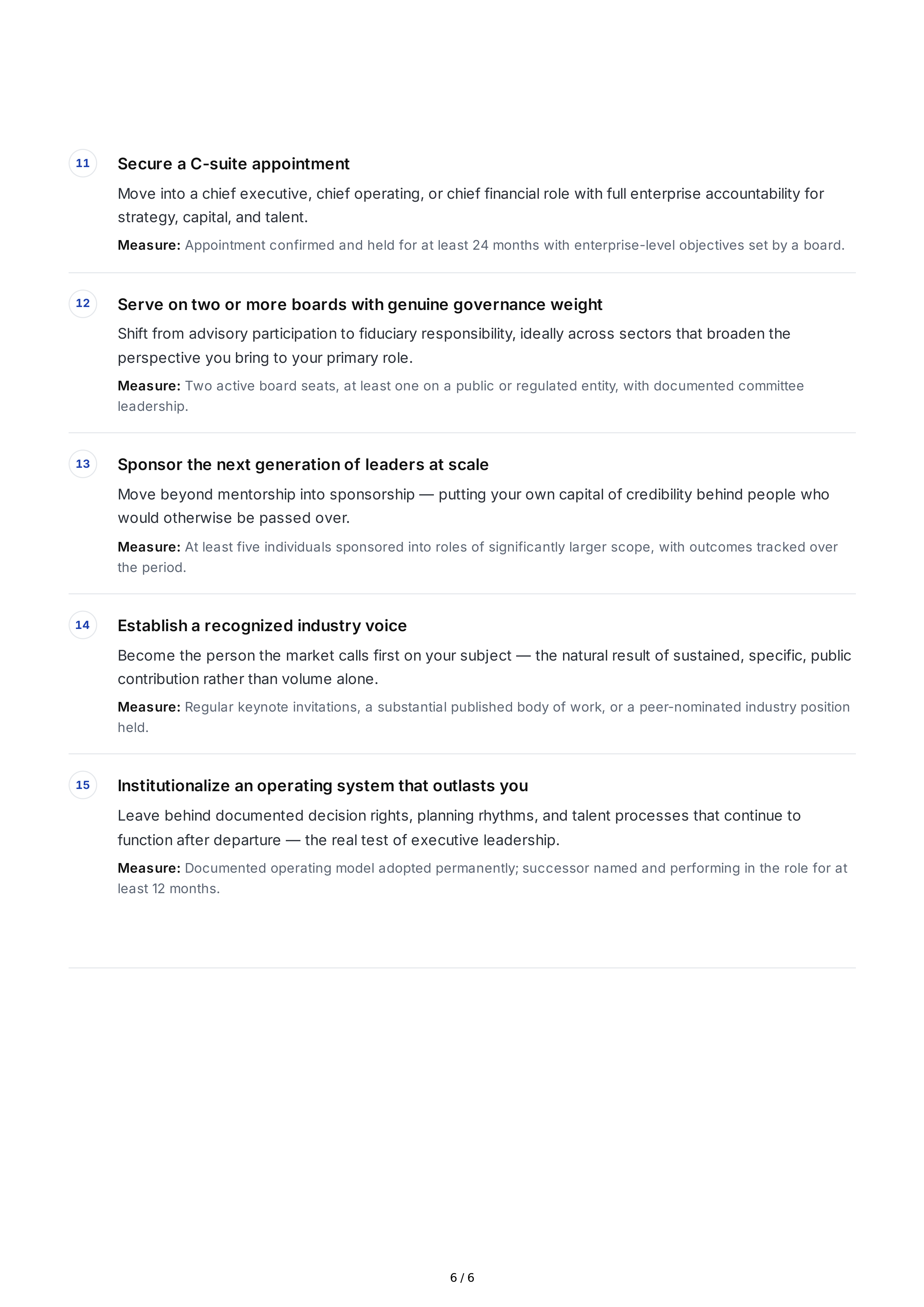
11
Secure
a
C
-
suite
appointment
Move
into
a
chief
executive
,
chief
operating
,
or
chief
financial
role
with
full
enterprise
accountability
for
strategy
,
capital
,
and
talent
.
Measure
:
Appointment
confirmed
and
held
for
at
least
24
months
with
enterprise
-
level
objectives
set
by
a
board
.
12
Serve
on
two
or
more
boards
with
genuine
governance
weight
Shift
from
advisory
participation
to
fiduciary
responsibility
,
ideally
across
sectors
that
broaden
the
perspective
you
bring
to
your
primary
role
.
Measure
:
Two
active
board
seats
,
at
least
one
on
a
public
or
regulated
entity
,
with
documented
committee
leadership
.
13
Sponsor
the
next
generation
of
leaders
at
scale
Move
beyond
mentorship
into
sponsorship
—
putting
your
own
capital
of
credibility
behind
people
who
would
otherwise
be
passed
over
.
Measure
:
At
least
five
individuals
sponsored
into
roles
of
significantly
larger
scope
,
with
outcomes
tracked
over
the
period
.
14
Establish
a
recognized
industry
voice
Become
the
person
the
market
calls
first
on
your
subject
—
the
natural
result
of
sustained
,
specific
,
public
contribution
rather
than
volume
alone
.
Measure
:
Regular
keynote
invitations
,
a
substantial
published
body
of
work
,
or
a
peer
-
nominated
industry
position
held
.
15
Institutionalize
an
operating
system
that
outlasts
you
Leave
behind
documented
decision
rights
,
planning
rhythms
,
and
talent
processes
that
continue
to
function
after
departure
—
the
real
test
of
executive
leadership
.
Measure
:
Documented
operating
model
adopted
permanently
;
successor
named
and
performing
in
the
role
for
at
least
12
months
.
6 / 6
