
Professional
Achievement
Goals
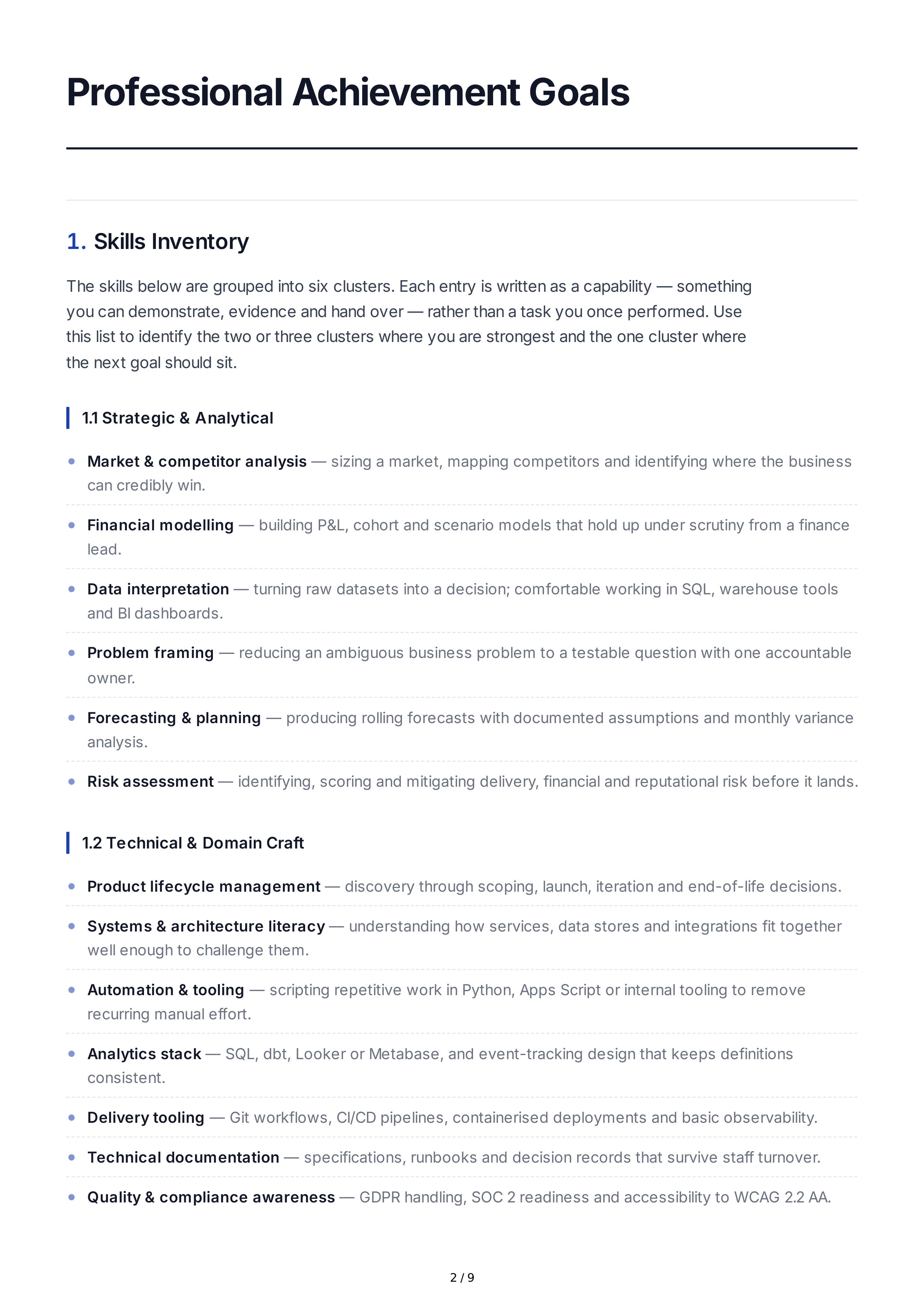
1.
Skills
Inventory
The
skills
below
are
grouped
into
six
clusters
.
Each
entry
is
written
as
a
capability
—
something
you
can
demonstrate
,
evidence
and
hand
over
—
rather
than
a
task
you
once
performed
.
Use
this
list
to
identify
the
two
or
three
clusters
where
you
are
strongest
and
the
one
cluster
where
the
next
goal
should
sit
.
1.1
Strategic
&
Analytical
1.2
Technical
&
Domain
Craft
Market
&
competitor
analysis
—
sizing
a
market
,
mapping
competitors
and
identifying
where
the
business
can
credibly
win
.
Financial
modelling
—
building
P
&
L
,
cohort
and
scenario
models
that
hold
up
under
scrutiny
from
a
finance
lead
.
Data
interpretation
—
turning
raw
datasets
into
a
decision
;
comfortable
working
in
SQL
,
warehouse
tools
and
BI
dashboards
.
Problem
framing
—
reducing
an
ambiguous
business
problem
to
a
testable
question
with
one
accountable
owner
.
Forecasting
&
planning
—
producing
rolling
forecasts
with
documented
assumptions
and
monthly
variance
analysis
.
Risk
assessment
—
identifying
,
scoring
and
mitigating
delivery
,
financial
and
reputational
risk
before
it
lands
.
Product
lifecycle
management
—
discovery
through
scoping
,
launch
,
iteration
and
end
-
of
-
life
decisions
.
Systems
&
architecture
literacy
—
understanding
how
services
,
data
stores
and
integrations
fit
together
well
enough
to
challenge
them
.
Automation
&
tooling
—
scripting
repetitive
work
in
Python
,
Apps
Script
or
internal
tooling
to
remove
recurring
manual
effort
.
Analytics
stack
—
SQL
,
dbt
,
Looker
or
Metabase
,
and
event
-
tracking
design
that
keeps
definitions
consistent
.
Delivery
tooling
—
Git
workflows
,
CI
/
CD
pipelines
,
containerised
deployments
and
basic
observability
.
Technical
documentation
—
specifications
,
runbooks
and
decision
records
that
survive
staff
turnover
.
Quality
&
compliance
awareness
—
GDPR
handling
,
SOC
2
readiness
and
accessibility
to
WCAG
2.2
AA
.
2 / 9
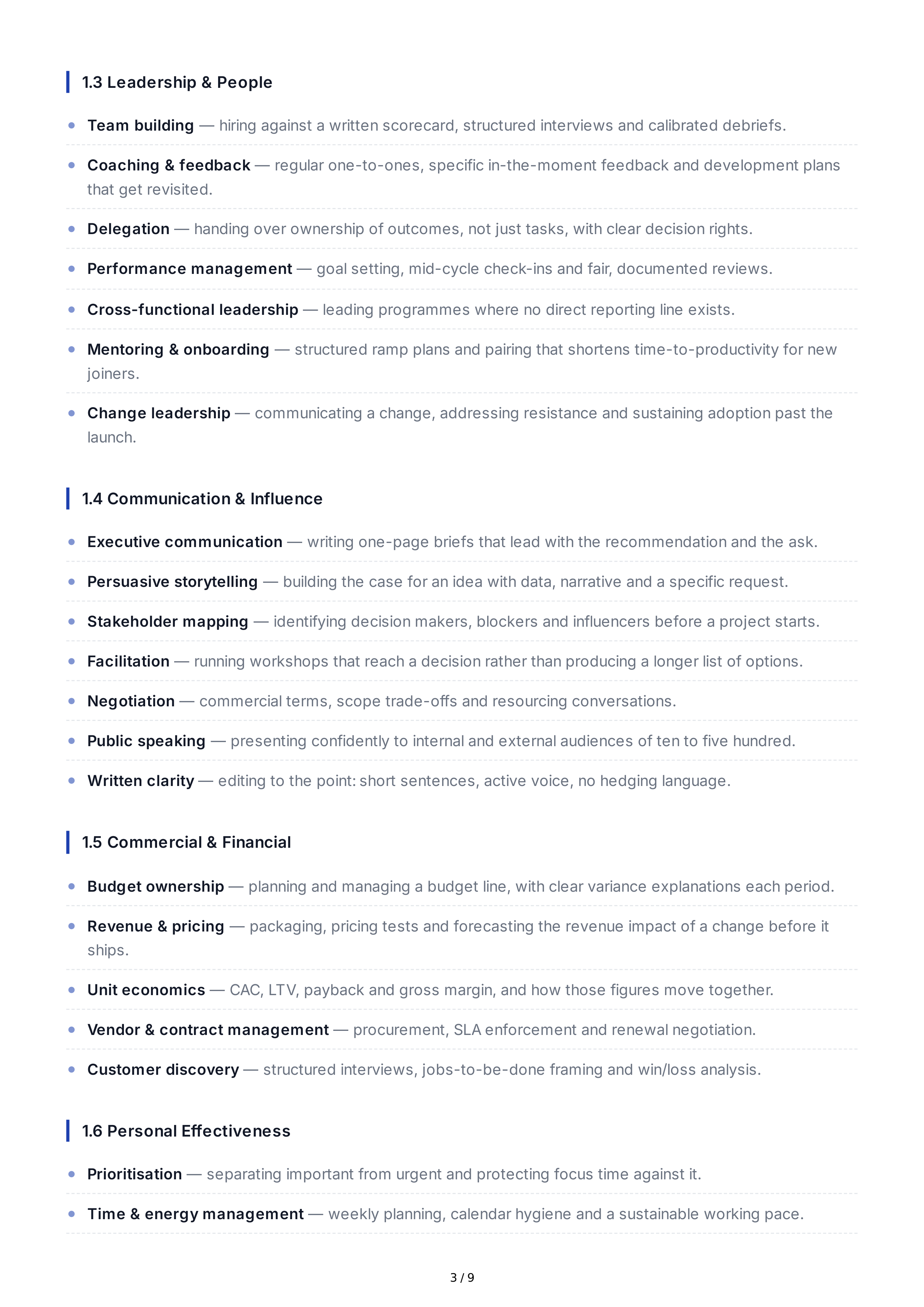
1.3
Leadership
&
People
1.4
Communication
&
Influence
1.5
Commercial
&
Financial
1.6
Personal
Effectiveness
Team
building
—
hiring
against
a
written
scorecard
,
structured
interviews
and
calibrated
debriefs
.
Coaching
&
feedback
—
regular
one
-
to
-
ones
,
specific
in
-
the
-
moment
feedback
and
development
plans
that
get
revisited
.
Delegation
—
handing
over
ownership
of
outcomes
,
not
just
tasks
,
with
clear
decision
rights
.
Performance
management
—
goal
setting
,
mid
-
cycle
check
-
ins
and
fair
,
documented
reviews
.
Cross
-
functional
leadership
—
leading
programmes
where
no
direct
reporting
line
exists
.
Mentoring
&
onboarding
—
structured
ramp
plans
and
pairing
that
shortens
time
-
to
-
productivity
for
new
joiners
.
Change
leadership
—
communicating
a
change
,
addressing
resistance
and
sustaining
adoption
past
the
launch
.
Executive
communication
—
writing
one
-
page
briefs
that
lead
with
the
recommendation
and
the
ask
.
Persuasive
storytelling
—
building
the
case
for
an
idea
with
data
,
narrative
and
a
specific
request
.
Stakeholder
mapping
—
identifying
decision
makers
,
blockers
and
influencers
before
a
project
starts
.
Facilitation
—
running
workshops
that
reach
a
decision
rather
than
producing
a
longer
list
of
options
.
Negotiation
—
commercial
terms
,
scope
trade
-
offs
and
resourcing
conversations
.
Public
speaking
—
presenting
confidently
to
internal
and
external
audiences
of
ten
to
five
hundred
.
Written
clarity
—
editing
to
the
point
:
short
sentences
,
active
voice
,
no
hedging
language
.
Budget
ownership
—
planning
and
managing
a
budget
line
,
with
clear
variance
explanations
each
period
.
Revenue
&
pricing
—
packaging
,
pricing
tests
and
forecasting
the
revenue
impact
of
a
change
before
it
ships
.
Unit
economics
—
CAC
,
LTV
,
payback
and
gross
margin
,
and
how
those
figures
move
together
.
Vendor
&
contract
management
—
procurement
,
SLA
enforcement
and
renewal
negotiation
.
Customer
discovery
—
structured
interviews
,
jobs
-
to
-
be
-
done
framing
and
win
/
loss
analysis
.
Prioritisation
—
separating
important
from
urgent
and
protecting
focus
time
against
it
.
Time
&
energy
management
—
weekly
planning
,
calendar
hygiene
and
a
sustainable
working
pace
.
3 / 9

Resilience
—
operating
under
ambiguity
,
setback
and
compressed
timelines
without
dropping
quality
.
Continuous
learning
—
deliberate
practice
,
certifications
,
reading
and
structured
peer
review
.
Adaptability
—
learning
a
new
tool
,
domain
or
market
quickly
and
applying
it
to
live
work
.
4 / 9
2.
Professional
Achievement
Goals
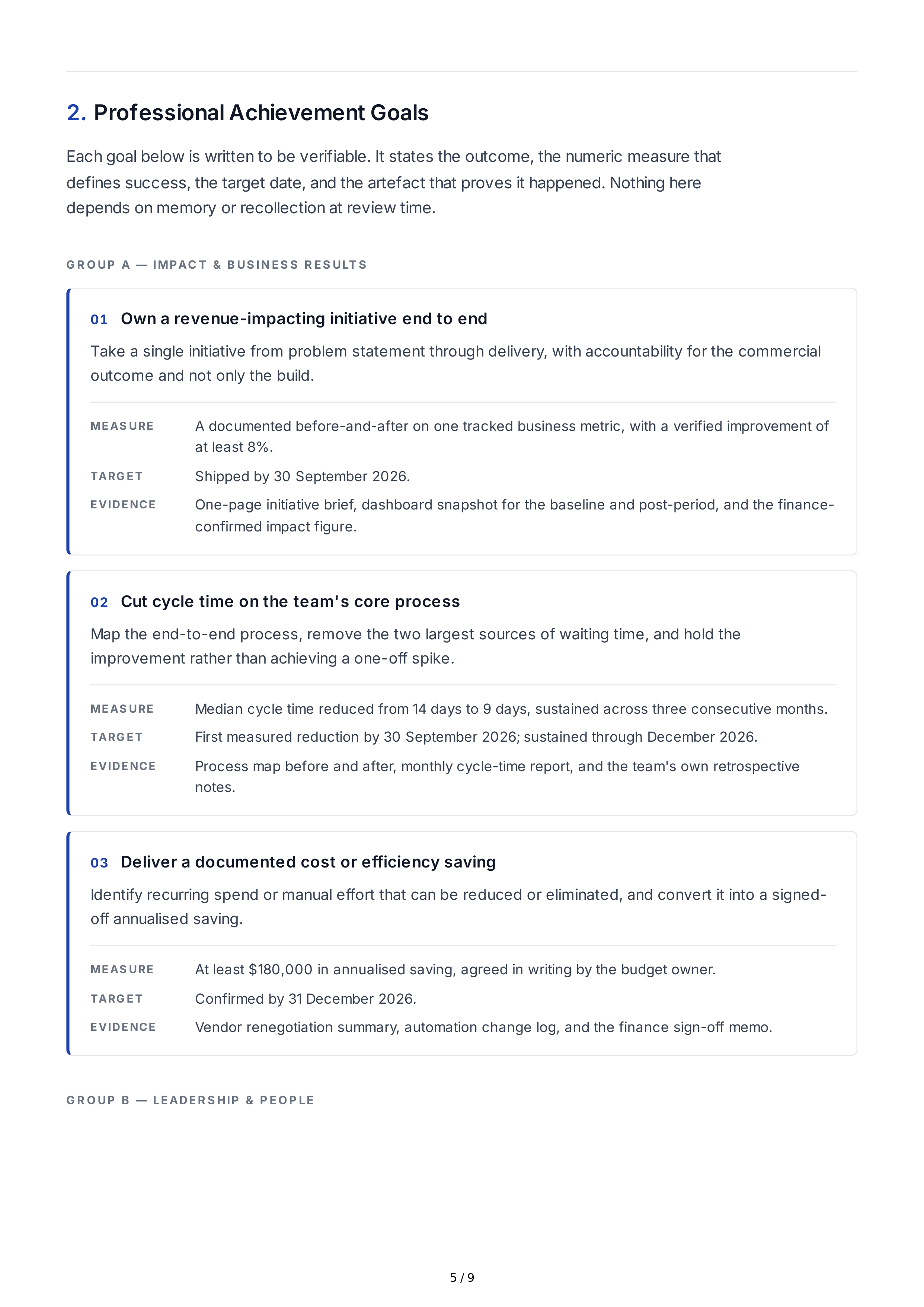
Each
goal
below
is
written
to
be
verifiable
.
It
states
the
outcome
,
the
numeric
measure
that
defines
success
,
the
target
date
,
and
the
artefact
that
proves
it
happened
.
Nothing
here
depends
on
memory
or
recollection
at
review
time
.
G R O UP
A
—
IMPAC T
&
B US IN E S S
R E S ULT S
01
Own
a
revenue
-
impacting
initiative
end
to
end
Take
a
single
initiative
from
problem
statement
through
delivery
,
with
accountability
for
the
commercial
outcome
and
not
only
the
build
.
MEAS URE
A
documented
before
-
and
-
after
on
one
tracked
business
metric
,
with
a
verified
improvement
of
at
least
8%.
TARG ET
Shipped
by
30
September
2026.
EVIDENCE
One
-
page
initiative
brief
,
dashboard
snapshot
for
the
baseline
and
post
-
period
,
and
the
finance
-
confirmed
impact
figure
.
02
Cut
cycle
time
on
the
team
'
s
core
process
Map
the
end
-
to
-
end
process
,
remove
the
two
largest
sources
of
waiting
time
,
and
hold
the
improvement
rather
than
achieving
a
one
-
off
spike
.
MEAS URE
Median
cycle
time
reduced
from
14
days
to
9
days
,
sustained
across
three
consecutive
months
.
TARG ET
First
measured
reduction
by
30
September
2026;
sustained
through
December
2026.
EVIDENCE
Process
map
before
and
after
,
monthly
cycle
-
time
report
,
and
the
team
'
s
own
retrospective
notes
.
03
Deliver
a
documented
cost
or
efficiency
saving
Identify
recurring
spend
or
manual
effort
that
can
be
reduced
or
eliminated
,
and
convert
it
into
a
signed
-
off
annualised
saving
.
MEAS URE
At
least
$
180,000
in
annualised
saving
,
agreed
in
writing
by
the
budget
owner
.
TARG ET
Confirmed
by
31
December
2026.
EVIDENCE
Vendor
renegotiation
summary
,
automation
change
log
,
and
the
finance
sign
-
off
memo
.
G R O UP
B
—
LE ADE R S HIP
&
P E O P LE
5 / 9
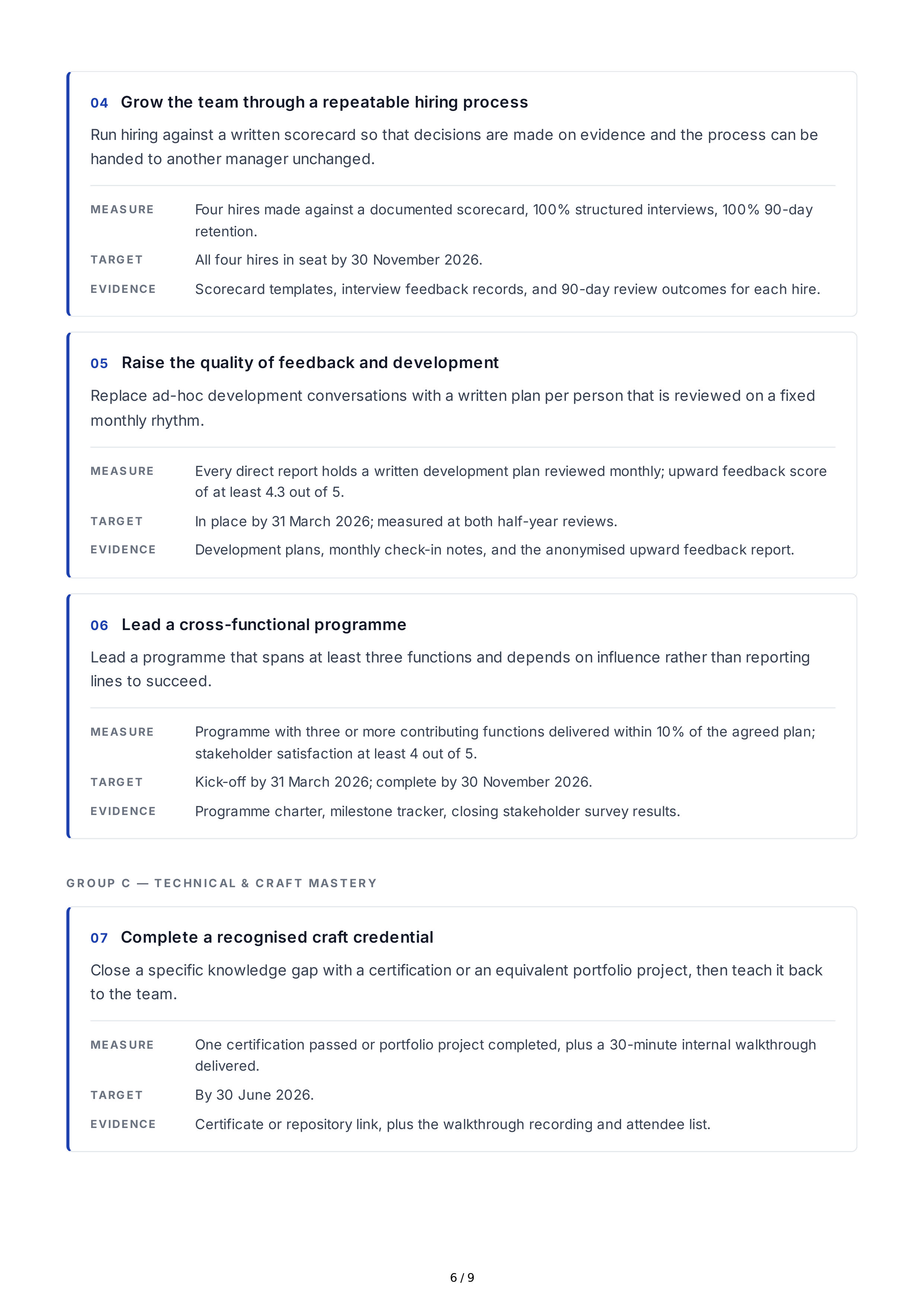
04
Grow
the
team
through
a
repeatable
hiring
process
Run
hiring
against
a
written
scorecard
so
that
decisions
are
made
on
evidence
and
the
process
can
be
handed
to
another
manager
unchanged
.
MEAS URE
Four
hires
made
against
a
documented
scorecard
, 100%
structured
interviews
, 100% 90-
day
retention
.
TARG ET
All
four
hires
in
seat
by
30
November
2026.
EVIDENCE
Scorecard
templates
,
interview
feedback
records
,
and
90-
day
review
outcomes
for
each
hire
.
05
Raise
the
quality
of
feedback
and
development
Replace
ad
-
hoc
development
conversations
with
a
written
plan
per
person
that
is
reviewed
on
a
fixed
monthly
rhythm
.
MEAS URE
Every
direct
report
holds
a
written
development
plan
reviewed
monthly
;
upward
feedback
score
of
at
least
4.3
out
of
5.
TARG ET
In
place
by
31
March
2026;
measured
at
both
half
-
year
reviews
.
EVIDENCE
Development
plans
,
monthly
check
-
in
notes
,
and
the
anonymised
upward
feedback
report
.
06
Lead
a
cross
-
functional
programme
Lead
a
programme
that
spans
at
least
three
functions
and
depends
on
influence
rather
than
reporting
lines
to
succeed
.
MEAS URE
Programme
with
three
or
more
contributing
functions
delivered
within
10%
of
the
agreed
plan
;
stakeholder
satisfaction
at
least
4
out
of
5.
TARG ET
Kick
-
off
by
31
March
2026;
complete
by
30
November
2026.
EVIDENCE
Programme
charter
,
milestone
tracker
,
closing
stakeholder
survey
results
.
G R O UP
C
—
T E C HN IC AL
&
C R AF T
MAS T E R Y
07
Complete
a
recognised
craft
credential
Close
a
specific
knowledge
gap
with
a
certification
or
an
equivalent
portfolio
project
,
then
teach
it
back
to
the
team
.
MEAS URE
One
certification
passed
or
portfolio
project
completed
,
plus
a
30-
minute
internal
walkthrough
delivered
.
TARG ET
By
30
June
2026.
EVIDENCE
Certificate
or
repository
link
,
plus
the
walkthrough
recording
and
attendee
list
.
6 / 9
08
Automate
the
three
largest
manual
workflows
Target
the
three
workflows
that
consume
the
most
recurring
manual
effort
and
remove
the
human
step
from
each
.
MEAS URE
At
least
12
hours
per
week
of
recurring
manual
effort
removed
,
verified
against
two
weeks
of
time
logs
.
TARG ET
All
three
automated
by
31
August
2026.
EVIDENCE
Before
-
and
-
after
time
logs
,
scripts
or
configuration
,
and
handover
documentation
for
each
workflow
.
09
Publish
written
work
that
others
rely
on
Build
a
visible
body
of
writing
—
specifications
,
runbooks
,
decision
records
or
articles
—
that
others
actually
use
as
reference
.
MEAS URE
Six
published
pieces
across
the
year
,
each
peer
-
reviewed
,
with
at
least
three
cited
in
another
team
'
s
work
.
TARG ET
Two
pieces
per
quarter
through
2026.
EVIDENCE
Publication
links
,
review
comments
,
and
the
referencing
documents
.
G R O UP
D
—
VIS IB ILIT Y
&
IN F LUE N C E
10
Build
a
credible
external
professional
profile
Move
from
being
known
internally
to
being
recognised
in
the
wider
field
,
through
speaking
and
consistent
public
writing
.
MEAS URE
Two
speaking
engagements
delivered
,
a
quarterly
public
writing
cadence
maintained
,
and
500
relevant
professional
connections
.
TARG ET
By
31
December
2026.
EVIDENCE
Event
programmes
or
recordings
,
published
articles
,
and
the
current
profile
page
.
11
Mentor
two
colleagues
outside
the
reporting
line
Support
two
people
you
do
not
manage
,
with
a
defined
goal
for
each
and
measurable
progress
they
can
report
themselves
.
MEAS URE
Fortnightly
sessions
held
across
six
months
;
both
mentees
report
measurable
progress
in
their
own
reviews
.
TARG ET
Starting
February
2026,
concluding
August
2026.
EVIDENCE
Session
log
,
agreed
goals
for
each
mentee
,
and
their
written
progress
statements
.
G R O UP
E
—
P E R S O N AL
G R O WT H
&
E F F E C T IVE N E S S
7 / 9
12
Complete
a
structured
leadership
development
programme
Work
through
a
formal
programme
and
convert
the
feedback
into
a
written
action
plan
rather
than
a
certificate
on
a
wall
.
MEAS URE
One
eight
-
week
programme
completed
,
plus
a
360-
degree
feedback
cycle
and
a
written
action
plan
with
three
named
changes
.
TARG ET
By
30
September
2026.
EVIDENCE
Programme
completion
record
, 360
feedback
report
,
and
the
action
plan
with
a
progress
check
at
six
months
.
13
Protect
deep
work
and
reduce
meeting
load
Rebuild
the
working
week
around
uninterrupted
blocks
of
focused
time
,
and
remove
or
shorten
meetings
that
no
longer
earn
their
place
.
MEAS URE
At
least
10
hours
per
week
of
uninterrupted
deep
work
;
total
meeting
load
reduced
by
20%.
TARG ET
Sustained
for
two
consecutive
quarters
,
measured
from
March
2026.
EVIDENCE
Calendar
analytics
export
,
a
list
of
meetings
removed
or
shortened
,
and
delivered
output
during
protected
blocks
.
8 / 9
3.
Writing
Goals
That
Hold
Up
at
Review
A
goal
that
cannot
be
checked
in
thirty
seconds
is
not
a
goal
—
it
is
an
intention
.
Apply
the
following
tests
to
every
entry
before
it
goes
into
a
written
plan
.
Rule
of
thumb
:
if
a
goal
cannot
be
evidenced
with
an
artefact
that
already
exists
somewhere
—
a
dashboard
,
a
repository
,
a
signed
document
,
a
recording
—
it
will
be
argued
over
at
review
time
instead
of
assessed
.
Start
with
the
outcome
,
not
the
activity
.
“
Reduce
onboarding
time
to
four
days
”
is
a
goal
. “
Work
on
onboarding
”
is
a
diary
entry
.
Attach
a
number
.
If
no
metric
exists
yet
,
name
the
evidence
you
will
produce
instead
—
a
document
,
a
handover
,
a
signed
approval
.
Name
one
owner
.
A
goal
with
two
owners
has
none
.
Shared
accountability
belongs
in
the
dependency
notes
,
not
the
goal
statement
.
Set
the
check
-
in
point
before
you
start
.
A
goal
with
no
review
date
is
discovered
,
not
managed
.
Write
both
a
commit
and
a
stretch
level
.
The
commit
level
is
what
you
will
deliver
.
The
stretch
is
what
success
looks
like
if
everything
goes
right
.
Keep
the
count
between
five
and
eight
.
More
than
eight
active
goals
per
cycle
means
nothing
gets
full
attention
.
State
the
review
paragraph
up
front
.
Complete
this
sentence
before
starting
: “
In
twelve
months
I
will
be
able
to
show
…”
If
you
cannot
finish
it
,
the
goal
is
too
vague
.
9 / 9
