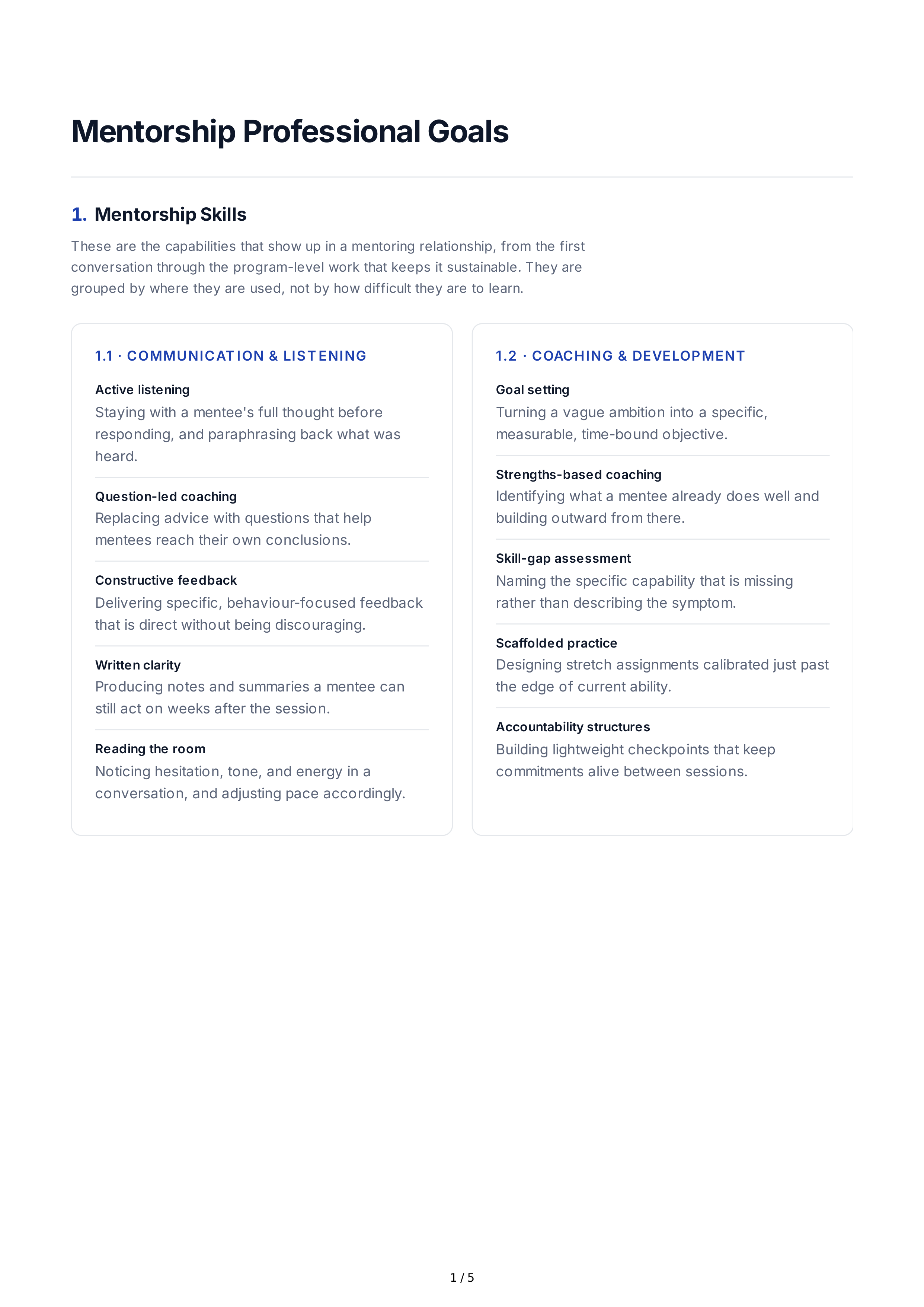
Mentorship
Professional
Goals
1.
Mentorship
Skills
These
are
the
capabilities
that
show
up
in
a
mentoring
relationship
,
from
the
first
conversation
through
the
program
-
level
work
that
keeps
it
sustainable
.
They
are
grouped
by
where
they
are
used
,
not
by
how
difficult
they
are
to
learn
.
1.1 ·
COMMUNICAT ION
&
LIST ENING
Active
listening
Staying
with
a
mentee
'
s
full
thought
before
responding
,
and
paraphrasing
back
what
was
heard
.
Question
-
led
coaching
Replacing
advice
with
questions
that
help
mentees
reach
their
own
conclusions
.
Constructive
feedback
Delivering
specific
,
behaviour
-
focused
feedback
that
is
direct
without
being
discouraging
.
Written
clarity
Producing
notes
and
summaries
a
mentee
can
still
act
on
weeks
after
the
session
.
Reading
the
room
Noticing
hesitation
,
tone
,
and
energy
in
a
conversation
,
and
adjusting
pace
accordingly
.
1.2 ·
COACHING
&
DEVELOPMENT
Goal
setting
Turning
a
vague
ambition
into
a
specific
,
measurable
,
time
-
bound
objective
.
Strengths
-
based
coaching
Identifying
what
a
mentee
already
does
well
and
building
outward
from
there
.
Skill
-
gap
assessment
Naming
the
specific
capability
that
is
missing
rather
than
describing
the
symptom
.
Scaffolded
practice
Designing
stretch
assignments
calibrated
just
past
the
edge
of
current
ability
.
Accountability
structures
Building
lightweight
checkpoints
that
keep
commitments
alive
between
sessions
.
1 / 5
1.3 ·
RELAT IONSHIP
&
T RUST
Psychological
safety
Making
it
possible
to
admit
a
mistake
or
a
gap
without
fear
of
judgment
.
Empathy
Understanding
a
mentee
'
s
workload
,
background
,
and
constraints
before
advising
.
Cultural
awareness
Recognising
how
identity
and
background
shape
a
mentee
'
s
experience
at
work
.
Boundary
management
Keeping
the
relationship
professional
,
predictable
,
and
free
of
dependency
.
Confidentiality
Holding
disclosures
in
confidence
and
knowing
exactly
when
that
confidence
has
a
limit
.
1.4 ·
LEADERSHIP
&
PROGRAM
WORK
Sponsorship
Spending
reputation
on
a
mentee
'
s
behalf
—
recommending
them
for
visible
work
.
Network
brokerage
Introducing
mentees
to
people
they
would
not
otherwise
reach
on
their
own
.
Program
design
Building
intake
,
matching
,
and
review
processes
that
still
work
at
scale
.
Facilitation
Running
group
sessions
,
peer
circles
,
and
cohort
kickoffs
without
losing
the
room
.
Measurement
Defining
and
tracking
the
outcomes
that
prove
a
program
is
actually
working
.
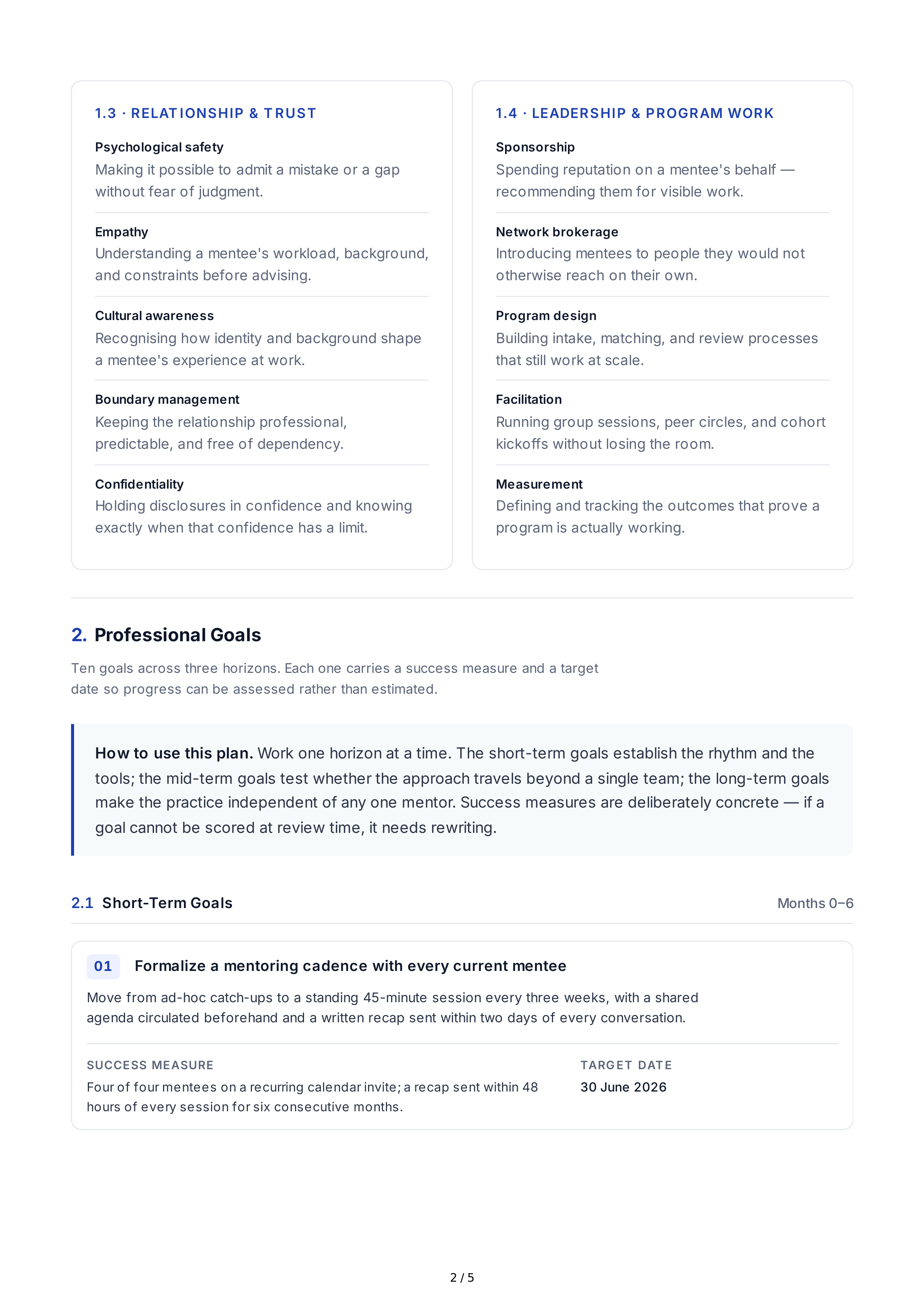
2.
Professional
Goals
Ten
goals
across
three
horizons
.
Each
one
carries
a
success
measure
and
a
target
date
so
progress
can
be
assessed
rather
than
estimated
.
How
to
use
this
plan
.
Work
one
horizon
at
a
time
.
The
short
-
term
goals
establish
the
rhythm
and
the
tools
;
the
mid
-
term
goals
test
whether
the
approach
travels
beyond
a
single
team
;
the
long
-
term
goals
make
the
practice
independent
of
any
one
mentor
.
Success
measures
are
deliberately
concrete
—
if
a
goal
cannot
be
scored
at
review
time
,
it
needs
rewriting
.
2.1
Short
-
Term
Goals
Months
0–6
01
Formalize
a
mentoring
cadence
with
every
current
mentee
Move
from
ad
-
hoc
catch
-
ups
to
a
standing
45-
minute
session
every
three
weeks
,
with
a
shared
agenda
circulated
beforehand
and
a
written
recap
sent
within
two
days
of
every
conversation
.
SUCCESS
MEASURE
Four
of
four
mentees
on
a
recurring
calendar
invite
;
a
recap
sent
within
48
hours
of
every
session
for
six
consecutive
months
.
TARGET
DATE
30
June
2026
2 / 5
02
Complete
a
recognised
mentoring
credential
Finish
a
structured
coaching
and
mentoring
certification
,
including
the
assessed
practice
hours
,
and
apply
at
least
three
techniques
from
the
course
to
live
mentoring
sessions
within
a
month
of
completing
it
.
SUCCESS
MEASURE
Certificate
issued
;
six
logged
practice
hours
with
written
supervisor
feedback
;
three
techniques
trialled
and
documented
.
TARGET
DATE
31
May
2026
03
Build
a
reusable
mentee
intake
and
goal
-
setting
kit
Produce
a
one
-
page
intake
form
,
a
goal
-
setting
worksheet
,
and
a
repeatable
session
template
that
any
mentor
in
the
organisation
can
pick
up
and
use
without
a
live
handover
.
SUCCESS
MEASURE
Kit
reviewed
and
approved
by
People
Development
;
adopted
by
at
least
five
mentors
in
the
pilot
cohort
.
TARGET
DATE
31
July
2026
2.2
Mid
-
Term
Goals
Months
6–12
04
Measure
and
report
mentee
outcomes
every
quarter
Track
promotion
,
change
in
scope
,
completed
certifications
,
and
self
-
rated
confidence
for
each
mentee
,
with
a
baseline
captured
in
the
first
month
of
the
relationship
so
progress
is
comparable
rather
than
remembered
.
SUCCESS
MEASURE
80%
of
mentees
report
measurable
progress
against
their
original
goal
by
month
nine
;
a
quarterly
summary
shared
with
People
Development
.
TARGET
DATE
Quarterly
,
from
September
2026
05
Expand
mentoring
beyond
my
own
team
Take
on
two
mentees
from
adjacent
functions
to
test
whether
the
approach
holds
up
outside
my
own
discipline
,
and
document
what
has
to
change
when
the
context
does
.
SUCCESS
MEASURE
Two
cross
-
functional
mentees
onboarded
;
average
satisfaction
of
4.5
out
of
5
or
higher
at
the
six
-
month
review
.
TARGET
DATE
31
December
2026
06
Start
a
peer
circle
for
other
mentors
Run
a
monthly
60-
minute
forum
where
mentors
compare
notes
on
stuck
mentees
,
difficult
conversations
,
and
the
practices
they
have
quietly
stopped
using
because
they
did
not
work
.
SUCCESS
MEASURE
Eight
or
more
mentors
attending
at
least
three
sessions
per
year
;
a
written
summary
of
themes
shared
after
each
one
.
TARGET
DATE
First
session
by
30
November
2026
3 / 5
2.3
Long
-
Term
Goals
Years
1–3
07
Publish
an
internal
mentorship
playbook
Document
the
intake
process
,
session
structure
,
feedback
norms
,
and
anonymised
case
examples
from
the
program
,
so
a
new
mentor
can
be
onboarded
without
a
live
handover
from
an
experienced
one
.
SUCCESS
MEASURE
Playbook
published
and
referenced
in
at
least
ten
new
mentor
onboardings
;
reviewed
and
refreshed
annually
.
TARGET
DATE
By
Q
2 2027
08
Mentor
25
professionals
end
to
end
Sustain
an
active
roster
of
three
to
five
mentees
per
year
,
with
each
relationship
running
at
least
six
sessions
and
closing
with
a
written
outcome
review
agreed
by
both
parties
.
SUCCESS
MEASURE
25
completed
mentoring
relationships
; 70%
reporting
a
promotion
,
role
change
,
or
new
responsibility
within
12
months
of
completion
.
TARGET
DATE
By
December
2028
09
Build
a
mentoring
alumni
network
Keep
former
mentees
connected
to
one
another
and
to
the
program
so
that
mentoring
continues
to
happen
without
me
at
the
centre
of
it
,
including
pairs
that
form
without
facilitation
.
SUCCESS
MEASURE
40
alumni
in
the
network
;
at
least
six
mentor
–
mentee
pairs
formed
between
alumni
without
intervention
.
TARGET
DATE
By
Q
4 2028
10
Contribute
to
the
wider
field
Present
at
one
internal
learning
event
and
one
external
meetup
each
year
on
mentoring
practice
,
and
submit
a
short
case
study
to
the
People
Development
knowledge
base
covering
what
worked
and
what
did
not
.
SUCCESS
MEASURE
Two
talks
delivered
per
year
;
one
case
study
published
annually
;
at
least
one
recommendation
from
the
case
study
adopted
by
another
team
.
TARGET
DATE
Ongoing
from
2027
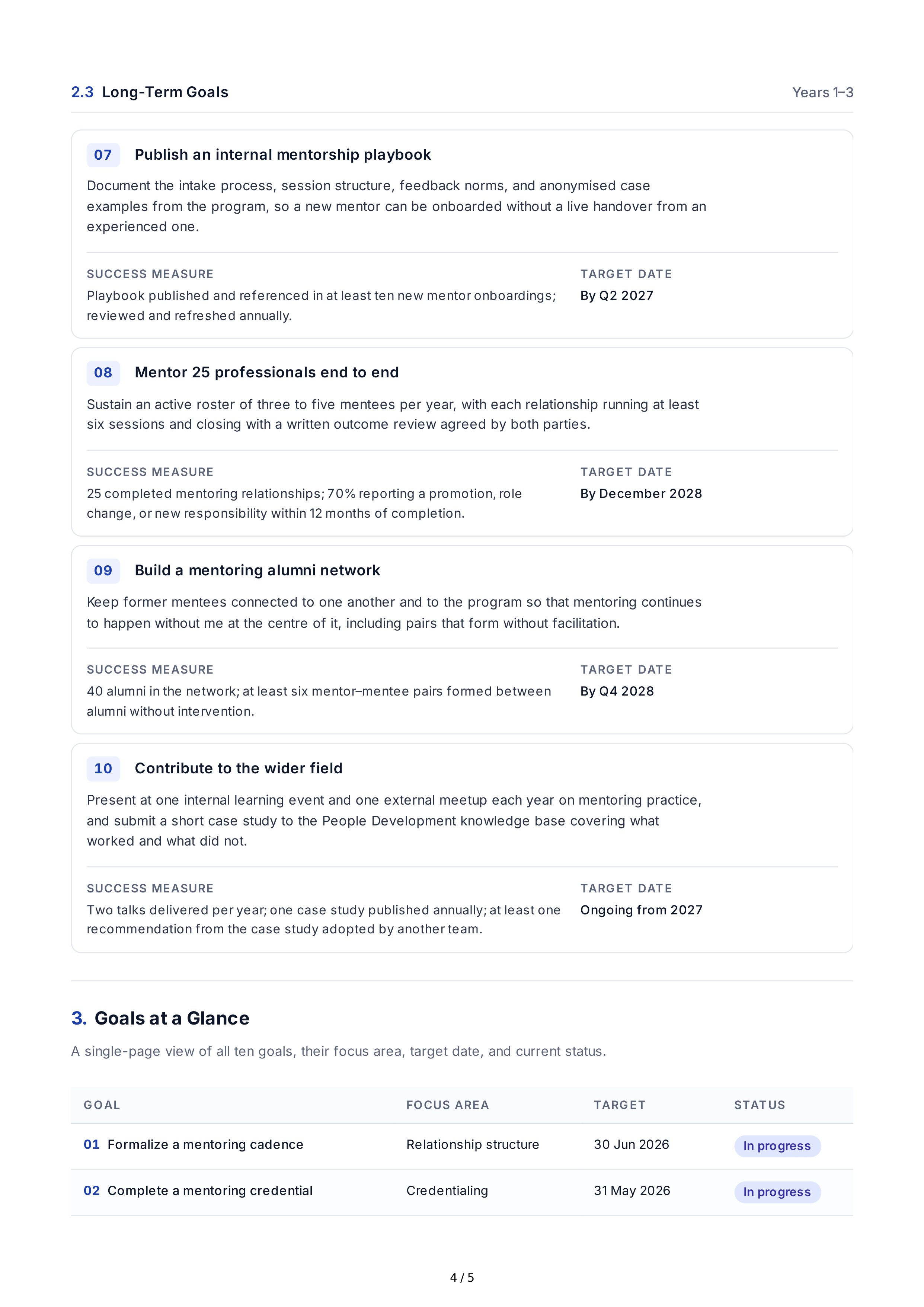
3.
Goals
at
a
Glance
A
single
-
page
view
of
all
ten
goals
,
their
focus
area
,
target
date
,
and
current
status
.
GOAL
FOCUS
AREA
TARGET
STATUS
01
Formalize
a
mentoring
cadence
Relationship
structure
30
Jun
2026
In
progress
02
Complete
a
mentoring
credential
Credentialing
31
May
2026
In
progress
4 / 5

GOAL
FOCUS
AREA
TARGET
STATUS
03
Build
an
intake
and
goal
-
setting
kit
Resources
31
Jul
2026
Planned
04
Report
mentee
outcomes
quarterly
Measurement
From
Sep
2026
Planned
05
Expand
mentoring
beyond
my
team
Reach
31
Dec
2026
Planned
06
Start
a
peer
circle
for
mentors
Community
30
Nov
2026
Planned
07
Publish
a
mentorship
playbook
Documentation
Q
2 2027
Planned
08
Mentor
25
professionals
end
to
end
Scale
Dec
2028
Planned
09
Build
a
mentoring
alumni
network
Sustainability
Q
4 2028
Planned
10
Contribute
to
the
wider
field
Advocacy
From
2027
Planned
5 / 5