
Professional
Reputation
Goals
1 / 8
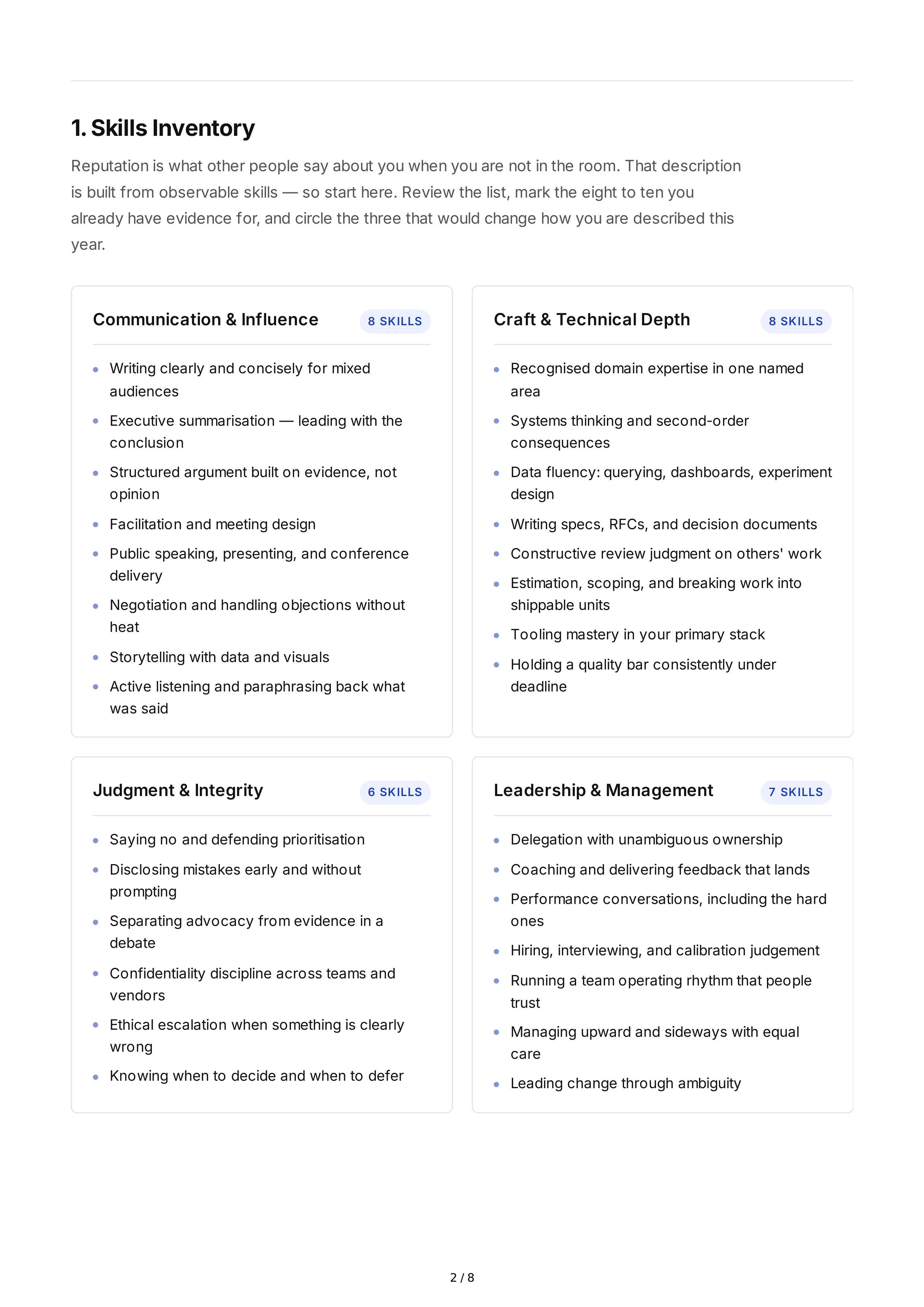
1.
Skills
Inventory
Reputation
is
what
other
people
say
about
you
when
you
are
not
in
the
room
.
That
description
is
built
from
observable
skills
—
so
start
here
.
Review
the
list
,
mark
the
eight
to
ten
you
already
have
evidence
for
,
and
circle
the
three
that
would
change
how
you
are
described
this
year
.
Communication
&
Influence
8
SKILLS
Craft
&
Technical
Depth
8
SKILLS
Judgment
&
Integrity
6
SKILLS
Leadership
&
Management
7
SKILLS
Writing
clearly
and
concisely
for
mixed
audiences
Executive
summarisation
—
leading
with
the
conclusion
Structured
argument
built
on
evidence
,
not
opinion
Facilitation
and
meeting
design
Public
speaking
,
presenting
,
and
conference
delivery
Negotiation
and
handling
objections
without
heat
Storytelling
with
data
and
visuals
Active
listening
and
paraphrasing
back
what
was
said
Recognised
domain
expertise
in
one
named
area
Systems
thinking
and
second
-
order
consequences
Data
fluency
:
querying
,
dashboards
,
experiment
design
Writing
specs
,
RFCs
,
and
decision
documents
Constructive
review
judgment
on
others
'
work
Estimation
,
scoping
,
and
breaking
work
into
shippable
units
Tooling
mastery
in
your
primary
stack
Holding
a
quality
bar
consistently
under
deadline
Saying
no
and
defending
prioritisation
Disclosing
mistakes
early
and
without
prompting
Separating
advocacy
from
evidence
in
a
debate
Confidentiality
discipline
across
teams
and
vendors
Ethical
escalation
when
something
is
clearly
wrong
Knowing
when
to
decide
and
when
to
defer
Delegation
with
unambiguous
ownership
Coaching
and
delivering
feedback
that
lands
Performance
conversations
,
including
the
hard
ones
Hiring
,
interviewing
,
and
calibration
judgement
Running
a
team
operating
rhythm
that
people
trust
Managing
upward
and
sideways
with
equal
care
Leading
change
through
ambiguity
2 / 8
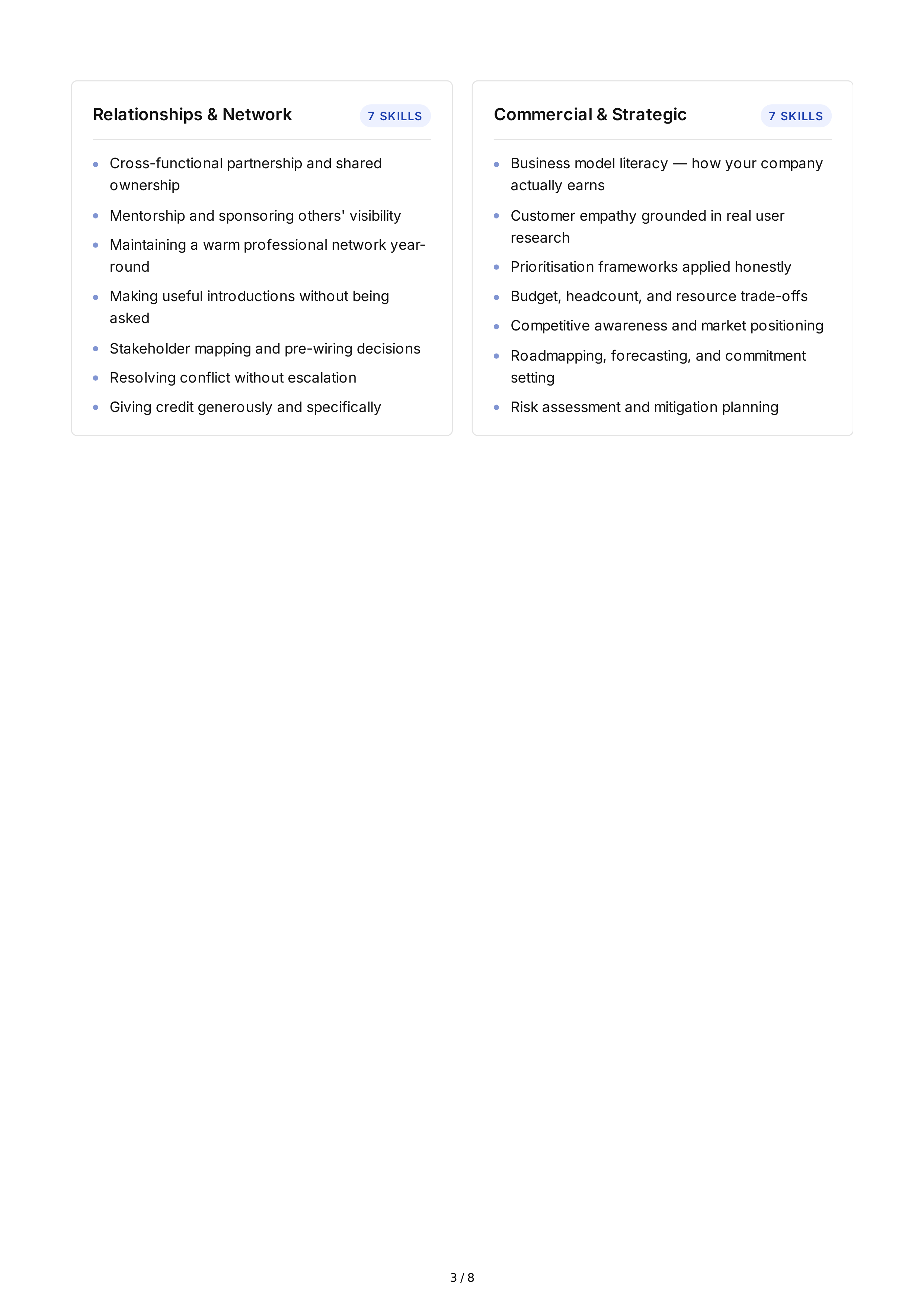
Relationships
&
Network
7
SKILLS
Commercial
&
Strategic
7
SKILLS
Cross
-
functional
partnership
and
shared
ownership
Mentorship
and
sponsoring
others
'
visibility
Maintaining
a
warm
professional
network
year
-
round
Making
useful
introductions
without
being
asked
Stakeholder
mapping
and
pre
-
wiring
decisions
Resolving
conflict
without
escalation
Giving
credit
generously
and
specifically
Business
model
literacy
—
how
your
company
actually
earns
Customer
empathy
grounded
in
real
user
research
Prioritisation
frameworks
applied
honestly
Budget
,
headcount
,
and
resource
trade
-
offs
Competitive
awareness
and
market
positioning
Roadmapping
,
forecasting
,
and
commitment
setting
Risk
assessment
and
mitigation
planning
3 / 8
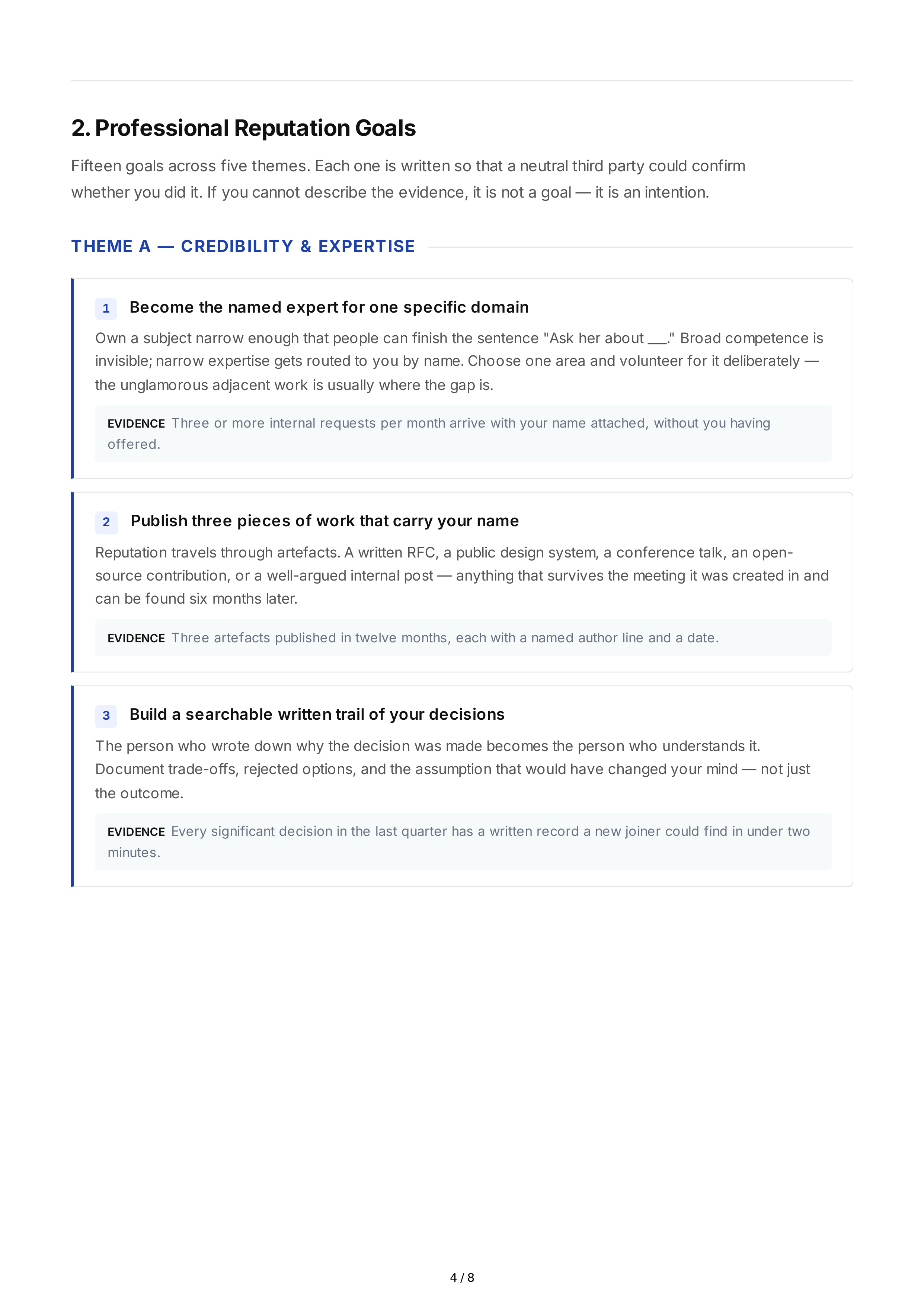
2.
Professional
Reputation
Goals
Fifteen
goals
across
five
themes
.
Each
one
is
written
so
that
a
neutral
third
party
could
confirm
whether
you
did
it
.
If
you
cannot
describe
the
evidence
,
it
is
not
a
goal
—
it
is
an
intention
.
THEME
A
—
CREDIBILITY
&
EXPERTISE
1
Become
the
named
expert
for
one
specific
domain
Own
a
subject
narrow
enough
that
people
can
finish
the
sentence
"
Ask
her
about
___."
Broad
competence
is
invisible
;
narrow
expertise
gets
routed
to
you
by
name
.
Choose
one
area
and
volunteer
for
it
deliberately
—
the
unglamorous
adjacent
work
is
usually
where
the
gap
is
.
EVIDENCE
Three
or
more
internal
requests
per
month
arrive
with
your
name
attached
,
without
you
having
offered
.
2
Publish
three
pieces
of
work
that
carry
your
name
Reputation
travels
through
artefacts
.
A
written
RFC
,
a
public
design
system
,
a
conference
talk
,
an
open
-
source
contribution
,
or
a
well
-
argued
internal
post
—
anything
that
survives
the
meeting
it
was
created
in
and
can
be
found
six
months
later
.
EVIDENCE
Three
artefacts
published
in
twelve
months
,
each
with
a
named
author
line
and
a
date
.
3
Build
a
searchable
written
trail
of
your
decisions
The
person
who
wrote
down
why
the
decision
was
made
becomes
the
person
who
understands
it
.
Document
trade
-
offs
,
rejected
options
,
and
the
assumption
that
would
have
changed
your
mind
—
not
just
the
outcome
.
EVIDENCE
Every
significant
decision
in
the
last
quarter
has
a
written
record
a
new
joiner
could
find
in
under
two
minutes
.
4 / 8
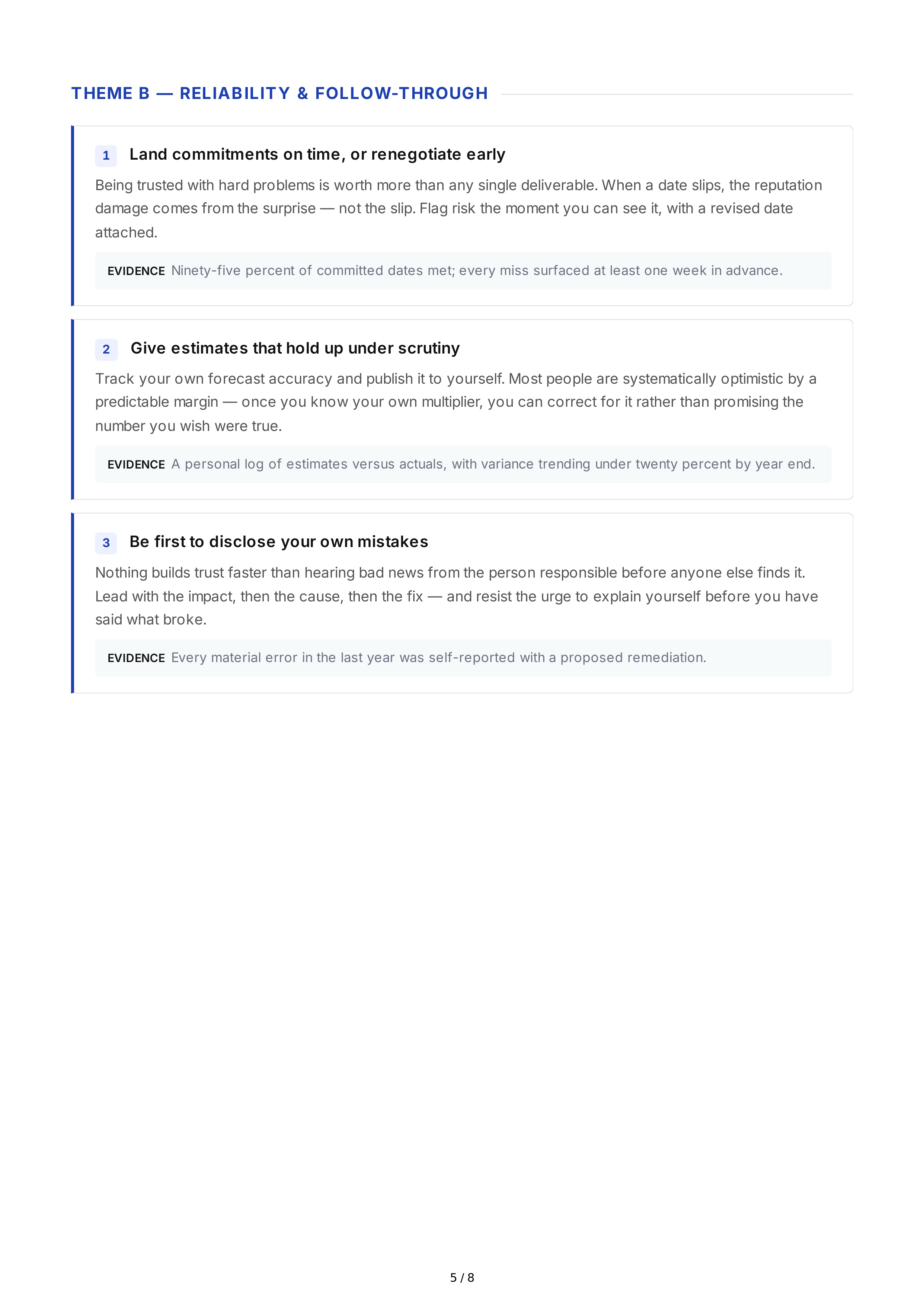
THEME
B
—
RELIABILITY
&
FOLLOW
-
THROUGH
1
Land
commitments
on
time
,
or
renegotiate
early
Being
trusted
with
hard
problems
is
worth
more
than
any
single
deliverable
.
When
a
date
slips
,
the
reputation
damage
comes
from
the
surprise
—
not
the
slip
.
Flag
risk
the
moment
you
can
see
it
,
with
a
revised
date
attached
.
EVIDENCE
Ninety
-
five
percent
of
committed
dates
met
;
every
miss
surfaced
at
least
one
week
in
advance
.
2
Give
estimates
that
hold
up
under
scrutiny
Track
your
own
forecast
accuracy
and
publish
it
to
yourself
.
Most
people
are
systematically
optimistic
by
a
predictable
margin
—
once
you
know
your
own
multiplier
,
you
can
correct
for
it
rather
than
promising
the
number
you
wish
were
true
.
EVIDENCE
A
personal
log
of
estimates
versus
actuals
,
with
variance
trending
under
twenty
percent
by
year
end
.
3
Be
first
to
disclose
your
own
mistakes
Nothing
builds
trust
faster
than
hearing
bad
news
from
the
person
responsible
before
anyone
else
finds
it
.
Lead
with
the
impact
,
then
the
cause
,
then
the
fix
—
and
resist
the
urge
to
explain
yourself
before
you
have
said
what
broke
.
EVIDENCE
Every
material
error
in
the
last
year
was
self
-
reported
with
a
proposed
remediation
.
5 / 8
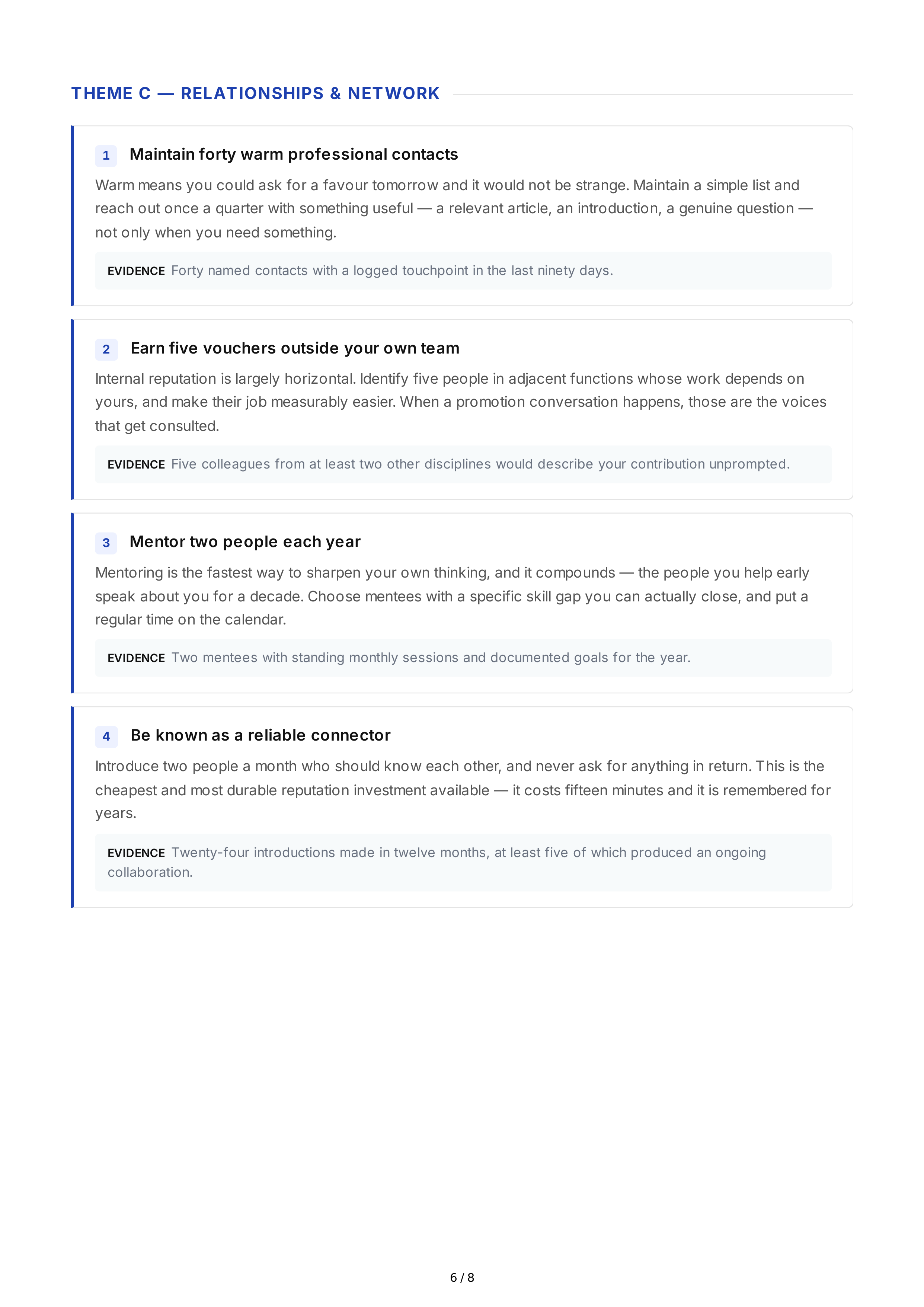
THEME
C
—
RELATIONSHIPS
&
NETWORK
1
Maintain
forty
warm
professional
contacts
Warm
means
you
could
ask
for
a
favour
tomorrow
and
it
would
not
be
strange
.
Maintain
a
simple
list
and
reach
out
once
a
quarter
with
something
useful
—
a
relevant
article
,
an
introduction
,
a
genuine
question
—
not
only
when
you
need
something
.
EVIDENCE
Forty
named
contacts
with
a
logged
touchpoint
in
the
last
ninety
days
.
2
Earn
five
vouchers
outside
your
own
team
Internal
reputation
is
largely
horizontal
.
Identify
five
people
in
adjacent
functions
whose
work
depends
on
yours
,
and
make
their
job
measurably
easier
.
When
a
promotion
conversation
happens
,
those
are
the
voices
that
get
consulted
.
EVIDENCE
Five
colleagues
from
at
least
two
other
disciplines
would
describe
your
contribution
unprompted
.
3
Mentor
two
people
each
year
Mentoring
is
the
fastest
way
to
sharpen
your
own
thinking
,
and
it
compounds
—
the
people
you
help
early
speak
about
you
for
a
decade
.
Choose
mentees
with
a
specific
skill
gap
you
can
actually
close
,
and
put
a
regular
time
on
the
calendar
.
EVIDENCE
Two
mentees
with
standing
monthly
sessions
and
documented
goals
for
the
year
.
4
Be
known
as
a
reliable
connector
Introduce
two
people
a
month
who
should
know
each
other
,
and
never
ask
for
anything
in
return
.
This
is
the
cheapest
and
most
durable
reputation
investment
available
—
it
costs
fifteen
minutes
and
it
is
remembered
for
years
.
EVIDENCE
Twenty
-
four
introductions
made
in
twelve
months
,
at
least
five
of
which
produced
an
ongoing
collaboration
.
6 / 8
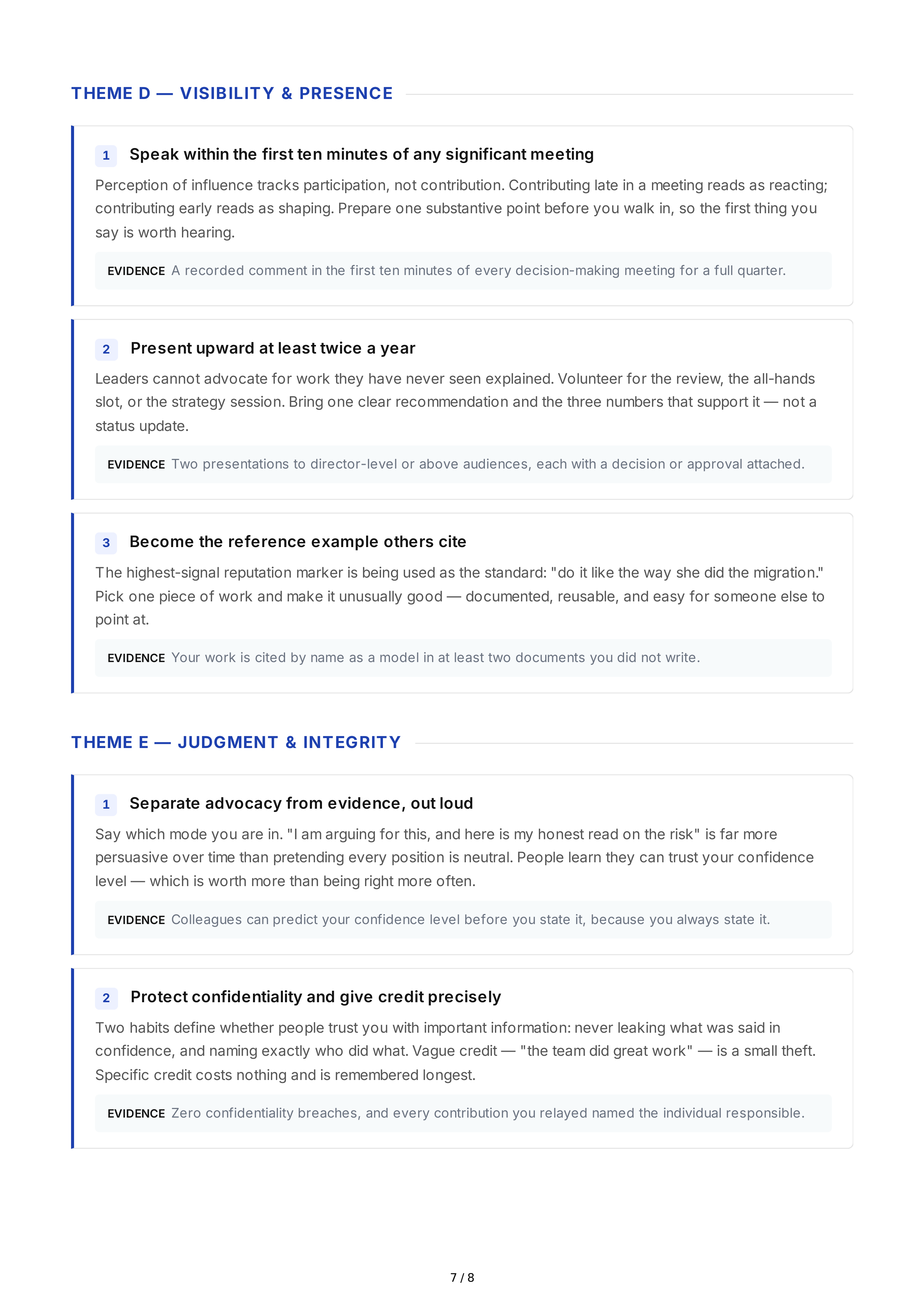
THEME
D
—
VISIBILITY
&
PRESENCE
1
Speak
within
the
first
ten
minutes
of
any
significant
meeting
Perception
of
influence
tracks
participation
,
not
contribution
.
Contributing
late
in
a
meeting
reads
as
reacting
;
contributing
early
reads
as
shaping
.
Prepare
one
substantive
point
before
you
walk
in
,
so
the
first
thing
you
say
is
worth
hearing
.
EVIDENCE
A
recorded
comment
in
the
first
ten
minutes
of
every
decision
-
making
meeting
for
a
full
quarter
.
2
Present
upward
at
least
twice
a
year
Leaders
cannot
advocate
for
work
they
have
never
seen
explained
.
Volunteer
for
the
review
,
the
all
-
hands
slot
,
or
the
strategy
session
.
Bring
one
clear
recommendation
and
the
three
numbers
that
support
it
—
not
a
status
update
.
EVIDENCE
Two
presentations
to
director
-
level
or
above
audiences
,
each
with
a
decision
or
approval
attached
.
3
Become
the
reference
example
others
cite
The
highest
-
signal
reputation
marker
is
being
used
as
the
standard
: "
do
it
like
the
way
she
did
the
migration
."
Pick
one
piece
of
work
and
make
it
unusually
good
—
documented
,
reusable
,
and
easy
for
someone
else
to
point
at
.
EVIDENCE
Your
work
is
cited
by
name
as
a
model
in
at
least
two
documents
you
did
not
write
.
THEME
E
—
JUDGMENT
&
INTEGRITY
1
Separate
advocacy
from
evidence
,
out
loud
Say
which
mode
you
are
in
. "
I
am
arguing
for
this
,
and
here
is
my
honest
read
on
the
risk
"
is
far
more
persuasive
over
time
than
pretending
every
position
is
neutral
.
People
learn
they
can
trust
your
confidence
level
—
which
is
worth
more
than
being
right
more
often
.
EVIDENCE
Colleagues
can
predict
your
confidence
level
before
you
state
it
,
because
you
always
state
it
.
2
Protect
confidentiality
and
give
credit
precisely
Two
habits
define
whether
people
trust
you
with
important
information
:
never
leaking
what
was
said
in
confidence
,
and
naming
exactly
who
did
what
.
Vague
credit
— "
the
team
did
great
work
" —
is
a
small
theft
.
Specific
credit
costs
nothing
and
is
remembered
longest
.
EVIDENCE
Zero
confidentiality
breaches
,
and
every
contribution
you
relayed
named
the
individual
responsible
.
7 / 8
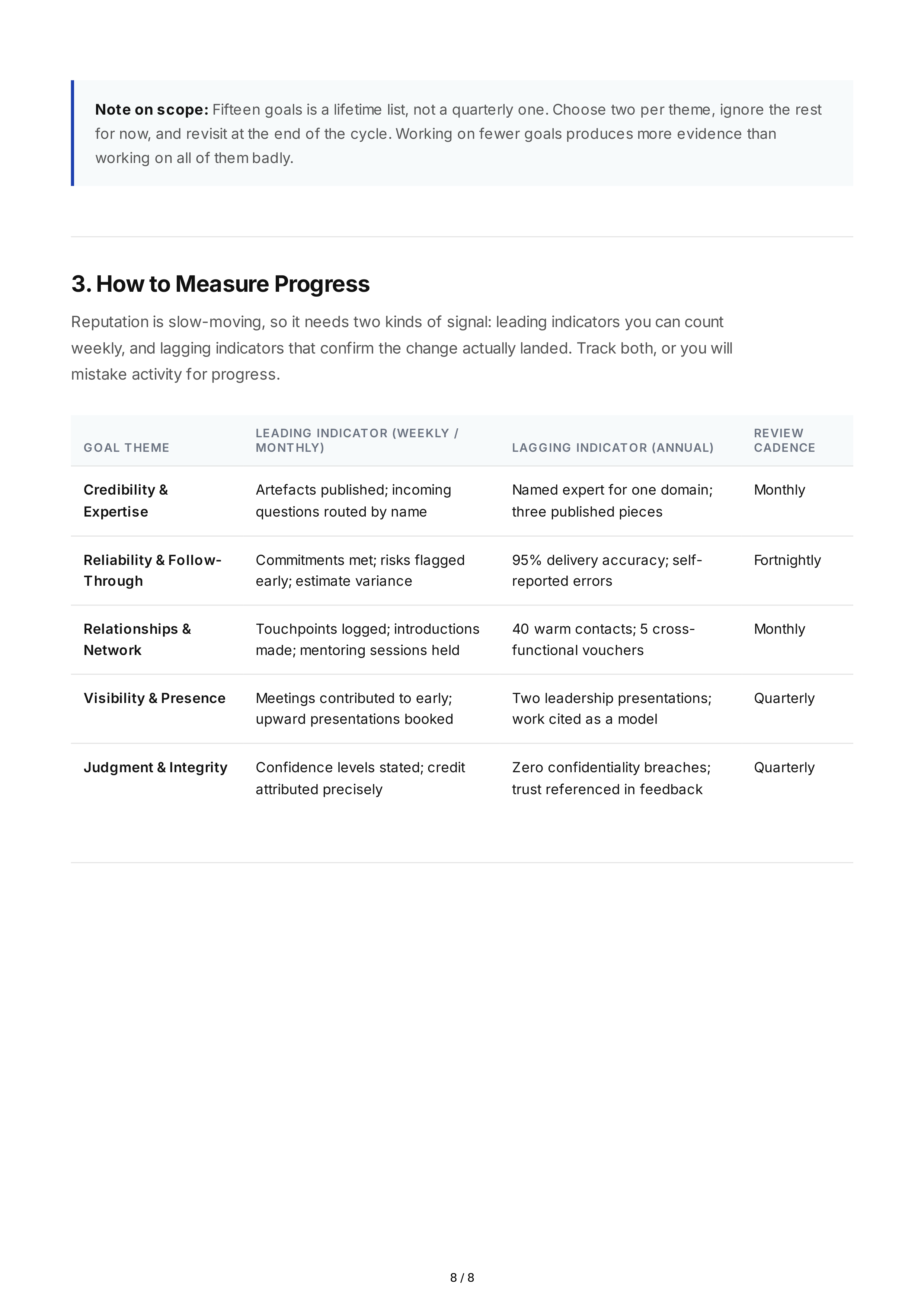
Note
on
scope
:
Fifteen
goals
is
a
lifetime
list
,
not
a
quarterly
one
.
Choose
two
per
theme
,
ignore
the
rest
for
now
,
and
revisit
at
the
end
of
the
cycle
.
Working
on
fewer
goals
produces
more
evidence
than
working
on
all
of
them
badly
.
3.
How
to
Measure
Progress
Reputation
is
slow
-
moving
,
so
it
needs
two
kinds
of
signal
:
leading
indicators
you
can
count
weekly
,
and
lagging
indicators
that
confirm
the
change
actually
landed
.
Track
both
,
or
you
will
mistake
activity
for
progress
.
GOAL
THEME
LEADING
INDICATOR
(
WEEKLY
/
MONTHLY
)
LAGGING
INDICATOR
(
ANNUAL
)
REVIEW
CADENCE
Credibility
&
Expertise
Artefacts
published
;
incoming
questions
routed
by
name
Named
expert
for
one
domain
;
three
published
pieces
Monthly
Reliability
&
Follow
-
Through
Commitments
met
;
risks
flagged
early
;
estimate
variance
95%
delivery
accuracy
;
self
-
reported
errors
Fortnightly
Relationships
&
Network
Touchpoints
logged
;
introductions
made
;
mentoring
sessions
held
40
warm
contacts
; 5
cross
-
functional
vouchers
Monthly
Visibility
&
Presence
Meetings
contributed
to
early
;
upward
presentations
booked
Two
leadership
presentations
;
work
cited
as
a
model
Quarterly
Judgment
&
Integrity
Confidence
levels
stated
;
credit
attributed
precisely
Zero
confidentiality
breaches
;
trust
referenced
in
feedback
Quarterly
8 / 8
