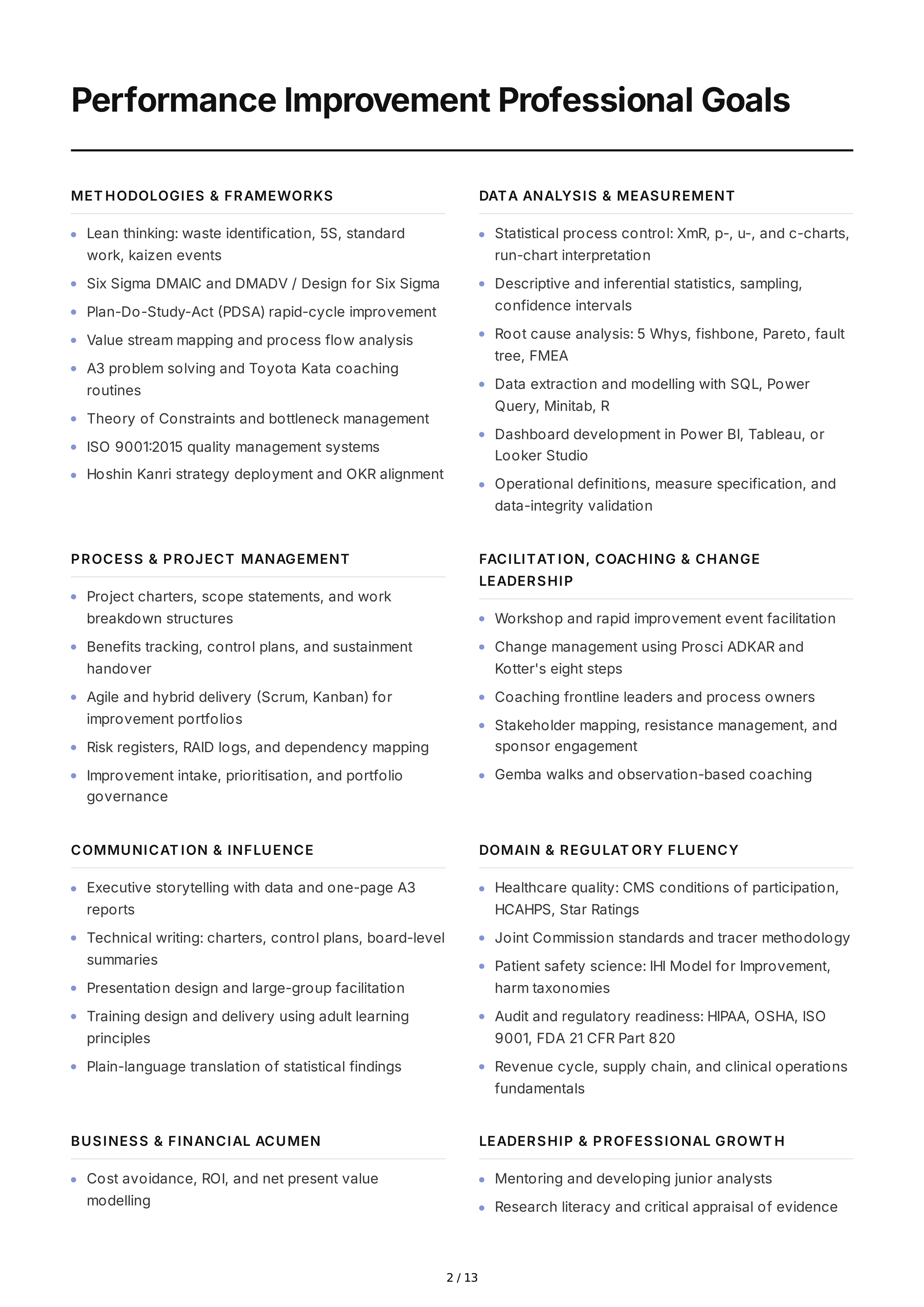
Performance
Improvement
Professional
Goals
MET HODOLOGIES
&
FRAMEWORKS
DATA
ANALYSIS
&
MEASUREMENT
PROCESS
&
PROJECT
MANAGEMENT
FACILITAT ION
,
COACHING
&
CHANGE
LEADERSHIP
COMMUNICAT ION
&
INFLUENCE
DOMAIN
&
REGULAT ORY
FLUENCY
BUSINESS
&
FINANCIAL
ACUMEN
LEADERSHIP
&
PROFESSIONAL
GROWT H
Lean
thinking
:
waste
identification
, 5
S
,
standard
work
,
kaizen
events
Six
Sigma
DMAIC
and
DMADV
/
Design
for
Six
Sigma
Plan
-
Do
-
Study
-
Act
(
PDSA
)
rapid
-
cycle
improvement
Value
stream
mapping
and
process
flow
analysis
A
3
problem
solving
and
Toyota
Kata
coaching
routines
Theory
of
Constraints
and
bottleneck
management
ISO
9001:2015
quality
management
systems
Hoshin
Kanri
strategy
deployment
and
OKR
alignment
Statistical
process
control
:
XmR
,
p
-,
u
-,
and
c
-
charts
,
run
-
chart
interpretation
Descriptive
and
inferential
statistics
,
sampling
,
confidence
intervals
Root
cause
analysis
: 5
Whys
,
fishbone
,
Pareto
,
fault
tree
,
FMEA
Data
extraction
and
modelling
with
SQL
,
Power
Query
,
Minitab
,
R
Dashboard
development
in
Power
BI
,
Tableau
,
or
Looker
Studio
Operational
definitions
,
measure
specification
,
and
data
-
integrity
validation
Project
charters
,
scope
statements
,
and
work
breakdown
structures
Benefits
tracking
,
control
plans
,
and
sustainment
handover
Agile
and
hybrid
delivery
(
Scrum
,
Kanban
)
for
improvement
portfolios
Risk
registers
,
RAID
logs
,
and
dependency
mapping
Improvement
intake
,
prioritisation
,
and
portfolio
governance
Workshop
and
rapid
improvement
event
facilitation
Change
management
using
Prosci
ADKAR
and
Kotter
'
s
eight
steps
Coaching
frontline
leaders
and
process
owners
Stakeholder
mapping
,
resistance
management
,
and
sponsor
engagement
Gemba
walks
and
observation
-
based
coaching
Executive
storytelling
with
data
and
one
-
page
A
3
reports
Technical
writing
:
charters
,
control
plans
,
board
-
level
summaries
Presentation
design
and
large
-
group
facilitation
Training
design
and
delivery
using
adult
learning
principles
Plain
-
language
translation
of
statistical
findings
Healthcare
quality
:
CMS
conditions
of
participation
,
HCAHPS
,
Star
Ratings
Joint
Commission
standards
and
tracer
methodology
Patient
safety
science
:
IHI
Model
for
Improvement
,
harm
taxonomies
Audit
and
regulatory
readiness
:
HIPAA
,
OSHA
,
ISO
9001,
FDA
21
CFR
Part
820
Revenue
cycle
,
supply
chain
,
and
clinical
operations
fundamentals
Cost
avoidance
,
ROI
,
and
net
present
value
modelling
Mentoring
and
developing
junior
analysts
Research
literacy
and
critical
appraisal
of
evidence
2 / 13

Benefit
realisation
tracking
against
baseline
and
target
Budget
construction
for
improvement
portfolios
Vendor
evaluation
and
build
-
versus
-
buy
analysis
Equity
-
informed
improvement
and
health
disparities
analysis
Certification
maintenance
and
continuing
education
planning
Professional
networking
and
knowledge
sharing
3 / 13
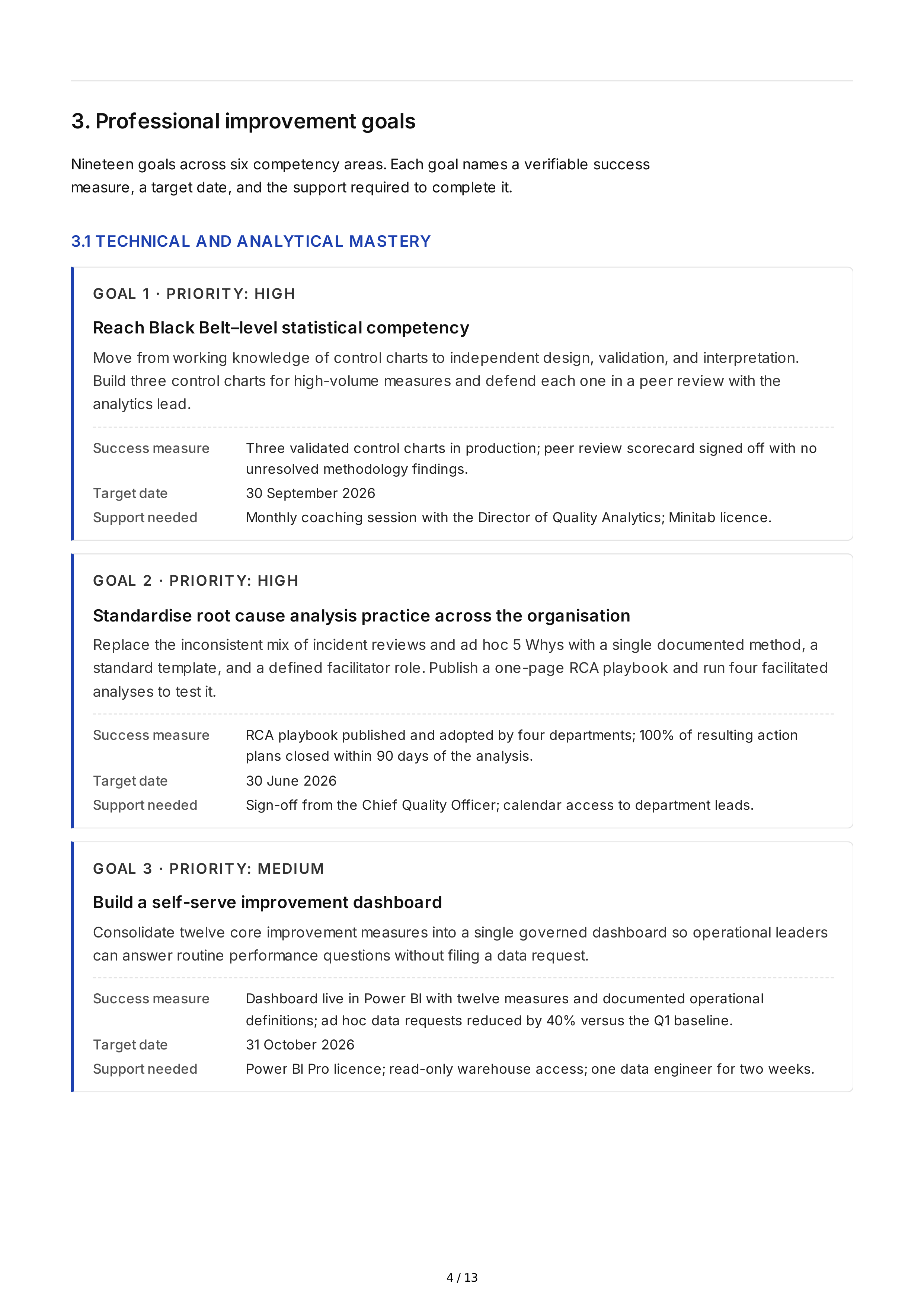
3.
Professional
improvement
goals
Nineteen
goals
across
six
competency
areas
.
Each
goal
names
a
verifiable
success
measure
,
a
target
date
,
and
the
support
required
to
complete
it
.
3.1
TECHNICAL
AND
ANALYTICAL
MASTERY
GOAL
1 ·
PRIORITY
:
HIGH
Reach
Black
Belt
–
level
statistical
competency
Move
from
working
knowledge
of
control
charts
to
independent
design
,
validation
,
and
interpretation
.
Build
three
control
charts
for
high
-
volume
measures
and
defend
each
one
in
a
peer
review
with
the
analytics
lead
.
Success
measure
Three
validated
control
charts
in
production
;
peer
review
scorecard
signed
off
with
no
unresolved
methodology
findings
.
Target
date
30
September
2026
Support
needed
Monthly
coaching
session
with
the
Director
of
Quality
Analytics
;
Minitab
licence
.
GOAL
2 ·
PRIORITY
:
HIGH
Standardise
root
cause
analysis
practice
across
the
organisation
Replace
the
inconsistent
mix
of
incident
reviews
and
ad
hoc
5
Whys
with
a
single
documented
method
,
a
standard
template
,
and
a
defined
facilitator
role
.
Publish
a
one
-
page
RCA
playbook
and
run
four
facilitated
analyses
to
test
it
.
Success
measure
RCA
playbook
published
and
adopted
by
four
departments
; 100%
of
resulting
action
plans
closed
within
90
days
of
the
analysis
.
Target
date
30
June
2026
Support
needed
Sign
-
off
from
the
Chief
Quality
Officer
;
calendar
access
to
department
leads
.
GOAL
3 ·
PRIORITY
:
MEDIUM
Build
a
self
-
serve
improvement
dashboard
Consolidate
twelve
core
improvement
measures
into
a
single
governed
dashboard
so
operational
leaders
can
answer
routine
performance
questions
without
filing
a
data
request
.
Success
measure
Dashboard
live
in
Power
BI
with
twelve
measures
and
documented
operational
definitions
;
ad
hoc
data
requests
reduced
by
40%
versus
the
Q
1
baseline
.
Target
date
31
October
2026
Support
needed
Power
BI
Pro
licence
;
read
-
only
warehouse
access
;
one
data
engineer
for
two
weeks
.
4 / 13
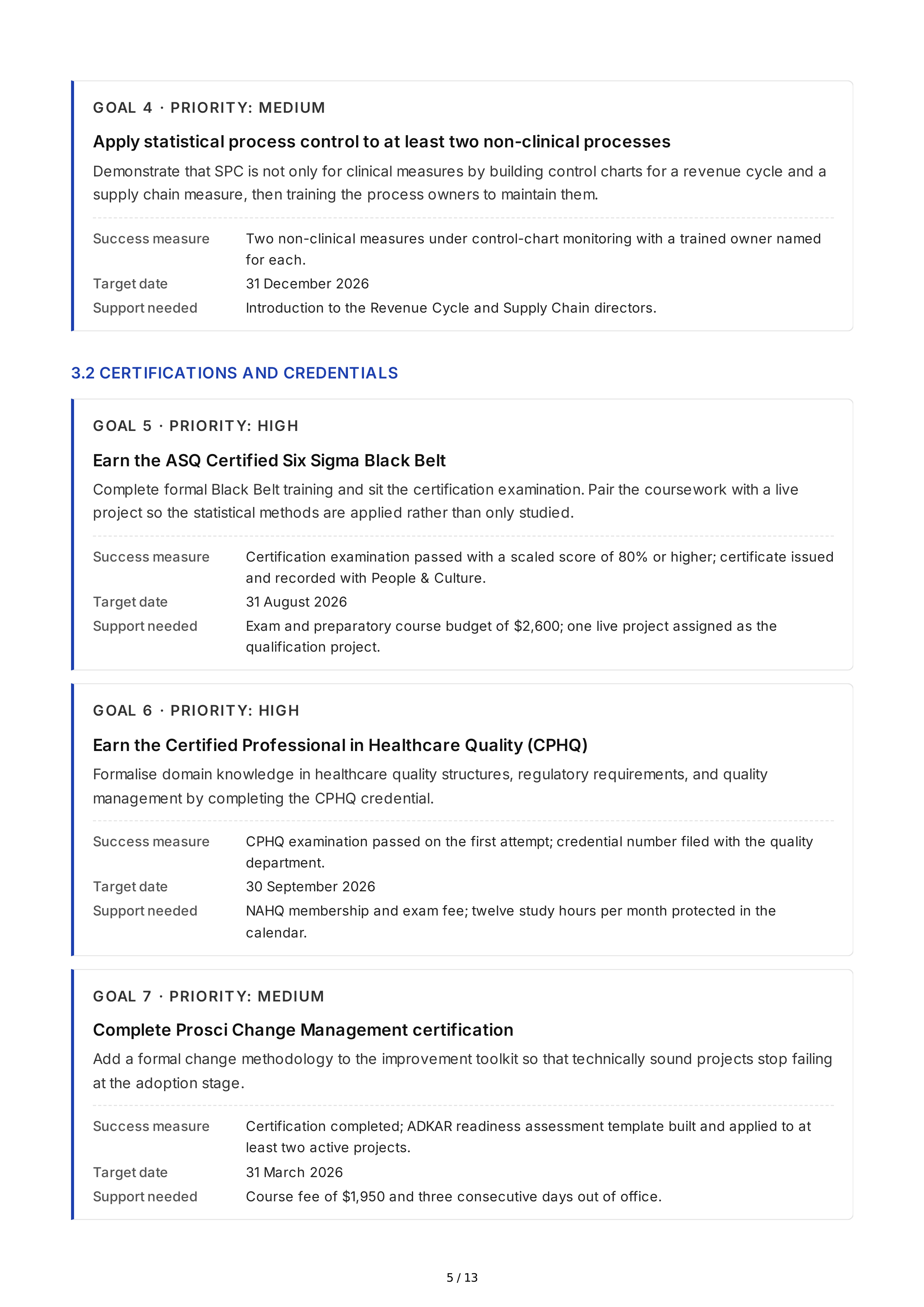
GOAL
4 ·
PRIORITY
:
MEDIUM
Apply
statistical
process
control
to
at
least
two
non
-
clinical
processes
Demonstrate
that
SPC
is
not
only
for
clinical
measures
by
building
control
charts
for
a
revenue
cycle
and
a
supply
chain
measure
,
then
training
the
process
owners
to
maintain
them
.
Success
measure
Two
non
-
clinical
measures
under
control
-
chart
monitoring
with
a
trained
owner
named
for
each
.
Target
date
31
December
2026
Support
needed
Introduction
to
the
Revenue
Cycle
and
Supply
Chain
directors
.
3.2
CERTIFICATIONS
AND
CREDENTIALS
GOAL
5 ·
PRIORITY
:
HIGH
Earn
the
ASQ
Certified
Six
Sigma
Black
Belt
Complete
formal
Black
Belt
training
and
sit
the
certification
examination
.
Pair
the
coursework
with
a
live
project
so
the
statistical
methods
are
applied
rather
than
only
studied
.
Success
measure
Certification
examination
passed
with
a
scaled
score
of
80%
or
higher
;
certificate
issued
and
recorded
with
People
&
Culture
.
Target
date
31
August
2026
Support
needed
Exam
and
preparatory
course
budget
of
$
2,600;
one
live
project
assigned
as
the
qualification
project
.
GOAL
6 ·
PRIORITY
:
HIGH
Earn
the
Certified
Professional
in
Healthcare
Quality
(
CPHQ
)
Formalise
domain
knowledge
in
healthcare
quality
structures
,
regulatory
requirements
,
and
quality
management
by
completing
the
CPHQ
credential
.
Success
measure
CPHQ
examination
passed
on
the
first
attempt
;
credential
number
filed
with
the
quality
department
.
Target
date
30
September
2026
Support
needed
NAHQ
membership
and
exam
fee
;
twelve
study
hours
per
month
protected
in
the
calendar
.
GOAL
7 ·
PRIORITY
:
MEDIUM
Complete
Prosci
Change
Management
certification
Add
a
formal
change
methodology
to
the
improvement
toolkit
so
that
technically
sound
projects
stop
failing
at
the
adoption
stage
.
Success
measure
Certification
completed
;
ADKAR
readiness
assessment
template
built
and
applied
to
at
least
two
active
projects
.
Target
date
31
March
2026
Support
needed
Course
fee
of
$
1,950
and
three
consecutive
days
out
of
office
.
5 / 13
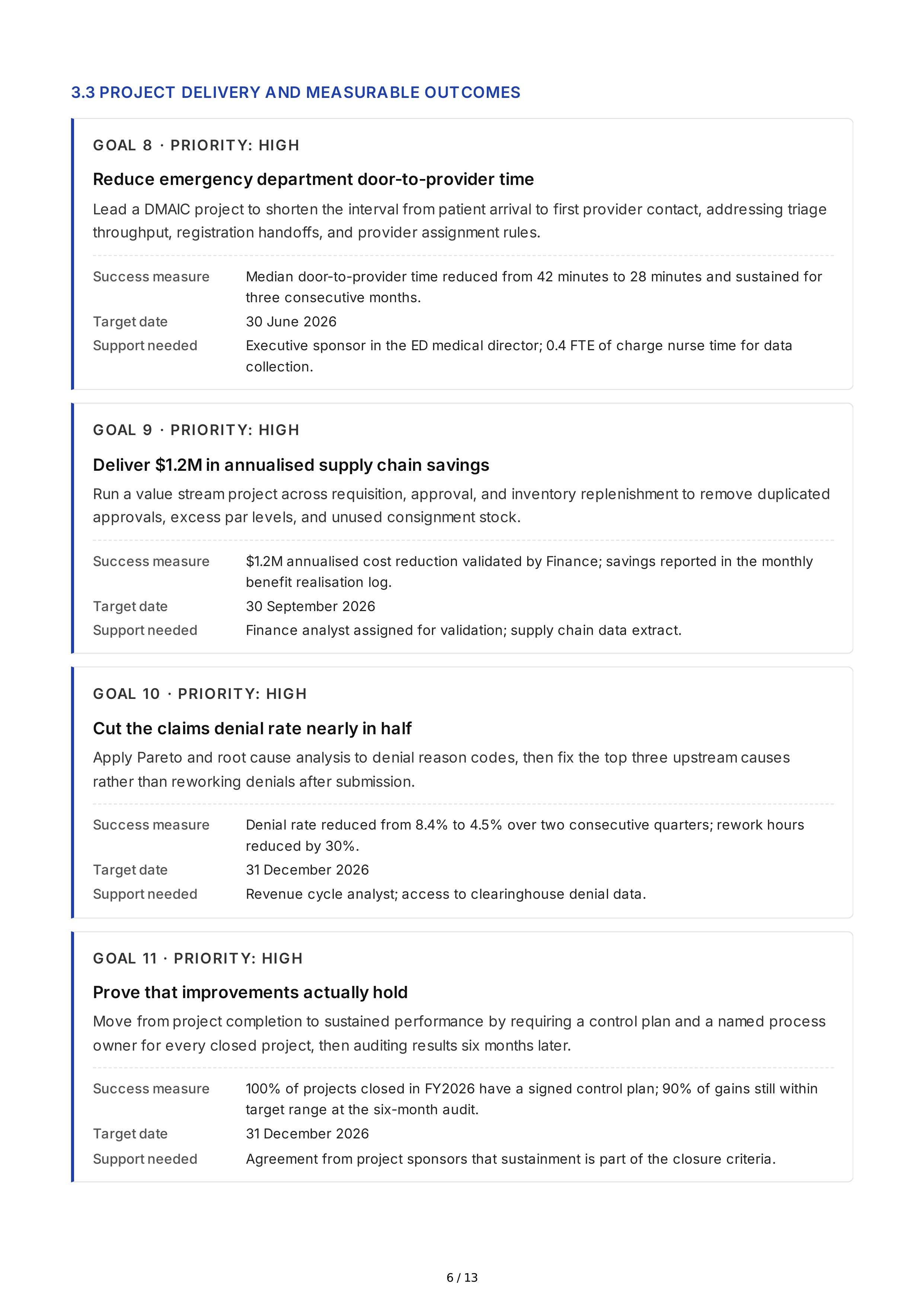
3.3
PROJECT
DELIVERY
AND
MEASURABLE
OUTCOMES
GOAL
8 ·
PRIORITY
:
HIGH
Reduce
emergency
department
door
-
to
-
provider
time
Lead
a
DMAIC
project
to
shorten
the
interval
from
patient
arrival
to
first
provider
contact
,
addressing
triage
throughput
,
registration
handoffs
,
and
provider
assignment
rules
.
Success
measure
Median
door
-
to
-
provider
time
reduced
from
42
minutes
to
28
minutes
and
sustained
for
three
consecutive
months
.
Target
date
30
June
2026
Support
needed
Executive
sponsor
in
the
ED
medical
director
; 0.4
FTE
of
charge
nurse
time
for
data
collection
.
GOAL
9 ·
PRIORITY
:
HIGH
Deliver
$
1.2
M
in
annualised
supply
chain
savings
Run
a
value
stream
project
across
requisition
,
approval
,
and
inventory
replenishment
to
remove
duplicated
approvals
,
excess
par
levels
,
and
unused
consignment
stock
.
Success
measure
$
1.2
M
annualised
cost
reduction
validated
by
Finance
;
savings
reported
in
the
monthly
benefit
realisation
log
.
Target
date
30
September
2026
Support
needed
Finance
analyst
assigned
for
validation
;
supply
chain
data
extract
.
GOAL
10 ·
PRIORITY
:
HIGH
Cut
the
claims
denial
rate
nearly
in
half
Apply
Pareto
and
root
cause
analysis
to
denial
reason
codes
,
then
fix
the
top
three
upstream
causes
rather
than
reworking
denials
after
submission
.
Success
measure
Denial
rate
reduced
from
8.4%
to
4.5%
over
two
consecutive
quarters
;
rework
hours
reduced
by
30%.
Target
date
31
December
2026
Support
needed
Revenue
cycle
analyst
;
access
to
clearinghouse
denial
data
.
GOAL
11 ·
PRIORITY
:
HIGH
Prove
that
improvements
actually
hold
Move
from
project
completion
to
sustained
performance
by
requiring
a
control
plan
and
a
named
process
owner
for
every
closed
project
,
then
auditing
results
six
months
later
.
Success
measure
100%
of
projects
closed
in
FY
2026
have
a
signed
control
plan
; 90%
of
gains
still
within
target
range
at
the
six
-
month
audit
.
Target
date
31
December
2026
Support
needed
Agreement
from
project
sponsors
that
sustainment
is
part
of
the
closure
criteria
.
6 / 13
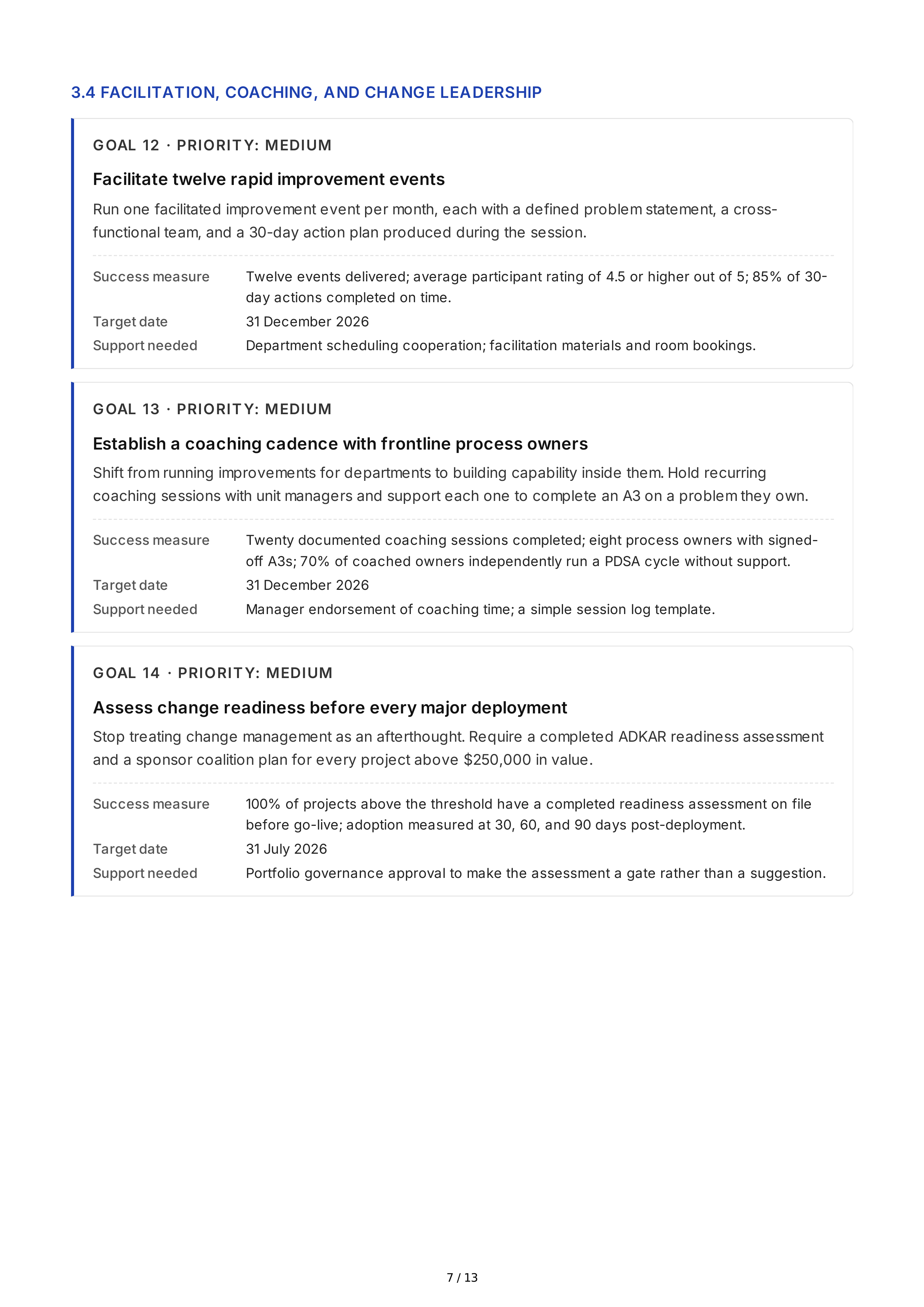
3.4
FACILITATION
,
COACHING
,
AND
CHANGE
LEADERSHIP
GOAL
12 ·
PRIORITY
:
MEDIUM
Facilitate
twelve
rapid
improvement
events
Run
one
facilitated
improvement
event
per
month
,
each
with
a
defined
problem
statement
,
a
cross
-
functional
team
,
and
a
30-
day
action
plan
produced
during
the
session
.
Success
measure
Twelve
events
delivered
;
average
participant
rating
of
4.5
or
higher
out
of
5; 85%
of
30-
day
actions
completed
on
time
.
Target
date
31
December
2026
Support
needed
Department
scheduling
cooperation
;
facilitation
materials
and
room
bookings
.
GOAL
13 ·
PRIORITY
:
MEDIUM
Establish
a
coaching
cadence
with
frontline
process
owners
Shift
from
running
improvements
for
departments
to
building
capability
inside
them
.
Hold
recurring
coaching
sessions
with
unit
managers
and
support
each
one
to
complete
an
A
3
on
a
problem
they
own
.
Success
measure
Twenty
documented
coaching
sessions
completed
;
eight
process
owners
with
signed
-
off
A
3
s
; 70%
of
coached
owners
independently
run
a
PDSA
cycle
without
support
.
Target
date
31
December
2026
Support
needed
Manager
endorsement
of
coaching
time
;
a
simple
session
log
template
.
GOAL
14 ·
PRIORITY
:
MEDIUM
Assess
change
readiness
before
every
major
deployment
Stop
treating
change
management
as
an
afterthought
.
Require
a
completed
ADKAR
readiness
assessment
and
a
sponsor
coalition
plan
for
every
project
above
$
250,000
in
value
.
Success
measure
100%
of
projects
above
the
threshold
have
a
completed
readiness
assessment
on
file
before
go
-
live
;
adoption
measured
at
30, 60,
and
90
days
post
-
deployment
.
Target
date
31
July
2026
Support
needed
Portfolio
governance
approval
to
make
the
assessment
a
gate
rather
than
a
suggestion
.
7 / 13
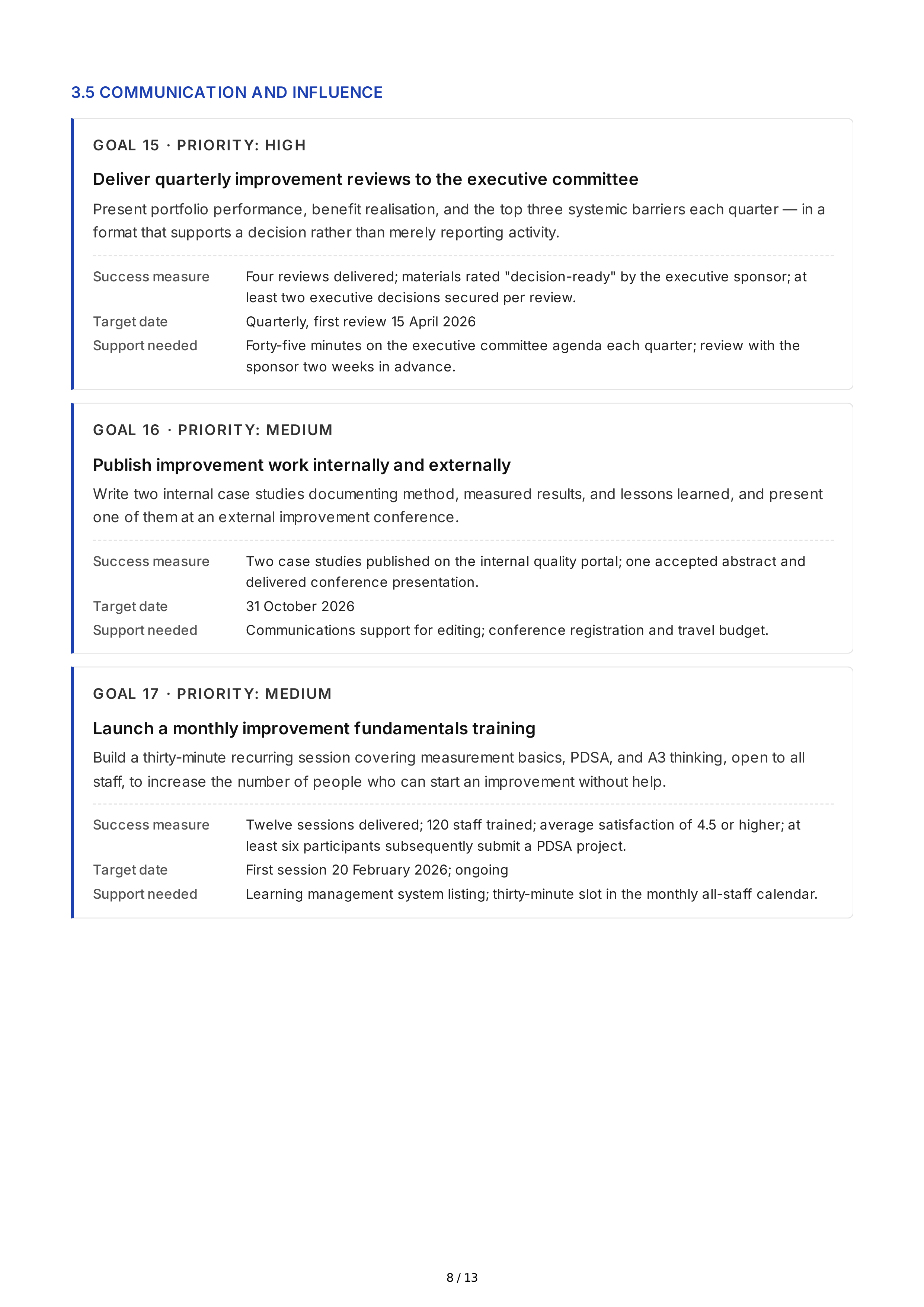
3.5
COMMUNICATION
AND
INFLUENCE
GOAL
15 ·
PRIORITY
:
HIGH
Deliver
quarterly
improvement
reviews
to
the
executive
committee
Present
portfolio
performance
,
benefit
realisation
,
and
the
top
three
systemic
barriers
each
quarter
—
in
a
format
that
supports
a
decision
rather
than
merely
reporting
activity
.
Success
measure
Four
reviews
delivered
;
materials
rated
"
decision
-
ready
"
by
the
executive
sponsor
;
at
least
two
executive
decisions
secured
per
review
.
Target
date
Quarterly
,
first
review
15
April
2026
Support
needed
Forty
-
five
minutes
on
the
executive
committee
agenda
each
quarter
;
review
with
the
sponsor
two
weeks
in
advance
.
GOAL
16 ·
PRIORITY
:
MEDIUM
Publish
improvement
work
internally
and
externally
Write
two
internal
case
studies
documenting
method
,
measured
results
,
and
lessons
learned
,
and
present
one
of
them
at
an
external
improvement
conference
.
Success
measure
Two
case
studies
published
on
the
internal
quality
portal
;
one
accepted
abstract
and
delivered
conference
presentation
.
Target
date
31
October
2026
Support
needed
Communications
support
for
editing
;
conference
registration
and
travel
budget
.
GOAL
17 ·
PRIORITY
:
MEDIUM
Launch
a
monthly
improvement
fundamentals
training
Build
a
thirty
-
minute
recurring
session
covering
measurement
basics
,
PDSA
,
and
A
3
thinking
,
open
to
all
staff
,
to
increase
the
number
of
people
who
can
start
an
improvement
without
help
.
Success
measure
Twelve
sessions
delivered
; 120
staff
trained
;
average
satisfaction
of
4.5
or
higher
;
at
least
six
participants
subsequently
submit
a
PDSA
project
.
Target
date
First
session
20
February
2026;
ongoing
Support
needed
Learning
management
system
listing
;
thirty
-
minute
slot
in
the
monthly
all
-
staff
calendar
.
8 / 13
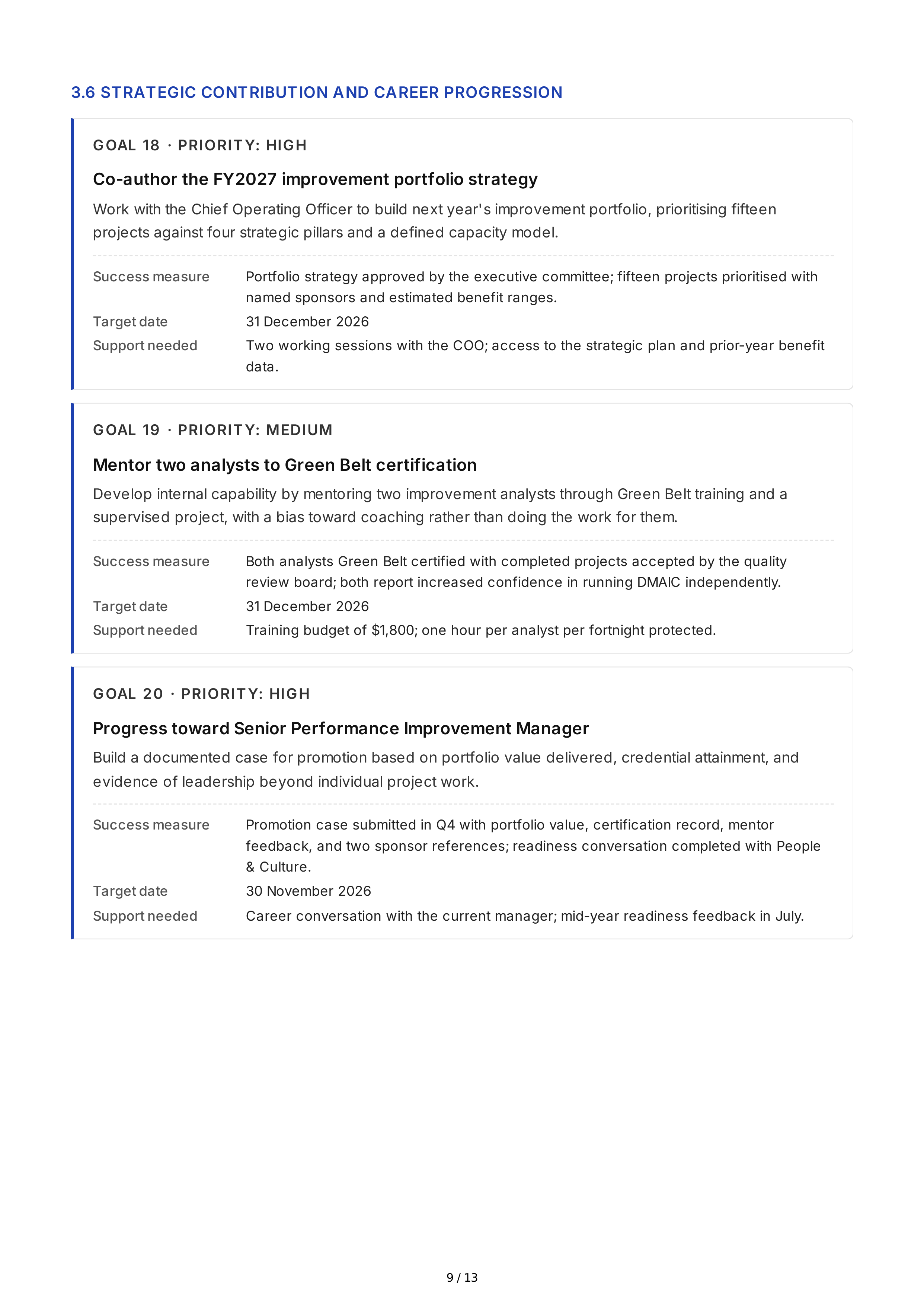
3.6
STRATEGIC
CONTRIBUTION
AND
CAREER
PROGRESSION
GOAL
18 ·
PRIORITY
:
HIGH
Co
-
author
the
FY
2027
improvement
portfolio
strategy
Work
with
the
Chief
Operating
Officer
to
build
next
year
'
s
improvement
portfolio
,
prioritising
fifteen
projects
against
four
strategic
pillars
and
a
defined
capacity
model
.
Success
measure
Portfolio
strategy
approved
by
the
executive
committee
;
fifteen
projects
prioritised
with
named
sponsors
and
estimated
benefit
ranges
.
Target
date
31
December
2026
Support
needed
Two
working
sessions
with
the
COO
;
access
to
the
strategic
plan
and
prior
-
year
benefit
data
.
GOAL
19 ·
PRIORITY
:
MEDIUM
Mentor
two
analysts
to
Green
Belt
certification
Develop
internal
capability
by
mentoring
two
improvement
analysts
through
Green
Belt
training
and
a
supervised
project
,
with
a
bias
toward
coaching
rather
than
doing
the
work
for
them
.
Success
measure
Both
analysts
Green
Belt
certified
with
completed
projects
accepted
by
the
quality
review
board
;
both
report
increased
confidence
in
running
DMAIC
independently
.
Target
date
31
December
2026
Support
needed
Training
budget
of
$
1,800;
one
hour
per
analyst
per
fortnight
protected
.
GOAL
20 ·
PRIORITY
:
HIGH
Progress
toward
Senior
Performance
Improvement
Manager
Build
a
documented
case
for
promotion
based
on
portfolio
value
delivered
,
credential
attainment
,
and
evidence
of
leadership
beyond
individual
project
work
.
Success
measure
Promotion
case
submitted
in
Q
4
with
portfolio
value
,
certification
record
,
mentor
feedback
,
and
two
sponsor
references
;
readiness
conversation
completed
with
People
&
Culture
.
Target
date
30
November
2026
Support
needed
Career
conversation
with
the
current
manager
;
mid
-
year
readiness
feedback
in
July
.
9 / 13
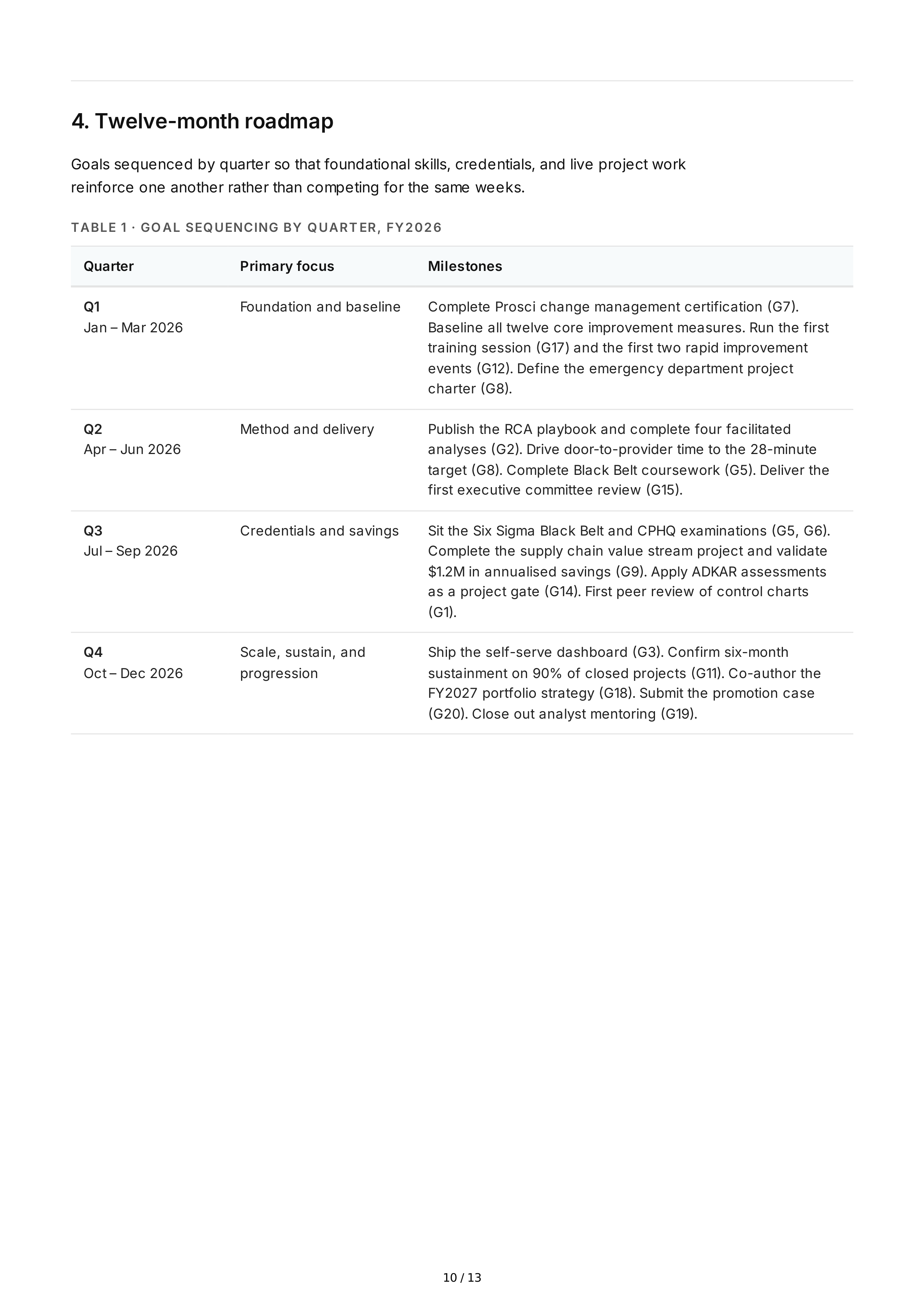
4.
Twelve
-
month
roadmap
Goals
sequenced
by
quarter
so
that
foundational
skills
,
credentials
,
and
live
project
work
reinforce
one
another
rather
than
competing
for
the
same
weeks
.
TABLE
1 ·
GOAL
SEQUENCING
BY
QUART ER
,
FY
2026
Quarter
Primary
focus
Milestones
Q
1
Jan
–
Mar
2026
Foundation
and
baseline
Complete
Prosci
change
management
certification
(
G
7).
Baseline
all
twelve
core
improvement
measures
.
Run
the
first
training
session
(
G
17)
and
the
first
two
rapid
improvement
events
(
G
12).
Define
the
emergency
department
project
charter
(
G
8).
Q
2
Apr
–
Jun
2026
Method
and
delivery
Publish
the
RCA
playbook
and
complete
four
facilitated
analyses
(
G
2).
Drive
door
-
to
-
provider
time
to
the
28-
minute
target
(
G
8).
Complete
Black
Belt
coursework
(
G
5).
Deliver
the
first
executive
committee
review
(
G
15).
Q
3
Jul
–
Sep
2026
Credentials
and
savings
Sit
the
Six
Sigma
Black
Belt
and
CPHQ
examinations
(
G
5,
G
6).
Complete
the
supply
chain
value
stream
project
and
validate
$
1.2
M
in
annualised
savings
(
G
9).
Apply
ADKAR
assessments
as
a
project
gate
(
G
14).
First
peer
review
of
control
charts
(
G
1).
Q
4
Oct
–
Dec
2026
Scale
,
sustain
,
and
progression
Ship
the
self
-
serve
dashboard
(
G
3).
Confirm
six
-
month
sustainment
on
90%
of
closed
projects
(
G
11).
Co
-
author
the
FY
2027
portfolio
strategy
(
G
18).
Submit
the
promotion
case
(
G
20).
Close
out
analyst
mentoring
(
G
19).
10 / 13
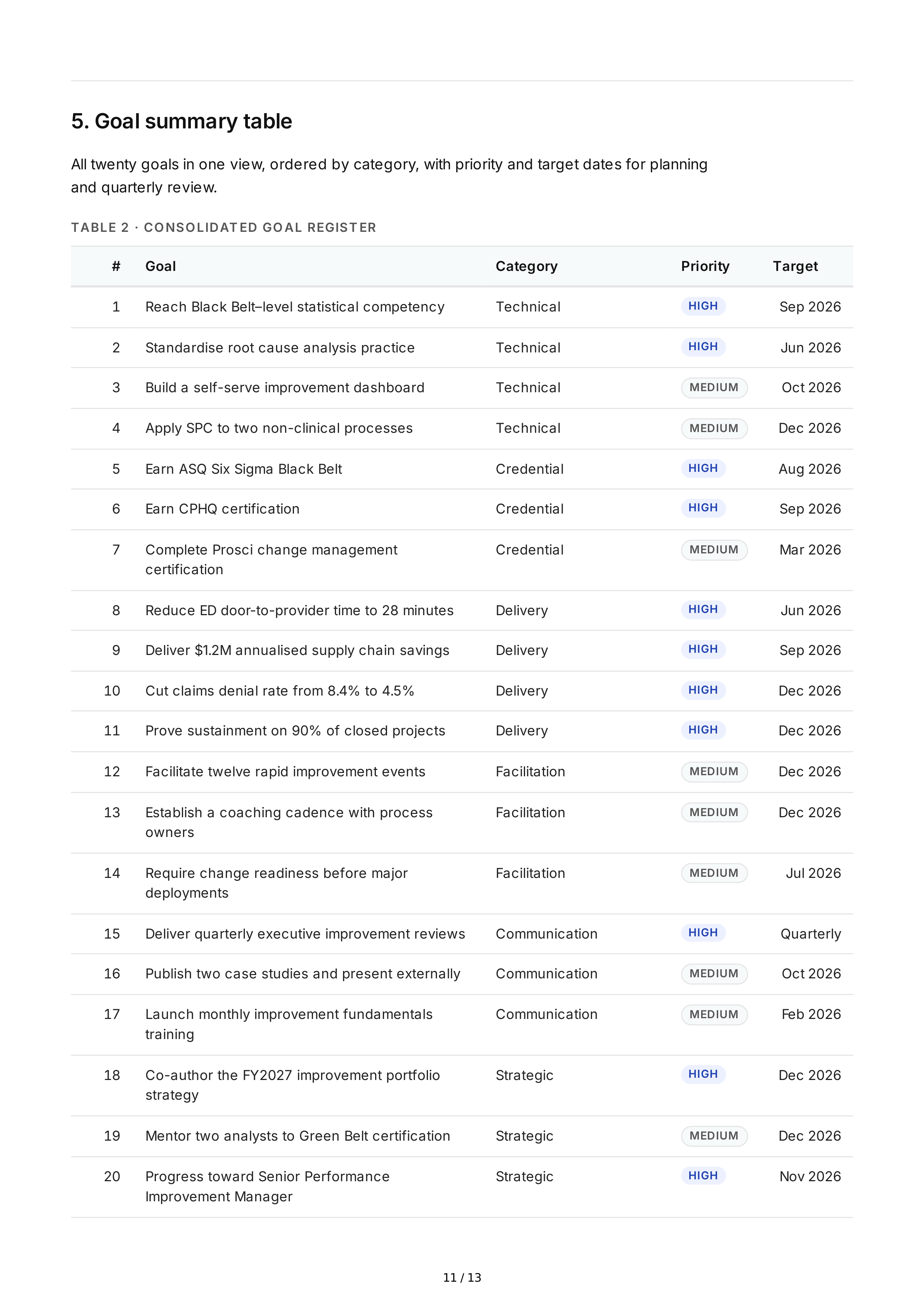
5.
Goal
summary
table
All
twenty
goals
in
one
view
,
ordered
by
category
,
with
priority
and
target
dates
for
planning
and
quarterly
review
.
TABLE
2 ·
CONSOLIDAT ED
GOAL
REGIST ER
#
Goal
Category
Priority
Target
1
Reach
Black
Belt
–
level
statistical
competency
Technical
HIGH
Sep
2026
2
Standardise
root
cause
analysis
practice
Technical
HIGH
Jun
2026
3
Build
a
self
-
serve
improvement
dashboard
Technical
MEDIUM
Oct
2026
4
Apply
SPC
to
two
non
-
clinical
processes
Technical
MEDIUM
Dec
2026
5
Earn
ASQ
Six
Sigma
Black
Belt
Credential
HIGH
Aug
2026
6
Earn
CPHQ
certification
Credential
HIGH
Sep
2026
7
Complete
Prosci
change
management
certification
Credential
MEDIUM
Mar
2026
8
Reduce
ED
door
-
to
-
provider
time
to
28
minutes
Delivery
HIGH
Jun
2026
9
Deliver
$
1.2
M
annualised
supply
chain
savings
Delivery
HIGH
Sep
2026
10
Cut
claims
denial
rate
from
8.4%
to
4.5%
Delivery
HIGH
Dec
2026
11
Prove
sustainment
on
90%
of
closed
projects
Delivery
HIGH
Dec
2026
12
Facilitate
twelve
rapid
improvement
events
Facilitation
MEDIUM
Dec
2026
13
Establish
a
coaching
cadence
with
process
owners
Facilitation
MEDIUM
Dec
2026
14
Require
change
readiness
before
major
deployments
Facilitation
MEDIUM
Jul
2026
15
Deliver
quarterly
executive
improvement
reviews
Communication
HIGH
Quarterly
16
Publish
two
case
studies
and
present
externally
Communication
MEDIUM
Oct
2026
17
Launch
monthly
improvement
fundamentals
training
Communication
MEDIUM
Feb
2026
18
Co
-
author
the
FY
2027
improvement
portfolio
strategy
Strategic
HIGH
Dec
2026
19
Mentor
two
analysts
to
Green
Belt
certification
Strategic
MEDIUM
Dec
2026
20
Progress
toward
Senior
Performance
Improvement
Manager
Strategic
HIGH
Nov
2026
11 / 13
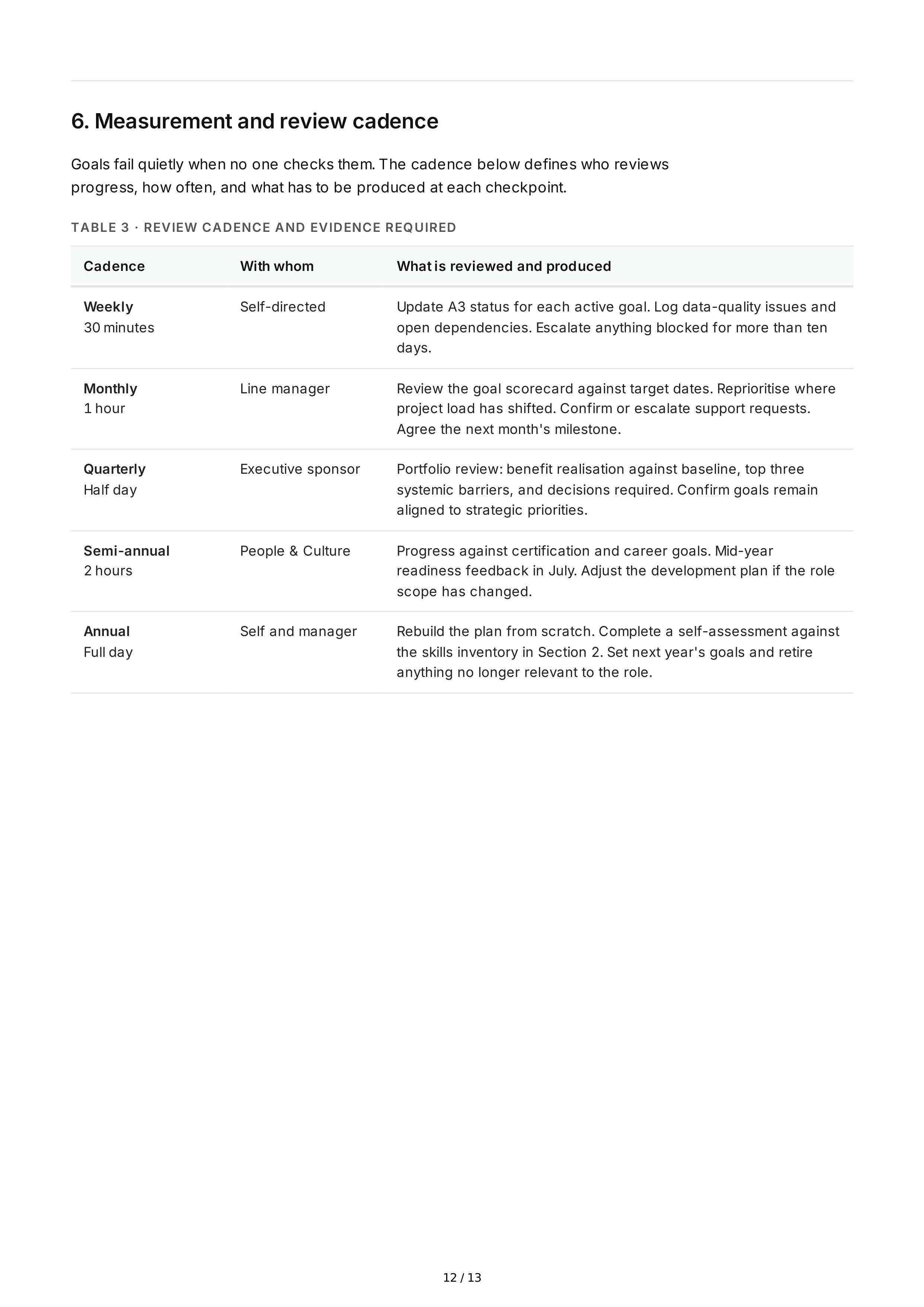
6.
Measurement
and
review
cadence
Goals
fail
quietly
when
no
one
checks
them
.
The
cadence
below
defines
who
reviews
progress
,
how
often
,
and
what
has
to
be
produced
at
each
checkpoint
.
TABLE
3 ·
REVIEW
CADENCE
AND
EVIDENCE
REQUIRED
Cadence
With
whom
What
is
reviewed
and
produced
Weekly
30
minutes
Self
-
directed
Update
A
3
status
for
each
active
goal
.
Log
data
-
quality
issues
and
open
dependencies
.
Escalate
anything
blocked
for
more
than
ten
days
.
Monthly
1
hour
Line
manager
Review
the
goal
scorecard
against
target
dates
.
Reprioritise
where
project
load
has
shifted
.
Confirm
or
escalate
support
requests
.
Agree
the
next
month
'
s
milestone
.
Quarterly
Half
day
Executive
sponsor
Portfolio
review
:
benefit
realisation
against
baseline
,
top
three
systemic
barriers
,
and
decisions
required
.
Confirm
goals
remain
aligned
to
strategic
priorities
.
Semi
-
annual
2
hours
People
&
Culture
Progress
against
certification
and
career
goals
.
Mid
-
year
readiness
feedback
in
July
.
Adjust
the
development
plan
if
the
role
scope
has
changed
.
Annual
Full
day
Self
and
manager
Rebuild
the
plan
from
scratch
.
Complete
a
self
-
assessment
against
the
skills
inventory
in
Section
2.
Set
next
year
'
s
goals
and
retire
anything
no
longer
relevant
to
the
role
.
12 / 13
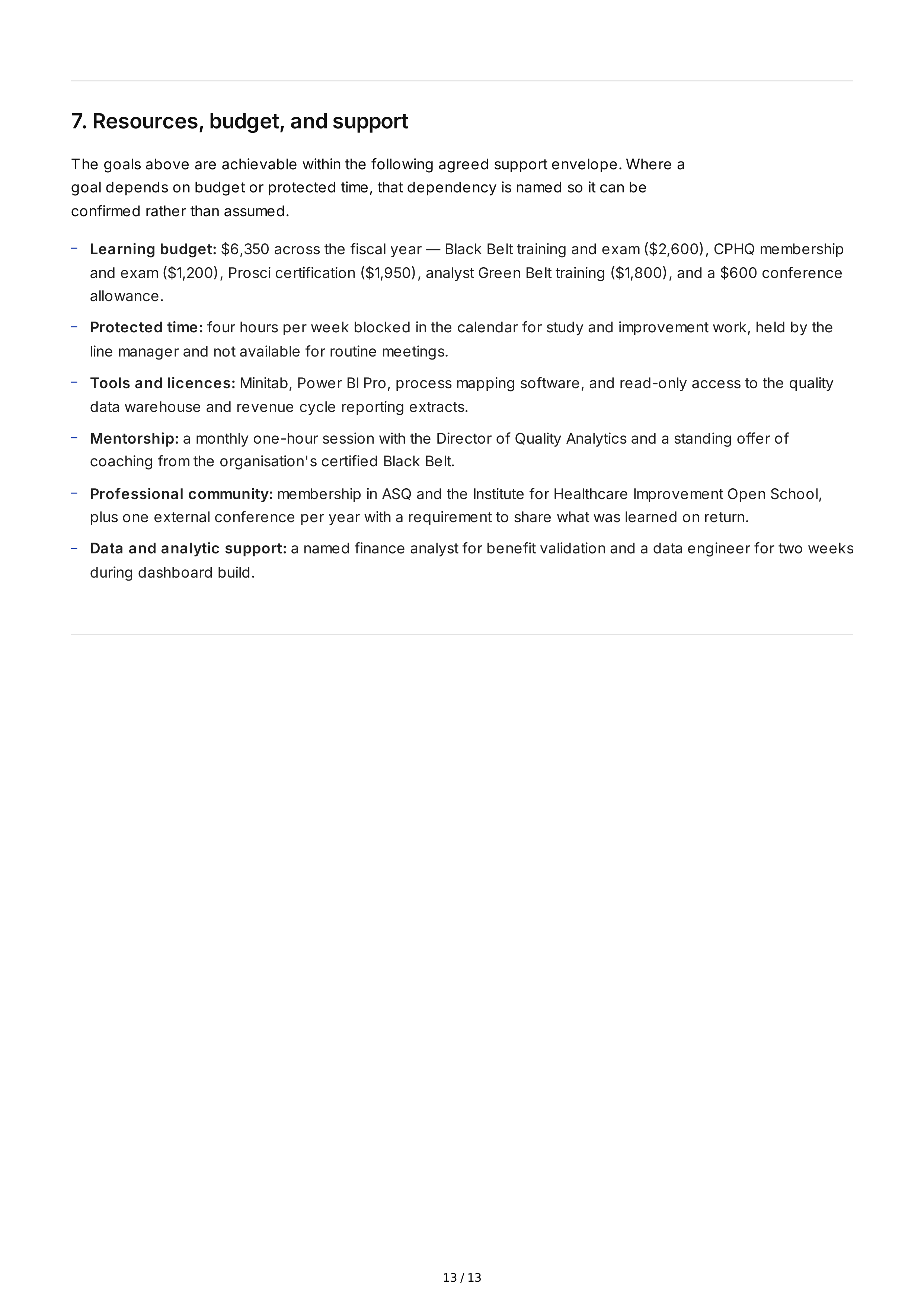
7.
Resources
,
budget
,
and
support
The
goals
above
are
achievable
within
the
following
agreed
support
envelope
.
Where
a
goal
depends
on
budget
or
protected
time
,
that
dependency
is
named
so
it
can
be
confirmed
rather
than
assumed
.
Learning
budget
:
$
6,350
across
the
fiscal
year
—
Black
Belt
training
and
exam
(
$
2,600),
CPHQ
membership
and
exam
(
$
1,200),
Prosci
certification
(
$
1,950),
analyst
Green
Belt
training
(
$
1,800),
and
a
$
600
conference
allowance
.
Protected
time
:
four
hours
per
week
blocked
in
the
calendar
for
study
and
improvement
work
,
held
by
the
line
manager
and
not
available
for
routine
meetings
.
Tools
and
licences
:
Minitab
,
Power
BI
Pro
,
process
mapping
software
,
and
read
-
only
access
to
the
quality
data
warehouse
and
revenue
cycle
reporting
extracts
.
Mentorship
:
a
monthly
one
-
hour
session
with
the
Director
of
Quality
Analytics
and
a
standing
offer
of
coaching
from
the
organisation
'
s
certified
Black
Belt
.
Professional
community
:
membership
in
ASQ
and
the
Institute
for
Healthcare
Improvement
Open
School
,
plus
one
external
conference
per
year
with
a
requirement
to
share
what
was
learned
on
return
.
Data
and
analytic
support
:
a
named
finance
analyst
for
benefit
validation
and
a
data
engineer
for
two
weeks
during
dashboard
build
.
13 / 13