
Career
Success
—
Professional
Goals
1 / 6
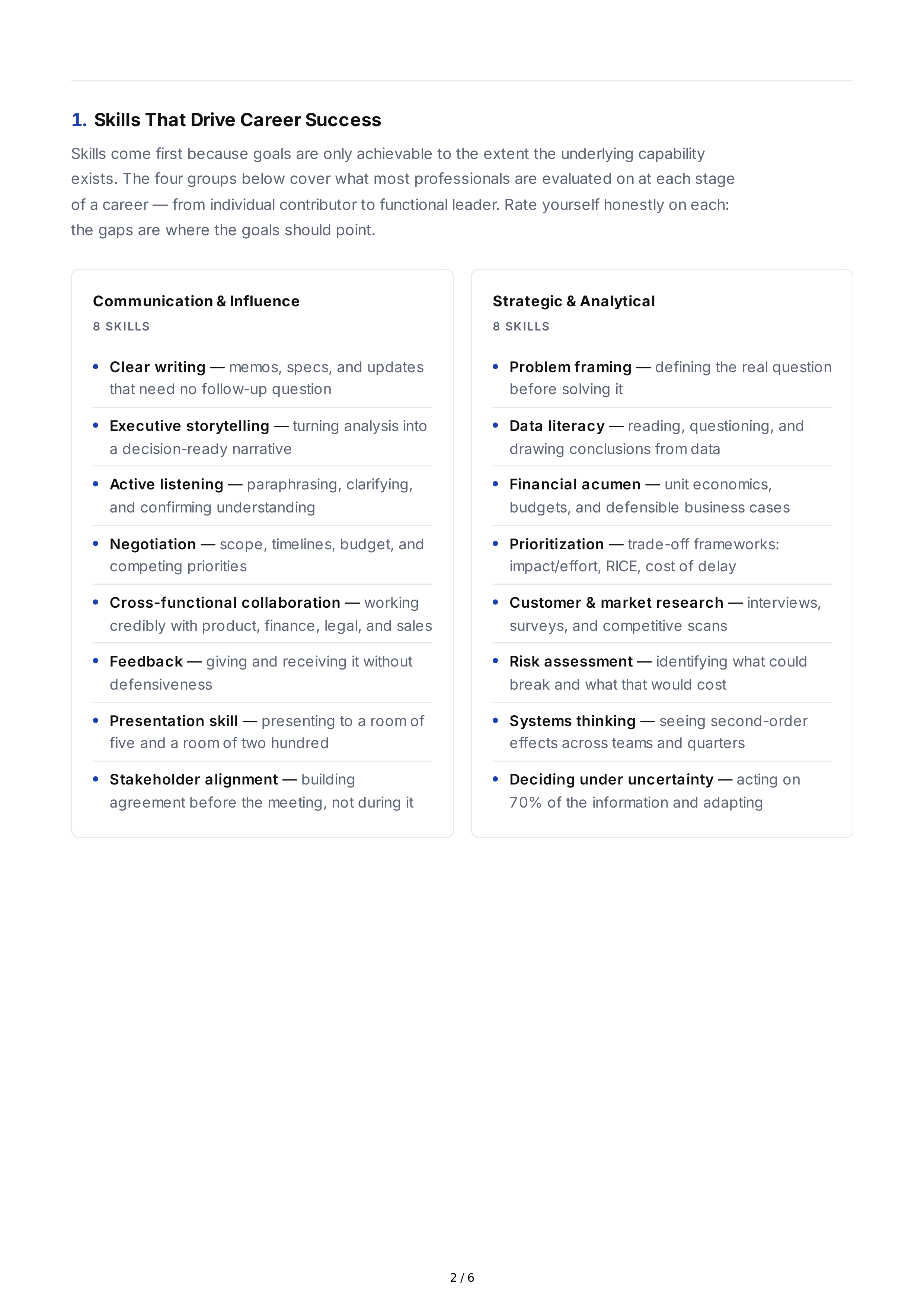
1.
Skills
That
Drive
Career
Success
Skills
come
first
because
goals
are
only
achievable
to
the
extent
the
underlying
capability
exists
.
The
four
groups
below
cover
what
most
professionals
are
evaluated
on
at
each
stage
of
a
career
—
from
individual
contributor
to
functional
leader
.
Rate
yourself
honestly
on
each
:
the
gaps
are
where
the
goals
should
point
.
Communication
&
Influence
8
SKILLS
Strategic
&
Analytical
8
SKILLS
Clear
writing
—
memos
,
specs
,
and
updates
that
need
no
follow
-
up
question
Executive
storytelling
—
turning
analysis
into
a
decision
-
ready
narrative
Active
listening
—
paraphrasing
,
clarifying
,
and
confirming
understanding
Negotiation
—
scope
,
timelines
,
budget
,
and
competing
priorities
Cross
-
functional
collaboration
—
working
credibly
with
product
,
finance
,
legal
,
and
sales
Feedback
—
giving
and
receiving
it
without
defensiveness
Presentation
skill
—
presenting
to
a
room
of
five
and
a
room
of
two
hundred
Stakeholder
alignment
—
building
agreement
before
the
meeting
,
not
during
it
Problem
framing
—
defining
the
real
question
before
solving
it
Data
literacy
—
reading
,
questioning
,
and
drawing
conclusions
from
data
Financial
acumen
—
unit
economics
,
budgets
,
and
defensible
business
cases
Prioritization
—
trade
-
off
frameworks
:
impact
/
effort
,
RICE
,
cost
of
delay
Customer
&
market
research
—
interviews
,
surveys
,
and
competitive
scans
Risk
assessment
—
identifying
what
could
break
and
what
that
would
cost
Systems
thinking
—
seeing
second
-
order
effects
across
teams
and
quarters
Deciding
under
uncertainty
—
acting
on
70%
of
the
information
and
adapting
2 / 6
Leadership
&
Management
8
SKILLS
Personal
Effectiveness
8
SKILLS
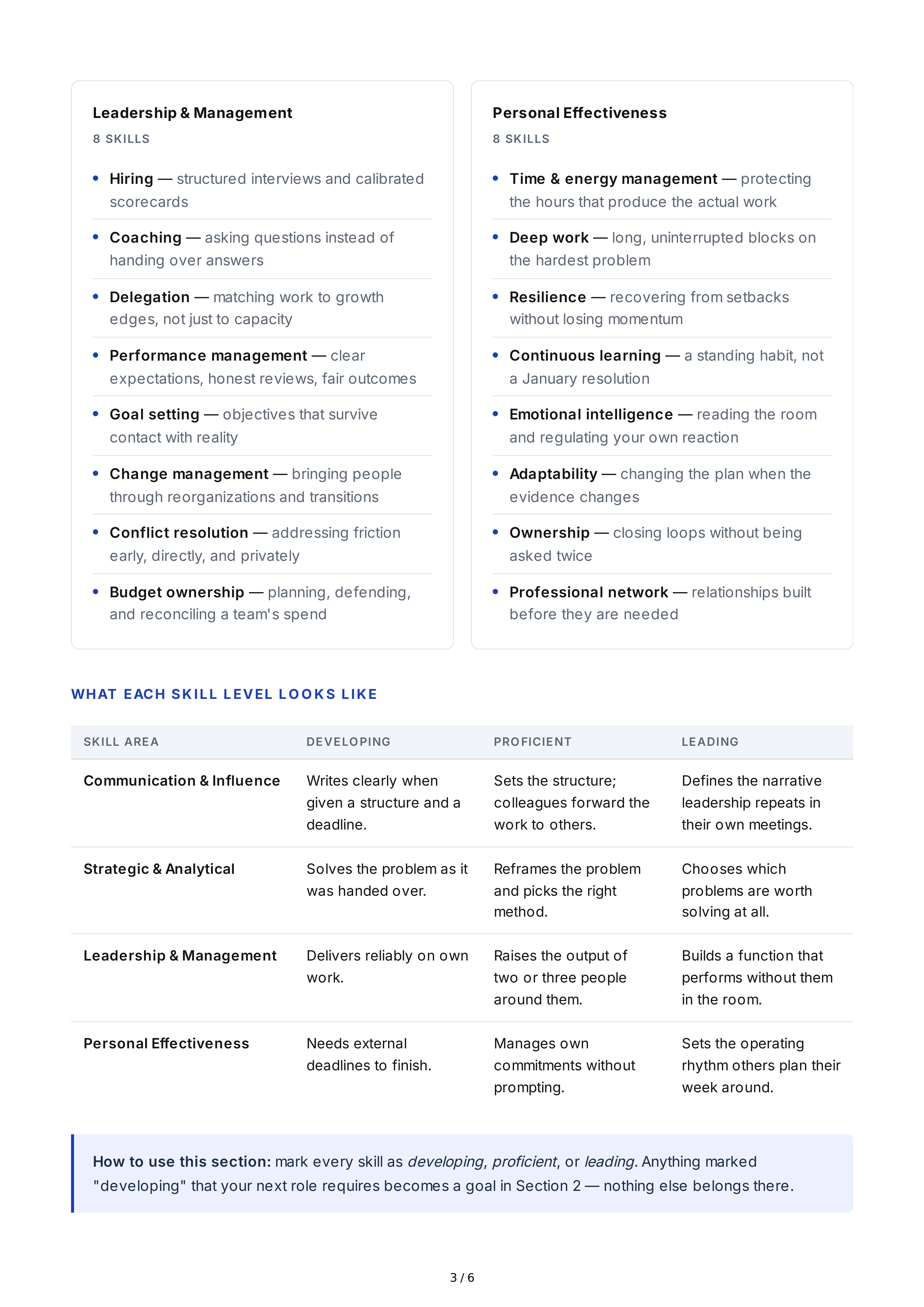
WHAT
EACH
SK IL L
L EVEL
L O O K S
L IK E
SKILL
AREA
DEVELOPING
PROFICIENT
LEADING
Communication
&
Influence
Writes
clearly
when
given
a
structure
and
a
deadline
.
Sets
the
structure
;
colleagues
forward
the
work
to
others
.
Defines
the
narrative
leadership
repeats
in
their
own
meetings
.
Strategic
&
Analytical
Solves
the
problem
as
it
was
handed
over
.
Reframes
the
problem
and
picks
the
right
method
.
Chooses
which
problems
are
worth
solving
at
all
.
Leadership
&
Management
Delivers
reliably
on
own
work
.
Raises
the
output
of
two
or
three
people
around
them
.
Builds
a
function
that
performs
without
them
in
the
room
.
Personal
Effectiveness
Needs
external
deadlines
to
finish
.
Manages
own
commitments
without
prompting
.
Sets
the
operating
rhythm
others
plan
their
week
around
.
How
to
use
this
section
:
mark
every
skill
as
developing
,
proficient
,
or
leading
.
Anything
marked
"
developing
"
that
your
next
role
requires
becomes
a
goal
in
Section
2 —
nothing
else
belongs
there
.
Hiring
—
structured
interviews
and
calibrated
scorecards
Coaching
—
asking
questions
instead
of
handing
over
answers
Delegation
—
matching
work
to
growth
edges
,
not
just
to
capacity
Performance
management
—
clear
expectations
,
honest
reviews
,
fair
outcomes
Goal
setting
—
objectives
that
survive
contact
with
reality
Change
management
—
bringing
people
through
reorganizations
and
transitions
Conflict
resolution
—
addressing
friction
early
,
directly
,
and
privately
Budget
ownership
—
planning
,
defending
,
and
reconciling
a
team
'
s
spend
Time
&
energy
management
—
protecting
the
hours
that
produce
the
actual
work
Deep
work
—
long
,
uninterrupted
blocks
on
the
hardest
problem
Resilience
—
recovering
from
setbacks
without
losing
momentum
Continuous
learning
—
a
standing
habit
,
not
a
January
resolution
Emotional
intelligence
—
reading
the
room
and
regulating
your
own
reaction
Adaptability
—
changing
the
plan
when
the
evidence
changes
Ownership
—
closing
loops
without
being
asked
twice
Professional
network
—
relationships
built
before
they
are
needed
3 / 6
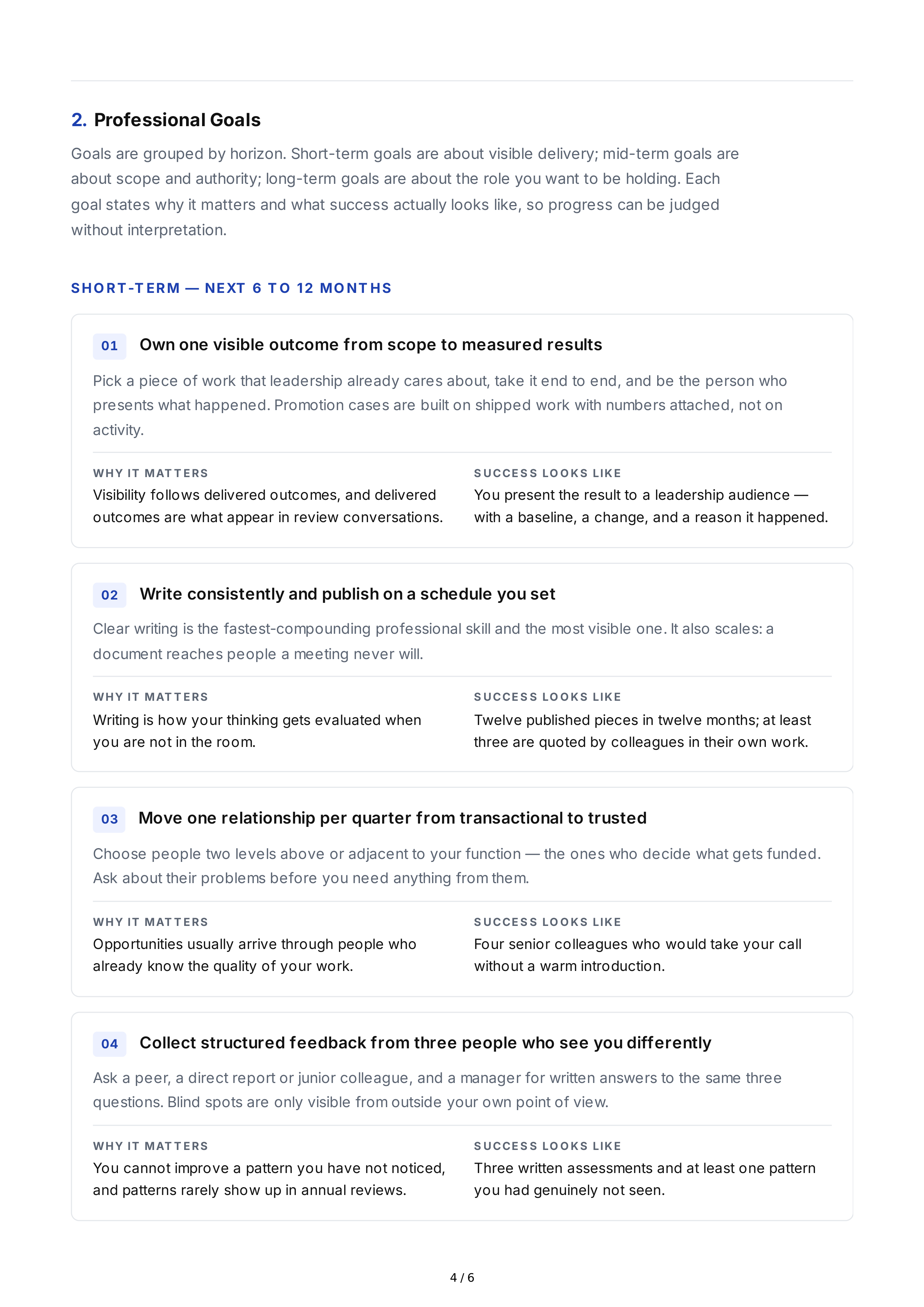
2.
Professional
Goals
Goals
are
grouped
by
horizon
.
Short
-
term
goals
are
about
visible
delivery
;
mid
-
term
goals
are
about
scope
and
authority
;
long
-
term
goals
are
about
the
role
you
want
to
be
holding
.
Each
goal
states
why
it
matters
and
what
success
actually
looks
like
,
so
progress
can
be
judged
without
interpretation
.
SHO RT
-
T ERM
—
NEXT
6
T O
12
MO NT HS
01
Own
one
visible
outcome
from
scope
to
measured
results
Pick
a
piece
of
work
that
leadership
already
cares
about
,
take
it
end
to
end
,
and
be
the
person
who
presents
what
happened
.
Promotion
cases
are
built
on
shipped
work
with
numbers
attached
,
not
on
activity
.
WHY
IT
MAT T E RS
Visibility
follows
delivered
outcomes
,
and
delivered
outcomes
are
what
appear
in
review
conversations
.
S UCCE S S
LO O KS
LIKE
You
present
the
result
to
a
leadership
audience
—
with
a
baseline
,
a
change
,
and
a
reason
it
happened
.
02
Write
consistently
and
publish
on
a
schedule
you
set
Clear
writing
is
the
fastest
-
compounding
professional
skill
and
the
most
visible
one
.
It
also
scales
:
a
document
reaches
people
a
meeting
never
will
.
WHY
IT
MAT T E RS
Writing
is
how
your
thinking
gets
evaluated
when
you
are
not
in
the
room
.
S UCCE S S
LO O KS
LIKE
Twelve
published
pieces
in
twelve
months
;
at
least
three
are
quoted
by
colleagues
in
their
own
work
.
03
Move
one
relationship
per
quarter
from
transactional
to
trusted
Choose
people
two
levels
above
or
adjacent
to
your
function
—
the
ones
who
decide
what
gets
funded
.
Ask
about
their
problems
before
you
need
anything
from
them
.
WHY
IT
MAT T E RS
Opportunities
usually
arrive
through
people
who
already
know
the
quality
of
your
work
.
S UCCE S S
LO O KS
LIKE
Four
senior
colleagues
who
would
take
your
call
without
a
warm
introduction
.
04
Collect
structured
feedback
from
three
people
who
see
you
differently
Ask
a
peer
,
a
direct
report
or
junior
colleague
,
and
a
manager
for
written
answers
to
the
same
three
questions
.
Blind
spots
are
only
visible
from
outside
your
own
point
of
view
.
WHY
IT
MAT T E RS
You
cannot
improve
a
pattern
you
have
not
noticed
,
and
patterns
rarely
show
up
in
annual
reviews
.
S UCCE S S
LO O KS
LIKE
Three
written
assessments
and
at
least
one
pattern
you
had
genuinely
not
seen
.
4 / 6
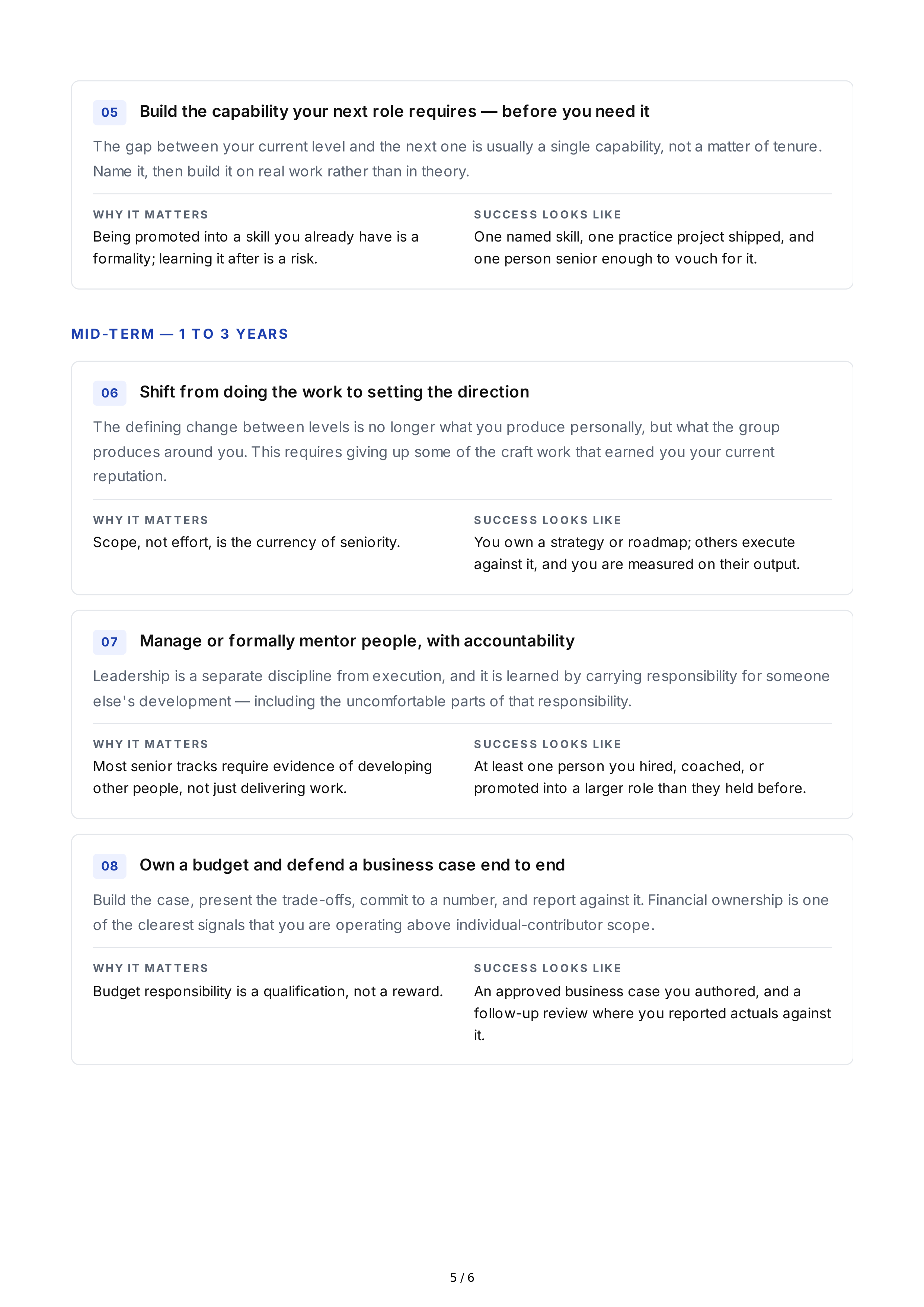
05
Build
the
capability
your
next
role
requires
—
before
you
need
it
The
gap
between
your
current
level
and
the
next
one
is
usually
a
single
capability
,
not
a
matter
of
tenure
.
Name
it
,
then
build
it
on
real
work
rather
than
in
theory
.
WHY
IT
MAT T E RS
Being
promoted
into
a
skill
you
already
have
is
a
formality
;
learning
it
after
is
a
risk
.
S UCCE S S
LO O KS
LIKE
One
named
skill
,
one
practice
project
shipped
,
and
one
person
senior
enough
to
vouch
for
it
.
MID
-
T ERM
— 1
T O
3
YEARS
06
Shift
from
doing
the
work
to
setting
the
direction
The
defining
change
between
levels
is
no
longer
what
you
produce
personally
,
but
what
the
group
produces
around
you
.
This
requires
giving
up
some
of
the
craft
work
that
earned
you
your
current
reputation
.
WHY
IT
MAT T E RS
Scope
,
not
effort
,
is
the
currency
of
seniority
.
S UCCE S S
LO O KS
LIKE
You
own
a
strategy
or
roadmap
;
others
execute
against
it
,
and
you
are
measured
on
their
output
.
07
Manage
or
formally
mentor
people
,
with
accountability
Leadership
is
a
separate
discipline
from
execution
,
and
it
is
learned
by
carrying
responsibility
for
someone
else
'
s
development
—
including
the
uncomfortable
parts
of
that
responsibility
.
WHY
IT
MAT T E RS
Most
senior
tracks
require
evidence
of
developing
other
people
,
not
just
delivering
work
.
S UCCE S S
LO O KS
LIKE
At
least
one
person
you
hired
,
coached
,
or
promoted
into
a
larger
role
than
they
held
before
.
08
Own
a
budget
and
defend
a
business
case
end
to
end
Build
the
case
,
present
the
trade
-
offs
,
commit
to
a
number
,
and
report
against
it
.
Financial
ownership
is
one
of
the
clearest
signals
that
you
are
operating
above
individual
-
contributor
scope
.
WHY
IT
MAT T E RS
Budget
responsibility
is
a
qualification
,
not
a
reward
.
S UCCE S S
LO O KS
LIKE
An
approved
business
case
you
authored
,
and
a
follow
-
up
review
where
you
reported
actuals
against
it
.
5 / 6
09
Become
the
person
others
come
to
for
one
specific
thing
Depth
,
not
breadth
,
is
what
makes
a
professional
hard
to
replace
.
Pick
a
narrow
area
—
a
market
,
a
system
,
a
method
—
and
become
its
recognized
internal
expert
.
WHY
IT
MAT T E RS
A
reputation
for
one
specific
thing
travels
further
than
a
reputation
for
being
generally
competent
.
S UCCE S S
LO O KS
LIKE
You
are
named
in
conversations
you
are
not
part
of
,
on
that
topic
specifically
.
L O NG
-
T ERM
— 3
T O
5
YEARS
10
Lead
a
function
or
practice
,
not
only
a
team
The
move
from
managing
a
team
to
leading
a
function
means
owning
a
system
—
standards
,
hiring
bars
,
planning
cycles
,
and
the
reputation
of
the
discipline
within
the
organization
.
WHY
IT
MAT T E RS
It
is
the
difference
between
running
this
quarter
and
shaping
how
the
work
is
done
for
years
.
S UCCE S S
LO O KS
LIKE
You
define
the
standards
other
teams
adopt
,
and
you
have
hired
at
least
one
person
capable
of
succeeding
you
.
11
Build
a
reputation
that
is
not
dependent
on
your
current
employer
Publish
,
speak
,
contribute
to
a
professional
community
,
or
build
something
under
your
own
name
.
A
portable
reputation
gives
you
options
that
an
internal
title
never
can
.
WHY
IT
MAT T E RS
Careers
are
long
;
being
known
outside
one
company
reduces
the
risk
of
any
single
job
.
S UCCE S S
LO O KS
LIKE
Inbound
opportunities
—
speaking
invitations
,
advisory
requests
,
or
approaches
from
recruiters
—
that
you
did
not
initiate
.
12
Develop
the
next
generation
of
leaders
behind
you
Sponsor
people
rather
than
just
mentoring
them
:
put
their
names
forward
for
work
they
are
not
yet
fully
ready
for
,
and
stay
accountable
for
the
outcome
alongside
them
.
WHY
IT
MAT T E RS
You
cannot
take
on
a
larger
scope
until
someone
competent
is
holding
the
current
one
.
S UCCE S S
LO O KS
LIKE
Two
or
three
people
who
advanced
because
you
advocated
for
them
specifically
.
6 / 6
