Negotiation
Professional
Goals
01
02
03
04
05
06
07
08
09
10
11
12
13
14
15
16
17
18
19
20
21
22
23
24
25
26
27
28
29
30
1 / 8
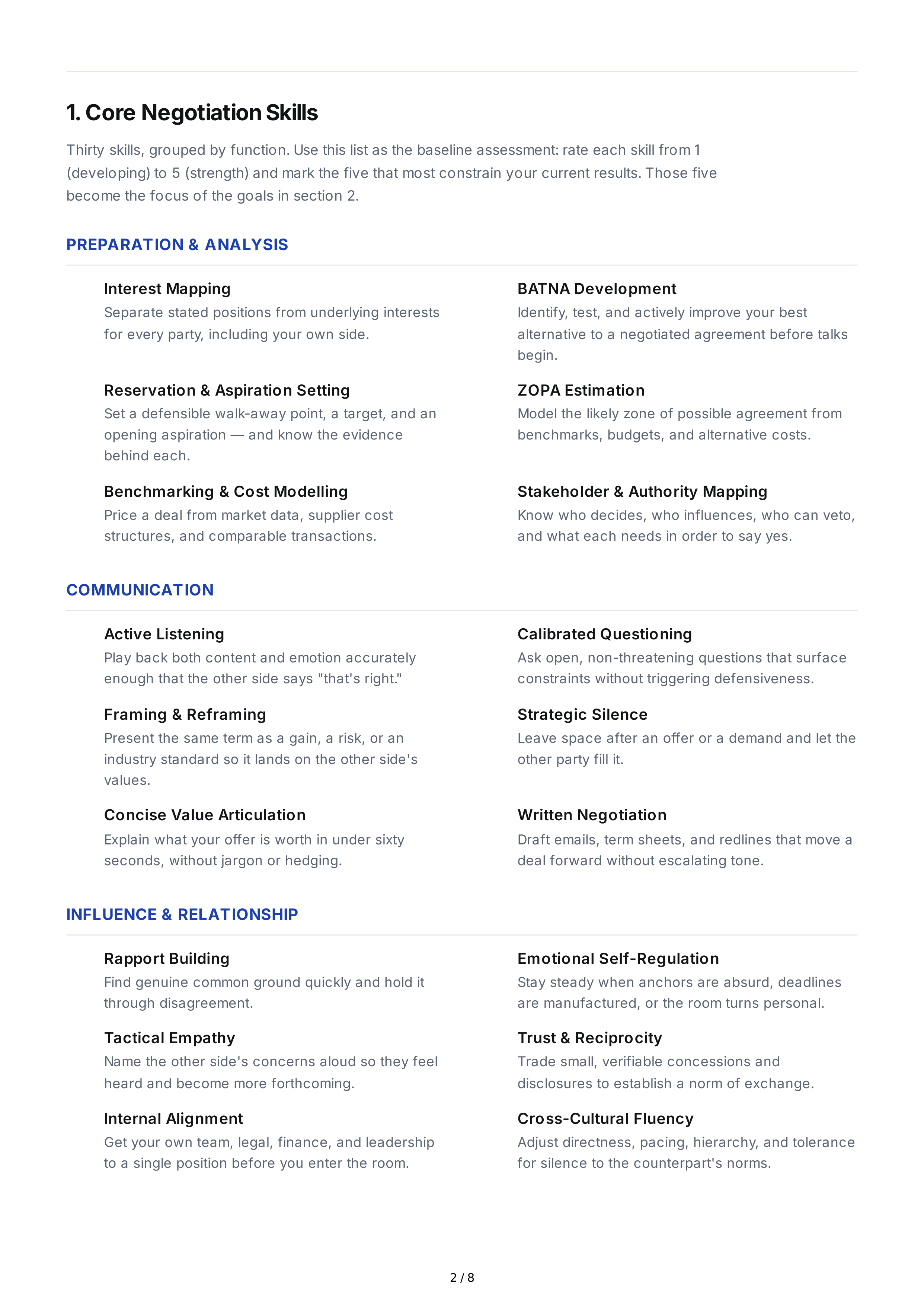
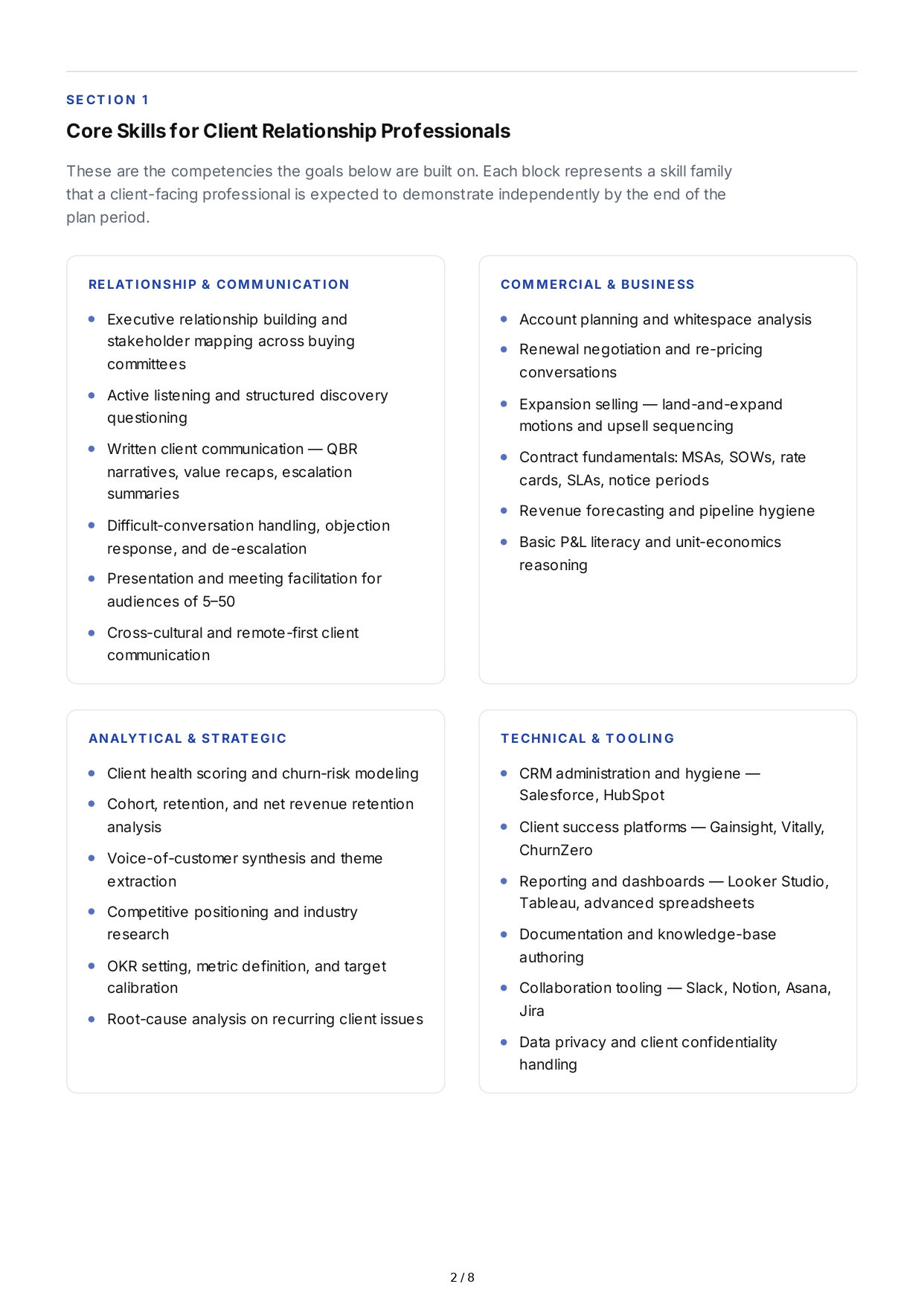
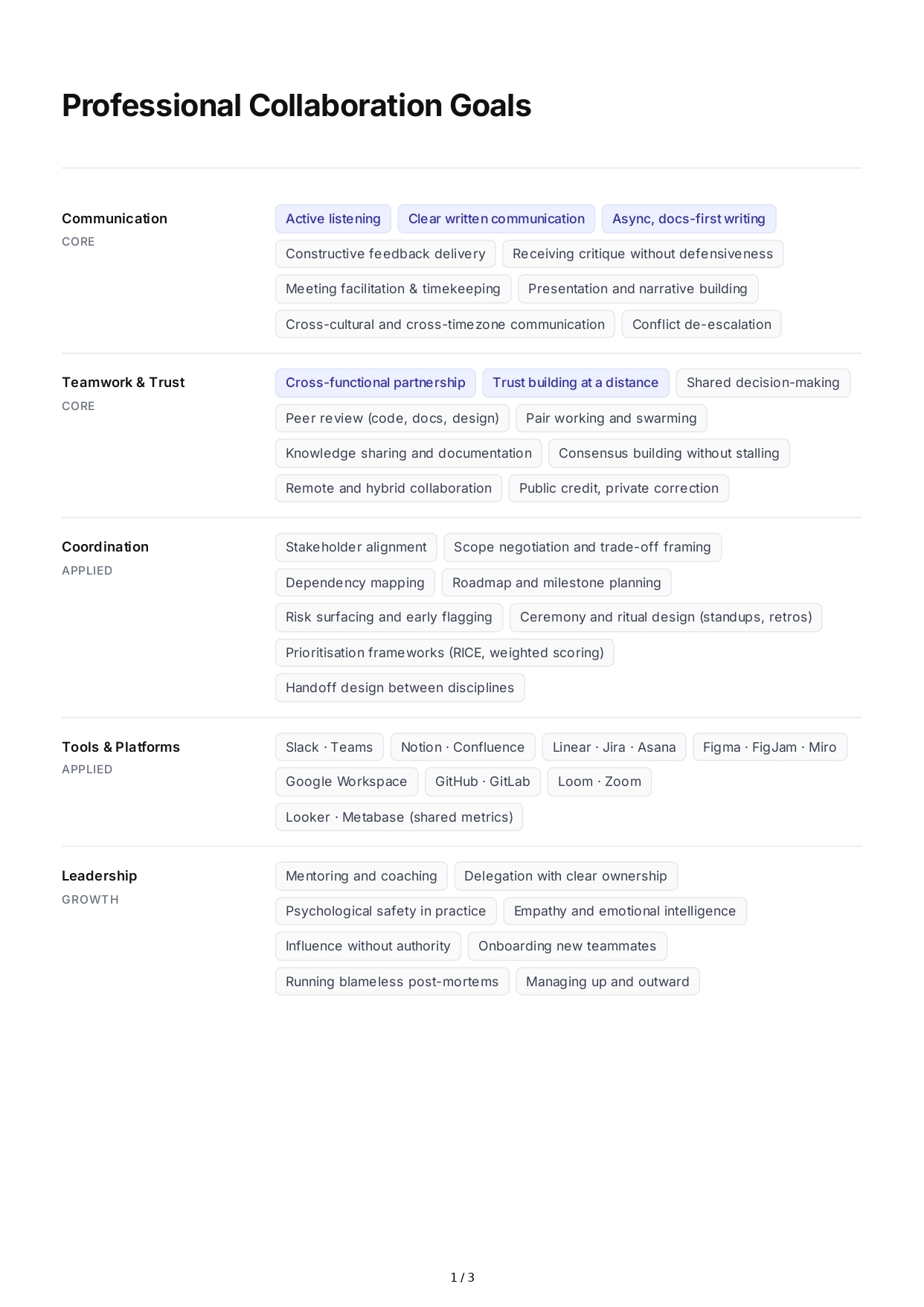
1.
Core
Negotiation
Skills
Thirty
skills
,
grouped
by
function
.
Use
this
list
as
the
baseline
assessment
:
rate
each
skill
from
1
(
developing
)
to
5 (
strength
)
and
mark
the
five
that
most
constrain
your
current
results
.
Those
five
become
the
focus
of
the
goals
in
section
2.
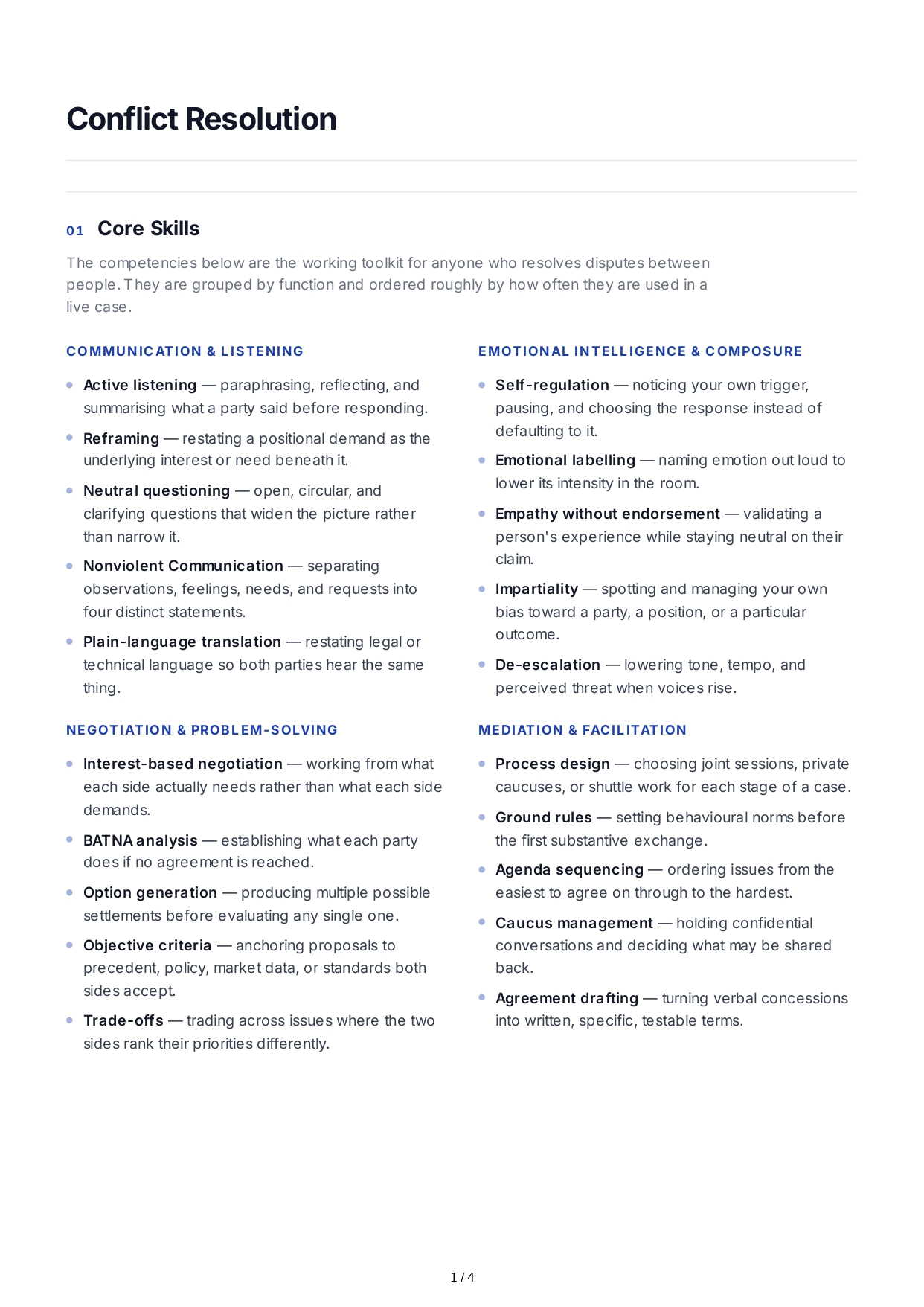
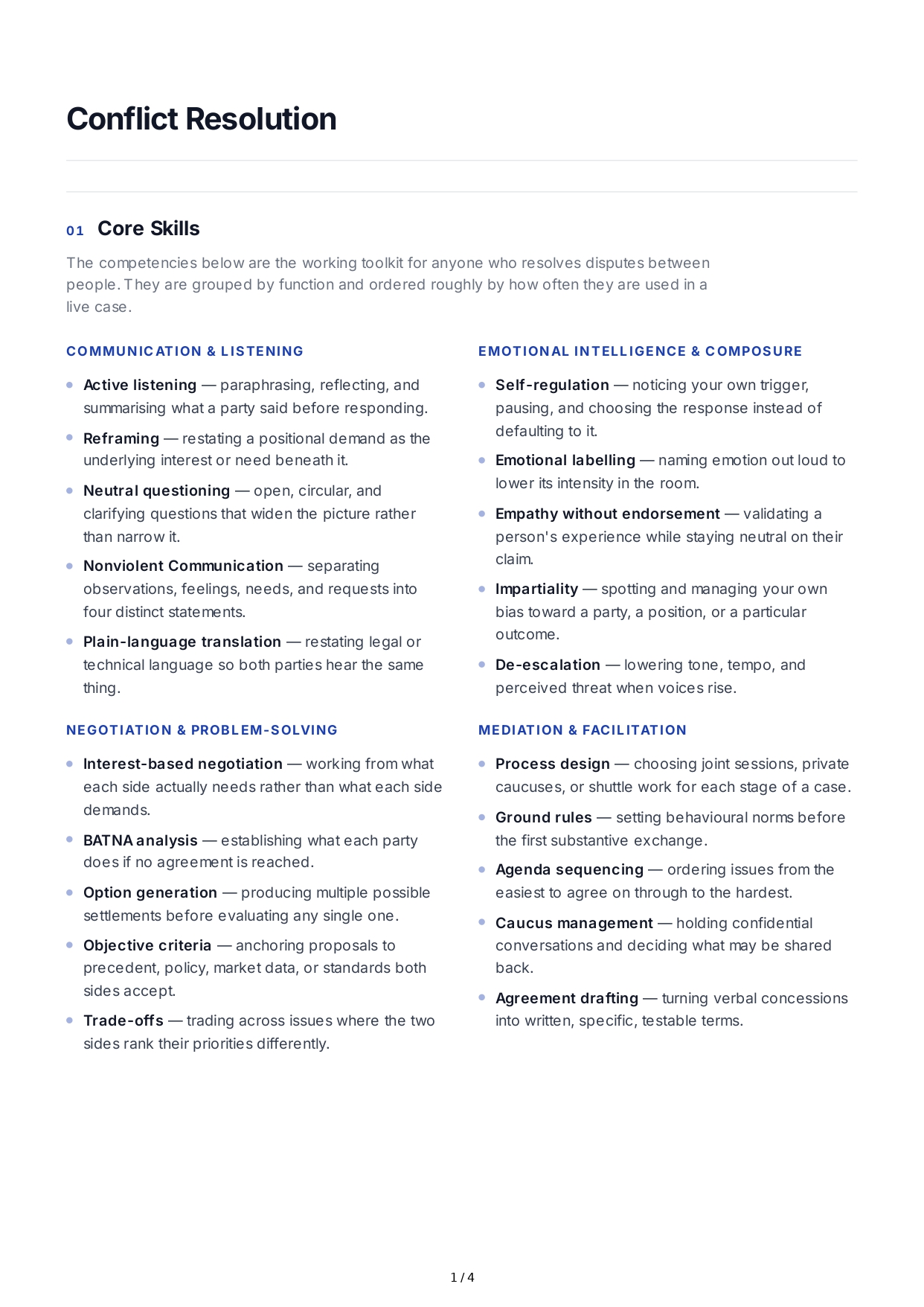
PREPARATION
&
ANALYSIS
Interest
Mapping
Separate
stated
positions
from
underlying
interests
for
every
party
,
including
your
own
side
.
BATNA
Development
Identify
,
test
,
and
actively
improve
your
best
alternative
to
a
negotiated
agreement
before
talks
begin
.
Reservation
&
Aspiration
Setting
Set
a
defensible
walk
-
away
point
,
a
target
,
and
an
opening
aspiration
—
and
know
the
evidence
behind
each
.
ZOPA
Estimation
Model
the
likely
zone
of
possible
agreement
from
benchmarks
,
budgets
,
and
alternative
costs
.
Benchmarking
&
Cost
Modelling
Price
a
deal
from
market
data
,
supplier
cost
structures
,
and
comparable
transactions
.
Stakeholder
&
Authority
Mapping
Know
who
decides
,
who
influences
,
who
can
veto
,
and
what
each
needs
in
order
to
say
yes
.
COMMUNICATION
Active
Listening
Play
back
both
content
and
emotion
accurately
enough
that
the
other
side
says
"
that
'
s
right
."
Calibrated
Questioning
Ask
open
,
non
-
threatening
questions
that
surface
constraints
without
triggering
defensiveness
.
Framing
&
Reframing
Present
the
same
term
as
a
gain
,
a
risk
,
or
an
industry
standard
so
it
lands
on
the
other
side
'
s
values
.
Strategic
Silence
Leave
space
after
an
offer
or
a
demand
and
let
the
other
party
fill
it
.
Concise
Value
Articulation
Explain
what
your
offer
is
worth
in
under
sixty
seconds
,
without
jargon
or
hedging
.
Written
Negotiation
Draft
emails
,
term
sheets
,
and
redlines
that
move
a
deal
forward
without
escalating
tone
.
INFLUENCE
&
RELATIONSHIP
Rapport
Building
Find
genuine
common
ground
quickly
and
hold
it
through
disagreement
.
Emotional
Self
-
Regulation
Stay
steady
when
anchors
are
absurd
,
deadlines
are
manufactured
,
or
the
room
turns
personal
.
Tactical
Empathy
Name
the
other
side
'
s
concerns
aloud
so
they
feel
heard
and
become
more
forthcoming
.
Trust
&
Reciprocity
Trade
small
,
verifiable
concessions
and
disclosures
to
establish
a
norm
of
exchange
.
Internal
Alignment
Get
your
own
team
,
legal
,
finance
,
and
leadership
to
a
single
position
before
you
enter
the
room
.
Cross
-
Cultural
Fluency
Adjust
directness
,
pacing
,
hierarchy
,
and
tolerance
for
silence
to
the
counterpart
'
s
norms
.
2 / 8
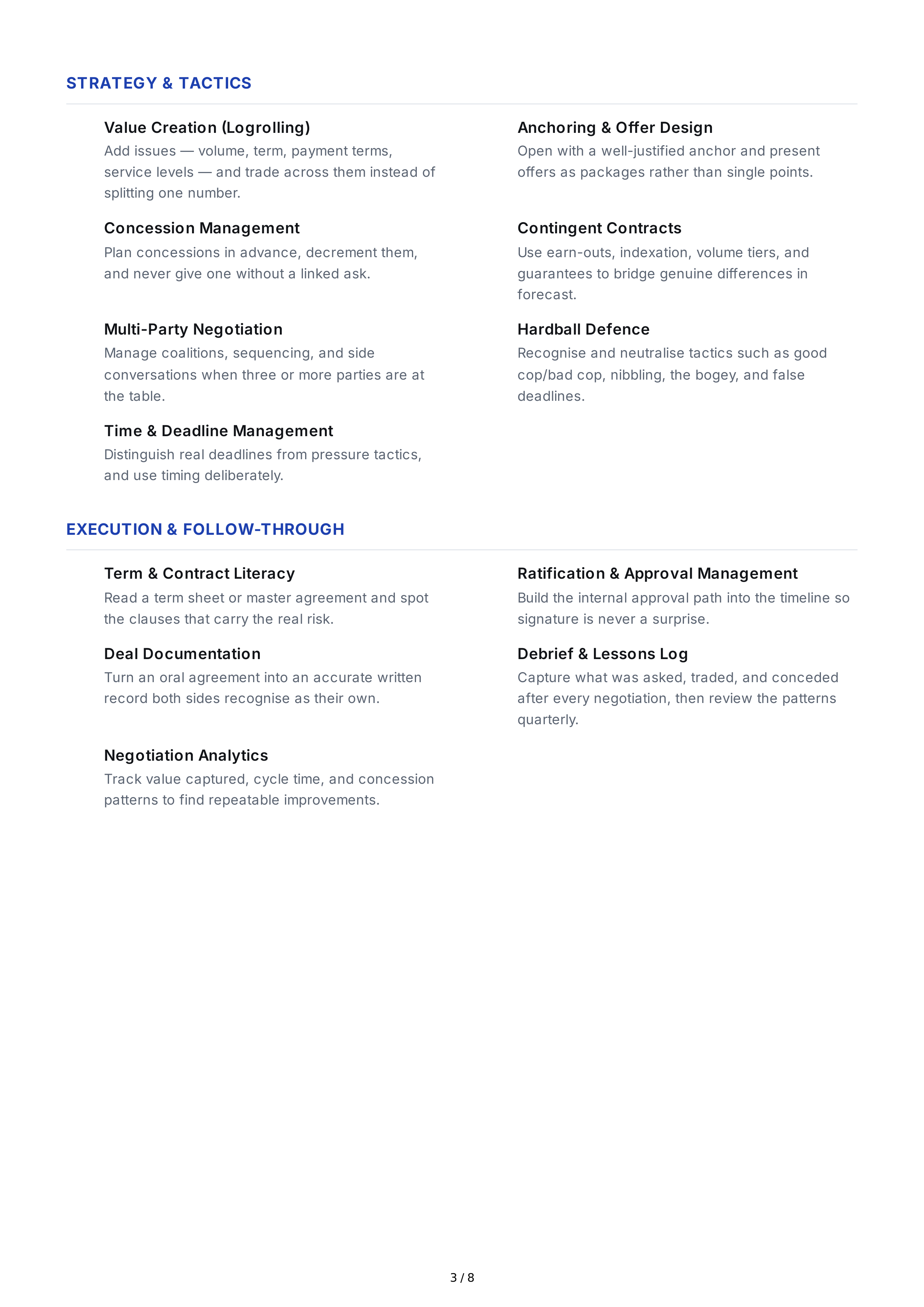
STRATEGY
&
TACTICS
Value
Creation
(
Logrolling
)
Add
issues
—
volume
,
term
,
payment
terms
,
service
levels
—
and
trade
across
them
instead
of
splitting
one
number
.
Anchoring
&
Offer
Design
Open
with
a
well
-
justified
anchor
and
present
offers
as
packages
rather
than
single
points
.
Concession
Management
Plan
concessions
in
advance
,
decrement
them
,
and
never
give
one
without
a
linked
ask
.
Contingent
Contracts
Use
earn
-
outs
,
indexation
,
volume
tiers
,
and
guarantees
to
bridge
genuine
differences
in
forecast
.
Multi
-
Party
Negotiation
Manage
coalitions
,
sequencing
,
and
side
conversations
when
three
or
more
parties
are
at
the
table
.
Hardball
Defence
Recognise
and
neutralise
tactics
such
as
good
cop
/
bad
cop
,
nibbling
,
the
bogey
,
and
false
deadlines
.
Time
&
Deadline
Management
Distinguish
real
deadlines
from
pressure
tactics
,
and
use
timing
deliberately
.
EXECUTION
&
FOLLOW
-
THROUGH
Term
&
Contract
Literacy
Read
a
term
sheet
or
master
agreement
and
spot
the
clauses
that
carry
the
real
risk
.
Ratification
&
Approval
Management
Build
the
internal
approval
path
into
the
timeline
so
signature
is
never
a
surprise
.
Deal
Documentation
Turn
an
oral
agreement
into
an
accurate
written
record
both
sides
recognise
as
their
own
.
Debrief
&
Lessons
Log
Capture
what
was
asked
,
traded
,
and
conceded
after
every
negotiation
,
then
review
the
patterns
quarterly
.
Negotiation
Analytics
Track
value
captured
,
cycle
time
,
and
concession
patterns
to
find
repeatable
improvements
.
3 / 8
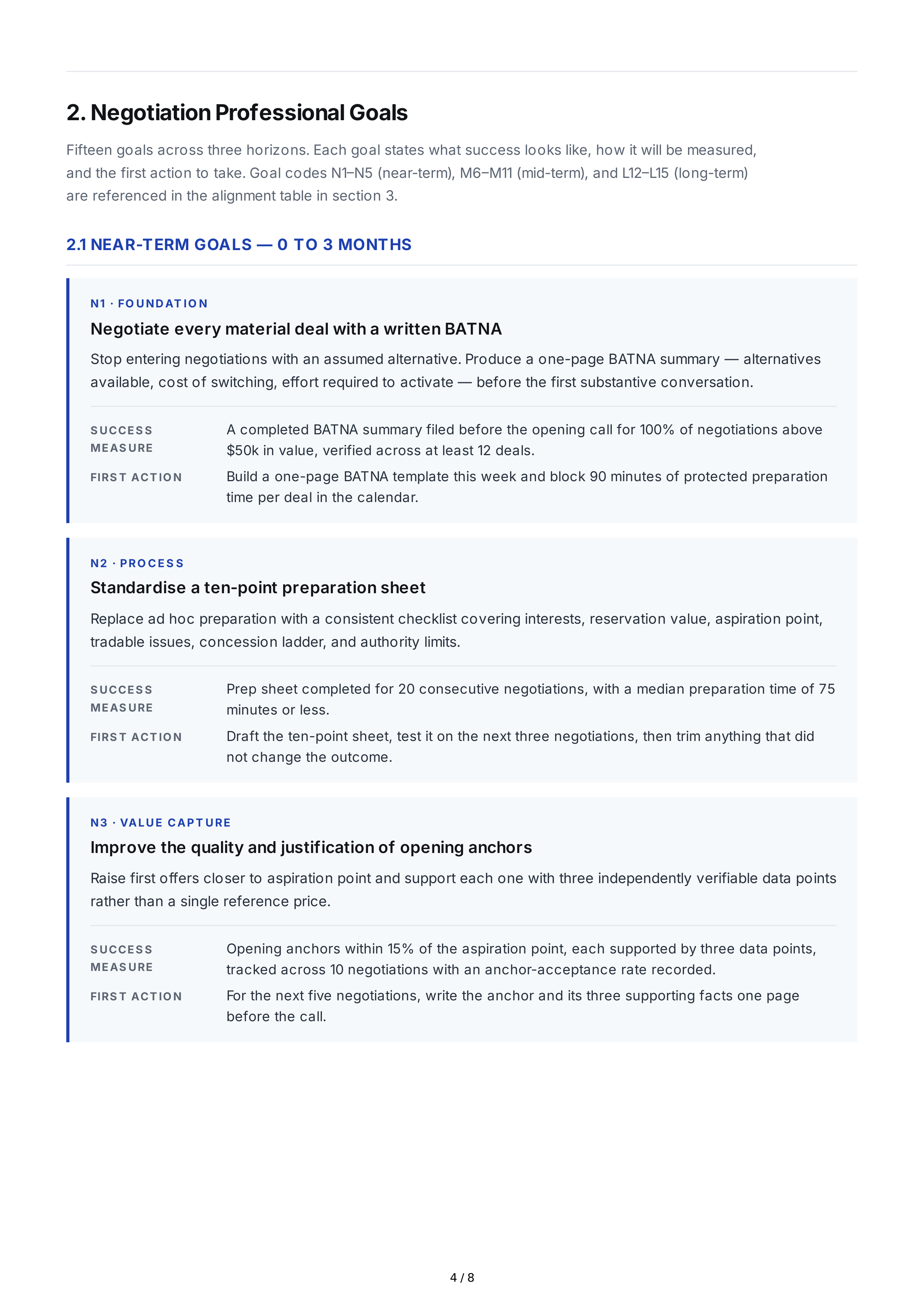
2.
Negotiation
Professional
Goals
Fifteen
goals
across
three
horizons
.
Each
goal
states
what
success
looks
like
,
how
it
will
be
measured
,
and
the
first
action
to
take
.
Goal
codes
N
1–
N
5 (
near
-
term
),
M
6–
M
11 (
mid
-
term
),
and
L
12–
L
15 (
long
-
term
)
are
referenced
in
the
alignment
table
in
section
3.
2.1
NEAR
-
TERM
GOALS
— 0
TO
3
MONTHS
N
1 ·
FO U ND AT IO N
Negotiate
every
material
deal
with
a
written
BATNA
Stop
entering
negotiations
with
an
assumed
alternative
.
Produce
a
one
-
page
BATNA
summary
—
alternatives
available
,
cost
of
switching
,
effort
required
to
activate
—
before
the
first
substantive
conversation
.
S UCCES S
MEAS URE
A
completed
BATNA
summary
filed
before
the
opening
call
for
100%
of
negotiations
above
$
50
k
in
value
,
verified
across
at
least
12
deals
.
FIRS T
ACT IO N
Build
a
one
-
page
BATNA
template
this
week
and
block
90
minutes
of
protected
preparation
time
per
deal
in
the
calendar
.
N
2 ·
PRO CE S S
Standardise
a
ten
-
point
preparation
sheet
Replace
ad
hoc
preparation
with
a
consistent
checklist
covering
interests
,
reservation
value
,
aspiration
point
,
tradable
issues
,
concession
ladder
,
and
authority
limits
.
S UCCES S
MEAS URE
Prep
sheet
completed
for
20
consecutive
negotiations
,
with
a
median
preparation
time
of
75
minutes
or
less
.
FIRS T
ACT IO N
Draft
the
ten
-
point
sheet
,
test
it
on
the
next
three
negotiations
,
then
trim
anything
that
did
not
change
the
outcome
.
N
3 ·
VALU E
CAPT U RE
Improve
the
quality
and
justification
of
opening
anchors
Raise
first
offers
closer
to
aspiration
point
and
support
each
one
with
three
independently
verifiable
data
points
rather
than
a
single
reference
price
.
S UCCES S
MEAS URE
Opening
anchors
within
15%
of
the
aspiration
point
,
each
supported
by
three
data
points
,
tracked
across
10
negotiations
with
an
anchor
-
acceptance
rate
recorded
.
FIRS T
ACT IO N
For
the
next
five
negotiations
,
write
the
anchor
and
its
three
supporting
facts
one
page
before
the
call
.
4 / 8
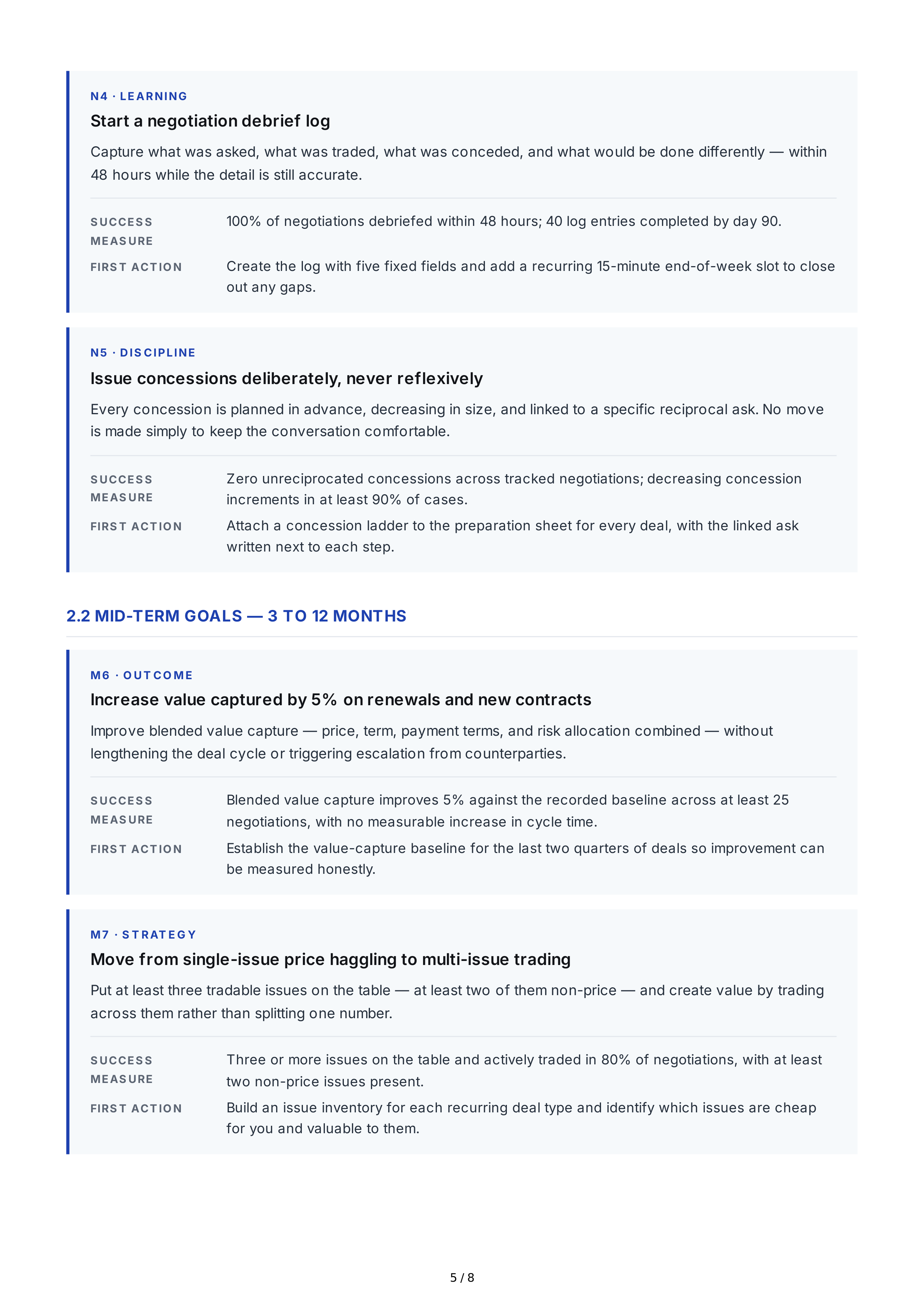
N
4 ·
LE ARNING
Start
a
negotiation
debrief
log
Capture
what
was
asked
,
what
was
traded
,
what
was
conceded
,
and
what
would
be
done
differently
—
within
48
hours
while
the
detail
is
still
accurate
.
S UCCES S
MEAS URE
100%
of
negotiations
debriefed
within
48
hours
; 40
log
entries
completed
by
day
90.
FIRS T
ACT IO N
Create
the
log
with
five
fixed
fields
and
add
a
recurring
15-
minute
end
-
of
-
week
slot
to
close
out
any
gaps
.
N
5 ·
D IS CIPLINE
Issue
concessions
deliberately
,
never
reflexively
Every
concession
is
planned
in
advance
,
decreasing
in
size
,
and
linked
to
a
specific
reciprocal
ask
.
No
move
is
made
simply
to
keep
the
conversation
comfortable
.
S UCCES S
MEAS URE
Zero
unreciprocated
concessions
across
tracked
negotiations
;
decreasing
concession
increments
in
at
least
90%
of
cases
.
FIRS T
ACT IO N
Attach
a
concession
ladder
to
the
preparation
sheet
for
every
deal
,
with
the
linked
ask
written
next
to
each
step
.
2.2
MID
-
TERM
GOALS
— 3
TO
12
MONTHS
M
6 ·
O U T CO ME
Increase
value
captured
by
5%
on
renewals
and
new
contracts
Improve
blended
value
capture
—
price
,
term
,
payment
terms
,
and
risk
allocation
combined
—
without
lengthening
the
deal
cycle
or
triggering
escalation
from
counterparties
.
S UCCES S
MEAS URE
Blended
value
capture
improves
5%
against
the
recorded
baseline
across
at
least
25
negotiations
,
with
no
measurable
increase
in
cycle
time
.
FIRS T
ACT IO N
Establish
the
value
-
capture
baseline
for
the
last
two
quarters
of
deals
so
improvement
can
be
measured
honestly
.
M
7 ·
S T RAT E G Y
Move
from
single
-
issue
price
haggling
to
multi
-
issue
trading
Put
at
least
three
tradable
issues
on
the
table
—
at
least
two
of
them
non
-
price
—
and
create
value
by
trading
across
them
rather
than
splitting
one
number
.
S UCCES S
MEAS URE
Three
or
more
issues
on
the
table
and
actively
traded
in
80%
of
negotiations
,
with
at
least
two
non
-
price
issues
present
.
FIRS T
ACT IO N
Build
an
issue
inventory
for
each
recurring
deal
type
and
identify
which
issues
are
cheap
for
you
and
valuable
to
them
.
5 / 8
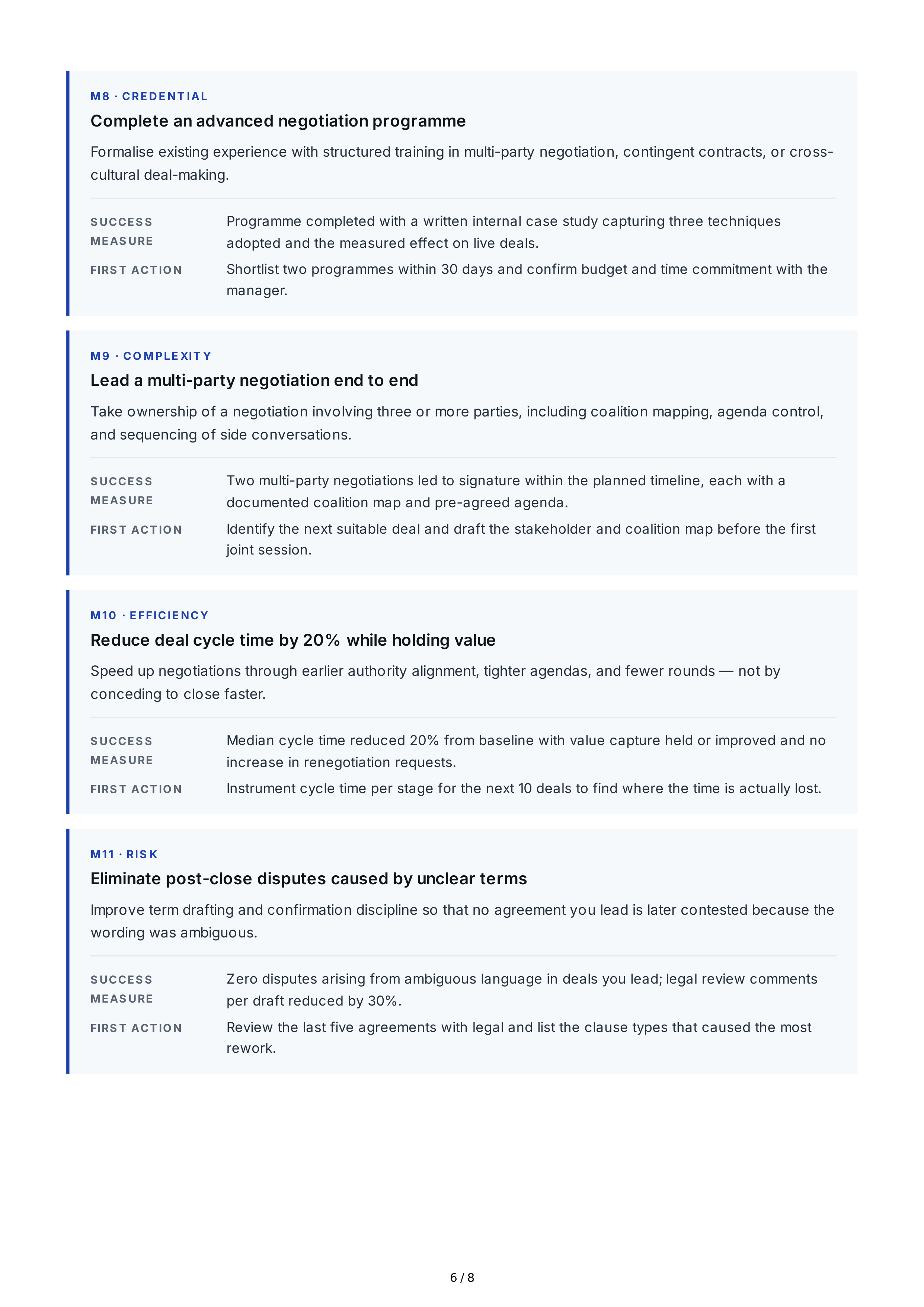
M
8 ·
CRE D E NT IAL
Complete
an
advanced
negotiation
programme
Formalise
existing
experience
with
structured
training
in
multi
-
party
negotiation
,
contingent
contracts
,
or
cross
-
cultural
deal
-
making
.
S UCCES S
MEAS URE
Programme
completed
with
a
written
internal
case
study
capturing
three
techniques
adopted
and
the
measured
effect
on
live
deals
.
FIRS T
ACT IO N
Shortlist
two
programmes
within
30
days
and
confirm
budget
and
time
commitment
with
the
manager
.
M
9 ·
CO MPLE XIT Y
Lead
a
multi
-
party
negotiation
end
to
end
Take
ownership
of
a
negotiation
involving
three
or
more
parties
,
including
coalition
mapping
,
agenda
control
,
and
sequencing
of
side
conversations
.
S UCCES S
MEAS URE
Two
multi
-
party
negotiations
led
to
signature
within
the
planned
timeline
,
each
with
a
documented
coalition
map
and
pre
-
agreed
agenda
.
FIRS T
ACT IO N
Identify
the
next
suitable
deal
and
draft
the
stakeholder
and
coalition
map
before
the
first
joint
session
.
M
1 0 ·
E FFICIE NCY
Reduce
deal
cycle
time
by
20%
while
holding
value
Speed
up
negotiations
through
earlier
authority
alignment
,
tighter
agendas
,
and
fewer
rounds
—
not
by
conceding
to
close
faster
.
S UCCES S
MEAS URE
Median
cycle
time
reduced
20%
from
baseline
with
value
capture
held
or
improved
and
no
increase
in
renegotiation
requests
.
FIRS T
ACT IO N
Instrument
cycle
time
per
stage
for
the
next
10
deals
to
find
where
the
time
is
actually
lost
.
M
1 1 ·
RIS K
Eliminate
post
-
close
disputes
caused
by
unclear
terms
Improve
term
drafting
and
confirmation
discipline
so
that
no
agreement
you
lead
is
later
contested
because
the
wording
was
ambiguous
.
S UCCES S
MEAS URE
Zero
disputes
arising
from
ambiguous
language
in
deals
you
lead
;
legal
review
comments
per
draft
reduced
by
30%.
FIRS T
ACT IO N
Review
the
last
five
agreements
with
legal
and
list
the
clause
types
that
caused
the
most
rework
.
6 / 8
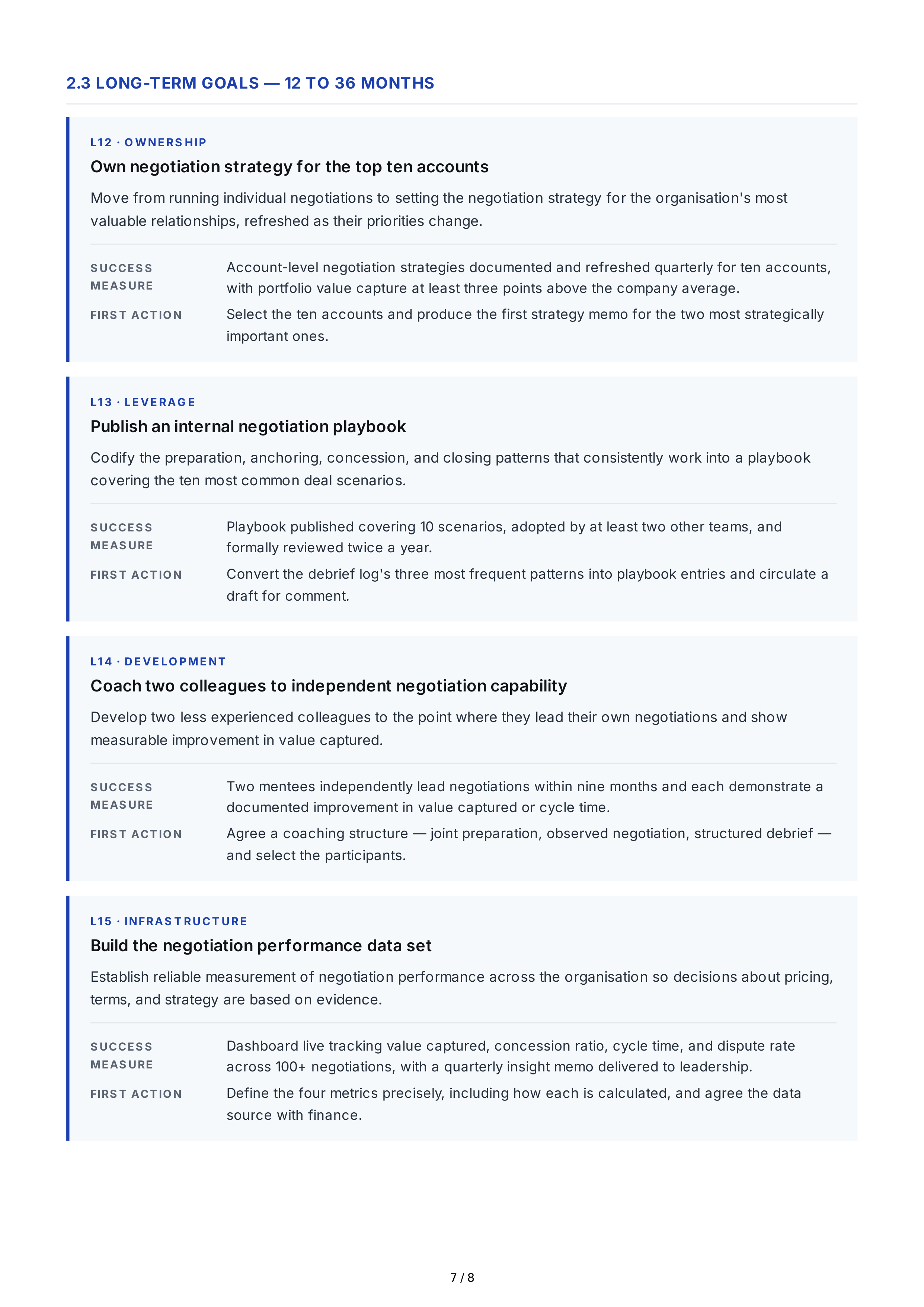
2.3
LONG
-
TERM
GOALS
— 12
TO
36
MONTHS
L
1 2 ·
O WNE RS HIP
Own
negotiation
strategy
for
the
top
ten
accounts
Move
from
running
individual
negotiations
to
setting
the
negotiation
strategy
for
the
organisation
'
s
most
valuable
relationships
,
refreshed
as
their
priorities
change
.
S UCCES S
MEAS URE
Account
-
level
negotiation
strategies
documented
and
refreshed
quarterly
for
ten
accounts
,
with
portfolio
value
capture
at
least
three
points
above
the
company
average
.
FIRS T
ACT IO N
Select
the
ten
accounts
and
produce
the
first
strategy
memo
for
the
two
most
strategically
important
ones
.
L
1 3 ·
LE VE RAG E
Publish
an
internal
negotiation
playbook
Codify
the
preparation
,
anchoring
,
concession
,
and
closing
patterns
that
consistently
work
into
a
playbook
covering
the
ten
most
common
deal
scenarios
.
S UCCES S
MEAS URE
Playbook
published
covering
10
scenarios
,
adopted
by
at
least
two
other
teams
,
and
formally
reviewed
twice
a
year
.
FIRS T
ACT IO N
Convert
the
debrief
log
'
s
three
most
frequent
patterns
into
playbook
entries
and
circulate
a
draft
for
comment
.
L
1 4 ·
D E VE LO PME NT
Coach
two
colleagues
to
independent
negotiation
capability
Develop
two
less
experienced
colleagues
to
the
point
where
they
lead
their
own
negotiations
and
show
measurable
improvement
in
value
captured
.
S UCCES S
MEAS URE
Two
mentees
independently
lead
negotiations
within
nine
months
and
each
demonstrate
a
documented
improvement
in
value
captured
or
cycle
time
.
FIRS T
ACT IO N
Agree
a
coaching
structure
—
joint
preparation
,
observed
negotiation
,
structured
debrief
—
and
select
the
participants
.
L
1 5 ·
INFRAS T RU CT U RE
Build
the
negotiation
performance
data
set
Establish
reliable
measurement
of
negotiation
performance
across
the
organisation
so
decisions
about
pricing
,
terms
,
and
strategy
are
based
on
evidence
.
S UCCES S
MEAS URE
Dashboard
live
tracking
value
captured
,
concession
ratio
,
cycle
time
,
and
dispute
rate
across
100+
negotiations
,
with
a
quarterly
insight
memo
delivered
to
leadership
.
FIRS T
ACT IO N
Define
the
four
metrics
precisely
,
including
how
each
is
calculated
,
and
agree
the
data
source
with
finance
.
7 / 8
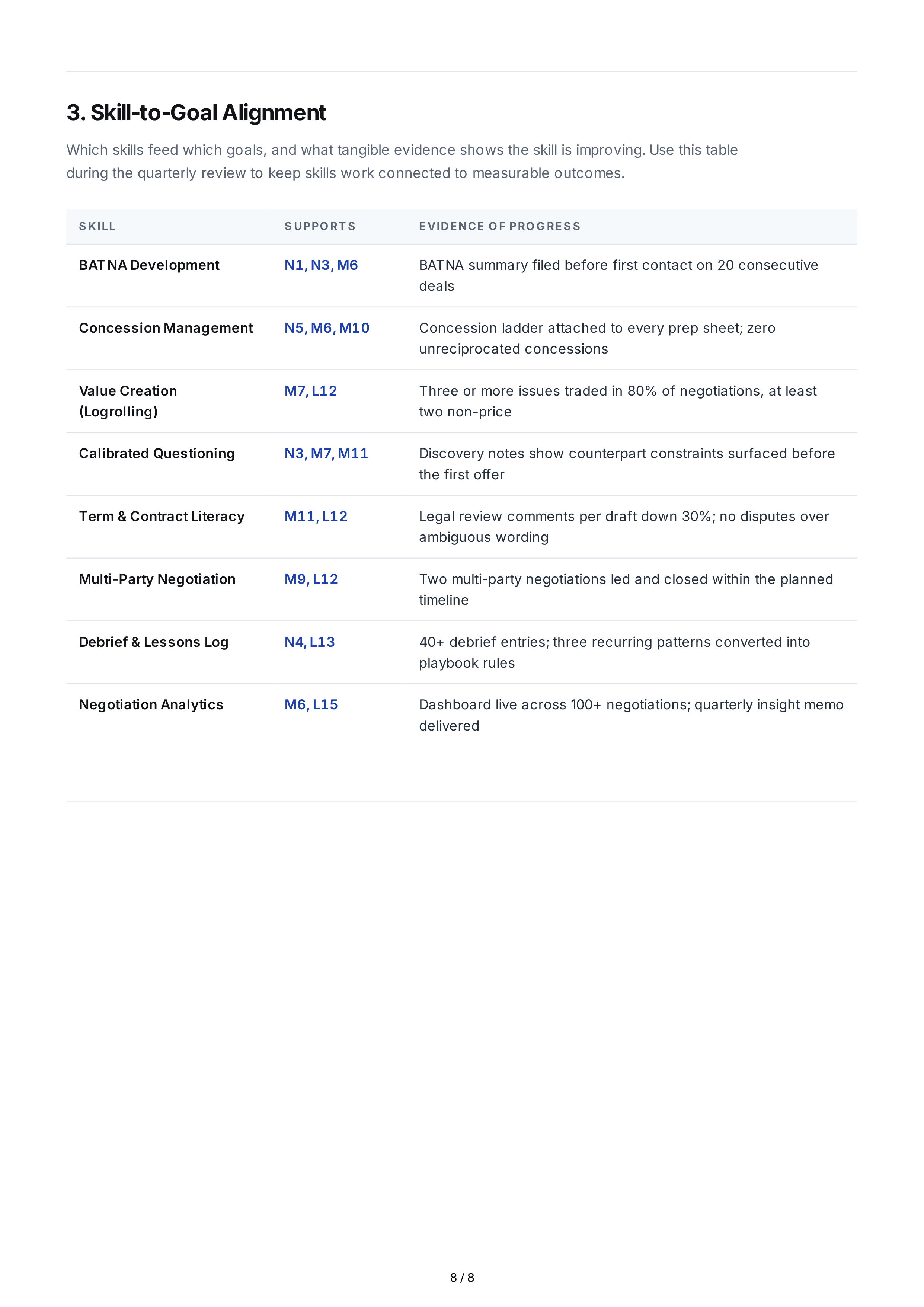
3.
Skill
-
to
-
Goal
Alignment
Which
skills
feed
which
goals
,
and
what
tangible
evidence
shows
the
skill
is
improving
.
Use
this
table
during
the
quarterly
review
to
keep
skills
work
connected
to
measurable
outcomes
.
S KILL
S UPPO RT S
EVIDENCE
O F
PRO G RES S
BATNA
Development
N
1,
N
3,
M
6
BATNA
summary
filed
before
first
contact
on
20
consecutive
deals
Concession
Management
N
5,
M
6,
M
10
Concession
ladder
attached
to
every
prep
sheet
;
zero
unreciprocated
concessions
Value
Creation
(
Logrolling
)
M
7,
L
12
Three
or
more
issues
traded
in
80%
of
negotiations
,
at
least
two
non
-
price
Calibrated
Questioning
N
3,
M
7,
M
11
Discovery
notes
show
counterpart
constraints
surfaced
before
the
first
offer
Term
&
Contract
Literacy
M
11,
L
12
Legal
review
comments
per
draft
down
30%;
no
disputes
over
ambiguous
wording
Multi
-
Party
Negotiation
M
9,
L
12
Two
multi
-
party
negotiations
led
and
closed
within
the
planned
timeline
Debrief
&
Lessons
Log
N
4,
L
13
40+
debrief
entries
;
three
recurring
patterns
converted
into
playbook
rules
Negotiation
Analytics
M
6,
L
15
Dashboard
live
across
100+
negotiations
;
quarterly
insight
memo
delivered
8 / 8