Critical
Thinking
Development
1.
Core
Skill
Inventory
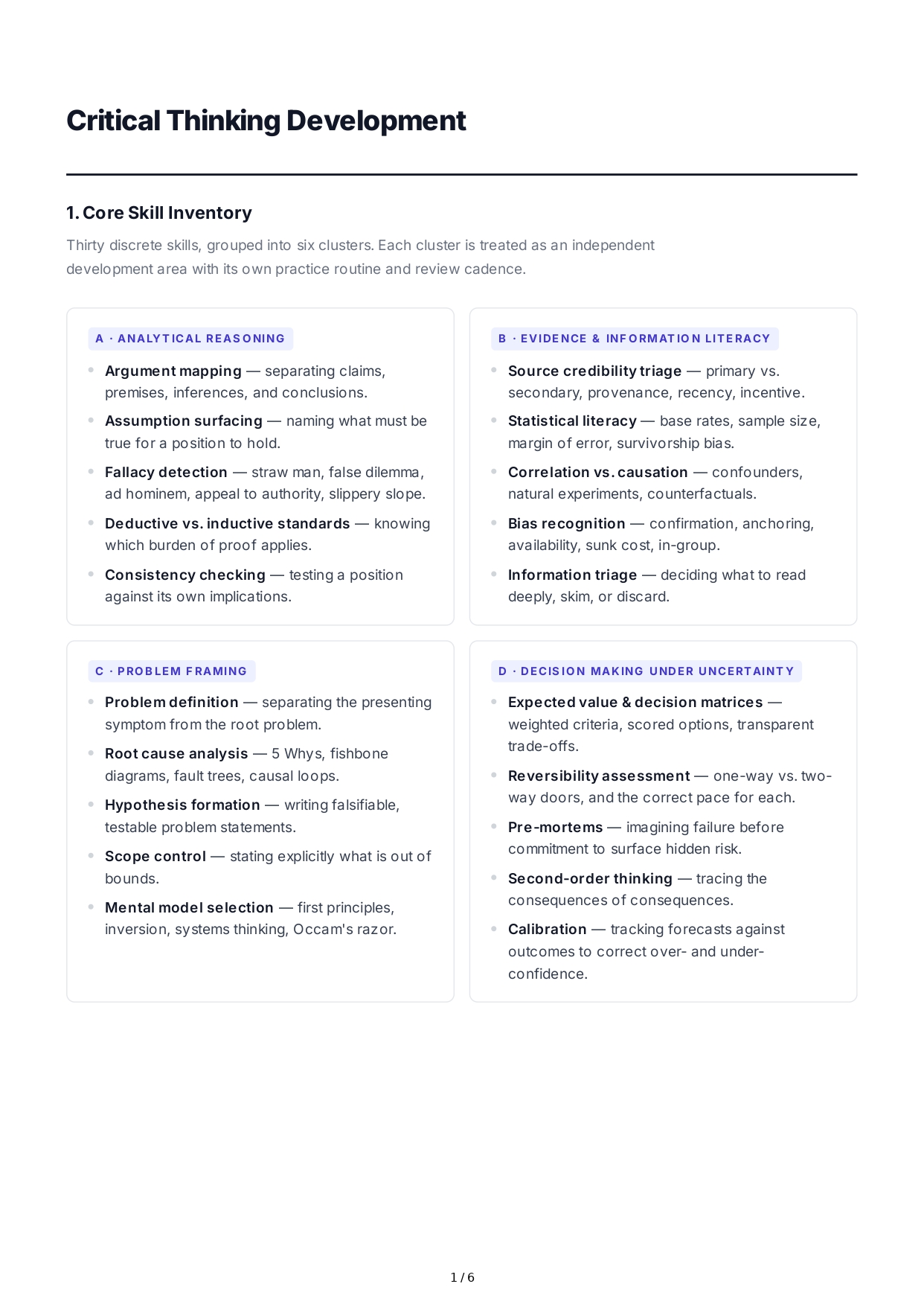
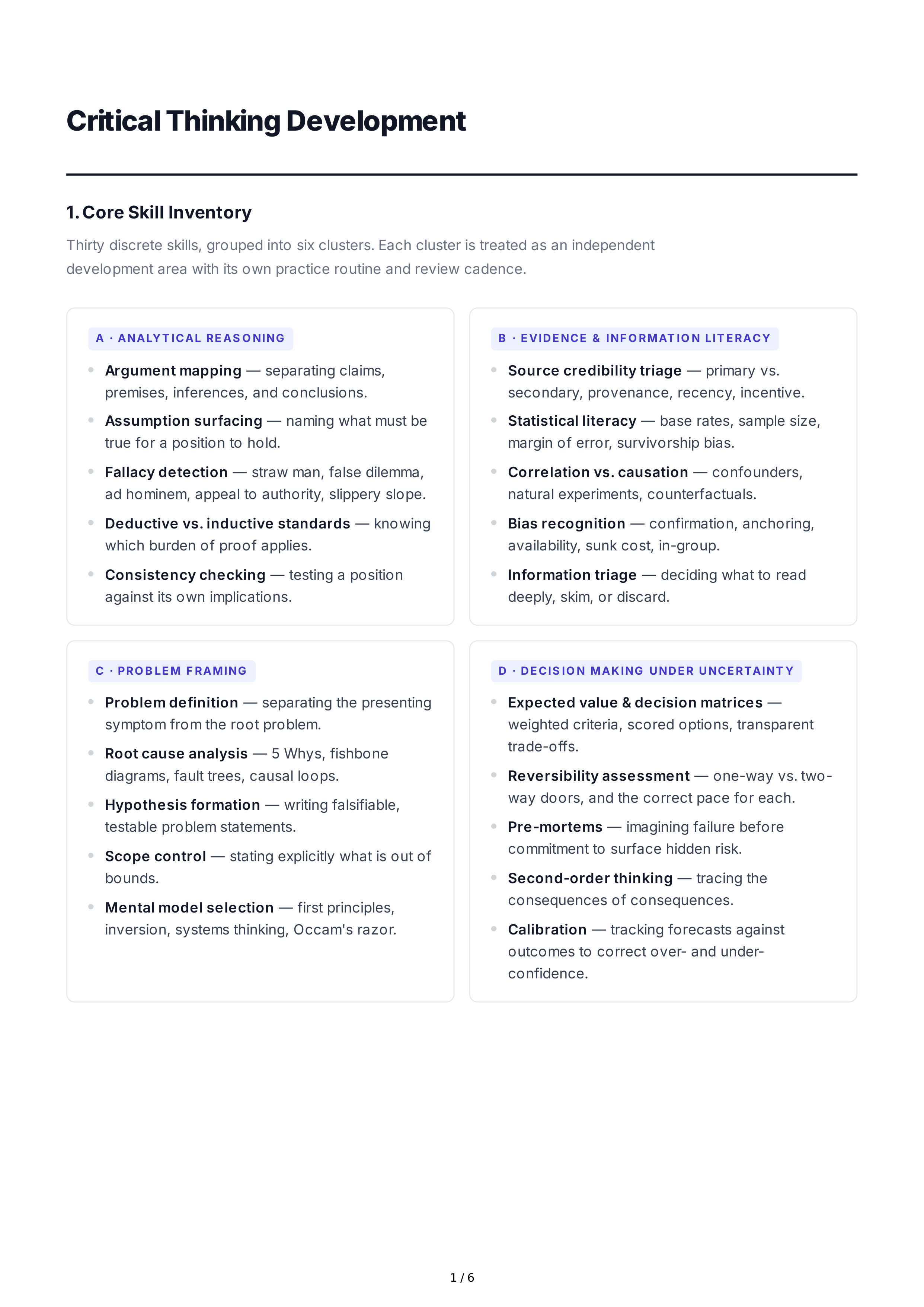
Thirty
discrete
skills
,
grouped
into
six
clusters
.
Each
cluster
is
treated
as
an
independent
development
area
with
its
own
practice
routine
and
review
cadence
.
A
·
ANALYT ICAL
RE AS O NING
B
·
E VIDE NCE
&
INF O RMAT IO N
LIT E RACY
C
·
PRO B LE M
F RAMING
D
·
DE CIS IO N
MAKING
UNDE R
UNCE RTAINT Y
Argument
mapping
—
separating
claims
,
premises
,
inferences
,
and
conclusions
.
Assumption
surfacing
—
naming
what
must
be
true
for
a
position
to
hold
.
Fallacy
detection
—
straw
man
,
false
dilemma
,
ad
hominem
,
appeal
to
authority
,
slippery
slope
.
Deductive
vs
.
inductive
standards
—
knowing
which
burden
of
proof
applies
.
Consistency
checking
—
testing
a
position
against
its
own
implications
.
Source
credibility
triage
—
primary
vs
.
secondary
,
provenance
,
recency
,
incentive
.
Statistical
literacy
—
base
rates
,
sample
size
,
margin
of
error
,
survivorship
bias
.
Correlation
vs
.
causation
—
confounders
,
natural
experiments
,
counterfactuals
.
Bias
recognition
—
confirmation
,
anchoring
,
availability
,
sunk
cost
,
in
-
group
.
Information
triage
—
deciding
what
to
read
deeply
,
skim
,
or
discard
.
Problem
definition
—
separating
the
presenting
symptom
from
the
root
problem
.
Root
cause
analysis
— 5
Whys
,
fishbone
diagrams
,
fault
trees
,
causal
loops
.
Hypothesis
formation
—
writing
falsifiable
,
testable
problem
statements
.
Scope
control
—
stating
explicitly
what
is
out
of
bounds
.
Mental
model
selection
—
first
principles
,
inversion
,
systems
thinking
,
Occam
'
s
razor
.
Expected
value
&
decision
matrices
—
weighted
criteria
,
scored
options
,
transparent
trade
-
offs
.
Reversibility
assessment
—
one
-
way
vs
.
two
-
way
doors
,
and
the
correct
pace
for
each
.
Pre
-
mortems
—
imagining
failure
before
commitment
to
surface
hidden
risk
.
Second
-
order
thinking
—
tracing
the
consequences
of
consequences
.
Calibration
—
tracking
forecasts
against
outcomes
to
correct
over
-
and
under
-
confidence
.
1 / 6
E
·
ME TACO G NIT IO N
&
INT E LLE CT UAL
HAB IT S
F
·
CO MMUNICAT IO N
&
INF LUE NCE
2.
Professional
Goals
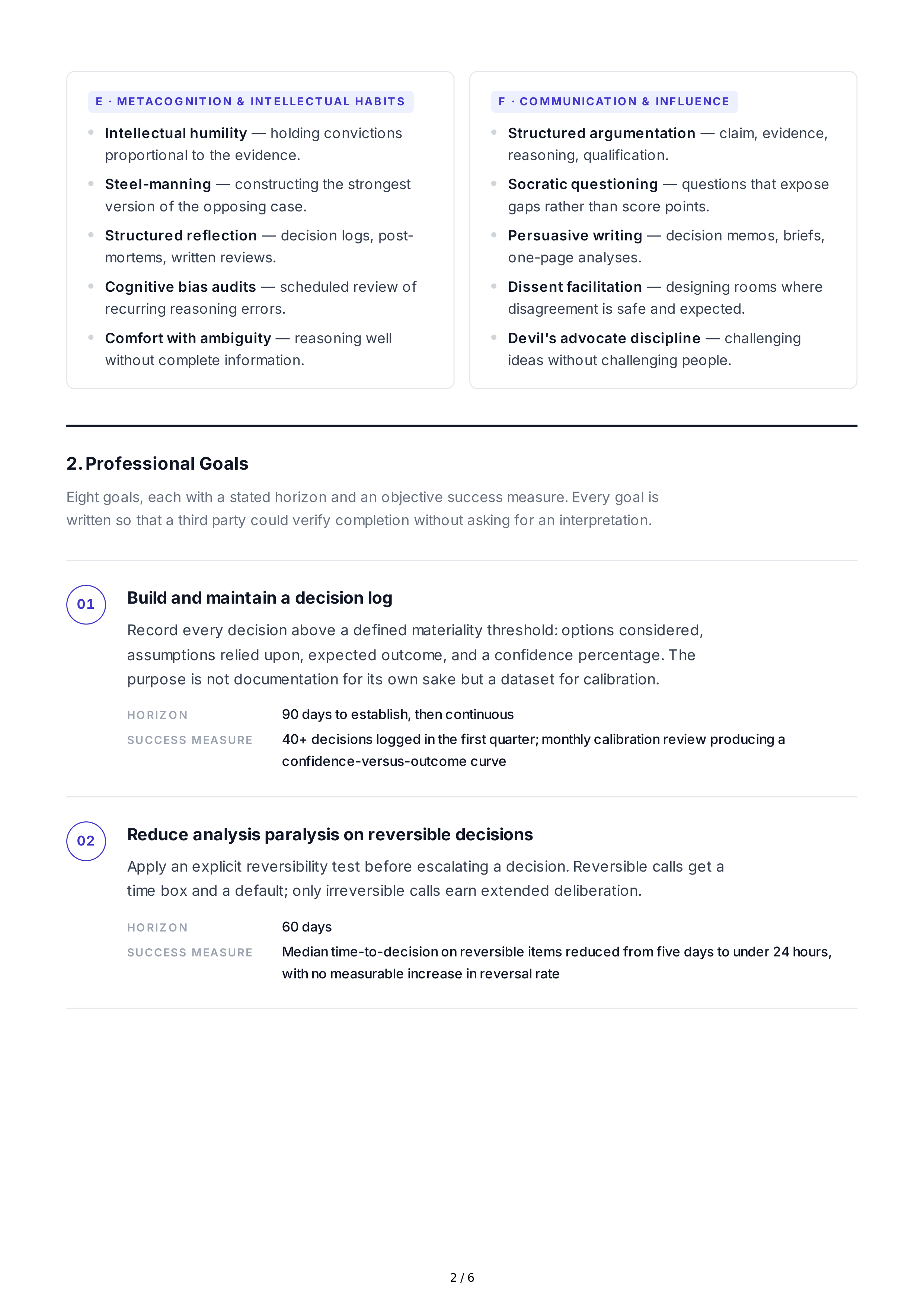
Eight
goals
,
each
with
a
stated
horizon
and
an
objective
success
measure
.
Every
goal
is
written
so
that
a
third
party
could
verify
completion
without
asking
for
an
interpretation
.
01
Build
and
maintain
a
decision
log
Record
every
decision
above
a
defined
materiality
threshold
:
options
considered
,
assumptions
relied
upon
,
expected
outcome
,
and
a
confidence
percentage
.
The
purpose
is
not
documentation
for
its
own
sake
but
a
dataset
for
calibration
.
HO RIZ O N
90
days
to
establish
,
then
continuous
SUCCESS
MEASURE
40+
decisions
logged
in
the
first
quarter
;
monthly
calibration
review
producing
a
confidence
-
versus
-
outcome
curve
02
Reduce
analysis
paralysis
on
reversible
decisions
Apply
an
explicit
reversibility
test
before
escalating
a
decision
.
Reversible
calls
get
a
time
box
and
a
default
;
only
irreversible
calls
earn
extended
deliberation
.
HO RIZ O N
60
days
SUCCESS
MEASURE
Median
time
-
to
-
decision
on
reversible
items
reduced
from
five
days
to
under
24
hours
,
with
no
measurable
increase
in
reversal
rate
Intellectual
humility
—
holding
convictions
proportional
to
the
evidence
.
Steel
-
manning
—
constructing
the
strongest
version
of
the
opposing
case
.
Structured
reflection
—
decision
logs
,
post
-
mortems
,
written
reviews
.
Cognitive
bias
audits
—
scheduled
review
of
recurring
reasoning
errors
.
Comfort
with
ambiguity
—
reasoning
well
without
complete
information
.
Structured
argumentation
—
claim
,
evidence
,
reasoning
,
qualification
.
Socratic
questioning
—
questions
that
expose
gaps
rather
than
score
points
.
Persuasive
writing
—
decision
memos
,
briefs
,
one
-
page
analyses
.
Dissent
facilitation
—
designing
rooms
where
disagreement
is
safe
and
expected
.
Devil
'
s
advocate
discipline
—
challenging
ideas
without
challenging
people
.
2 / 6
03
Run
pre
-
mortems
on
every
material
project
Before
any
significant
commitment
,
convene
a
session
that
assumes
the
project
has
already
failed
and
works
backwards
to
the
causes
.
Output
feeds
directly
into
the
risk
register
.
HO RIZ O N
Quarterly
,
ongoing
SUCCESS
MEASURE
Pre
-
mortem
held
on
100%
of
projects
above
the
materiality
threshold
;
at
least
two
previously
unlisted
risks
identified
per
session
04
Formalise
statistical
and
probabilistic
literacy
Close
the
gap
between
intuitive
and
formal
reasoning
by
completing
a
structured
course
in
applied
statistics
or
decision
analysis
,
then
immediately
applying
it
to
live
work
.
HO RIZ O N
Two
quarters
SUCCESS
MEASURE
Course
assessed
as
complete
;
three
real
analyses
reworked
using
the
new
methods
;
one
previously
accepted
metric
corrected
or
retired
05
Publish
a
monthly
written
argument
A
700–900
word
brief
that
argues
one
position
and
steel
-
mans
the
strongest
opposing
case
.
Writing
forces
the
reasoning
to
be
complete
in
a
way
that
thinking
alone
does
not
.
HO RIZ O N
12
months
,
monthly
SUCCESS
MEASURE
Twelve
briefs
published
;
at
least
three
reviewed
by
a
peer
who
holds
the
opposing
view
06
Institutionalise
structured
dissent
Introduce
a
red
-
team
review
into
the
planning
cycle
so
that
challenge
is
a
scheduled
step
rather
than
an
act
of
individual
courage
.
The
measure
of
success
is
a
plan
that
changes
.
HO RIZ O N
Two
quarters
SUCCESS
MEASURE
Red
-
team
review
on
100%
of
quarterly
plans
;
documented
evidence
of
at
least
one
plan
materially
altered
by
the
review
07
Improve
forecasting
calibration
Make
weekly
predictions
with
explicit
confidence
bands
and
score
them
against
outcomes
.
Track
a
Brier
score
over
time
so
that
improvement
or
decline
is
measured
,
not
felt
.
HO RIZ O N
Six
months
SUCCESS
MEASURE
Brier
score
improved
by
20%
or
more
against
the
recorded
baseline
;
overconfidence
gap
on
90%
intervals
narrowed
to
under
15
percentage
points
3 / 6
08
Mentor
two
colleagues
in
applied
critical
thinking
Fortnightly
sessions
using
live
work
problems
rather
than
abstract
exercises
.
Teaching
is
treated
as
a
test
of
mastery
,
and
the
mentees
'
written
output
is
used
as
the
evidence
.
HO RIZ O N
Two
quarters
SUCCESS
MEASURE
Both
mentees
independently
apply
at
least
three
frameworks
without
prompting
;
measurable
improvement
in
their
written
briefs
against
a
shared
rubric
Standing
rule
:
every
goal
above
is
written
so
it
can
be
marked
complete
or
incomplete
by
someone
other
than
its
author
.
A
goal
without
an
external
verification
method
is
treated
as
a
wish
,
not
a
goal
.
3.
Goal
Matrix
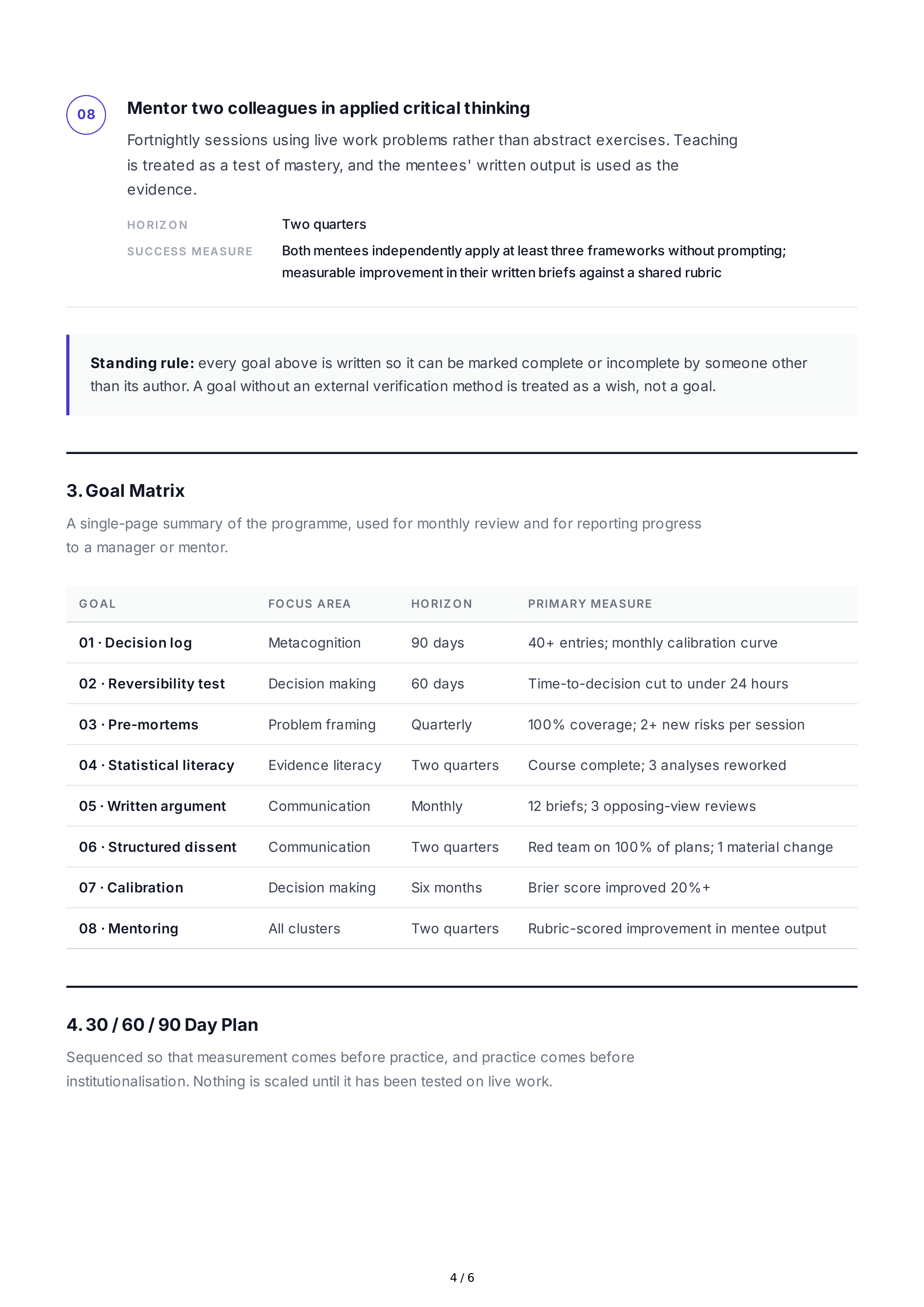
A
single
-
page
summary
of
the
programme
,
used
for
monthly
review
and
for
reporting
progress
to
a
manager
or
mentor
.
G OAL
FOCUS
AREA
HORIZ ON
PRIMARY
MEASURE
01 ·
Decision
log
Metacognition
90
days
40+
entries
;
monthly
calibration
curve
02 ·
Reversibility
test
Decision
making
60
days
Time
-
to
-
decision
cut
to
under
24
hours
03 ·
Pre
-
mortems
Problem
framing
Quarterly
100%
coverage
; 2+
new
risks
per
session
04 ·
Statistical
literacy
Evidence
literacy
Two
quarters
Course
complete
; 3
analyses
reworked
05 ·
Written
argument
Communication
Monthly
12
briefs
; 3
opposing
-
view
reviews
06 ·
Structured
dissent
Communication
Two
quarters
Red
team
on
100%
of
plans
; 1
material
change
07 ·
Calibration
Decision
making
Six
months
Brier
score
improved
20%+
08 ·
Mentoring
All
clusters
Two
quarters
Rubric
-
scored
improvement
in
mentee
output
4. 30 / 60 / 90
Day
Plan
Sequenced
so
that
measurement
comes
before
practice
,
and
practice
comes
before
institutionalisation
.
Nothing
is
scaled
until
it
has
been
tested
on
live
work
.
4 / 6
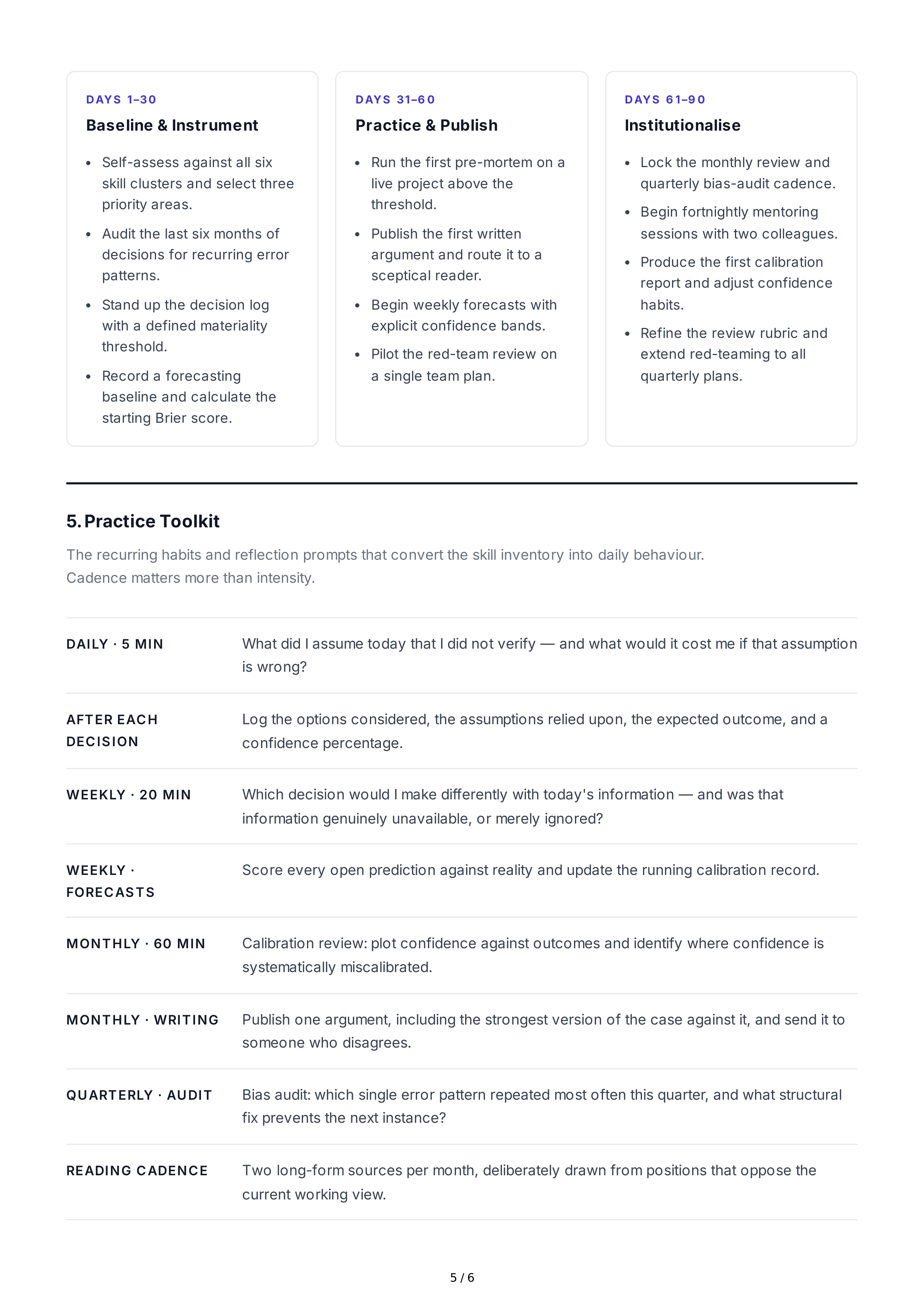
DAYS
1–30
Baseline
&
Instrument
Self
-
assess
against
all
six
skill
clusters
and
select
three
priority
areas
.
Audit
the
last
six
months
of
decisions
for
recurring
error
patterns
.
Stand
up
the
decision
log
with
a
defined
materiality
threshold
.
Record
a
forecasting
baseline
and
calculate
the
starting
Brier
score
.
DAYS
31–6 0
Practice
&
Publish
Run
the
first
pre
-
mortem
on
a
live
project
above
the
threshold
.
Publish
the
first
written
argument
and
route
it
to
a
sceptical
reader
.
Begin
weekly
forecasts
with
explicit
confidence
bands
.
Pilot
the
red
-
team
review
on
a
single
team
plan
.
DAYS
6 1–9 0
Institutionalise
Lock
the
monthly
review
and
quarterly
bias
-
audit
cadence
.
Begin
fortnightly
mentoring
sessions
with
two
colleagues
.
Produce
the
first
calibration
report
and
adjust
confidence
habits
.
Refine
the
review
rubric
and
extend
red
-
teaming
to
all
quarterly
plans
.
5.
Practice
Toolkit
The
recurring
habits
and
reflection
prompts
that
convert
the
skill
inventory
into
daily
behaviour
.
Cadence
matters
more
than
intensity
.
DAILY
· 5
MIN
What
did
I
assume
today
that
I
did
not
verify
—
and
what
would
it
cost
me
if
that
assumption
is
wrong
?
AFTER
EACH
DECISION
Log
the
options
considered
,
the
assumptions
relied
upon
,
the
expected
outcome
,
and
a
confidence
percentage
.
WEEKLY
· 20
MIN
Which
decision
would
I
make
differently
with
today
'
s
information
—
and
was
that
information
genuinely
unavailable
,
or
merely
ignored
?
WEEKLY
·
FORECASTS
Score
every
open
prediction
against
reality
and
update
the
running
calibration
record
.
MONTHLY
· 60
MIN
Calibration
review
:
plot
confidence
against
outcomes
and
identify
where
confidence
is
systematically
miscalibrated
.
MONTHLY
·
WRITING
Publish
one
argument
,
including
the
strongest
version
of
the
case
against
it
,
and
send
it
to
someone
who
disagrees
.
QUARTERLY
·
AUDIT
Bias
audit
:
which
single
error
pattern
repeated
most
often
this
quarter
,
and
what
structural
fix
prevents
the
next
instance
?
READING
CADENCE
Two
long
-
form
sources
per
month
,
deliberately
drawn
from
positions
that
oppose
the
current
working
view
.
5 / 6
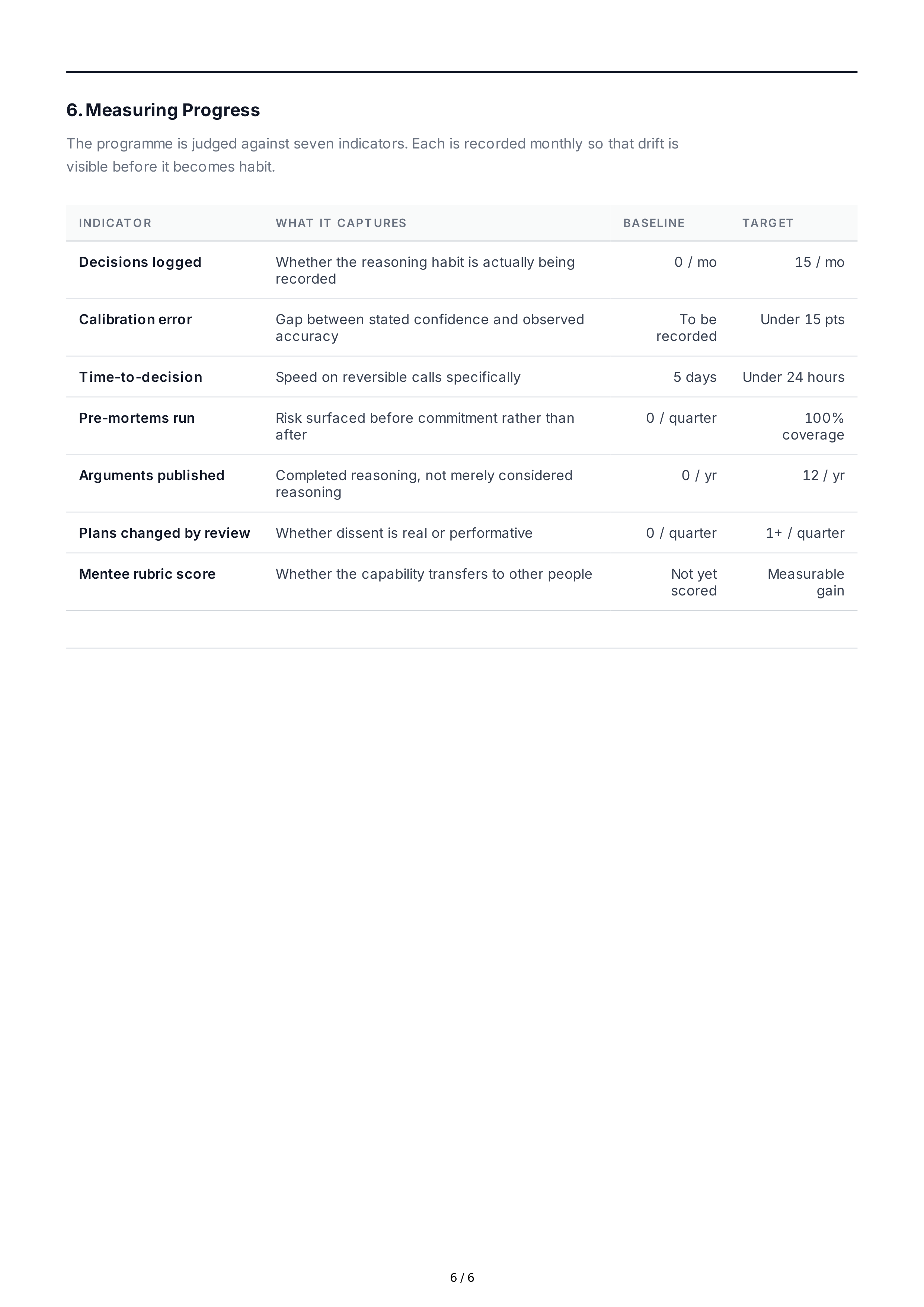
6.
Measuring
Progress
The
programme
is
judged
against
seven
indicators
.
Each
is
recorded
monthly
so
that
drift
is
visible
before
it
becomes
habit
.
INDICAT OR
WHAT
IT
CAPT URES
BASELINE
TARG ET
Decisions
logged
Whether
the
reasoning
habit
is
actually
being
recorded
0 /
mo
15 /
mo
Calibration
error
Gap
between
stated
confidence
and
observed
accuracy
To
be
recorded
Under
15
pts
Time
-
to
-
decision
Speed
on
reversible
calls
specifically
5
days
Under
24
hours
Pre
-
mortems
run
Risk
surfaced
before
commitment
rather
than
after
0 /
quarter
100%
coverage
Arguments
published
Completed
reasoning
,
not
merely
considered
reasoning
0 /
yr
12 /
yr
Plans
changed
by
review
Whether
dissent
is
real
or
performative
0 /
quarter
1+ /
quarter
Mentee
rubric
score
Whether
the
capability
transfers
to
other
people
Not
yet
scored
Measurable
gain
6 / 6