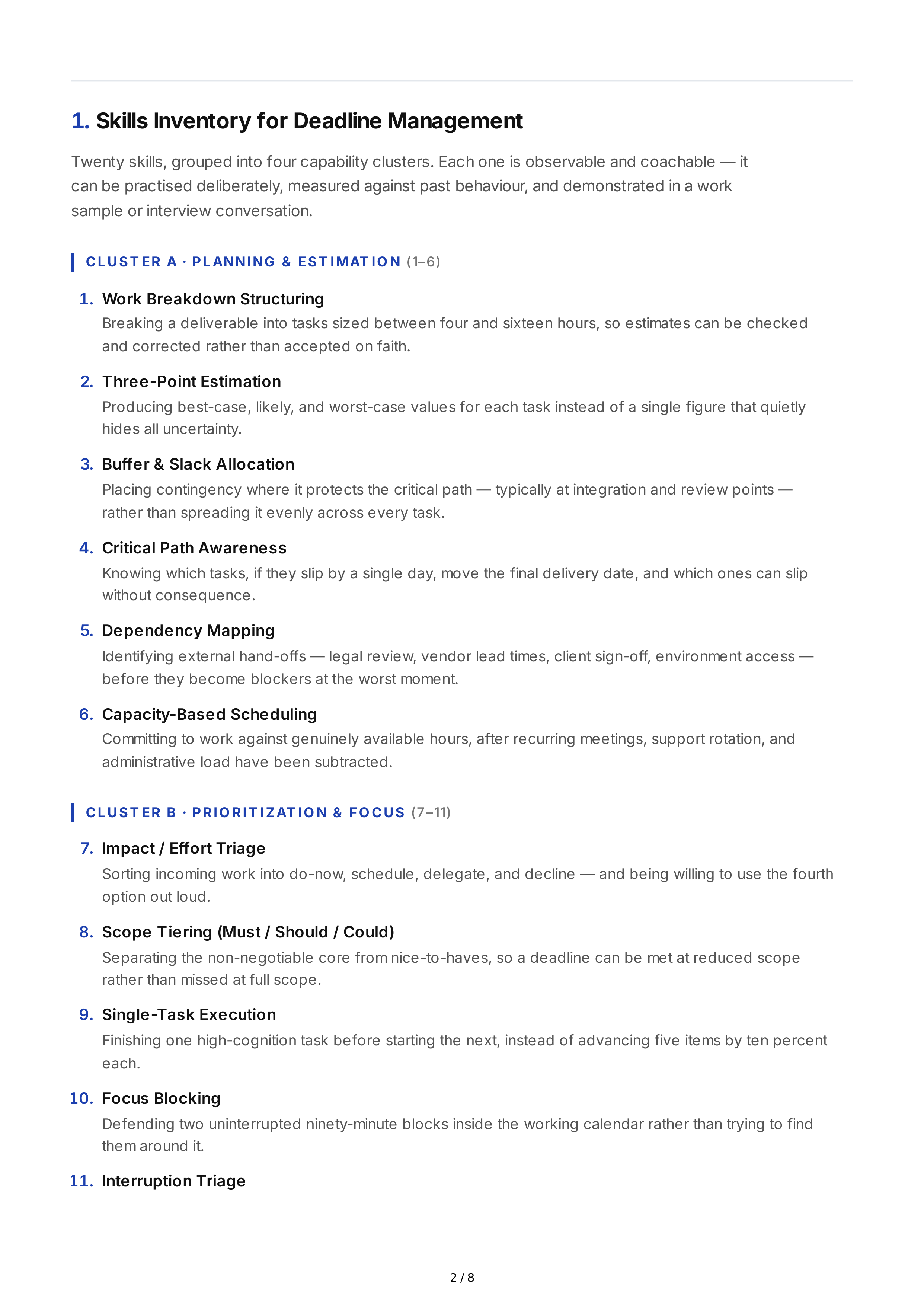
1.
Skills
Inventory
for
Deadline
Management
Twenty
skills
,
grouped
into
four
capability
clusters
.
Each
one
is
observable
and
coachable
—
it
can
be
practised
deliberately
,
measured
against
past
behaviour
,
and
demonstrated
in
a
work
sample
or
interview
conversation
.
CL UST ER
A
·
PL ANNING
&
EST IMAT IO N
(1–6)
1.
Work
Breakdown
Structuring
Breaking
a
deliverable
into
tasks
sized
between
four
and
sixteen
hours
,
so
estimates
can
be
checked
and
corrected
rather
than
accepted
on
faith
.
2.
Three
-
Point
Estimation
Producing
best
-
case
,
likely
,
and
worst
-
case
values
for
each
task
instead
of
a
single
figure
that
quietly
hides
all
uncertainty
.
3.
Buffer
&
Slack
Allocation
Placing
contingency
where
it
protects
the
critical
path
—
typically
at
integration
and
review
points
—
rather
than
spreading
it
evenly
across
every
task
.
4.
Critical
Path
Awareness
Knowing
which
tasks
,
if
they
slip
by
a
single
day
,
move
the
final
delivery
date
,
and
which
ones
can
slip
without
consequence
.
5.
Dependency
Mapping
Identifying
external
hand
-
offs
—
legal
review
,
vendor
lead
times
,
client
sign
-
off
,
environment
access
—
before
they
become
blockers
at
the
worst
moment
.
6.
Capacity
-
Based
Scheduling
Committing
to
work
against
genuinely
available
hours
,
after
recurring
meetings
,
support
rotation
,
and
administrative
load
have
been
subtracted
.
CL UST ER
B
·
PRIO RIT IZAT IO N
&
FO CUS
(7–11)
7.
Impact
/
Effort
Triage
Sorting
incoming
work
into
do
-
now
,
schedule
,
delegate
,
and
decline
—
and
being
willing
to
use
the
fourth
option
out
loud
.
8.
Scope
Tiering
(
Must
/
Should
/
Could
)
Separating
the
non
-
negotiable
core
from
nice
-
to
-
haves
,
so
a
deadline
can
be
met
at
reduced
scope
rather
than
missed
at
full
scope
.
9.
Single
-
Task
Execution
Finishing
one
high
-
cognition
task
before
starting
the
next
,
instead
of
advancing
five
items
by
ten
percent
each
.
10.
Focus
Blocking
Defending
two
uninterrupted
ninety
-
minute
blocks
inside
the
working
calendar
rather
than
trying
to
find
them
around
it
.
11.
Interruption
Triage
2 / 8
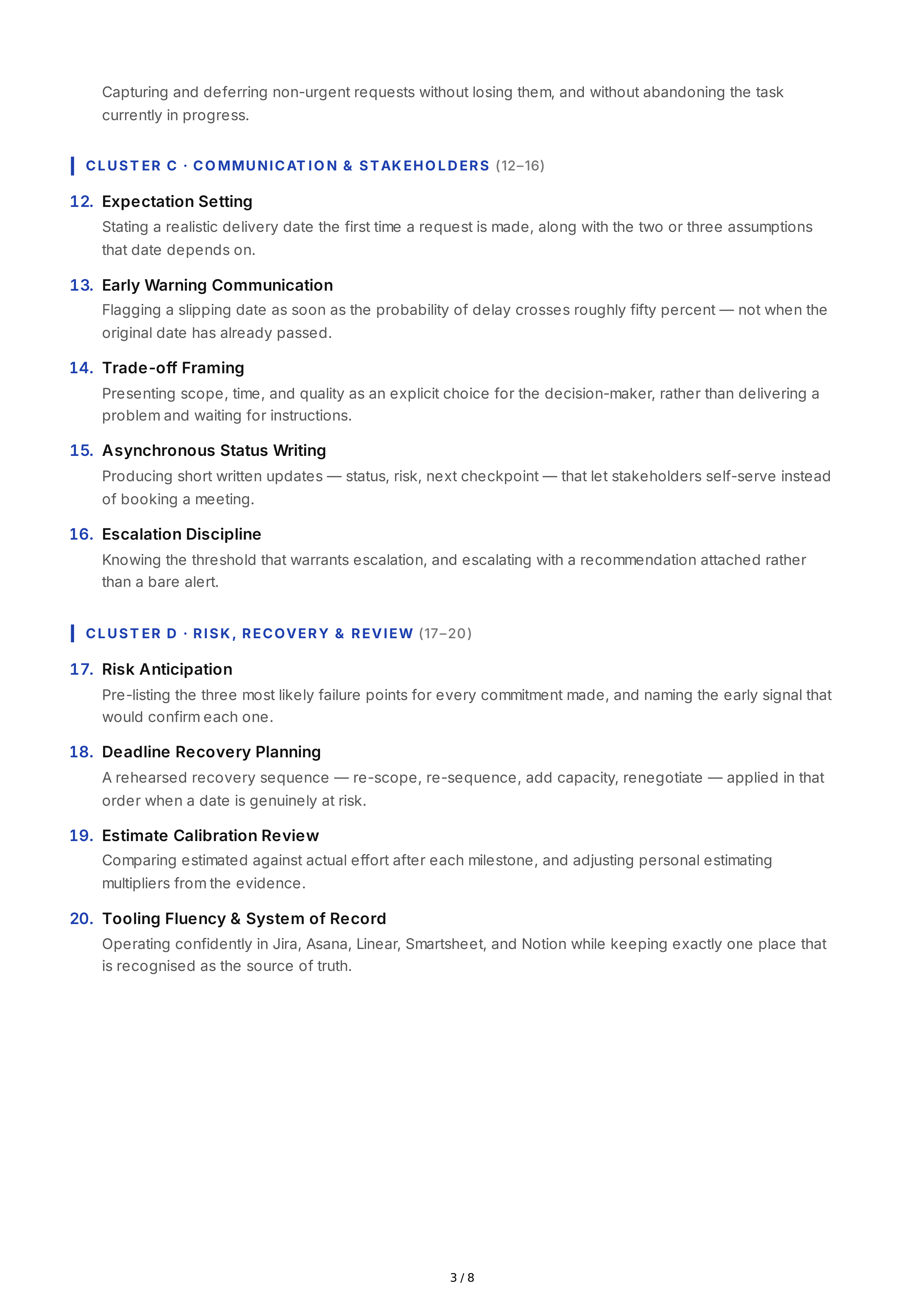
Capturing
and
deferring
non
-
urgent
requests
without
losing
them
,
and
without
abandoning
the
task
currently
in
progress
.
CL UST ER
C
·
CO MMUNICAT IO N
&
STAK EHO L DERS
(12–16)
12.
Expectation
Setting
Stating
a
realistic
delivery
date
the
first
time
a
request
is
made
,
along
with
the
two
or
three
assumptions
that
date
depends
on
.
13.
Early
Warning
Communication
Flagging
a
slipping
date
as
soon
as
the
probability
of
delay
crosses
roughly
fifty
percent
—
not
when
the
original
date
has
already
passed
.
14.
Trade
-
off
Framing
Presenting
scope
,
time
,
and
quality
as
an
explicit
choice
for
the
decision
-
maker
,
rather
than
delivering
a
problem
and
waiting
for
instructions
.
15.
Asynchronous
Status
Writing
Producing
short
written
updates
—
status
,
risk
,
next
checkpoint
—
that
let
stakeholders
self
-
serve
instead
of
booking
a
meeting
.
16.
Escalation
Discipline
Knowing
the
threshold
that
warrants
escalation
,
and
escalating
with
a
recommendation
attached
rather
than
a
bare
alert
.
CL UST ER
D
·
RISK
,
RECOVERY
&
REVIEW
(17–20)
17.
Risk
Anticipation
Pre
-
listing
the
three
most
likely
failure
points
for
every
commitment
made
,
and
naming
the
early
signal
that
would
confirm
each
one
.
18.
Deadline
Recovery
Planning
A
rehearsed
recovery
sequence
—
re
-
scope
,
re
-
sequence
,
add
capacity
,
renegotiate
—
applied
in
that
order
when
a
date
is
genuinely
at
risk
.
19.
Estimate
Calibration
Review
Comparing
estimated
against
actual
effort
after
each
milestone
,
and
adjusting
personal
estimating
multipliers
from
the
evidence
.
20.
Tooling
Fluency
&
System
of
Record
Operating
confidently
in
Jira
,
Asana
,
Linear
,
Smartsheet
,
and
Notion
while
keeping
exactly
one
place
that
is
recognised
as
the
source
of
truth
.
3 / 8
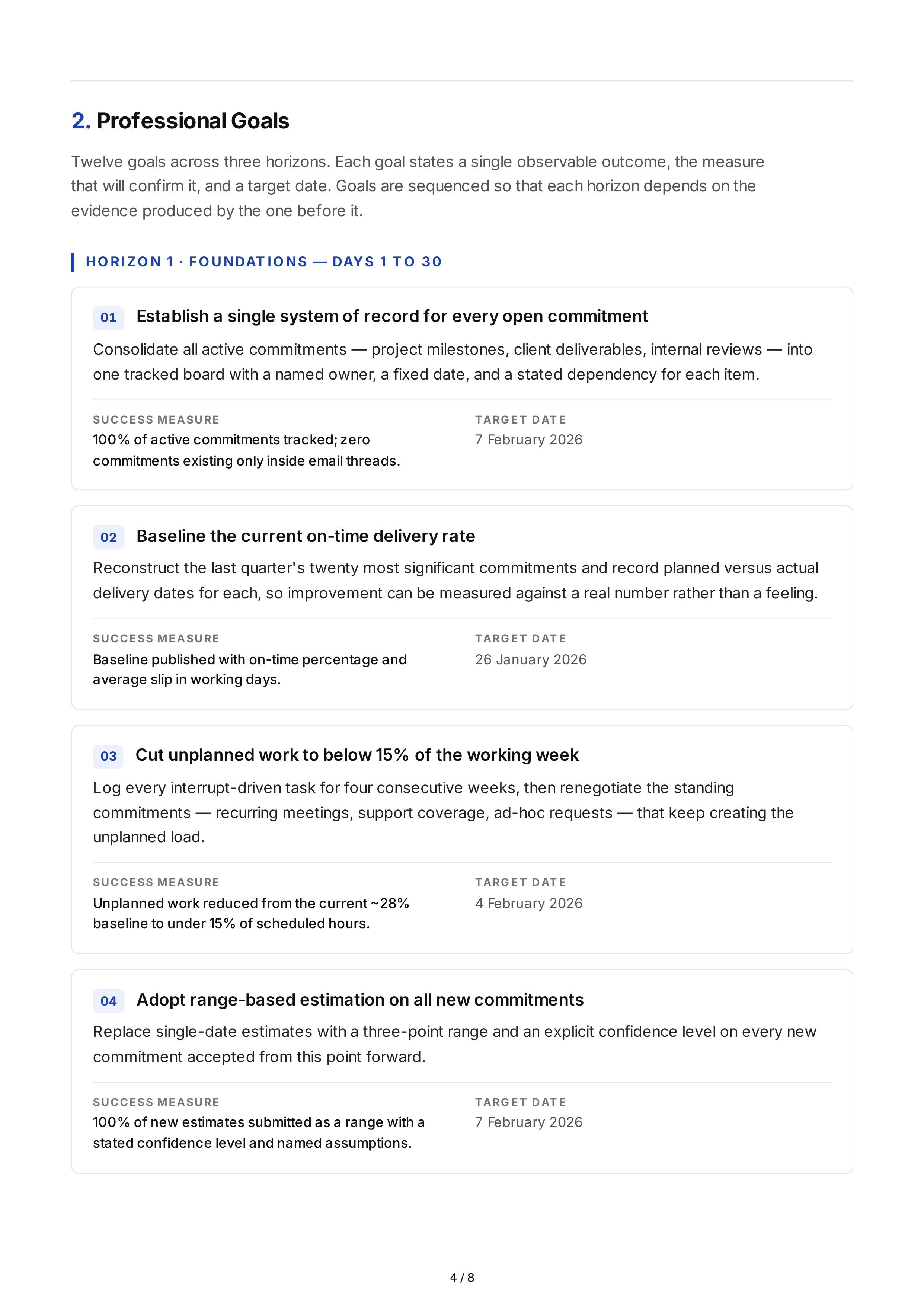
2.
Professional
Goals
Twelve
goals
across
three
horizons
.
Each
goal
states
a
single
observable
outcome
,
the
measure
that
will
confirm
it
,
and
a
target
date
.
Goals
are
sequenced
so
that
each
horizon
depends
on
the
evidence
produced
by
the
one
before
it
.
HO RIZO N
1 ·
FO UNDAT IO NS
—
DAYS
1
T O
30
01
Establish
a
single
system
of
record
for
every
open
commitment
Consolidate
all
active
commitments
—
project
milestones
,
client
deliverables
,
internal
reviews
—
into
one
tracked
board
with
a
named
owner
,
a
fixed
date
,
and
a
stated
dependency
for
each
item
.
SUCCE SS
ME ASURE
100%
of
active
commitments
tracked
;
zero
commitments
existing
only
inside
email
threads
.
TARG E T
DAT E
7
February
2026
02
Baseline
the
current
on
-
time
delivery
rate
Reconstruct
the
last
quarter
'
s
twenty
most
significant
commitments
and
record
planned
versus
actual
delivery
dates
for
each
,
so
improvement
can
be
measured
against
a
real
number
rather
than
a
feeling
.
SUCCE SS
ME ASURE
Baseline
published
with
on
-
time
percentage
and
average
slip
in
working
days
.
TARG E T
DAT E
26
January
2026
03
Cut
unplanned
work
to
below
15%
of
the
working
week
Log
every
interrupt
-
driven
task
for
four
consecutive
weeks
,
then
renegotiate
the
standing
commitments
—
recurring
meetings
,
support
coverage
,
ad
-
hoc
requests
—
that
keep
creating
the
unplanned
load
.
SUCCE SS
ME ASURE
Unplanned
work
reduced
from
the
current
~28%
baseline
to
under
15%
of
scheduled
hours
.
TARG E T
DAT E
4
February
2026
04
Adopt
range
-
based
estimation
on
all
new
commitments
Replace
single
-
date
estimates
with
a
three
-
point
range
and
an
explicit
confidence
level
on
every
new
commitment
accepted
from
this
point
forward
.
SUCCE SS
ME ASURE
100%
of
new
estimates
submitted
as
a
range
with
a
stated
confidence
level
and
named
assumptions
.
TARG E T
DAT E
7
February
2026
4 / 8
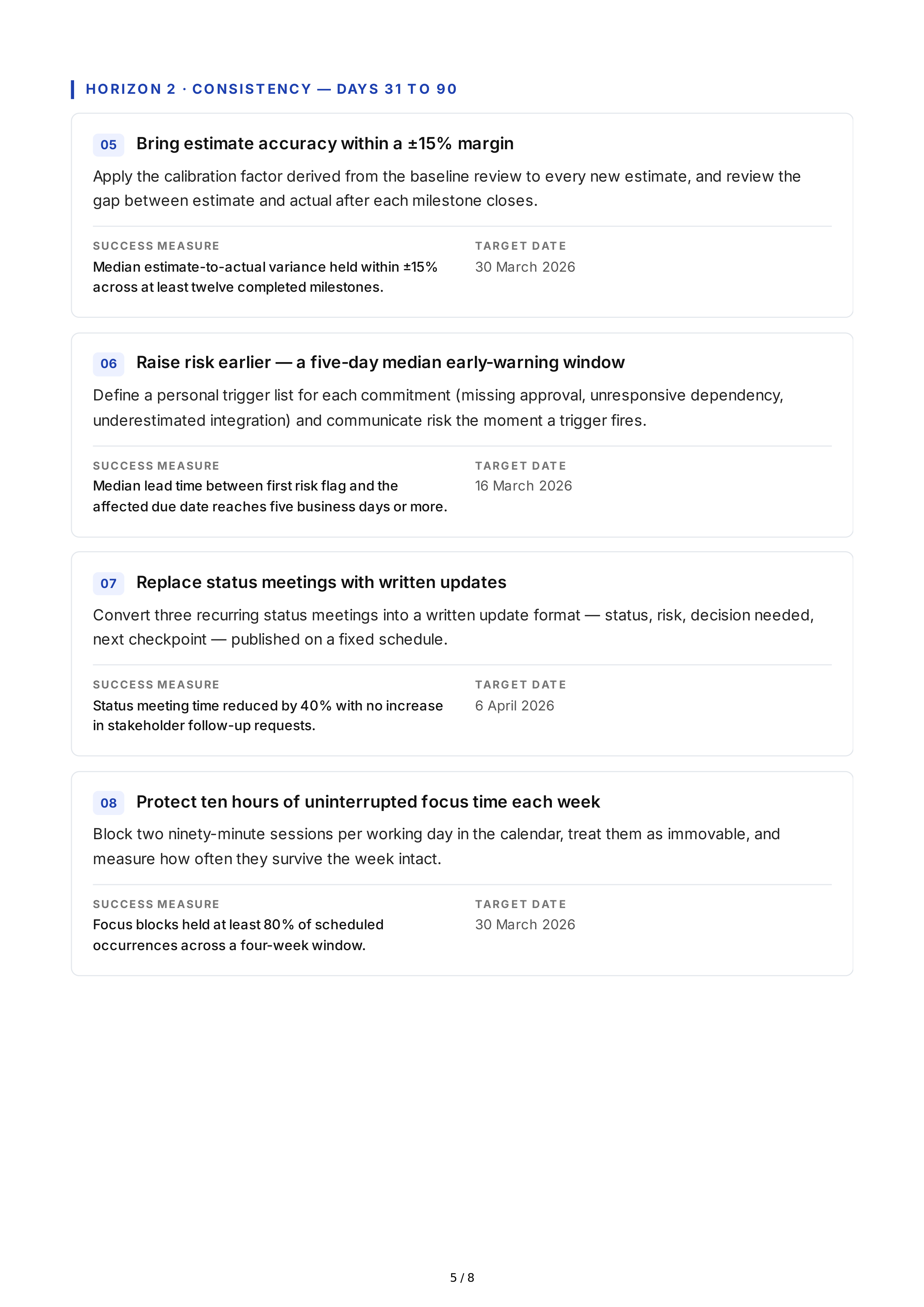
HO RIZO N
2 ·
CO NSIST ENCY
—
DAYS
31
T O
90
05
Bring
estimate
accuracy
within
a
±15%
margin
Apply
the
calibration
factor
derived
from
the
baseline
review
to
every
new
estimate
,
and
review
the
gap
between
estimate
and
actual
after
each
milestone
closes
.
SUCCE SS
ME ASURE
Median
estimate
-
to
-
actual
variance
held
within
±15%
across
at
least
twelve
completed
milestones
.
TARG E T
DAT E
30
March
2026
06
Raise
risk
earlier
—
a
five
-
day
median
early
-
warning
window
Define
a
personal
trigger
list
for
each
commitment
(
missing
approval
,
unresponsive
dependency
,
underestimated
integration
)
and
communicate
risk
the
moment
a
trigger
fires
.
SUCCE SS
ME ASURE
Median
lead
time
between
first
risk
flag
and
the
affected
due
date
reaches
five
business
days
or
more
.
TARG E T
DAT E
16
March
2026
07
Replace
status
meetings
with
written
updates
Convert
three
recurring
status
meetings
into
a
written
update
format
—
status
,
risk
,
decision
needed
,
next
checkpoint
—
published
on
a
fixed
schedule
.
SUCCE SS
ME ASURE
Status
meeting
time
reduced
by
40%
with
no
increase
in
stakeholder
follow
-
up
requests
.
TARG E T
DAT E
6
April
2026
08
Protect
ten
hours
of
uninterrupted
focus
time
each
week
Block
two
ninety
-
minute
sessions
per
working
day
in
the
calendar
,
treat
them
as
immovable
,
and
measure
how
often
they
survive
the
week
intact
.
SUCCE SS
ME ASURE
Focus
blocks
held
at
least
80%
of
scheduled
occurrences
across
a
four
-
week
window
.
TARG E T
DAT E
30
March
2026
5 / 8
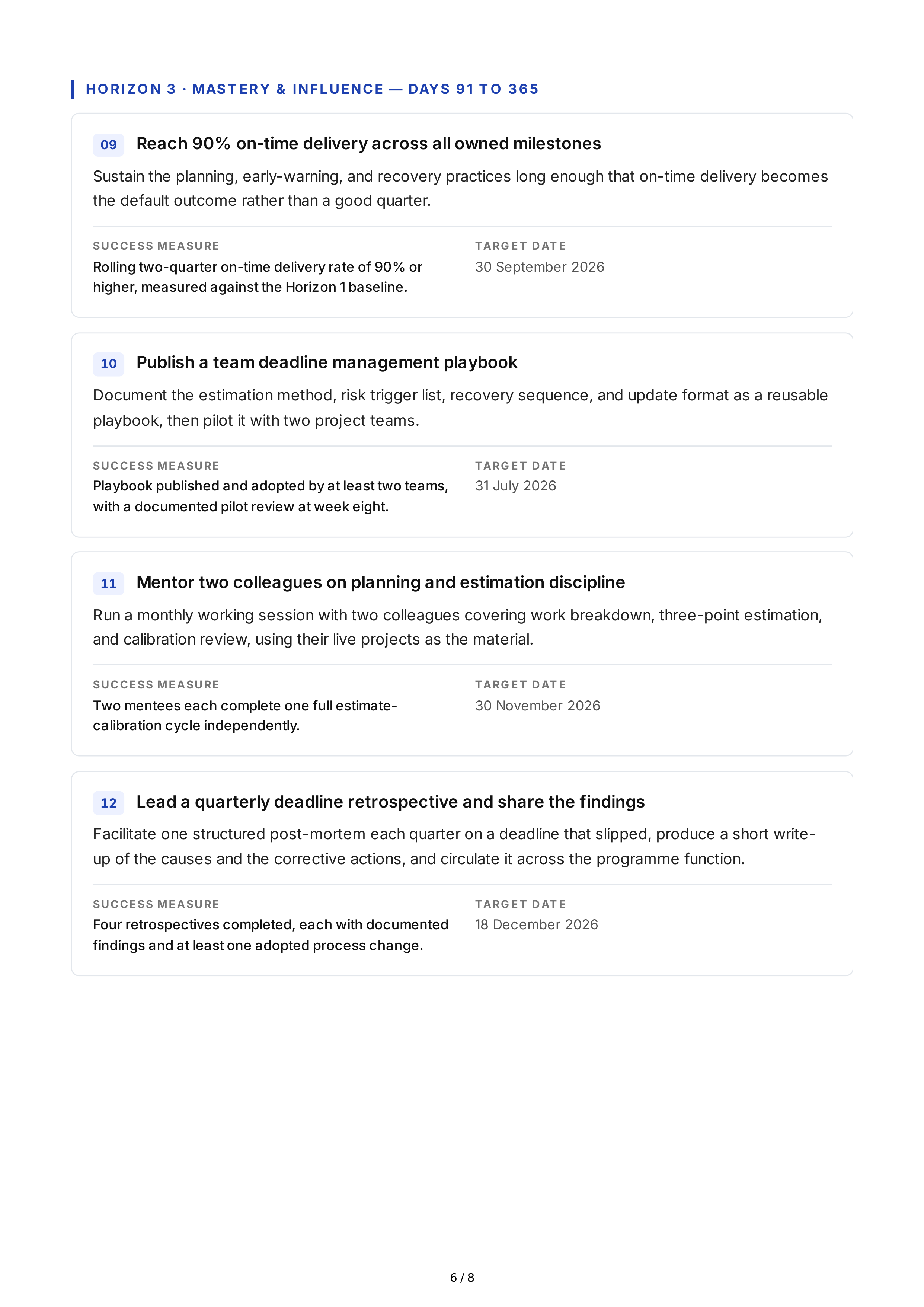
HO RIZO N
3 ·
MAST ERY
&
INFL UENCE
—
DAYS
91
T O
365
09
Reach
90%
on
-
time
delivery
across
all
owned
milestones
Sustain
the
planning
,
early
-
warning
,
and
recovery
practices
long
enough
that
on
-
time
delivery
becomes
the
default
outcome
rather
than
a
good
quarter
.
SUCCE SS
ME ASURE
Rolling
two
-
quarter
on
-
time
delivery
rate
of
90%
or
higher
,
measured
against
the
Horizon
1
baseline
.
TARG E T
DAT E
30
September
2026
10
Publish
a
team
deadline
management
playbook
Document
the
estimation
method
,
risk
trigger
list
,
recovery
sequence
,
and
update
format
as
a
reusable
playbook
,
then
pilot
it
with
two
project
teams
.
SUCCE SS
ME ASURE
Playbook
published
and
adopted
by
at
least
two
teams
,
with
a
documented
pilot
review
at
week
eight
.
TARG E T
DAT E
31
July
2026
11
Mentor
two
colleagues
on
planning
and
estimation
discipline
Run
a
monthly
working
session
with
two
colleagues
covering
work
breakdown
,
three
-
point
estimation
,
and
calibration
review
,
using
their
live
projects
as
the
material
.
SUCCE SS
ME ASURE
Two
mentees
each
complete
one
full
estimate
-
calibration
cycle
independently
.
TARG E T
DAT E
30
November
2026
12
Lead
a
quarterly
deadline
retrospective
and
share
the
findings
Facilitate
one
structured
post
-
mortem
each
quarter
on
a
deadline
that
slipped
,
produce
a
short
write
-
up
of
the
causes
and
the
corrective
actions
,
and
circulate
it
across
the
programme
function
.
SUCCE SS
ME ASURE
Four
retrospectives
completed
,
each
with
documented
findings
and
at
least
one
adopted
process
change
.
TARG E T
DAT E
18
December
2026
6 / 8
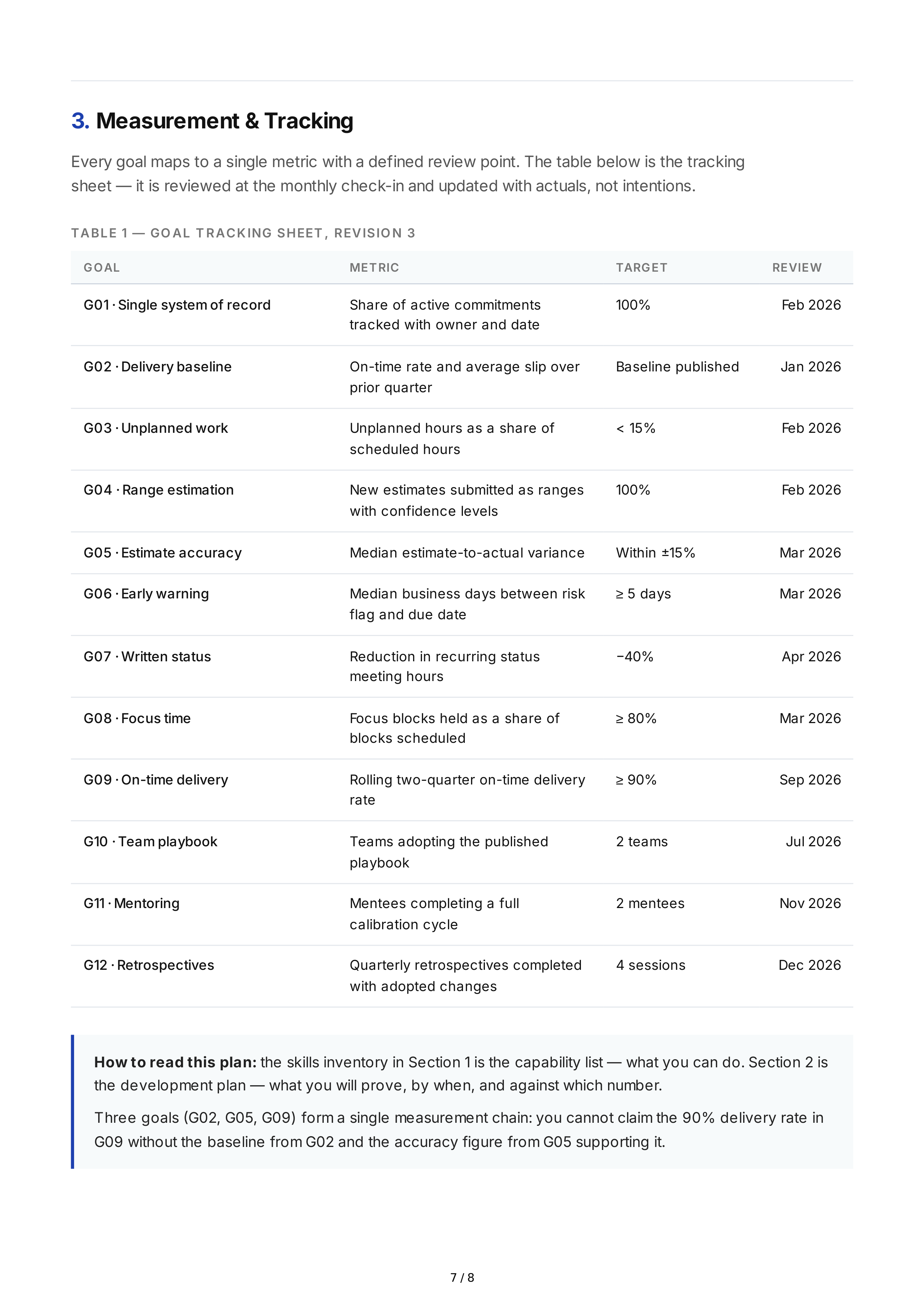
3.
Measurement
&
Tracking
Every
goal
maps
to
a
single
metric
with
a
defined
review
point
.
The
table
below
is
the
tracking
sheet
—
it
is
reviewed
at
the
monthly
check
-
in
and
updated
with
actuals
,
not
intentions
.
TABLE
1 —
GO AL
T RACKING
SHEET
,
REVISIO N
3
GOAL
METRIC
TARGET
REVIEW
G
01 ·
Single
system
of
record
Share
of
active
commitments
tracked
with
owner
and
date
100%
Feb
2026
G
02 ·
Delivery
baseline
On
-
time
rate
and
average
slip
over
prior
quarter
Baseline
published
Jan
2026
G
03 ·
Unplanned
work
Unplanned
hours
as
a
share
of
scheduled
hours
< 15%
Feb
2026
G
04 ·
Range
estimation
New
estimates
submitted
as
ranges
with
confidence
levels
100%
Feb
2026
G
05 ·
Estimate
accuracy
Median
estimate
-
to
-
actual
variance
Within
±15%
Mar
2026
G
06 ·
Early
warning
Median
business
days
between
risk
flag
and
due
date
≥
5
days
Mar
2026
G
07 ·
Written
status
Reduction
in
recurring
status
meeting
hours
−40%
Apr
2026
G
08 ·
Focus
time
Focus
blocks
held
as
a
share
of
blocks
scheduled
≥
80%
Mar
2026
G
09 ·
On
-
time
delivery
Rolling
two
-
quarter
on
-
time
delivery
rate
≥
90%
Sep
2026
G
10 ·
Team
playbook
Teams
adopting
the
published
playbook
2
teams
Jul
2026
G
11 ·
Mentoring
Mentees
completing
a
full
calibration
cycle
2
mentees
Nov
2026
G
12 ·
Retrospectives
Quarterly
retrospectives
completed
with
adopted
changes
4
sessions
Dec
2026
How
to
read
this
plan
:
the
skills
inventory
in
Section
1
is
the
capability
list
—
what
you
can
do
.
Section
2
is
the
development
plan
—
what
you
will
prove
,
by
when
,
and
against
which
number
.
Three
goals
(
G
02,
G
05,
G
09)
form
a
single
measurement
chain
:
you
cannot
claim
the
90%
delivery
rate
in
G
09
without
the
baseline
from
G
02
and
the
accuracy
figure
from
G
05
supporting
it
.
7 / 8