Project
Completion
Professional
Goals
01
Core
Skills
Grouped
,
not
ranked
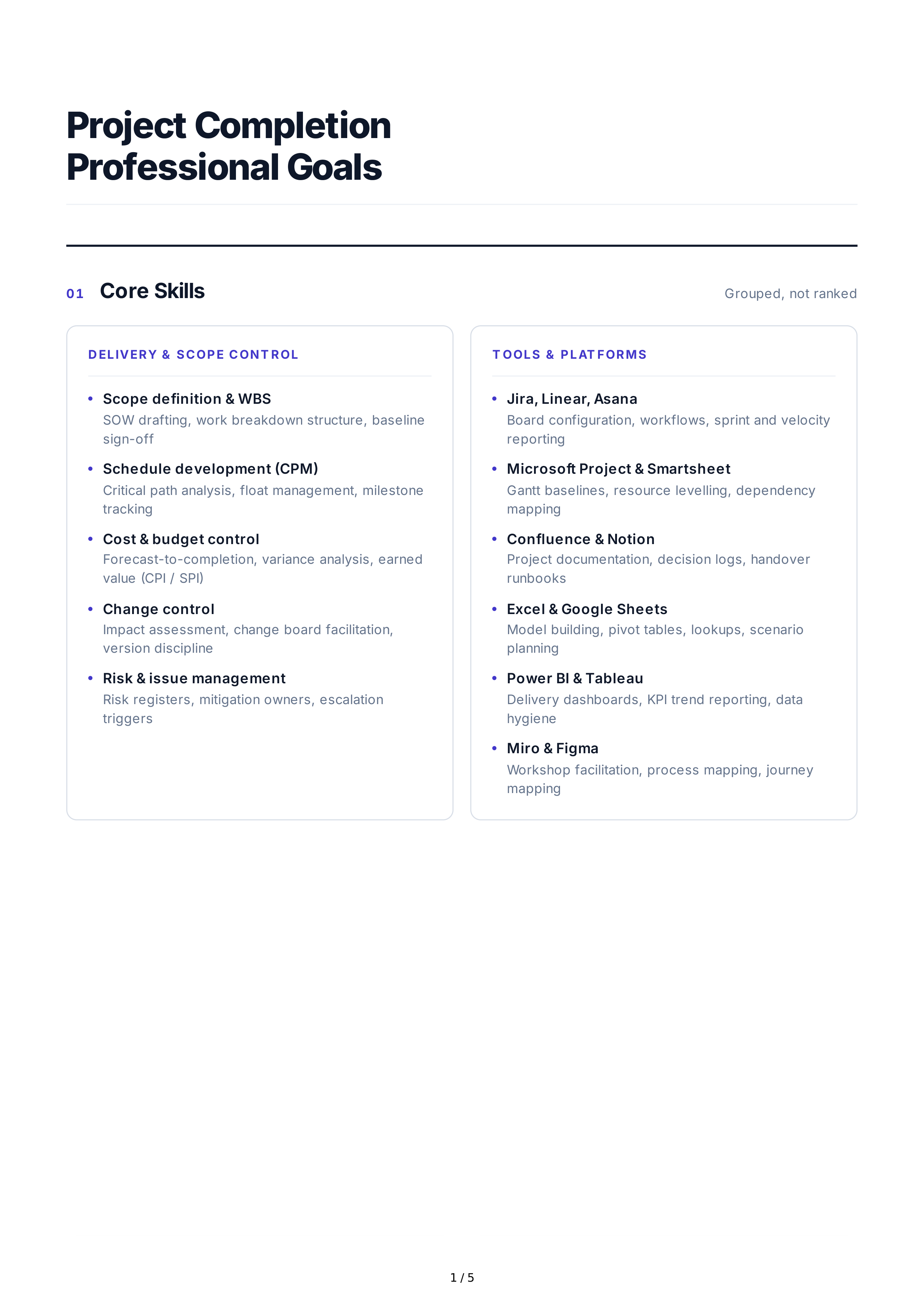
D ELIVERY
&
SCOPE
CONT ROL
T OOLS
&
PLAT FORMS
Scope
definition
&
WBS
SOW
drafting
,
work
breakdown
structure
,
baseline
sign
-
off
Schedule
development
(
CPM
)
Critical
path
analysis
,
float
management
,
milestone
tracking
Cost
&
budget
control
Forecast
-
to
-
completion
,
variance
analysis
,
earned
value
(
CPI
/
SPI
)
Change
control
Impact
assessment
,
change
board
facilitation
,
version
discipline
Risk
&
issue
management
Risk
registers
,
mitigation
owners
,
escalation
triggers
Jira
,
Linear
,
Asana
Board
configuration
,
workflows
,
sprint
and
velocity
reporting
Microsoft
Project
&
Smartsheet
Gantt
baselines
,
resource
levelling
,
dependency
mapping
Confluence
&
Notion
Project
documentation
,
decision
logs
,
handover
runbooks
Excel
&
Google
Sheets
Model
building
,
pivot
tables
,
lookups
,
scenario
planning
Power
BI
&
Tableau
Delivery
dashboards
,
KPI
trend
reporting
,
data
hygiene
Miro
&
Figma
Workshop
facilitation
,
process
mapping
,
journey
mapping
1 / 5
LEAD ERSHIP
&
T EAM
COMMUNICAT ION
ANALYSIS
&
QUALIT Y
MET HOD OLOGIES
&
FRAMEWORK S
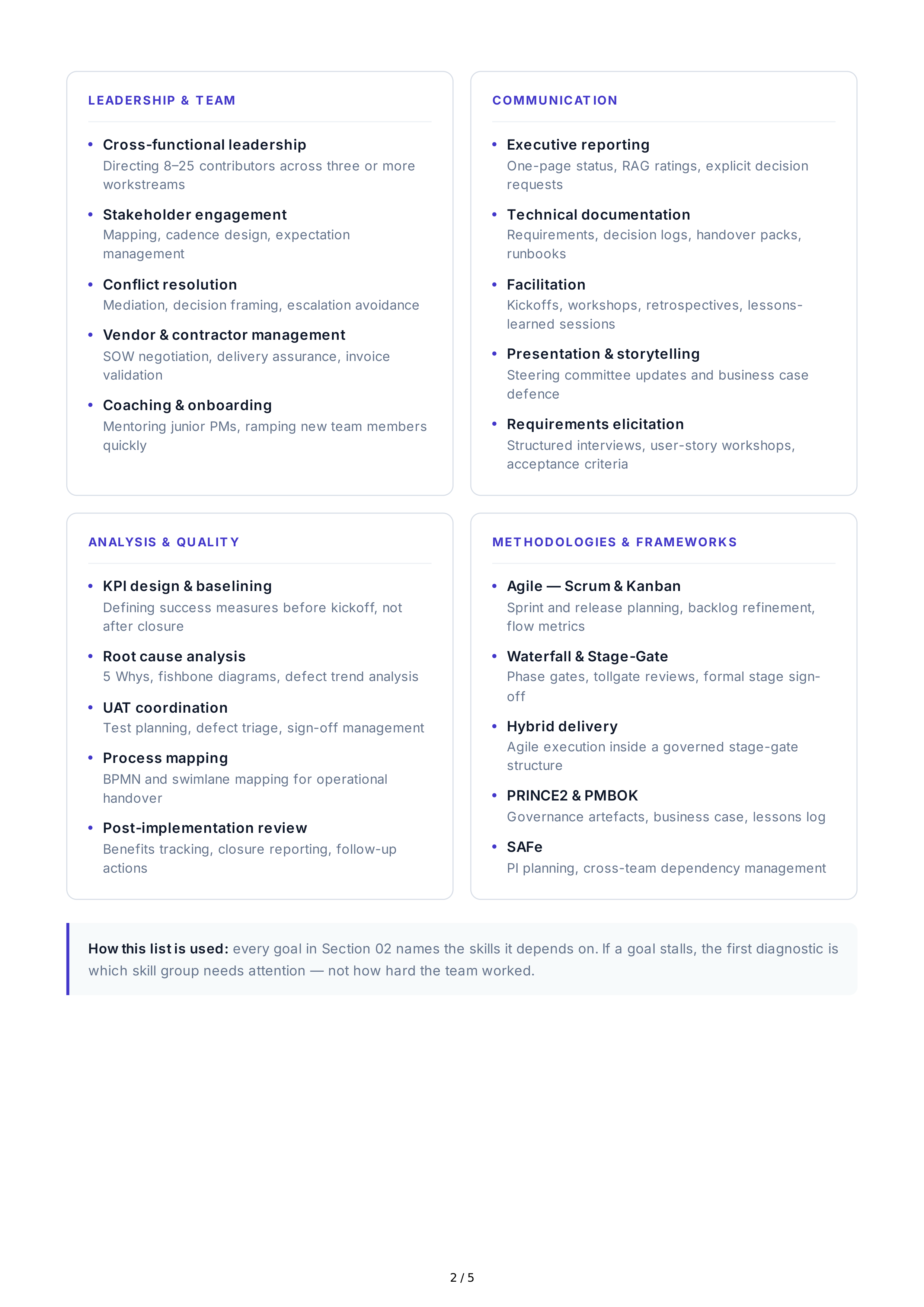
How
this
list
is
used
:
every
goal
in
Section
02
names
the
skills
it
depends
on
.
If
a
goal
stalls
,
the
first
diagnostic
is
which
skill
group
needs
attention
—
not
how
hard
the
team
worked
.
Cross
-
functional
leadership
Directing
8–25
contributors
across
three
or
more
workstreams
Stakeholder
engagement
Mapping
,
cadence
design
,
expectation
management
Conflict
resolution
Mediation
,
decision
framing
,
escalation
avoidance
Vendor
&
contractor
management
SOW
negotiation
,
delivery
assurance
,
invoice
validation
Coaching
&
onboarding
Mentoring
junior
PMs
,
ramping
new
team
members
quickly
Executive
reporting
One
-
page
status
,
RAG
ratings
,
explicit
decision
requests
Technical
documentation
Requirements
,
decision
logs
,
handover
packs
,
runbooks
Facilitation
Kickoffs
,
workshops
,
retrospectives
,
lessons
-
learned
sessions
Presentation
&
storytelling
Steering
committee
updates
and
business
case
defence
Requirements
elicitation
Structured
interviews
,
user
-
story
workshops
,
acceptance
criteria
KPI
design
&
baselining
Defining
success
measures
before
kickoff
,
not
after
closure
Root
cause
analysis
5
Whys
,
fishbone
diagrams
,
defect
trend
analysis
UAT
coordination
Test
planning
,
defect
triage
,
sign
-
off
management
Process
mapping
BPMN
and
swimlane
mapping
for
operational
handover
Post
-
implementation
review
Benefits
tracking
,
closure
reporting
,
follow
-
up
actions
Agile
—
Scrum
&
Kanban
Sprint
and
release
planning
,
backlog
refinement
,
flow
metrics
Waterfall
&
Stage
-
Gate
Phase
gates
,
tollgate
reviews
,
formal
stage
sign
-
off
Hybrid
delivery
Agile
execution
inside
a
governed
stage
-
gate
structure
PRINCE
2 &
PMBOK
Governance
artefacts
,
business
case
,
lessons
log
SAFe
PI
planning
,
cross
-
team
dependency
management
2 / 5
02
Professional
Goals
—
Project
Completion
14
goals
· 4
focus
areas
A
·
D ELIVERY
EXECU T ION
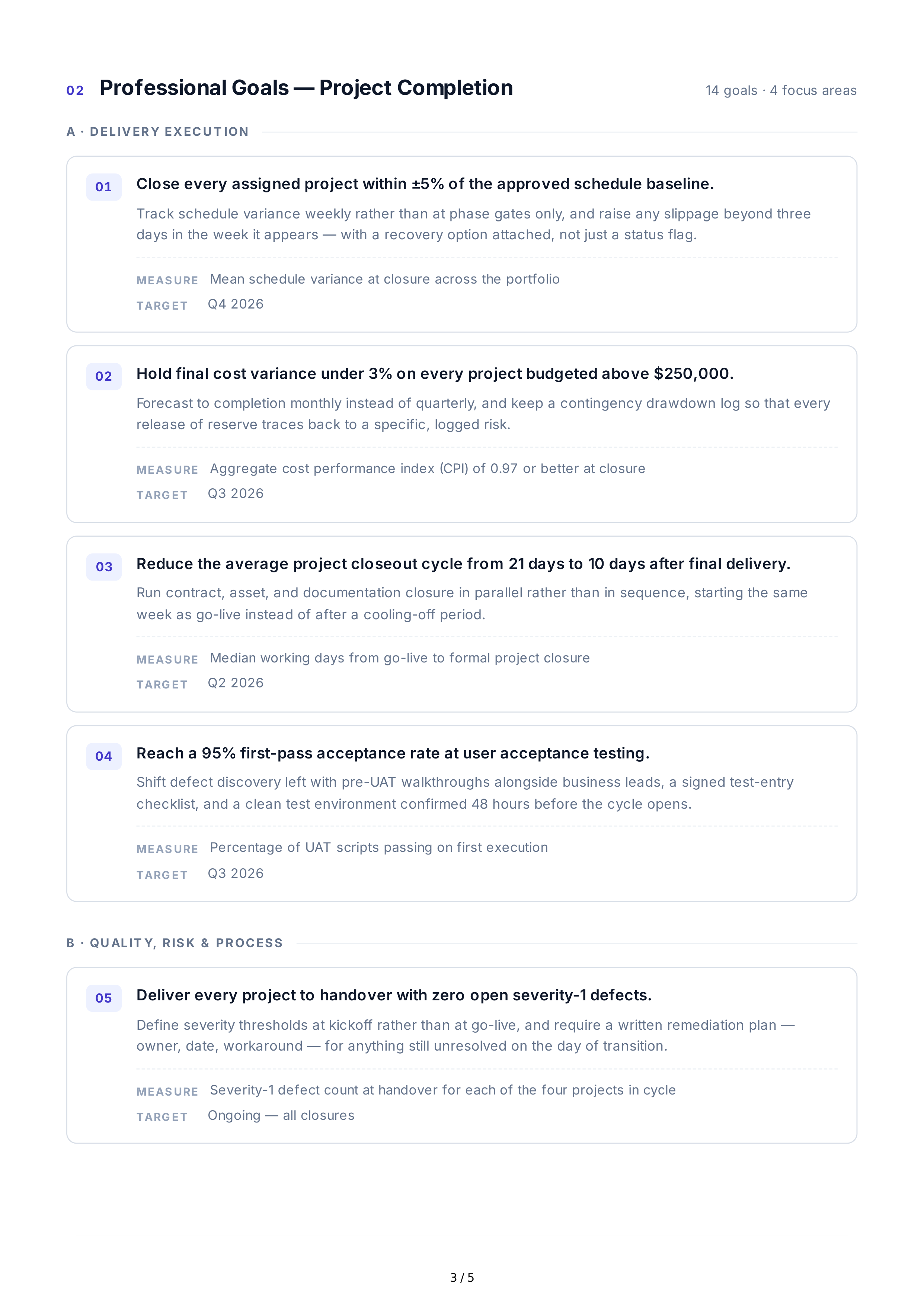
01
Close
every
assigned
project
within
±5%
of
the
approved
schedule
baseline
.
Track
schedule
variance
weekly
rather
than
at
phase
gates
only
,
and
raise
any
slippage
beyond
three
days
in
the
week
it
appears
—
with
a
recovery
option
attached
,
not
just
a
status
flag
.
MEAS URE
Mean
schedule
variance
at
closure
across
the
portfolio
TARG ET
Q
4 2026
02
Hold
final
cost
variance
under
3%
on
every
project
budgeted
above
$
250,000.
Forecast
to
completion
monthly
instead
of
quarterly
,
and
keep
a
contingency
drawdown
log
so
that
every
release
of
reserve
traces
back
to
a
specific
,
logged
risk
.
MEAS URE
Aggregate
cost
performance
index
(
CPI
)
of
0.97
or
better
at
closure
TARG ET
Q
3 2026
03
Reduce
the
average
project
closeout
cycle
from
21
days
to
10
days
after
final
delivery
.
Run
contract
,
asset
,
and
documentation
closure
in
parallel
rather
than
in
sequence
,
starting
the
same
week
as
go
-
live
instead
of
after
a
cooling
-
off
period
.
MEAS URE
Median
working
days
from
go
-
live
to
formal
project
closure
TARG ET
Q
2 2026
04
Reach
a
95%
first
-
pass
acceptance
rate
at
user
acceptance
testing
.
Shift
defect
discovery
left
with
pre
-
UAT
walkthroughs
alongside
business
leads
,
a
signed
test
-
entry
checklist
,
and
a
clean
test
environment
confirmed
48
hours
before
the
cycle
opens
.
MEAS URE
Percentage
of
UAT
scripts
passing
on
first
execution
TARG ET
Q
3 2026
B
·
QU ALIT Y
,
RISK
&
PROCESS
05
Deliver
every
project
to
handover
with
zero
open
severity
-1
defects
.
Define
severity
thresholds
at
kickoff
rather
than
at
go
-
live
,
and
require
a
written
remediation
plan
—
owner
,
date
,
workaround
—
for
anything
still
unresolved
on
the
day
of
transition
.
MEAS URE
Severity
-1
defect
count
at
handover
for
each
of
the
four
projects
in
cycle
TARG ET
Ongoing
—
all
closures
3 / 5
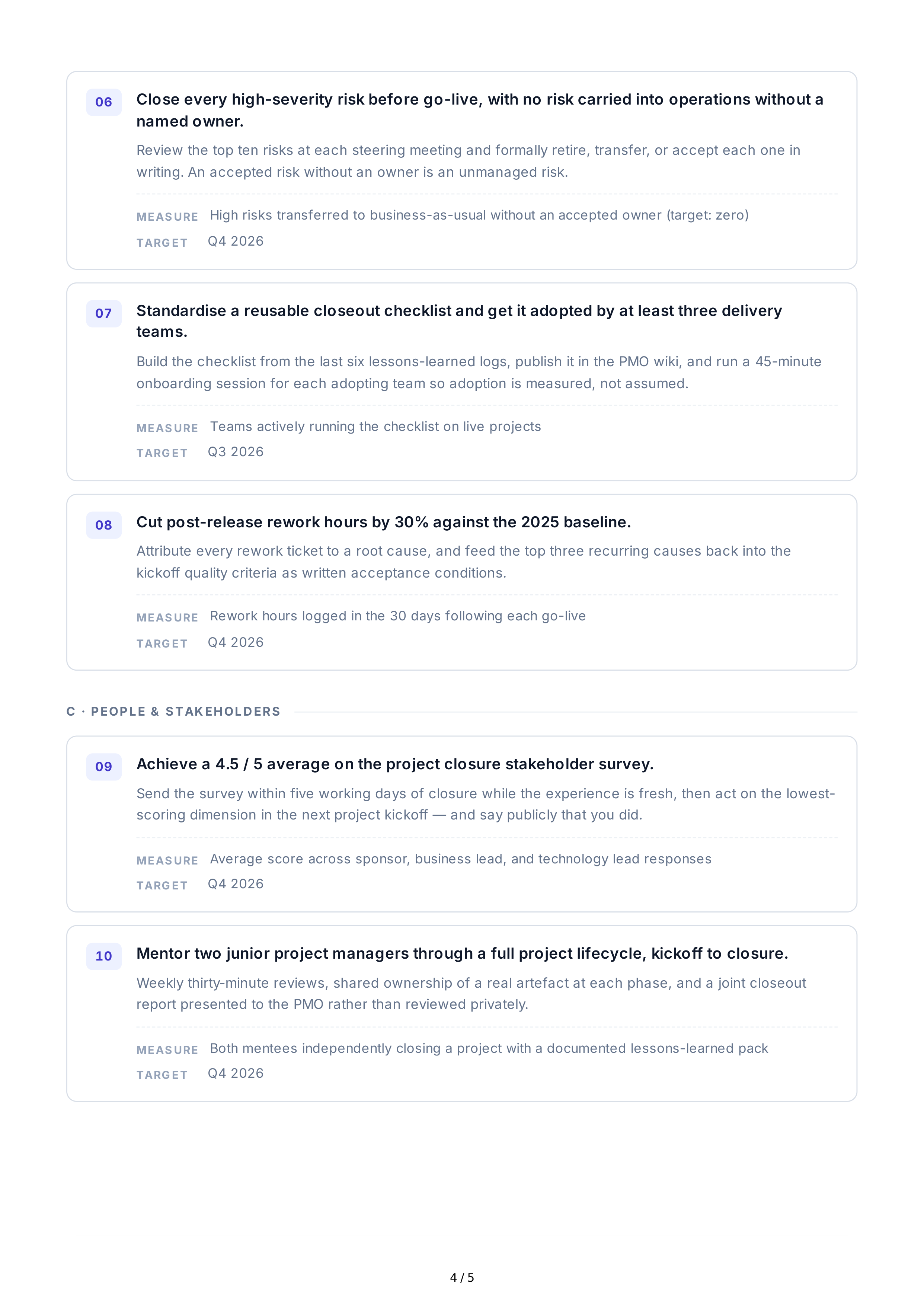
06
Close
every
high
-
severity
risk
before
go
-
live
,
with
no
risk
carried
into
operations
without
a
named
owner
.
Review
the
top
ten
risks
at
each
steering
meeting
and
formally
retire
,
transfer
,
or
accept
each
one
in
writing
.
An
accepted
risk
without
an
owner
is
an
unmanaged
risk
.
MEAS URE
High
risks
transferred
to
business
-
as
-
usual
without
an
accepted
owner
(
target
:
zero
)
TARG ET
Q
4 2026
07
Standardise
a
reusable
closeout
checklist
and
get
it
adopted
by
at
least
three
delivery
teams
.
Build
the
checklist
from
the
last
six
lessons
-
learned
logs
,
publish
it
in
the
PMO
wiki
,
and
run
a
45-
minute
onboarding
session
for
each
adopting
team
so
adoption
is
measured
,
not
assumed
.
MEAS URE
Teams
actively
running
the
checklist
on
live
projects
TARG ET
Q
3 2026
08
Cut
post
-
release
rework
hours
by
30%
against
the
2025
baseline
.
Attribute
every
rework
ticket
to
a
root
cause
,
and
feed
the
top
three
recurring
causes
back
into
the
kickoff
quality
criteria
as
written
acceptance
conditions
.
MEAS URE
Rework
hours
logged
in
the
30
days
following
each
go
-
live
TARG ET
Q
4 2026
C
·
PEOPLE
&
STAK EHOLD ERS
09
Achieve
a
4.5 / 5
average
on
the
project
closure
stakeholder
survey
.
Send
the
survey
within
five
working
days
of
closure
while
the
experience
is
fresh
,
then
act
on
the
lowest
-
scoring
dimension
in
the
next
project
kickoff
—
and
say
publicly
that
you
did
.
MEAS URE
Average
score
across
sponsor
,
business
lead
,
and
technology
lead
responses
TARG ET
Q
4 2026
10
Mentor
two
junior
project
managers
through
a
full
project
lifecycle
,
kickoff
to
closure
.
Weekly
thirty
-
minute
reviews
,
shared
ownership
of
a
real
artefact
at
each
phase
,
and
a
joint
closeout
report
presented
to
the
PMO
rather
than
reviewed
privately
.
MEAS URE
Both
mentees
independently
closing
a
project
with
a
documented
lessons
-
learned
pack
TARG ET
Q
4 2026
4 / 5
11
Reduce
steering
-
committee
escalations
by
40%.
Resolve
decisions
at
the
working
-
group
level
within
48
hours
,
and
escalate
only
genuine
conflicts
of
scope
,
budget
,
or
timeline
—
never
items
that
a
decision
owner
could
have
settled
directly
.
MEAS URE
Items
added
to
the
steering
agenda
as
escalations
rather
than
routine
updates
TARG ET
Q
3 2026
D
·
GROWT H
&
CRED ENT IALING
12
Complete
PMP
certification
and
apply
earned
-
value
reporting
to
two
live
projects
.
Build
a
study
plan
across
the
first
two
quarters
,
sit
the
exam
by
the
end
of
Q
2,
then
pilot
monthly
CPI
and
SPI
reporting
on
two
live
projects
in
the
second
half
of
the
year
.
MEAS URE
Certification
on
file
plus
two
projects
reporting
CPI
and
SPI
monthly
TARG ET
Q
2 2026
13
Lead
one
measurable
process
improvement
per
quarter
,
each
with
a
before
-
and
-
after
metric
.
Source
every
improvement
from
a
specific
lessons
-
learned
entry
.
No
improvement
without
a
problem
it
closes
,
and
no
closure
without
a
number
that
moved
.
MEAS URE
Four
documented
improvements
with
quantified
impact
evidence
TARG ET
Quarterly
14
Present
a
lessons
-
learned
case
study
at
the
quarterly
PMO
forum
.
One
twenty
-
minute
case
study
each
half
-
year
covering
what
was
planned
,
what
actually
happened
,
and
the
specific
change
made
as
a
result
—
including
the
parts
that
did
not
go
well
.
MEAS URE
Two
forum
presentations
delivered
plus
the
resulting
template
or
checklist
updates
TARG ET
Semi
-
annual
5 / 5