Career
Stability
:
Goals
&
Skills
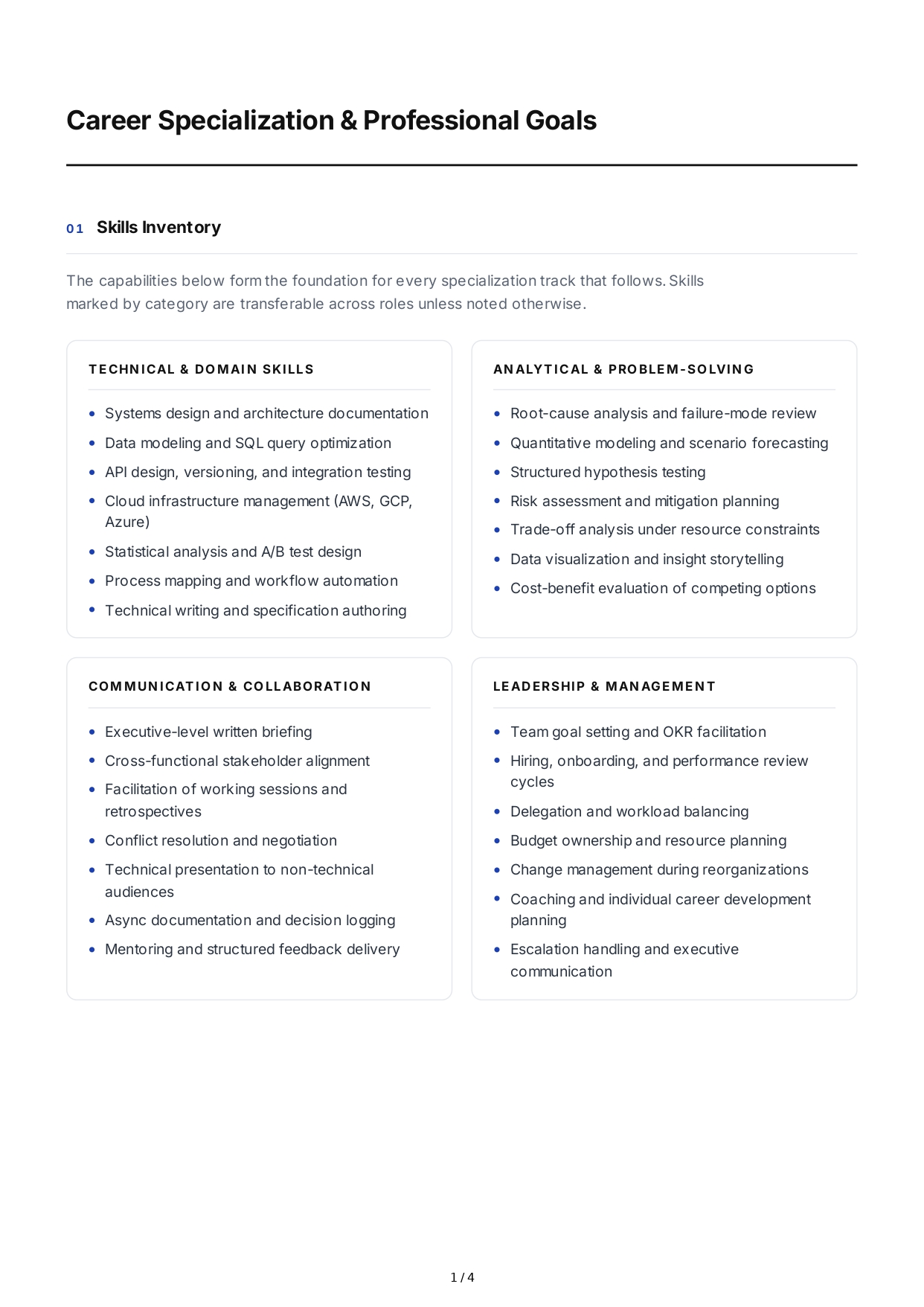
CORE
PROFES S IONAL
S KILLS
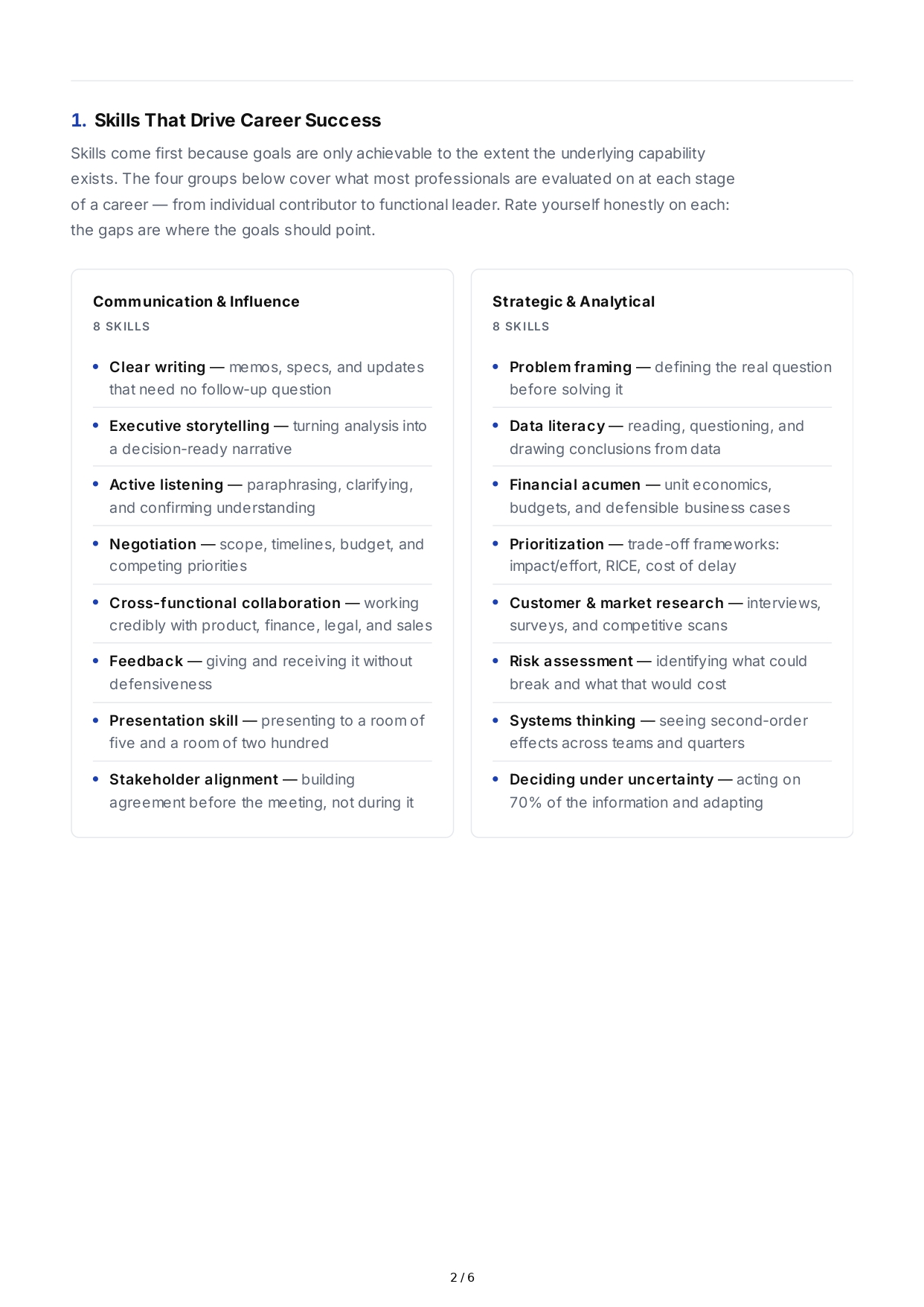
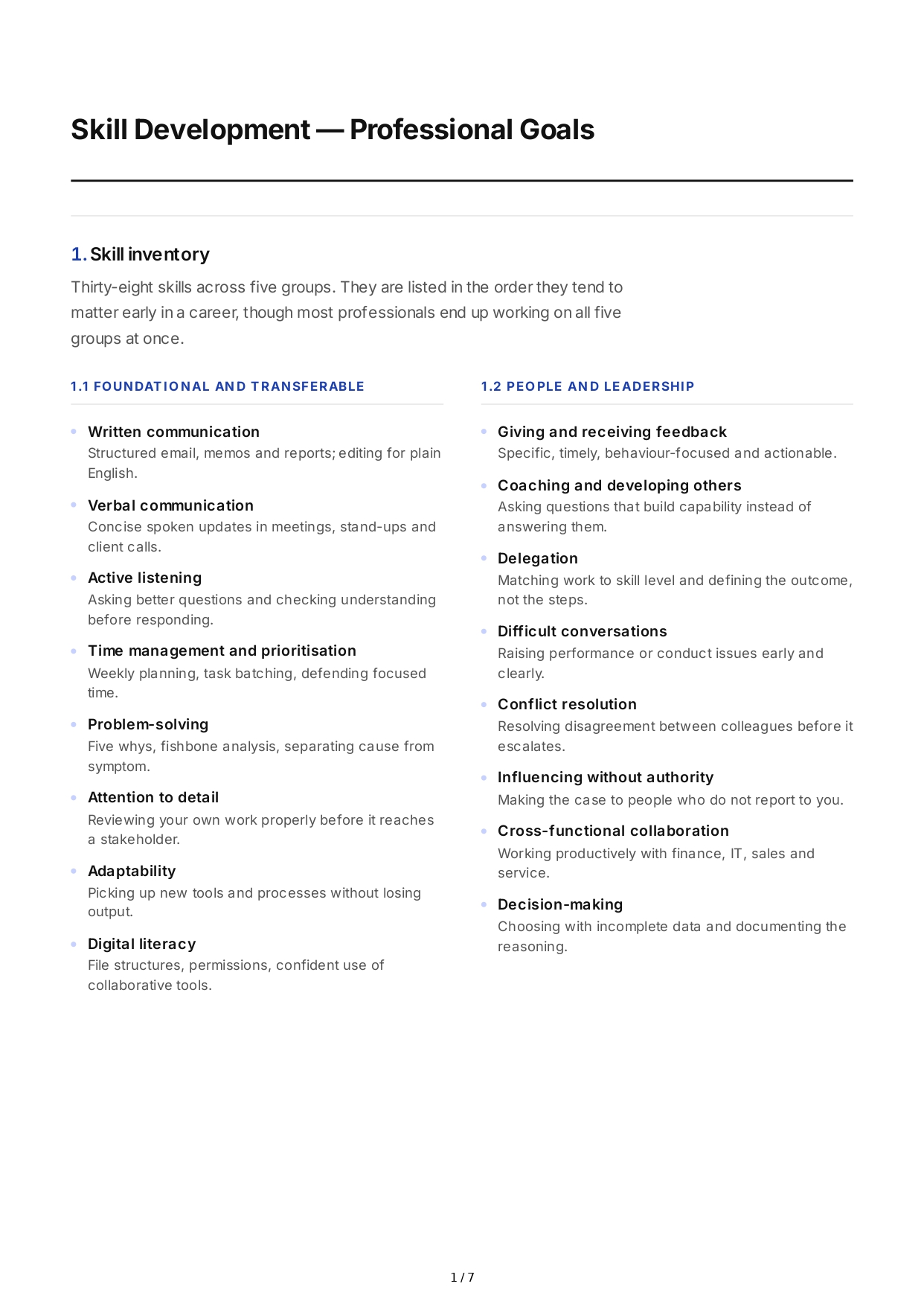
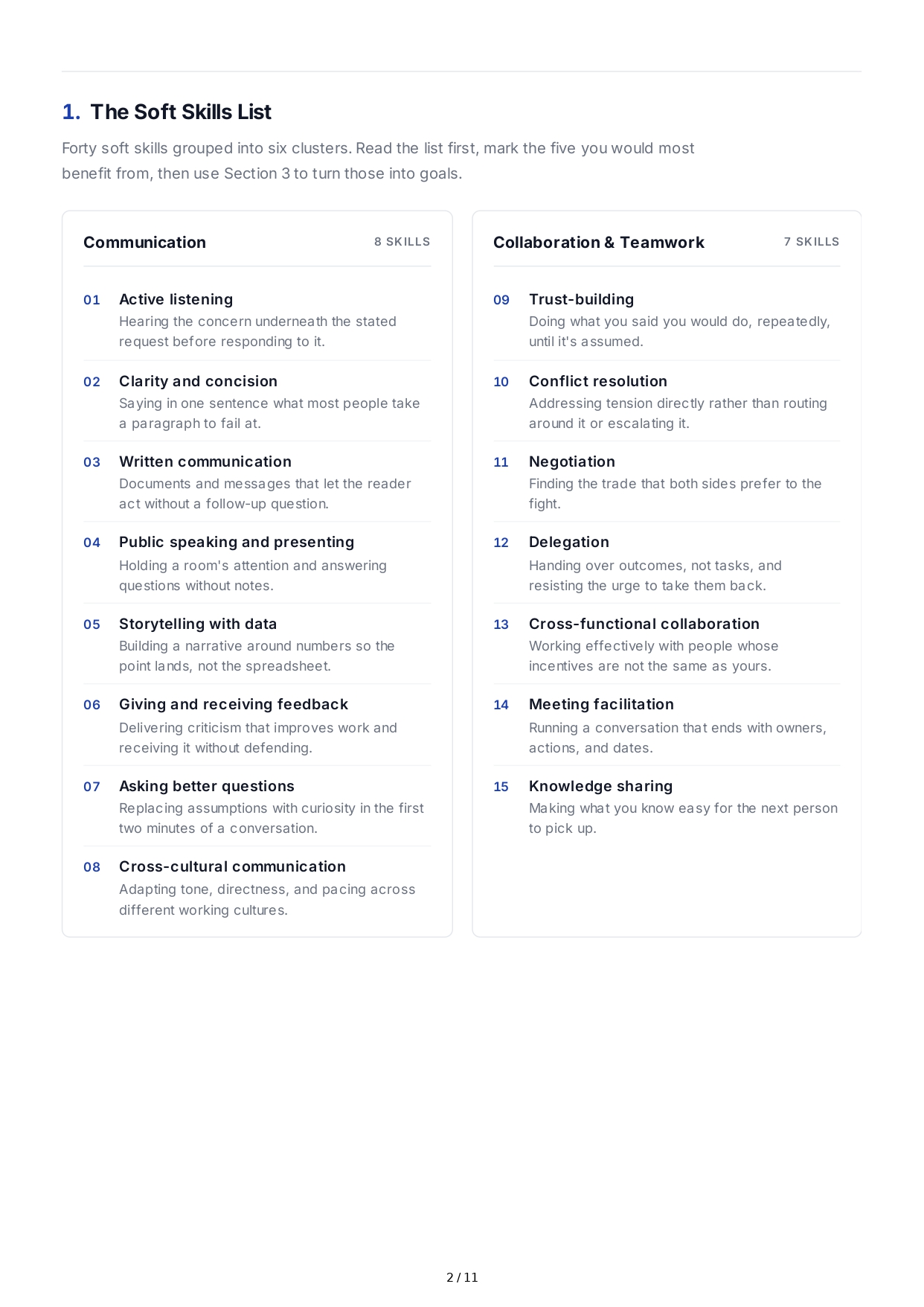
Cross
-
functional
collaboration
across
product
,
finance
,
and
operations
Written
communication
:
specs
,
status
updates
,
decision
memos
Stakeholder
management
and
expectation
setting
Process
documentation
and
knowledge
transfer
Prioritization
under
conflicting
deadlines
Risk
identification
and
early
escalation
Meeting
facilitation
and
decision
capture
Time
and
workload
management
across
parallel
workstreams
TECHNICAL
&
OPERATIONAL
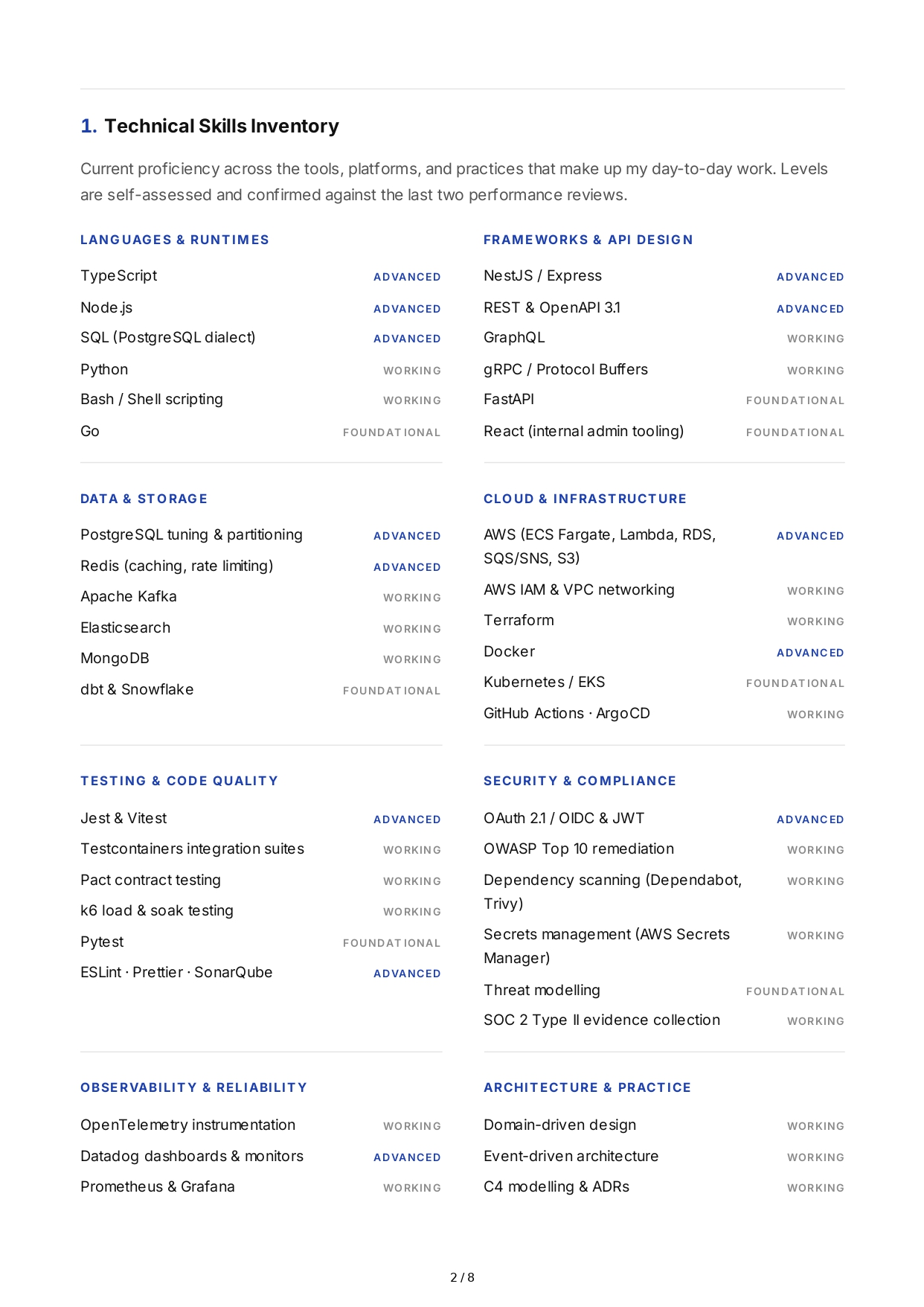
Data
analysis
in
SQL
and
spreadsheet
modelling
Budget
forecasting
and
variance
reporting
Vendor
evaluation
and
contract
review
Project
delivery
in
Agile
and
stage
-
gate
environments
Incident
response
and
post
-
mortem
writing
Ownership
of
a
business
system
(
CRM
,
ERP
,
billing
,
reporting
)
Compliance
,
audit
preparation
,
and
control
documentation
INTERPERS ONAL
&
LEADERS HIP
Mentoring
junior
colleagues
and
interns
Giving
and
receiving
direct
,
specific
feedback
Negotiating
scope
,
timelines
,
and
compensation
Managing
up
:
briefing
an
executive
in
under
five
minutes
Conflict
de
-
escalation
between
teams
Onboarding
and
training
new
hires
Building
trust
across
remote
and
distributed
teams
02
FIVE
SKILLS
THAT
PROTECT
A
CAREER
MOST
If
you
can
only
invest
in
five
,
invest
in
these
.
Each
one
either
raises
the
cost
of
replacing
you
or
lowers
the
cost
of
leaving
.
1 / 4
01
Process
documentation
Undocumented
work
looks
small
.
Written
work
compounds
and
travels
without
you
.
02
Stakeholder
communication
People
protect
the
colleagues
they
understand
.
Clarity
about
your
work
is
a
form
of
insurance
.
03
Data
literacy
Budget
decisions
are
made
with
numbers
.
Being
the
person
who
can
produce
and
defend
them
is
durable
.
04
Domain
specialization
Deep
knowledge
of
one
critical
system
is
harder
to
hire
for
than
general
competence
.
05
Mentoring
It
builds
advocates
who
speak
about
you
in
rooms
you
are
not
standing
in
.
03
PROFESSIONAL
GOALS
FOR
CAREER
STABILITY
Ten
goals
,
each
with
a
concrete
action
for
the
current
quarter
and
a
way
to
tell
whether
it
actually
happened
.
Stability
is
built
from
evidence
,
not
intentions
.
1
Become
the
recognized
owner
of
one
critical
system
EXPERT ISE
Pick
the
system
your
team
cannot
operate
without
—
the
billing
pipeline
,
the
release
process
,
the
compliance
calendar
—
and
become
the
person
whose
name
comes
up
first
when
it
breaks
or
needs
to
change
.
Depth
in
one
critical
area
is
far
harder
to
replace
than
broad
familiarity
with
many
.
ACT IO N
T HIS
Q UART ER
Map
every
process
that
touches
the
system
,
write
a
one
-
page
ownership
summary
,
and
share
it
with
your
manager
.
MEASURE
O F
SUCCESS
You
are
named
as
the
escalation
point
in
the
team
runbook
within
two
quarters
.
2
Document
your
work
so
it
can
exist
without
you
VISIBILIT Y
Documentation
protects
you
in
two
directions
:
it
makes
your
contribution
legible
to
leadership
,
and
it
makes
handing
off
your
role
trivial
when
you
are
promoted
.
Written
work
is
also
the
only
version
of
your
output
that
survives
a
reorganization
.
ACT IO N
T HIS
Q UART ER
Publish
one
process
document
and
one
decision
memo
per
month
.
MEASURE
O F
SUCCESS
Twelve
or
more
documents
in
the
team
knowledge
base
by
year
end
,
at
least
three
cited
by
colleagues
in
their
own
work
.
2 / 4
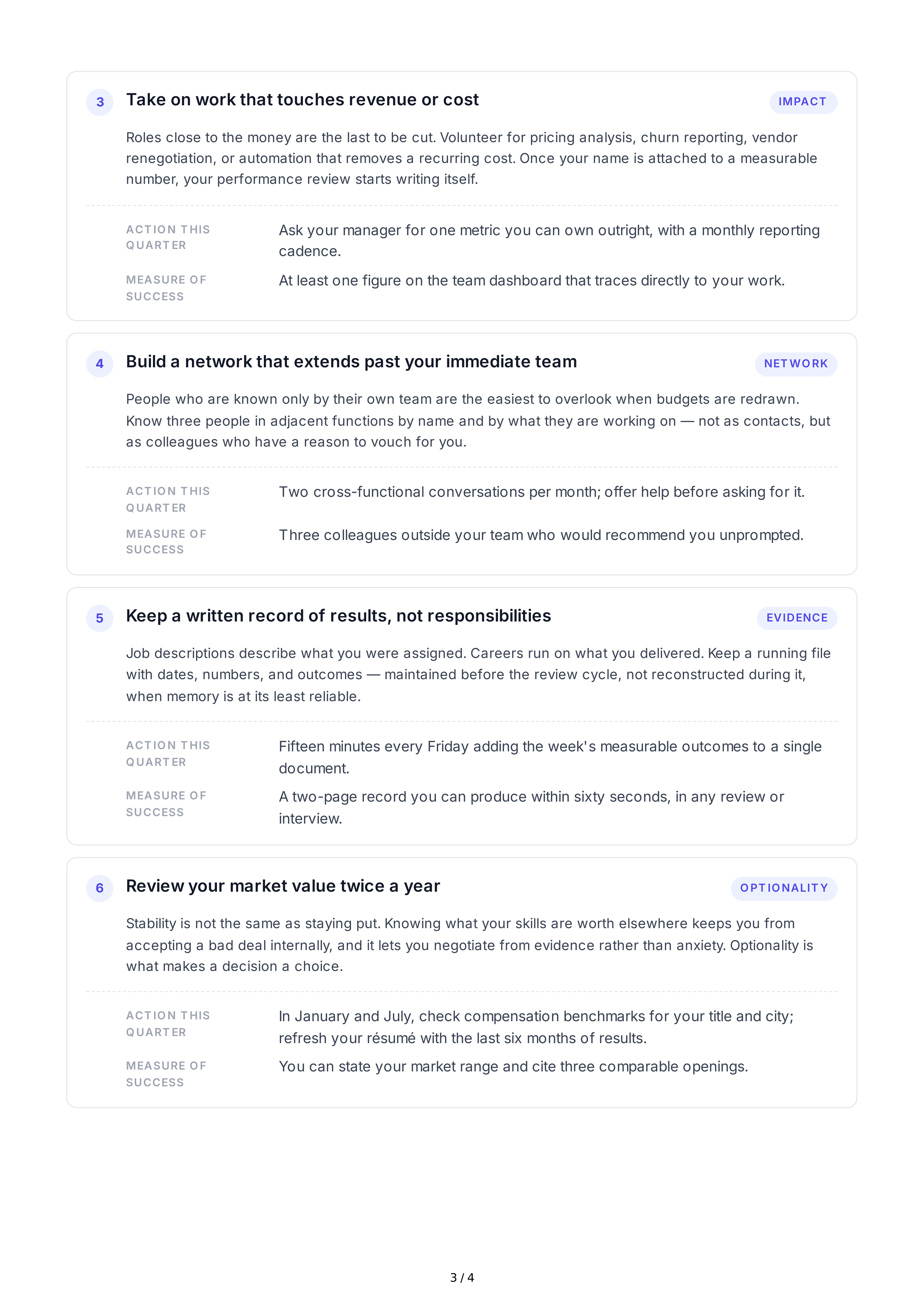
3
Take
on
work
that
touches
revenue
or
cost
IMPACT
Roles
close
to
the
money
are
the
last
to
be
cut
.
Volunteer
for
pricing
analysis
,
churn
reporting
,
vendor
renegotiation
,
or
automation
that
removes
a
recurring
cost
.
Once
your
name
is
attached
to
a
measurable
number
,
your
performance
review
starts
writing
itself
.
ACT IO N
T HIS
Q UART ER
Ask
your
manager
for
one
metric
you
can
own
outright
,
with
a
monthly
reporting
cadence
.
MEASURE
O F
SUCCESS
At
least
one
figure
on
the
team
dashboard
that
traces
directly
to
your
work
.
4
Build
a
network
that
extends
past
your
immediate
team
NET WO RK
People
who
are
known
only
by
their
own
team
are
the
easiest
to
overlook
when
budgets
are
redrawn
.
Know
three
people
in
adjacent
functions
by
name
and
by
what
they
are
working
on
—
not
as
contacts
,
but
as
colleagues
who
have
a
reason
to
vouch
for
you
.
ACT IO N
T HIS
Q UART ER
Two
cross
-
functional
conversations
per
month
;
offer
help
before
asking
for
it
.
MEASURE
O F
SUCCESS
Three
colleagues
outside
your
team
who
would
recommend
you
unprompted
.
5
Keep
a
written
record
of
results
,
not
responsibilities
EVIDENCE
Job
descriptions
describe
what
you
were
assigned
.
Careers
run
on
what
you
delivered
.
Keep
a
running
file
with
dates
,
numbers
,
and
outcomes
—
maintained
before
the
review
cycle
,
not
reconstructed
during
it
,
when
memory
is
at
its
least
reliable
.
ACT IO N
T HIS
Q UART ER
Fifteen
minutes
every
Friday
adding
the
week
'
s
measurable
outcomes
to
a
single
document
.
MEASURE
O F
SUCCESS
A
two
-
page
record
you
can
produce
within
sixty
seconds
,
in
any
review
or
interview
.
6
Review
your
market
value
twice
a
year
O PT IO NALIT Y
Stability
is
not
the
same
as
staying
put
.
Knowing
what
your
skills
are
worth
elsewhere
keeps
you
from
accepting
a
bad
deal
internally
,
and
it
lets
you
negotiate
from
evidence
rather
than
anxiety
.
Optionality
is
what
makes
a
decision
a
choice
.
ACT IO N
T HIS
Q UART ER
In
January
and
July
,
check
compensation
benchmarks
for
your
title
and
city
;
refresh
your
résumé
with
the
last
six
months
of
results
.
MEASURE
O F
SUCCESS
You
can
state
your
market
range
and
cite
three
comparable
openings
.
3 / 4
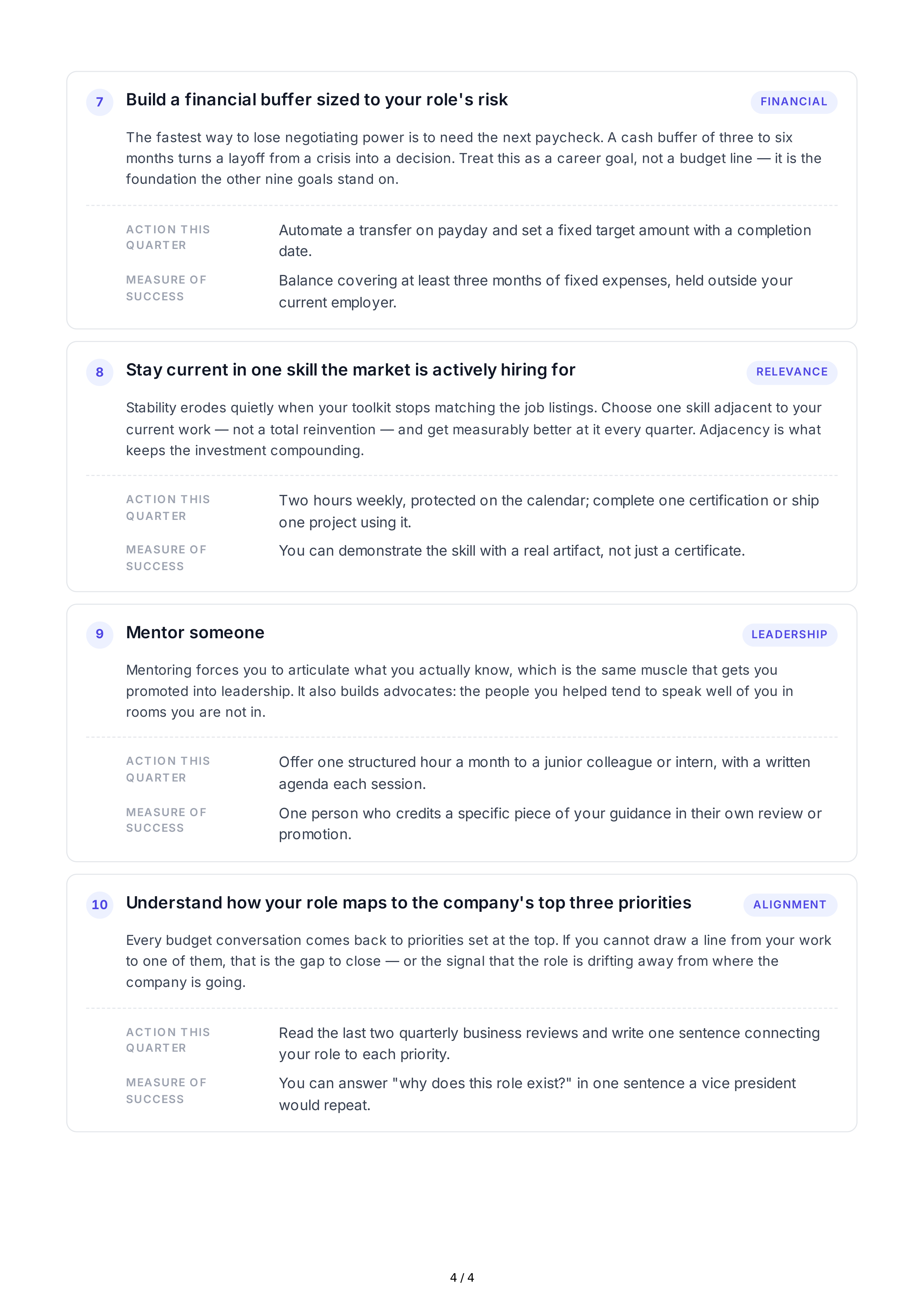
7
Build
a
financial
buffer
sized
to
your
role
'
s
risk
FINANCIAL
The
fastest
way
to
lose
negotiating
power
is
to
need
the
next
paycheck
.
A
cash
buffer
of
three
to
six
months
turns
a
layoff
from
a
crisis
into
a
decision
.
Treat
this
as
a
career
goal
,
not
a
budget
line
—
it
is
the
foundation
the
other
nine
goals
stand
on
.
ACT IO N
T HIS
Q UART ER
Automate
a
transfer
on
payday
and
set
a
fixed
target
amount
with
a
completion
date
.
MEASURE
O F
SUCCESS
Balance
covering
at
least
three
months
of
fixed
expenses
,
held
outside
your
current
employer
.
8
Stay
current
in
one
skill
the
market
is
actively
hiring
for
RELEVANCE
Stability
erodes
quietly
when
your
toolkit
stops
matching
the
job
listings
.
Choose
one
skill
adjacent
to
your
current
work
—
not
a
total
reinvention
—
and
get
measurably
better
at
it
every
quarter
.
Adjacency
is
what
keeps
the
investment
compounding
.
ACT IO N
T HIS
Q UART ER
Two
hours
weekly
,
protected
on
the
calendar
;
complete
one
certification
or
ship
one
project
using
it
.
MEASURE
O F
SUCCESS
You
can
demonstrate
the
skill
with
a
real
artifact
,
not
just
a
certificate
.
9
Mentor
someone
LEADERSHIP
Mentoring
forces
you
to
articulate
what
you
actually
know
,
which
is
the
same
muscle
that
gets
you
promoted
into
leadership
.
It
also
builds
advocates
:
the
people
you
helped
tend
to
speak
well
of
you
in
rooms
you
are
not
in
.
ACT IO N
T HIS
Q UART ER
Offer
one
structured
hour
a
month
to
a
junior
colleague
or
intern
,
with
a
written
agenda
each
session
.
MEASURE
O F
SUCCESS
One
person
who
credits
a
specific
piece
of
your
guidance
in
their
own
review
or
promotion
.
10
Understand
how
your
role
maps
to
the
company
'
s
top
three
priorities
ALIGNMENT
Every
budget
conversation
comes
back
to
priorities
set
at
the
top
.
If
you
cannot
draw
a
line
from
your
work
to
one
of
them
,
that
is
the
gap
to
close
—
or
the
signal
that
the
role
is
drifting
away
from
where
the
company
is
going
.
ACT IO N
T HIS
Q UART ER
Read
the
last
two
quarterly
business
reviews
and
write
one
sentence
connecting
your
role
to
each
priority
.
MEASURE
O F
SUCCESS
You
can
answer
"
why
does
this
role
exist
?"
in
one
sentence
a
vice
president
would
repeat
.
4 / 4