Communication
Improvement
Goals
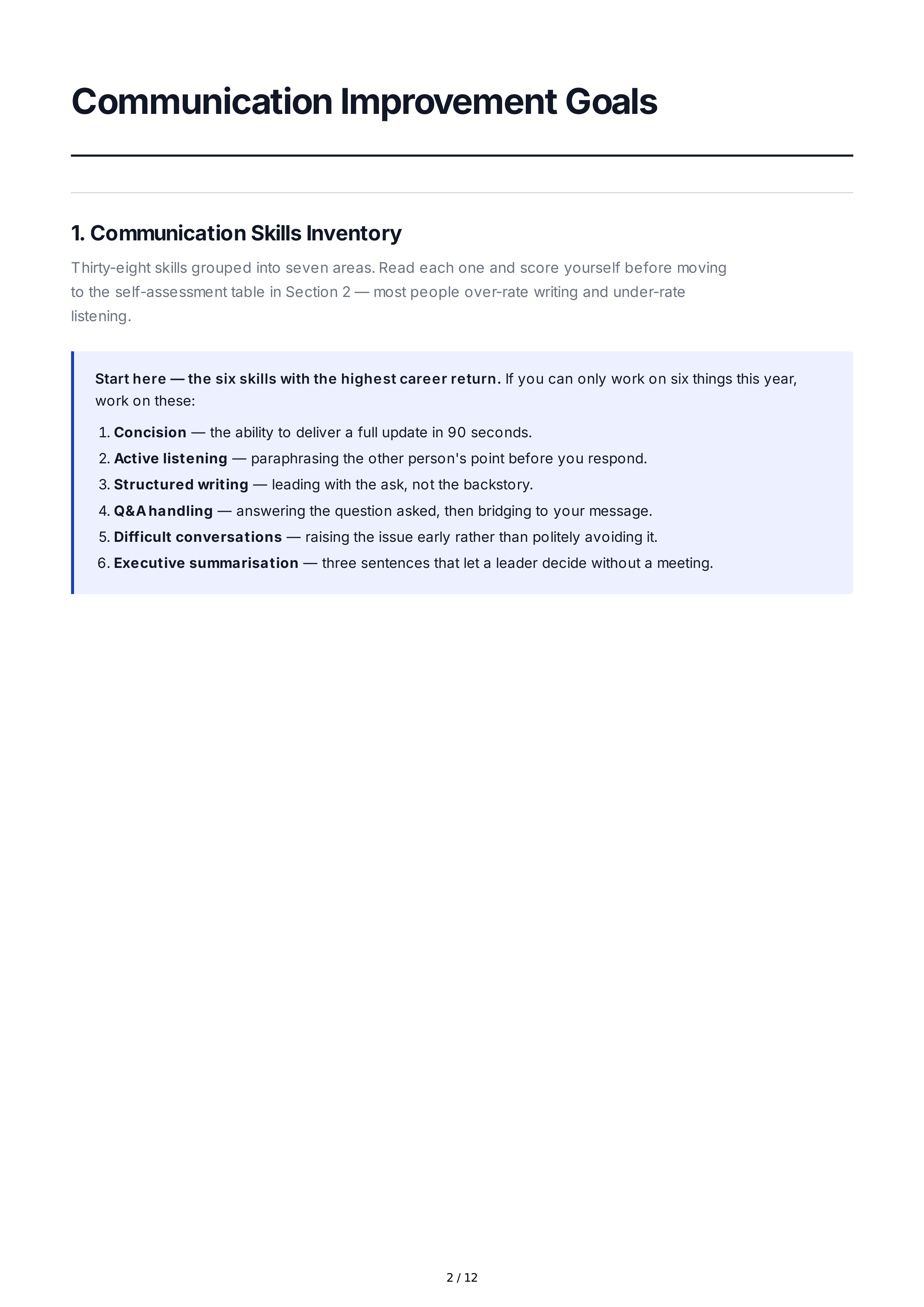
1.
Communication
Skills
Inventory
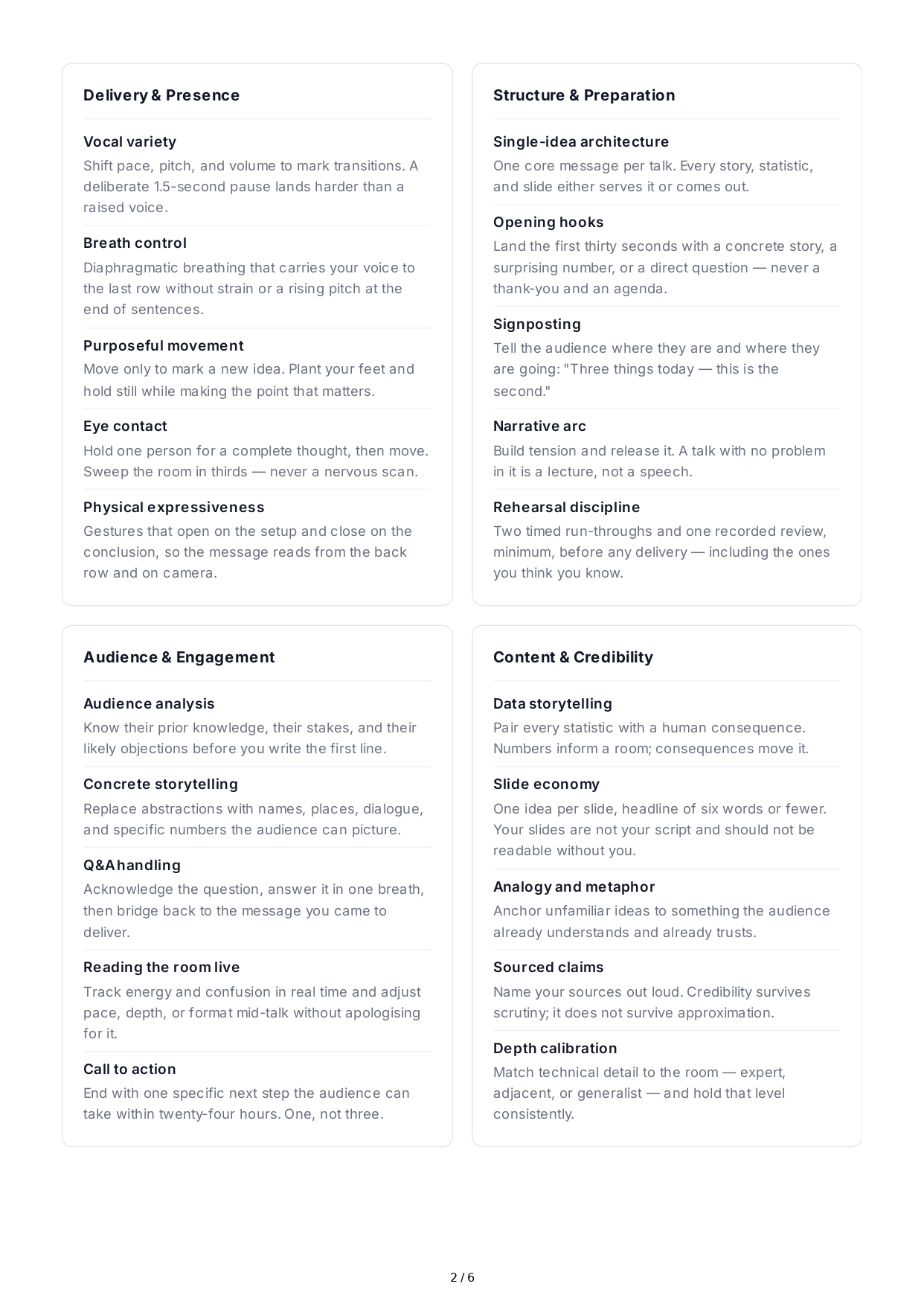
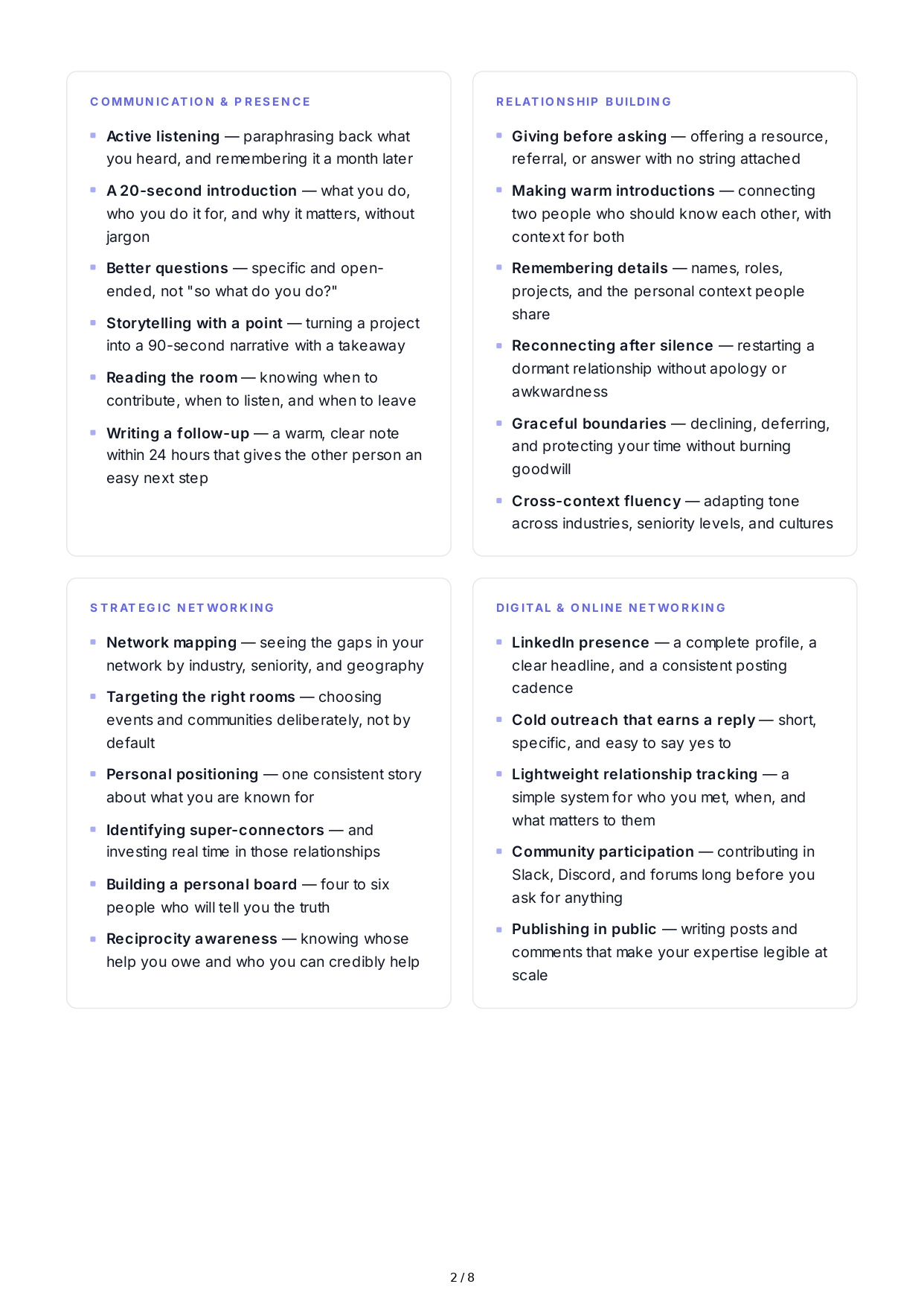
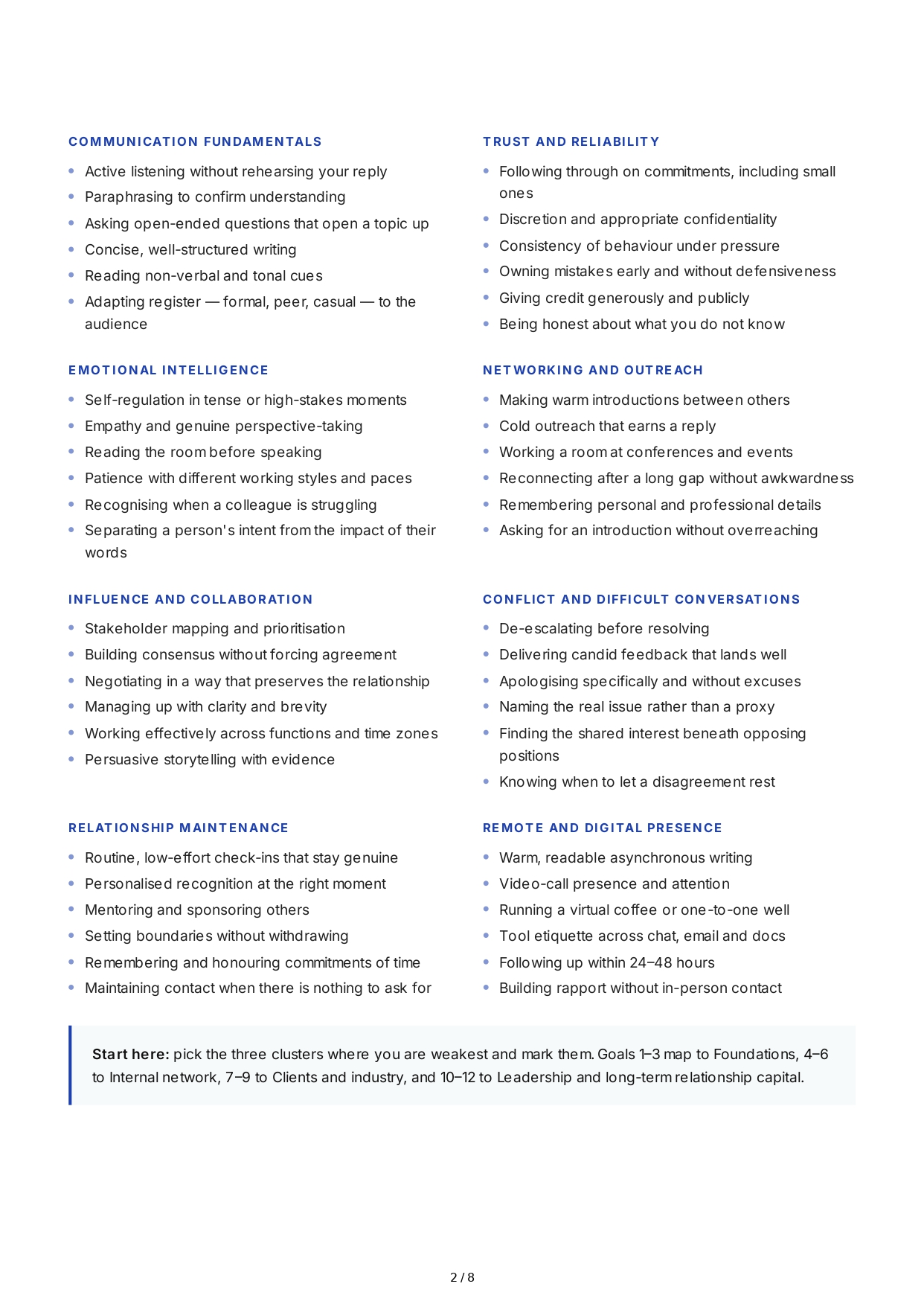
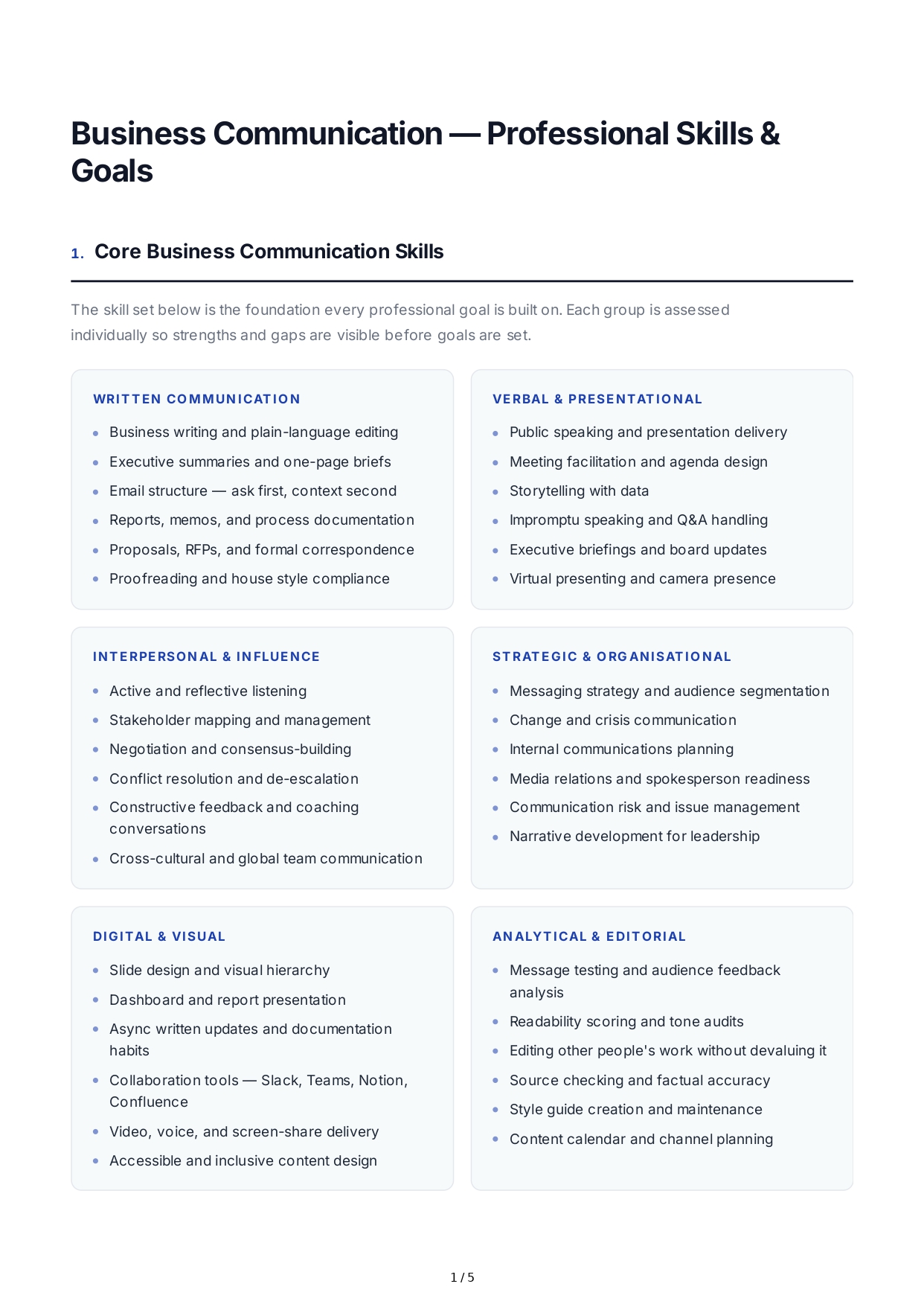
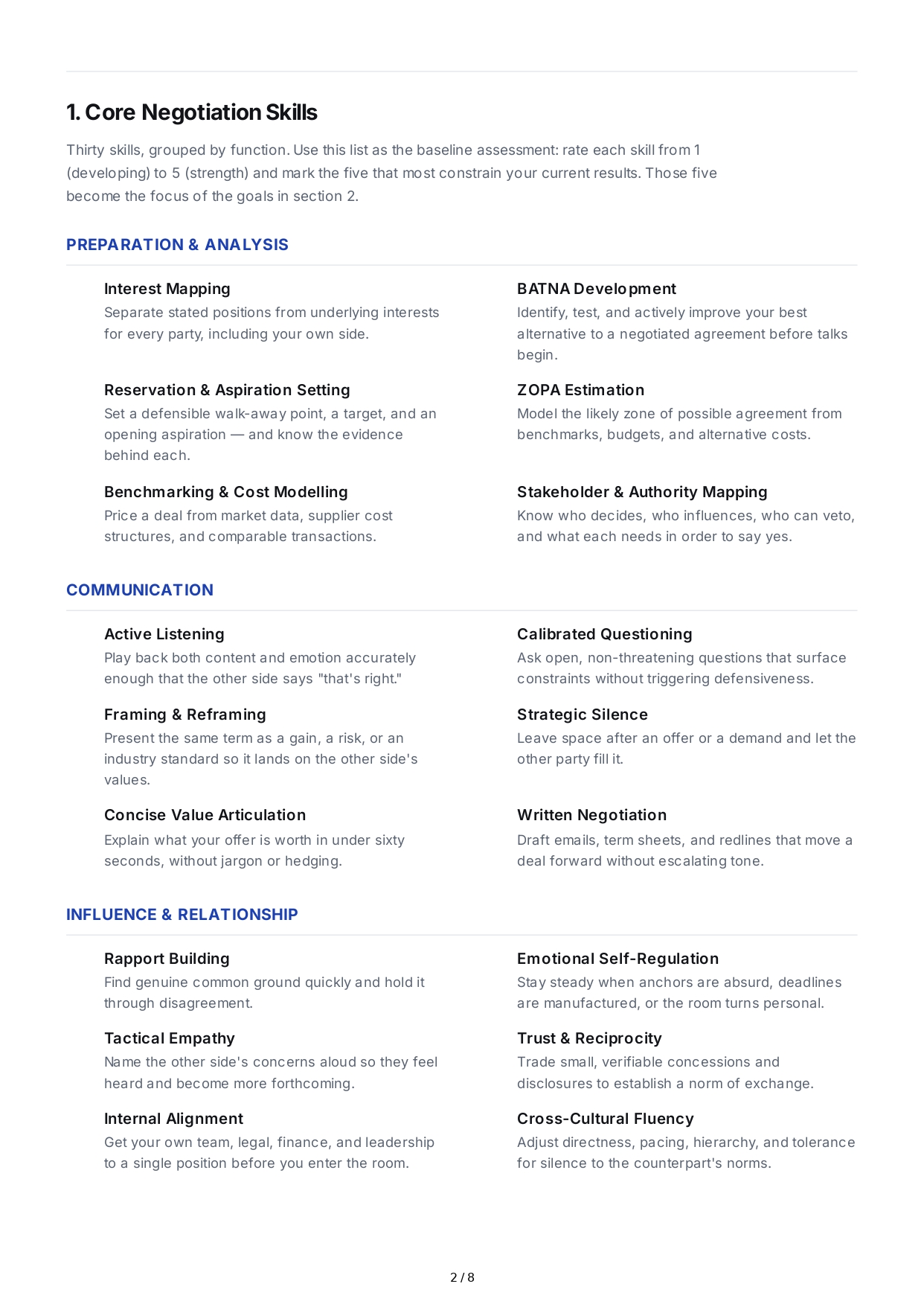
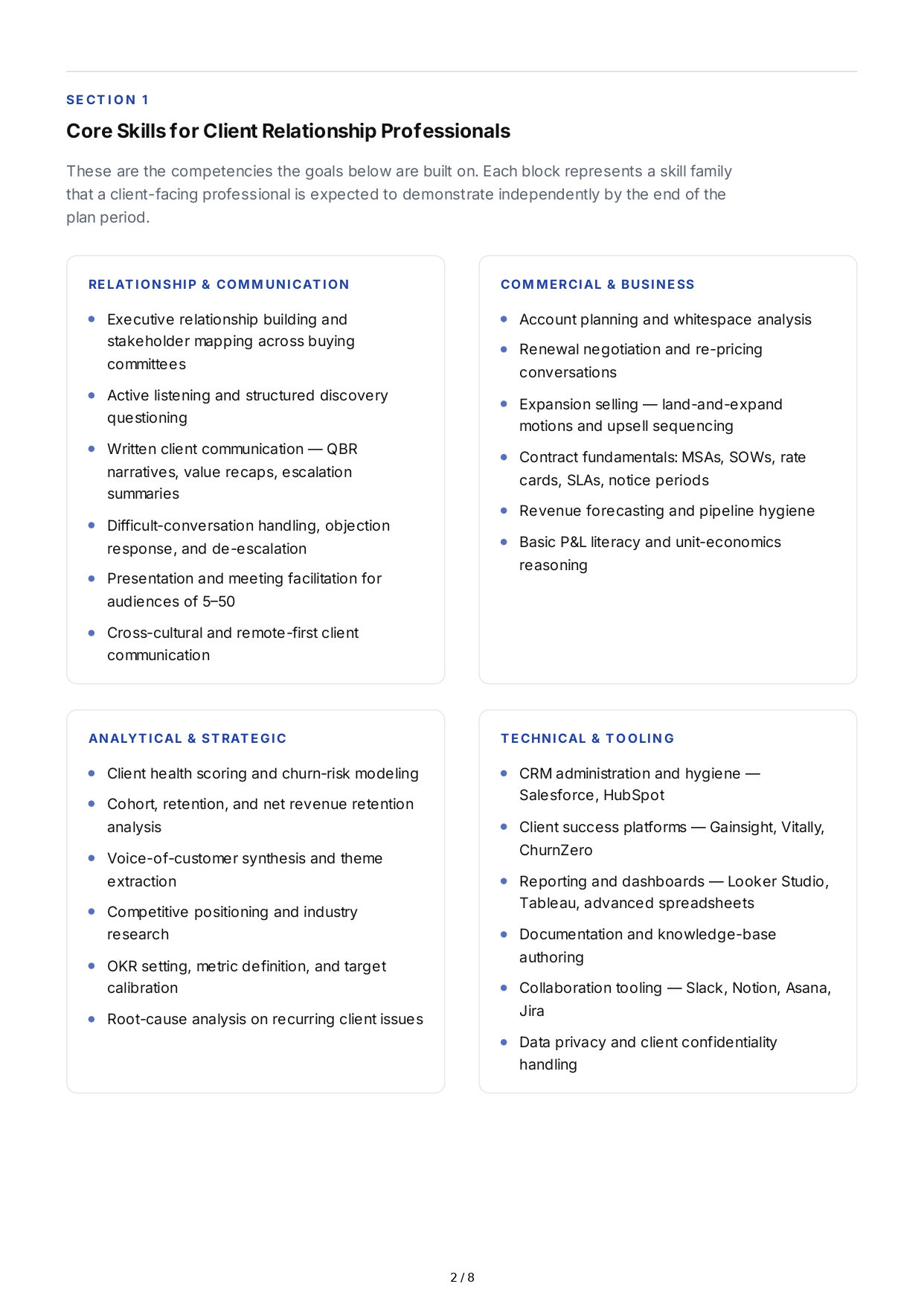
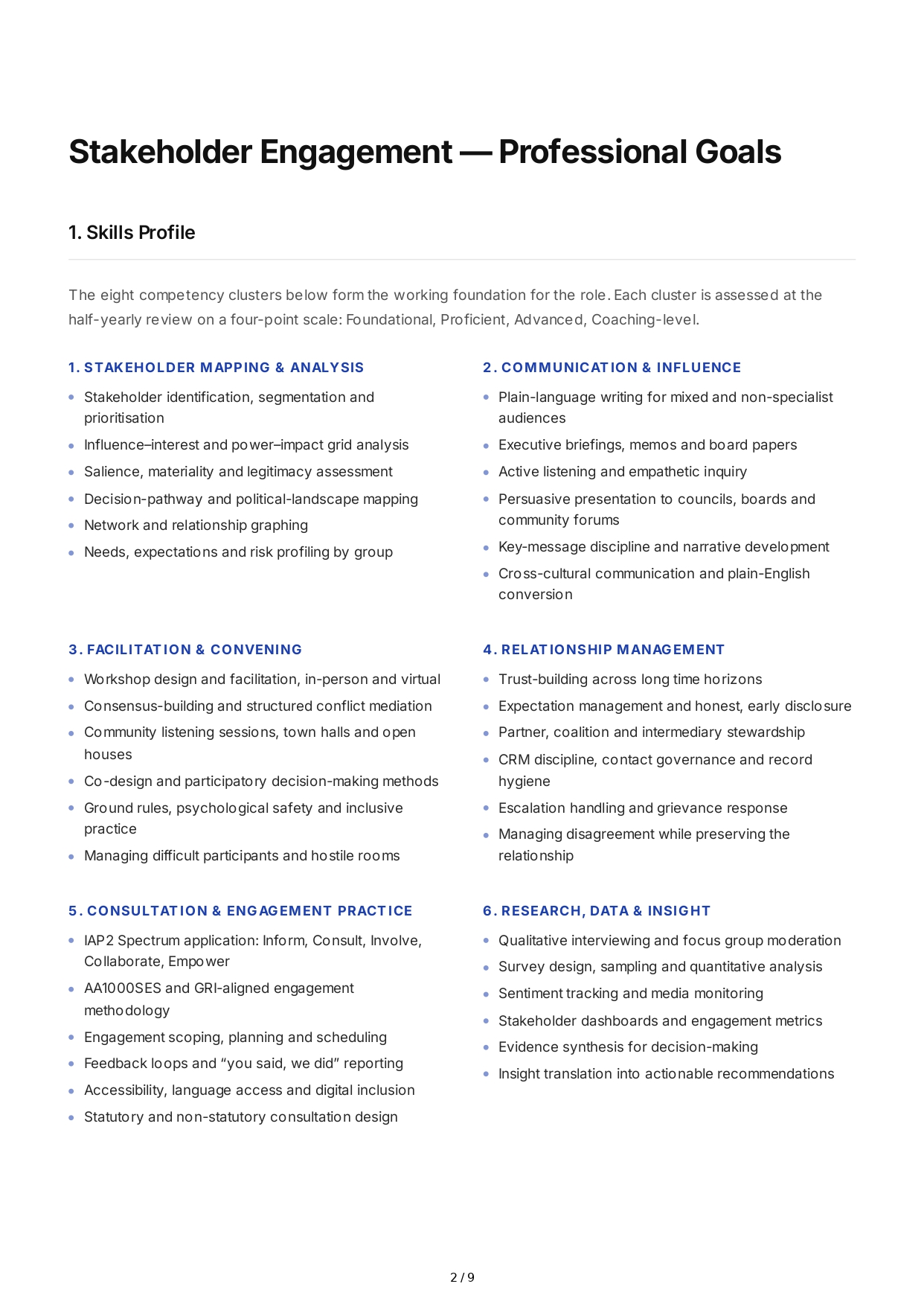
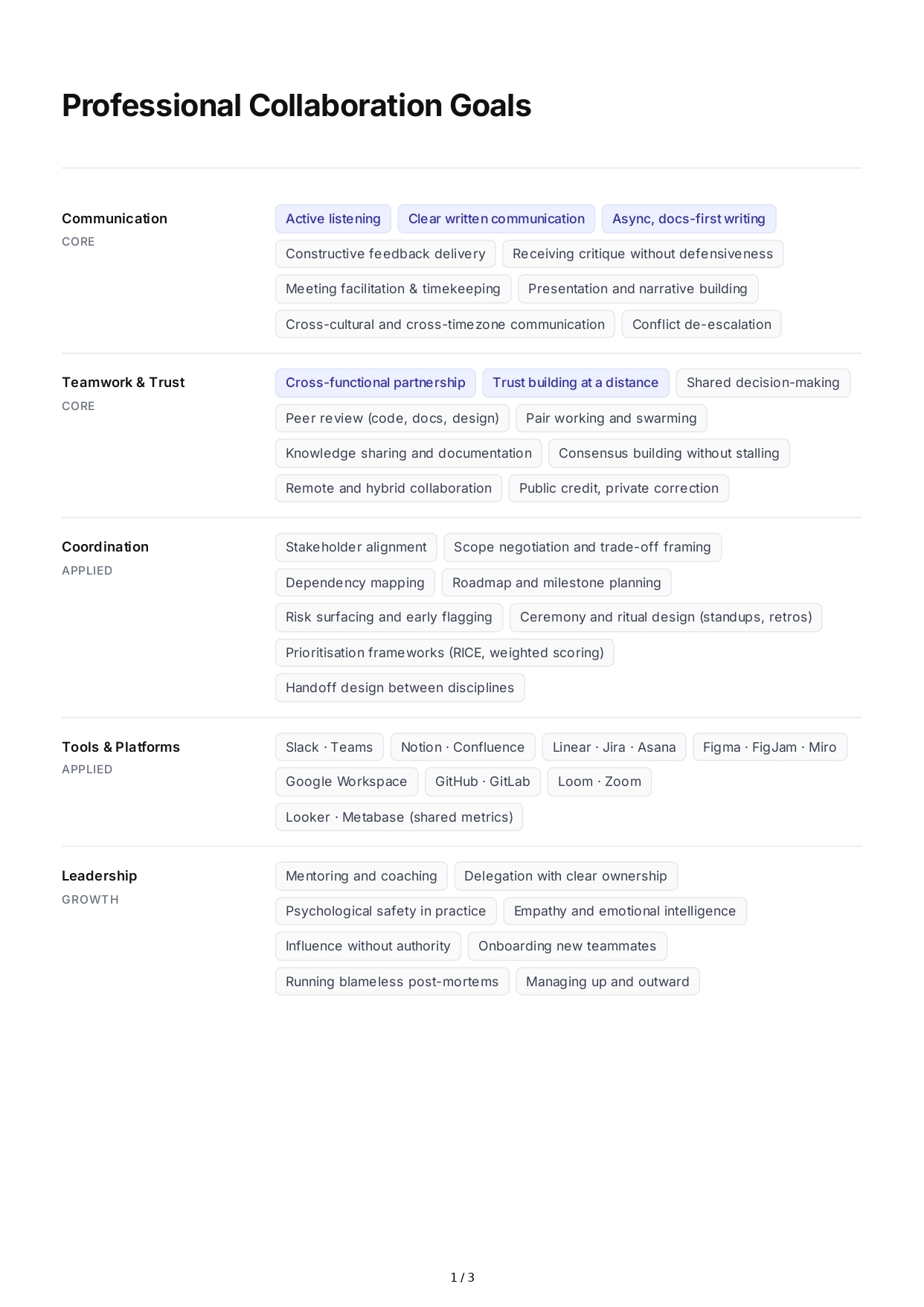
Thirty
-
eight
skills
grouped
into
seven
areas
.
Read
each
one
and
score
yourself
before
moving
to
the
self
-
assessment
table
in
Section
2 —
most
people
over
-
rate
writing
and
under
-
rate
listening
.
Start
here
—
the
six
skills
with
the
highest
career
return
.
If
you
can
only
work
on
six
things
this
year
,
work
on
these
:
1.
Concision
—
the
ability
to
deliver
a
full
update
in
90
seconds
.
2.
Active
listening
—
paraphrasing
the
other
person
'
s
point
before
you
respond
.
3.
Structured
writing
—
leading
with
the
ask
,
not
the
backstory
.
4.
Q
&
A
handling
—
answering
the
question
asked
,
then
bridging
to
your
message
.
5.
Difficult
conversations
—
raising
the
issue
early
rather
than
politely
avoiding
it
.
6.
Executive
summarisation
—
three
sentences
that
let
a
leader
decide
without
a
meeting
.
2 / 12
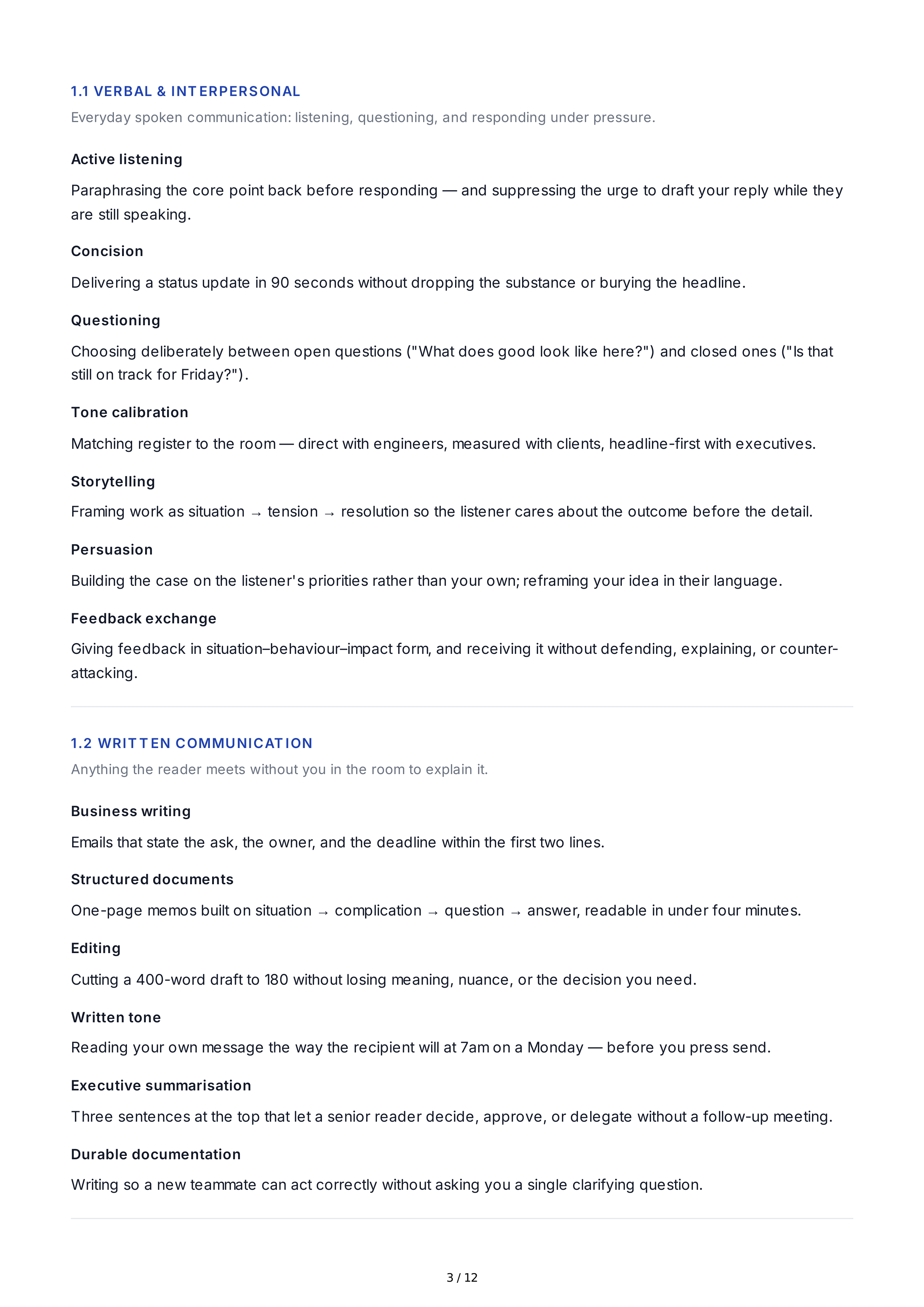
1.1
VERBAL
&
INT ERPERSONAL
Everyday
spoken
communication
:
listening
,
questioning
,
and
responding
under
pressure
.
Active
listening
Paraphrasing
the
core
point
back
before
responding
—
and
suppressing
the
urge
to
draft
your
reply
while
they
are
still
speaking
.
Concision
Delivering
a
status
update
in
90
seconds
without
dropping
the
substance
or
burying
the
headline
.
Questioning
Choosing
deliberately
between
open
questions
("
What
does
good
look
like
here
?")
and
closed
ones
("
Is
that
still
on
track
for
Friday
?").
Tone
calibration
Matching
register
to
the
room
—
direct
with
engineers
,
measured
with
clients
,
headline
-
first
with
executives
.
Storytelling
Framing
work
as
situation
→
tension
→
resolution
so
the
listener
cares
about
the
outcome
before
the
detail
.
Persuasion
Building
the
case
on
the
listener
'
s
priorities
rather
than
your
own
;
reframing
your
idea
in
their
language
.
Feedback
exchange
Giving
feedback
in
situation
–
behaviour
–
impact
form
,
and
receiving
it
without
defending
,
explaining
,
or
counter
-
attacking
.
1.2
WRIT T EN
COMMUNICAT ION
Anything
the
reader
meets
without
you
in
the
room
to
explain
it
.
Business
writing
Emails
that
state
the
ask
,
the
owner
,
and
the
deadline
within
the
first
two
lines
.
Structured
documents
One
-
page
memos
built
on
situation
→
complication
→
question
→
answer
,
readable
in
under
four
minutes
.
Editing
Cutting
a
400-
word
draft
to
180
without
losing
meaning
,
nuance
,
or
the
decision
you
need
.
Written
tone
Reading
your
own
message
the
way
the
recipient
will
at
7
am
on
a
Monday
—
before
you
press
send
.
Executive
summarisation
Three
sentences
at
the
top
that
let
a
senior
reader
decide
,
approve
,
or
delegate
without
a
follow
-
up
meeting
.
Durable
documentation
Writing
so
a
new
teammate
can
act
correctly
without
asking
you
a
single
clarifying
question
.
3 / 12
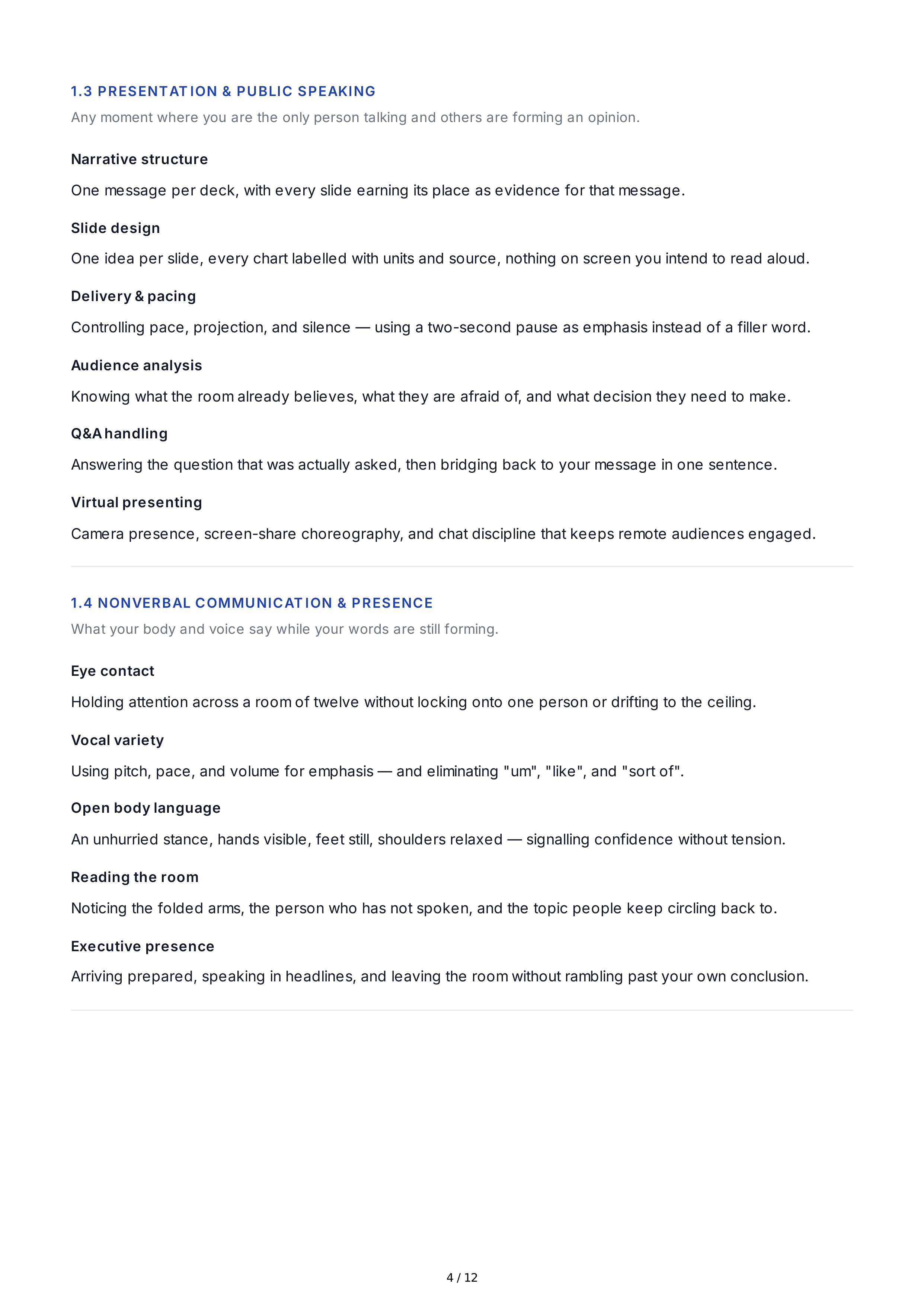
1.3
PRESENTAT ION
&
PUBLIC
SPEAKING
Any
moment
where
you
are
the
only
person
talking
and
others
are
forming
an
opinion
.
Narrative
structure
One
message
per
deck
,
with
every
slide
earning
its
place
as
evidence
for
that
message
.
Slide
design
One
idea
per
slide
,
every
chart
labelled
with
units
and
source
,
nothing
on
screen
you
intend
to
read
aloud
.
Delivery
&
pacing
Controlling
pace
,
projection
,
and
silence
—
using
a
two
-
second
pause
as
emphasis
instead
of
a
filler
word
.
Audience
analysis
Knowing
what
the
room
already
believes
,
what
they
are
afraid
of
,
and
what
decision
they
need
to
make
.
Q
&
A
handling
Answering
the
question
that
was
actually
asked
,
then
bridging
back
to
your
message
in
one
sentence
.
Virtual
presenting
Camera
presence
,
screen
-
share
choreography
,
and
chat
discipline
that
keeps
remote
audiences
engaged
.
1.4
NONVERBAL
COMMUNICAT ION
&
PRESENCE
What
your
body
and
voice
say
while
your
words
are
still
forming
.
Eye
contact
Holding
attention
across
a
room
of
twelve
without
locking
onto
one
person
or
drifting
to
the
ceiling
.
Vocal
variety
Using
pitch
,
pace
,
and
volume
for
emphasis
—
and
eliminating
"
um
", "
like
",
and
"
sort
of
".
Open
body
language
An
unhurried
stance
,
hands
visible
,
feet
still
,
shoulders
relaxed
—
signalling
confidence
without
tension
.
Reading
the
room
Noticing
the
folded
arms
,
the
person
who
has
not
spoken
,
and
the
topic
people
keep
circling
back
to
.
Executive
presence
Arriving
prepared
,
speaking
in
headlines
,
and
leaving
the
room
without
rambling
past
your
own
conclusion
.
4 / 12
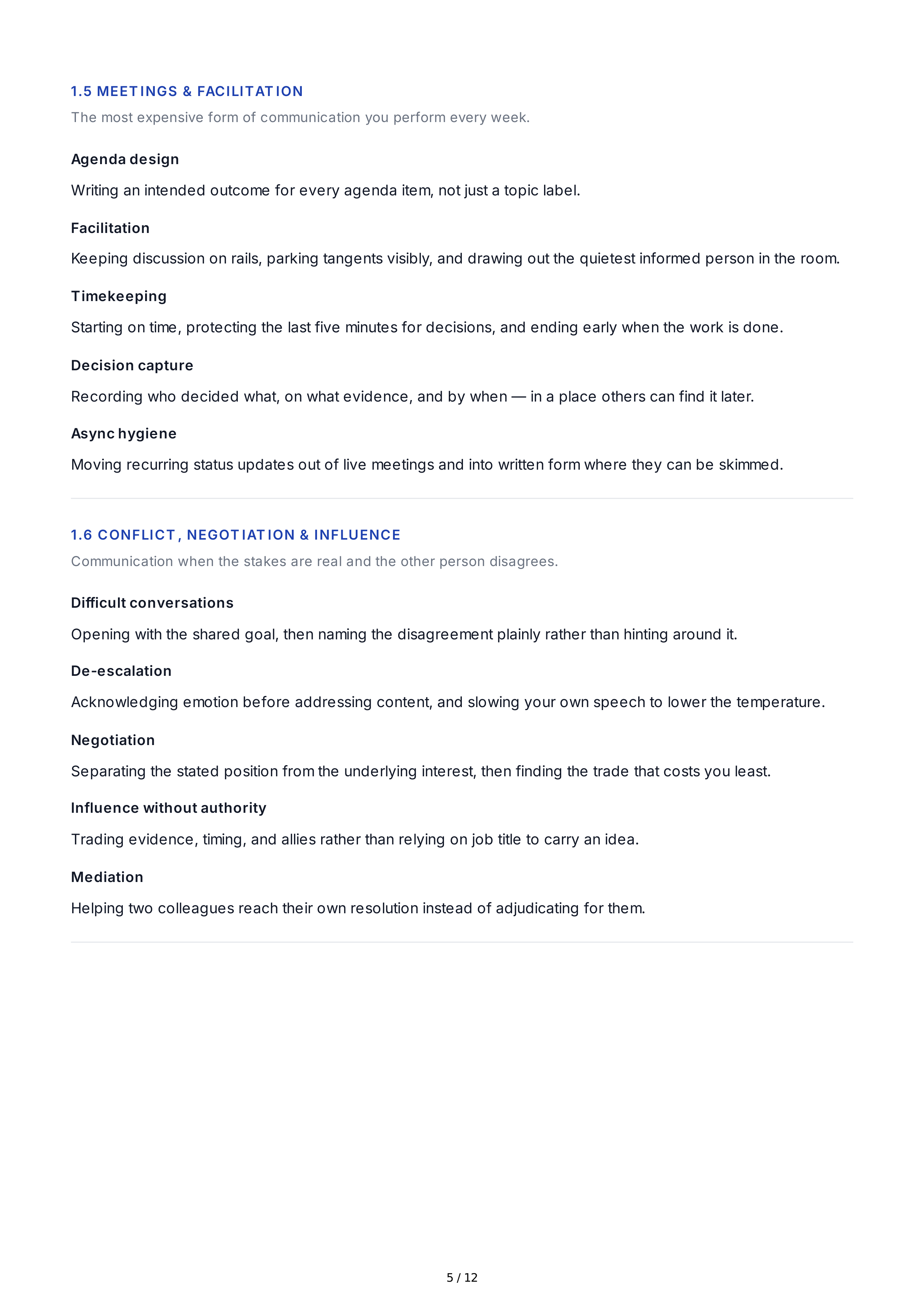
1.5
MEET INGS
&
FACILITAT ION
The
most
expensive
form
of
communication
you
perform
every
week
.
Agenda
design
Writing
an
intended
outcome
for
every
agenda
item
,
not
just
a
topic
label
.
Facilitation
Keeping
discussion
on
rails
,
parking
tangents
visibly
,
and
drawing
out
the
quietest
informed
person
in
the
room
.
Timekeeping
Starting
on
time
,
protecting
the
last
five
minutes
for
decisions
,
and
ending
early
when
the
work
is
done
.
Decision
capture
Recording
who
decided
what
,
on
what
evidence
,
and
by
when
—
in
a
place
others
can
find
it
later
.
Async
hygiene
Moving
recurring
status
updates
out
of
live
meetings
and
into
written
form
where
they
can
be
skimmed
.
1.6
CONFLICT
,
NEGOT IAT ION
&
INFLUENCE
Communication
when
the
stakes
are
real
and
the
other
person
disagrees
.
Difficult
conversations
Opening
with
the
shared
goal
,
then
naming
the
disagreement
plainly
rather
than
hinting
around
it
.
De
-
escalation
Acknowledging
emotion
before
addressing
content
,
and
slowing
your
own
speech
to
lower
the
temperature
.
Negotiation
Separating
the
stated
position
from
the
underlying
interest
,
then
finding
the
trade
that
costs
you
least
.
Influence
without
authority
Trading
evidence
,
timing
,
and
allies
rather
than
relying
on
job
title
to
carry
an
idea
.
Mediation
Helping
two
colleagues
reach
their
own
resolution
instead
of
adjudicating
for
them
.
5 / 12
1.7
CROSS
-
CULT URAL
&
DIGITAL
Communication
across
time
zones
,
languages
,
and
distance
.
Cultural
intelligence
Recognising
that
directness
,
hierarchy
,
and
saving
face
carry
different
weight
in
different
contexts
.
Language
accommodation
Dropping
idioms
,
sports
metaphors
,
and
abbreviations
when
speaking
with
non
-
native
speakers
.
Remote
collaboration
Over
-
communicating
context
deliberately
,
because
you
cannot
read
a
room
you
cannot
see
.
Chat
tone
Knowing
when
a
written
thread
has
stopped
working
and
should
become
a
five
-
minute
call
.
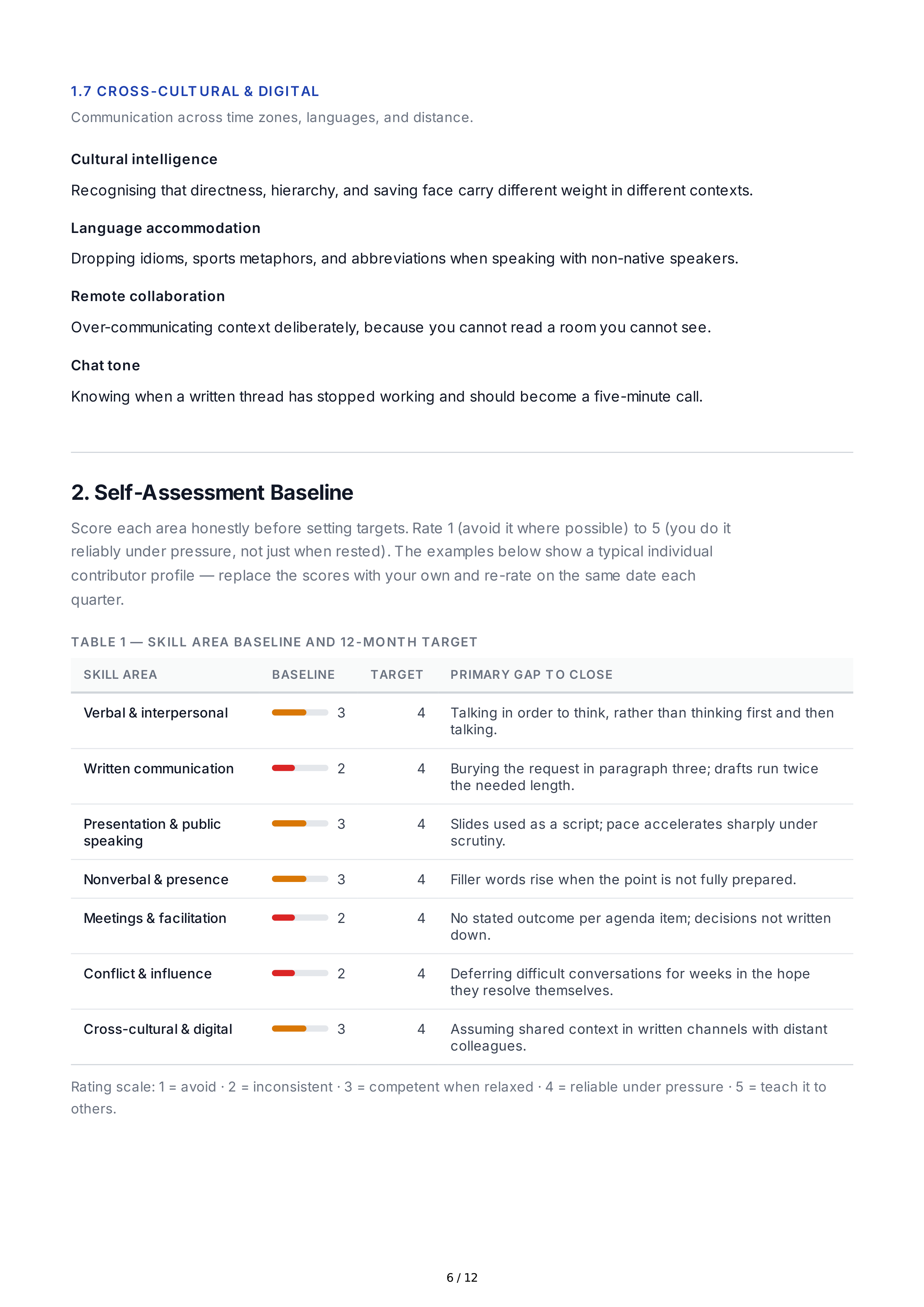
2.
Self
-
Assessment
Baseline
Score
each
area
honestly
before
setting
targets
.
Rate
1 (
avoid
it
where
possible
)
to
5 (
you
do
it
reliably
under
pressure
,
not
just
when
rested
).
The
examples
below
show
a
typical
individual
contributor
profile
—
replace
the
scores
with
your
own
and
re
-
rate
on
the
same
date
each
quarter
.
TABLE
1 —
SKILL
AREA
BASELINE
AND
12-
MONT H
TARGET
SKILL
AREA
BASELINE
TARGET
PRIMARY
GAP
T O
CLOSE
Verbal
&
interpersonal
3
4
Talking
in
order
to
think
,
rather
than
thinking
first
and
then
talking
.
Written
communication
2
4
Burying
the
request
in
paragraph
three
;
drafts
run
twice
the
needed
length
.
Presentation
&
public
speaking
3
4
Slides
used
as
a
script
;
pace
accelerates
sharply
under
scrutiny
.
Nonverbal
&
presence
3
4
Filler
words
rise
when
the
point
is
not
fully
prepared
.
Meetings
&
facilitation
2
4
No
stated
outcome
per
agenda
item
;
decisions
not
written
down
.
Conflict
&
influence
2
4
Deferring
difficult
conversations
for
weeks
in
the
hope
they
resolve
themselves
.
Cross
-
cultural
&
digital
3
4
Assuming
shared
context
in
written
channels
with
distant
colleagues
.
Rating
scale
: 1 =
avoid
· 2 =
inconsistent
· 3 =
competent
when
relaxed
· 4 =
reliable
under
pressure
· 5 =
teach
it
to
others
.
6 / 12
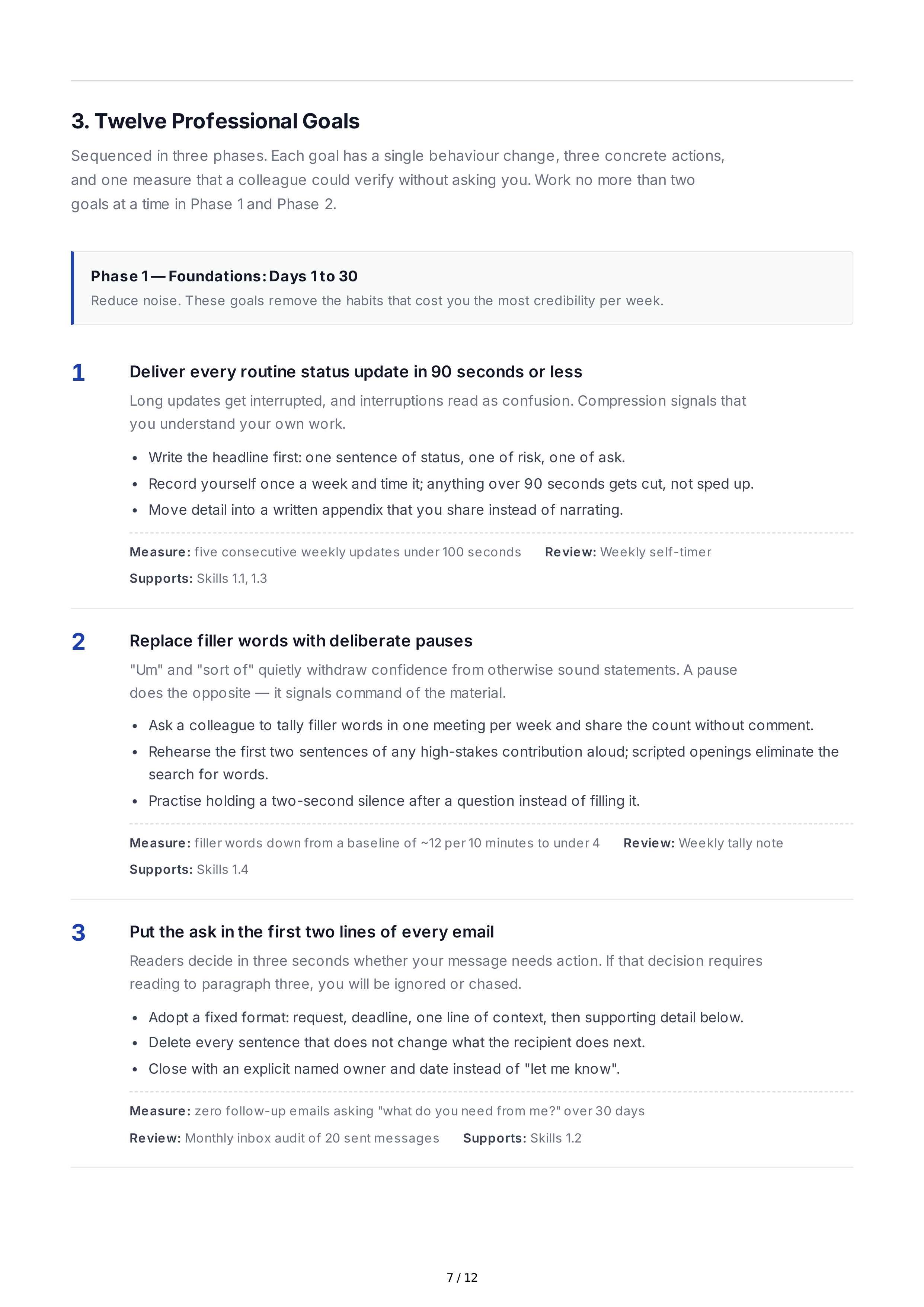
3.
Twelve
Professional
Goals
Sequenced
in
three
phases
.
Each
goal
has
a
single
behaviour
change
,
three
concrete
actions
,
and
one
measure
that
a
colleague
could
verify
without
asking
you
.
Work
no
more
than
two
goals
at
a
time
in
Phase
1
and
Phase
2.
Phase
1 —
Foundations
:
Days
1
to
30
Reduce
noise
.
These
goals
remove
the
habits
that
cost
you
the
most
credibility
per
week
.
1
Deliver
every
routine
status
update
in
90
seconds
or
less
Long
updates
get
interrupted
,
and
interruptions
read
as
confusion
.
Compression
signals
that
you
understand
your
own
work
.
Write
the
headline
first
:
one
sentence
of
status
,
one
of
risk
,
one
of
ask
.
Record
yourself
once
a
week
and
time
it
;
anything
over
90
seconds
gets
cut
,
not
sped
up
.
Move
detail
into
a
written
appendix
that
you
share
instead
of
narrating
.
Measure
:
five
consecutive
weekly
updates
under
100
seconds
Review
:
Weekly
self
-
timer
Supports
:
Skills
1.1, 1.3
2
Replace
filler
words
with
deliberate
pauses
"
Um
"
and
"
sort
of
"
quietly
withdraw
confidence
from
otherwise
sound
statements
.
A
pause
does
the
opposite
—
it
signals
command
of
the
material
.
Ask
a
colleague
to
tally
filler
words
in
one
meeting
per
week
and
share
the
count
without
comment
.
Rehearse
the
first
two
sentences
of
any
high
-
stakes
contribution
aloud
;
scripted
openings
eliminate
the
search
for
words
.
Practise
holding
a
two
-
second
silence
after
a
question
instead
of
filling
it
.
Measure
:
filler
words
down
from
a
baseline
of
~12
per
10
minutes
to
under
4
Review
:
Weekly
tally
note
Supports
:
Skills
1.4
3
Put
the
ask
in
the
first
two
lines
of
every
email
Readers
decide
in
three
seconds
whether
your
message
needs
action
.
If
that
decision
requires
reading
to
paragraph
three
,
you
will
be
ignored
or
chased
.
Adopt
a
fixed
format
:
request
,
deadline
,
one
line
of
context
,
then
supporting
detail
below
.
Delete
every
sentence
that
does
not
change
what
the
recipient
does
next
.
Close
with
an
explicit
named
owner
and
date
instead
of
"
let
me
know
".
Measure
:
zero
follow
-
up
emails
asking
"
what
do
you
need
from
me
?"
over
30
days
Review
:
Monthly
inbox
audit
of
20
sent
messages
Supports
:
Skills
1.2
7 / 12
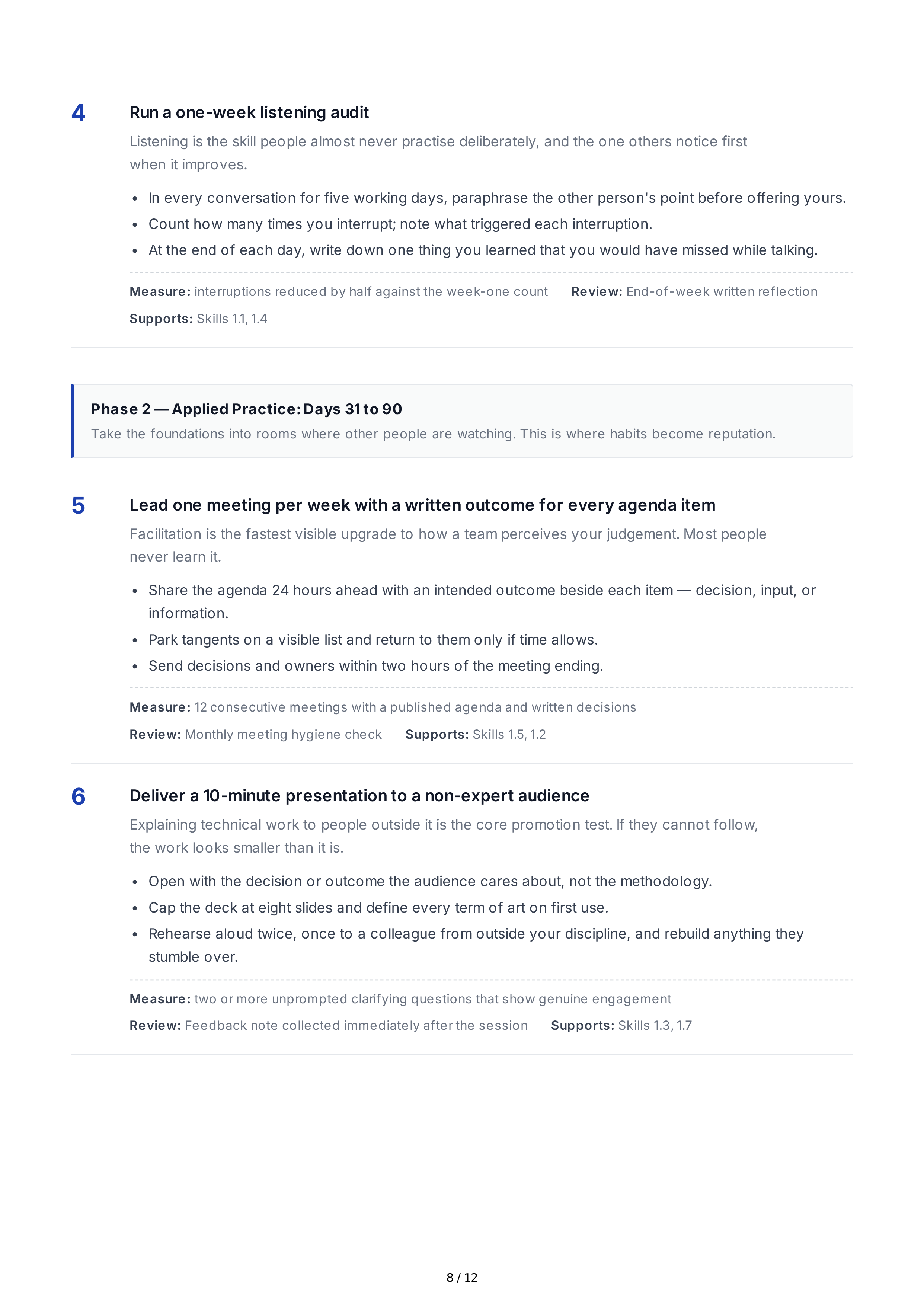
4
Run
a
one
-
week
listening
audit
Listening
is
the
skill
people
almost
never
practise
deliberately
,
and
the
one
others
notice
first
when
it
improves
.
In
every
conversation
for
five
working
days
,
paraphrase
the
other
person
'
s
point
before
offering
yours
.
Count
how
many
times
you
interrupt
;
note
what
triggered
each
interruption
.
At
the
end
of
each
day
,
write
down
one
thing
you
learned
that
you
would
have
missed
while
talking
.
Measure
:
interruptions
reduced
by
half
against
the
week
-
one
count
Review
:
End
-
of
-
week
written
reflection
Supports
:
Skills
1.1, 1.4
Phase
2 —
Applied
Practice
:
Days
31
to
90
Take
the
foundations
into
rooms
where
other
people
are
watching
.
This
is
where
habits
become
reputation
.
5
Lead
one
meeting
per
week
with
a
written
outcome
for
every
agenda
item
Facilitation
is
the
fastest
visible
upgrade
to
how
a
team
perceives
your
judgement
.
Most
people
never
learn
it
.
Share
the
agenda
24
hours
ahead
with
an
intended
outcome
beside
each
item
—
decision
,
input
,
or
information
.
Park
tangents
on
a
visible
list
and
return
to
them
only
if
time
allows
.
Send
decisions
and
owners
within
two
hours
of
the
meeting
ending
.
Measure
:
12
consecutive
meetings
with
a
published
agenda
and
written
decisions
Review
:
Monthly
meeting
hygiene
check
Supports
:
Skills
1.5, 1.2
6
Deliver
a
10-
minute
presentation
to
a
non
-
expert
audience
Explaining
technical
work
to
people
outside
it
is
the
core
promotion
test
.
If
they
cannot
follow
,
the
work
looks
smaller
than
it
is
.
Open
with
the
decision
or
outcome
the
audience
cares
about
,
not
the
methodology
.
Cap
the
deck
at
eight
slides
and
define
every
term
of
art
on
first
use
.
Rehearse
aloud
twice
,
once
to
a
colleague
from
outside
your
discipline
,
and
rebuild
anything
they
stumble
over
.
Measure
:
two
or
more
unprompted
clarifying
questions
that
show
genuine
engagement
Review
:
Feedback
note
collected
immediately
after
the
session
Supports
:
Skills
1.3, 1.7
8 / 12
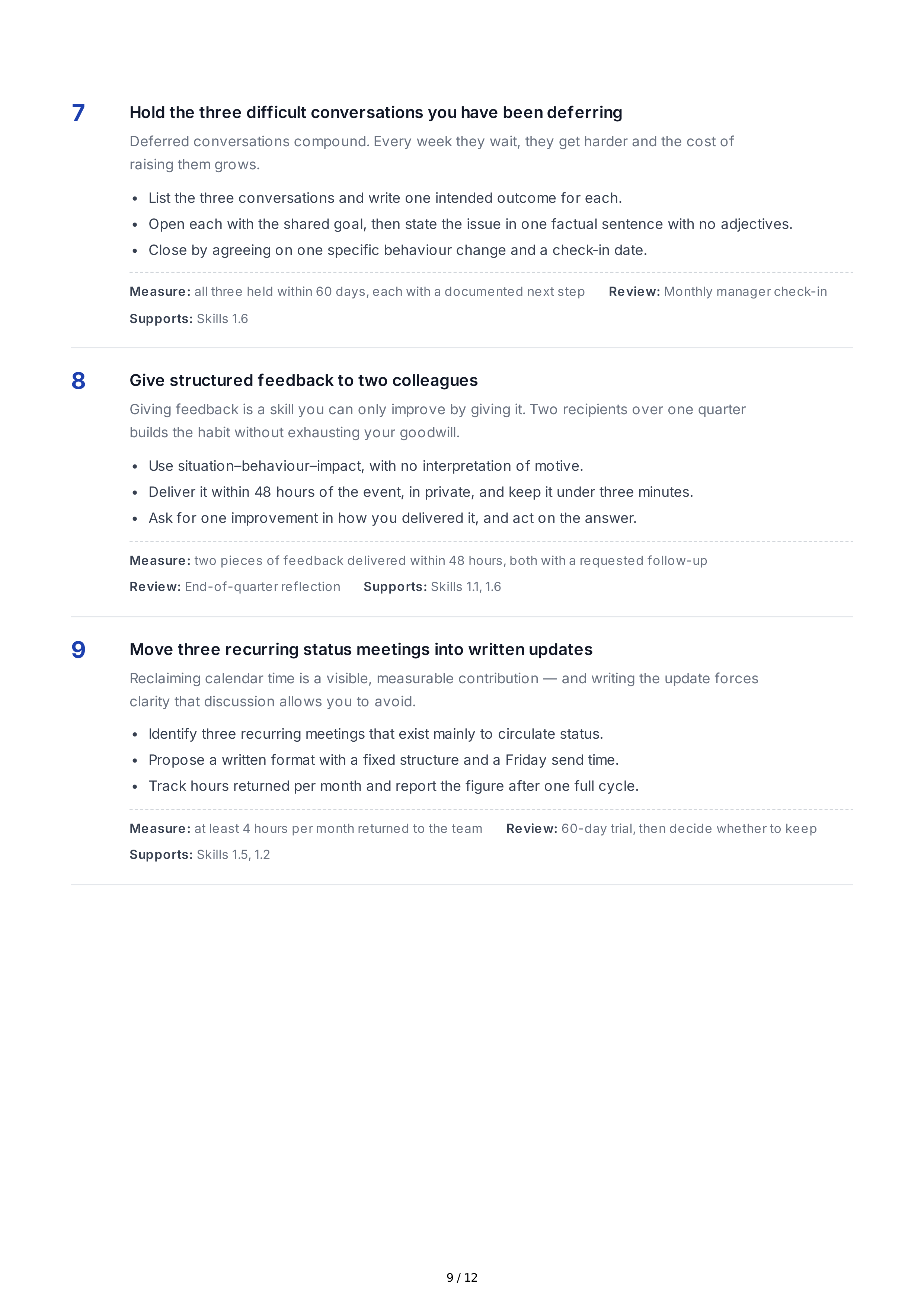
7
Hold
the
three
difficult
conversations
you
have
been
deferring
Deferred
conversations
compound
.
Every
week
they
wait
,
they
get
harder
and
the
cost
of
raising
them
grows
.
List
the
three
conversations
and
write
one
intended
outcome
for
each
.
Open
each
with
the
shared
goal
,
then
state
the
issue
in
one
factual
sentence
with
no
adjectives
.
Close
by
agreeing
on
one
specific
behaviour
change
and
a
check
-
in
date
.
Measure
:
all
three
held
within
60
days
,
each
with
a
documented
next
step
Review
:
Monthly
manager
check
-
in
Supports
:
Skills
1.6
8
Give
structured
feedback
to
two
colleagues
Giving
feedback
is
a
skill
you
can
only
improve
by
giving
it
.
Two
recipients
over
one
quarter
builds
the
habit
without
exhausting
your
goodwill
.
Use
situation
–
behaviour
–
impact
,
with
no
interpretation
of
motive
.
Deliver
it
within
48
hours
of
the
event
,
in
private
,
and
keep
it
under
three
minutes
.
Ask
for
one
improvement
in
how
you
delivered
it
,
and
act
on
the
answer
.
Measure
:
two
pieces
of
feedback
delivered
within
48
hours
,
both
with
a
requested
follow
-
up
Review
:
End
-
of
-
quarter
reflection
Supports
:
Skills
1.1, 1.6
9
Move
three
recurring
status
meetings
into
written
updates
Reclaiming
calendar
time
is
a
visible
,
measurable
contribution
—
and
writing
the
update
forces
clarity
that
discussion
allows
you
to
avoid
.
Identify
three
recurring
meetings
that
exist
mainly
to
circulate
status
.
Propose
a
written
format
with
a
fixed
structure
and
a
Friday
send
time
.
Track
hours
returned
per
month
and
report
the
figure
after
one
full
cycle
.
Measure
:
at
least
4
hours
per
month
returned
to
the
team
Review
:
60-
day
trial
,
then
decide
whether
to
keep
Supports
:
Skills
1.5, 1.2
9 / 12
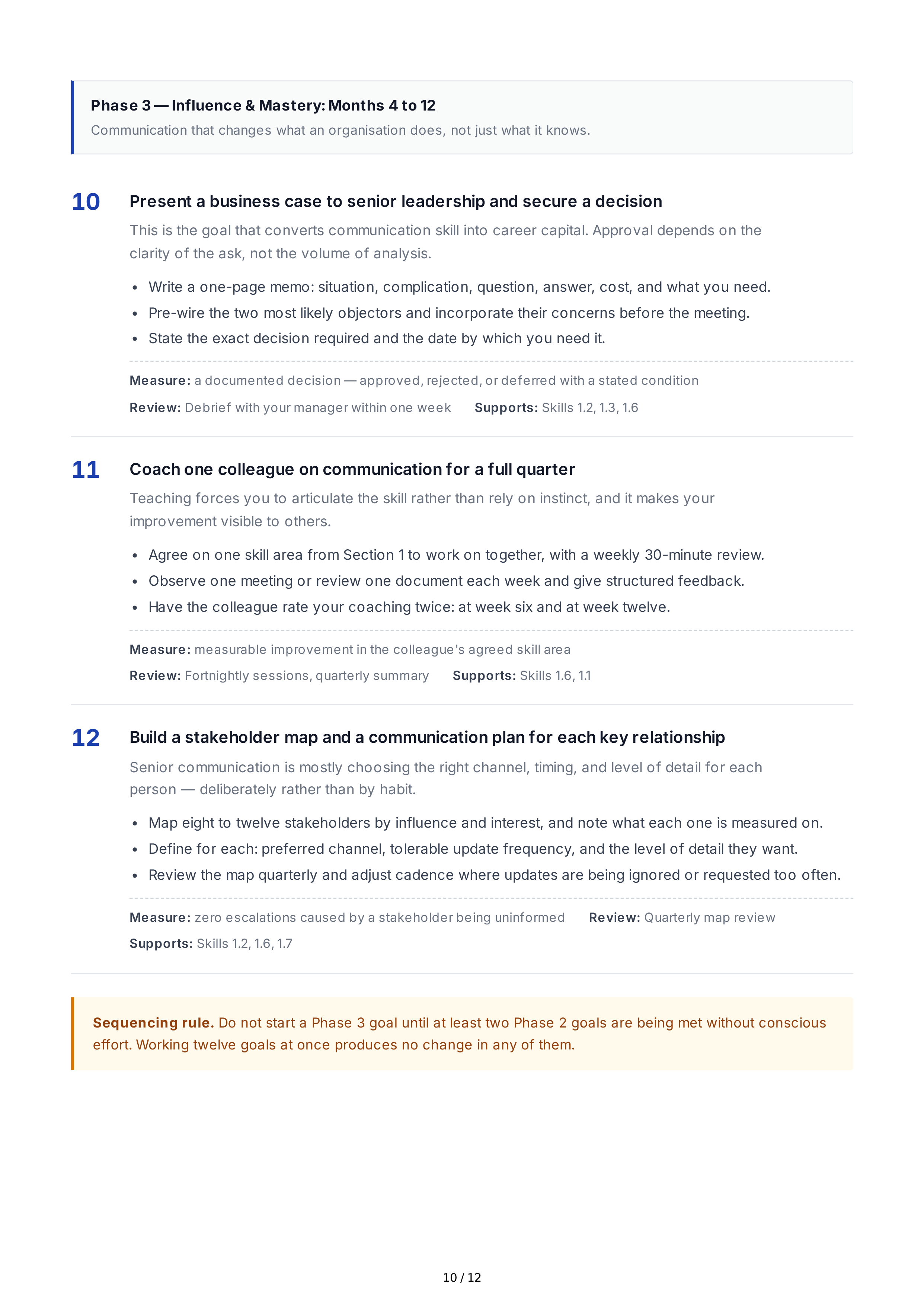
Phase
3 —
Influence
&
Mastery
:
Months
4
to
12
Communication
that
changes
what
an
organisation
does
,
not
just
what
it
knows
.
10
Present
a
business
case
to
senior
leadership
and
secure
a
decision
This
is
the
goal
that
converts
communication
skill
into
career
capital
.
Approval
depends
on
the
clarity
of
the
ask
,
not
the
volume
of
analysis
.
Write
a
one
-
page
memo
:
situation
,
complication
,
question
,
answer
,
cost
,
and
what
you
need
.
Pre
-
wire
the
two
most
likely
objectors
and
incorporate
their
concerns
before
the
meeting
.
State
the
exact
decision
required
and
the
date
by
which
you
need
it
.
Measure
:
a
documented
decision
—
approved
,
rejected
,
or
deferred
with
a
stated
condition
Review
:
Debrief
with
your
manager
within
one
week
Supports
:
Skills
1.2, 1.3, 1.6
11
Coach
one
colleague
on
communication
for
a
full
quarter
Teaching
forces
you
to
articulate
the
skill
rather
than
rely
on
instinct
,
and
it
makes
your
improvement
visible
to
others
.
Agree
on
one
skill
area
from
Section
1
to
work
on
together
,
with
a
weekly
30-
minute
review
.
Observe
one
meeting
or
review
one
document
each
week
and
give
structured
feedback
.
Have
the
colleague
rate
your
coaching
twice
:
at
week
six
and
at
week
twelve
.
Measure
:
measurable
improvement
in
the
colleague
'
s
agreed
skill
area
Review
:
Fortnightly
sessions
,
quarterly
summary
Supports
:
Skills
1.6, 1.1
12
Build
a
stakeholder
map
and
a
communication
plan
for
each
key
relationship
Senior
communication
is
mostly
choosing
the
right
channel
,
timing
,
and
level
of
detail
for
each
person
—
deliberately
rather
than
by
habit
.
Map
eight
to
twelve
stakeholders
by
influence
and
interest
,
and
note
what
each
one
is
measured
on
.
Define
for
each
:
preferred
channel
,
tolerable
update
frequency
,
and
the
level
of
detail
they
want
.
Review
the
map
quarterly
and
adjust
cadence
where
updates
are
being
ignored
or
requested
too
often
.
Measure
:
zero
escalations
caused
by
a
stakeholder
being
uninformed
Review
:
Quarterly
map
review
Supports
:
Skills
1.2, 1.6, 1.7
Sequencing
rule
.
Do
not
start
a
Phase
3
goal
until
at
least
two
Phase
2
goals
are
being
met
without
conscious
effort
.
Working
twelve
goals
at
once
produces
no
change
in
any
of
them
.
10 / 12
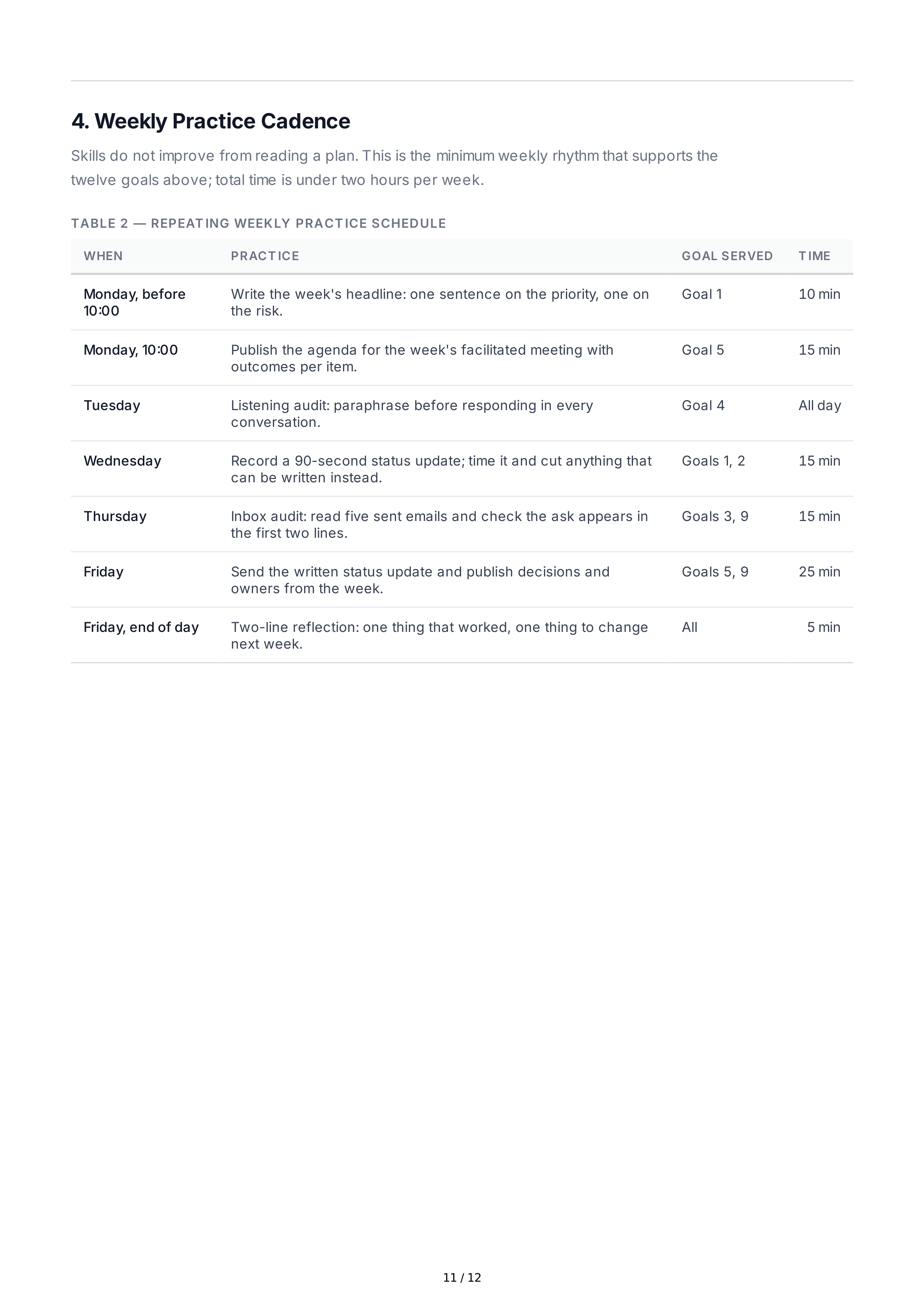
4.
Weekly
Practice
Cadence
Skills
do
not
improve
from
reading
a
plan
.
This
is
the
minimum
weekly
rhythm
that
supports
the
twelve
goals
above
;
total
time
is
under
two
hours
per
week
.
TABLE
2 —
REPEAT ING
WEEKLY
PRACT ICE
SCHEDULE
WHEN
PRACT ICE
GOAL
SERVED
T IME
Monday
,
before
10:00
Write
the
week
'
s
headline
:
one
sentence
on
the
priority
,
one
on
the
risk
.
Goal
1
10
min
Monday
, 10:00
Publish
the
agenda
for
the
week
'
s
facilitated
meeting
with
outcomes
per
item
.
Goal
5
15
min
Tuesday
Listening
audit
:
paraphrase
before
responding
in
every
conversation
.
Goal
4
All
day
Wednesday
Record
a
90-
second
status
update
;
time
it
and
cut
anything
that
can
be
written
instead
.
Goals
1, 2
15
min
Thursday
Inbox
audit
:
read
five
sent
emails
and
check
the
ask
appears
in
the
first
two
lines
.
Goals
3, 9
15
min
Friday
Send
the
written
status
update
and
publish
decisions
and
owners
from
the
week
.
Goals
5, 9
25
min
Friday
,
end
of
day
Two
-
line
reflection
:
one
thing
that
worked
,
one
thing
to
change
next
week
.
All
5
min
11 / 12
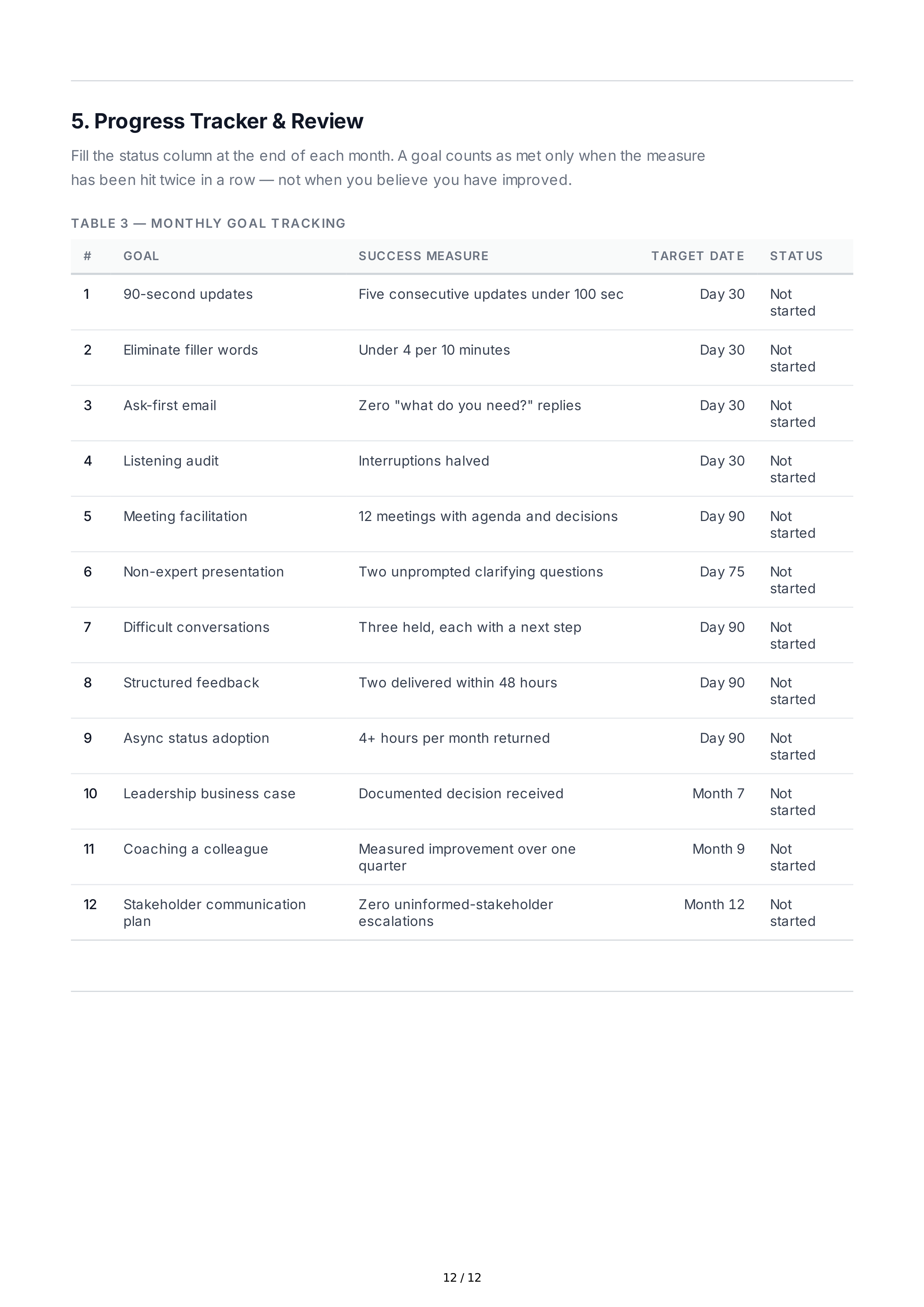
5.
Progress
Tracker
&
Review
Fill
the
status
column
at
the
end
of
each
month
.
A
goal
counts
as
met
only
when
the
measure
has
been
hit
twice
in
a
row
—
not
when
you
believe
you
have
improved
.
TABLE
3 —
MONT HLY
GOAL
T RACKING
#
GOAL
SUCCESS
MEASURE
TARGET
DAT E
STAT US
1
90-
second
updates
Five
consecutive
updates
under
100
sec
Day
30
Not
started
2
Eliminate
filler
words
Under
4
per
10
minutes
Day
30
Not
started
3
Ask
-
first
email
Zero
"
what
do
you
need
?"
replies
Day
30
Not
started
4
Listening
audit
Interruptions
halved
Day
30
Not
started
5
Meeting
facilitation
12
meetings
with
agenda
and
decisions
Day
90
Not
started
6
Non
-
expert
presentation
Two
unprompted
clarifying
questions
Day
75
Not
started
7
Difficult
conversations
Three
held
,
each
with
a
next
step
Day
90
Not
started
8
Structured
feedback
Two
delivered
within
48
hours
Day
90
Not
started
9
Async
status
adoption
4+
hours
per
month
returned
Day
90
Not
started
10
Leadership
business
case
Documented
decision
received
Month
7
Not
started
11
Coaching
a
colleague
Measured
improvement
over
one
quarter
Month
9
Not
started
12
Stakeholder
communication
plan
Zero
uninformed
-
stakeholder
escalations
Month
12
Not
started
12 / 12