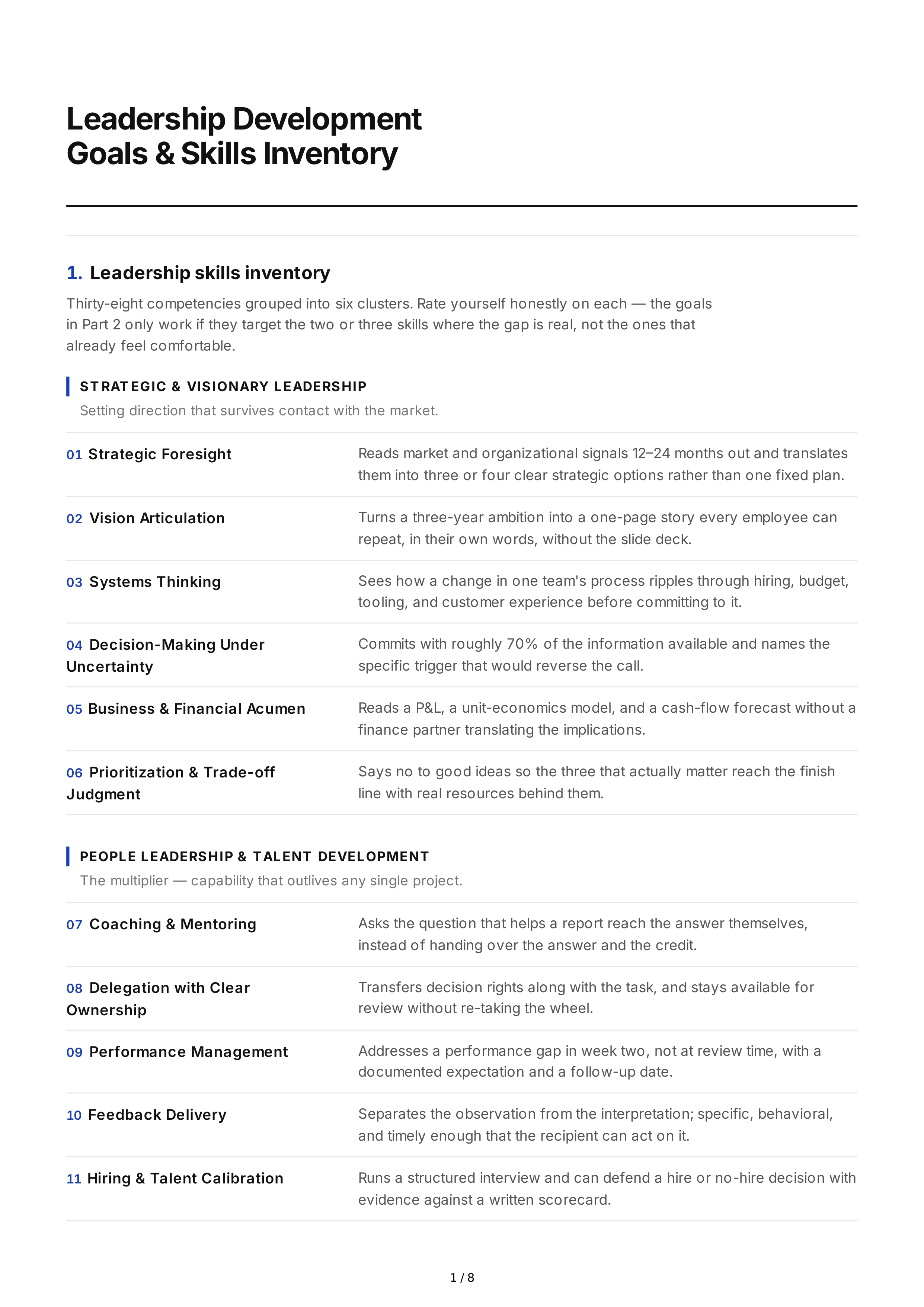
Leadership
Development
Goals
&
Skills
Inventory
1.
Leadership
skills
inventory
Thirty
-
eight
competencies
grouped
into
six
clusters
.
Rate
yourself
honestly
on
each
—
the
goals
in
Part
2
only
work
if
they
target
the
two
or
three
skills
where
the
gap
is
real
,
not
the
ones
that
already
feel
comfortable
.
ST RAT EGIC
&
VISIONARY
LEADERSHIP
Setting
direction
that
survives
contact
with
the
market
.
01
Strategic
Foresight
Reads
market
and
organizational
signals
12–24
months
out
and
translates
them
into
three
or
four
clear
strategic
options
rather
than
one
fixed
plan
.
02
Vision
Articulation
Turns
a
three
-
year
ambition
into
a
one
-
page
story
every
employee
can
repeat
,
in
their
own
words
,
without
the
slide
deck
.
03
Systems
Thinking
Sees
how
a
change
in
one
team
'
s
process
ripples
through
hiring
,
budget
,
tooling
,
and
customer
experience
before
committing
to
it
.
04
Decision
-
Making
Under
Uncertainty
Commits
with
roughly
70%
of
the
information
available
and
names
the
specific
trigger
that
would
reverse
the
call
.
05
Business
&
Financial
Acumen
Reads
a
P
&
L
,
a
unit
-
economics
model
,
and
a
cash
-
flow
forecast
without
a
finance
partner
translating
the
implications
.
06
Prioritization
&
Trade
-
off
Judgment
Says
no
to
good
ideas
so
the
three
that
actually
matter
reach
the
finish
line
with
real
resources
behind
them
.
PEOPLE
LEADERSHIP
&
TALENT
DEVELOPMENT
The
multiplier
—
capability
that
outlives
any
single
project
.
07
Coaching
&
Mentoring
Asks
the
question
that
helps
a
report
reach
the
answer
themselves
,
instead
of
handing
over
the
answer
and
the
credit
.
08
Delegation
with
Clear
Ownership
Transfers
decision
rights
along
with
the
task
,
and
stays
available
for
review
without
re
-
taking
the
wheel
.
09
Performance
Management
Addresses
a
performance
gap
in
week
two
,
not
at
review
time
,
with
a
documented
expectation
and
a
follow
-
up
date
.
10
Feedback
Delivery
Separates
the
observation
from
the
interpretation
;
specific
,
behavioral
,
and
timely
enough
that
the
recipient
can
act
on
it
.
11
Hiring
&
Talent
Calibration
Runs
a
structured
interview
and
can
defend
a
hire
or
no
-
hire
decision
with
evidence
against
a
written
scorecard
.
1 / 8
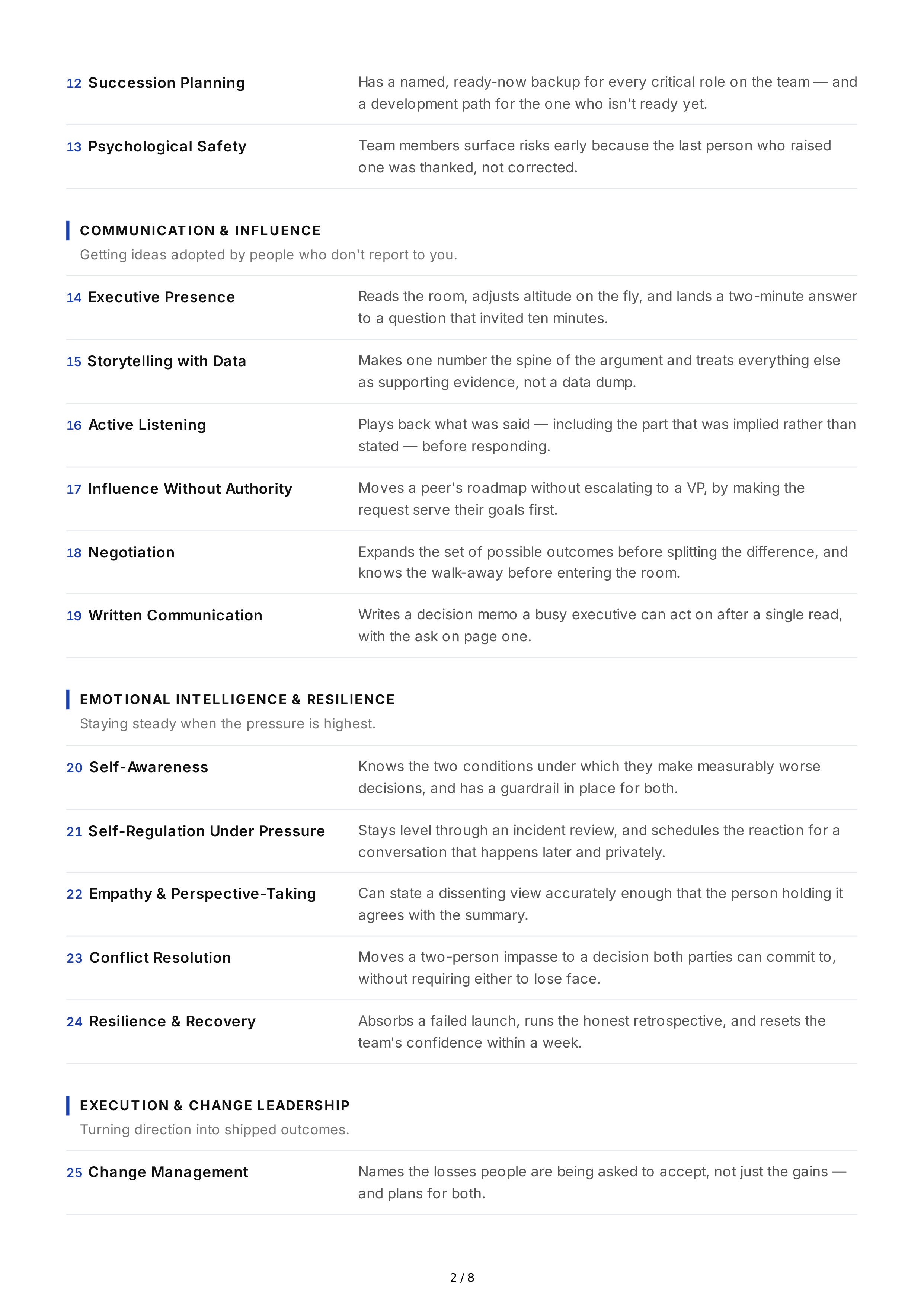
12
Succession
Planning
Has
a
named
,
ready
-
now
backup
for
every
critical
role
on
the
team
—
and
a
development
path
for
the
one
who
isn
'
t
ready
yet
.
13
Psychological
Safety
Team
members
surface
risks
early
because
the
last
person
who
raised
one
was
thanked
,
not
corrected
.
COMMUNICAT ION
&
INFLUENCE
Getting
ideas
adopted
by
people
who
don
'
t
report
to
you
.
14
Executive
Presence
Reads
the
room
,
adjusts
altitude
on
the
fly
,
and
lands
a
two
-
minute
answer
to
a
question
that
invited
ten
minutes
.
15
Storytelling
with
Data
Makes
one
number
the
spine
of
the
argument
and
treats
everything
else
as
supporting
evidence
,
not
a
data
dump
.
16
Active
Listening
Plays
back
what
was
said
—
including
the
part
that
was
implied
rather
than
stated
—
before
responding
.
17
Influence
Without
Authority
Moves
a
peer
'
s
roadmap
without
escalating
to
a
VP
,
by
making
the
request
serve
their
goals
first
.
18
Negotiation
Expands
the
set
of
possible
outcomes
before
splitting
the
difference
,
and
knows
the
walk
-
away
before
entering
the
room
.
19
Written
Communication
Writes
a
decision
memo
a
busy
executive
can
act
on
after
a
single
read
,
with
the
ask
on
page
one
.
EMOT IONAL
INT ELLIGENCE
&
RESILIENCE
Staying
steady
when
the
pressure
is
highest
.
20
Self
-
Awareness
Knows
the
two
conditions
under
which
they
make
measurably
worse
decisions
,
and
has
a
guardrail
in
place
for
both
.
21
Self
-
Regulation
Under
Pressure
Stays
level
through
an
incident
review
,
and
schedules
the
reaction
for
a
conversation
that
happens
later
and
privately
.
22
Empathy
&
Perspective
-
Taking
Can
state
a
dissenting
view
accurately
enough
that
the
person
holding
it
agrees
with
the
summary
.
23
Conflict
Resolution
Moves
a
two
-
person
impasse
to
a
decision
both
parties
can
commit
to
,
without
requiring
either
to
lose
face
.
24
Resilience
&
Recovery
Absorbs
a
failed
launch
,
runs
the
honest
retrospective
,
and
resets
the
team
'
s
confidence
within
a
week
.
EXECUT ION
&
CHANGE
LEADERSHIP
Turning
direction
into
shipped
outcomes
.
25
Change
Management
Names
the
losses
people
are
being
asked
to
accept
,
not
just
the
gains
—
and
plans
for
both
.
2 / 8
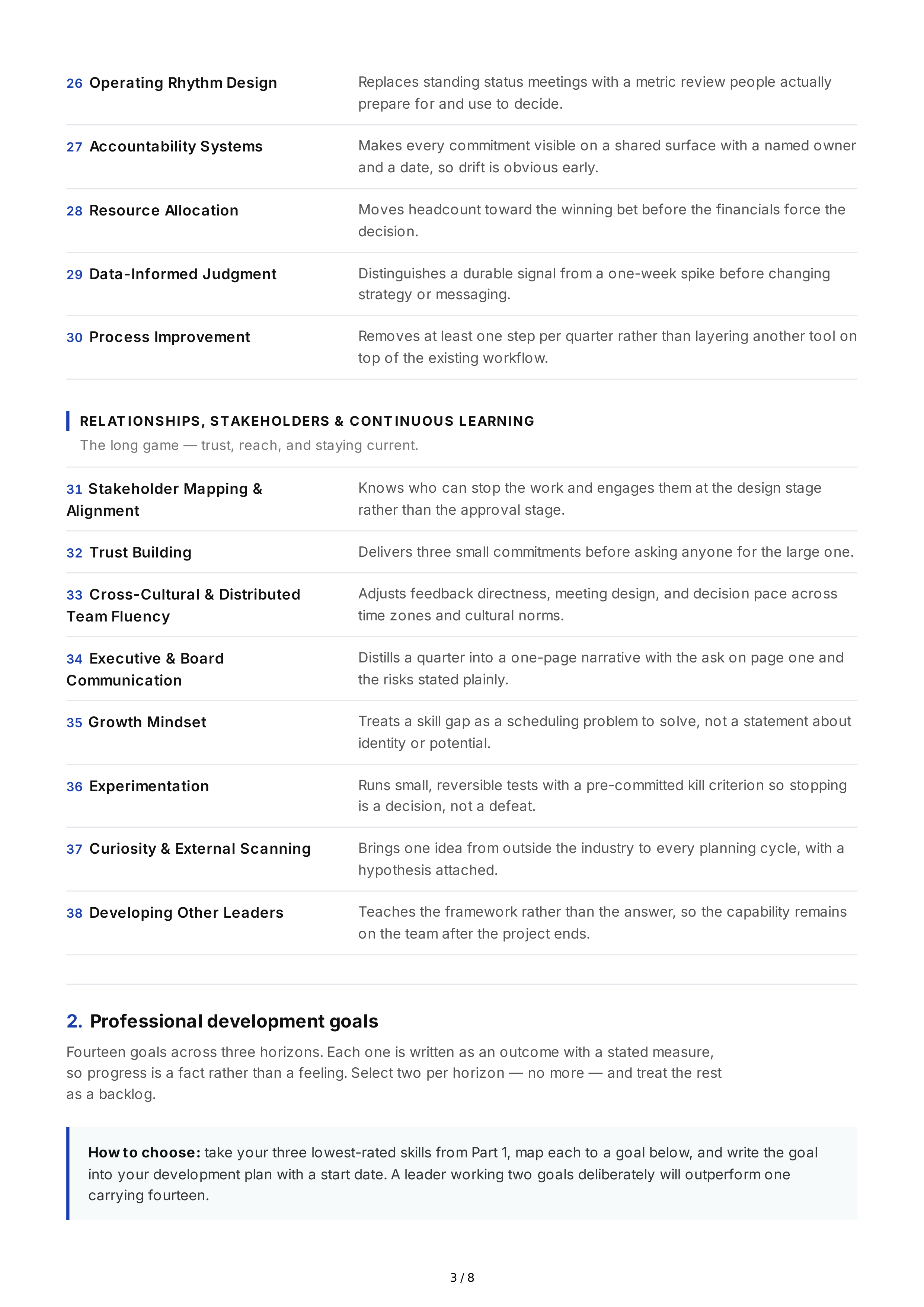
26
Operating
Rhythm
Design
Replaces
standing
status
meetings
with
a
metric
review
people
actually
prepare
for
and
use
to
decide
.
27
Accountability
Systems
Makes
every
commitment
visible
on
a
shared
surface
with
a
named
owner
and
a
date
,
so
drift
is
obvious
early
.
28
Resource
Allocation
Moves
headcount
toward
the
winning
bet
before
the
financials
force
the
decision
.
29
Data
-
Informed
Judgment
Distinguishes
a
durable
signal
from
a
one
-
week
spike
before
changing
strategy
or
messaging
.
30
Process
Improvement
Removes
at
least
one
step
per
quarter
rather
than
layering
another
tool
on
top
of
the
existing
workflow
.
RELAT IONSHIPS
,
STAKEHOLDERS
&
CONT INUOUS
LEARNING
The
long
game
—
trust
,
reach
,
and
staying
current
.
31
Stakeholder
Mapping
&
Alignment
Knows
who
can
stop
the
work
and
engages
them
at
the
design
stage
rather
than
the
approval
stage
.
32
Trust
Building
Delivers
three
small
commitments
before
asking
anyone
for
the
large
one
.
33
Cross
-
Cultural
&
Distributed
Team
Fluency
Adjusts
feedback
directness
,
meeting
design
,
and
decision
pace
across
time
zones
and
cultural
norms
.
34
Executive
&
Board
Communication
Distills
a
quarter
into
a
one
-
page
narrative
with
the
ask
on
page
one
and
the
risks
stated
plainly
.
35
Growth
Mindset
Treats
a
skill
gap
as
a
scheduling
problem
to
solve
,
not
a
statement
about
identity
or
potential
.
36
Experimentation
Runs
small
,
reversible
tests
with
a
pre
-
committed
kill
criterion
so
stopping
is
a
decision
,
not
a
defeat
.
37
Curiosity
&
External
Scanning
Brings
one
idea
from
outside
the
industry
to
every
planning
cycle
,
with
a
hypothesis
attached
.
38
Developing
Other
Leaders
Teaches
the
framework
rather
than
the
answer
,
so
the
capability
remains
on
the
team
after
the
project
ends
.
2.
Professional
development
goals
Fourteen
goals
across
three
horizons
.
Each
one
is
written
as
an
outcome
with
a
stated
measure
,
so
progress
is
a
fact
rather
than
a
feeling
.
Select
two
per
horizon
—
no
more
—
and
treat
the
rest
as
a
backlog
.
How
to
choose
:
take
your
three
lowest
-
rated
skills
from
Part
1,
map
each
to
a
goal
below
,
and
write
the
goal
into
your
development
plan
with
a
start
date
.
A
leader
working
two
goals
deliberately
will
outperform
one
carrying
fourteen
.
3 / 8
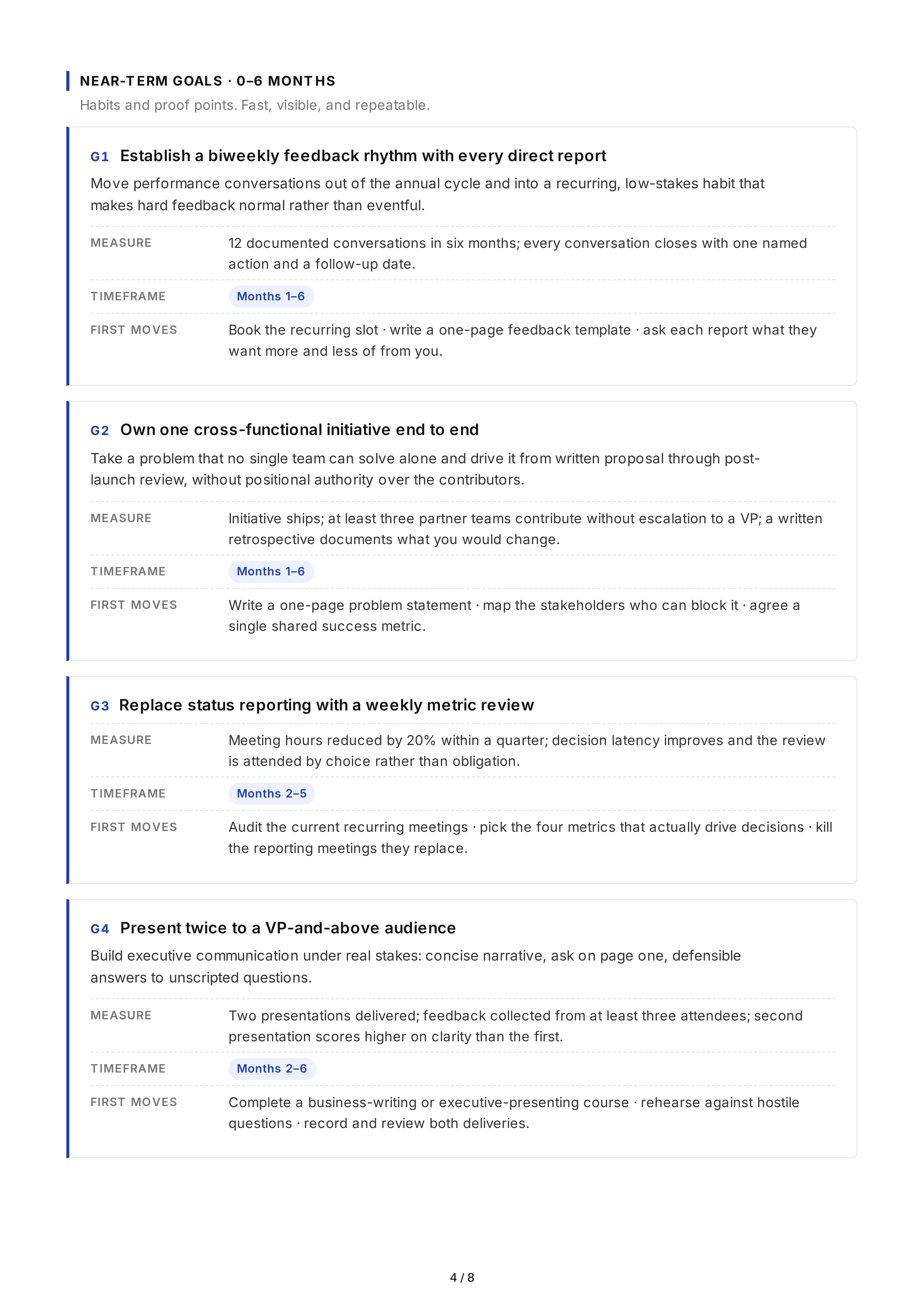
NEAR
-
T ERM
GOALS
· 0–6
MONT HS
Habits
and
proof
points
.
Fast
,
visible
,
and
repeatable
.
G
1
Establish
a
biweekly
feedback
rhythm
with
every
direct
report
Move
performance
conversations
out
of
the
annual
cycle
and
into
a
recurring
,
low
-
stakes
habit
that
makes
hard
feedback
normal
rather
than
eventful
.
MEASURE
12
documented
conversations
in
six
months
;
every
conversation
closes
with
one
named
action
and
a
follow
-
up
date
.
TIMEFRAME
Months
1–6
FIRST
MOVES
Book
the
recurring
slot
·
write
a
one
-
page
feedback
template
·
ask
each
report
what
they
want
more
and
less
of
from
you
.
G
2
Own
one
cross
-
functional
initiative
end
to
end
Take
a
problem
that
no
single
team
can
solve
alone
and
drive
it
from
written
proposal
through
post
-
launch
review
,
without
positional
authority
over
the
contributors
.
MEASURE
Initiative
ships
;
at
least
three
partner
teams
contribute
without
escalation
to
a
VP
;
a
written
retrospective
documents
what
you
would
change
.
TIMEFRAME
Months
1–6
FIRST
MOVES
Write
a
one
-
page
problem
statement
·
map
the
stakeholders
who
can
block
it
·
agree
a
single
shared
success
metric
.
G
3
Replace
status
reporting
with
a
weekly
metric
review
MEASURE
Meeting
hours
reduced
by
20%
within
a
quarter
;
decision
latency
improves
and
the
review
is
attended
by
choice
rather
than
obligation
.
TIMEFRAME
Months
2–5
FIRST
MOVES
Audit
the
current
recurring
meetings
·
pick
the
four
metrics
that
actually
drive
decisions
·
kill
the
reporting
meetings
they
replace
.
G
4
Present
twice
to
a
VP
-
and
-
above
audience
Build
executive
communication
under
real
stakes
:
concise
narrative
,
ask
on
page
one
,
defensible
answers
to
unscripted
questions
.
MEASURE
Two
presentations
delivered
;
feedback
collected
from
at
least
three
attendees
;
second
presentation
scores
higher
on
clarity
than
the
first
.
TIMEFRAME
Months
2–6
FIRST
MOVES
Complete
a
business
-
writing
or
executive
-
presenting
course
·
rehearse
against
hostile
questions
·
record
and
review
both
deliveries
.
4 / 8
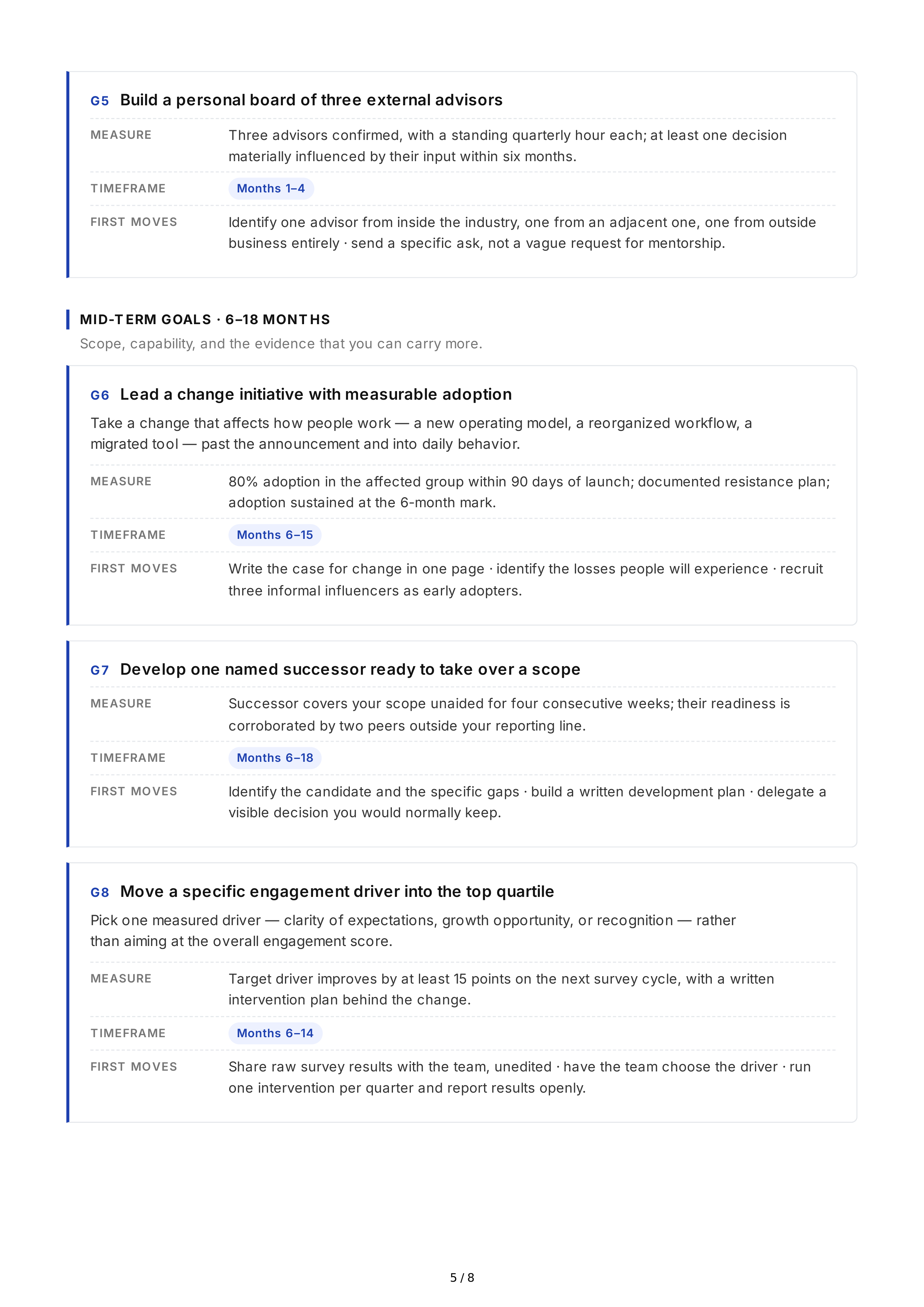
G
5
Build
a
personal
board
of
three
external
advisors
MEASURE
Three
advisors
confirmed
,
with
a
standing
quarterly
hour
each
;
at
least
one
decision
materially
influenced
by
their
input
within
six
months
.
TIMEFRAME
Months
1–4
FIRST
MOVES
Identify
one
advisor
from
inside
the
industry
,
one
from
an
adjacent
one
,
one
from
outside
business
entirely
·
send
a
specific
ask
,
not
a
vague
request
for
mentorship
.
MID
-
T ERM
GOALS
· 6–18
MONT HS
Scope
,
capability
,
and
the
evidence
that
you
can
carry
more
.
G
6
Lead
a
change
initiative
with
measurable
adoption
Take
a
change
that
affects
how
people
work
—
a
new
operating
model
,
a
reorganized
workflow
,
a
migrated
tool
—
past
the
announcement
and
into
daily
behavior
.
MEASURE
80%
adoption
in
the
affected
group
within
90
days
of
launch
;
documented
resistance
plan
;
adoption
sustained
at
the
6-
month
mark
.
TIMEFRAME
Months
6–15
FIRST
MOVES
Write
the
case
for
change
in
one
page
·
identify
the
losses
people
will
experience
·
recruit
three
informal
influencers
as
early
adopters
.
G
7
Develop
one
named
successor
ready
to
take
over
a
scope
MEASURE
Successor
covers
your
scope
unaided
for
four
consecutive
weeks
;
their
readiness
is
corroborated
by
two
peers
outside
your
reporting
line
.
TIMEFRAME
Months
6–18
FIRST
MOVES
Identify
the
candidate
and
the
specific
gaps
·
build
a
written
development
plan
·
delegate
a
visible
decision
you
would
normally
keep
.
G
8
Move
a
specific
engagement
driver
into
the
top
quartile
Pick
one
measured
driver
—
clarity
of
expectations
,
growth
opportunity
,
or
recognition
—
rather
than
aiming
at
the
overall
engagement
score
.
MEASURE
Target
driver
improves
by
at
least
15
points
on
the
next
survey
cycle
,
with
a
written
intervention
plan
behind
the
change
.
TIMEFRAME
Months
6–14
FIRST
MOVES
Share
raw
survey
results
with
the
team
,
unedited
·
have
the
team
choose
the
driver
·
run
one
intervention
per
quarter
and
report
results
openly
.
5 / 8
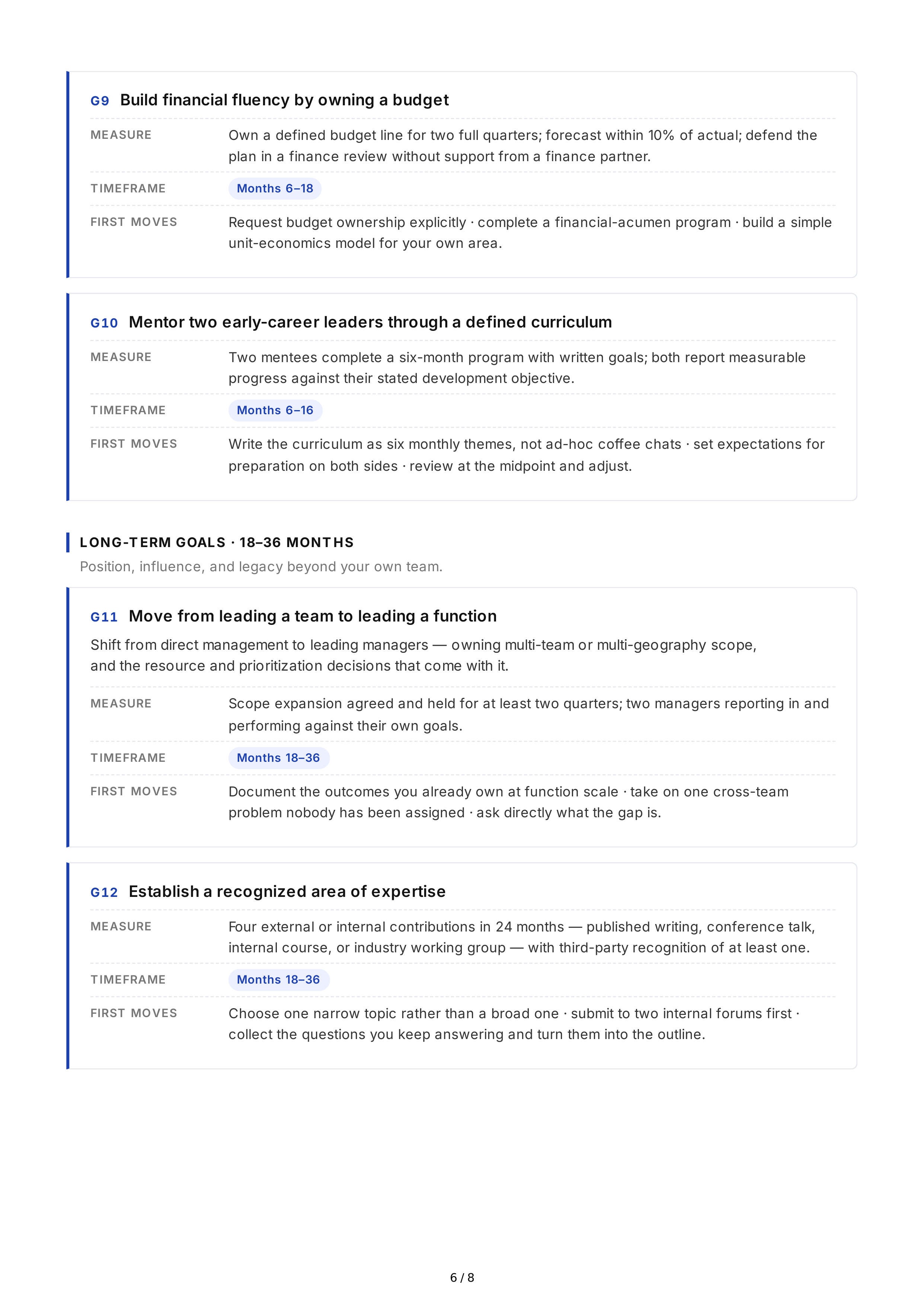
G
9
Build
financial
fluency
by
owning
a
budget
MEASURE
Own
a
defined
budget
line
for
two
full
quarters
;
forecast
within
10%
of
actual
;
defend
the
plan
in
a
finance
review
without
support
from
a
finance
partner
.
TIMEFRAME
Months
6–18
FIRST
MOVES
Request
budget
ownership
explicitly
·
complete
a
financial
-
acumen
program
·
build
a
simple
unit
-
economics
model
for
your
own
area
.
G
10
Mentor
two
early
-
career
leaders
through
a
defined
curriculum
MEASURE
Two
mentees
complete
a
six
-
month
program
with
written
goals
;
both
report
measurable
progress
against
their
stated
development
objective
.
TIMEFRAME
Months
6–16
FIRST
MOVES
Write
the
curriculum
as
six
monthly
themes
,
not
ad
-
hoc
coffee
chats
·
set
expectations
for
preparation
on
both
sides
·
review
at
the
midpoint
and
adjust
.
LONG
-
T ERM
GOALS
· 18–36
MONT HS
Position
,
influence
,
and
legacy
beyond
your
own
team
.
G
11
Move
from
leading
a
team
to
leading
a
function
Shift
from
direct
management
to
leading
managers
—
owning
multi
-
team
or
multi
-
geography
scope
,
and
the
resource
and
prioritization
decisions
that
come
with
it
.
MEASURE
Scope
expansion
agreed
and
held
for
at
least
two
quarters
;
two
managers
reporting
in
and
performing
against
their
own
goals
.
TIMEFRAME
Months
18–36
FIRST
MOVES
Document
the
outcomes
you
already
own
at
function
scale
·
take
on
one
cross
-
team
problem
nobody
has
been
assigned
·
ask
directly
what
the
gap
is
.
G
12
Establish
a
recognized
area
of
expertise
MEASURE
Four
external
or
internal
contributions
in
24
months
—
published
writing
,
conference
talk
,
internal
course
,
or
industry
working
group
—
with
third
-
party
recognition
of
at
least
one
.
TIMEFRAME
Months
18–36
FIRST
MOVES
Choose
one
narrow
topic
rather
than
a
broad
one
·
submit
to
two
internal
forums
first
·
collect
the
questions
you
keep
answering
and
turn
them
into
the
outline
.
6 / 8
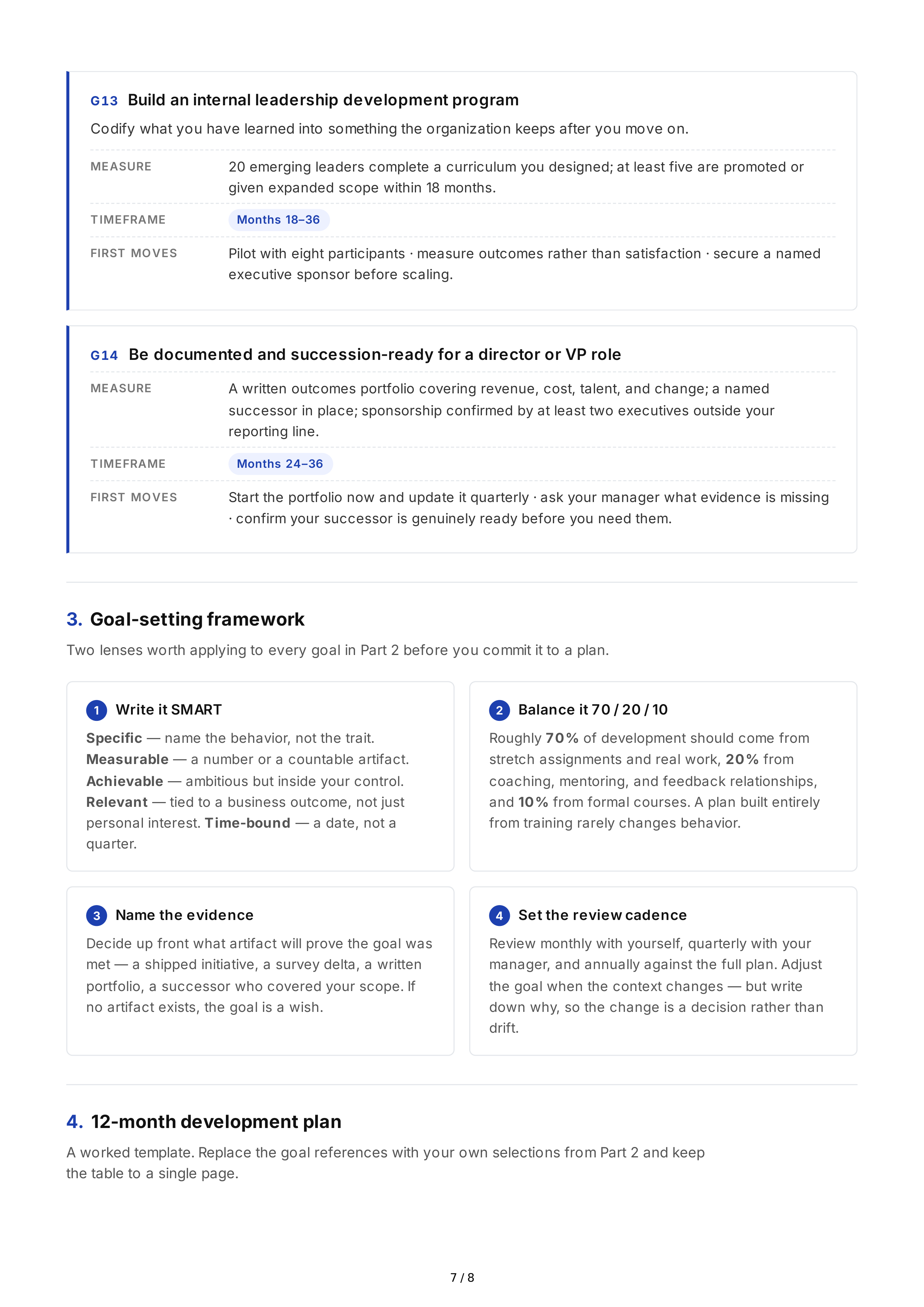
G
13
Build
an
internal
leadership
development
program
Codify
what
you
have
learned
into
something
the
organization
keeps
after
you
move
on
.
MEASURE
20
emerging
leaders
complete
a
curriculum
you
designed
;
at
least
five
are
promoted
or
given
expanded
scope
within
18
months
.
TIMEFRAME
Months
18–36
FIRST
MOVES
Pilot
with
eight
participants
·
measure
outcomes
rather
than
satisfaction
·
secure
a
named
executive
sponsor
before
scaling
.
G
14
Be
documented
and
succession
-
ready
for
a
director
or
VP
role
MEASURE
A
written
outcomes
portfolio
covering
revenue
,
cost
,
talent
,
and
change
;
a
named
successor
in
place
;
sponsorship
confirmed
by
at
least
two
executives
outside
your
reporting
line
.
TIMEFRAME
Months
24–36
FIRST
MOVES
Start
the
portfolio
now
and
update
it
quarterly
·
ask
your
manager
what
evidence
is
missing
·
confirm
your
successor
is
genuinely
ready
before
you
need
them
.
3.
Goal
-
setting
framework
Two
lenses
worth
applying
to
every
goal
in
Part
2
before
you
commit
it
to
a
plan
.
1
Write
it
SMART
Specific
—
name
the
behavior
,
not
the
trait
.
Measurable
—
a
number
or
a
countable
artifact
.
Achievable
—
ambitious
but
inside
your
control
.
Relevant
—
tied
to
a
business
outcome
,
not
just
personal
interest
.
Time
-
bound
—
a
date
,
not
a
quarter
.
2
Balance
it
70 / 20 / 10
Roughly
70%
of
development
should
come
from
stretch
assignments
and
real
work
,
20%
from
coaching
,
mentoring
,
and
feedback
relationships
,
and
10%
from
formal
courses
.
A
plan
built
entirely
from
training
rarely
changes
behavior
.
3
Name
the
evidence
Decide
up
front
what
artifact
will
prove
the
goal
was
met
—
a
shipped
initiative
,
a
survey
delta
,
a
written
portfolio
,
a
successor
who
covered
your
scope
.
If
no
artifact
exists
,
the
goal
is
a
wish
.
4
Set
the
review
cadence
Review
monthly
with
yourself
,
quarterly
with
your
manager
,
and
annually
against
the
full
plan
.
Adjust
the
goal
when
the
context
changes
—
but
write
down
why
,
so
the
change
is
a
decision
rather
than
drift
.
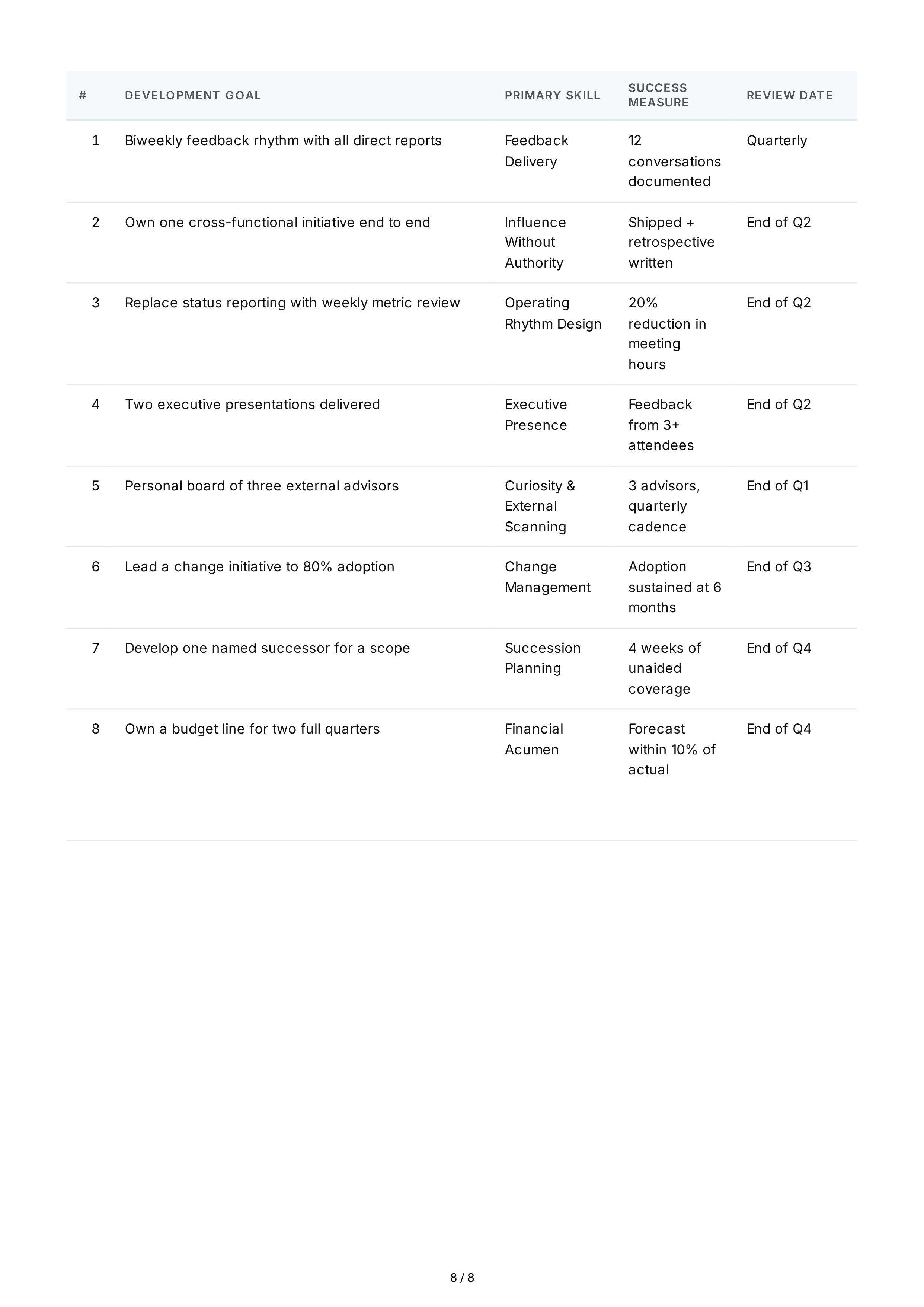
4.
12-
month
development
plan
A
worked
template
.
Replace
the
goal
references
with
your
own
selections
from
Part
2
and
keep
the
table
to
a
single
page
.
7 / 8
#
DEVELOPMENT
GOAL
PRIMARY
SKILL
SUCCESS
MEASURE
REVIEW
DATE
1
Biweekly
feedback
rhythm
with
all
direct
reports
Feedback
Delivery
12
conversations
documented
Quarterly
2
Own
one
cross
-
functional
initiative
end
to
end
Influence
Without
Authority
Shipped
+
retrospective
written
End
of
Q
2
3
Replace
status
reporting
with
weekly
metric
review
Operating
Rhythm
Design
20%
reduction
in
meeting
hours
End
of
Q
2
4
Two
executive
presentations
delivered
Executive
Presence
Feedback
from
3+
attendees
End
of
Q
2
5
Personal
board
of
three
external
advisors
Curiosity
&
External
Scanning
3
advisors
,
quarterly
cadence
End
of
Q
1
6
Lead
a
change
initiative
to
80%
adoption
Change
Management
Adoption
sustained
at
6
months
End
of
Q
3
7
Develop
one
named
successor
for
a
scope
Succession
Planning
4
weeks
of
unaided
coverage
End
of
Q
4
8
Own
a
budget
line
for
two
full
quarters
Financial
Acumen
Forecast
within
10%
of
actual
End
of
Q
4
8 / 8