
Skills
,
Goals
&
Promotion
Readiness
1 / 8
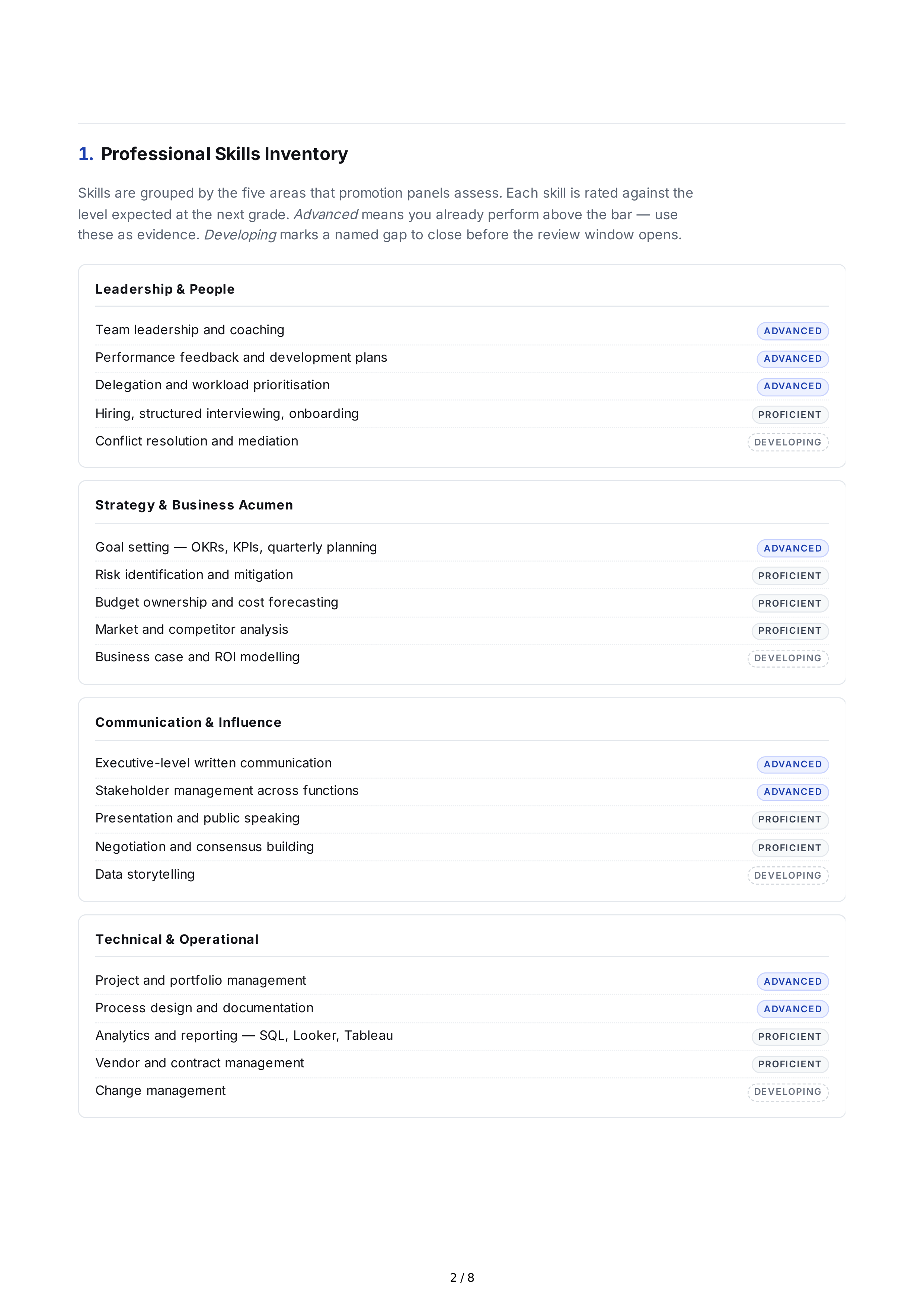
1.
Professional
Skills
Inventory
Skills
are
grouped
by
the
five
areas
that
promotion
panels
assess
.
Each
skill
is
rated
against
the
level
expected
at
the
next
grade
.
Advanced
means
you
already
perform
above
the
bar
—
use
these
as
evidence
.
Developing
marks
a
named
gap
to
close
before
the
review
window
opens
.
Leadership
&
People
Team
leadership
and
coaching
ADVANCED
Performance
feedback
and
development
plans
ADVANCED
Delegation
and
workload
prioritisation
ADVANCED
Hiring
,
structured
interviewing
,
onboarding
PROFICIENT
Conflict
resolution
and
mediation
DEVELOPING
Strategy
&
Business
Acumen
Goal
setting
—
OKRs
,
KPIs
,
quarterly
planning
ADVANCED
Risk
identification
and
mitigation
PROFICIENT
Budget
ownership
and
cost
forecasting
PROFICIENT
Market
and
competitor
analysis
PROFICIENT
Business
case
and
ROI
modelling
DEVELOPING
Communication
&
Influence
Executive
-
level
written
communication
ADVANCED
Stakeholder
management
across
functions
ADVANCED
Presentation
and
public
speaking
PROFICIENT
Negotiation
and
consensus
building
PROFICIENT
Data
storytelling
DEVELOPING
Technical
&
Operational
Project
and
portfolio
management
ADVANCED
Process
design
and
documentation
ADVANCED
Analytics
and
reporting
—
SQL
,
Looker
,
Tableau
PROFICIENT
Vendor
and
contract
management
PROFICIENT
Change
management
DEVELOPING
2 / 8
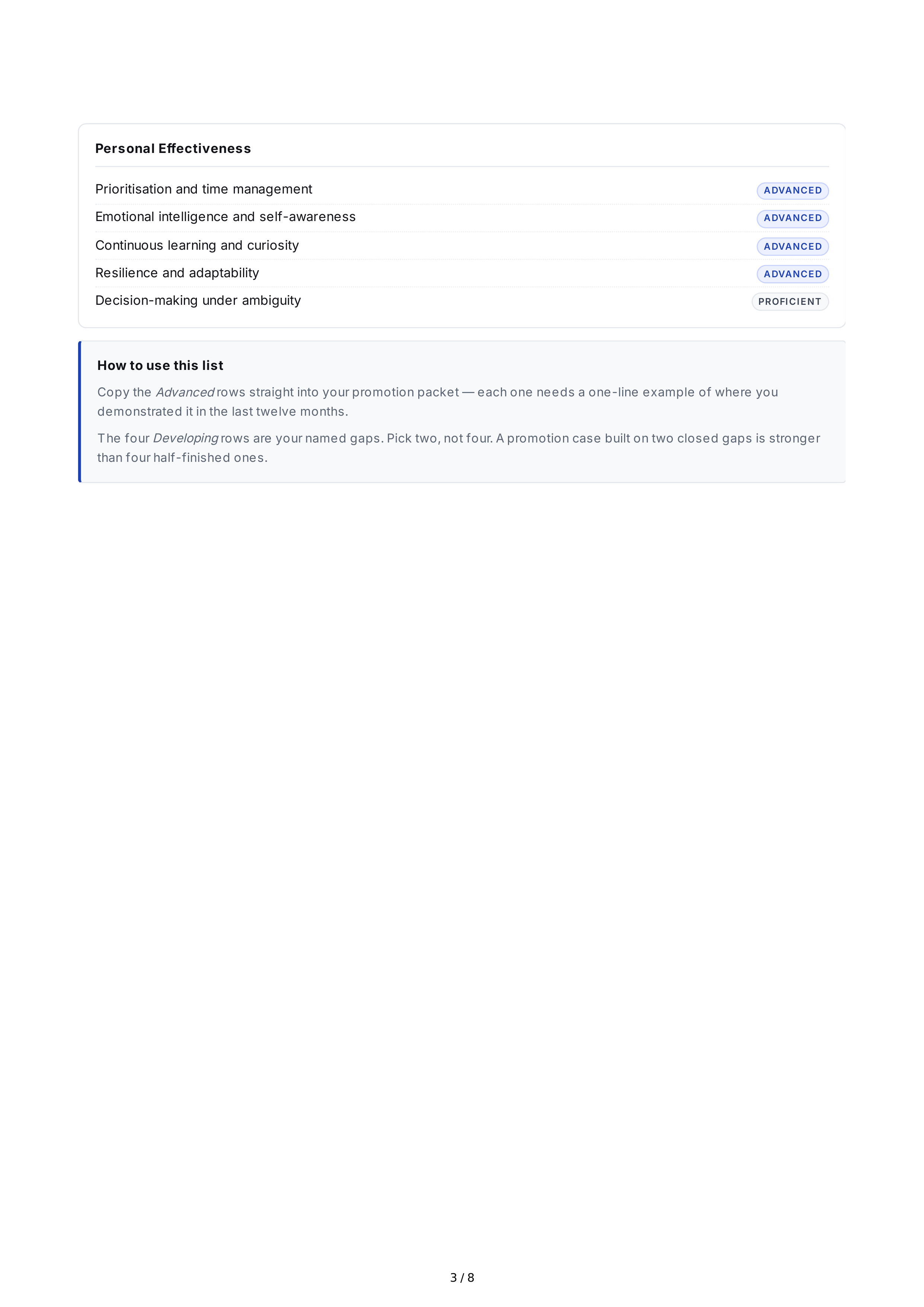
Personal
Effectiveness
Prioritisation
and
time
management
ADVANCED
Emotional
intelligence
and
self
-
awareness
ADVANCED
Continuous
learning
and
curiosity
ADVANCED
Resilience
and
adaptability
ADVANCED
Decision
-
making
under
ambiguity
PROFICIENT
How
to
use
this
list
Copy
the
Advanced
rows
straight
into
your
promotion
packet
—
each
one
needs
a
one
-
line
example
of
where
you
demonstrated
it
in
the
last
twelve
months
.
The
four
Developing
rows
are
your
named
gaps
.
Pick
two
,
not
four
.
A
promotion
case
built
on
two
closed
gaps
is
stronger
than
four
half
-
finished
ones
.
3 / 8
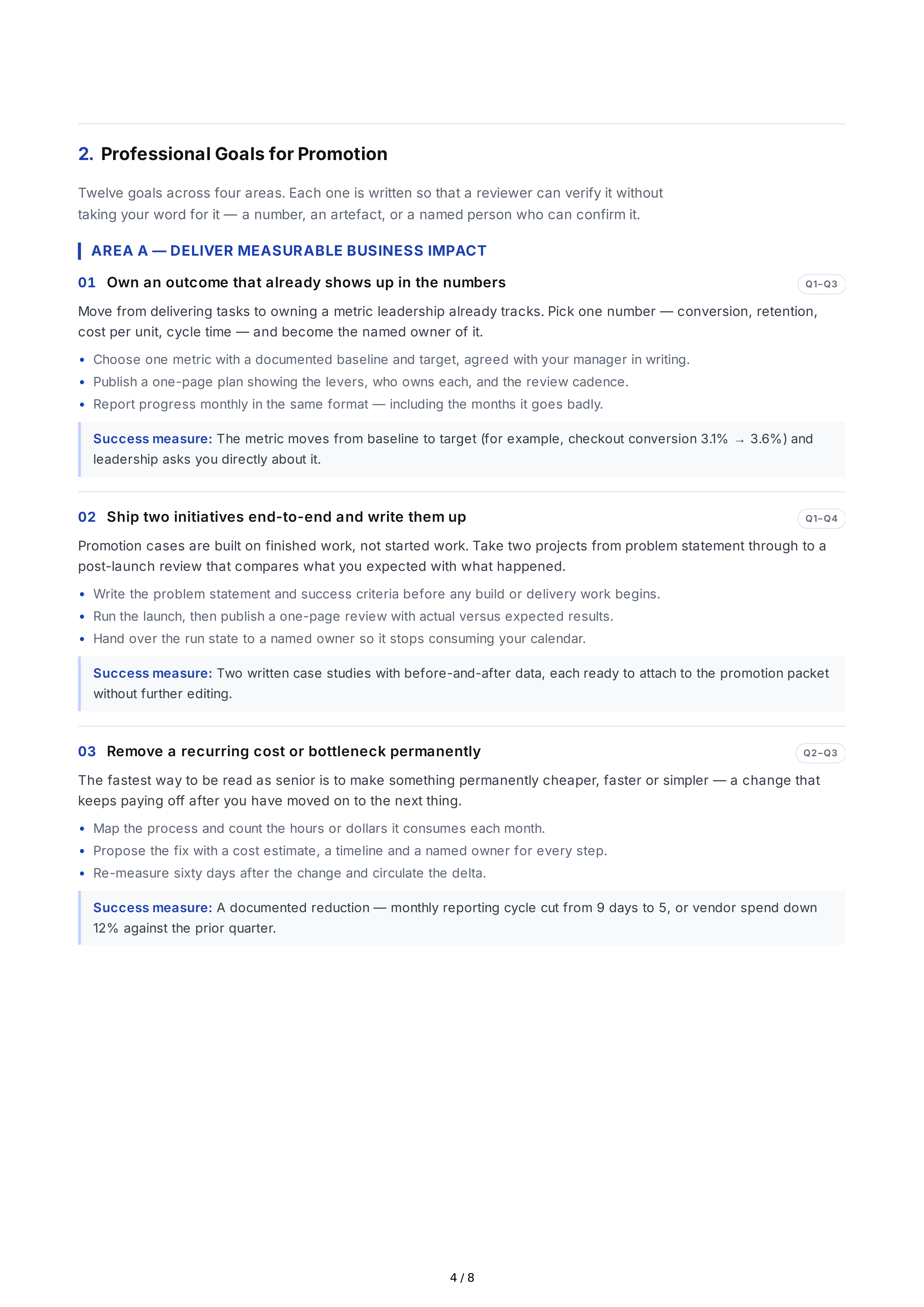
2.
Professional
Goals
for
Promotion
Twelve
goals
across
four
areas
.
Each
one
is
written
so
that
a
reviewer
can
verify
it
without
taking
your
word
for
it
—
a
number
,
an
artefact
,
or
a
named
person
who
can
confirm
it
.
AREA
A
—
DELIVER
MEASURABLE
BUSINESS
IMPACT
01
Own
an
outcome
that
already
shows
up
in
the
numbers
Q
1–
Q
3
Move
from
delivering
tasks
to
owning
a
metric
leadership
already
tracks
.
Pick
one
number
—
conversion
,
retention
,
cost
per
unit
,
cycle
time
—
and
become
the
named
owner
of
it
.
Success
measure
:
The
metric
moves
from
baseline
to
target
(
for
example
,
checkout
conversion
3.1%
→
3.6%)
and
leadership
asks
you
directly
about
it
.
02
Ship
two
initiatives
end
-
to
-
end
and
write
them
up
Q
1–
Q
4
Promotion
cases
are
built
on
finished
work
,
not
started
work
.
Take
two
projects
from
problem
statement
through
to
a
post
-
launch
review
that
compares
what
you
expected
with
what
happened
.
Success
measure
:
Two
written
case
studies
with
before
-
and
-
after
data
,
each
ready
to
attach
to
the
promotion
packet
without
further
editing
.
03
Remove
a
recurring
cost
or
bottleneck
permanently
Q
2–
Q
3
The
fastest
way
to
be
read
as
senior
is
to
make
something
permanently
cheaper
,
faster
or
simpler
—
a
change
that
keeps
paying
off
after
you
have
moved
on
to
the
next
thing
.
Success
measure
:
A
documented
reduction
—
monthly
reporting
cycle
cut
from
9
days
to
5,
or
vendor
spend
down
12%
against
the
prior
quarter
.
Choose
one
metric
with
a
documented
baseline
and
target
,
agreed
with
your
manager
in
writing
.
Publish
a
one
-
page
plan
showing
the
levers
,
who
owns
each
,
and
the
review
cadence
.
Report
progress
monthly
in
the
same
format
—
including
the
months
it
goes
badly
.
Write
the
problem
statement
and
success
criteria
before
any
build
or
delivery
work
begins
.
Run
the
launch
,
then
publish
a
one
-
page
review
with
actual
versus
expected
results
.
Hand
over
the
run
state
to
a
named
owner
so
it
stops
consuming
your
calendar
.
Map
the
process
and
count
the
hours
or
dollars
it
consumes
each
month
.
Propose
the
fix
with
a
cost
estimate
,
a
timeline
and
a
named
owner
for
every
step
.
Re
-
measure
sixty
days
after
the
change
and
circulate
the
delta
.
4 / 8
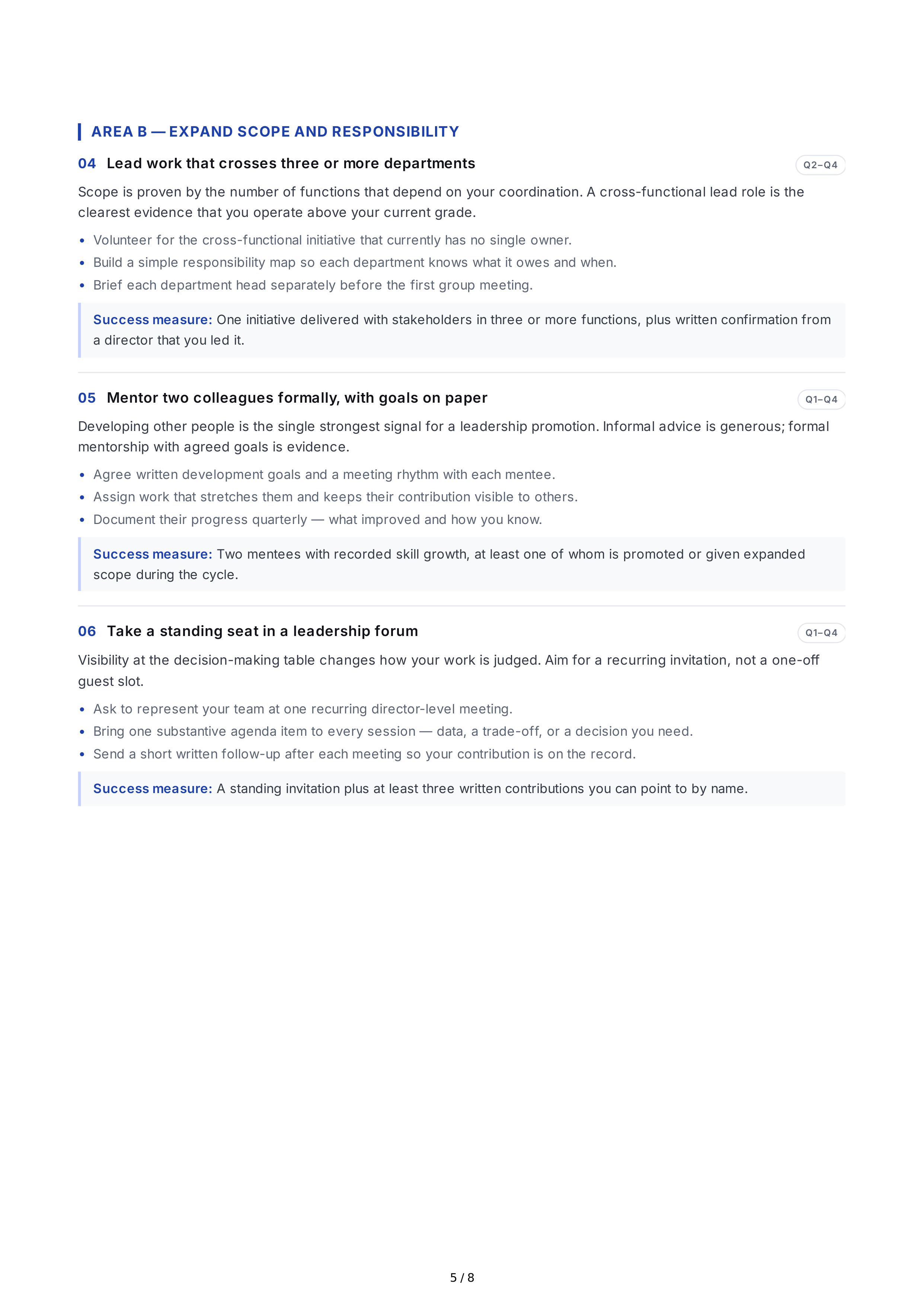
AREA
B
—
EXPAND
SCOPE
AND
RESPONSIBILITY
04
Lead
work
that
crosses
three
or
more
departments
Q
2–
Q
4
Scope
is
proven
by
the
number
of
functions
that
depend
on
your
coordination
.
A
cross
-
functional
lead
role
is
the
clearest
evidence
that
you
operate
above
your
current
grade
.
Success
measure
:
One
initiative
delivered
with
stakeholders
in
three
or
more
functions
,
plus
written
confirmation
from
a
director
that
you
led
it
.
05
Mentor
two
colleagues
formally
,
with
goals
on
paper
Q
1–
Q
4
Developing
other
people
is
the
single
strongest
signal
for
a
leadership
promotion
.
Informal
advice
is
generous
;
formal
mentorship
with
agreed
goals
is
evidence
.
Success
measure
:
Two
mentees
with
recorded
skill
growth
,
at
least
one
of
whom
is
promoted
or
given
expanded
scope
during
the
cycle
.
06
Take
a
standing
seat
in
a
leadership
forum
Q
1–
Q
4
Visibility
at
the
decision
-
making
table
changes
how
your
work
is
judged
.
Aim
for
a
recurring
invitation
,
not
a
one
-
off
guest
slot
.
Success
measure
:
A
standing
invitation
plus
at
least
three
written
contributions
you
can
point
to
by
name
.
Volunteer
for
the
cross
-
functional
initiative
that
currently
has
no
single
owner
.
Build
a
simple
responsibility
map
so
each
department
knows
what
it
owes
and
when
.
Brief
each
department
head
separately
before
the
first
group
meeting
.
Agree
written
development
goals
and
a
meeting
rhythm
with
each
mentee
.
Assign
work
that
stretches
them
and
keeps
their
contribution
visible
to
others
.
Document
their
progress
quarterly
—
what
improved
and
how
you
know
.
Ask
to
represent
your
team
at
one
recurring
director
-
level
meeting
.
Bring
one
substantive
agenda
item
to
every
session
—
data
,
a
trade
-
off
,
or
a
decision
you
need
.
Send
a
short
written
follow
-
up
after
each
meeting
so
your
contribution
is
on
the
record
.
5 / 8
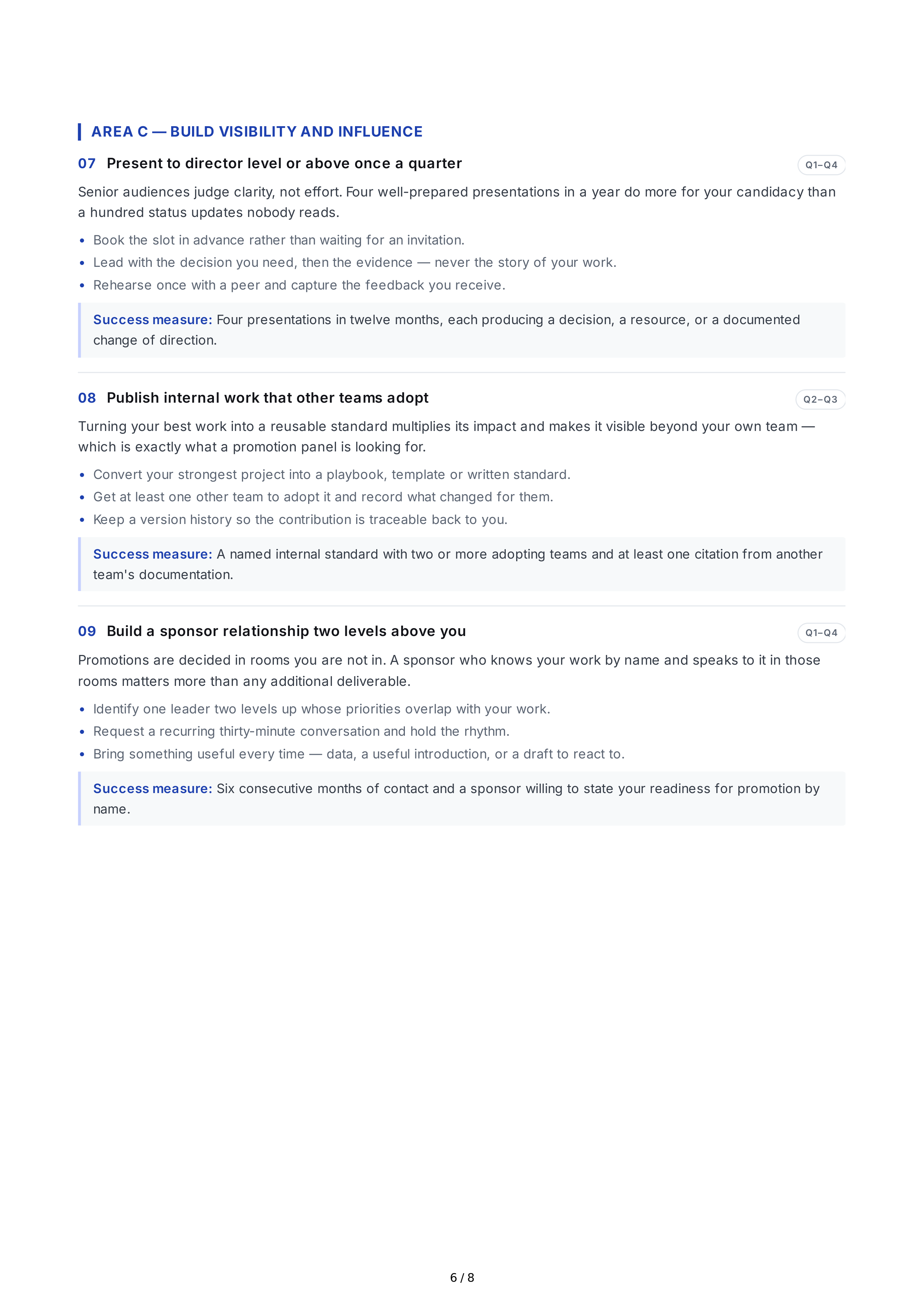
AREA
C
—
BUILD
VISIBILITY
AND
INFLUENCE
07
Present
to
director
level
or
above
once
a
quarter
Q
1–
Q
4
Senior
audiences
judge
clarity
,
not
effort
.
Four
well
-
prepared
presentations
in
a
year
do
more
for
your
candidacy
than
a
hundred
status
updates
nobody
reads
.
Success
measure
:
Four
presentations
in
twelve
months
,
each
producing
a
decision
,
a
resource
,
or
a
documented
change
of
direction
.
08
Publish
internal
work
that
other
teams
adopt
Q
2–
Q
3
Turning
your
best
work
into
a
reusable
standard
multiplies
its
impact
and
makes
it
visible
beyond
your
own
team
—
which
is
exactly
what
a
promotion
panel
is
looking
for
.
Success
measure
:
A
named
internal
standard
with
two
or
more
adopting
teams
and
at
least
one
citation
from
another
team
'
s
documentation
.
09
Build
a
sponsor
relationship
two
levels
above
you
Q
1–
Q
4
Promotions
are
decided
in
rooms
you
are
not
in
.
A
sponsor
who
knows
your
work
by
name
and
speaks
to
it
in
those
rooms
matters
more
than
any
additional
deliverable
.
Success
measure
:
Six
consecutive
months
of
contact
and
a
sponsor
willing
to
state
your
readiness
for
promotion
by
name
.
Book
the
slot
in
advance
rather
than
waiting
for
an
invitation
.
Lead
with
the
decision
you
need
,
then
the
evidence
—
never
the
story
of
your
work
.
Rehearse
once
with
a
peer
and
capture
the
feedback
you
receive
.
Convert
your
strongest
project
into
a
playbook
,
template
or
written
standard
.
Get
at
least
one
other
team
to
adopt
it
and
record
what
changed
for
them
.
Keep
a
version
history
so
the
contribution
is
traceable
back
to
you
.
Identify
one
leader
two
levels
up
whose
priorities
overlap
with
your
work
.
Request
a
recurring
thirty
-
minute
conversation
and
hold
the
rhythm
.
Bring
something
useful
every
time
—
data
,
a
useful
introduction
,
or
a
draft
to
react
to
.
6 / 8
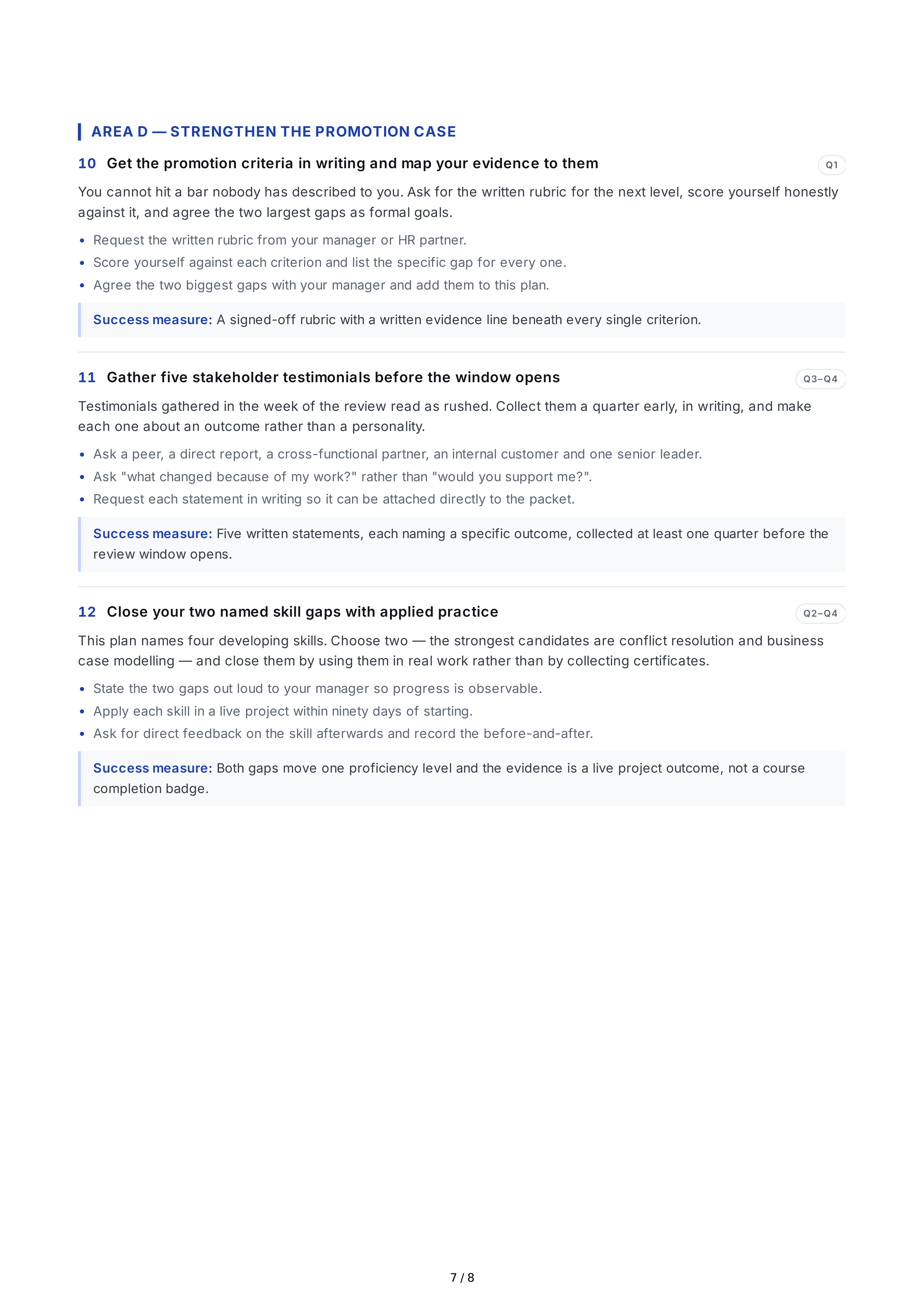
AREA
D
—
STRENGTHEN
THE
PROMOTION
CASE
10
Get
the
promotion
criteria
in
writing
and
map
your
evidence
to
them
Q
1
You
cannot
hit
a
bar
nobody
has
described
to
you
.
Ask
for
the
written
rubric
for
the
next
level
,
score
yourself
honestly
against
it
,
and
agree
the
two
largest
gaps
as
formal
goals
.
Success
measure
:
A
signed
-
off
rubric
with
a
written
evidence
line
beneath
every
single
criterion
.
11
Gather
five
stakeholder
testimonials
before
the
window
opens
Q
3–
Q
4
Testimonials
gathered
in
the
week
of
the
review
read
as
rushed
.
Collect
them
a
quarter
early
,
in
writing
,
and
make
each
one
about
an
outcome
rather
than
a
personality
.
Success
measure
:
Five
written
statements
,
each
naming
a
specific
outcome
,
collected
at
least
one
quarter
before
the
review
window
opens
.
12
Close
your
two
named
skill
gaps
with
applied
practice
Q
2–
Q
4
This
plan
names
four
developing
skills
.
Choose
two
—
the
strongest
candidates
are
conflict
resolution
and
business
case
modelling
—
and
close
them
by
using
them
in
real
work
rather
than
by
collecting
certificates
.
Success
measure
:
Both
gaps
move
one
proficiency
level
and
the
evidence
is
a
live
project
outcome
,
not
a
course
completion
badge
.
Request
the
written
rubric
from
your
manager
or
HR
partner
.
Score
yourself
against
each
criterion
and
list
the
specific
gap
for
every
one
.
Agree
the
two
biggest
gaps
with
your
manager
and
add
them
to
this
plan
.
Ask
a
peer
,
a
direct
report
,
a
cross
-
functional
partner
,
an
internal
customer
and
one
senior
leader
.
Ask
"
what
changed
because
of
my
work
?"
rather
than
"
would
you
support
me
?".
Request
each
statement
in
writing
so
it
can
be
attached
directly
to
the
packet
.
State
the
two
gaps
out
loud
to
your
manager
so
progress
is
observable
.
Apply
each
skill
in
a
live
project
within
ninety
days
of
starting
.
Ask
for
direct
feedback
on
the
skill
afterwards
and
record
the
before
-
and
-
after
.
7 / 8
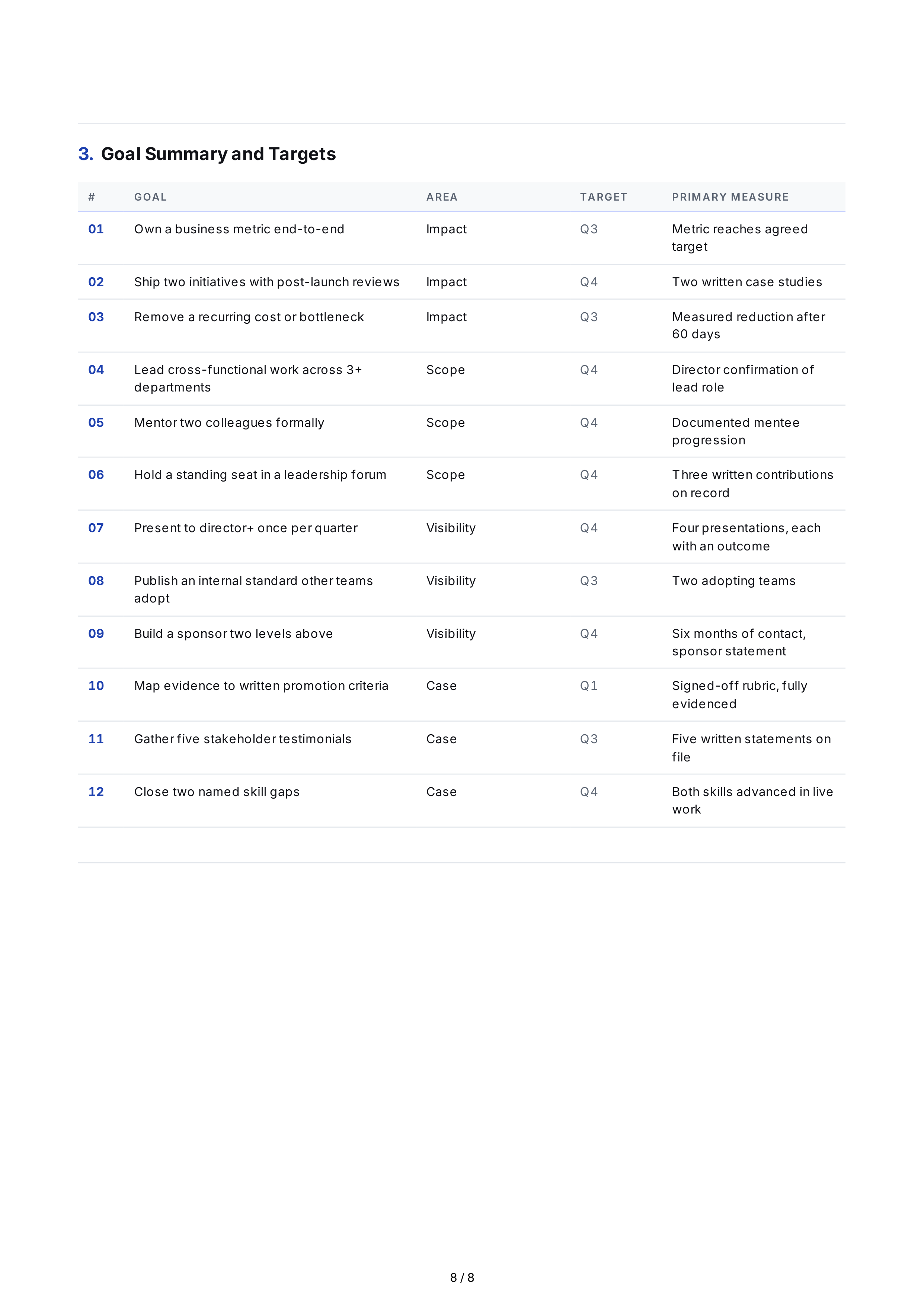
3.
Goal
Summary
and
Targets
#
GOAL
AREA
TARGET
PRIMARY
MEASURE
01
Own
a
business
metric
end
-
to
-
end
Impact
Q
3
Metric
reaches
agreed
target
02
Ship
two
initiatives
with
post
-
launch
reviews
Impact
Q
4
Two
written
case
studies
03
Remove
a
recurring
cost
or
bottleneck
Impact
Q
3
Measured
reduction
after
60
days
04
Lead
cross
-
functional
work
across
3+
departments
Scope
Q
4
Director
confirmation
of
lead
role
05
Mentor
two
colleagues
formally
Scope
Q
4
Documented
mentee
progression
06
Hold
a
standing
seat
in
a
leadership
forum
Scope
Q
4
Three
written
contributions
on
record
07
Present
to
director
+
once
per
quarter
Visibility
Q
4
Four
presentations
,
each
with
an
outcome
08
Publish
an
internal
standard
other
teams
adopt
Visibility
Q
3
Two
adopting
teams
09
Build
a
sponsor
two
levels
above
Visibility
Q
4
Six
months
of
contact
,
sponsor
statement
10
Map
evidence
to
written
promotion
criteria
Case
Q
1
Signed
-
off
rubric
,
fully
evidenced
11
Gather
five
stakeholder
testimonials
Case
Q
3
Five
written
statements
on
file
12
Close
two
named
skill
gaps
Case
Q
4
Both
skills
advanced
in
live
work
8 / 8
