
Career
Transition
:
Skills
&
Professional
Goals
1 / 7
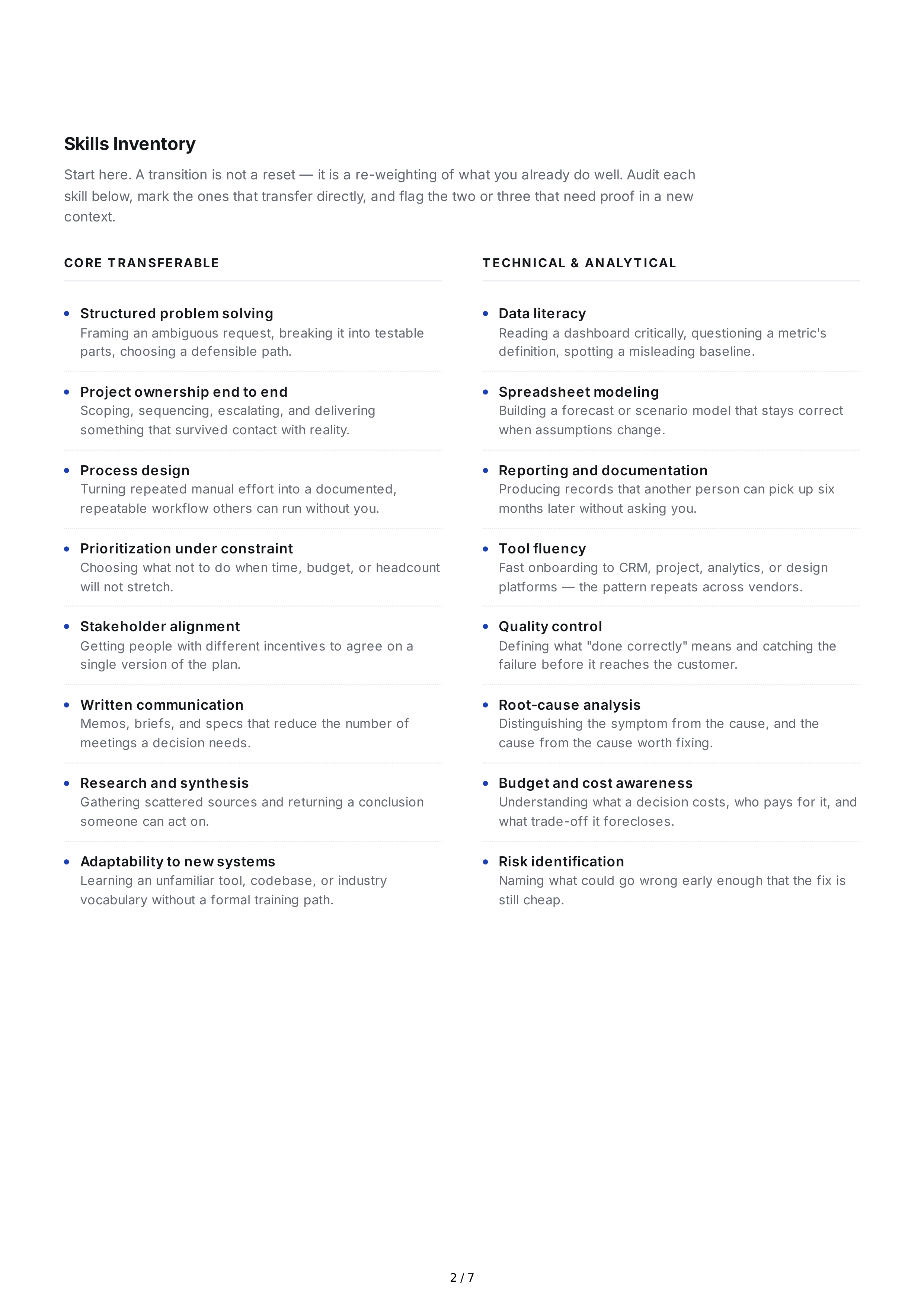
Skills
Inventory
Start
here
.
A
transition
is
not
a
reset
—
it
is
a
re
-
weighting
of
what
you
already
do
well
.
Audit
each
skill
below
,
mark
the
ones
that
transfer
directly
,
and
flag
the
two
or
three
that
need
proof
in
a
new
context
.
CORE
T RAN SFERABLE
T ECHN ICAL
&
AN ALYT ICAL
Structured
problem
solving
Framing
an
ambiguous
request
,
breaking
it
into
testable
parts
,
choosing
a
defensible
path
.
Project
ownership
end
to
end
Scoping
,
sequencing
,
escalating
,
and
delivering
something
that
survived
contact
with
reality
.
Process
design
Turning
repeated
manual
effort
into
a
documented
,
repeatable
workflow
others
can
run
without
you
.
Prioritization
under
constraint
Choosing
what
not
to
do
when
time
,
budget
,
or
headcount
will
not
stretch
.
Stakeholder
alignment
Getting
people
with
different
incentives
to
agree
on
a
single
version
of
the
plan
.
Written
communication
Memos
,
briefs
,
and
specs
that
reduce
the
number
of
meetings
a
decision
needs
.
Research
and
synthesis
Gathering
scattered
sources
and
returning
a
conclusion
someone
can
act
on
.
Adaptability
to
new
systems
Learning
an
unfamiliar
tool
,
codebase
,
or
industry
vocabulary
without
a
formal
training
path
.
Data
literacy
Reading
a
dashboard
critically
,
questioning
a
metric
'
s
definition
,
spotting
a
misleading
baseline
.
Spreadsheet
modeling
Building
a
forecast
or
scenario
model
that
stays
correct
when
assumptions
change
.
Reporting
and
documentation
Producing
records
that
another
person
can
pick
up
six
months
later
without
asking
you
.
Tool
fluency
Fast
onboarding
to
CRM
,
project
,
analytics
,
or
design
platforms
—
the
pattern
repeats
across
vendors
.
Quality
control
Defining
what
"
done
correctly
"
means
and
catching
the
failure
before
it
reaches
the
customer
.
Root
-
cause
analysis
Distinguishing
the
symptom
from
the
cause
,
and
the
cause
from
the
cause
worth
fixing
.
Budget
and
cost
awareness
Understanding
what
a
decision
costs
,
who
pays
for
it
,
and
what
trade
-
off
it
forecloses
.
Risk
identification
Naming
what
could
go
wrong
early
enough
that
the
fix
is
still
cheap
.
2 / 7
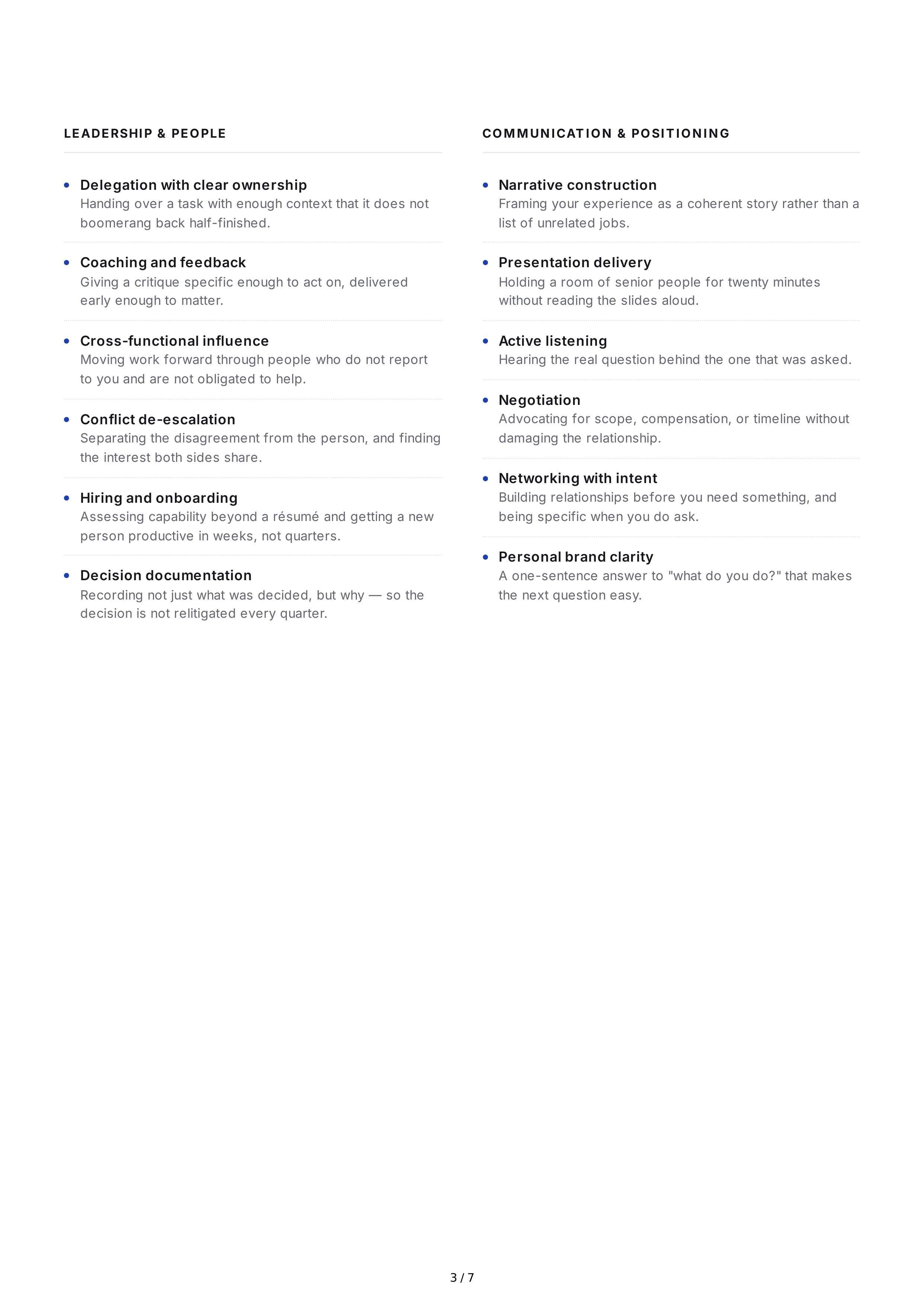
LEADERSHIP
&
PEOPLE
COMMUN ICAT ION
&
POSIT ION IN G
Delegation
with
clear
ownership
Handing
over
a
task
with
enough
context
that
it
does
not
boomerang
back
half
-
finished
.
Coaching
and
feedback
Giving
a
critique
specific
enough
to
act
on
,
delivered
early
enough
to
matter
.
Cross
-
functional
influence
Moving
work
forward
through
people
who
do
not
report
to
you
and
are
not
obligated
to
help
.
Conflict
de
-
escalation
Separating
the
disagreement
from
the
person
,
and
finding
the
interest
both
sides
share
.
Hiring
and
onboarding
Assessing
capability
beyond
a
résumé
and
getting
a
new
person
productive
in
weeks
,
not
quarters
.
Decision
documentation
Recording
not
just
what
was
decided
,
but
why
—
so
the
decision
is
not
relitigated
every
quarter
.
Narrative
construction
Framing
your
experience
as
a
coherent
story
rather
than
a
list
of
unrelated
jobs
.
Presentation
delivery
Holding
a
room
of
senior
people
for
twenty
minutes
without
reading
the
slides
aloud
.
Active
listening
Hearing
the
real
question
behind
the
one
that
was
asked
.
Negotiation
Advocating
for
scope
,
compensation
,
or
timeline
without
damaging
the
relationship
.
Networking
with
intent
Building
relationships
before
you
need
something
,
and
being
specific
when
you
do
ask
.
Personal
brand
clarity
A
one
-
sentence
answer
to
"
what
do
you
do
?"
that
makes
the
next
question
easy
.
3 / 7
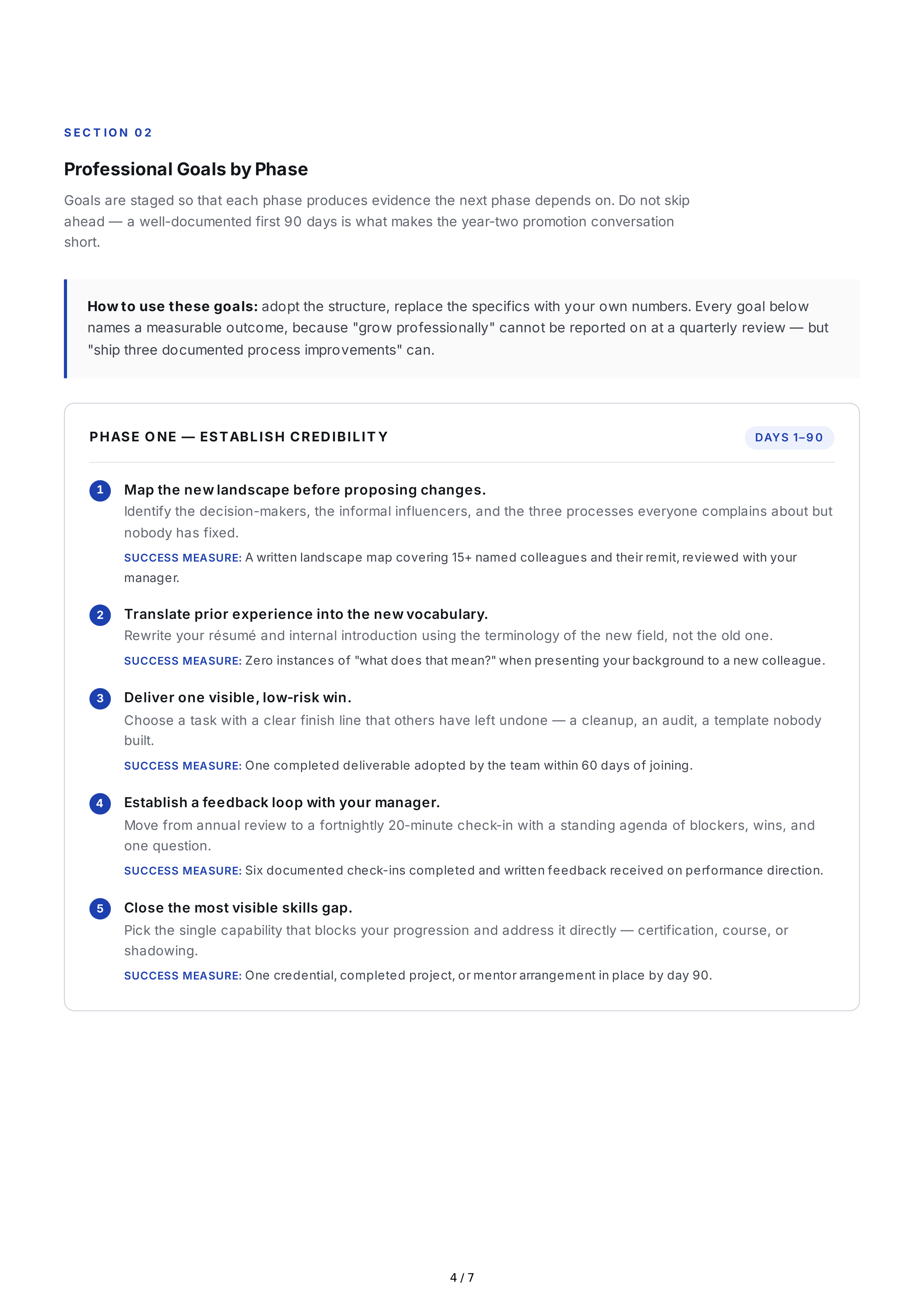
S E C T IO N
0 2
Professional
Goals
by
Phase
Goals
are
staged
so
that
each
phase
produces
evidence
the
next
phase
depends
on
.
Do
not
skip
ahead
—
a
well
-
documented
first
90
days
is
what
makes
the
year
-
two
promotion
conversation
short
.
How
to
use
these
goals
:
adopt
the
structure
,
replace
the
specifics
with
your
own
numbers
.
Every
goal
below
names
a
measurable
outcome
,
because
"
grow
professionally
"
cannot
be
reported
on
at
a
quarterly
review
—
but
"
ship
three
documented
process
improvements
"
can
.
PHASE
O NE
—
ESTABLISH
CREDIBILIT Y
DAYS
1–9 0
Map
the
new
landscape
before
proposing
changes
.
Identify
the
decision
-
makers
,
the
informal
influencers
,
and
the
three
processes
everyone
complains
about
but
nobody
has
fixed
.
SUCCESS
MEASURE
:
A
written
landscape
map
covering
15+
named
colleagues
and
their
remit
,
reviewed
with
your
manager
.
1
Translate
prior
experience
into
the
new
vocabulary
.
Rewrite
your
résumé
and
internal
introduction
using
the
terminology
of
the
new
field
,
not
the
old
one
.
SUCCESS
MEASURE
:
Zero
instances
of
"
what
does
that
mean
?"
when
presenting
your
background
to
a
new
colleague
.
2
Deliver
one
visible
,
low
-
risk
win
.
Choose
a
task
with
a
clear
finish
line
that
others
have
left
undone
—
a
cleanup
,
an
audit
,
a
template
nobody
built
.
SUCCESS
MEASURE
:
One
completed
deliverable
adopted
by
the
team
within
60
days
of
joining
.
3
Establish
a
feedback
loop
with
your
manager
.
Move
from
annual
review
to
a
fortnightly
20-
minute
check
-
in
with
a
standing
agenda
of
blockers
,
wins
,
and
one
question
.
SUCCESS
MEASURE
:
Six
documented
check
-
ins
completed
and
written
feedback
received
on
performance
direction
.
4
Close
the
most
visible
skills
gap
.
Pick
the
single
capability
that
blocks
your
progression
and
address
it
directly
—
certification
,
course
,
or
shadowing
.
SUCCESS
MEASURE
:
One
credential
,
completed
project
,
or
mentor
arrangement
in
place
by
day
90.
5
4 / 7
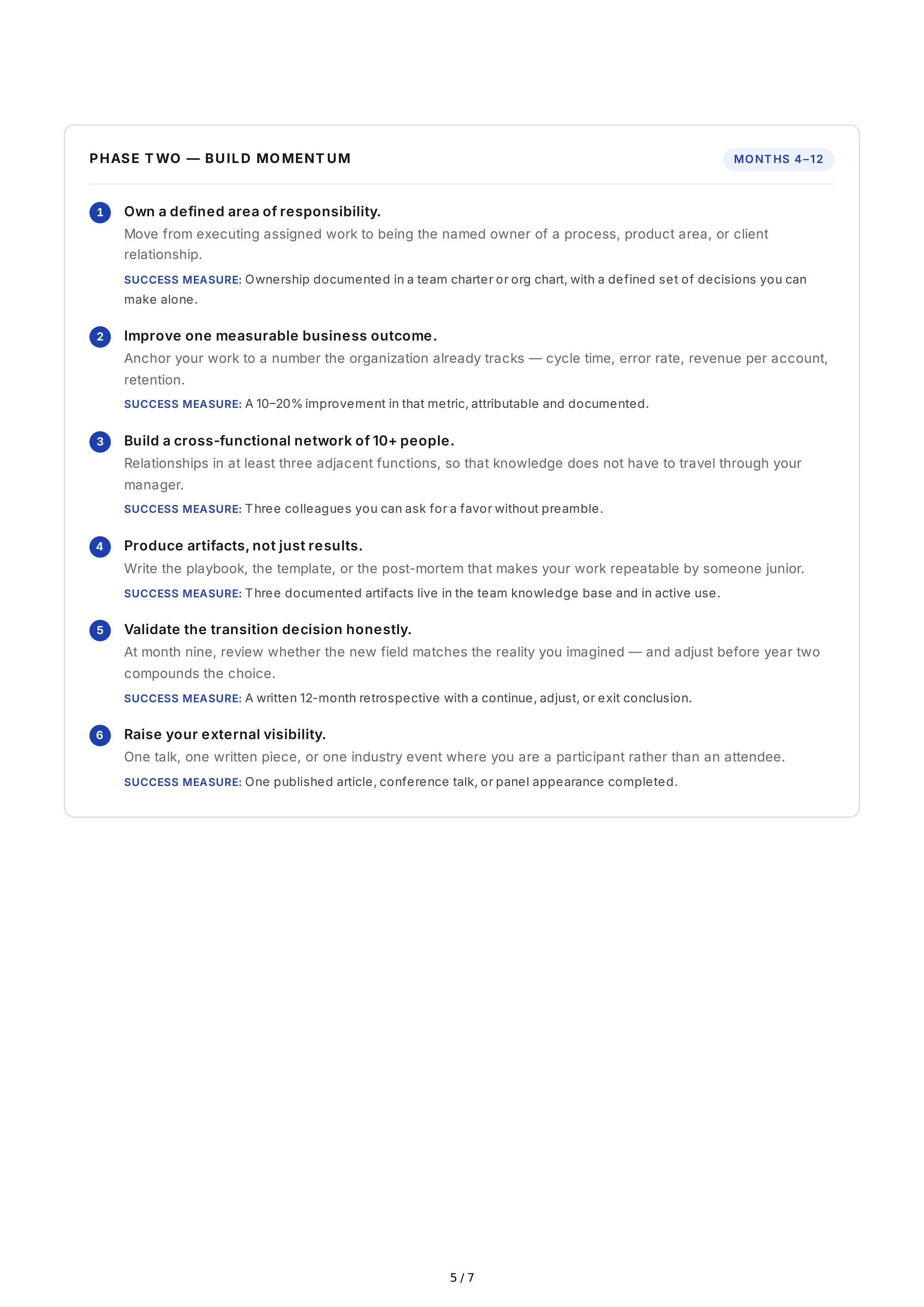
PHASE
T WO
—
BUILD
MO MENT UM
MONTHS
4–12
Own
a
defined
area
of
responsibility
.
Move
from
executing
assigned
work
to
being
the
named
owner
of
a
process
,
product
area
,
or
client
relationship
.
SUCCESS
MEASURE
:
Ownership
documented
in
a
team
charter
or
org
chart
,
with
a
defined
set
of
decisions
you
can
make
alone
.
1
Improve
one
measurable
business
outcome
.
Anchor
your
work
to
a
number
the
organization
already
tracks
—
cycle
time
,
error
rate
,
revenue
per
account
,
retention
.
SUCCESS
MEASURE
:
A
10–20%
improvement
in
that
metric
,
attributable
and
documented
.
2
Build
a
cross
-
functional
network
of
10+
people
.
Relationships
in
at
least
three
adjacent
functions
,
so
that
knowledge
does
not
have
to
travel
through
your
manager
.
SUCCESS
MEASURE
:
Three
colleagues
you
can
ask
for
a
favor
without
preamble
.
3
Produce
artifacts
,
not
just
results
.
Write
the
playbook
,
the
template
,
or
the
post
-
mortem
that
makes
your
work
repeatable
by
someone
junior
.
SUCCESS
MEASURE
:
Three
documented
artifacts
live
in
the
team
knowledge
base
and
in
active
use
.
4
Validate
the
transition
decision
honestly
.
At
month
nine
,
review
whether
the
new
field
matches
the
reality
you
imagined
—
and
adjust
before
year
two
compounds
the
choice
.
SUCCESS
MEASURE
:
A
written
12-
month
retrospective
with
a
continue
,
adjust
,
or
exit
conclusion
.
5
Raise
your
external
visibility
.
One
talk
,
one
written
piece
,
or
one
industry
event
where
you
are
a
participant
rather
than
an
attendee
.
SUCCESS
MEASURE
:
One
published
article
,
conference
talk
,
or
panel
appearance
completed
.
6
5 / 7
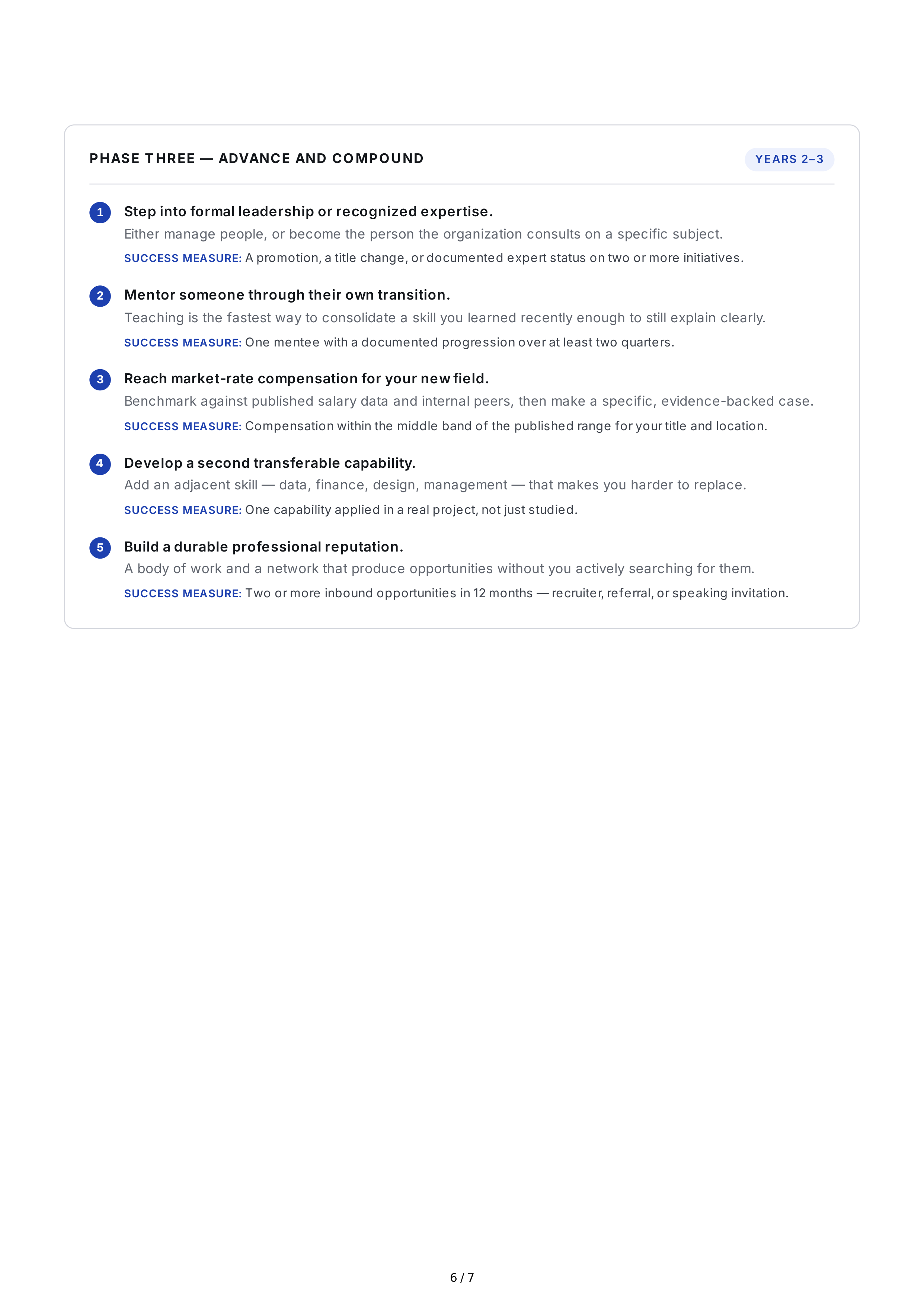
PHASE
T HREE
—
ADVANCE
AND
CO MPO UND
YEARS
2–3
Step
into
formal
leadership
or
recognized
expertise
.
Either
manage
people
,
or
become
the
person
the
organization
consults
on
a
specific
subject
.
SUCCESS
MEASURE
:
A
promotion
,
a
title
change
,
or
documented
expert
status
on
two
or
more
initiatives
.
1
Mentor
someone
through
their
own
transition
.
Teaching
is
the
fastest
way
to
consolidate
a
skill
you
learned
recently
enough
to
still
explain
clearly
.
SUCCESS
MEASURE
:
One
mentee
with
a
documented
progression
over
at
least
two
quarters
.
2
Reach
market
-
rate
compensation
for
your
new
field
.
Benchmark
against
published
salary
data
and
internal
peers
,
then
make
a
specific
,
evidence
-
backed
case
.
SUCCESS
MEASURE
:
Compensation
within
the
middle
band
of
the
published
range
for
your
title
and
location
.
3
Develop
a
second
transferable
capability
.
Add
an
adjacent
skill
—
data
,
finance
,
design
,
management
—
that
makes
you
harder
to
replace
.
SUCCESS
MEASURE
:
One
capability
applied
in
a
real
project
,
not
just
studied
.
4
Build
a
durable
professional
reputation
.
A
body
of
work
and
a
network
that
produce
opportunities
without
you
actively
searching
for
them
.
SUCCESS
MEASURE
:
Two
or
more
inbound
opportunities
in
12
months
—
recruiter
,
referral
,
or
speaking
invitation
.
5
6 / 7
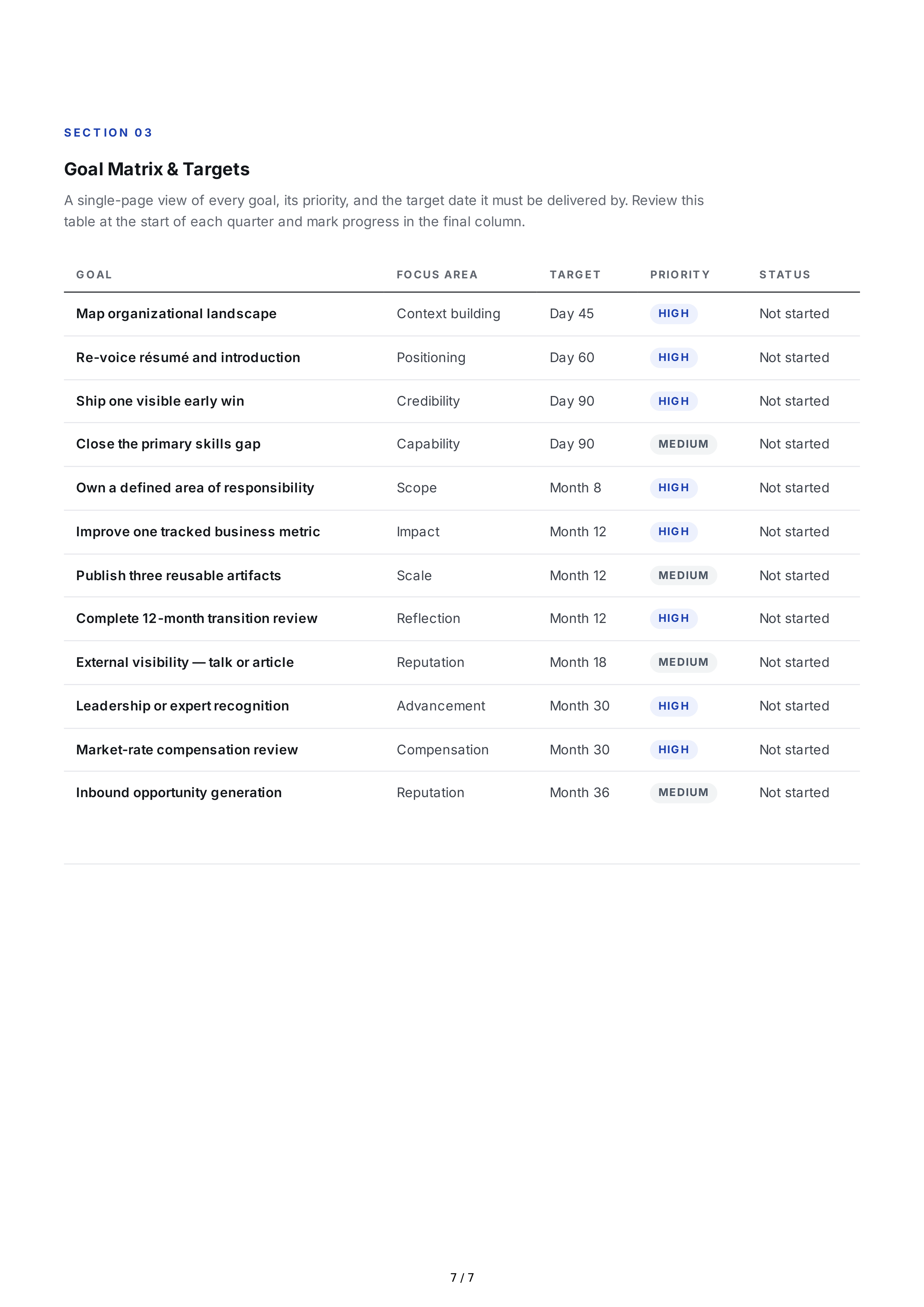
S E C T IO N
0 3
Goal
Matrix
&
Targets
A
single
-
page
view
of
every
goal
,
its
priority
,
and
the
target
date
it
must
be
delivered
by
.
Review
this
table
at
the
start
of
each
quarter
and
mark
progress
in
the
final
column
.
G O AL
FO CUS
AREA
TARG ET
PRIO RIT Y
S TAT US
Map
organizational
landscape
Context
building
Day
45
HIG H
Not
started
Re
-
voice
résumé
and
introduction
Positioning
Day
60
HIG H
Not
started
Ship
one
visible
early
win
Credibility
Day
90
HIG H
Not
started
Close
the
primary
skills
gap
Capability
Day
90
MEDIUM
Not
started
Own
a
defined
area
of
responsibility
Scope
Month
8
HIG H
Not
started
Improve
one
tracked
business
metric
Impact
Month
12
HIG H
Not
started
Publish
three
reusable
artifacts
Scale
Month
12
MEDIUM
Not
started
Complete
12-
month
transition
review
Reflection
Month
12
HIG H
Not
started
External
visibility
—
talk
or
article
Reputation
Month
18
MEDIUM
Not
started
Leadership
or
expert
recognition
Advancement
Month
30
HIG H
Not
started
Market
-
rate
compensation
review
Compensation
Month
30
HIG H
Not
started
Inbound
opportunity
generation
Reputation
Month
36
MEDIUM
Not
started
7 / 7
