
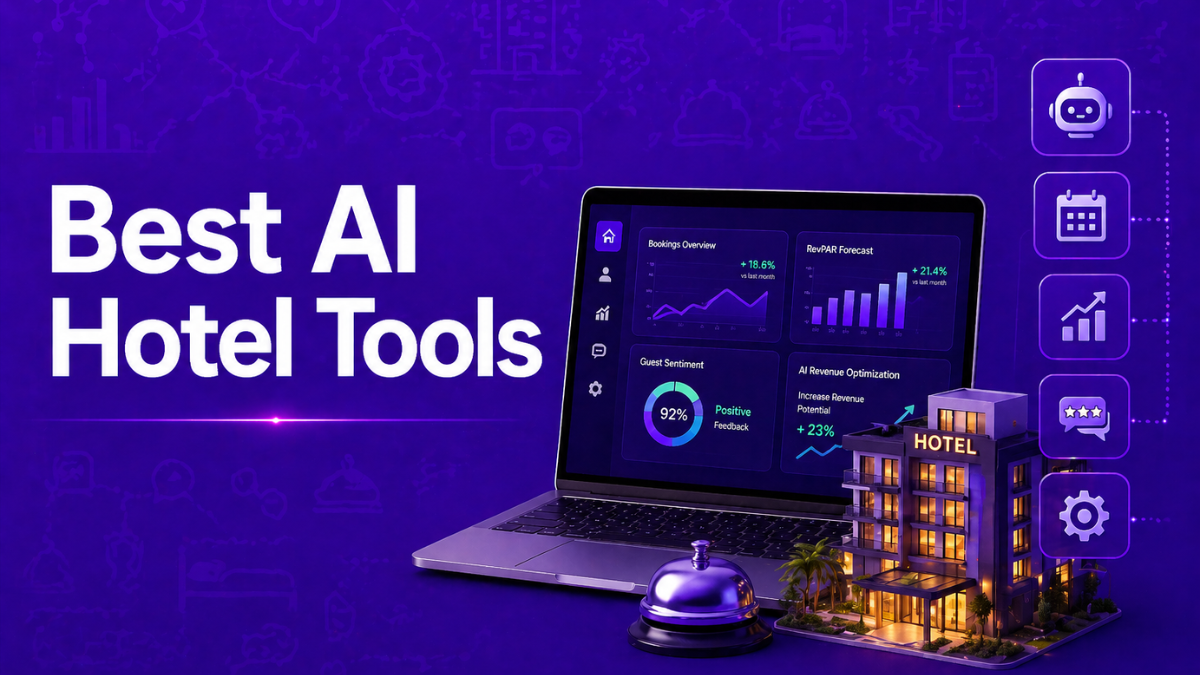
Artificial intelligence is transforming hospitality, and AI hotel tools are becoming essential for modern hotel operations. These tools use machine learning, automation, and data analysis to manage guest communication, pricing strategies, bookings, and operational workflows. Hotels adopt AI systems to improve efficiency, deliver personalized guest experiences, and optimize revenue decisions. From AI-powered concierge services to dynamic pricing engines, these technologies help hotels operate more efficiently while meeting rising traveler expectations.
What are AI Hotel Tools
AI hotel tools are software platforms that use artificial intelligence to automate and improve hotel operations. These tools help hotels manage tasks such as guest communication, booking assistance, pricing optimization, and data analysis.
Hotels use AI hotel tools to handle repetitive tasks, provide instant guest support, and make better business decisions using data. Common examples include AI chatbots for guest messaging, revenue management systems for dynamic pricing, and analytics tools for tracking hotel performance.
By using AI hotel tools, hotels can increase efficiency, improve guest experiences, and optimize revenue management.
Types of AI Hotel Tools
AI solutions used in the hospitality industry generally fall into several categories:
- Guest communication AI
- Revenue management AI
- Property management AI
- Hotel analytics platforms
- Distribution and channel management tools
- Voice AI assistants
List of the Best AI Hotel Tools
The following AI hotel tools help automate guest communication, optimize pricing strategies, improve analytics, and enhance overall hotel operations.
- HiJiffy AI
- Canary Technologies AI
- Duetto AI
- Atomize RMS AI
- Mews AI
- Juyo Analytics AI
- Revinate AI
- My AI Front Desk AI
- SiteMinder AI
- Gondola AI
AI Hotel Tools Comparison Table
The following comparison table highlights the main differences between the leading AI hotel tools based on functionality, use case, and pricing model.
| Tool | Best For | Key Features | Category | Pricing |
|---|---|---|---|---|
| HiJiffy AI | AI hotel chatbot & messaging | Omnichannel messaging, booking automation | Guest communication | Custom |
| Canary Technologies AI | Guest engagement automation | Messaging, digital check-in, upselling | Guest experience | Custom |
| Duetto AI | Revenue optimization | Dynamic pricing, demand forecasting | Revenue management | Enterprise |
| Atomize RMS AI | Automated pricing | Machine learning rate optimization | Revenue management | Custom |
| Mews AI | AI property management | PMS automation, check-in automation | Operations | Custom |
| Juyo Analytics AI | Hotel performance analytics | Custom dashboards, revenue analytics | Data analytics | Custom |
| Revinate AI | Guest feedback intelligence | Review analysis, CRM insights | Guest data | Custom |
| My AI Front Desk AI | AI hotel receptionist | Voice AI booking agent, call automation | Voice AI | Subscription |
| SiteMinder AI | Hotel distribution platform | Channel management, booking engine | Distribution | Custom |
| Gondola AI | Loyalty pricing optimization | Points + cash pricing optimization | Loyalty analytics | Custom |
AI tools in hospitality are typically designed to automate guest interactions, analyze operational data, and optimize pricing strategies using machine learning and predictive analytics. Many platforms can also automate a large share of guest inquiries and messaging, reducing manual workload for hotel staff while improving response times.
In the next section, we will explore each AI hotel tool in detail, including how it works, its main benefits, and the types of hotels that benefit most from using it.
1. HiJiffy AI
What is HiJiffy AI
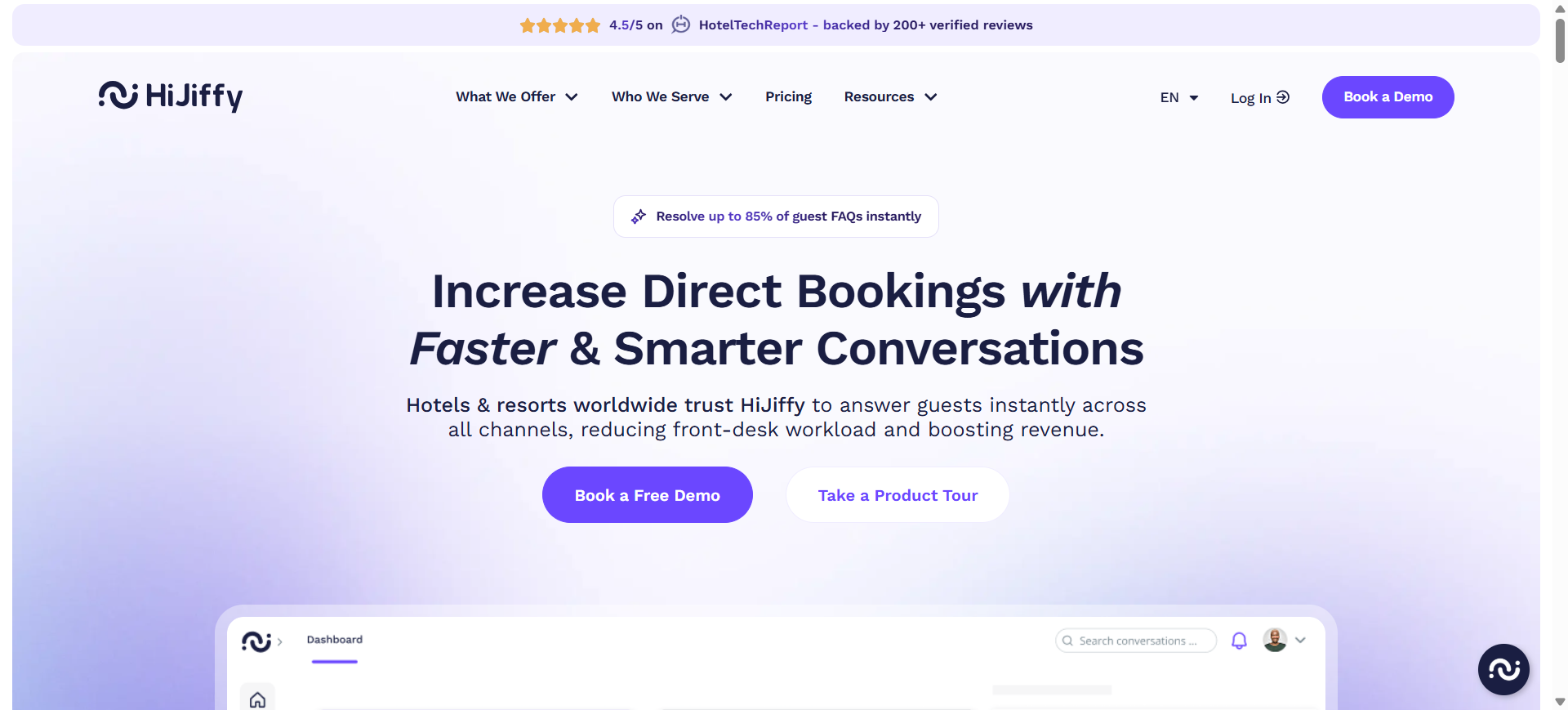
HiJiffy is a hotel chatbot and guest communication platform designed to automate conversations with hotel guests. It works as an AI concierge that answers questions, assists with bookings, and manages guest requests through chat. The tool supports messaging across websites, social media, and apps like WhatsApp. Hotels use it to provide instant responses and automate guest support 24/7.
How to Use HiJiffy AI for Hotels
- Sign up and connect the platform to your hotel website or booking engine.
- Configure chatbot responses, FAQs, and booking workflows.
- Integrate messaging channels like WhatsApp, Facebook, or web chat.
- Monitor guest conversations and analytics to improve communication.
Benefits of Using HiJiffy AI
- Automates guest questions and booking inquiries
- Reduces workload for hotel front desk staff
- Increases direct bookings through conversational booking
- Provides 24/7 multilingual guest communication
- Improves response time and guest satisfaction
Use Cases
A hotel installs HiJiffy on its website so guests can ask about room availability, amenities, or pricing. The chatbot answers instantly and guides the guest through the booking process without requiring a staff member.
Who Should Use It
- Boutique hotels
- Hotel chains and resorts
- Hotel marketing teams
- Front desk managers
- Hospitality operations teams
Pricing
HiJiffy offers pricing based on the number of hotel rooms and integrations. Basic plans start around $100 per month, while advanced packages are available with custom pricing for larger hotels.
Best For
Best for hotels that want to automate guest messaging and increase direct bookings with an AI chatbot.
2. Canary Technologies AI
What is Canary Technologies AI
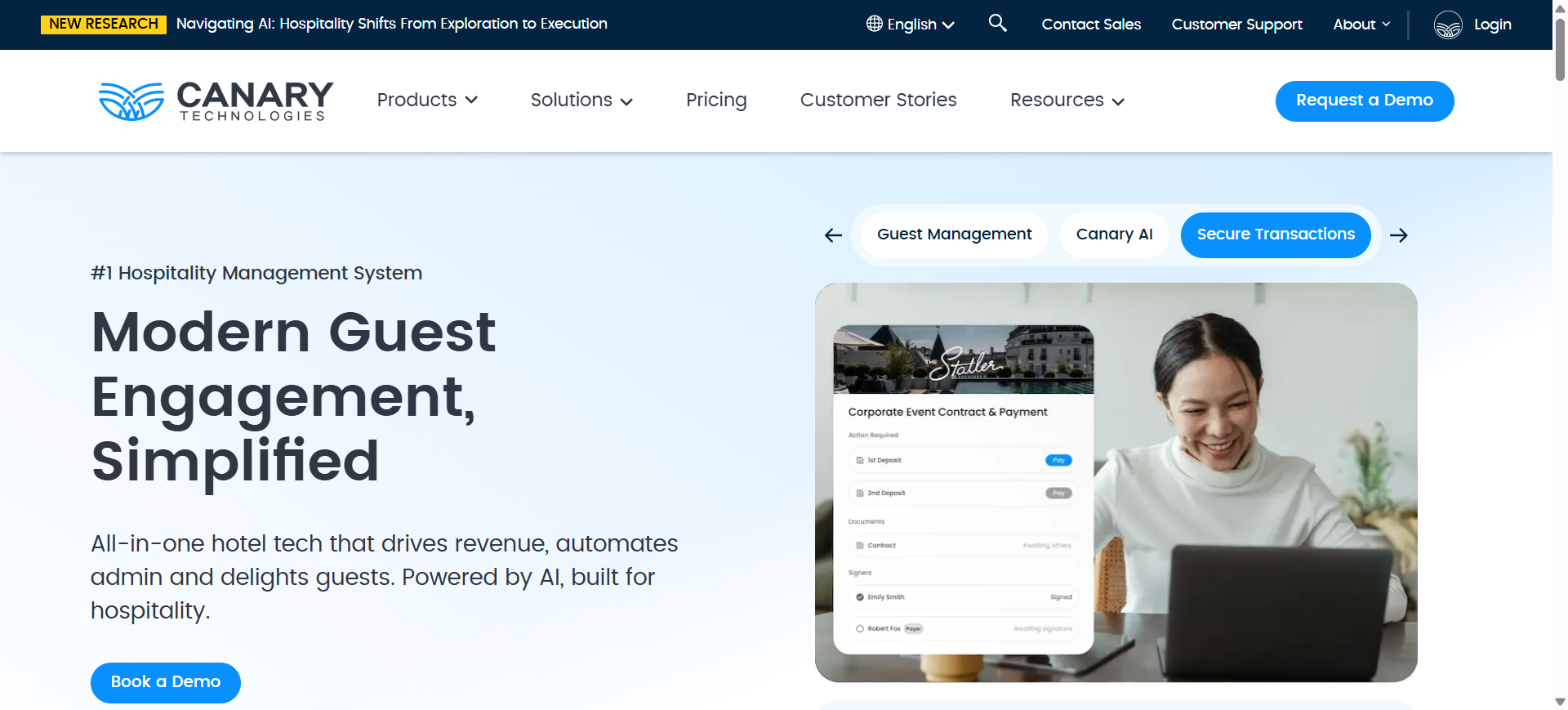
Canary Technologies is a guest experience and hotel operations platform designed to automate communication with guests and streamline hotel workflows. It helps hotels manage messaging, check-in, payments, and upselling through one centralized system. The platform uses AI to respond to guest questions, automate service requests, and improve guest engagement across digital channels. Hotels use it widely to enhance guest experiences and increase operational efficiency.
How to Use Canary Technologies AI for Hotels
- Sign up for the platform and connect it with your hotel property management system.
- Set up guest communication channels such as SMS, WhatsApp, or web messaging.
- Configure automated responses, check-in flows, and upsell offers.
- Monitor guest interactions and performance through the platform dashboard.
Benefits of Using Canary Technologies AI
- Automates guest inquiries and messaging tasks
- Reduces front desk workload and response times
- Increases revenue through AI-driven upsells
- Improves guest satisfaction and online reviews
- Centralizes guest communication in one platform
Use Cases
A hotel uses Canary AI messaging to answer guest questions about Wi-Fi, check-in times, or room upgrades through SMS or WhatsApp. This allows staff to focus on in-person service while the system automatically handles common guest requests.
Who Should Use It
- Boutique hotels
- Large hotel chains
- Resort operators
- Hotel operations managers
- Guest experience teams
Pricing
Canary Technologies AI offers flexible pricing based on hotel size and required features. Most hotels use custom pricing plans tailored to the number of rooms and integrations.
Best For
Best for hotels that want to automate guest communication and improve the overall guest experience.
3. Duetto AI
What is Duetto AI
Duetto is a hotel revenue management system designed to optimize room pricing and maximize hotel revenue. It uses data, machine learning, and market demand signals to recommend the best room rates in real time. Hotels use Duetto to forecast demand, analyze booking trends, and automate pricing decisions. The platform helps hotels adjust prices based on demand, competitors, and guest behavior.
How to Use Duetto AI for Hotels
- Sign up for Duetto and connect it with your hotel’s PMS and booking systems.
- Import historical booking data and market demand information.
- Configure pricing rules and revenue strategies for different room types.
- Monitor demand forecasts and allow the system to automate dynamic pricing.
Benefits of Using Duetto AI
- Automates hotel room pricing based on demand
- Increases revenue through dynamic pricing strategies
- Reduces manual revenue management work
- Provides accurate demand forecasting and analytics
- Helps hotels respond quickly to market changes
Use Cases
A resort uses Duetto to automatically adjust room prices during high-demand periods such as holidays or local events. The system analyzes booking trends and competitor prices to recommend optimal rates, helping the hotel increase revenue while maintaining occupancy.
Who Should Use It
- Hotel chains
- Resorts and large properties
- Revenue managers
- Hospitality groups managing multiple hotels
- Hotels using dynamic pricing strategies
Pricing
Duetto does not publish fixed pricing publicly. Most hotels receive custom pricing based on the number of rooms, integrations, and property size.
Best For
Best for hotels that want automated pricing and advanced revenue management.
4. Atomize RMS AI
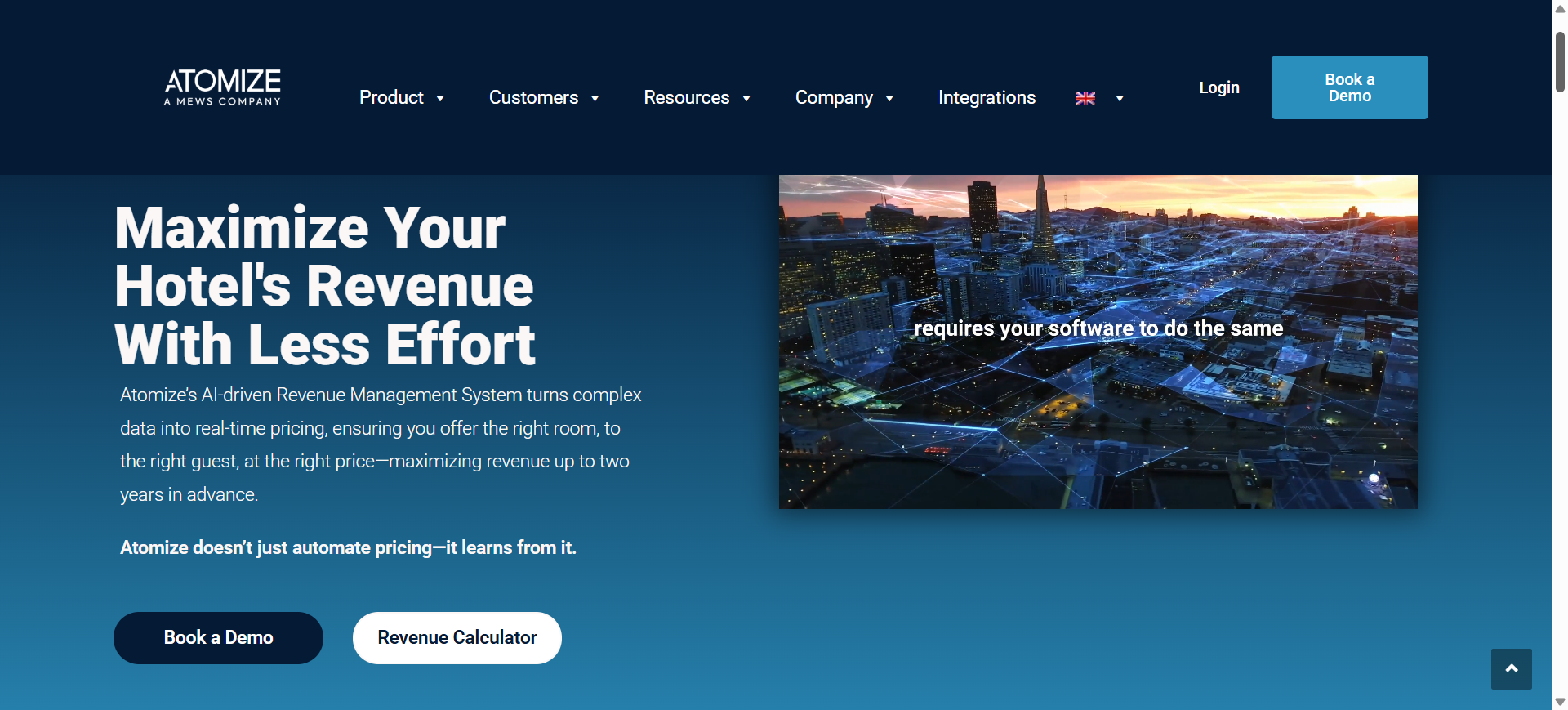
What is Atomize RMS AI
Atomize RMS is a revenue management system designed to help hotels automatically optimize room pricing. It uses artificial intelligence to analyze demand, booking trends, competitor prices, and market data to recommend the best room rates. The system continuously updates pricing in real time to maximize revenue and occupancy. Hotels use Atomize to automate pricing decisions and improve profitability.
How to Use Atomize RMS AI for Hotels
- Sign up for Atomize and connect it with your hotel PMS and booking systems.
- Import historical booking data and competitor market data.
- Configure pricing rules and revenue strategies for different room types.
- Let the AI automatically update prices based on demand and forecasting.
Benefits of Using Atomize RMS AI
- Automates hotel room pricing using AI
- Increases revenue through dynamic pricing strategies
- Reduces manual work for revenue managers
- Provides demand forecasting and market insights
- Helps hotels react quickly to market changes
Use Cases
A city hotel uses Atomize to automatically adjust room prices during major local events. The system analyzes demand patterns and competitor rates, increasing prices when demand rises and lowering them during low-demand periods to maintain occupancy.
Who Should Use It
- Hotel chains
- Boutique hotels
- Revenue managers
- Hospitality groups managing multiple properties
- Hotels using dynamic pricing strategies
Pricing
Atomize typically offers subscription-based pricing depending on property size and integrations. Entry pricing reported for some plans starts around €299 per month, with advanced packages available through custom pricing.
Best For
Best for hotels that want automated pricing and AI-driven revenue optimization.
5. Mews AI
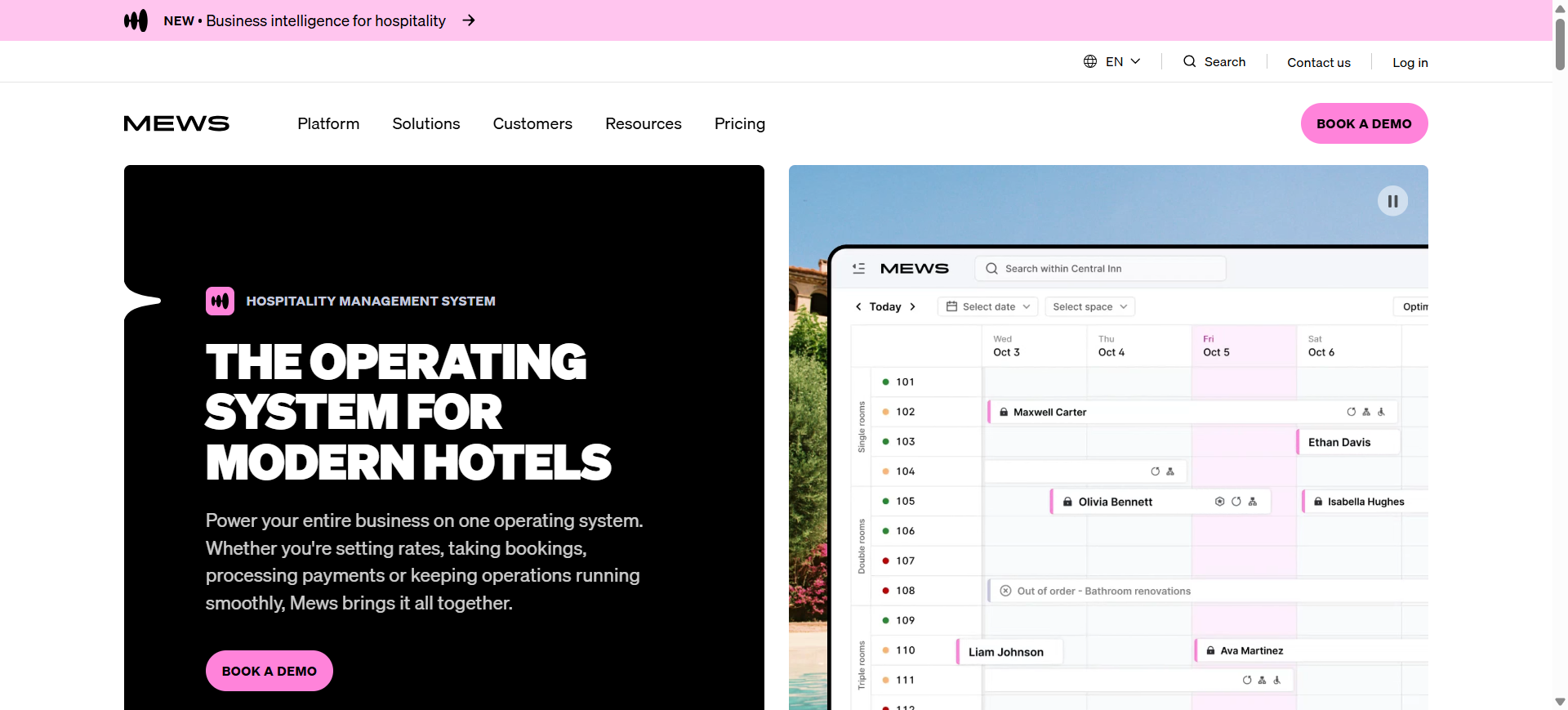
What is Mews AI
Mews is a cloud-based hotel property management system (PMS) that helps hotels automate daily operations and manage the entire guest journey. It centralizes tasks such as reservations, payments, check-in, housekeeping, and guest communication in one platform. The system uses AI features like guest insights and automated workflows to improve service personalization and operational efficiency. It is widely used by hotels to streamline operations and increase revenue.
How to Use Mews AI for Hotels
- Sign up for Mews and connect it with your booking channels and payment systems.
- Import hotel data including rooms, rates, and guest profiles.
- Set up automated workflows for check-in, payments, and housekeeping tasks.
- Use the dashboard to manage reservations, guest communication, and hotel operations.
Benefits of Using Mews AI
- Automates hotel operations like reservations and billing
- Reduces manual work for front desk and staff
- Improves guest experience with personalized insights
- Integrates with many hotel apps and booking channels
- Provides real-time data and operational reports
Use Cases
A boutique hotel uses Mews to automate online check-in and payments before arrival. Guests receive digital check-in links, reducing front desk queues and allowing staff to focus on guest service during busy periods.
Who Should Use It
- Boutique hotels
- Hotel chains
- Resort operators
- Hotel operations managers
- Hospitality technology teams
Pricing
Mews typically offers custom pricing based on hotel size, number of rooms, and integrations. Most hotels choose subscription plans with optional add-ons such as POS or revenue management tools.
Best For
Best for hotels that want an all-in-one AI-powered property management system.
6. Juyo Analytics AI
What is Juyo Analytics AI
Juyo Analytics is a hotel data analytics and business intelligence platform that helps hotels analyze performance and make better decisions. It collects data from systems like PMS, finance tools, and booking platforms and turns it into visual dashboards and reports. The platform helps hotel teams track revenue, market trends, and operational performance in one place. Hotels use it to uncover insights and improve profitability.
How to Use Juyo Analytics AI for Hotels
- Sign up for Juyo Analytics and connect it to your hotel systems such as PMS and revenue tools.
- Import operational and revenue data from multiple sources.
- Configure custom dashboards and performance reports for your hotel teams.
- Monitor analytics and use insights to improve pricing, marketing, and operations.
Benefits of Using Juyo Analytics AI
- Combines hotel data from multiple systems into one platform
- Helps managers make data-driven decisions quickly
- Identifies revenue opportunities and market trends
- Improves forecasting and strategic planning
- Provides clear dashboards for operational performance
Use Cases
A hotel revenue manager uses Juyo Analytics dashboards to track booking trends, distribution costs, and room performance across multiple channels, helping the team adjust pricing strategies and increase overall profitability.
Who Should Use It
- Hotel chains and groups
- Revenue managers
- Hotel owners and executives
- Hospitality data analysts
- Commercial strategy teams
Pricing
Juyo Analytics typically offers custom pricing based on hotel size and integrations. Some plans start around $2.70 per room per month with setup fees, depending on features and property scale.
Best For
Best for hotels that want advanced data analytics and performance insights.
7. Revinate AI
What is Revinate AI
Revinate is a hotel guest data and marketing platform that helps hotels understand guest behavior and increase direct bookings. It works as a hospitality CRM that collects guest data from multiple systems and creates a unified guest profile. Hotels use Revinate to automate personalized email campaigns, analyze guest feedback, and improve marketing performance. The platform helps hotels engage guests before, during, and after their stay.
How to Use Revinate AI for Hotels
- Sign up for Revinate and connect it with your hotel PMS and booking systems.
- Import guest data such as reservations, reviews, and contact details.
- Create automated marketing campaigns and personalized offers.
- Track campaign results and guest engagement through analytics dashboards.
Benefits of Using Revinate AI
- Centralizes guest data into one unified profile
- Automates targeted marketing campaigns
- Increases direct bookings and repeat guests
- Improves guest communication and personalization
- Provides analytics for marketing and revenue insights
Use Cases
A hotel marketing team uses Revinate to send personalized pre-arrival emails offering room upgrades and spa packages. The platform analyzes guest preferences and booking history to target guests with relevant offers, helping the hotel increase revenue from direct bookings.
Who Should Use It
- Boutique hotels
- Hotel chains and groups
- Hospitality marketing teams
- Revenue managers
- Guest experience teams
Pricing
Revinate offers several products such as Revinate Marketing and Guest Feedback, typically available with custom pricing plans. Some CRM-based plans start around $150 per user per month, depending on features and integrations.
Best For
Best for hotels that want to improve guest marketing and increase direct bookings using data and AI.
8. My AI Front Desk
What is My AI Front Desk
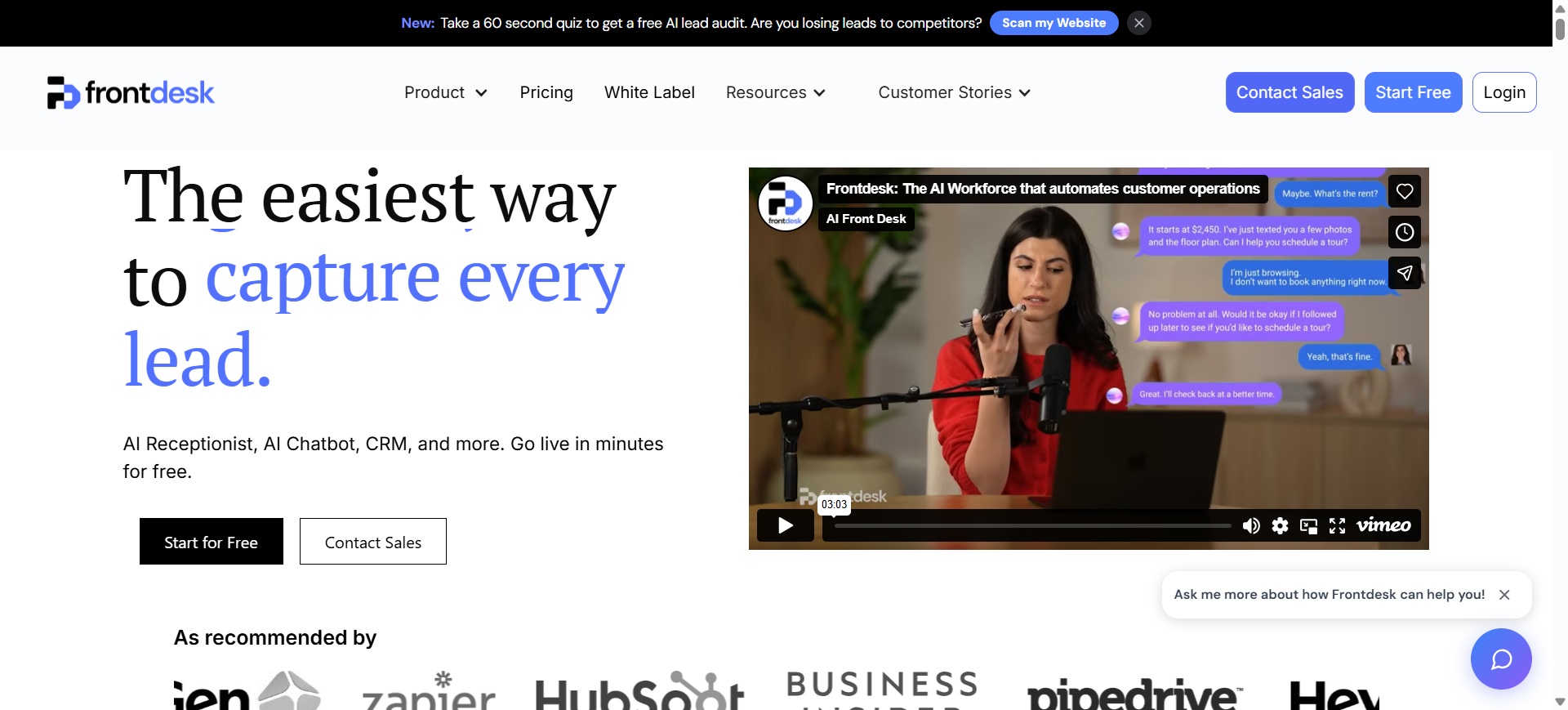
My AI Front Desk is a voice-based virtual receptionist designed for hotels and short-term rental businesses. It answers phone calls, handles booking inquiries, and responds to guest questions automatically. The system uses conversational AI to understand natural speech and provide helpful responses. Hotels use it to manage phone support 24/7 without needing additional front desk staff.
How to Use My AI Front Desk for Hotels
- Sign up for My AI Front Desk and connect it with your booking or reservation system.
- Configure call flows, frequently asked questions, and booking rules.
- Set up the AI phone assistant to answer incoming guest calls.
- Monitor conversations and bookings through the management dashboard.
Benefits of Using My AI Front Desk
- Automates hotel phone calls and guest inquiries
- Provides 24/7 phone support without additional staff
- Reduces missed booking opportunities from unanswered calls
- Saves time for front desk teams
- Improves guest experience with instant responses
Use Cases
A boutique hotel installs My AI Front Desk to answer late-night calls. When guests ask about room availability or pricing, the AI assistant provides information and guides them through the reservation process.
Who Should Use It
- Small hotels and boutique properties
- Vacation rental operators
- Hotels with limited front desk staff
- Hospitality managers
- Hotel owners
Pricing
My AI Front Desk typically offers subscription-based pricing depending on call volume and integrations. Entry plans often start around $30–$50 per month, while larger businesses may use higher-tier plans.
Best For
Best for small hotels that want an automated AI phone receptionist.
9. SiteMinder AI
What is SiteMinder AI
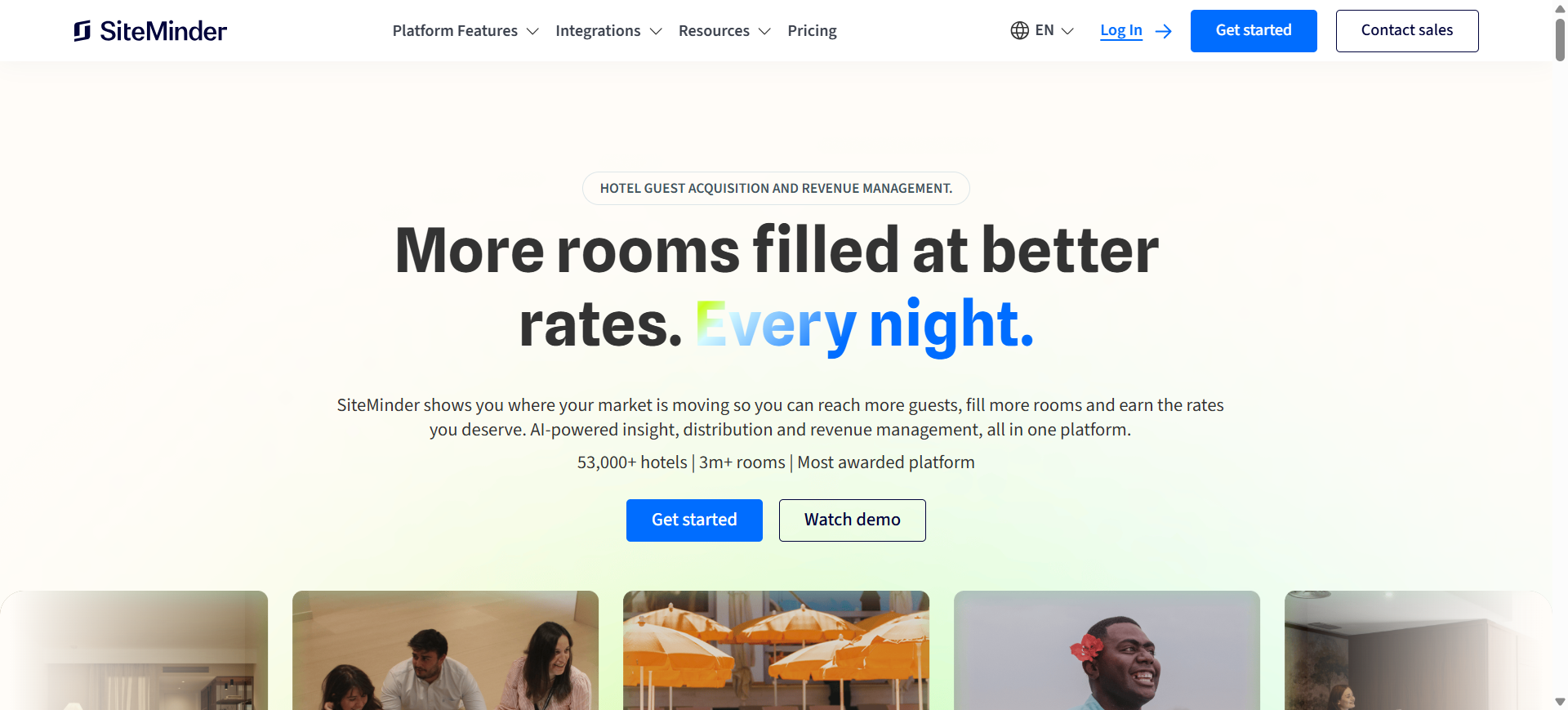
SiteMinder is a hotel distribution and channel management platform that helps hotels manage room availability, pricing, and bookings across many online travel channels. It connects hotels to hundreds of booking platforms such as OTAs and metasearch sites from a single dashboard. The platform automatically updates rates and availability in real time, helping hotels avoid overbookings and manage inventory efficiently.
How to Use SiteMinder AI for Hotels
- Sign up for SiteMinder and connect it with your hotel PMS or reservation system.
- Add and configure online booking channels like Booking.com, Expedia, or Airbnb.
- Map room types, pricing, and availability across all connected channels.
- Use the dashboard to manage inventory, monitor bookings, and analyze performance.
Benefits of Using SiteMinder AI
- Synchronizes room availability across multiple booking channels
- Reduces the risk of overbookings with real-time updates
- Saves time by automating channel management tasks
- Increases online visibility across global travel platforms
- Provides insights into booking performance and channel data
Use Cases
A hotel connects SiteMinder to several online travel agencies. When a guest books a room on one platform, the system automatically updates availability on all other channels to prevent double bookings.
Who Should Use It
- Boutique hotels
- Hotel chains and groups
- Revenue managers
- Hospitality technology teams
- Hotels selling rooms across multiple booking platforms
Pricing
SiteMinder offers subscription-based pricing depending on hotel size and features. Entry plans typically start around $85 per month, while larger properties may require custom enterprise pricing.
Best For
Best for hotels that want to manage bookings across multiple online travel channels from one platform.
10. Gondola AI
What is Gondola AI
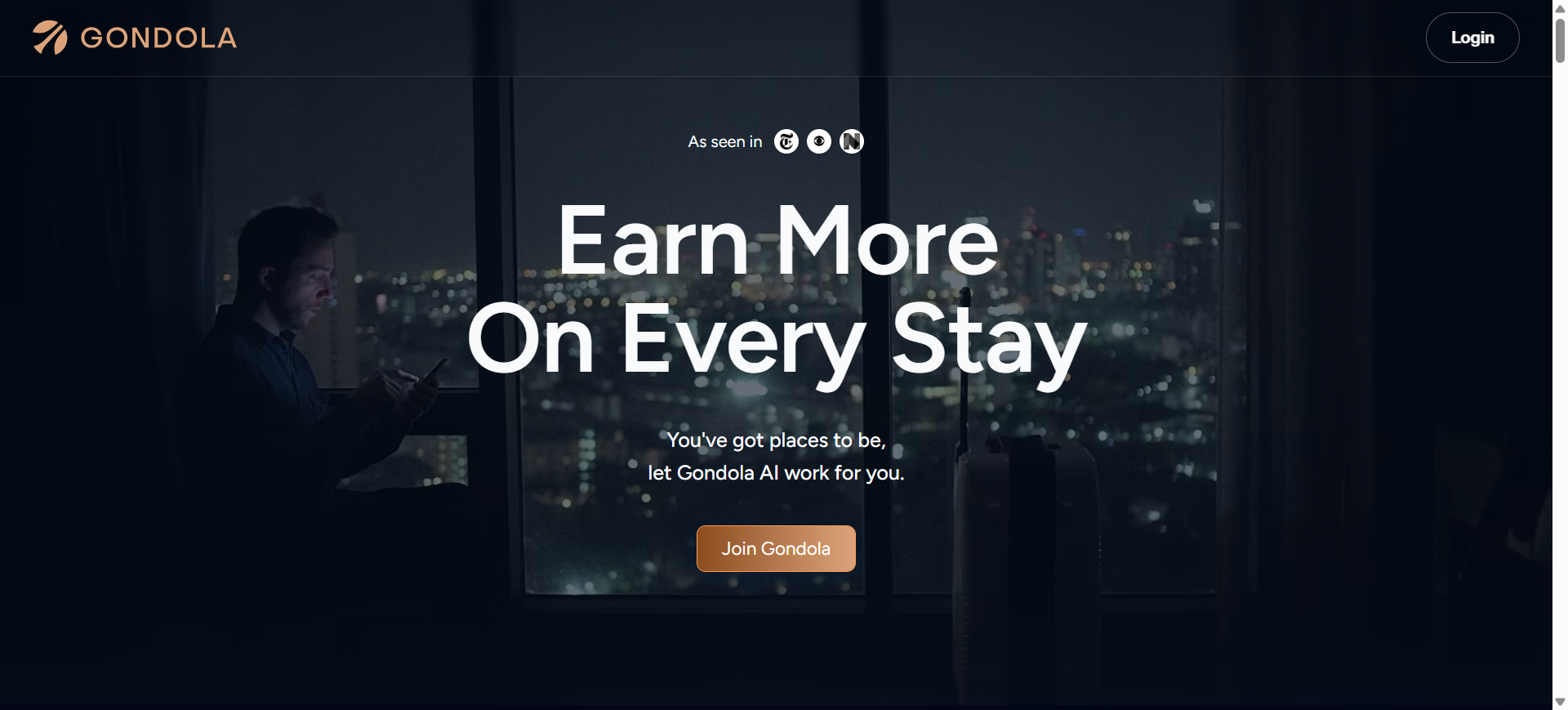
Gondola is a hotel search and booking platform that helps users find the best hotel deals using cash or loyalty points. It uses AI to compare hotel prices across major brands and shows whether paying with cash or points gives the best value. The platform also tracks hotel prices and loyalty rewards in one dashboard. Hotels and travelers use it to maximize loyalty benefits and find better booking deals.
How to Use Gondola AI for Hotels
- Sign up for a free Gondola account and connect your email or loyalty programs.
- Search for hotels and compare prices using cash or reward points.
- Track hotel bookings and activate price monitoring alerts.
- Use the dashboard to manage bookings and track loyalty rewards.
Benefits of Using Gondola AI
- Compares hotel prices using both cash and loyalty points
- Helps users maximize loyalty rewards and travel points
- Automatically monitors reservations for price drops
- Tracks multiple hotel loyalty accounts in one place
- Saves money by rebooking when prices fall
Use Cases
A frequent traveler uses Gondola AI to search hotels in a city. The platform compares the cash price and loyalty-points price across hotel brands and recommends the best option, helping the traveler save money while earning rewards.
Who Should Use It
- Frequent travelers
- Hotel loyalty program members
- Business travelers
- Travel planners and consultants
- Hotels analyzing loyalty pricing strategies
Pricing
Gondola AI offers a free membership that provides access to hotel search, price monitoring, and loyalty tracking features. Some reward tiers provide 3%–7% cashback on hotel bookings depending on user status.
Best For
Best for travelers and hotels that want to optimize hotel bookings using loyalty points and AI price comparisons.
AI Hotel Agents
What are AI Hotel Agents
AI hotel agents are intelligent software systems that can automatically perform hotel tasks, communicate with guests, and make decisions without constant human input. Unlike simple chatbots, AI agents can analyze data, connect with hotel systems such as PMS or CRM platforms, and execute multi-step actions like confirming bookings or recommending services.
In the hospitality industry, AI agents help automate guest communication, reservations, revenue decisions, and operational workflows. They are designed to operate as digital assistants that support hotel staff while delivering faster and more personalized guest service.
How AI Agents Are Transforming Hotel Operations
AI agents are changing hotel technology by turning traditional software into autonomous systems that can complete tasks independently. Instead of only providing insights or answering questions, AI agents can analyze information, make decisions, and execute actions across multiple hotel systems.
Key ways AI agents transform hotel operations include:
- Automated guest communication – responding instantly to questions and service requests
- Booking automation – confirming reservations and managing availability
- Revenue optimization – adjusting prices using predictive demand analysis
- Operational workflow automation – coordinating housekeeping, check-ins, and service tasks
- Personalized guest experiences – recommending services based on guest preferences
Hotels increasingly deploy AI agents to reduce manual workload and deliver 24/7 guest support, helping properties operate more efficiently even with limited staff.
Examples of AI Hotel Agents
Several types of AI agents are commonly used across the hospitality industry:
Booking Agents
AI booking agents assist guests in making reservations through chat, voice, or messaging apps. They can check availability, recommend rooms, and complete the booking process automatically.
Virtual Concierge Agents
These agents answer guest questions, recommend local attractions, and handle service requests such as room service or transportation.
Revenue Management Agents
Revenue agents analyze demand, booking patterns, and competitor prices to recommend or automatically update room rates.
Guest Messaging Agents
Messaging agents communicate with guests across platforms like WhatsApp, SMS, and hotel websites to handle questions, confirmations, and requests.
Tools Offering AI Hotel Agents
Several modern hotel platforms include AI agent capabilities as part of their automation systems:
- HiJiffy AI – AI messaging agents for hotel websites and messaging apps
- Canary Technologies AI – guest communication and service automation agents
- My AI Front Desk AI – voice-based AI receptionist agents for phone calls
- Duetto AI – AI agents for revenue optimization and pricing decisions
These tools demonstrate how AI agents are evolving from simple automation features into full digital assistants that manage guest interactions, bookings, and operational tasks across the entire hotel lifecycle.
Where AI Is Used in Hotels
Artificial intelligence is used across many areas of hotel operations to improve efficiency, automate routine tasks, and enhance guest experiences. Modern hotels rely on AI tools to manage guest communication, optimize pricing strategies, automate bookings, analyze operational data, and streamline property management workflows. The most common applications include the following.
Guest Communication
AI systems such as chatbots, messaging platforms, and voice assistants allow hotels to communicate with guests instantly. These tools answer questions about room availability, amenities, check-in times, and hotel services. Many hotels integrate AI messaging into websites, WhatsApp, SMS, and social media to provide 24/7 guest support without requiring additional staff.
Pricing Optimization
AI-powered revenue management systems analyze booking patterns, competitor prices, seasonal demand, and local market conditions. Based on this data, AI automatically adjusts room prices to maximize occupancy and revenue. This dynamic pricing approach allows hotels to respond quickly to demand fluctuations and maintain competitive pricing strategies.
Booking Automation
AI booking assistants simplify the reservation process by guiding guests through the booking journey. These systems can check room availability, recommend suitable room types, and assist guests in completing reservations. By reducing friction during booking, AI tools help hotels increase direct bookings and improve conversion rates.
Hotel Analytics
AI analytics platforms collect and process large volumes of hotel data from property management systems, booking engines, and marketing platforms. These insights help hotel managers monitor key metrics such as occupancy rates, revenue performance, and booking sources. With AI-driven analytics, hotels can make more accurate and data-driven business decisions.
Property Management
AI capabilities are increasingly integrated into hotel property management systems (PMS). These systems automate operational tasks such as check-ins, billing, housekeeping coordination, and guest profile management. By automating routine workflows, AI helps hotels reduce manual workloads and maintain smoother daily operations.
Benefits of AI Hotel Tools
Studies show AI guest messaging tools can automate up to 80–90% of common guest inquiries, reducing front desk workload and improving response times.
- Operational Automation – AI automates repetitive hotel tasks such as guest messaging, booking management, and reporting, reducing manual work for staff.
- Increased Revenue – Dynamic pricing systems and AI-driven upselling help hotels optimize room rates and generate higher revenue.
- Improved Guest Experience – AI enables faster responses, personalized recommendations, and seamless digital services for guests.
- Reduced Staffing Pressure – Automation handles common inquiries and routine tasks, allowing smaller teams to manage operations efficiently.
- Better Decision Making – AI analytics provide real-time insights into bookings, demand trends, and hotel performance.
- 24/7 Guest Support – AI chatbots and voice assistants allow hotels to provide continuous assistance to guests at any time.
- Higher Direct Bookings – AI booking assistants help guide guests through reservations, reducing reliance on third-party booking platforms.
How to Choose the Right AI Hotel Tool
Choosing the right AI hotel tool depends on your hotel’s needs, budget, and technology systems. Hotels should consider a few key factors to ensure the tool improves operations and integrates with existing software.
- Hotel Size – Small hotels may need basic automation tools, while large hotel chains often require advanced platforms with analytics and multi-property management.
- Budget – AI tools range from affordable monthly subscriptions to enterprise platforms with custom pricing. Choose a solution that fits your budget and expected ROI.
- Integration Capabilities – Ensure the tool integrates with existing systems like PMS, CRM, booking engines, and revenue management software.
- Use Case – Identify the main goal, such as guest communication, pricing optimization, booking automation, or hotel analytics.
- Automation Level – Some AI tools only provide insights, while others automate tasks like guest messaging, pricing updates, and operational workflows.
Selecting a tool based on these factors helps hotels implement AI solutions that support efficient operations and better guest experiences.
Why Hotels Are Adopting AI in 2026
AI adoption in hospitality is accelerating as hotels look for ways to improve efficiency, increase revenue, and meet changing guest expectations.
Staff Shortages
Many hotels continue to face staffing challenges. AI tools help automate routine tasks such as answering guest inquiries, managing bookings, and generating reports, allowing smaller teams to operate efficiently.
Guest Expectations for Instant Support
Modern travelers expect quick responses and personalized service. AI messaging tools and virtual assistants provide immediate answers to guest questions and service requests, improving overall guest satisfaction.
Data-Driven Revenue Management
Hotels increasingly rely on data to make pricing and marketing decisions. AI-powered revenue management systems analyze market trends, booking behavior, and competitor pricing to optimize room rates and maximize revenue.
Automation of Hotel Operations
AI tools automate many operational processes such as check-ins, guest communication, housekeeping coordination, and reporting. This automation improves operational efficiency and allows hotel staff to focus on delivering better guest experiences.
Future of AI in the Hotel Industry
The future of AI in the hotel industry will focus on deeper automation, smarter decision-making, and more personalized guest experiences. As AI technology evolves, hotels will increasingly use AI agents, predictive analytics, and advanced automation systems to manage operations more efficiently. These systems will analyze guest behavior, booking patterns, and market demand to automatically optimize pricing, personalize offers, and improve service delivery.
AI is also expected to play a larger role in voice assistants, smart hotel rooms, and autonomous hotel operations. Guests may interact with voice-controlled room systems, AI concierges, and automated check-in services that create a seamless travel experience. At the operational level, hotels will rely more on AI to coordinate housekeeping, manage inventory, forecast demand, and support data-driven business decisions.
As hospitality technology continues to advance, AI will become a core part of hotel management systems rather than an optional add-on. Hotels that adopt AI tools early will be better positioned to deliver efficient operations, reduce operational costs, and meet the evolving expectations of modern travelers.
Conclusion
AI hotel tools help hotels automate operations, improve guest communication, and optimize pricing strategies. By using AI systems such as chatbots, revenue management tools, and analytics platforms, hotels can increase efficiency and deliver better guest experiences.
As AI technology continues to evolve, hotels that adopt these technologies early will gain a competitive advantage in the modern hospitality industry.
FAQs
How do hotels use AI tools?
Hotels use AI tools for several operational tasks including automated guest messaging, dynamic room pricing, booking assistance, and performance analytics. AI systems analyze large amounts of hotel data to help managers make better decisions, optimize pricing strategies, and improve overall guest satisfaction.
What are AI hotel agents?
AI hotel agents are intelligent systems that can perform hotel tasks automatically without constant human involvement. They can answer guest inquiries, assist with bookings, recommend services, and optimize pricing decisions. These agents act as digital assistants that support hotel staff and improve operational efficiency.
Can AI improve hotel revenue management?
Yes, AI can significantly improve hotel revenue management. AI-powered revenue systems analyze demand patterns, competitor pricing, and booking trends to recommend optimal room rates. This dynamic pricing approach helps hotels maximize occupancy and increase revenue.
What is the best AI chatbot for hotels?
Some of the most widely used AI chatbots for hotels include HiJiffy AI and Canary Technologies AI. These tools automate guest communication across websites, messaging apps, and social media platforms while assisting guests with booking inquiries and service requests.
Are AI tools suitable for small hotels?
Yes, AI tools are suitable for small hotels as well as large hotel chains. Many platforms offer scalable pricing and features that allow small properties to automate guest communication, manage bookings, and improve operational efficiency without requiring large teams.
Are AI hotel tools expensive?
AI hotel tools vary in pricing depending on features and hotel size. Many tools offer subscription plans starting from around $30–$100 per month, while enterprise systems may require custom pricing based on integrations, room inventory, and automation capabilities.