ARTIFICIAL INTELLIGENCE
ANNOTATED BIBLIOGRAPHY
Artificial intelligence research
2
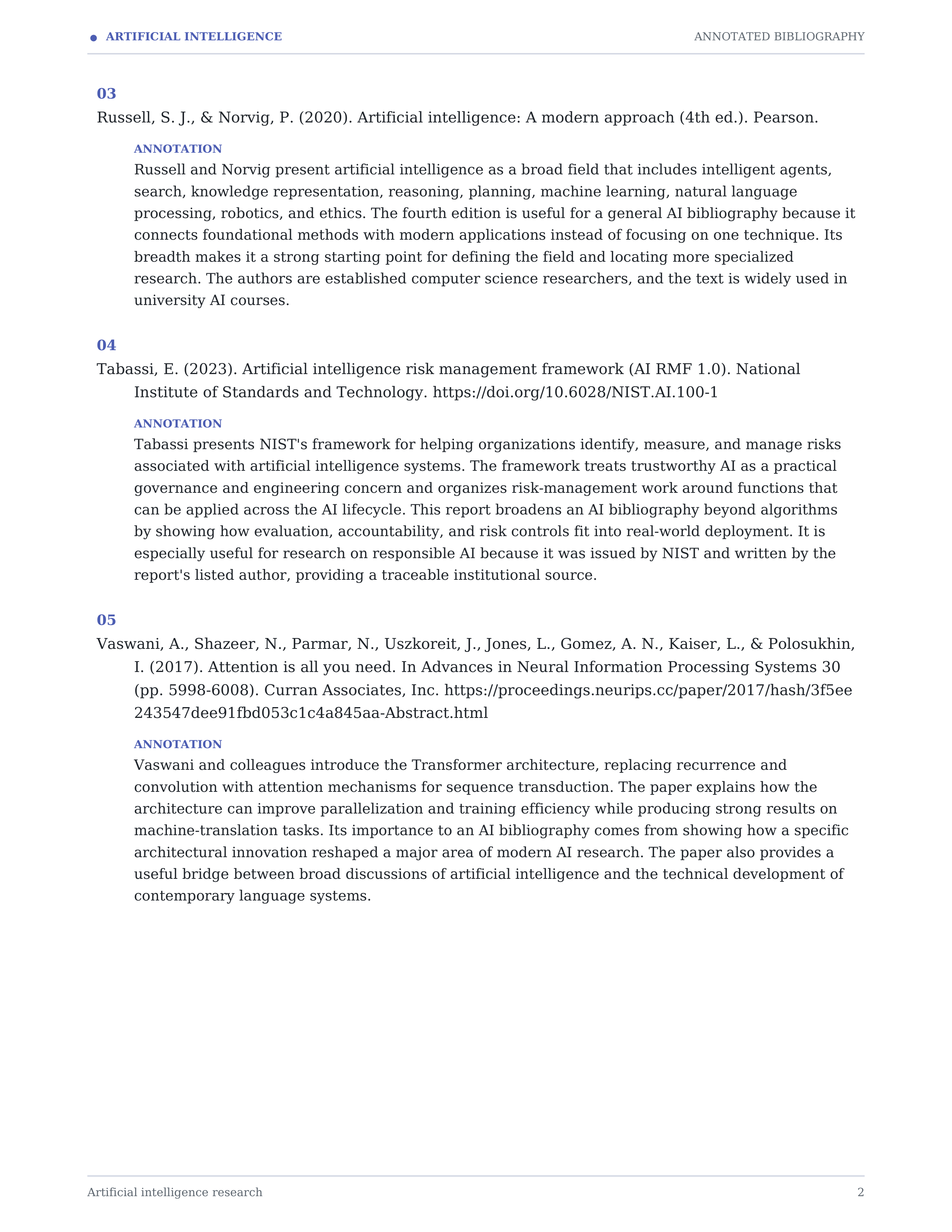
03
Russell, S. J., & Norvig, P. (2020). Artificial intelligence: A modern approach (4th ed.). Pearson.
ANNOTATION
Russell and Norvig present artificial intelligence as a broad field that includes intelligent agents,
search, knowledge representation, reasoning, planning, machine learning, natural language
processing, robotics, and ethics. The fourth edition is useful for a general AI bibliography because it
connects foundational methods with modern applications instead of focusing on one technique. Its
breadth makes it a strong starting point for defining the field and locating more specialized
research. The authors are established computer science researchers, and the text is widely used in
university AI courses.
04
Tabassi, E. (2023). Artificial intelligence risk management framework (AI RMF 1.0). National
Institute of Standards and Technology. https://doi.org/10.6028/NIST.AI.100-1
ANNOTATION
Tabassi presents NIST's framework for helping organizations identify, measure, and manage risks
associated with artificial intelligence systems. The framework treats trustworthy AI as a practical
governance and engineering concern and organizes risk-management work around functions that
can be applied across the AI lifecycle. This report broadens an AI bibliography beyond algorithms
by showing how evaluation, accountability, and risk controls fit into real-world deployment. It is
especially useful for research on responsible AI because it was issued by NIST and written by the
report's listed author, providing a traceable institutional source.
05
Vaswani, A., Shazeer, N., Parmar, N., Uszkoreit, J., Jones, L., Gomez, A. N., Kaiser, L., & Polosukhin,
I. (2017). Attention is all you need. In Advances in Neural Information Processing Systems 30
(pp. 5998-6008). Curran Associates, Inc. https://proceedings.neurips.cc/paper/2017/hash/3f5ee
243547dee91fbd053c1c4a845aa-Abstract.html
ANNOTATION
Vaswani and colleagues introduce the Transformer architecture, replacing recurrence and
convolution with attention mechanisms for sequence transduction. The paper explains how the
architecture can improve parallelization and training efficiency while producing strong results on
machine-translation tasks. Its importance to an AI bibliography comes from showing how a specific
architectural innovation reshaped a major area of modern AI research. The paper also provides a
useful bridge between broad discussions of artificial intelligence and the technical development of
contemporary language systems.