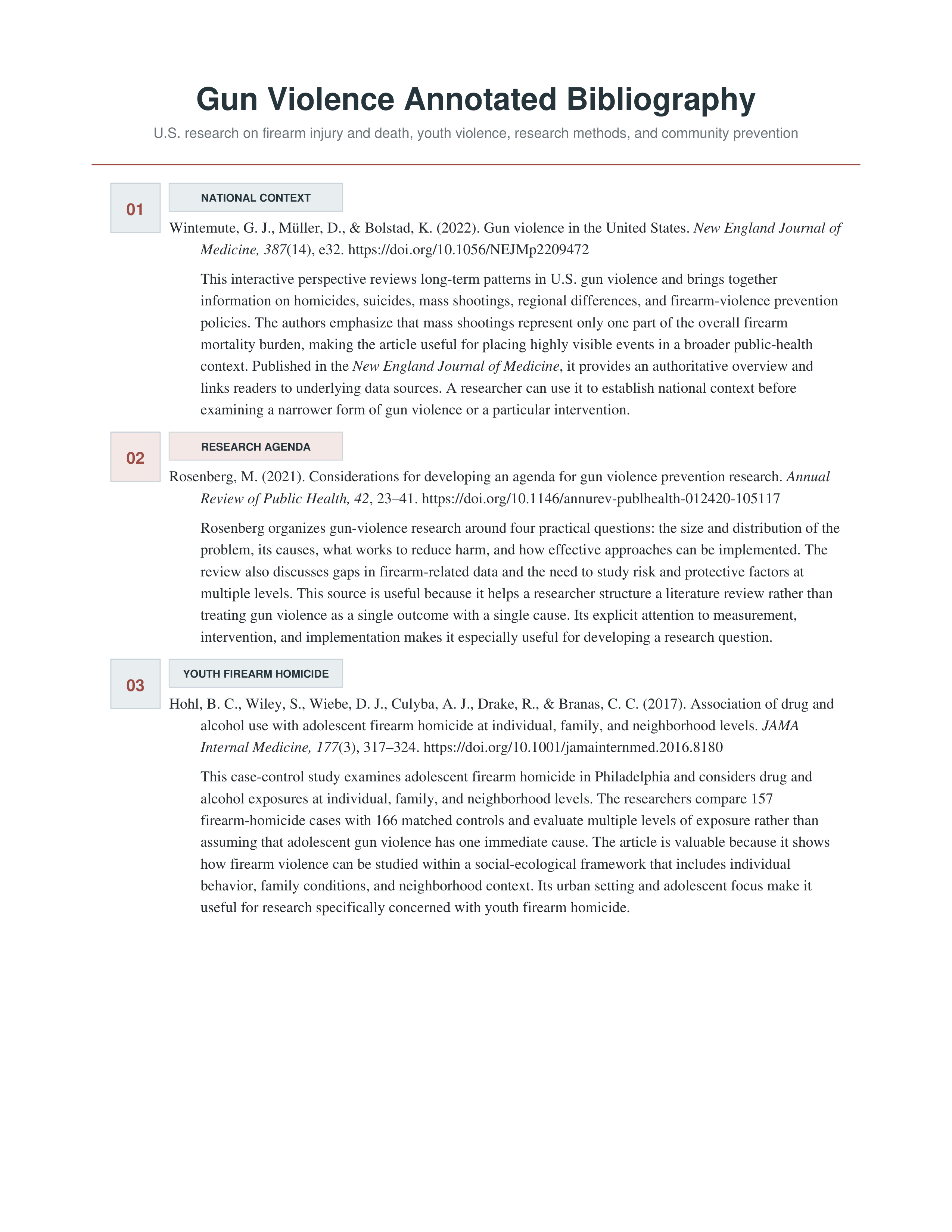
Gun Violence Annotated Bibliography
U.S. research on firearm injury and death, youth violence, research methods, and community prevention
01
NATIONAL CONTEXT
Wintemute, G. J., Müller, D., & Bolstad, K. (2022). Gun violence in the United States.
New England Journal of
Medicine, 387
(14), e32. https://doi.org/10.1056/NEJMp2209472
This interactive perspective reviews long-term patterns in U.S. gun violence and brings together
information on homicides, suicides, mass shootings, regional differences, and firearm-violence prevention
policies. The authors emphasize that mass shootings represent only one part of the overall firearm
mortality burden, making the article useful for placing highly visible events in a broader public-health
context. Published in the
New England Journal of Medicine
, it provides an authoritative overview and
links readers to underlying data sources. A researcher can use it to establish national context before
examining a narrower form of gun violence or a particular intervention.
02
RESEARCH AGENDA
Rosenberg, M. (2021). Considerations for developing an agenda for gun violence prevention research.
Annual
Review of Public Health, 42
, 23–41. https://doi.org/10.1146/annurev-publhealth-012420-105117
Rosenberg organizes gun-violence research around four practical questions: the size and distribution of the
problem, its causes, what works to reduce harm, and how effective approaches can be implemented. The
review also discusses gaps in firearm-related data and the need to study risk and protective factors at
multiple levels. This source is useful because it helps a researcher structure a literature review rather than
treating gun violence as a single outcome with a single cause. Its explicit attention to measurement,
intervention, and implementation makes it especially useful for developing a research question.
03
YOUTH FIREARM HOMICIDE
Hohl, B. C., Wiley, S., Wiebe, D. J., Culyba, A. J., Drake, R., & Branas, C. C. (2017). Association of drug and
alcohol use with adolescent firearm homicide at individual, family, and neighborhood levels.
JAMA
Internal Medicine, 177
(3), 317–324. https://doi.org/10.1001/jamainternmed.2016.8180
This case-control study examines adolescent firearm homicide in Philadelphia and considers drug and
alcohol exposures at individual, family, and neighborhood levels. The researchers compare 157
firearm-homicide cases with 166 matched controls and evaluate multiple levels of exposure rather than
assuming that adolescent gun violence has one immediate cause. The article is valuable because it shows
how firearm violence can be studied within a social-ecological framework that includes individual
behavior, family conditions, and neighborhood context. Its urban setting and adolescent focus make it
useful for research specifically concerned with youth firearm homicide.