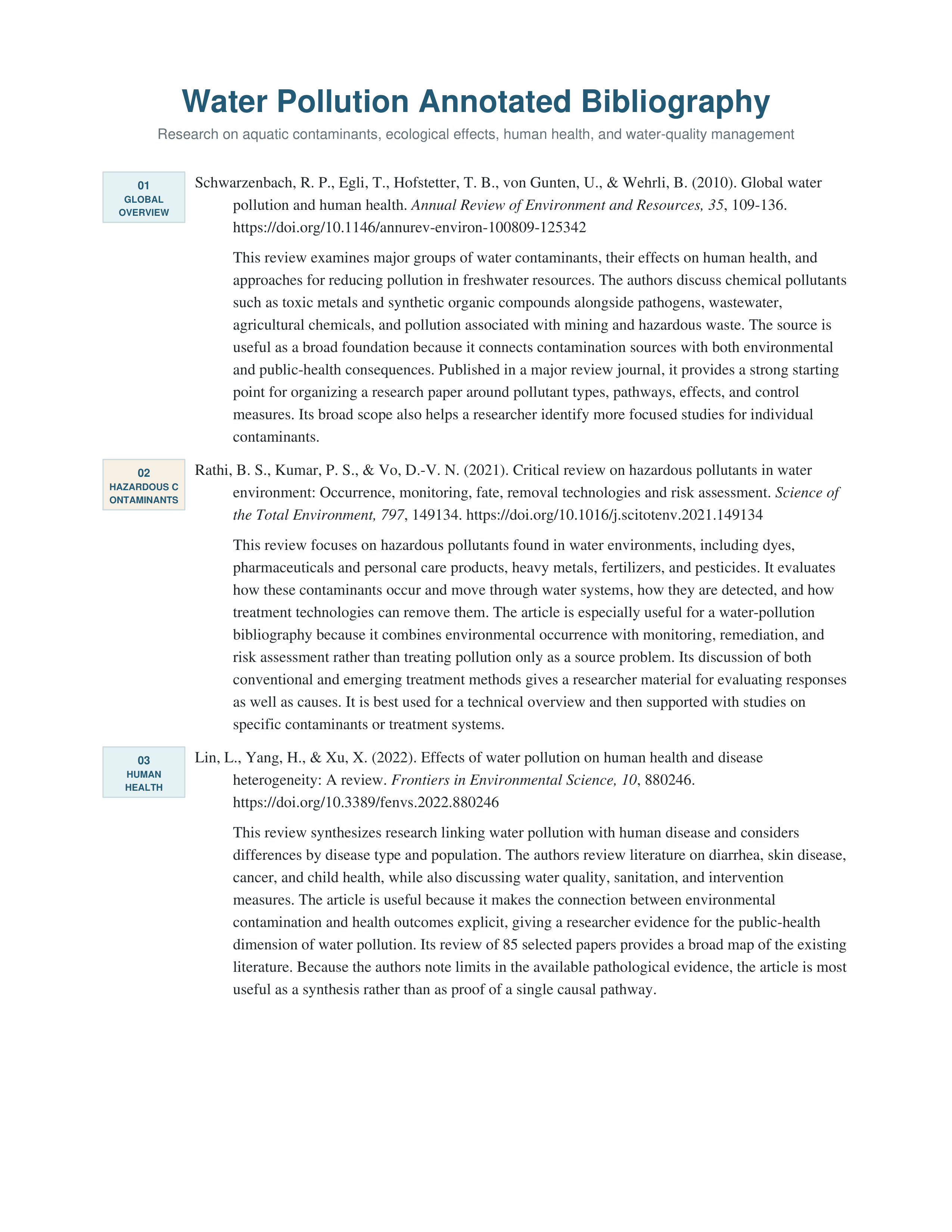
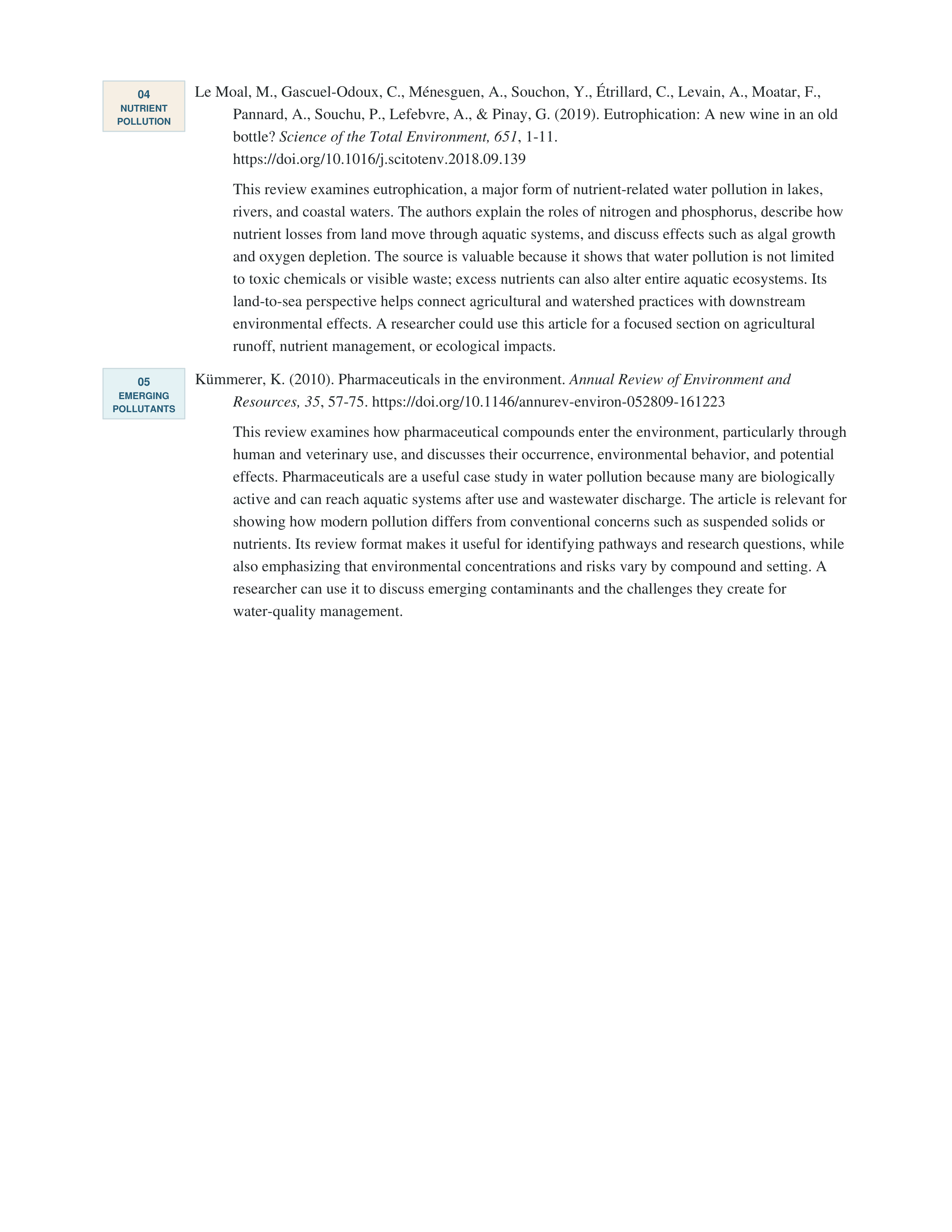
Water Pollution Annotated Bibliography
Research on aquatic contaminants, ecological effects, human health, and water-quality management
01
GLOBAL
OVERVIEW
Schwarzenbach, R. P., Egli, T., Hofstetter, T. B., von Gunten, U., & Wehrli, B. (2010). Global water
pollution and human health.
Annual Review of Environment and Resources, 35
, 109-136.
https://doi.org/10.1146/annurev-environ-100809-125342
This review examines major groups of water contaminants, their effects on human health, and
approaches for reducing pollution in freshwater resources. The authors discuss chemical pollutants
such as toxic metals and synthetic organic compounds alongside pathogens, wastewater,
agricultural chemicals, and pollution associated with mining and hazardous waste. The source is
useful as a broad foundation because it connects contamination sources with both environmental
and public-health consequences. Published in a major review journal, it provides a strong starting
point for organizing a research paper around pollutant types, pathways, effects, and control
measures. Its broad scope also helps a researcher identify more focused studies for individual
contaminants.
02
HAZARDOUS C
ONTAMINANTS
Rathi, B. S., Kumar, P. S., & Vo, D.-V. N. (2021). Critical review on hazardous pollutants in water
environment: Occurrence, monitoring, fate, removal technologies and risk assessment.
Science of
the Total Environment, 797
, 149134. https://doi.org/10.1016/j.scitotenv.2021.149134
This review focuses on hazardous pollutants found in water environments, including dyes,
pharmaceuticals and personal care products, heavy metals, fertilizers, and pesticides. It evaluates
how these contaminants occur and move through water systems, how they are detected, and how
treatment technologies can remove them. The article is especially useful for a water-pollution
bibliography because it combines environmental occurrence with monitoring, remediation, and
risk assessment rather than treating pollution only as a source problem. Its discussion of both
conventional and emerging treatment methods gives a researcher material for evaluating responses
as well as causes. It is best used for a technical overview and then supported with studies on
specific contaminants or treatment systems.
03
HUMAN
HEALTH
Lin, L., Yang, H., & Xu, X. (2022). Effects of water pollution on human health and disease
heterogeneity: A review.
Frontiers in Environmental Science, 10
, 880246.
https://doi.org/10.3389/fenvs.2022.880246
This review synthesizes research linking water pollution with human disease and considers
differences by disease type and population. The authors review literature on diarrhea, skin disease,
cancer, and child health, while also discussing water quality, sanitation, and intervention
measures. The article is useful because it makes the connection between environmental
contamination and health outcomes explicit, giving a researcher evidence for the public-health
dimension of water pollution. Its review of 85 selected papers provides a broad map of the existing
literature. Because the authors note limits in the available pathological evidence, the article is most
useful as a synthesis rather than as proof of a single causal pathway.