
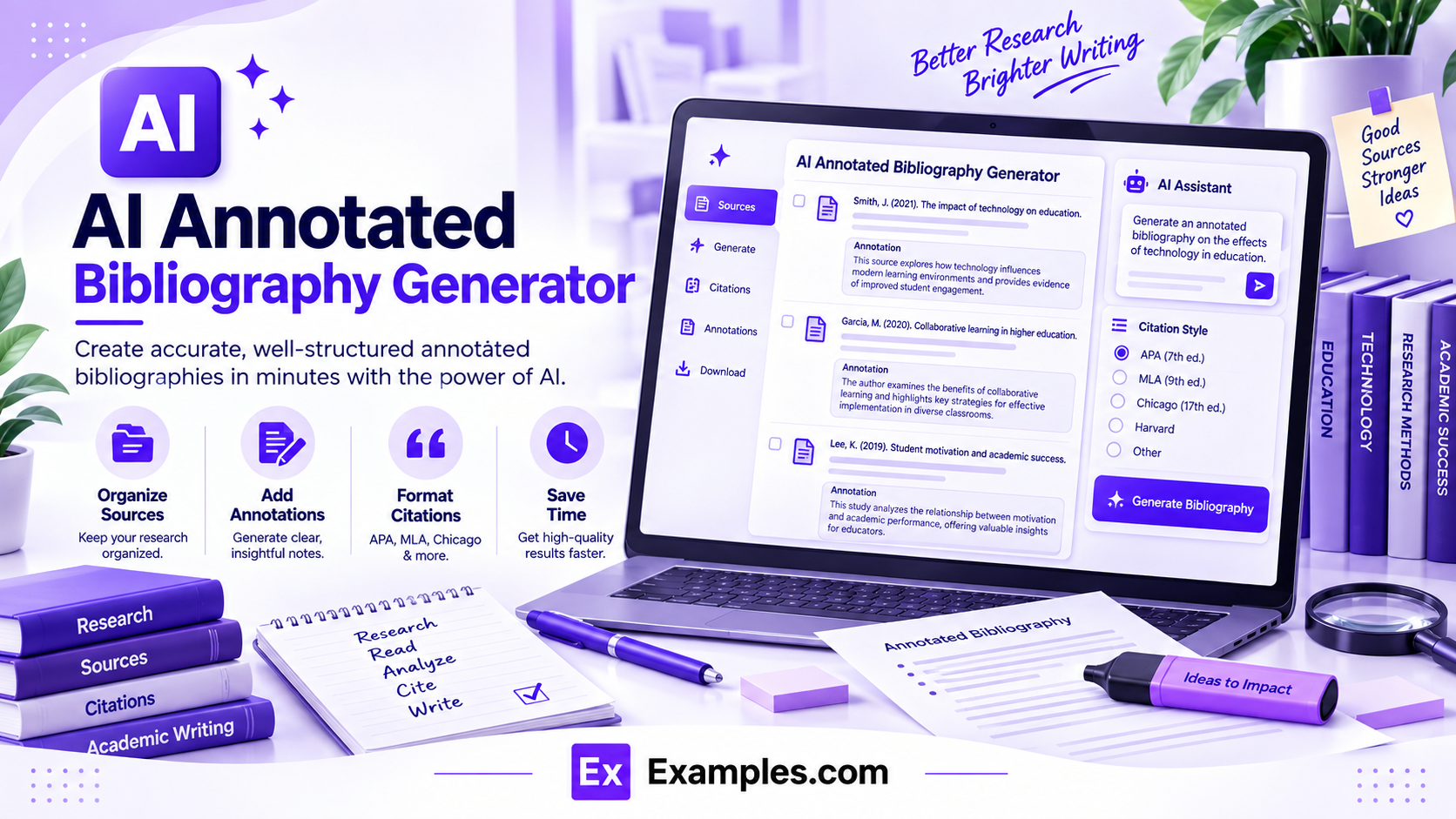
An annotated bibliography is a list of sources used for research that includes a citation and a brief annotation for each source. An annotation typically summarizes the source, evaluates its credibility or relevance, and explains how it contributes to the research topic. Unlike a standard bibliography or works cited page, an annotated bibliography provides information about each source rather than only listing its publication details.
What Is an Annotated Bibliography?
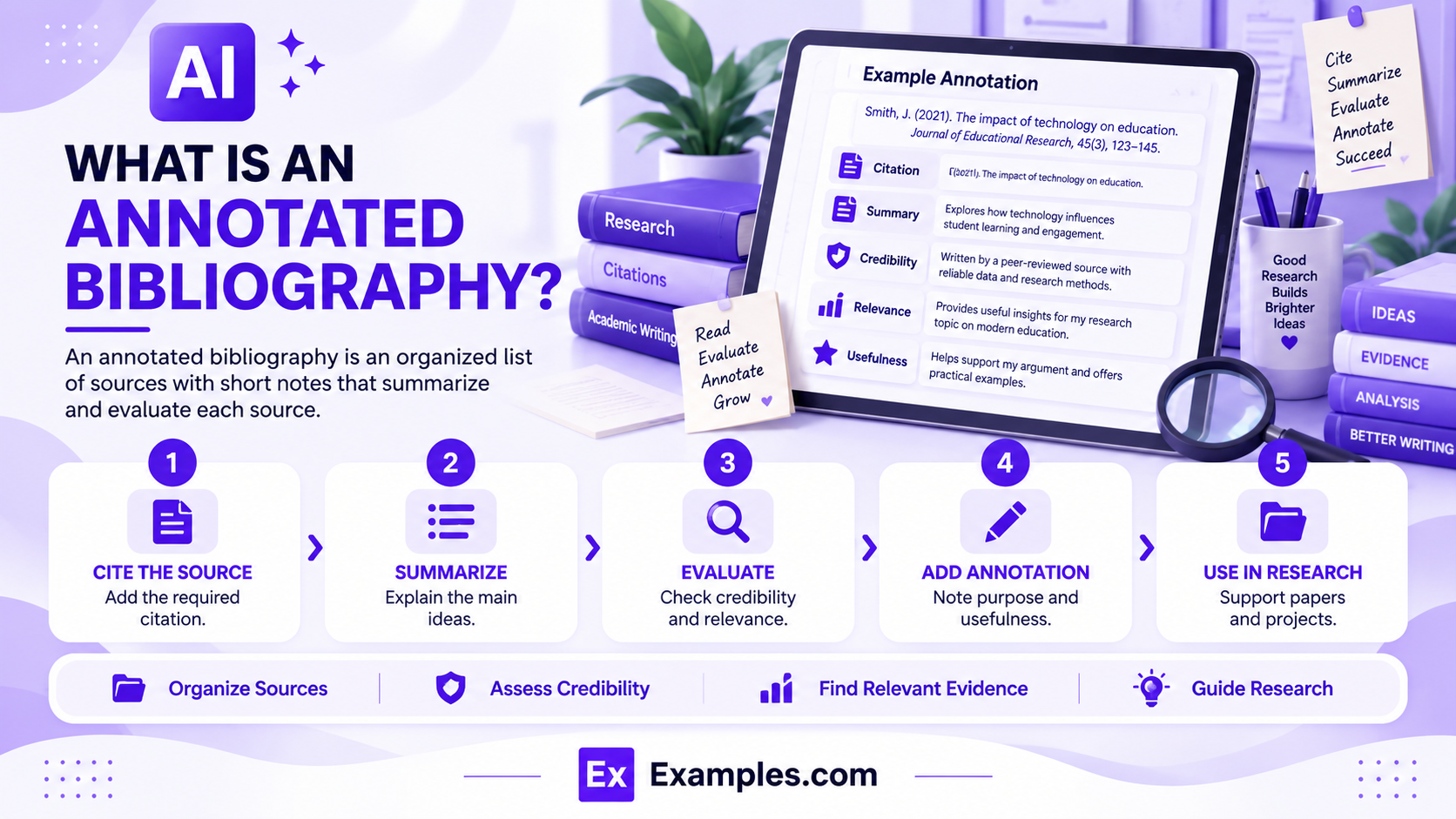
An annotated bibliography is an organized list of sources accompanied by short notes that explain, summarize, and evaluate each source. Each entry normally begins with a citation in the required style, followed by an annotation that may discuss the source’s main ideas, credibility, relevance, purpose, and usefulness for a research project. An annotated bibliography helps researchers understand and assess sources before using them in a paper, presentation, or other academic work.
What Are the Different Types of Annotated Bibliographies?
Descriptive Annotated Bibliography
A Descriptive Annotated Bibliography summarizes the main content, purpose, and focus of each source without extensively evaluating its strengths, weaknesses, or overall usefulness.
Critical Annotated Bibliography
A Critical Annotated Bibliography summarizes and evaluates each source by examining its credibility, evidence, strengths, limitations, assumptions, and relevance to the research topic.
Evaluative Annotated Bibliography
An Evaluative Annotated Bibliography focuses on assessing the quality, reliability, authority, and usefulness of each source for a particular research purpose.
Informative Annotated Bibliography
An Informative Annotated Bibliography provides concise information about the source’s main argument, findings, subject, and purpose to help readers understand what the source contributes.
Academic Annotated Bibliography
An Academic Annotated Bibliography organizes scholarly and academic sources while explaining their relevance, credibility, and contribution to an academic research question.
Literature Annotated Bibliography
A Literature Annotated Bibliography focuses on literary works or sources used in literary research and explains their content, perspective, relevance, and relationship to the research topic.
Research Annotated Bibliography
A Research Annotated Bibliography collects and evaluates sources related to a research question, helping the researcher identify useful evidence and understand different perspectives.
Source-Based Annotated Bibliography
A Source-Based Annotated Bibliography organizes different source types, such as books, journal articles, websites, reports, interviews, or primary sources, with annotations explaining their value.
Subject-Specific Annotated Bibliography
A Subject-Specific Annotated Bibliography focuses on sources related to a particular academic field, professional discipline, or specialized research topic.
Comparative Annotated Bibliography
A Comparative Annotated Bibliography examines multiple sources while highlighting differences in arguments, evidence, methods, perspectives, or conclusions.
How Do I Generate Annotated Bibliographies Using Real Examples?
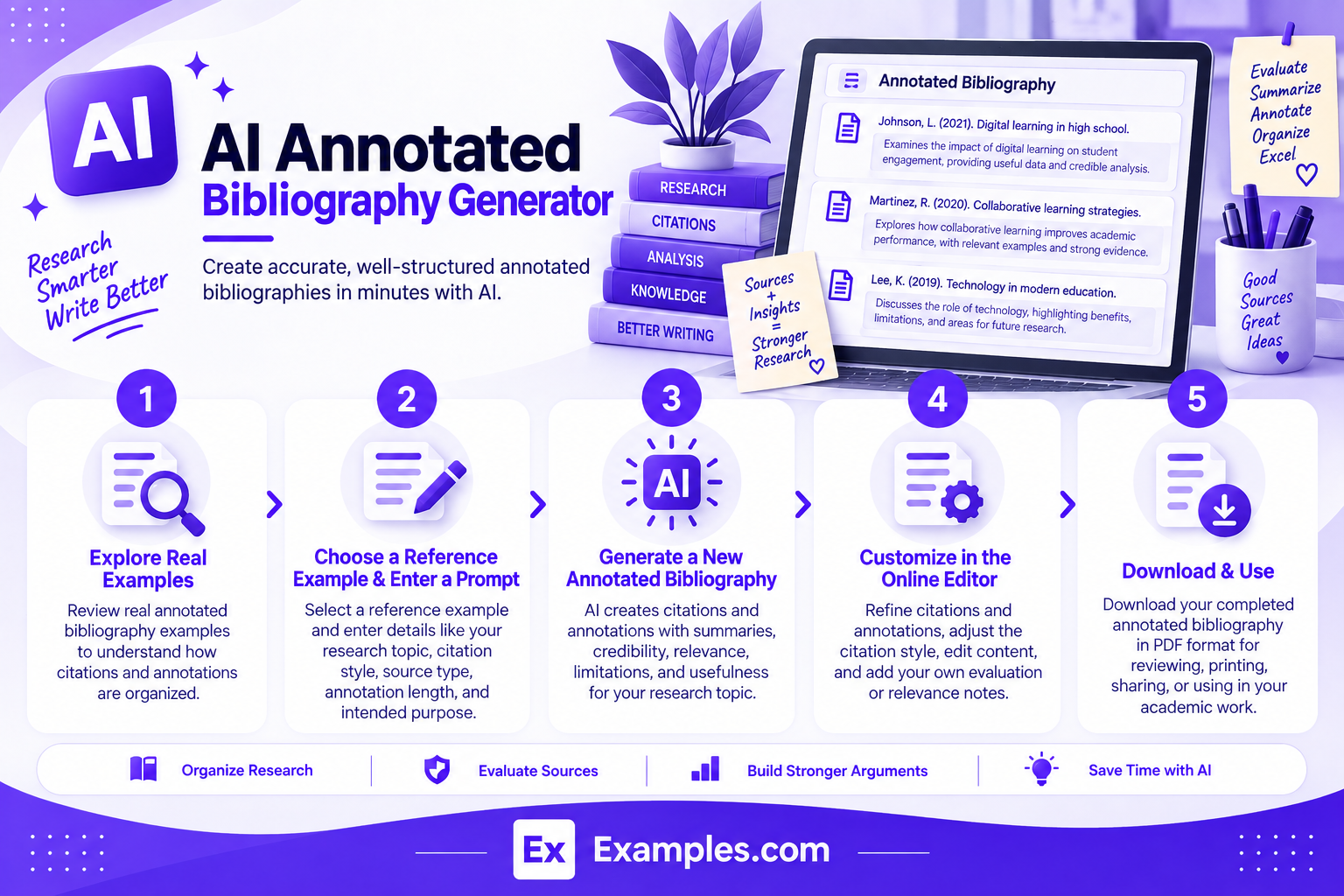
Explore Real Annotated Bibliography Examples
Review real annotated bibliography examples to understand how citations and annotations are organized and how writers summarize, evaluate, and explain the relevance of different sources. Examples can help you compare annotation styles and understand what information should be included for each source.
Choose A Reference Example And Enter An AI Prompt
Choose a reference annotated bibliography and describe what you need in your prompt, including the research topic, required citation style, source type, annotation length, evaluation criteria, and intended purpose. A specific prompt helps produce entries that match the requirements of your research assignment.
Generate A New AI Annotated Bibliography
Generate a new annotated bibliography from your prompt. The AI can organize source citations and annotations while helping explain the source’s main ideas, credibility, relevance, limitations, and usefulness to the research topic.
Customize The Annotated Bibliography In The Online Editor
Refine the citations and annotations in the online editor by correcting source details, adjusting the citation style, shortening or expanding annotations, and adding source-specific evaluation or relevance information.
Download And Use Your Annotated Bibliography
Download your completed annotated bibliography in PDF format for reviewing, printing, organizing, sharing, or using as a reference while developing a research paper, literature review, presentation, or academic project.
What Makes a Good Annotated Bibliography?
A good annotated bibliography uses accurate citations and concise, informative annotations that clearly explain each source. It should summarize the source fairly, evaluate its credibility or usefulness when required, and connect it to the research topic. Strong annotated bibliographies follow the required citation style, use reliable sources, maintain consistent formatting, and provide enough analysis to help readers understand why each source matters.
AI Annotated Bibliography Editing Features
AI Annotated Bibliography Generation
Generate annotated bibliography entries based on your research topic, sources, annotation requirements, citation style, and academic purpose.
Smart Citation Editing
Refine citation formatting, source information, punctuation, capitalization, and other details to better match the required citation style.
Source Summary Development
Create concise summaries of a source’s main argument, purpose, methods, findings, or key ideas based on the information you provide.
Annotation Customization
Adjust the annotation’s length, tone, focus, level of detail, and emphasis on summary, evaluation, relevance, or usefulness.
Source Evaluation Refinement
Strengthen explanations of a source’s credibility, authority, evidence, limitations, perspective, and relevance to the research topic.
Instant PDF Download
Download your completed annotated bibliography in PDF format for reviewing, printing, organizing, sharing, or using as a research reference.
What Are the Essential Elements of an Annotated Bibliography?
- Research Topic: Establish the subject, question, or problem that connects the selected sources.
- Accurate Citation: Provide complete bibliographic information in the required citation style.
- Source Identification: Clearly identify the book, article, website, report, interview, or other source being annotated.
- Summary: Briefly explain the source’s main argument, purpose, findings, or important ideas.
- Evaluation: Assess the source’s credibility, authority, evidence, limitations, or reliability when required.
- Relevance: Explain how the source relates to the research topic or question.
- Usefulness: Describe how the source may contribute to the research project or support a particular point.
- Concise Writing: Keep the annotation focused and include only information that contributes to understanding the source.
- Consistent Formatting: Apply the same citation and annotation formatting throughout the bibliography.
- Objective Analysis: Represent the source accurately and distinguish description of the source from your own evaluation or interpretation.
How Do I Write an Annotated Bibliography?
- Identify the Research Topic: Determine the subject, question, or problem that your sources need to address.
- Find Relevant Sources: Search for books, journal articles, websites, reports, interviews, and other sources that are appropriate for your research.
- Evaluate the Sources: Consider each source’s author, publication, evidence, credibility, currency, purpose, and relevance before including it.
- Choose the Citation Style: Determine whether the assignment requires APA, MLA, Chicago, or another citation format.
- Create the Citation: Record the complete bibliographic information for each source using the required style.
- Summarize the Source: Explain the main argument, purpose, findings, or important information presented by the source.
- Evaluate the Source: Discuss its credibility, strengths, limitations, evidence, perspective, or usefulness when the assignment requires evaluation.
- Explain the Relevance: Connect the source directly to your research topic, question, or planned argument.
- Organize the Entries: Arrange sources according to the required instructions, often alphabetically by the author’s last name unless another arrangement is specified.
- Review and Refine: Check citation accuracy, formatting, grammar, source details, annotation length, and consistency before submitting the bibliography.
Why Should I Use Real Annotated Bibliography Examples to Create My Own Annotated Bibliography?
- Real examples show how citations and annotations are combined into complete bibliography entries.
- They help you understand the difference between a regular bibliography and an annotated bibliography.
- They provide useful examples of source summaries, evaluations, and relevance statements.
- They show how different citation styles affect the formatting of source information.
- They help you understand how much detail to include in each annotation.
- They make it easier to organize your own sources clearly and consistently.
What Common Annotated Bibliography Mistakes Should I Avoid?
- Missing Citation Information: Make sure every source includes the information required by the selected citation style.
- Using the Wrong Citation Style: Follow the required APA, MLA, Chicago, or other formatting rules consistently.
- Only Summarizing the Source: An annotation may also require evaluation and explanation of relevance, not just a summary.
- Writing Without Evaluating Credibility: When evaluation is required, consider the author, publication, evidence, purpose, and limitations of the source.
- Being Too General: Explain specifically how the source relates to your research topic.
- Including Unreliable Sources: Consider source authority, evidence, publication quality, currency, and relevance before including a source.
- Copying Source Language: Summarize and evaluate the source in your own words and use quotations only when appropriate.
- Making Unsupported Claims: Base evaluations and descriptions on the source’s actual content and available evidence.
- Inconsistent Formatting: Keep citation structure, spacing, capitalization, indentation, and annotation formatting consistent.
- Ignoring Assignment Requirements: Check the required number of sources, annotation length, citation style, source types, and organizational instructions.
What Is the Difference Between an Annotated Bibliography and a Bibliography?
| Annotated Bibliography | Bibliography |
|---|---|
| Includes citations plus a brief annotation for each source. | Primarily lists the sources used or consulted for a project. |
| Explains or evaluates the content, quality, relevance, or usefulness of each source. | Usually provides bibliographic information without a detailed annotation. |
| Helps readers understand why individual sources matter to the research. | Helps readers identify the sources associated with the research. |
| Can include summaries, evaluations, and relevance statements. | Usually focuses on source identification and citation information. |
| Requires additional writing beyond the citation itself. | Generally consists primarily of source citations. |
| Can be used to assess and organize research sources before writing a larger project. | Provides a record of sources associated with a paper, project, or area of study. |
Annotated Bibliography Ideas for Different Research Areas
- History: Evaluate books, primary sources, archival materials, and scholarly articles that provide evidence about a historical event or period.
- Literature: Annotate literary works, criticism, scholarly articles, and other sources used to analyze an author, text, theme, or literary movement.
- Science: Summarize and evaluate research articles, studies, reports, and scientific sources related to a specific research question.
- Health and Medicine: Examine scholarly research, medical publications, reports, and evidence-based sources relevant to a health topic.
- Education: Annotate research studies, educational theories, policy documents, and professional sources related to teaching and learning.
- Psychology: Evaluate research articles, books, and academic sources addressing human behavior, cognition, development, or mental processes.
- Business: Review sources concerning management, marketing, finance, entrepreneurship, organizational behavior, or business strategy.
- Technology: Evaluate technical publications, research papers, reports, and credible online sources related to technology and innovation.
- Social Issues: Compare research, reports, academic publications, and credible sources presenting different perspectives on a social issue.
- Environmental Studies: Annotate scientific research, government reports, academic publications, and other sources related to environmental questions or sustainability.
FAQs
What Is an Annotated Bibliography?
An annotated bibliography is a list of sources accompanied by brief annotations that summarize, evaluate, and explain the relevance or usefulness of each source.
How Long Should an Annotated Bibliography Be?
The length depends on the assignment and the number of sources. Each individual annotation may range from a short paragraph to several paragraphs depending on the required level of summary and evaluation.
What Should Be Included in an Annotated Bibliography?
An annotated bibliography normally includes a citation for each source followed by an annotation that may summarize the source, evaluate its credibility or limitations, and explain its relevance to the research topic.
What Citation Style Should I Use for an Annotated Bibliography?
Use the citation style specified by your instructor, institution, publication, or assignment, such as APA, MLA, Chicago, or another required style.
Does an Annotated Bibliography Summarize Sources?
Yes. An annotation generally includes a concise summary of the source’s main ideas, argument, purpose, findings, or content. Some assignments also require evaluation and explanation of relevance.
Does an Annotated Bibliography Evaluate Sources?
It can. Many annotated bibliographies require evaluation of a source’s credibility, authority, evidence, limitations, purpose, or usefulness, although the exact requirements depend on the assignment.
How Is an Annotated Bibliography Different From a Works Cited Page?
An annotated bibliography includes explanatory notes about each source, while a works cited page primarily lists the sources cited in a paper using the required citation format.
Should Annotated Bibliography Sources Be in Alphabetical Order?
Often, yes. Many assignments organize entries alphabetically by the author’s last name, but you should follow the specific instructions provided for your assignment.
Can an Annotated Bibliography Include Websites?
Yes. Websites can be included when they are relevant and meet the source-quality requirements of the assignment. Their credibility, author, publication information, purpose, and currency should be considered.
Can AI Help Me Create an Annotated Bibliography?
Yes, AI can help organize source information, draft summaries, improve annotations, and refine citation formatting when you provide accurate source details and verify the final citations and descriptions against the original sources.