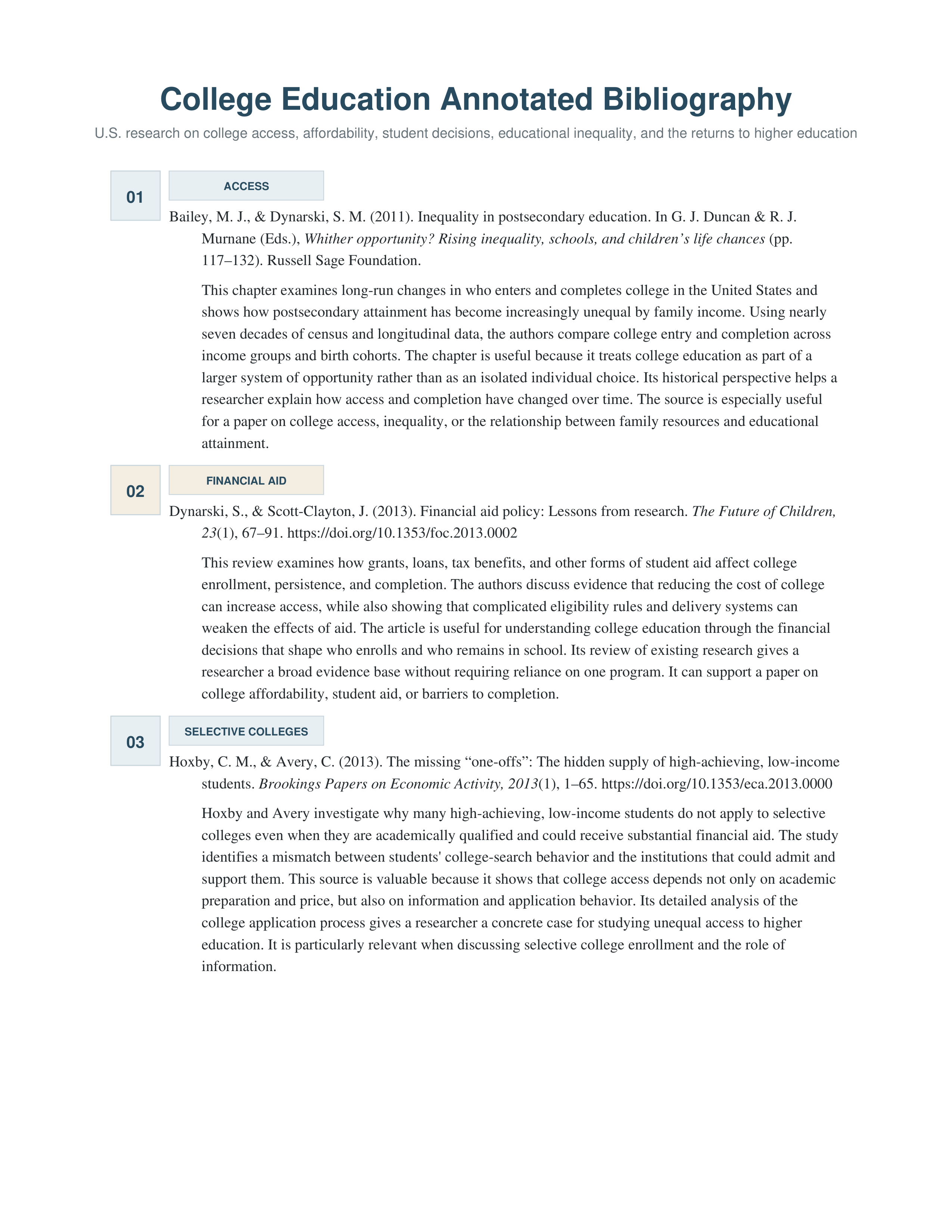
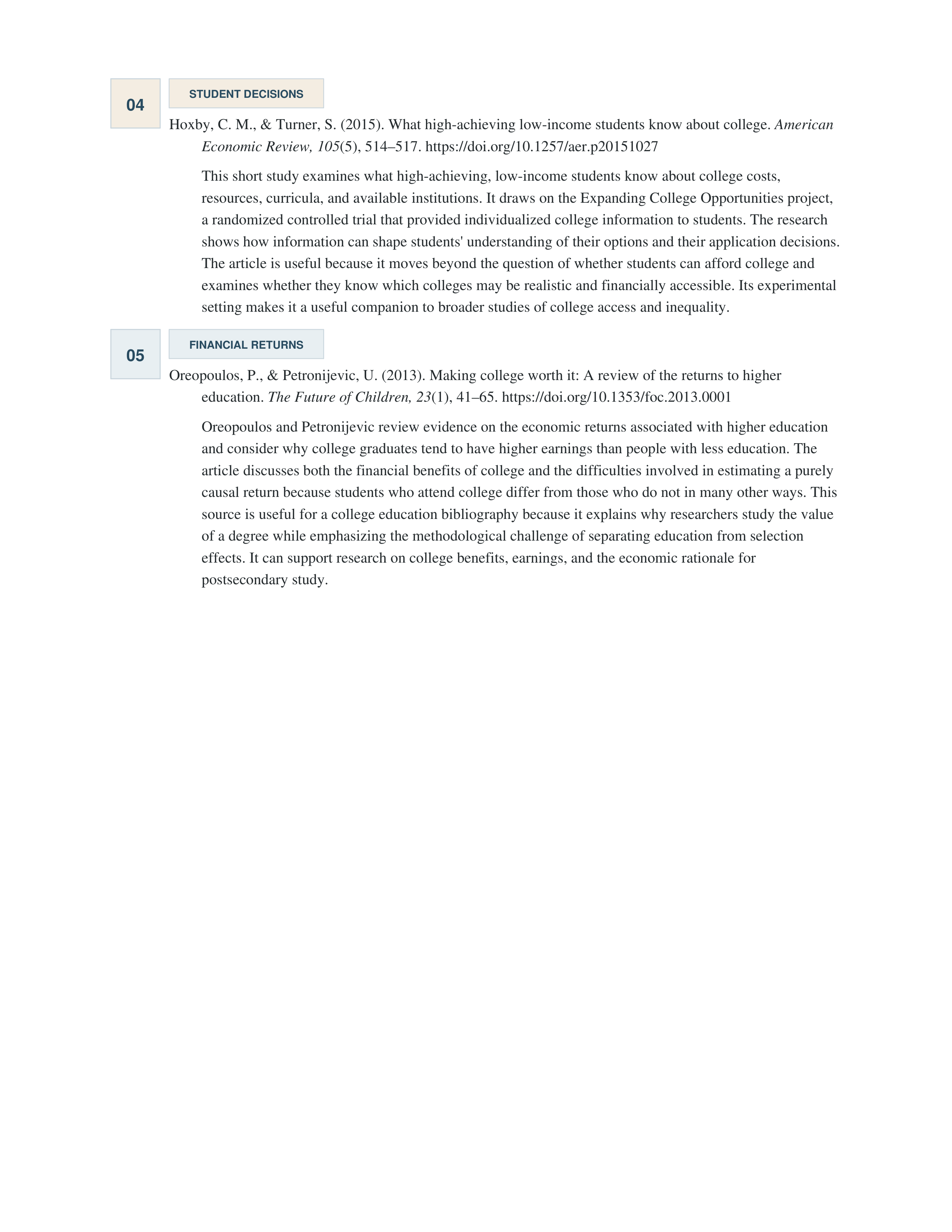
College Education Annotated Bibliography
U.S. research on college access, affordability, student decisions, educational inequality, and the returns to higher education
01
ACCESS
Bailey, M. J., & Dynarski, S. M. (2011). Inequality in postsecondary education. In G. J. Duncan & R. J.
Murnane (Eds.),
Whither opportunity? Rising inequality, schools, and children’s life chances
(pp.
117–132). Russell Sage Foundation.
This chapter examines long-run changes in who enters and completes college in the United States and
shows how postsecondary attainment has become increasingly unequal by family income. Using nearly
seven decades of census and longitudinal data, the authors compare college entry and completion across
income groups and birth cohorts. The chapter is useful because it treats college education as part of a
larger system of opportunity rather than as an isolated individual choice. Its historical perspective helps a
researcher explain how access and completion have changed over time. The source is especially useful
for a paper on college access, inequality, or the relationship between family resources and educational
attainment.
02
FINANCIAL AID
Dynarski, S., & Scott-Clayton, J. (2013). Financial aid policy: Lessons from research.
The Future of Children,
23
(1), 67–91. https://doi.org/10.1353/foc.2013.0002
This review examines how grants, loans, tax benefits, and other forms of student aid affect college
enrollment, persistence, and completion. The authors discuss evidence that reducing the cost of college
can increase access, while also showing that complicated eligibility rules and delivery systems can
weaken the effects of aid. The article is useful for understanding college education through the financial
decisions that shape who enrolls and who remains in school. Its review of existing research gives a
researcher a broad evidence base without requiring reliance on one program. It can support a paper on
college affordability, student aid, or barriers to completion.
03
SELECTIVE COLLEGES
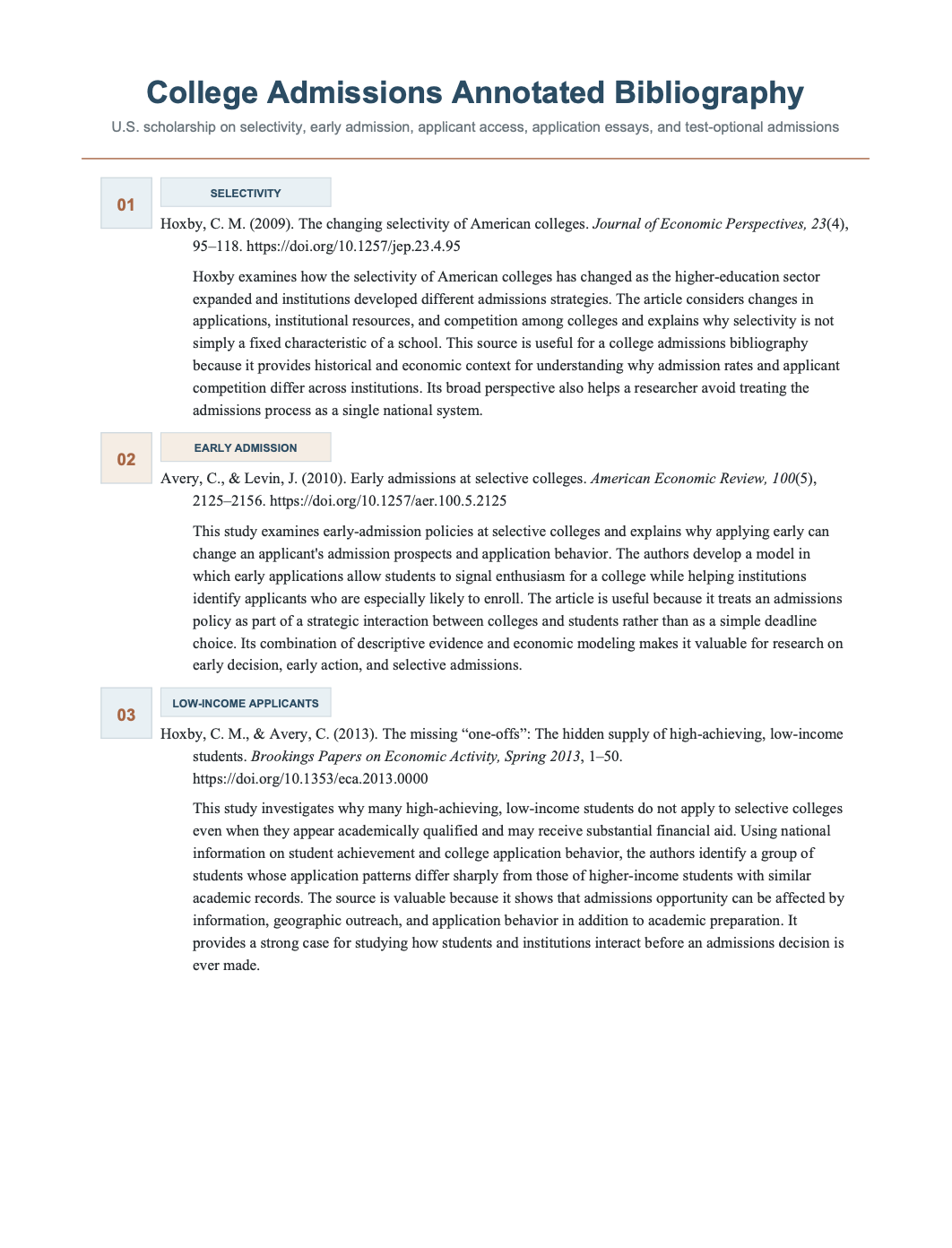
Hoxby, C. M., & Avery, C. (2013). The missing “one-offs”: The hidden supply of high-achieving, low-income
students.
Brookings Papers on Economic Activity, 2013
(1), 1–65. https://doi.org/10.1353/eca.2013.0000
Hoxby and Avery investigate why many high-achieving, low-income students do not apply to selective
colleges even when they are academically qualified and could receive substantial financial aid. The study
identifies a mismatch between students' college-search behavior and the institutions that could admit and
support them. This source is valuable because it shows that college access depends not only on academic
preparation and price, but also on information and application behavior. Its detailed analysis of the
college application process gives a researcher a concrete case for studying unequal access to higher
education. It is particularly relevant when discussing selective college enrollment and the role of
information.