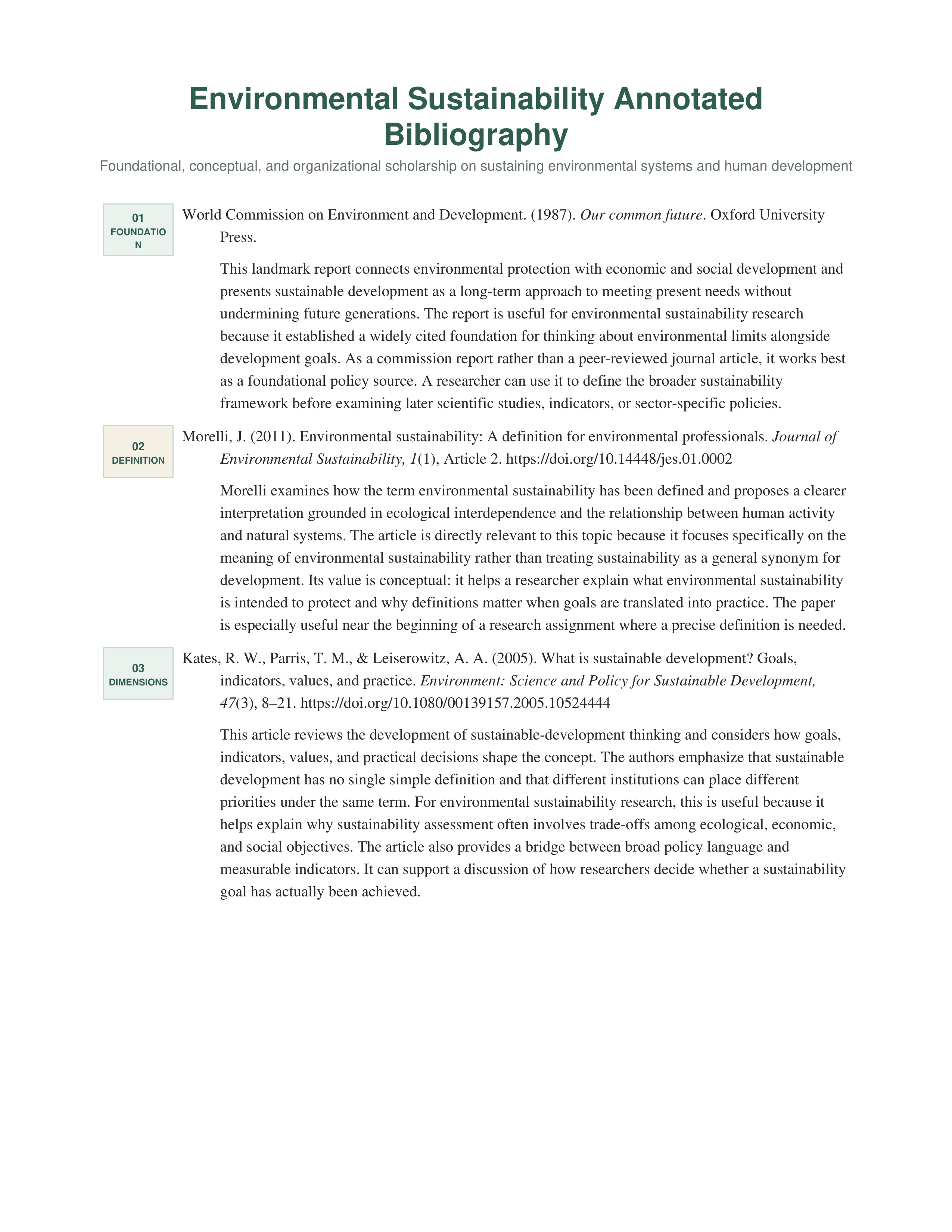
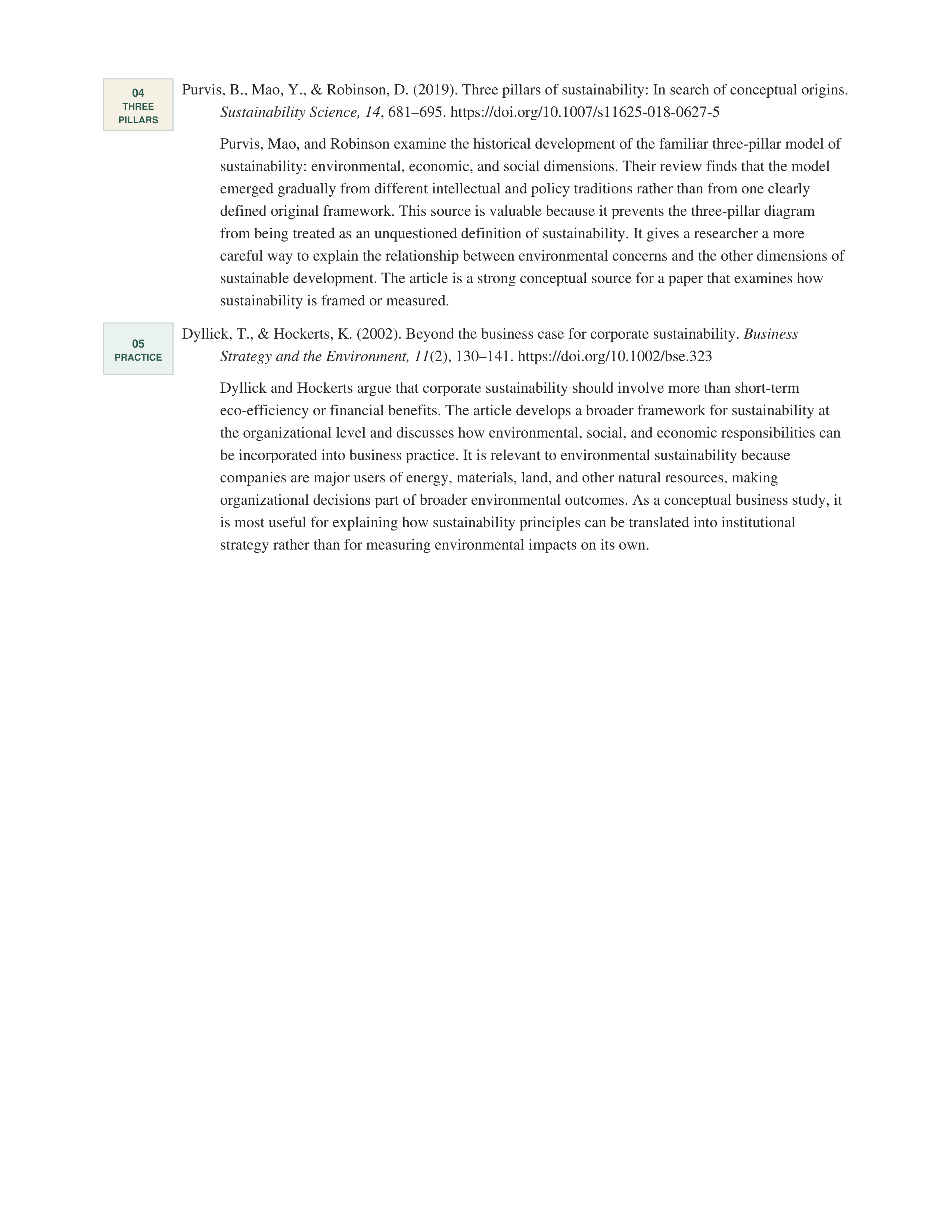
Environmental Sustainability Annotated
Bibliography
Foundational, conceptual, and organizational scholarship on sustaining environmental systems and human development
01
FOUNDATIO
N
World Commission on Environment and Development. (1987).
Our common future
. Oxford University
Press.
This landmark report connects environmental protection with economic and social development and
presents sustainable development as a long-term approach to meeting present needs without
undermining future generations. The report is useful for environmental sustainability research
because it established a widely cited foundation for thinking about environmental limits alongside
development goals. As a commission report rather than a peer-reviewed journal article, it works best
as a foundational policy source. A researcher can use it to define the broader sustainability
framework before examining later scientific studies, indicators, or sector-specific policies.
02
DEFINITION
Morelli, J. (2011). Environmental sustainability: A definition for environmental professionals.
Journal of
Environmental Sustainability, 1
(1), Article 2. https://doi.org/10.14448/jes.01.0002
Morelli examines how the term environmental sustainability has been defined and proposes a clearer
interpretation grounded in ecological interdependence and the relationship between human activity
and natural systems. The article is directly relevant to this topic because it focuses specifically on the
meaning of environmental sustainability rather than treating sustainability as a general synonym for
development. Its value is conceptual: it helps a researcher explain what environmental sustainability
is intended to protect and why definitions matter when goals are translated into practice. The paper
is especially useful near the beginning of a research assignment where a precise definition is needed.
03
DIMENSIONS
Kates, R. W., Parris, T. M., & Leiserowitz, A. A. (2005). What is sustainable development? Goals,
indicators, values, and practice.
Environment: Science and Policy for Sustainable Development,
47
(3), 8–21. https://doi.org/10.1080/00139157.2005.10524444
This article reviews the development of sustainable-development thinking and considers how goals,
indicators, values, and practical decisions shape the concept. The authors emphasize that sustainable
development has no single simple definition and that different institutions can place different
priorities under the same term. For environmental sustainability research, this is useful because it
helps explain why sustainability assessment often involves trade-offs among ecological, economic,
and social objectives. The article also provides a bridge between broad policy language and
measurable indicators. It can support a discussion of how researchers decide whether a sustainability
goal has actually been achieved.