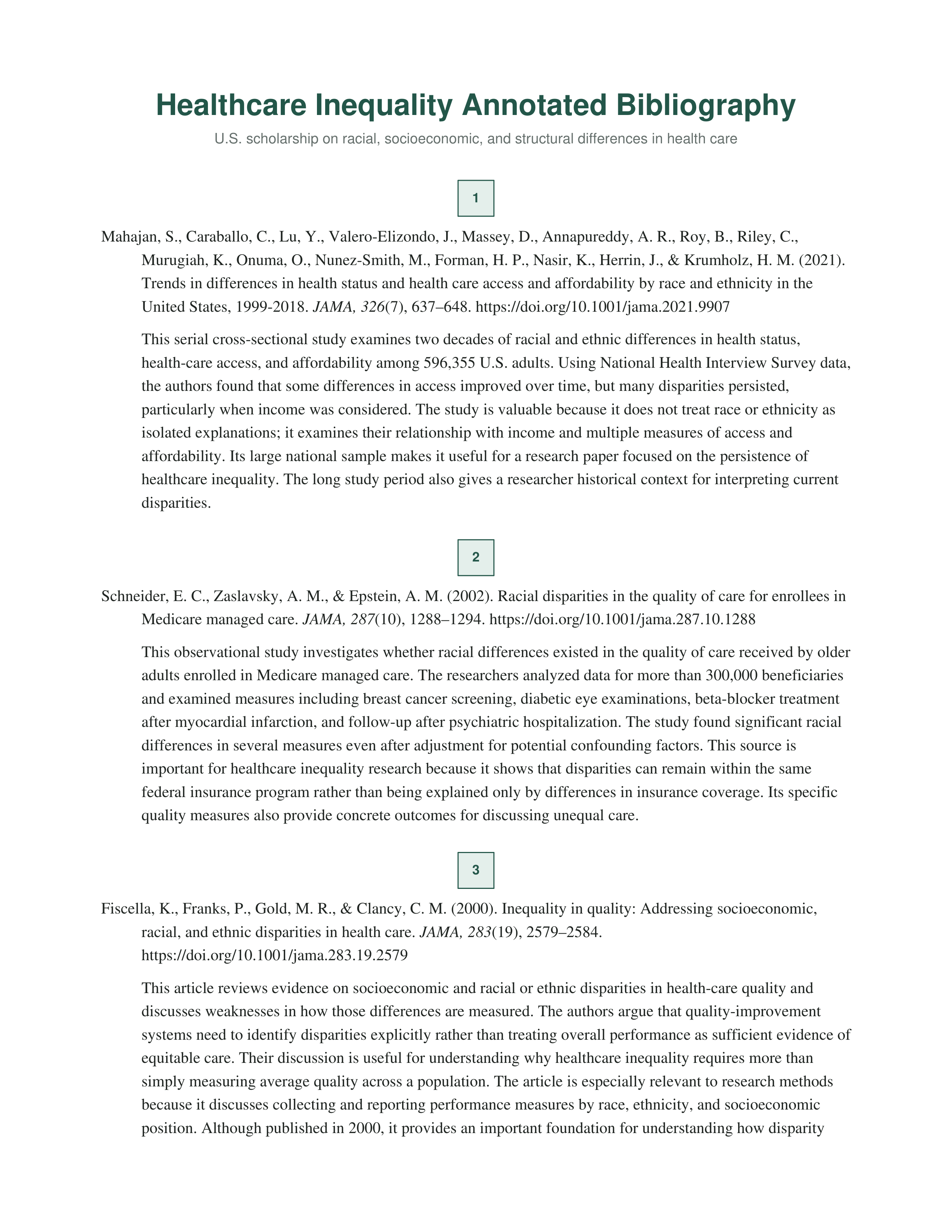
Healthcare Inequality Annotated Bibliography
U.S. scholarship on racial, socioeconomic, and structural differences in health care
1
Mahajan, S., Caraballo, C., Lu, Y., Valero-Elizondo, J., Massey, D., Annapureddy, A. R., Roy, B., Riley, C.,
Murugiah, K., Onuma, O., Nunez-Smith, M., Forman, H. P., Nasir, K., Herrin, J., & Krumholz, H. M. (2021).
Trends in differences in health status and health care access and affordability by race and ethnicity in the
United States, 1999-2018.
JAMA, 326
(7), 637–648. https://doi.org/10.1001/jama.2021.9907
This serial cross-sectional study examines two decades of racial and ethnic differences in health status,
health-care access, and affordability among 596,355 U.S. adults. Using National Health Interview Survey data,
the authors found that some differences in access improved over time, but many disparities persisted,
particularly when income was considered. The study is valuable because it does not treat race or ethnicity as
isolated explanations; it examines their relationship with income and multiple measures of access and
affordability. Its large national sample makes it useful for a research paper focused on the persistence of
healthcare inequality. The long study period also gives a researcher historical context for interpreting current
disparities.
2
Schneider, E. C., Zaslavsky, A. M., & Epstein, A. M. (2002). Racial disparities in the quality of care for enrollees in
Medicare managed care.
JAMA, 287
(10), 1288–1294. https://doi.org/10.1001/jama.287.10.1288
This observational study investigates whether racial differences existed in the quality of care received by older
adults enrolled in Medicare managed care. The researchers analyzed data for more than 300,000 beneficiaries
and examined measures including breast cancer screening, diabetic eye examinations, beta-blocker treatment
after myocardial infarction, and follow-up after psychiatric hospitalization. The study found significant racial
differences in several measures even after adjustment for potential confounding factors. This source is
important for healthcare inequality research because it shows that disparities can remain within the same
federal insurance program rather than being explained only by differences in insurance coverage. Its specific
quality measures also provide concrete outcomes for discussing unequal care.
3
Fiscella, K., Franks, P., Gold, M. R., & Clancy, C. M. (2000). Inequality in quality: Addressing socioeconomic,
racial, and ethnic disparities in health care.
JAMA, 283
(19), 2579–2584.
https://doi.org/10.1001/jama.283.19.2579
This article reviews evidence on socioeconomic and racial or ethnic disparities in health-care quality and
discusses weaknesses in how those differences are measured. The authors argue that quality-improvement
systems need to identify disparities explicitly rather than treating overall performance as sufficient evidence of
equitable care. Their discussion is useful for understanding why healthcare inequality requires more than
simply measuring average quality across a population. The article is especially relevant to research methods
because it discusses collecting and reporting performance measures by race, ethnicity, and socioeconomic
position. Although published in 2000, it provides an important foundation for understanding how disparity