Special Education Annotated Bibliography
Research on identification, service effects, general education access, inclusive placement, and outcomes for students with
disabilities
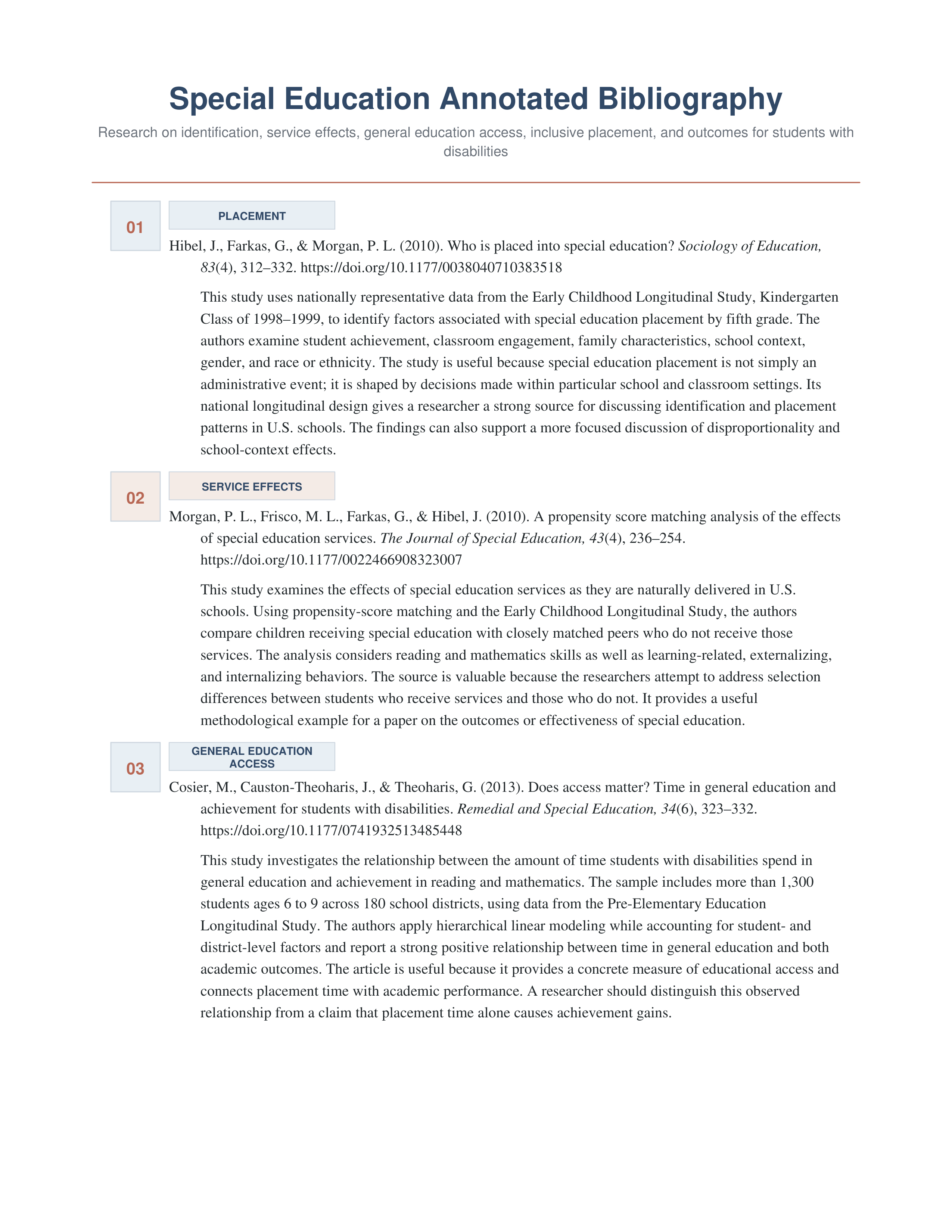
01
PLACEMENT
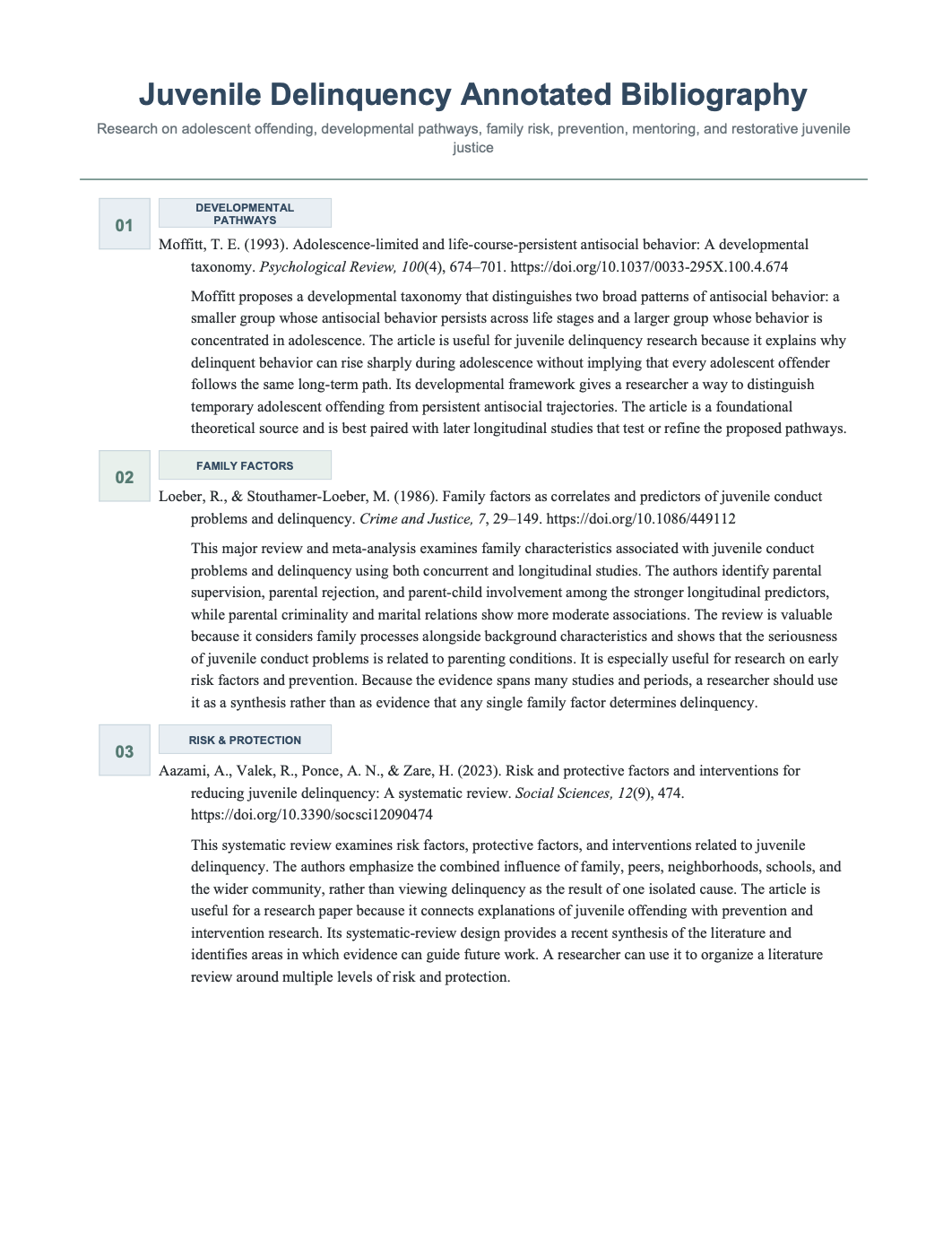
Hibel, J., Farkas, G., & Morgan, P. L. (2010). Who is placed into special education?
Sociology of Education,
83
(4), 312–332. https://doi.org/10.1177/0038040710383518
This study uses nationally representative data from the Early Childhood Longitudinal Study, Kindergarten
Class of 1998–1999, to identify factors associated with special education placement by fifth grade. The
authors examine student achievement, classroom engagement, family characteristics, school context,
gender, and race or ethnicity. The study is useful because special education placement is not simply an
administrative event; it is shaped by decisions made within particular school and classroom settings. Its
national longitudinal design gives a researcher a strong source for discussing identification and placement
patterns in U.S. schools. The findings can also support a more focused discussion of disproportionality and
school-context effects.
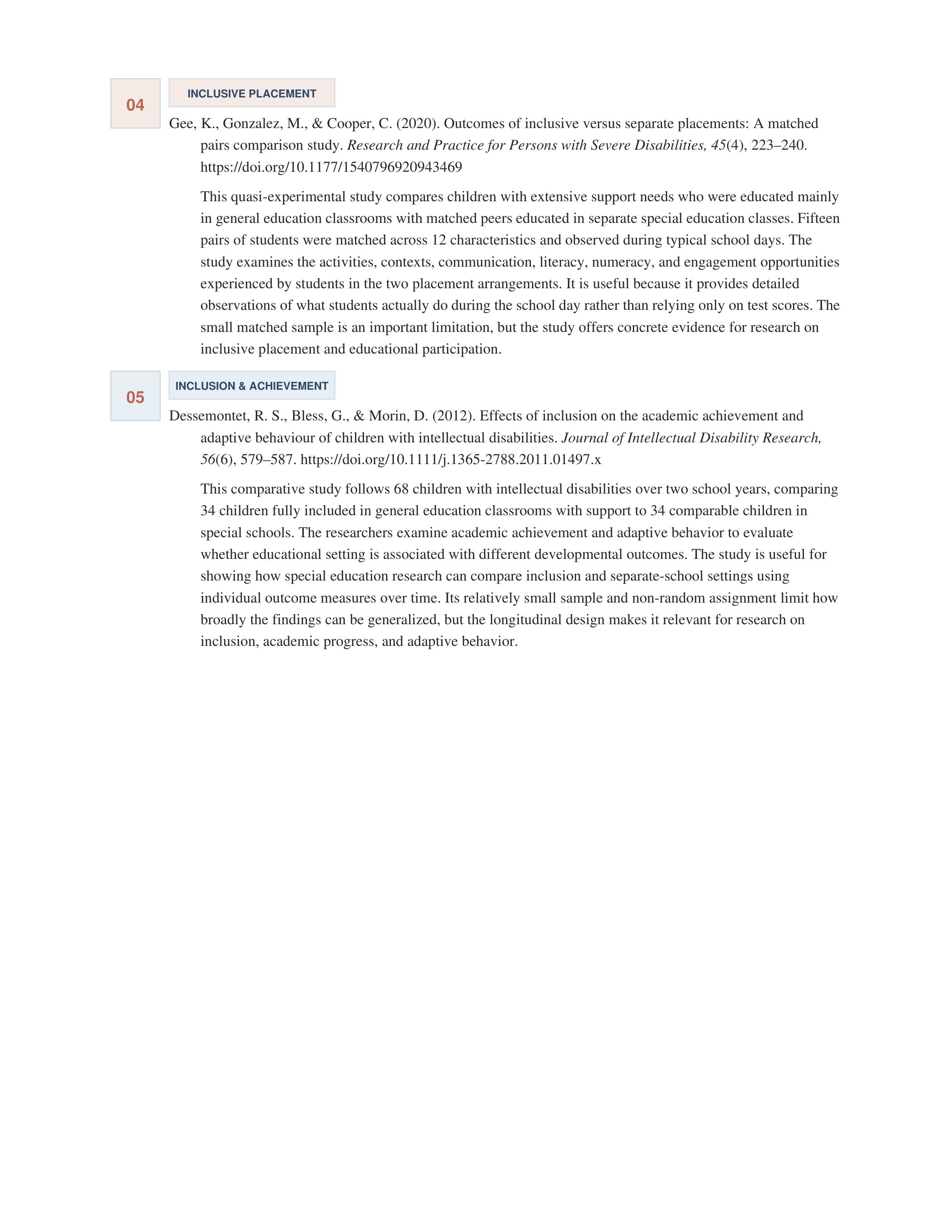
02
SERVICE EFFECTS
Morgan, P. L., Frisco, M. L., Farkas, G., & Hibel, J. (2010). A propensity score matching analysis of the effects
of special education services.
The Journal of Special Education, 43
(4), 236–254.
https://doi.org/10.1177/0022466908323007
This study examines the effects of special education services as they are naturally delivered in U.S.
schools. Using propensity-score matching and the Early Childhood Longitudinal Study, the authors
compare children receiving special education with closely matched peers who do not receive those
services. The analysis considers reading and mathematics skills as well as learning-related, externalizing,
and internalizing behaviors. The source is valuable because the researchers attempt to address selection
differences between students who receive services and those who do not. It provides a useful
methodological example for a paper on the outcomes or effectiveness of special education.
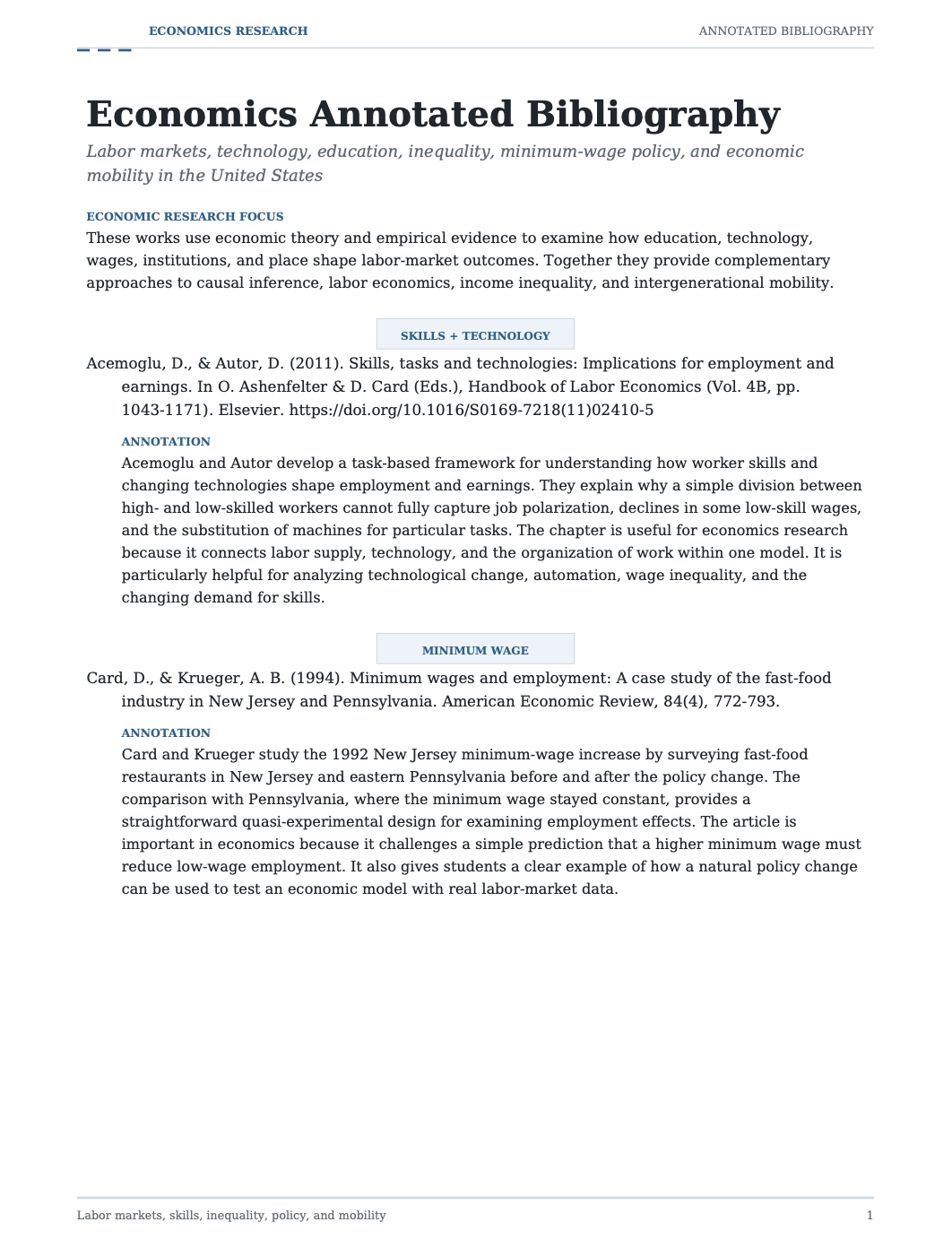
03
GENERAL EDUCATION
ACCESS
Cosier, M., Causton-Theoharis, J., & Theoharis, G. (2013). Does access matter? Time in general education and
achievement for students with disabilities.
Remedial and Special Education, 34
(6), 323–332.
https://doi.org/10.1177/0741932513485448
This study investigates the relationship between the amount of time students with disabilities spend in
general education and achievement in reading and mathematics. The sample includes more than 1,300
students ages 6 to 9 across 180 school districts, using data from the Pre-Elementary Education
Longitudinal Study. The authors apply hierarchical linear modeling while accounting for student- and
district-level factors and report a strong positive relationship between time in general education and both
academic outcomes. The article is useful because it provides a concrete measure of educational access and
connects placement time with academic performance. A researcher should distinguish this observed
relationship from a claim that placement time alone causes achievement gains.