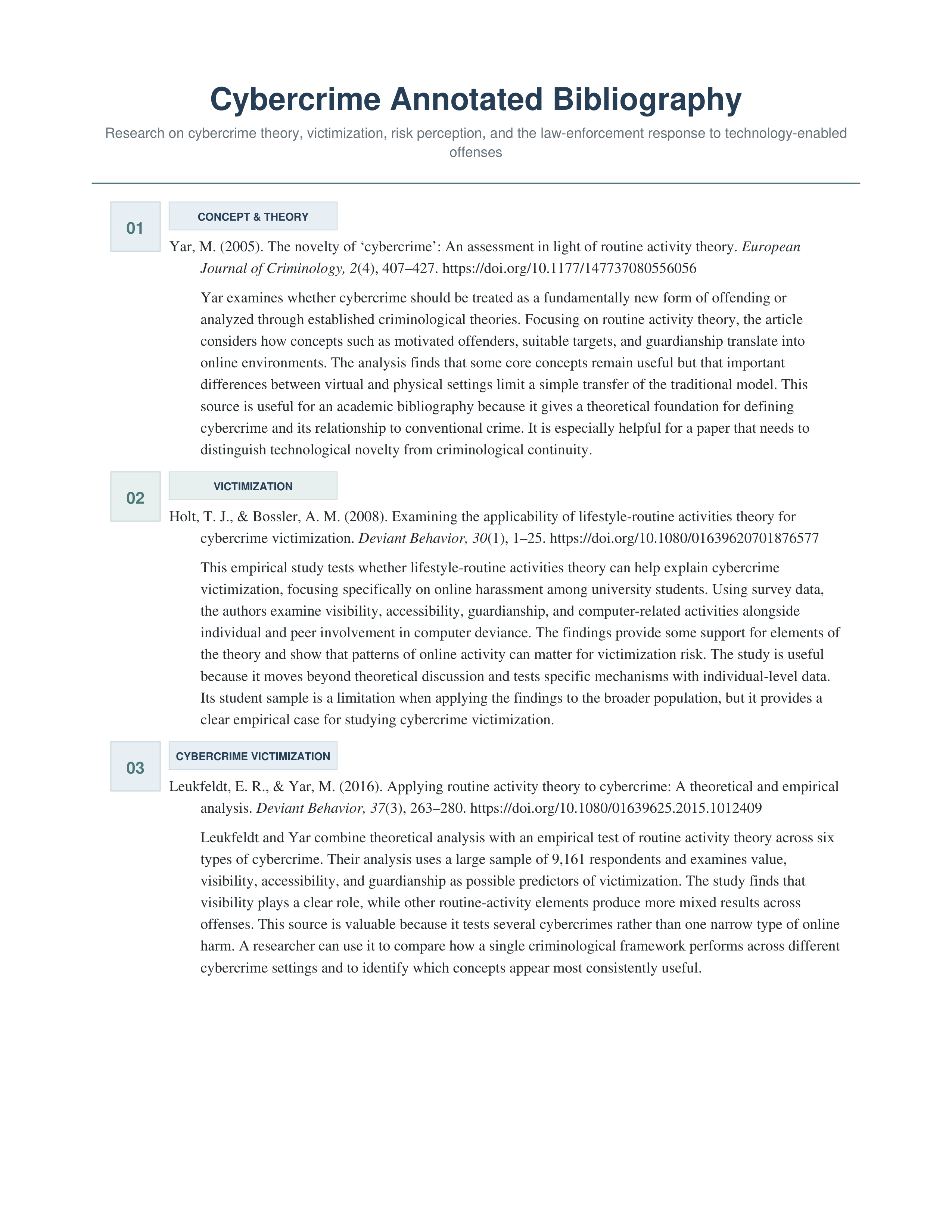
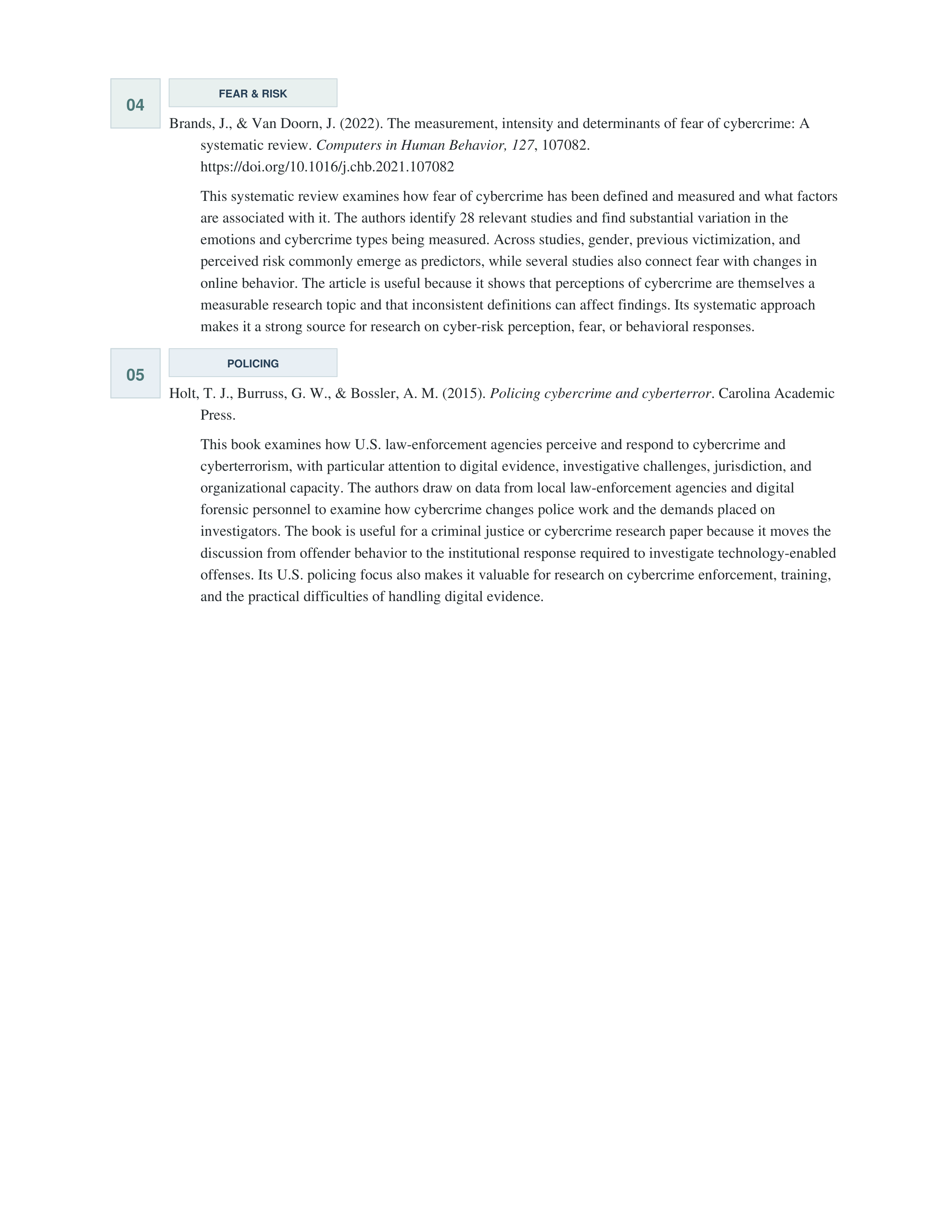
Cybercrime Annotated Bibliography
Research on cybercrime theory, victimization, risk perception, and the law-enforcement response to technology-enabled
offenses
01
CONCEPT & THEORY
Yar, M. (2005). The novelty of ‘cybercrime’: An assessment in light of routine activity theory.
European
Journal of Criminology, 2
(4), 407–427. https://doi.org/10.1177/147737080556056
Yar examines whether cybercrime should be treated as a fundamentally new form of offending or
analyzed through established criminological theories. Focusing on routine activity theory, the article
considers how concepts such as motivated offenders, suitable targets, and guardianship translate into
online environments. The analysis finds that some core concepts remain useful but that important
differences between virtual and physical settings limit a simple transfer of the traditional model. This
source is useful for an academic bibliography because it gives a theoretical foundation for defining
cybercrime and its relationship to conventional crime. It is especially helpful for a paper that needs to
distinguish technological novelty from criminological continuity.
02
VICTIMIZATION
Holt, T. J., & Bossler, A. M. (2008). Examining the applicability of lifestyle-routine activities theory for
cybercrime victimization.
Deviant Behavior, 30
(1), 1–25. https://doi.org/10.1080/01639620701876577
This empirical study tests whether lifestyle-routine activities theory can help explain cybercrime
victimization, focusing specifically on online harassment among university students. Using survey data,
the authors examine visibility, accessibility, guardianship, and computer-related activities alongside
individual and peer involvement in computer deviance. The findings provide some support for elements of
the theory and show that patterns of online activity can matter for victimization risk. The study is useful
because it moves beyond theoretical discussion and tests specific mechanisms with individual-level data.
Its student sample is a limitation when applying the findings to the broader population, but it provides a
clear empirical case for studying cybercrime victimization.
03
CYBERCRIME VICTIMIZATION
Leukfeldt, E. R., & Yar, M. (2016). Applying routine activity theory to cybercrime: A theoretical and empirical
analysis.
Deviant Behavior, 37
(3), 263–280. https://doi.org/10.1080/01639625.2015.1012409
Leukfeldt and Yar combine theoretical analysis with an empirical test of routine activity theory across six
types of cybercrime. Their analysis uses a large sample of 9,161 respondents and examines value,
visibility, accessibility, and guardianship as possible predictors of victimization. The study finds that
visibility plays a clear role, while other routine-activity elements produce more mixed results across
offenses. This source is valuable because it tests several cybercrimes rather than one narrow type of online
harm. A researcher can use it to compare how a single criminological framework performs across different
cybercrime settings and to identify which concepts appear most consistently useful.