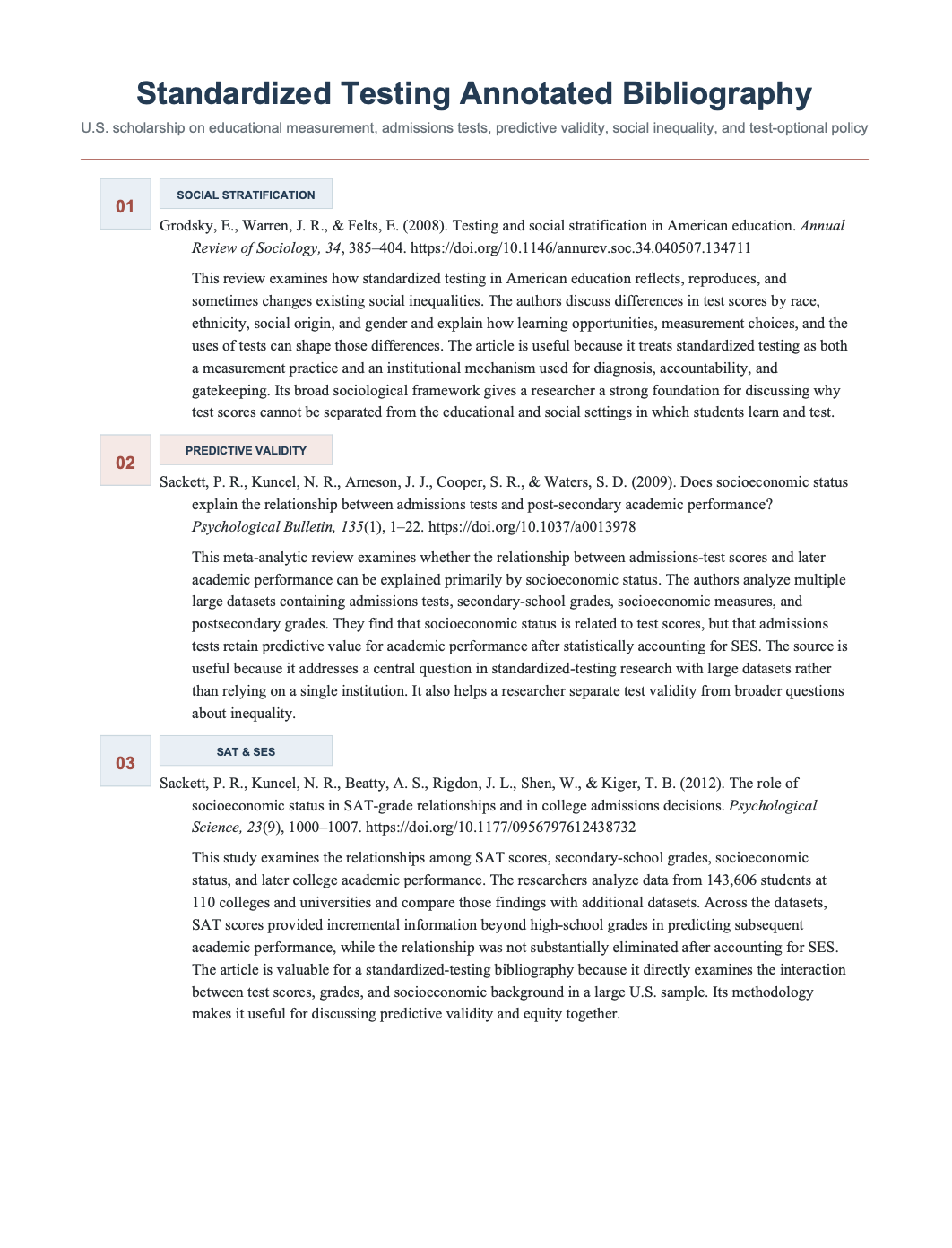
Racial Inequality Annotated Bibliography
U.S. research on discrimination, economic mobility, structural conditions, and racial disparities in health
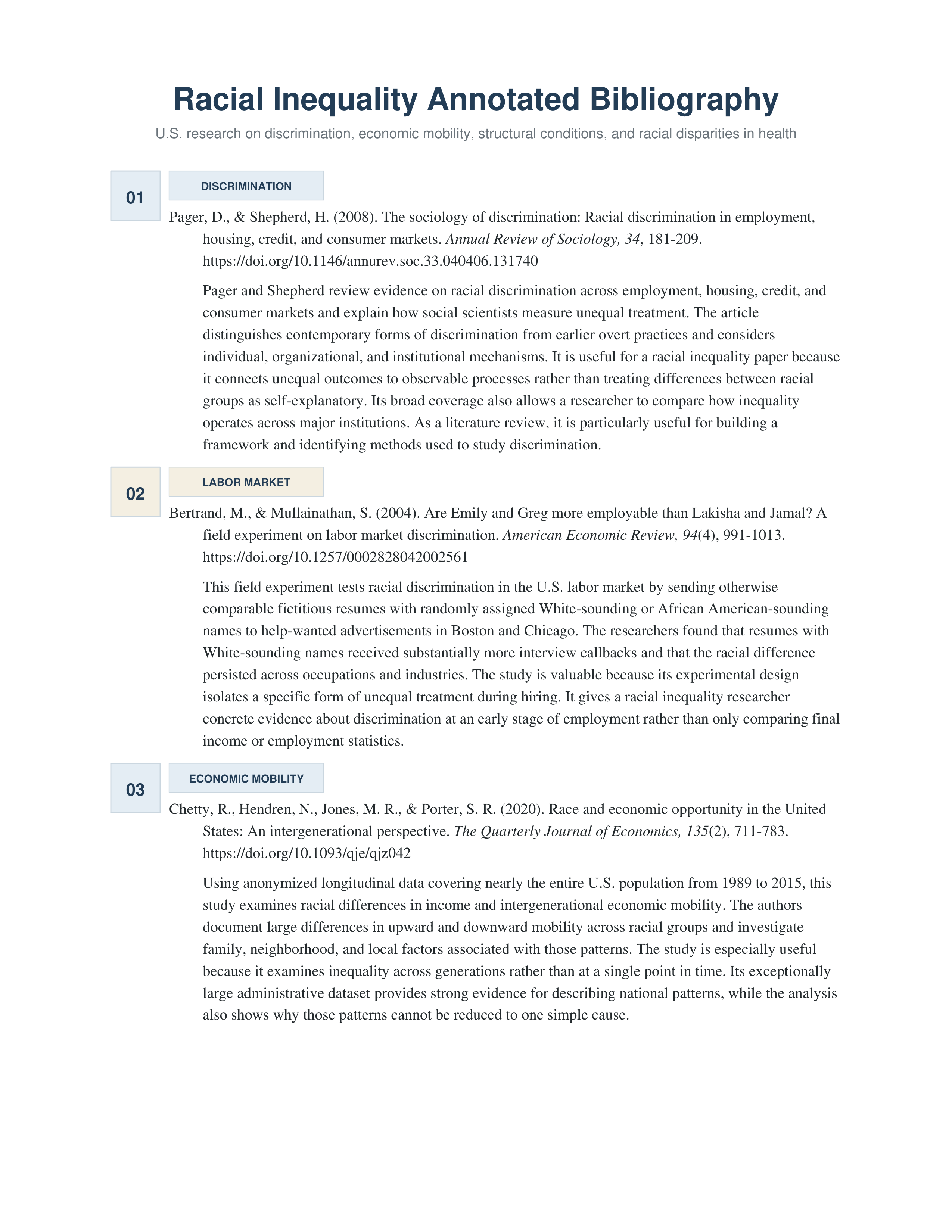
01
DISCRIMINATION
Pager, D., & Shepherd, H. (2008). The sociology of discrimination: Racial discrimination in employment,
housing, credit, and consumer markets.
Annual Review of Sociology, 34
, 181-209.
https://doi.org/10.1146/annurev.soc.33.040406.131740
Pager and Shepherd review evidence on racial discrimination across employment, housing, credit, and
consumer markets and explain how social scientists measure unequal treatment. The article
distinguishes contemporary forms of discrimination from earlier overt practices and considers
individual, organizational, and institutional mechanisms. It is useful for a racial inequality paper because
it connects unequal outcomes to observable processes rather than treating differences between racial
groups as self-explanatory. Its broad coverage also allows a researcher to compare how inequality
operates across major institutions. As a literature review, it is particularly useful for building a
framework and identifying methods used to study discrimination.
02
LABOR MARKET
Bertrand, M., & Mullainathan, S. (2004). Are Emily and Greg more employable than Lakisha and Jamal? A
field experiment on labor market discrimination.
American Economic Review, 94
(4), 991-1013.
https://doi.org/10.1257/0002828042002561
This field experiment tests racial discrimination in the U.S. labor market by sending otherwise
comparable fictitious resumes with randomly assigned White-sounding or African American-sounding
names to help-wanted advertisements in Boston and Chicago. The researchers found that resumes with
White-sounding names received substantially more interview callbacks and that the racial difference
persisted across occupations and industries. The study is valuable because its experimental design
isolates a specific form of unequal treatment during hiring. It gives a racial inequality researcher
concrete evidence about discrimination at an early stage of employment rather than only comparing final
income or employment statistics.
03
ECONOMIC MOBILITY
Chetty, R., Hendren, N., Jones, M. R., & Porter, S. R. (2020). Race and economic opportunity in the United
States: An intergenerational perspective.
The Quarterly Journal of Economics, 135
(2), 711-783.
https://doi.org/10.1093/qje/qjz042
Using anonymized longitudinal data covering nearly the entire U.S. population from 1989 to 2015, this
study examines racial differences in income and intergenerational economic mobility. The authors
document large differences in upward and downward mobility across racial groups and investigate
family, neighborhood, and local factors associated with those patterns. The study is especially useful
because it examines inequality across generations rather than at a single point in time. Its exceptionally
large administrative dataset provides strong evidence for describing national patterns, while the analysis
also shows why those patterns cannot be reduced to one simple cause.