DATA PRIVACY RESEARCH
ANNOTATED BIBLIOGRAPHY
Online privacy, personal data, consent, context, and digital markets
1
Data Privacy Annotated Bibliography
Online privacy, personal-data disclosure, contextual integrity, consent, and digital markets
RESEARCH THEME
These works examine data privacy as a social, behavioral, economic, and legal problem. The sources
move from theories of appropriate information flows to research on privacy behavior, online consent
practices, and the incentives created by digital markets.
CONTEXTUAL INTEGRITY
Nissenbaum, H. (2004). Privacy as contextual integrity. Washington Law Review, 79(1), 119-158.
https://digitalcommons.law.uw.edu/wlr/vol79/iss1/10
ANNOTATION
Nissenbaum proposes contextual integrity as a way to evaluate privacy in information-rich
environments. Instead of defining privacy only as secrecy or individual control, she argues that
information practices should fit the norms of the social context in which data is produced and
shared. The article is central to data-privacy research because it gives researchers a way to ask
whether collection, use, and disclosure are appropriate for a particular context. It is especially useful
for analyzing online services, surveillance, and data flows that move information between settings
with different expectations.
ONLINE PRIVACY
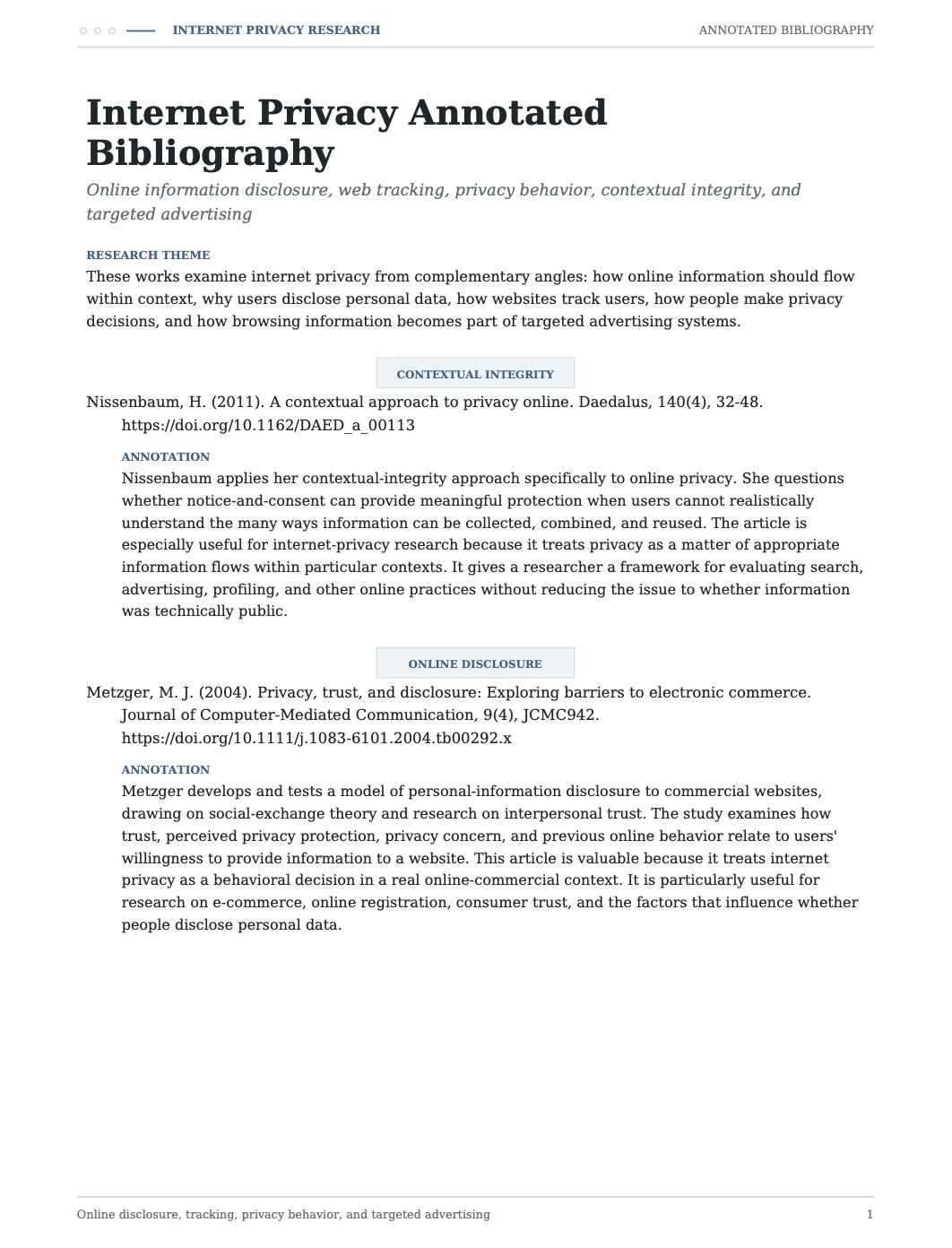
Nissenbaum, H. (2011). A contextual approach to privacy online. Daedalus, 140(4), 32-48.
https://doi.org/10.1162/DAED_a_00113
ANNOTATION
Nissenbaum applies contextual integrity directly to online privacy and examines the limits of
notice-and-consent as the main mechanism for protecting personal information. She discusses data
aggregation, profiling, third-party tracking, and selective targeting and argues that users cannot
reasonably understand every relevant consequence at the moment information is collected. This
article is useful because it turns a general privacy theory into a framework for studying actual online
data practices. It also helps explain why privacy research must consider the rules governing
information flows, not only whether users clicked an agreement.
PRIVACY BEHAVIOR
Acquisti, A., Brandimarte, L., & Loewenstein, G. (2015). Privacy and human behavior in the age of
information. Science, 347(6221), 509-514. https://doi.org/10.1126/science.aaa1465
ANNOTATION
Acquisti, Brandimarte, and Loewenstein review research on how people understand and respond to
privacy decisions in an information-rich environment. They organize the literature around
uncertainty about consequences, the context-dependence of privacy concerns, and the ways
commercial and governmental environments can shape those concerns. The review is useful because
it shows why privacy behavior cannot always be explained by a stable preference for secrecy. For a
data-privacy research project, it provides a strong bridge between behavioral evidence, technology,
and questions about policy and personal-information disclosure.