Poverty Annotated Bibliography
Research on poverty in the United States, its measurement, health effects, intergenerational consequences, and policy
responses
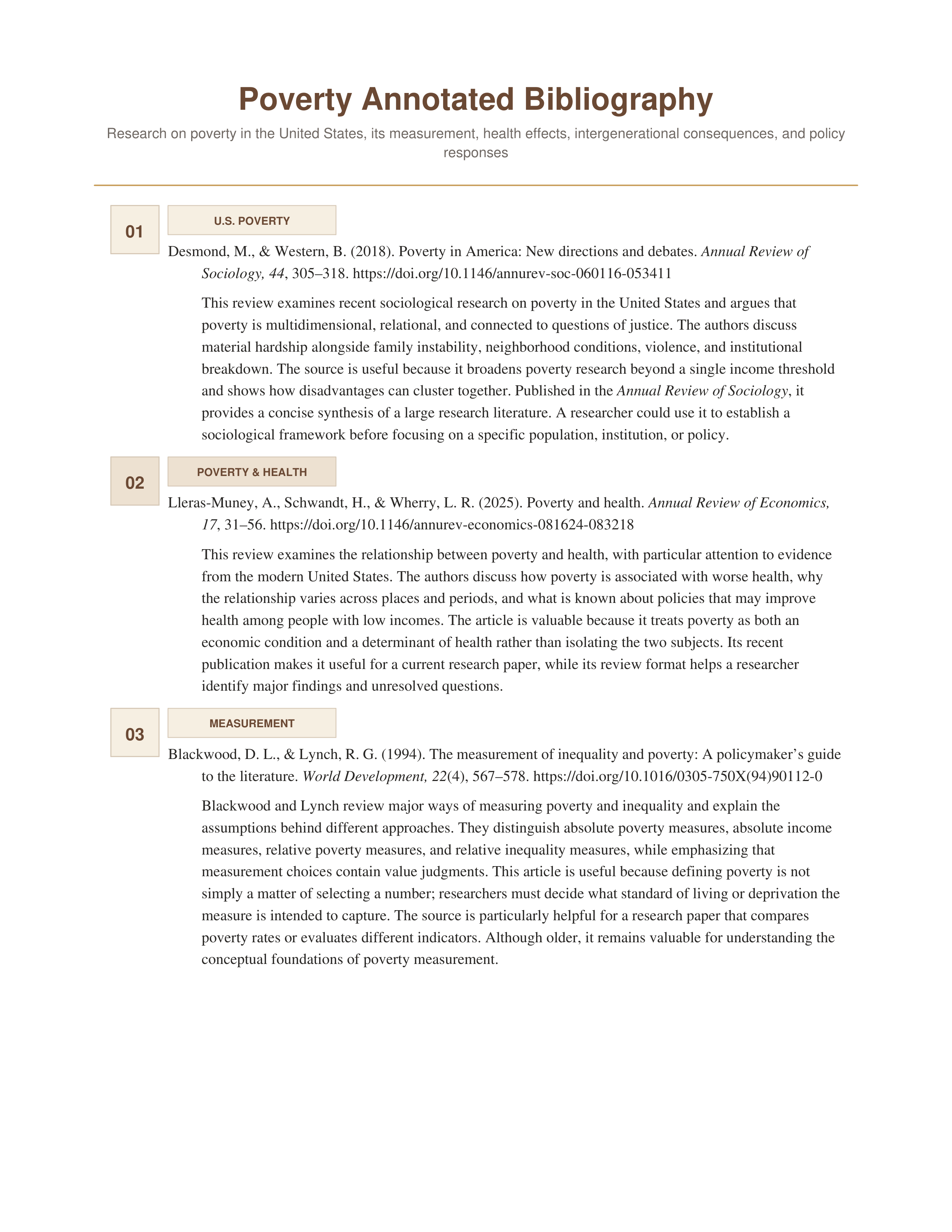
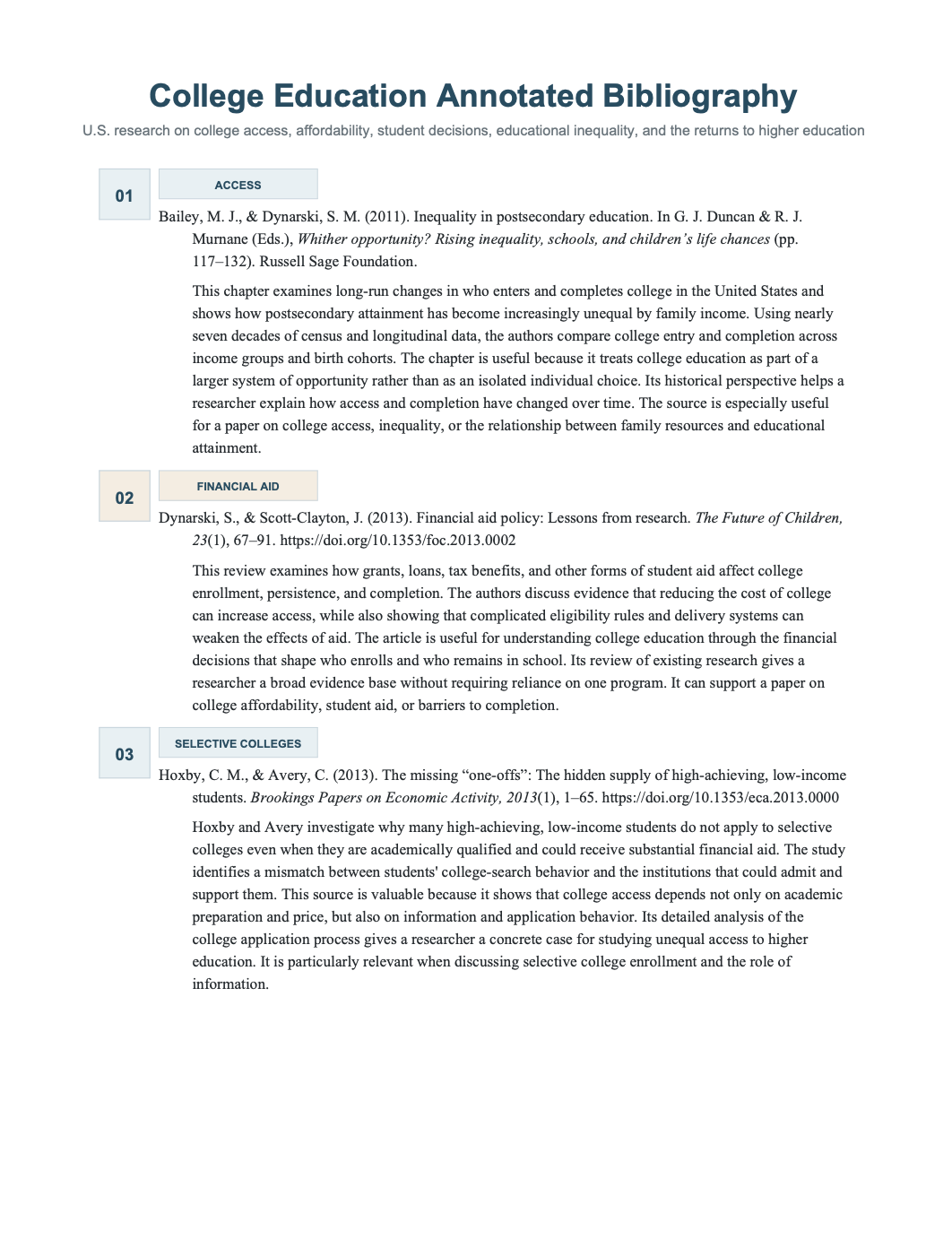
01
U.S. POVERTY
Desmond, M., & Western, B. (2018). Poverty in America: New directions and debates.
Annual Review of
Sociology, 44
, 305–318. https://doi.org/10.1146/annurev-soc-060116-053411
This review examines recent sociological research on poverty in the United States and argues that
poverty is multidimensional, relational, and connected to questions of justice. The authors discuss
material hardship alongside family instability, neighborhood conditions, violence, and institutional
breakdown. The source is useful because it broadens poverty research beyond a single income threshold
and shows how disadvantages can cluster together. Published in the
Annual Review of Sociology
, it
provides a concise synthesis of a large research literature. A researcher could use it to establish a
sociological framework before focusing on a specific population, institution, or policy.
02
POVERTY & HEALTH
Lleras-Muney, A., Schwandt, H., & Wherry, L. R. (2025). Poverty and health.
Annual Review of Economics,
17
, 31–56. https://doi.org/10.1146/annurev-economics-081624-083218
This review examines the relationship between poverty and health, with particular attention to evidence
from the modern United States. The authors discuss how poverty is associated with worse health, why
the relationship varies across places and periods, and what is known about policies that may improve
health among people with low incomes. The article is valuable because it treats poverty as both an
economic condition and a determinant of health rather than isolating the two subjects. Its recent
publication makes it useful for a current research paper, while its review format helps a researcher
identify major findings and unresolved questions.
03
MEASUREMENT
Blackwood, D. L., & Lynch, R. G. (1994). The measurement of inequality and poverty: A policymaker’s guide
to the literature.
World Development, 22
(4), 567–578. https://doi.org/10.1016/0305-750X(94)90112-0
Blackwood and Lynch review major ways of measuring poverty and inequality and explain the
assumptions behind different approaches. They distinguish absolute poverty measures, absolute income
measures, relative poverty measures, and relative inequality measures, while emphasizing that
measurement choices contain value judgments. This article is useful because defining poverty is not
simply a matter of selecting a number; researchers must decide what standard of living or deprivation the
measure is intended to capture. The source is particularly helpful for a research paper that compares
poverty rates or evaluates different indicators. Although older, it remains valuable for understanding the
conceptual foundations of poverty measurement.