Plastic Pollution Annotated Bibliography
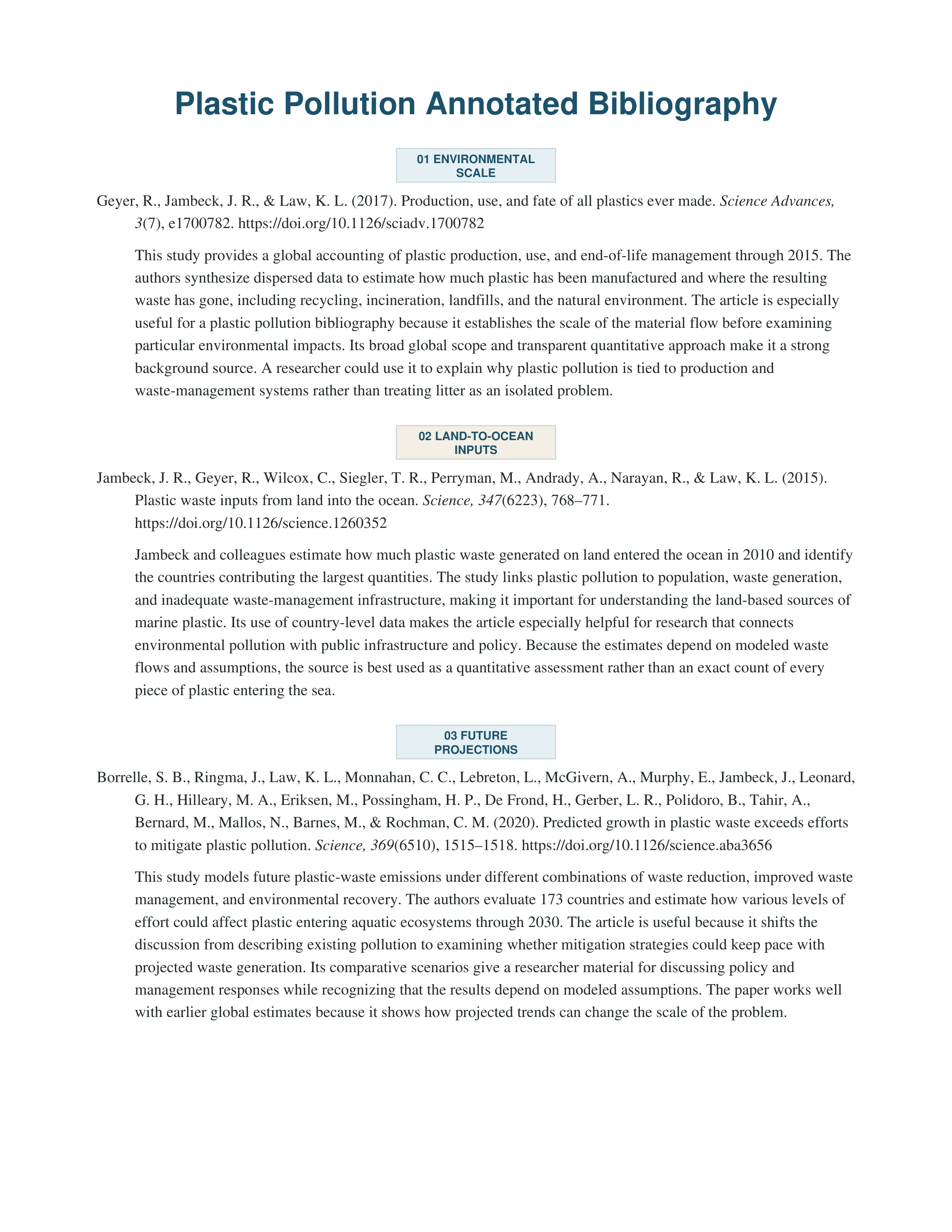
01 ENVIRONMENTAL
SCALE
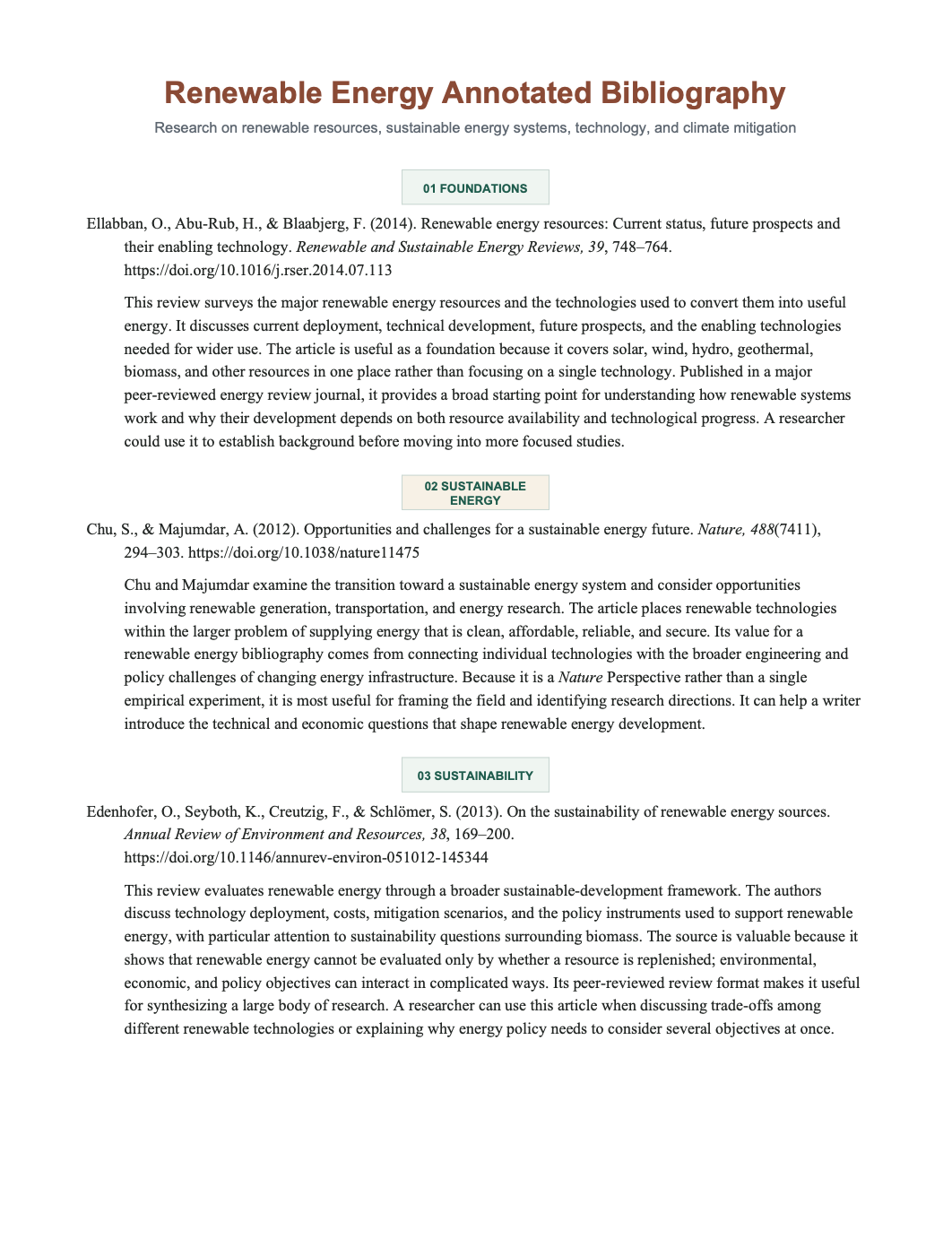
Geyer, R., Jambeck, J. R., & Law, K. L. (2017). Production, use, and fate of all plastics ever made.
Science Advances,
3
(7), e1700782. https://doi.org/10.1126/sciadv.1700782
This study provides a global accounting of plastic production, use, and end-of-life management through 2015. The
authors synthesize dispersed data to estimate how much plastic has been manufactured and where the resulting
waste has gone, including recycling, incineration, landfills, and the natural environment. The article is especially
useful for a plastic pollution bibliography because it establishes the scale of the material flow before examining
particular environmental impacts. Its broad global scope and transparent quantitative approach make it a strong
background source. A researcher could use it to explain why plastic pollution is tied to production and
waste-management systems rather than treating litter as an isolated problem.
02 LAND-TO-OCEAN
INPUTS
Jambeck, J. R., Geyer, R., Wilcox, C., Siegler, T. R., Perryman, M., Andrady, A., Narayan, R., & Law, K. L. (2015).
Plastic waste inputs from land into the ocean.
Science, 347
(6223), 768–771.
https://doi.org/10.1126/science.1260352
Jambeck and colleagues estimate how much plastic waste generated on land entered the ocean in 2010 and identify
the countries contributing the largest quantities. The study links plastic pollution to population, waste generation,
and inadequate waste-management infrastructure, making it important for understanding the land-based sources of
marine plastic. Its use of country-level data makes the article especially helpful for research that connects
environmental pollution with public infrastructure and policy. Because the estimates depend on modeled waste
flows and assumptions, the source is best used as a quantitative assessment rather than an exact count of every
piece of plastic entering the sea.
03 FUTURE
PROJECTIONS
Borrelle, S. B., Ringma, J., Law, K. L., Monnahan, C. C., Lebreton, L., McGivern, A., Murphy, E., Jambeck, J., Leonard,
G. H., Hilleary, M. A., Eriksen, M., Possingham, H. P., De Frond, H., Gerber, L. R., Polidoro, B., Tahir, A.,
Bernard, M., Mallos, N., Barnes, M., & Rochman, C. M. (2020). Predicted growth in plastic waste exceeds efforts
to mitigate plastic pollution.
Science, 369
(6510), 1515–1518. https://doi.org/10.1126/science.aba3656
This study models future plastic-waste emissions under different combinations of waste reduction, improved waste
management, and environmental recovery. The authors evaluate 173 countries and estimate how various levels of
effort could affect plastic entering aquatic ecosystems through 2030. The article is useful because it shifts the
discussion from describing existing pollution to examining whether mitigation strategies could keep pace with
projected waste generation. Its comparative scenarios give a researcher material for discussing policy and
management responses while recognizing that the results depend on modeled assumptions. The paper works well
with earlier global estimates because it shows how projected trends can change the scale of the problem.