SOCIAL MEDIA + MENTAL HEALTH
ANNOTATED BIBLIOGRAPHY
Adolescent depression, anxiety, distress, and well-being
1
Social Media and Mental Health
Annotated Bibliography
Adolescent social media use, depression, anxiety, psychological distress, and well-being
RESEARCH THEME
This bibliography examines how social media use is associated with adolescent mental health, with
attention to depression, anxiety, psychological distress, sleep, self-esteem, and patterns of use. The
sources range from systematic reviews and meta-analysis to a large cohort study, allowing different
forms of evidence to be compared.
EVIDENCE SYNTHESIS
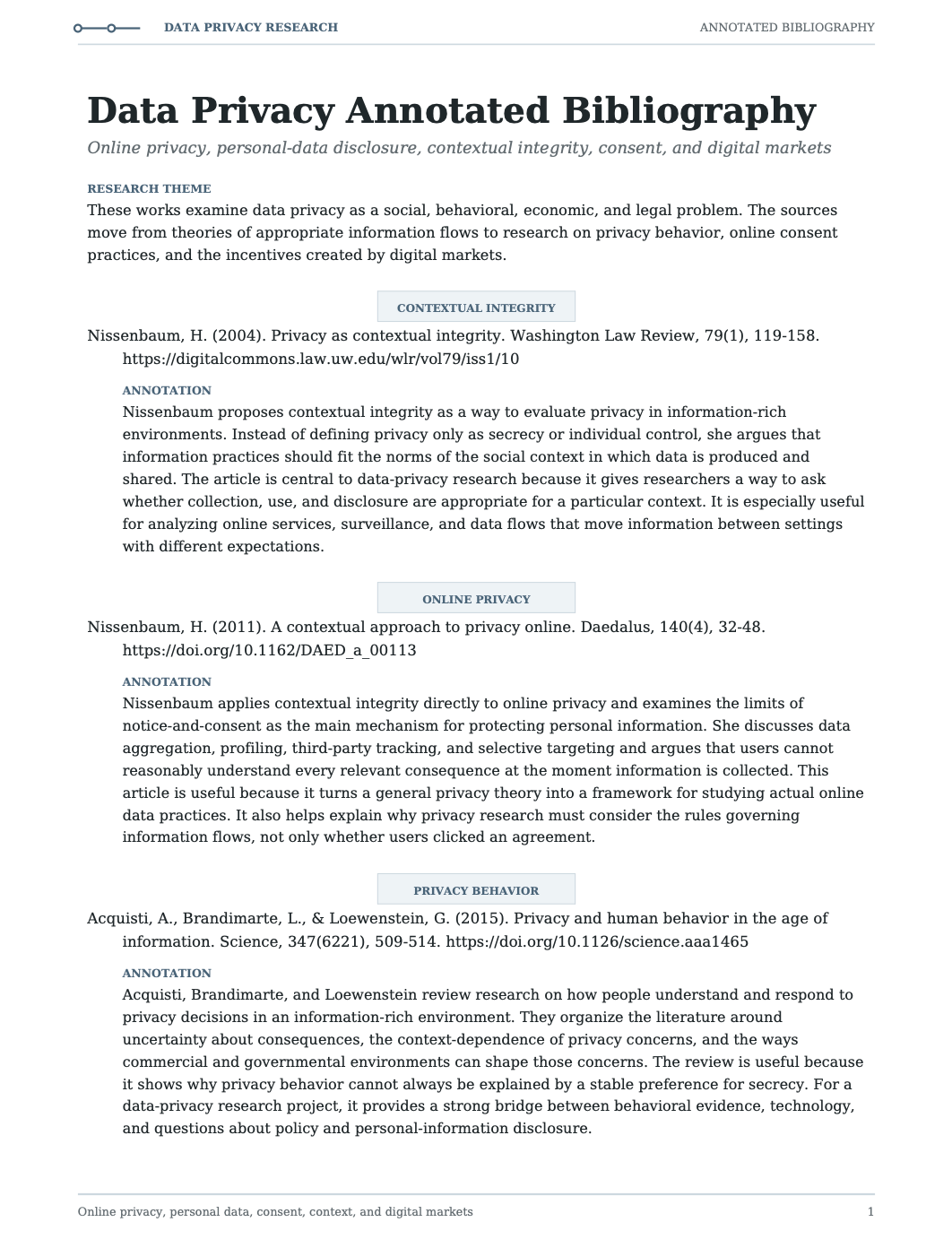
Valkenburg, P. M., Meier, A., & Beyens, I. (2022). Social media use and its impact on adolescent mental
health: An umbrella review of the evidence. Current Opinion in Psychology, 44, 58-68.
https://doi.org/10.1016/j.copsyc.2021.08.017
ANNOTATION
Valkenburg, Meier, and Beyens synthesize 25 reviews published from 2019 through mid-2021 to
examine what the accumulated literature says about social media and adolescent mental health. Their
umbrella review is valuable because it compares meta-analyses, systematic reviews, and narrative
reviews rather than relying on one dataset. They report that many reviews described associations as
weak or inconsistent, while some found more substantial negative relationships. This source is useful
for a research paper because it establishes the state of the evidence and identifies methodological
gaps that help explain disagreement across studies.
DEPRESSION + ANXIETY
Saleem, N., Young, P., & Yousuf, S. (2024). Exploring the relationship between social media use and
symptoms of depression and anxiety among children and adolescents: A systematic narrative
review. Cyberpsychology, Behavior, and Social Networking, 27(11), 771-797.
https://doi.org/10.1089/cyber.2023.0456
ANNOTATION
Saleem, Young, and Yousuf systematically review quantitative studies of children and adolescents
ages 5 to 18, focusing on social media exposure and symptoms of depression or anxiety. They
searched Medline, EMBASE, CINAHL, and PsycINFO and included 67 studies available through
February 2024. The review is especially useful because it separates common measures of social media
use, such as time and frequency, from the mental health outcomes being studied. Its discussion of
study quality and heterogeneity helps a researcher avoid treating correlation as proof of a single
causal effect.
SOCIAL MEDIA + MENTAL HEALTH
ANNOTATED BIBLIOGRAPHY
Adolescent depression, anxiety, distress, and well-being
2
USE INTENSITY
Liu, M., Kamper-DeMarco, K. E., Zhang, J., Xiao, J., Dong, D., & Xue, P. (2022). Time spent on social
media and risk of depression in adolescents: A dose-response meta-analysis. International Journal
of Environmental Research and Public Health, 19(9), 5164. https://doi.org/10.3390/ijerph19095164
ANNOTATION
Liu and colleagues conduct a dose-response meta-analysis examining whether the amount of time
adolescents spend on social media is related to depression risk. The study is useful because it asks a
more specific question than whether social media use is simply present or absent and combines
evidence across multiple studies. For an annotated bibliography, the meta-analytic design provides a
higher-level view of the literature while still requiring attention to differences in how individual
studies measured exposure and depression. It is particularly relevant when the research question
centers on frequency or duration of use.
COHORT EVIDENCE
Kelly, Y., Zilanawala, A., Booker, C., & Sacker, A. (2019). Social media use and adolescent mental
health: Findings from the UK Millennium Cohort Study. EClinicalMedicine, 6, 59-68.
https://doi.org/10.1016/j.eclinm.2018.12.005
ANNOTATION
Using population-based data from 10,904 fourteen-year-olds in the UK Millennium Cohort Study,
Kelly and colleagues examine social media use alongside depressive symptoms and possible pathways
involving online harassment, sleep, self-esteem, and body image. The study is useful because it does
not treat social media exposure as a single direct mechanism; it examines several experiences that
can accompany heavier use. Its large cohort provides important descriptive evidence, while the
observational design means the associations cannot by themselves establish that social media causes
mental health changes. This makes the article useful for discussing both findings and methodological
limits.
FOUNDATIONAL REVIEW
Keles, B., McCrae, N., & Grealish, A. (2020). A systematic review: The influence of social media on
depression, anxiety and psychological distress in adolescents. International Journal of Adolescence
and Youth, 25(1), 79-93. https://doi.org/10.1080/02673843.2019.1590851
ANNOTATION
Keles, McCrae, and Grealish review 13 eligible studies and organize the literature into four aspects of
social media use: time spent, activity, investment, and addiction. They report associations with
depression, anxiety, and psychological distress while emphasizing that most included studies were
cross-sectional and that sampling and measurement limitations affect interpretation. The article is
valuable because it shows how the evidence base was initially framed before later waves of larger
reviews and meta-analyses. It also supports a more precise approach to exposure by distinguishing
different forms of engagement instead of using screen time as the only measure.