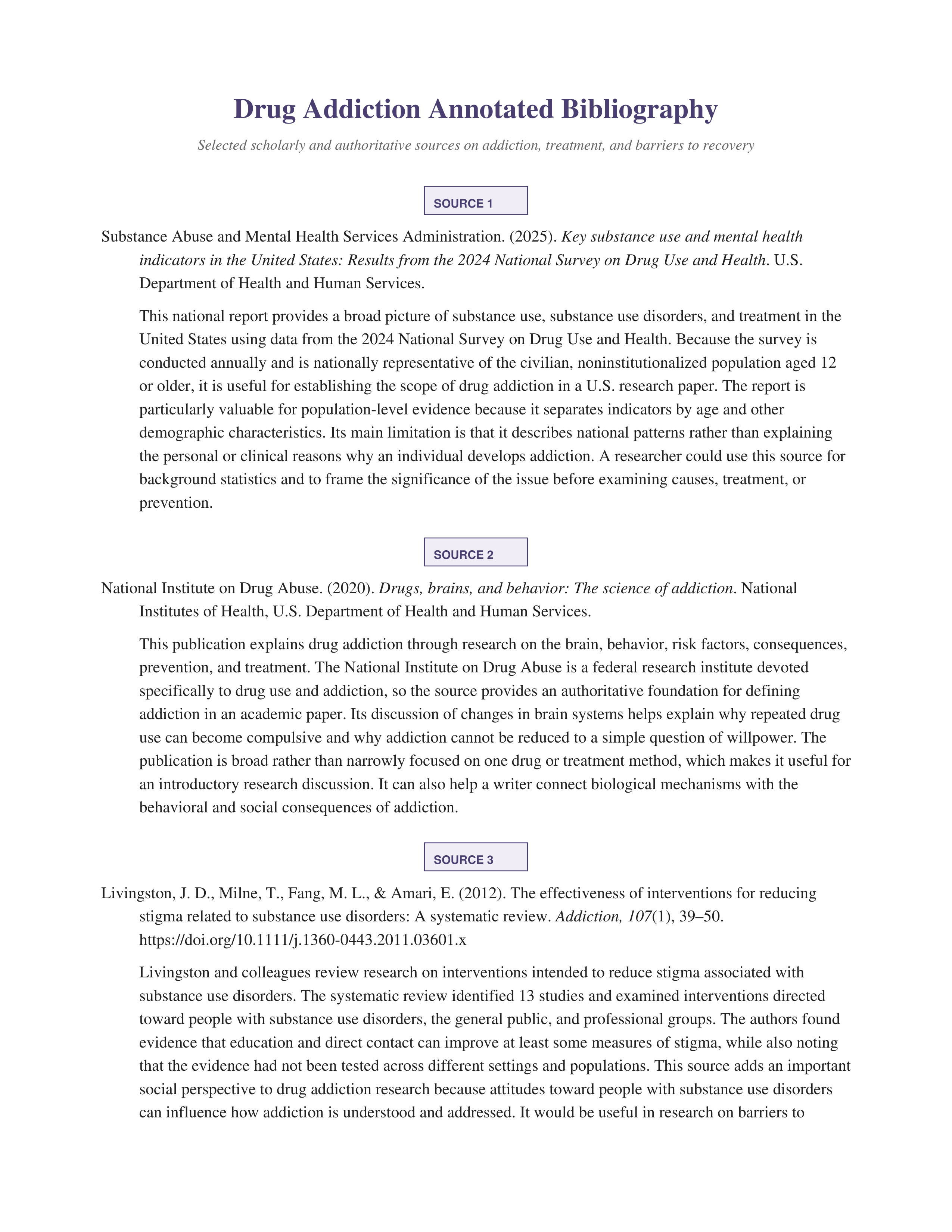
Drug Addiction Annotated Bibliography
Selected scholarly and authoritative sources on addiction, treatment, and barriers to recovery
SOURCE 1
Substance Abuse and Mental Health Services Administration. (2025).
Key substance use and mental health
indicators in the United States: Results from the 2024 National Survey on Drug Use and Health
. U.S.
Department of Health and Human Services.
This national report provides a broad picture of substance use, substance use disorders, and treatment in the
United States using data from the 2024 National Survey on Drug Use and Health. Because the survey is
conducted annually and is nationally representative of the civilian, noninstitutionalized population aged 12
or older, it is useful for establishing the scope of drug addiction in a U.S. research paper. The report is
particularly valuable for population-level evidence because it separates indicators by age and other
demographic characteristics. Its main limitation is that it describes national patterns rather than explaining
the personal or clinical reasons why an individual develops addiction. A researcher could use this source for
background statistics and to frame the significance of the issue before examining causes, treatment, or
prevention.
SOURCE 2
National Institute on Drug Abuse. (2020).
Drugs, brains, and behavior: The science of addiction
. National
Institutes of Health, U.S. Department of Health and Human Services.
This publication explains drug addiction through research on the brain, behavior, risk factors, consequences,
prevention, and treatment. The National Institute on Drug Abuse is a federal research institute devoted
specifically to drug use and addiction, so the source provides an authoritative foundation for defining
addiction in an academic paper. Its discussion of changes in brain systems helps explain why repeated drug
use can become compulsive and why addiction cannot be reduced to a simple question of willpower. The
publication is broad rather than narrowly focused on one drug or treatment method, which makes it useful for
an introductory research discussion. It can also help a writer connect biological mechanisms with the
behavioral and social consequences of addiction.
SOURCE 3
Livingston, J. D., Milne, T., Fang, M. L., & Amari, E. (2012). The effectiveness of interventions for reducing
stigma related to substance use disorders: A systematic review.
Addiction, 107
(1), 39–50.
https://doi.org/10.1111/j.1360-0443.2011.03601.x
Livingston and colleagues review research on interventions intended to reduce stigma associated with
substance use disorders. The systematic review identified 13 studies and examined interventions directed
toward people with substance use disorders, the general public, and professional groups. The authors found
evidence that education and direct contact can improve at least some measures of stigma, while also noting
that the evidence had not been tested across different settings and populations. This source adds an important
social perspective to drug addiction research because attitudes toward people with substance use disorders
can influence how addiction is understood and addressed. It would be useful in research on barriers to
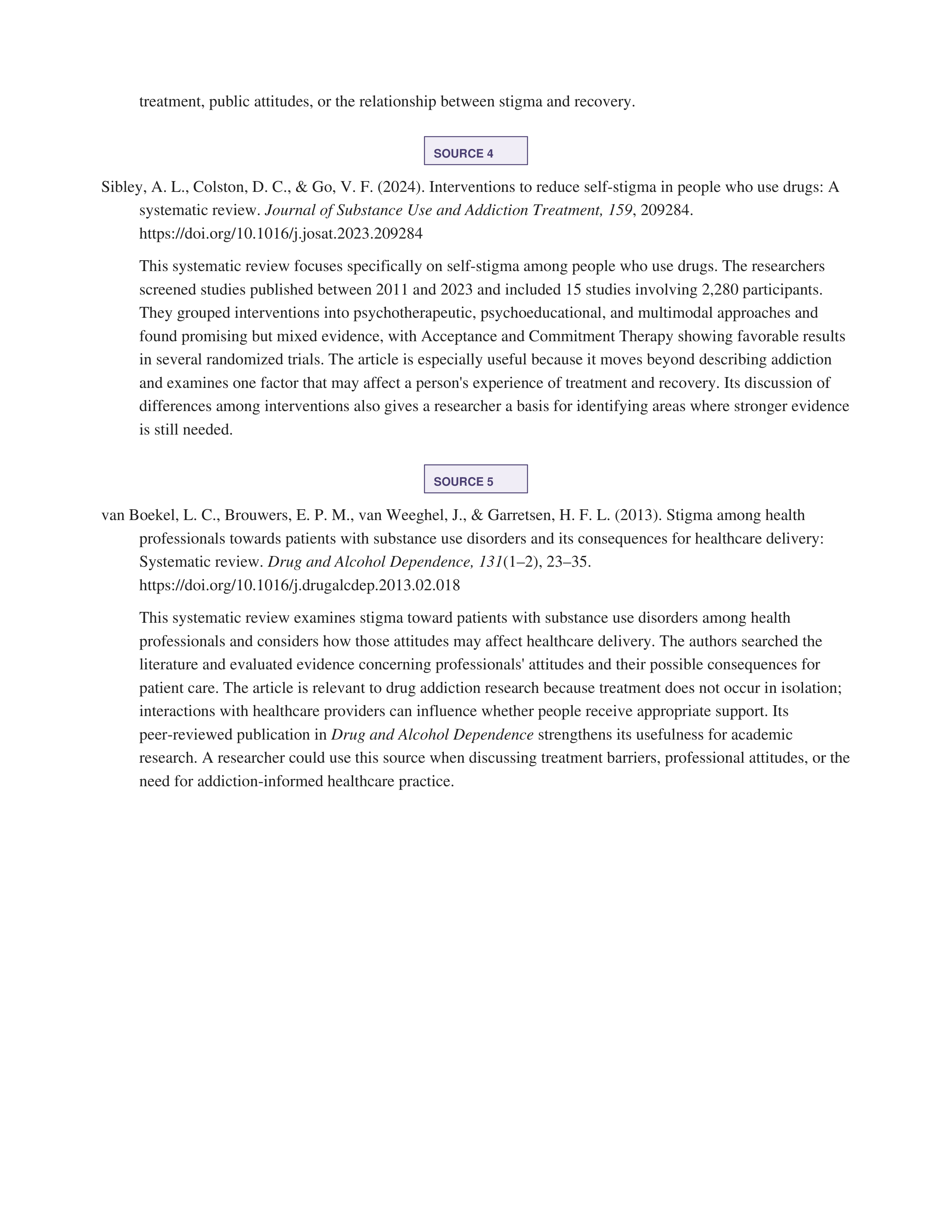
treatment, public attitudes, or the relationship between stigma and recovery.
SOURCE 4
Sibley, A. L., Colston, D. C., & Go, V. F. (2024). Interventions to reduce self-stigma in people who use drugs: A
systematic review.
Journal of Substance Use and Addiction Treatment, 159
, 209284.
https://doi.org/10.1016/j.josat.2023.209284
This systematic review focuses specifically on self-stigma among people who use drugs. The researchers
screened studies published between 2011 and 2023 and included 15 studies involving 2,280 participants.
They grouped interventions into psychotherapeutic, psychoeducational, and multimodal approaches and
found promising but mixed evidence, with Acceptance and Commitment Therapy showing favorable results
in several randomized trials. The article is especially useful because it moves beyond describing addiction
and examines one factor that may affect a person's experience of treatment and recovery. Its discussion of
differences among interventions also gives a researcher a basis for identifying areas where stronger evidence
is still needed.
SOURCE 5
van Boekel, L. C., Brouwers, E. P. M., van Weeghel, J., & Garretsen, H. F. L. (2013). Stigma among health
professionals towards patients with substance use disorders and its consequences for healthcare delivery:
Systematic review.
Drug and Alcohol Dependence, 131
(1–2), 23–35.
https://doi.org/10.1016/j.drugalcdep.2013.02.018
This systematic review examines stigma toward patients with substance use disorders among health
professionals and considers how those attitudes may affect healthcare delivery. The authors searched the
literature and evaluated evidence concerning professionals' attitudes and their possible consequences for
patient care. The article is relevant to drug addiction research because treatment does not occur in isolation;
interactions with healthcare providers can influence whether people receive appropriate support. Its
peer-reviewed publication in
Drug and Alcohol Dependence
strengthens its usefulness for academic
research. A researcher could use this source when discussing treatment barriers, professional attitudes, or the
need for addiction-informed healthcare practice.