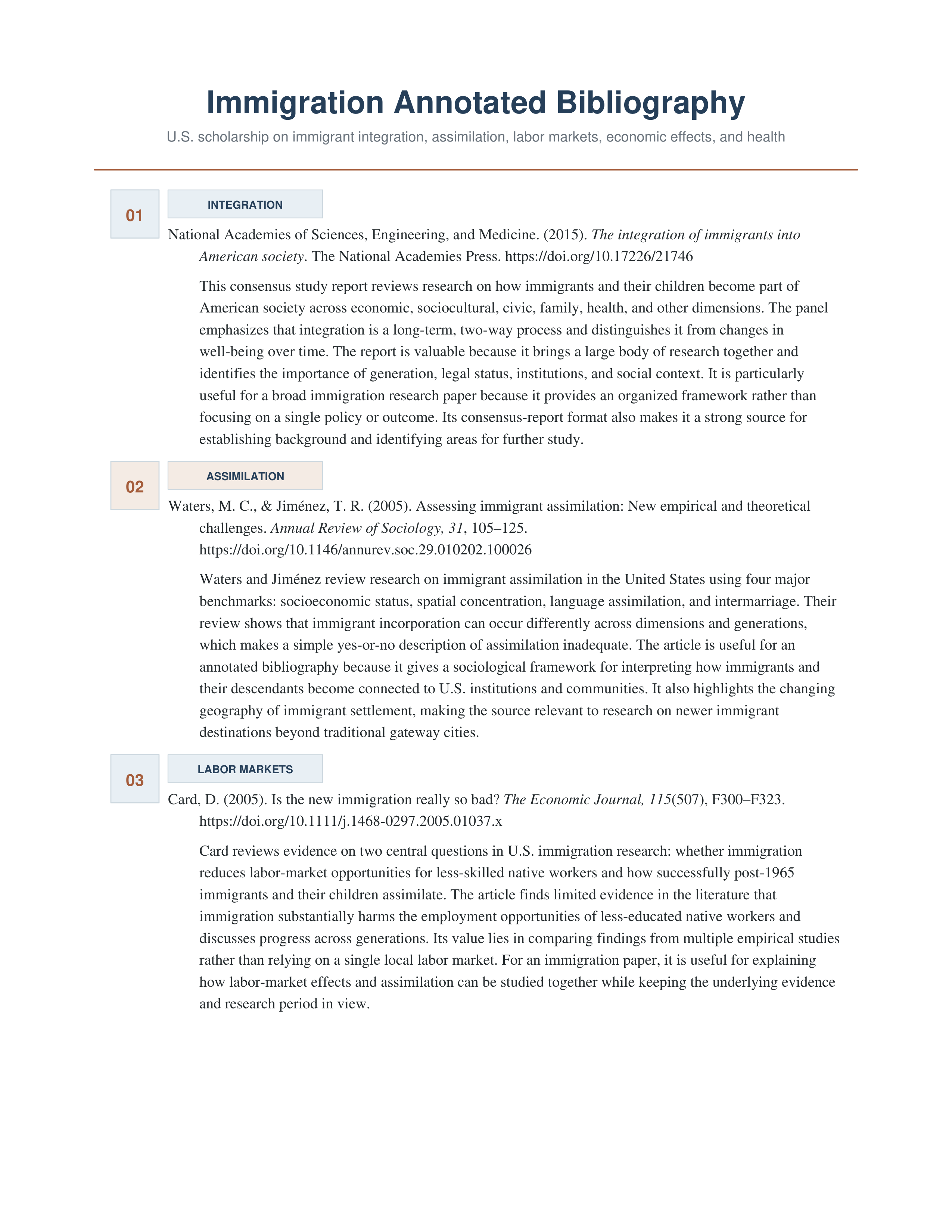
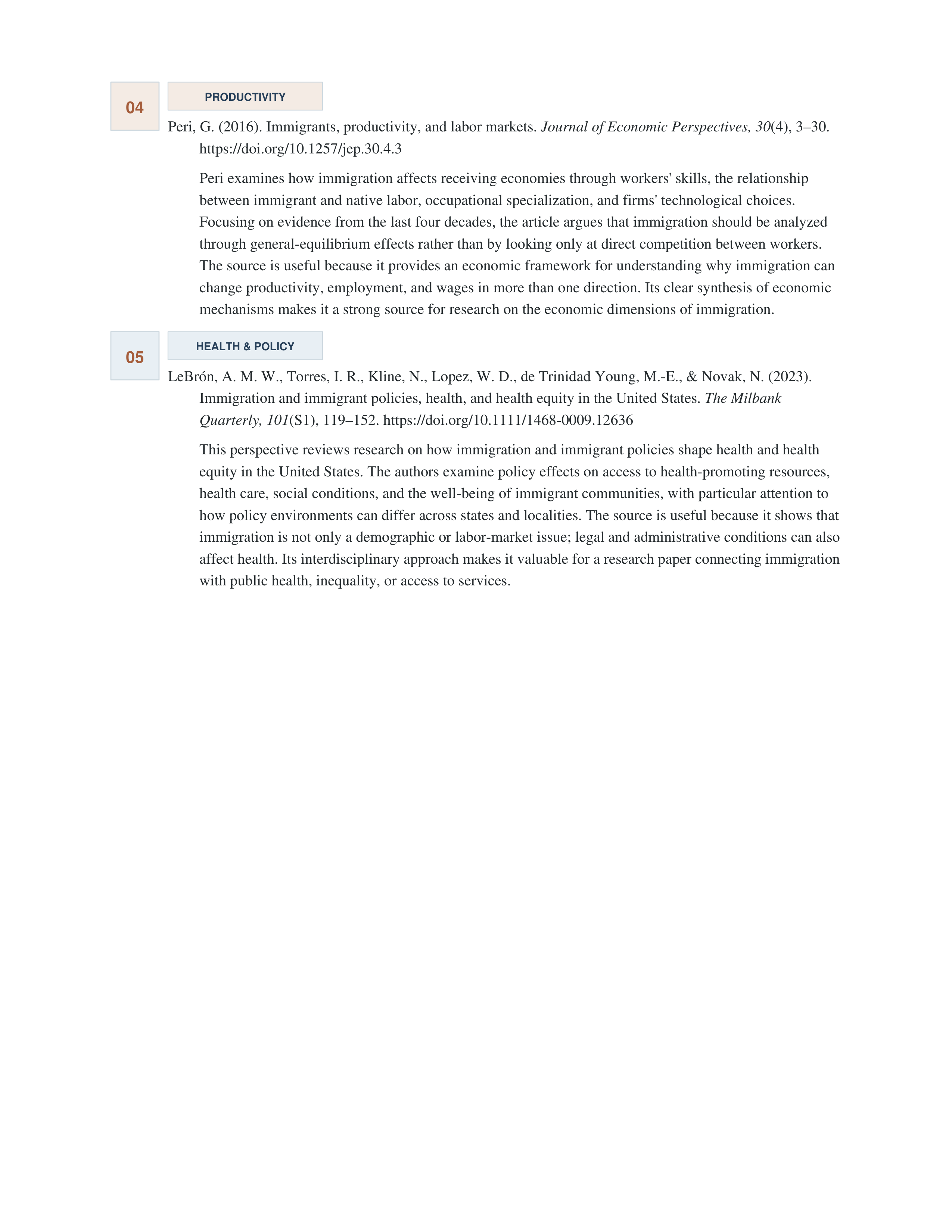
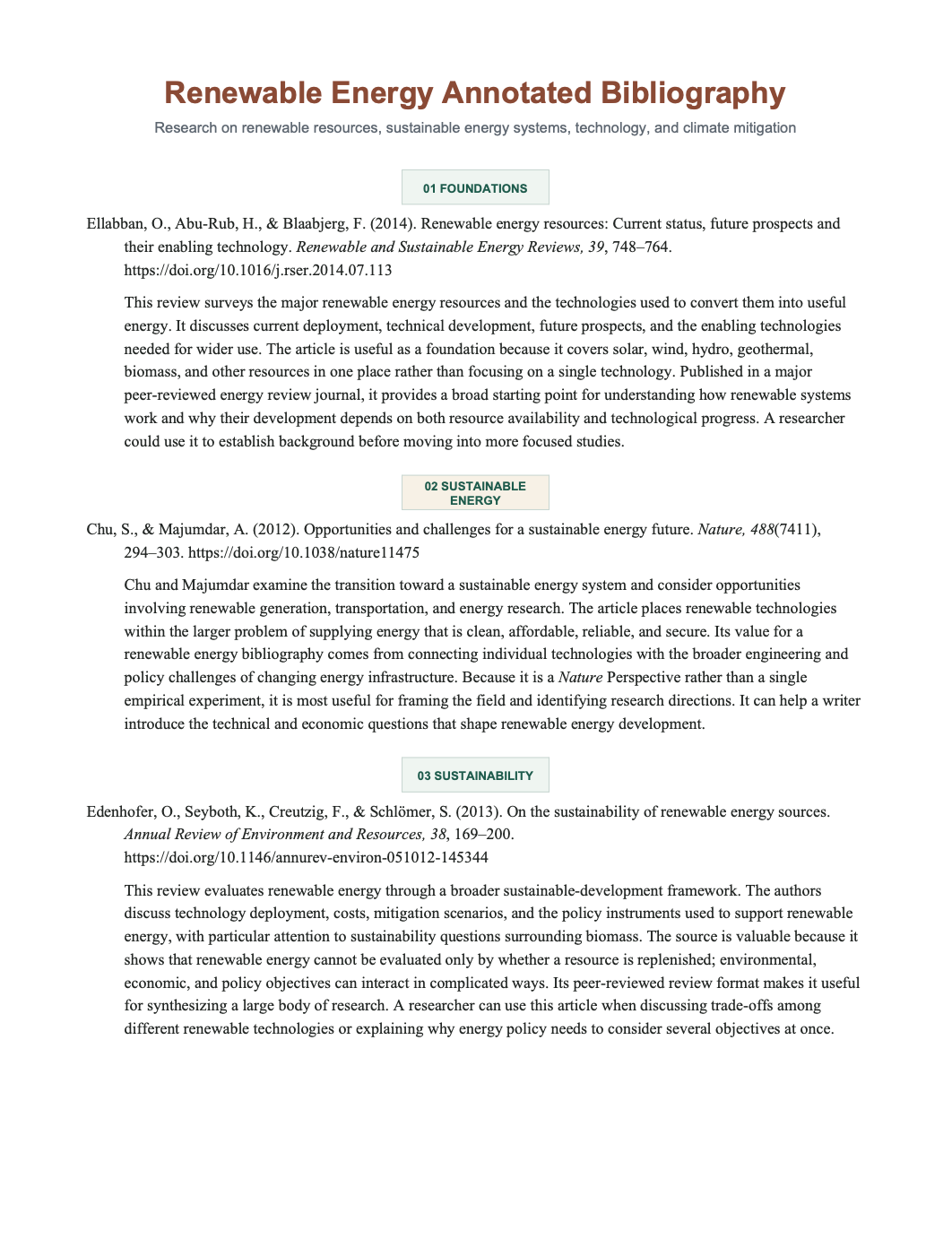
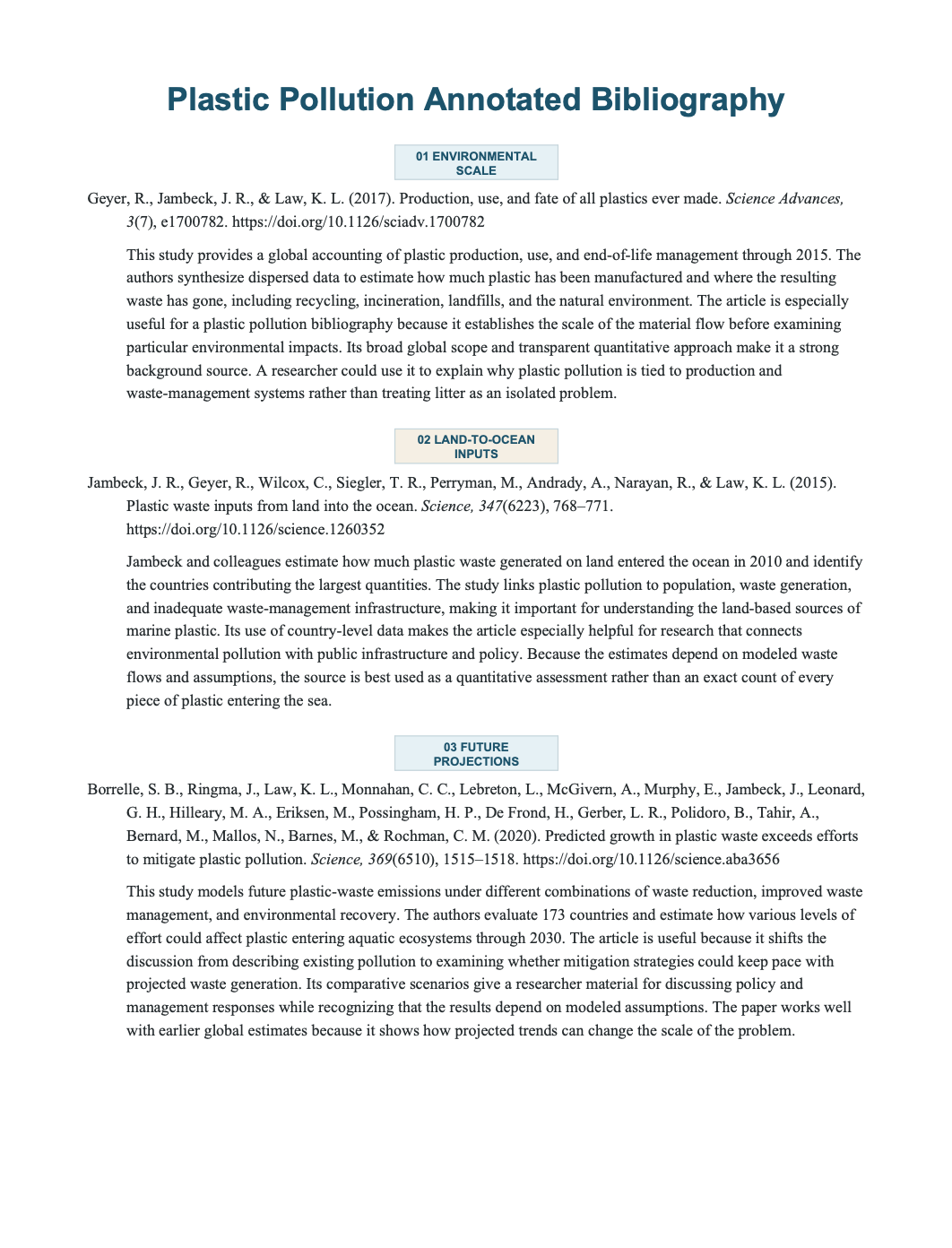
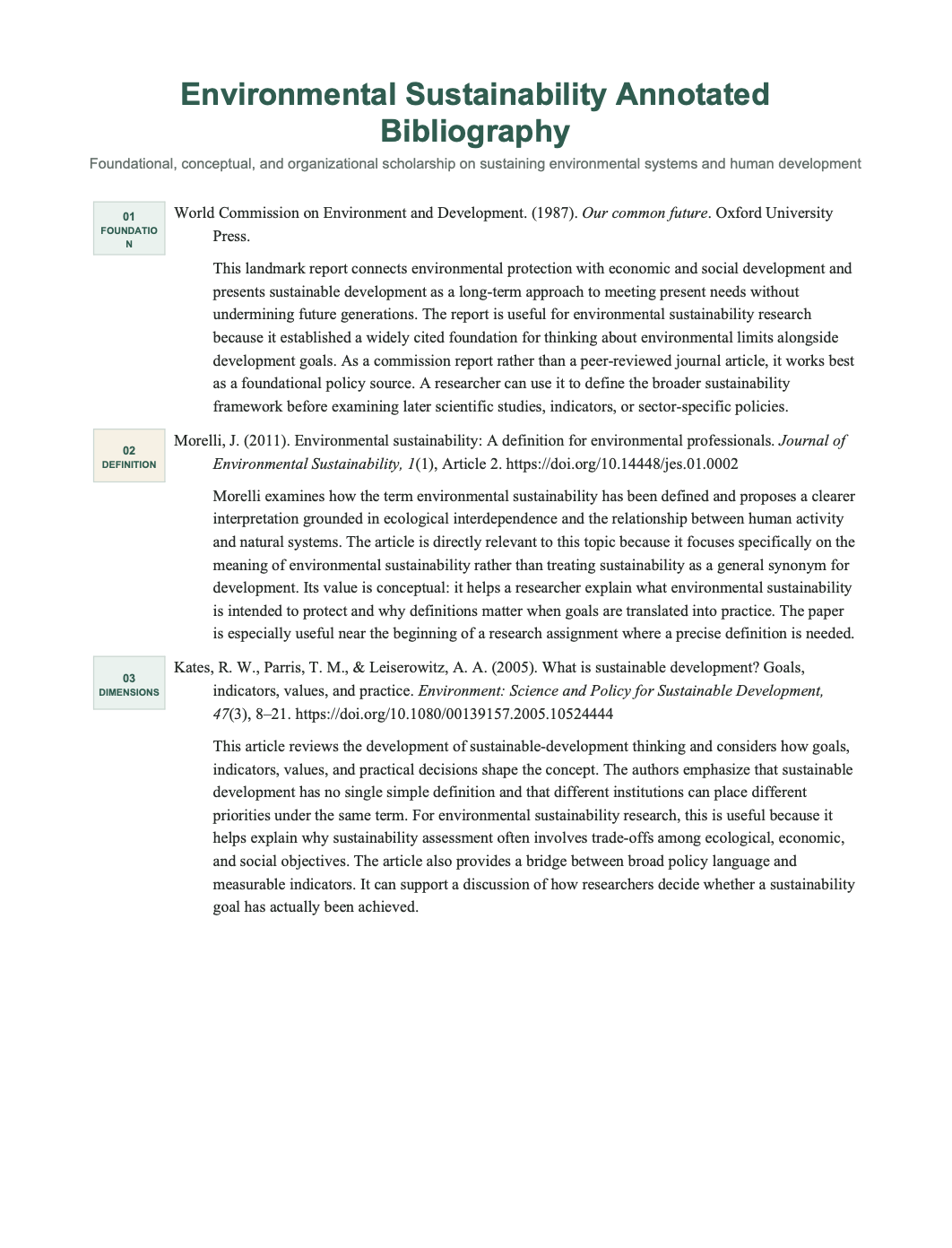
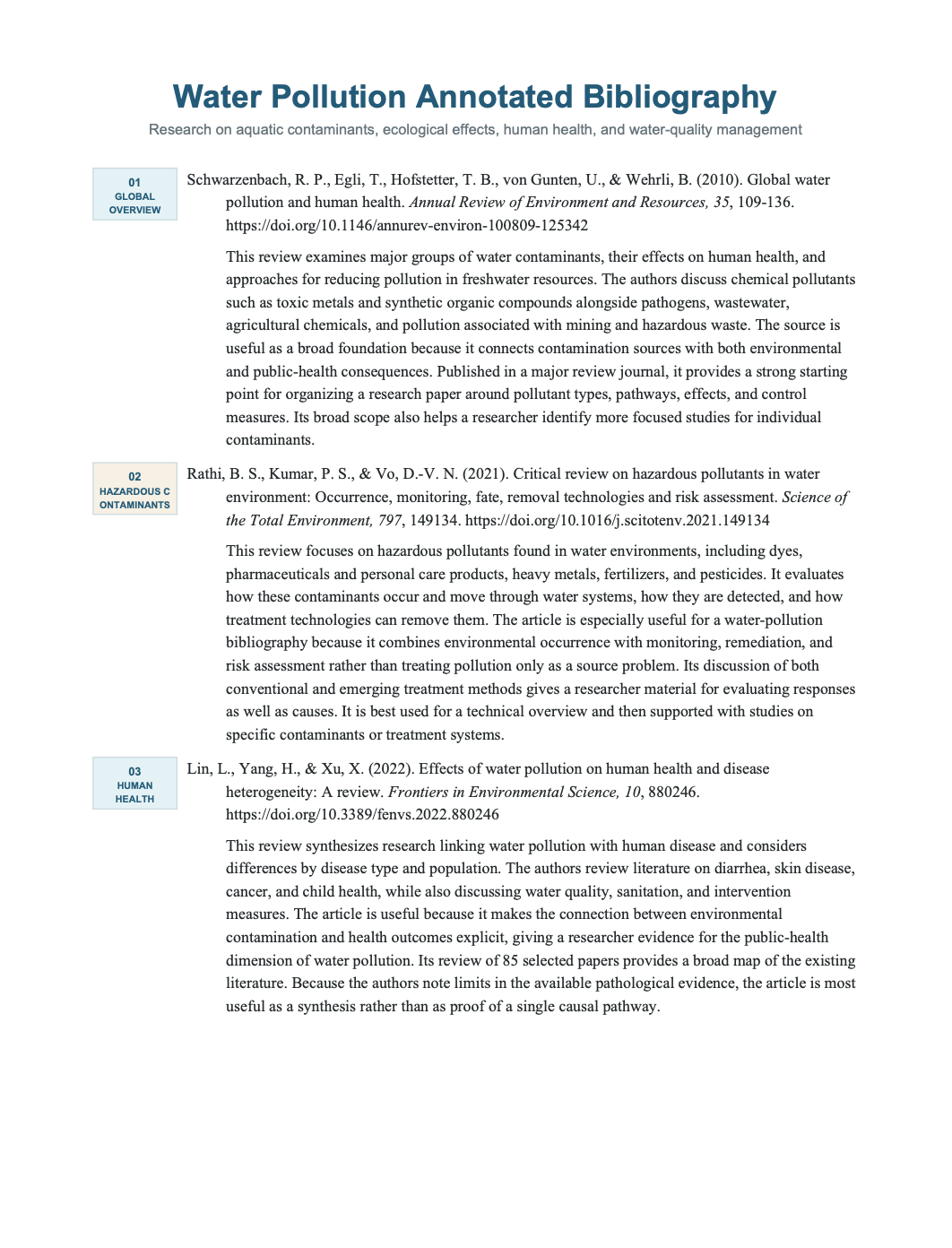
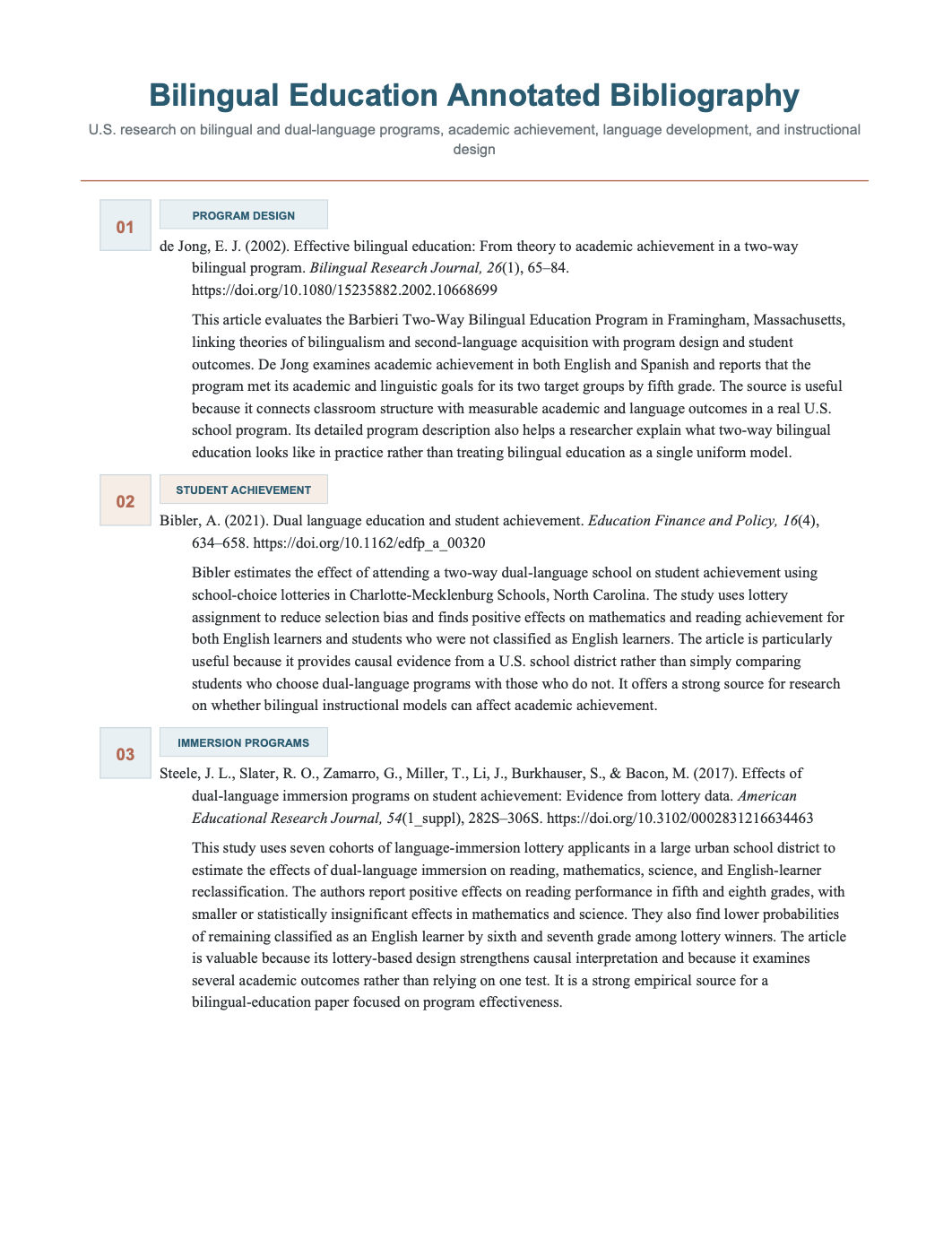
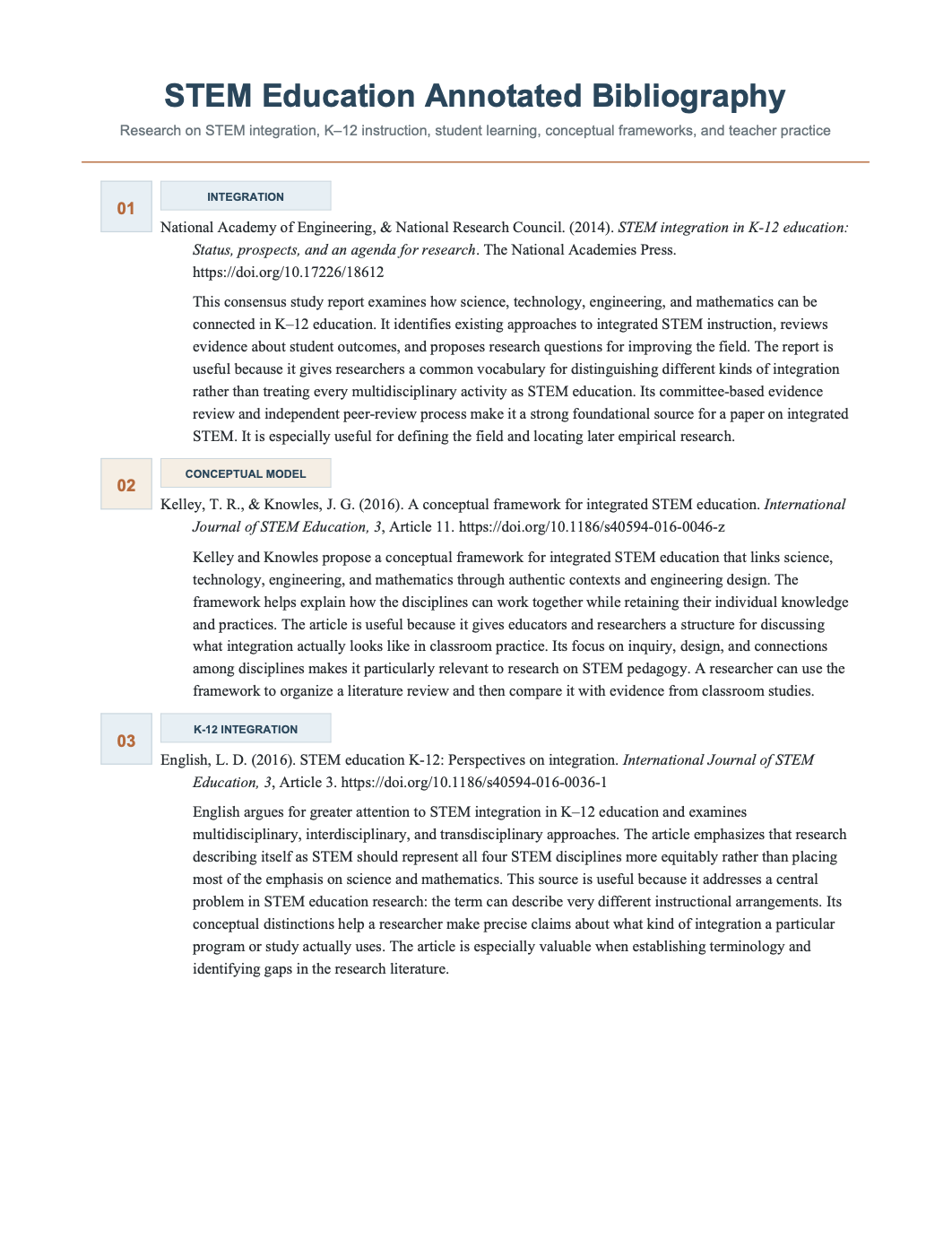
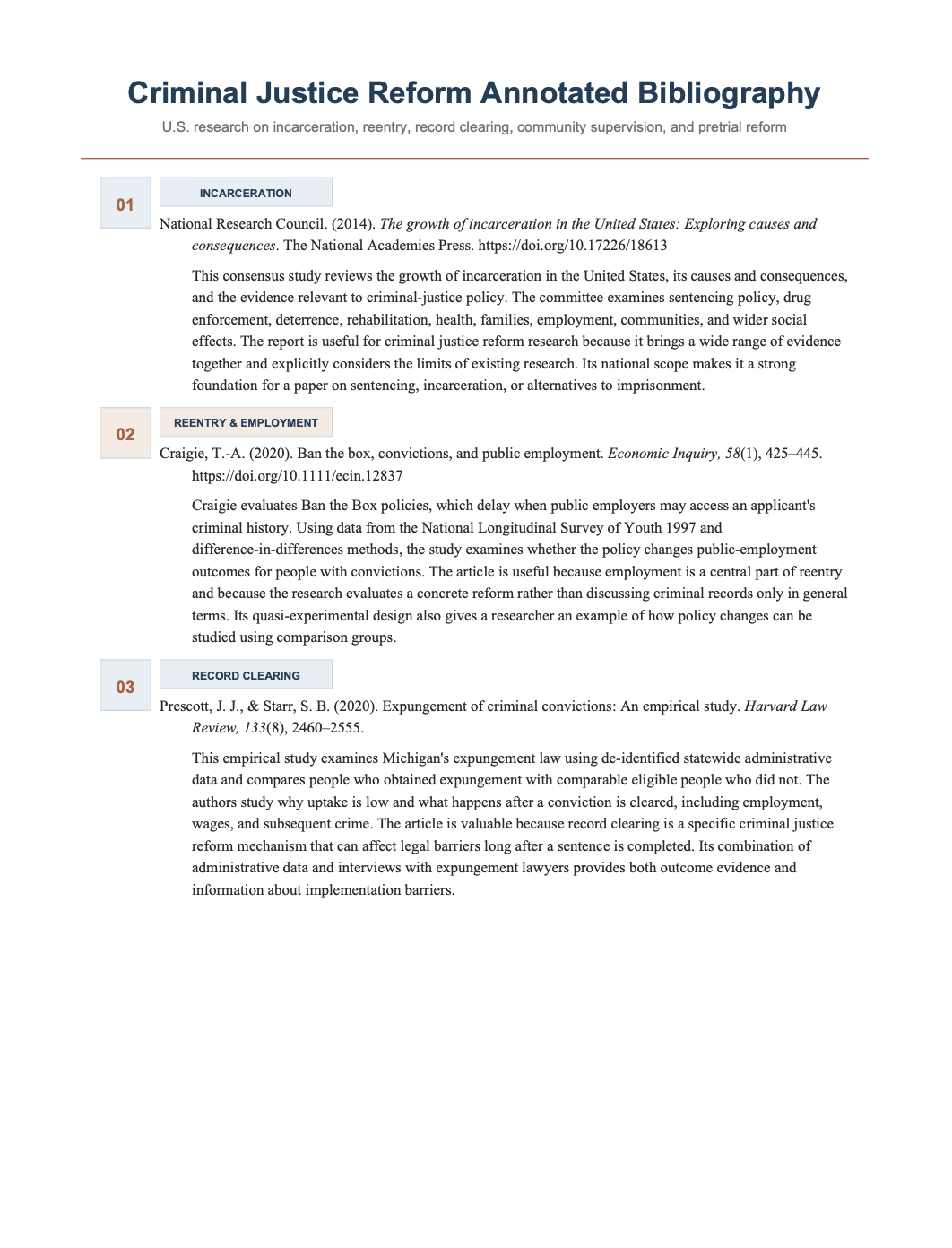
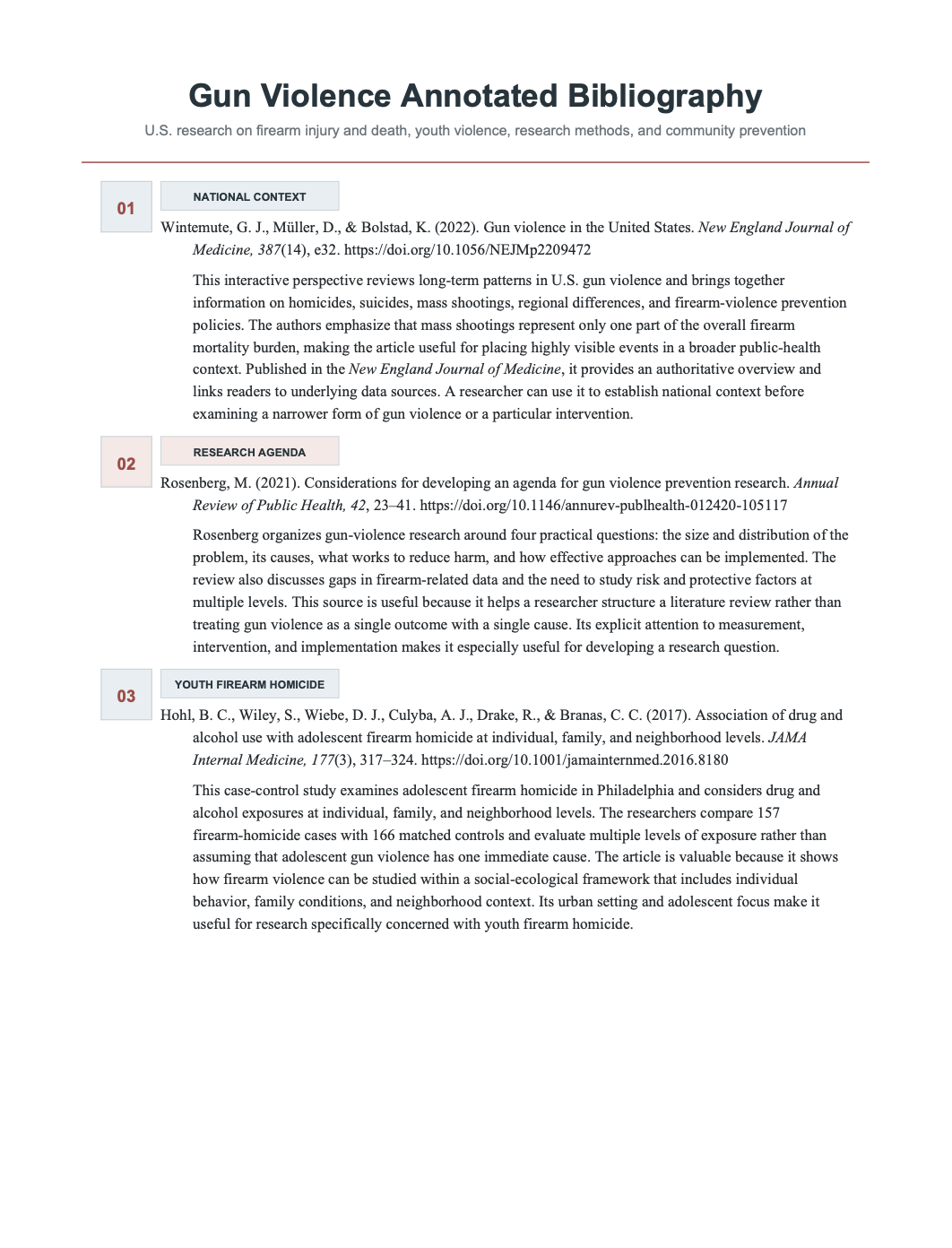
Immigration Annotated Bibliography
U.S. scholarship on immigrant integration, assimilation, labor markets, economic effects, and health
01
INTEGRATION
National Academies of Sciences, Engineering, and Medicine. (2015).
The integration of immigrants into
American society
. The National Academies Press. https://doi.org/10.17226/21746
This consensus study report reviews research on how immigrants and their children become part of
American society across economic, sociocultural, civic, family, health, and other dimensions. The panel
emphasizes that integration is a long-term, two-way process and distinguishes it from changes in
well-being over time. The report is valuable because it brings a large body of research together and
identifies the importance of generation, legal status, institutions, and social context. It is particularly
useful for a broad immigration research paper because it provides an organized framework rather than
focusing on a single policy or outcome. Its consensus-report format also makes it a strong source for
establishing background and identifying areas for further study.
02
ASSIMILATION
Waters, M. C., & Jiménez, T. R. (2005). Assessing immigrant assimilation: New empirical and theoretical
challenges.
Annual Review of Sociology, 31
, 105–125.
https://doi.org/10.1146/annurev.soc.29.010202.100026
Waters and Jiménez review research on immigrant assimilation in the United States using four major
benchmarks: socioeconomic status, spatial concentration, language assimilation, and intermarriage. Their
review shows that immigrant incorporation can occur differently across dimensions and generations,
which makes a simple yes-or-no description of assimilation inadequate. The article is useful for an
annotated bibliography because it gives a sociological framework for interpreting how immigrants and
their descendants become connected to U.S. institutions and communities. It also highlights the changing
geography of immigrant settlement, making the source relevant to research on newer immigrant
destinations beyond traditional gateway cities.
03
LABOR MARKETS
Card, D. (2005). Is the new immigration really so bad?
The Economic Journal, 115
(507), F300–F323.
https://doi.org/10.1111/j.1468-0297.2005.01037.x
Card reviews evidence on two central questions in U.S. immigration research: whether immigration
reduces labor-market opportunities for less-skilled native workers and how successfully post-1965
immigrants and their children assimilate. The article finds limited evidence in the literature that
immigration substantially harms the employment opportunities of less-educated native workers and
discusses progress across generations. Its value lies in comparing findings from multiple empirical studies
rather than relying on a single local labor market. For an immigration paper, it is useful for explaining
how labor-market effects and assimilation can be studied together while keeping the underlying evidence
and research period in view.