Standardized Testing Annotated Bibliography
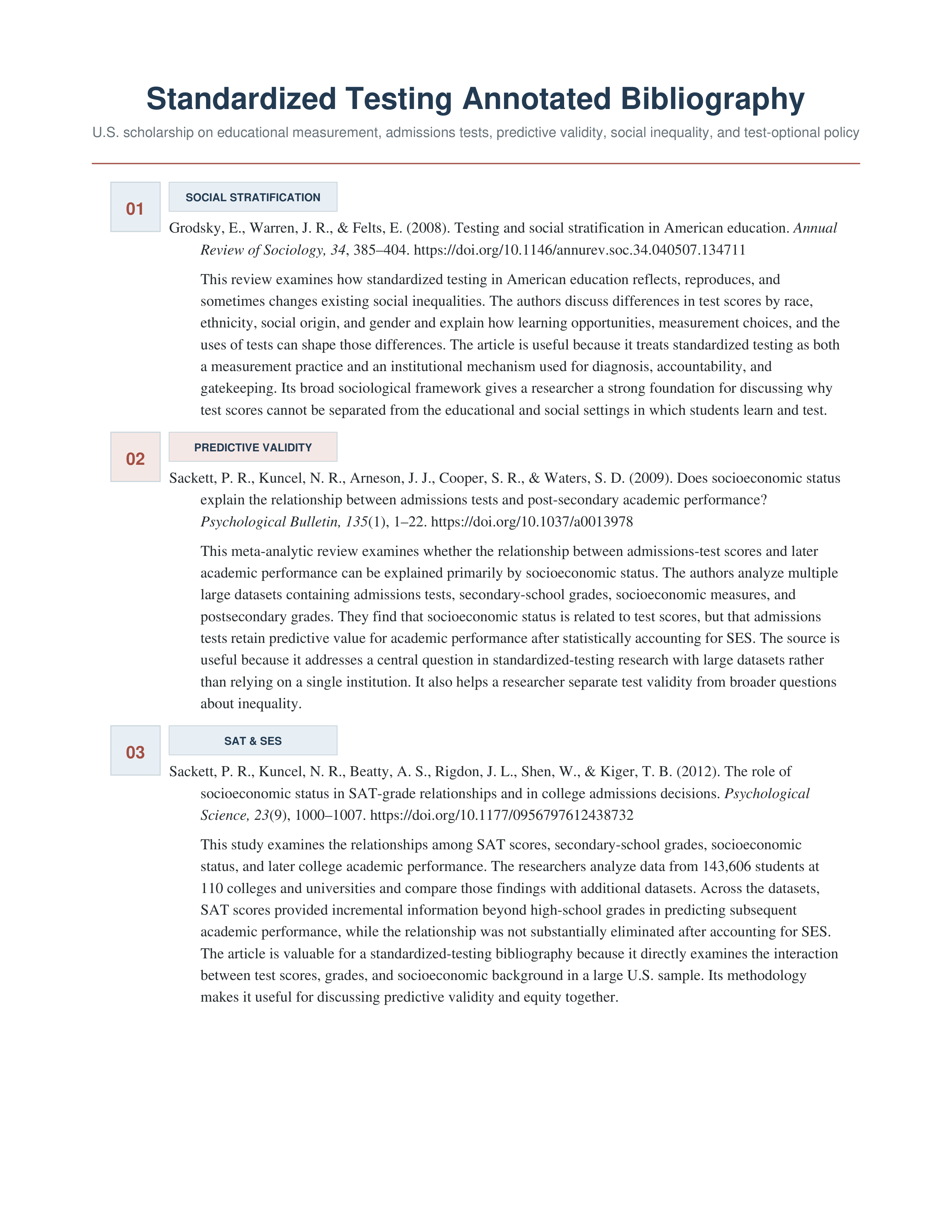
U.S. scholarship on educational measurement, admissions tests, predictive validity, social inequality, and test-optional policy
01
SOCIAL STRATIFICATION
Grodsky, E., Warren, J. R., & Felts, E. (2008). Testing and social stratification in American education.
Annual
Review of Sociology, 34
, 385–404. https://doi.org/10.1146/annurev.soc.34.040507.134711
This review examines how standardized testing in American education reflects, reproduces, and
sometimes changes existing social inequalities. The authors discuss differences in test scores by race,
ethnicity, social origin, and gender and explain how learning opportunities, measurement choices, and the
uses of tests can shape those differences. The article is useful because it treats standardized testing as both
a measurement practice and an institutional mechanism used for diagnosis, accountability, and
gatekeeping. Its broad sociological framework gives a researcher a strong foundation for discussing why
test scores cannot be separated from the educational and social settings in which students learn and test.
02
PREDICTIVE VALIDITY
Sackett, P. R., Kuncel, N. R., Arneson, J. J., Cooper, S. R., & Waters, S. D. (2009). Does socioeconomic status
explain the relationship between admissions tests and post-secondary academic performance?
Psychological Bulletin, 135
(1), 1–22. https://doi.org/10.1037/a0013978
This meta-analytic review examines whether the relationship between admissions-test scores and later
academic performance can be explained primarily by socioeconomic status. The authors analyze multiple
large datasets containing admissions tests, secondary-school grades, socioeconomic measures, and
postsecondary grades. They find that socioeconomic status is related to test scores, but that admissions
tests retain predictive value for academic performance after statistically accounting for SES. The source is
useful because it addresses a central question in standardized-testing research with large datasets rather
than relying on a single institution. It also helps a researcher separate test validity from broader questions
about inequality.
03
SAT & SES
Sackett, P. R., Kuncel, N. R., Beatty, A. S., Rigdon, J. L., Shen, W., & Kiger, T. B. (2012). The role of
socioeconomic status in SAT-grade relationships and in college admissions decisions.
Psychological
Science, 23
(9), 1000–1007. https://doi.org/10.1177/0956797612438732
This study examines the relationships among SAT scores, secondary-school grades, socioeconomic
status, and later college academic performance. The researchers analyze data from 143,606 students at
110 colleges and universities and compare those findings with additional datasets. Across the datasets,
SAT scores provided incremental information beyond high-school grades in predicting subsequent
academic performance, while the relationship was not substantially eliminated after accounting for SES.
The article is valuable for a standardized-testing bibliography because it directly examines the interaction
between test scores, grades, and socioeconomic background in a large U.S. sample. Its methodology
makes it useful for discussing predictive validity and equity together.