HEALTHCARE RESEARCH
ANNOTATED BIBLIOGRAPHY
Patient safety, quality, systems, and care delivery
1
Healthcare Annotated Bibliography
Patient safety, healthcare quality, system redesign, primary care, and quality improvement
HEALTH SERVICES RESEARCH FOCUS
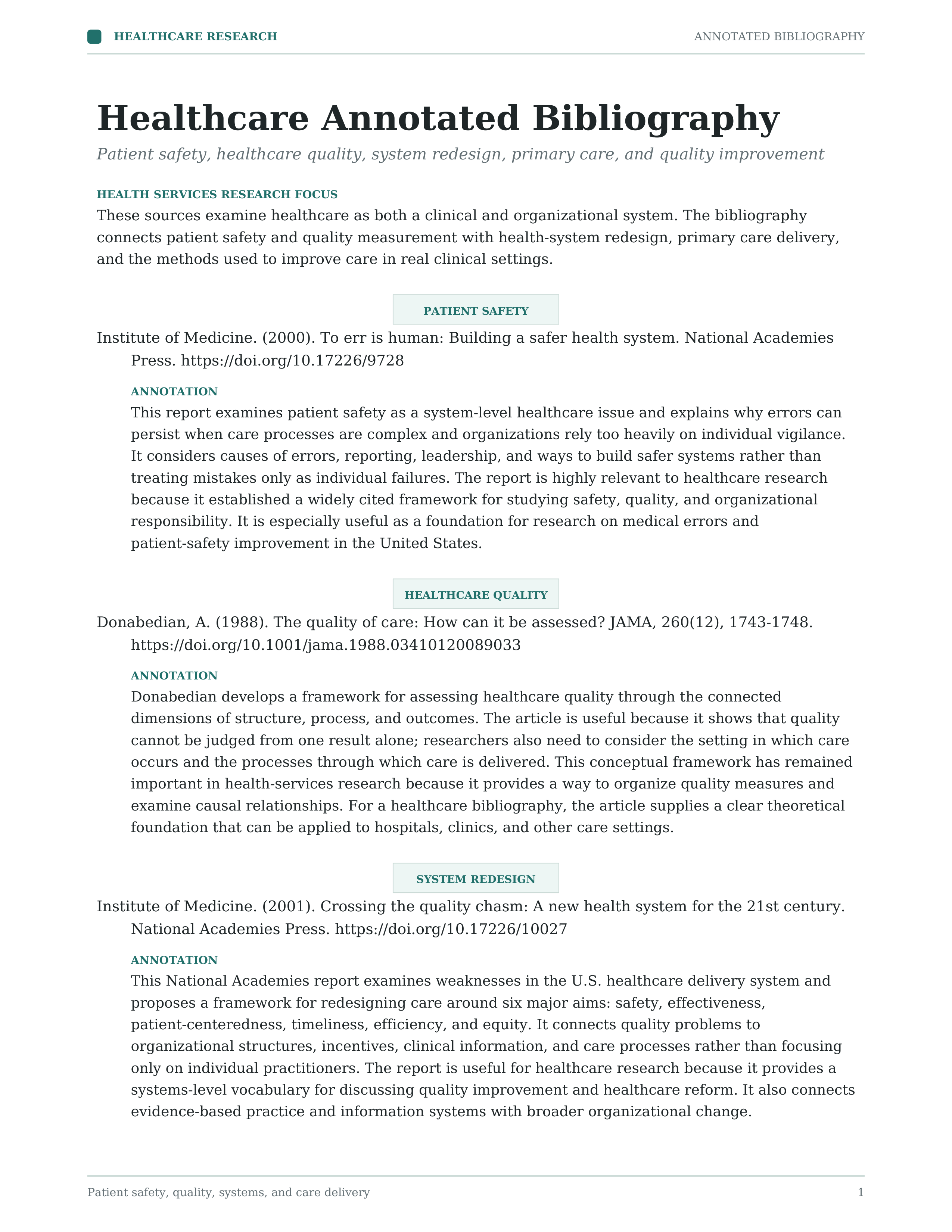
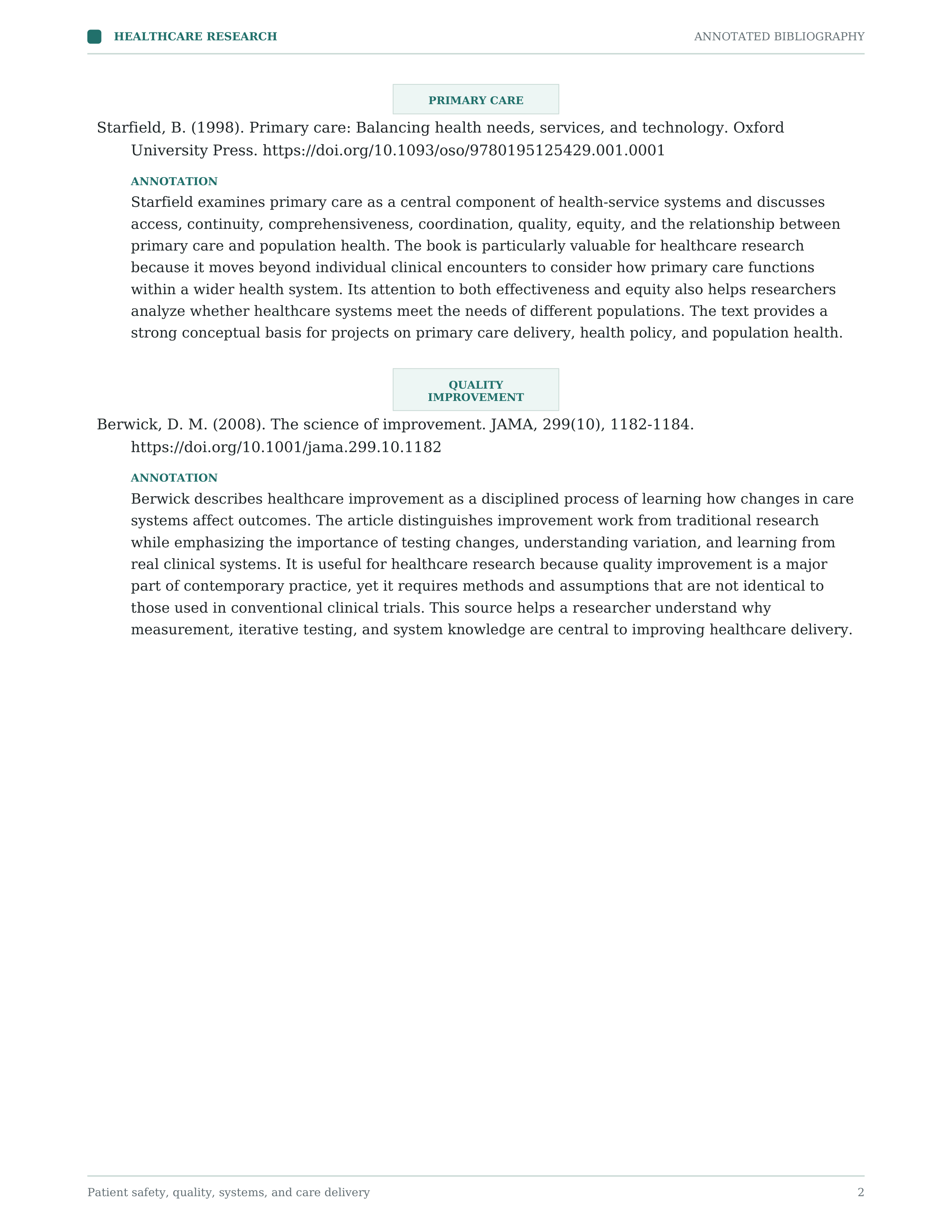
These sources examine healthcare as both a clinical and organizational system. The bibliography
connects patient safety and quality measurement with health-system redesign, primary care delivery,
and the methods used to improve care in real clinical settings.
PATIENT SAFETY
Institute of Medicine. (2000). To err is human: Building a safer health system. National Academies
Press. https://doi.org/10.17226/9728
ANNOTATION
This report examines patient safety as a system-level healthcare issue and explains why errors can
persist when care processes are complex and organizations rely too heavily on individual vigilance.
It considers causes of errors, reporting, leadership, and ways to build safer systems rather than
treating mistakes only as individual failures. The report is highly relevant to healthcare research
because it established a widely cited framework for studying safety, quality, and organizational
responsibility. It is especially useful as a foundation for research on medical errors and
patient-safety improvement in the United States.
HEALTHCARE QUALITY
Donabedian, A. (1988). The quality of care: How can it be assessed? JAMA, 260(12), 1743-1748.
https://doi.org/10.1001/jama.1988.03410120089033
ANNOTATION
Donabedian develops a framework for assessing healthcare quality through the connected
dimensions of structure, process, and outcomes. The article is useful because it shows that quality
cannot be judged from one result alone; researchers also need to consider the setting in which care
occurs and the processes through which care is delivered. This conceptual framework has remained
important in health-services research because it provides a way to organize quality measures and
examine causal relationships. For a healthcare bibliography, the article supplies a clear theoretical
foundation that can be applied to hospitals, clinics, and other care settings.
SYSTEM REDESIGN
Institute of Medicine. (2001). Crossing the quality chasm: A new health system for the 21st century.
National Academies Press. https://doi.org/10.17226/10027
ANNOTATION
This National Academies report examines weaknesses in the U.S. healthcare delivery system and
proposes a framework for redesigning care around six major aims: safety, effectiveness,
patient-centeredness, timeliness, efficiency, and equity. It connects quality problems to
organizational structures, incentives, clinical information, and care processes rather than focusing
only on individual practitioners. The report is useful for healthcare research because it provides a
systems-level vocabulary for discussing quality improvement and healthcare reform. It also connects
evidence-based practice and information systems with broader organizational change.