Bilingual Education Annotated Bibliography
U.S. research on bilingual and dual-language programs, academic achievement, language development, and instructional
design
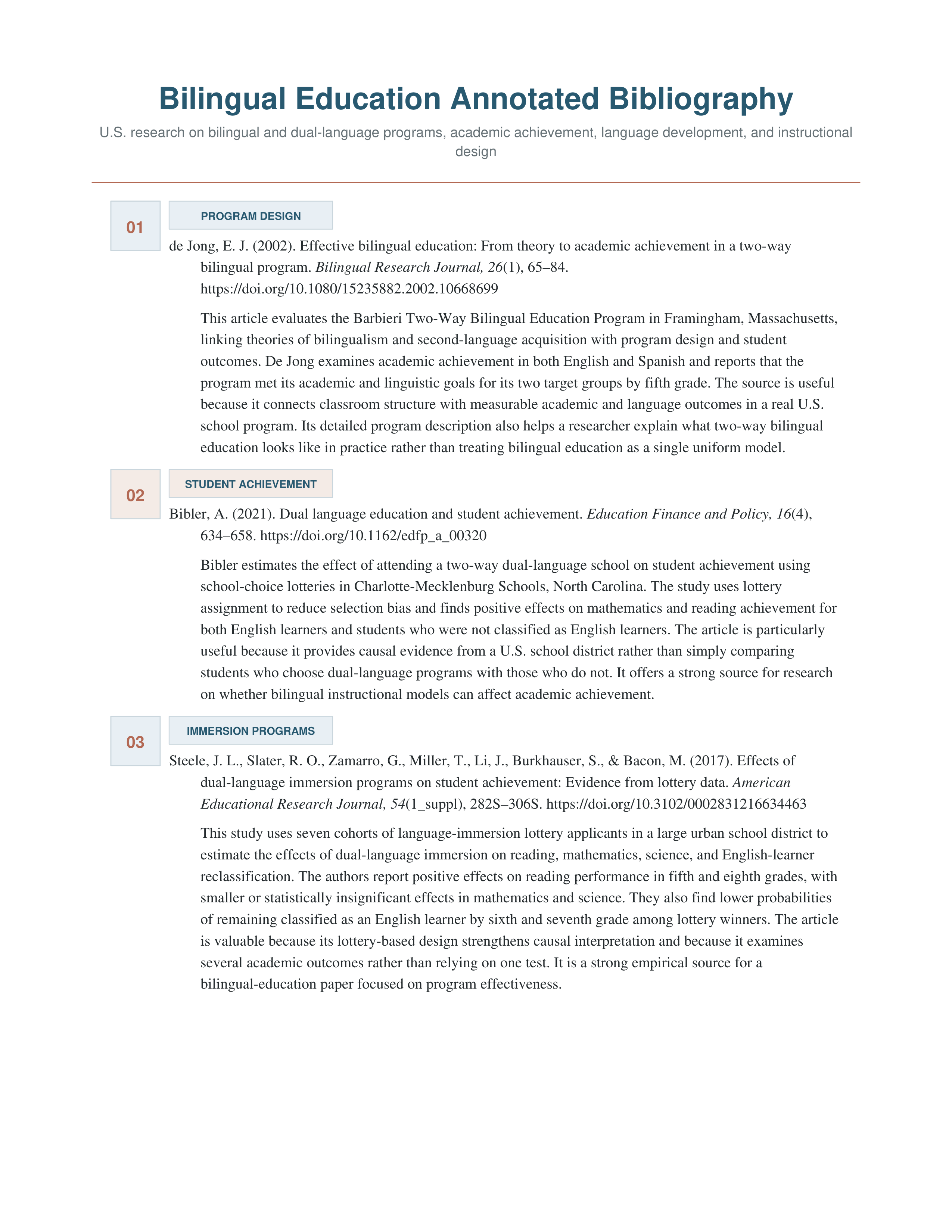
01
PROGRAM DESIGN
de Jong, E. J. (2002). Effective bilingual education: From theory to academic achievement in a two-way
bilingual program.
Bilingual Research Journal, 26
(1), 65–84.
https://doi.org/10.1080/15235882.2002.10668699
This article evaluates the Barbieri Two-Way Bilingual Education Program in Framingham, Massachusetts,
linking theories of bilingualism and second-language acquisition with program design and student
outcomes. De Jong examines academic achievement in both English and Spanish and reports that the
program met its academic and linguistic goals for its two target groups by fifth grade. The source is useful
because it connects classroom structure with measurable academic and language outcomes in a real U.S.
school program. Its detailed program description also helps a researcher explain what two-way bilingual
education looks like in practice rather than treating bilingual education as a single uniform model.
02
STUDENT ACHIEVEMENT
Bibler, A. (2021). Dual language education and student achievement.
Education Finance and Policy, 16
(4),
634–658. https://doi.org/10.1162/edfp_a_00320
Bibler estimates the effect of attending a two-way dual-language school on student achievement using
school-choice lotteries in Charlotte-Mecklenburg Schools, North Carolina. The study uses lottery
assignment to reduce selection bias and finds positive effects on mathematics and reading achievement for
both English learners and students who were not classified as English learners. The article is particularly
useful because it provides causal evidence from a U.S. school district rather than simply comparing
students who choose dual-language programs with those who do not. It offers a strong source for research
on whether bilingual instructional models can affect academic achievement.
03
IMMERSION PROGRAMS
Steele, J. L., Slater, R. O., Zamarro, G., Miller, T., Li, J., Burkhauser, S., & Bacon, M. (2017). Effects of
dual-language immersion programs on student achievement: Evidence from lottery data.
American
Educational Research Journal, 54
(1_suppl), 282S–306S. https://doi.org/10.3102/0002831216634463
This study uses seven cohorts of language-immersion lottery applicants in a large urban school district to
estimate the effects of dual-language immersion on reading, mathematics, science, and English-learner
reclassification. The authors report positive effects on reading performance in fifth and eighth grades, with
smaller or statistically insignificant effects in mathematics and science. They also find lower probabilities
of remaining classified as an English learner by sixth and seventh grade among lottery winners. The article
is valuable because its lottery-based design strengthens causal interpretation and because it examines
several academic outcomes rather than relying on one test. It is a strong empirical source for a
bilingual-education paper focused on program effectiveness.