STEM Education Annotated Bibliography
Research on STEM integration, K–12 instruction, student learning, conceptual frameworks, and teacher practice
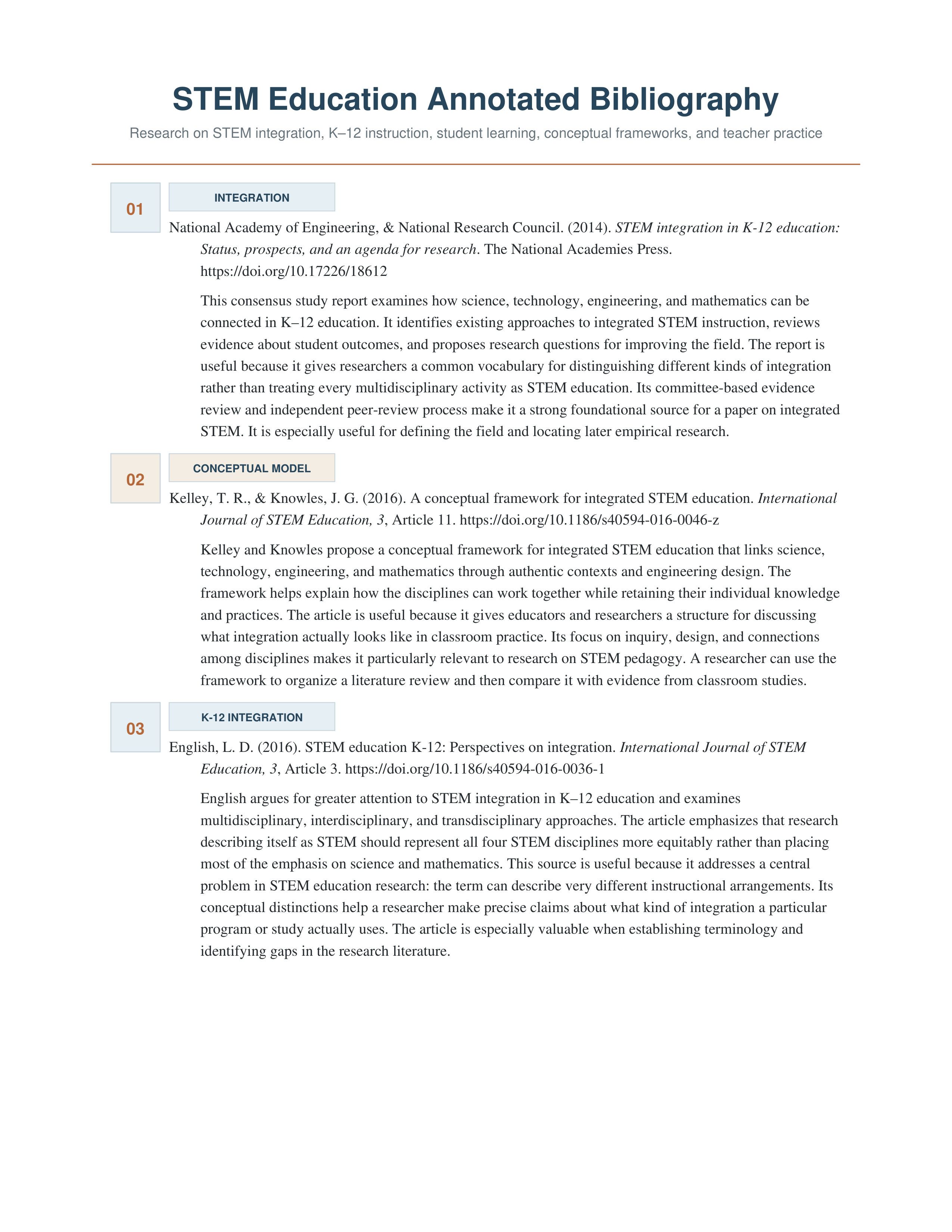
01
INTEGRATION
National Academy of Engineering, & National Research Council. (2014).
STEM integration in K-12 education:
Status, prospects, and an agenda for research
. The National Academies Press.
https://doi.org/10.17226/18612
This consensus study report examines how science, technology, engineering, and mathematics can be
connected in K–12 education. It identifies existing approaches to integrated STEM instruction, reviews
evidence about student outcomes, and proposes research questions for improving the field. The report is
useful because it gives researchers a common vocabulary for distinguishing different kinds of integration
rather than treating every multidisciplinary activity as STEM education. Its committee-based evidence
review and independent peer-review process make it a strong foundational source for a paper on integrated
STEM. It is especially useful for defining the field and locating later empirical research.
02
CONCEPTUAL MODEL
Kelley, T. R., & Knowles, J. G. (2016). A conceptual framework for integrated STEM education.
International
Journal of STEM Education, 3
, Article 11. https://doi.org/10.1186/s40594-016-0046-z
Kelley and Knowles propose a conceptual framework for integrated STEM education that links science,
technology, engineering, and mathematics through authentic contexts and engineering design. The
framework helps explain how the disciplines can work together while retaining their individual knowledge
and practices. The article is useful because it gives educators and researchers a structure for discussing
what integration actually looks like in classroom practice. Its focus on inquiry, design, and connections
among disciplines makes it particularly relevant to research on STEM pedagogy. A researcher can use the
framework to organize a literature review and then compare it with evidence from classroom studies.
03
K-12 INTEGRATION
English, L. D. (2016). STEM education K-12: Perspectives on integration.
International Journal of STEM
Education, 3
, Article 3. https://doi.org/10.1186/s40594-016-0036-1
English argues for greater attention to STEM integration in K–12 education and examines
multidisciplinary, interdisciplinary, and transdisciplinary approaches. The article emphasizes that research
describing itself as STEM should represent all four STEM disciplines more equitably rather than placing
most of the emphasis on science and mathematics. This source is useful because it addresses a central
problem in STEM education research: the term can describe very different instructional arrangements. Its
conceptual distinctions help a researcher make precise claims about what kind of integration a particular
program or study actually uses. The article is especially valuable when establishing terminology and
identifying gaps in the research literature.