MLA 9 | ANNOTATED RESEARCH RECORD
PAGE 1
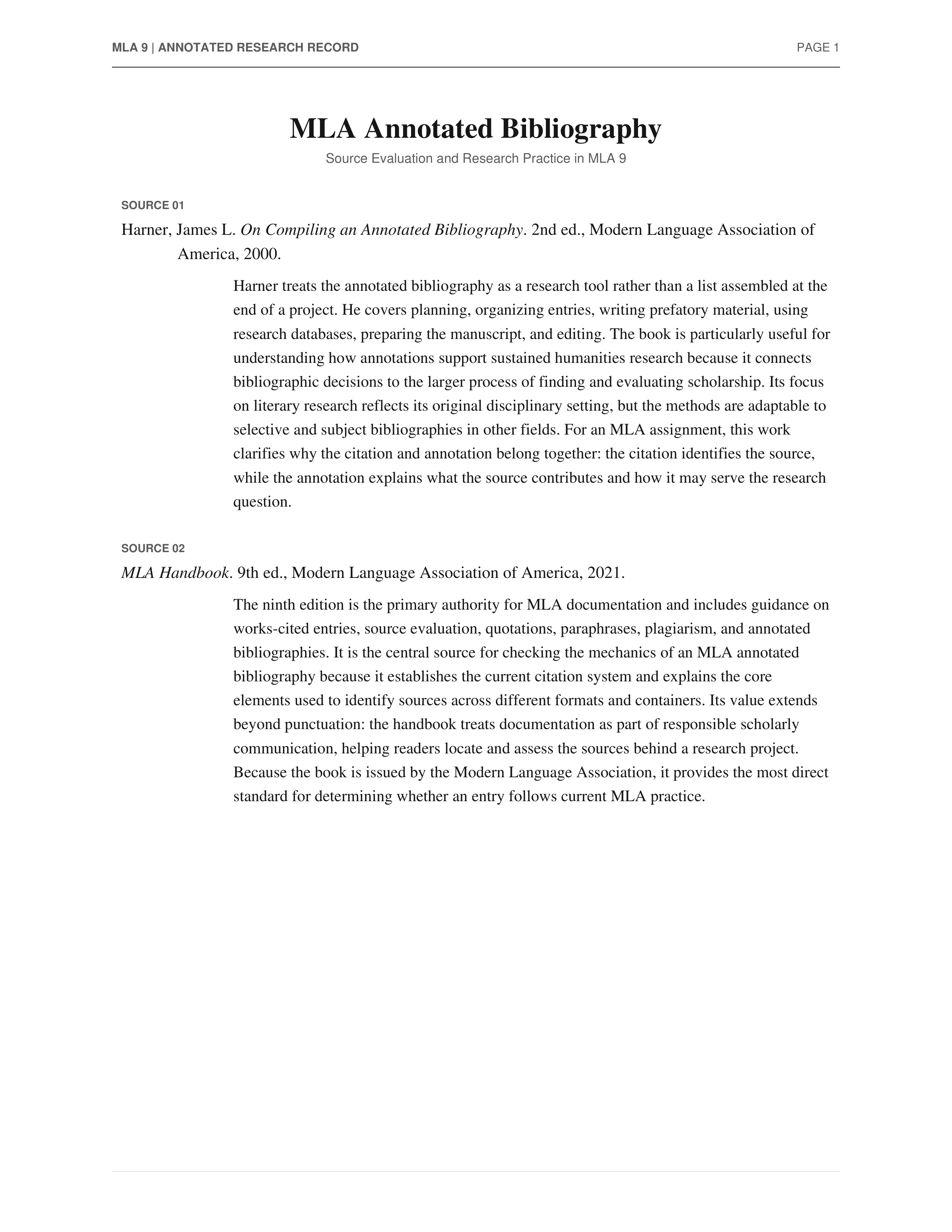
MLA Annotated Bibliography
Source Evaluation and Research Practice in MLA 9
SOURCE 01
Harner, James L.
On Compiling an Annotated Bibliography
. 2nd ed., Modern Language Association of
America, 2000.
Harner treats the annotated bibliography as a research tool rather than a list assembled at the
end of a project. He covers planning, organizing entries, writing prefatory material, using
research databases, preparing the manuscript, and editing. The book is particularly useful for
understanding how annotations support sustained humanities research because it connects
bibliographic decisions to the larger process of finding and evaluating scholarship. Its focus
on literary research reflects its original disciplinary setting, but the methods are adaptable to
selective and subject bibliographies in other fields. For an MLA assignment, this work
clarifies why the citation and annotation belong together: the citation identifies the source,
while the annotation explains what the source contributes and how it may serve the research
question.
SOURCE 02
MLA Handbook
. 9th ed., Modern Language Association of America, 2021.
The ninth edition is the primary authority for MLA documentation and includes guidance on
works-cited entries, source evaluation, quotations, paraphrases, plagiarism, and annotated
bibliographies. It is the central source for checking the mechanics of an MLA annotated
bibliography because it establishes the current citation system and explains the core
elements used to identify sources across different formats and containers. Its value extends
beyond punctuation: the handbook treats documentation as part of responsible scholarly
communication, helping readers locate and assess the sources behind a research project.
Because the book is issued by the Modern Language Association, it provides the most direct
standard for determining whether an entry follows current MLA practice.